
 Implementation of the longitudinal integrated clerkship in two medical schools: the first experience in Brazil
ABSTRACT
Introduction: The Longitudinal Integrated Clerkship (LIC) is a model emphasizing continuity in relationships among students, patients, and preceptors. Unlike the traditional model structured into short rotations focused on specific specialties, the LIC provides a continuous and integrated learning experience. This approach allows students deeper and broader immersion in various medical fields, promoting chronic disease management, preventive care, and understanding patient needs over time, thus strengthening holistic medical education.
Experience Report: This article describes the first implementation of the LIC in Brazil, conducted at two private medical schools located in medium-sized cities in the state of São Paulo. It details curricular planning, pedagogical strategies such as weekly clinical simulations, case discussions, and integrated theoretical activities. Students participated actively from the initial planning phase, complying with the National Curriculum Guidelines of 2014. The report highlights logistical and cultural challenges faced, as well as adaptations made throughout the process.
Discussion: The implementation of the LIC demonstrated clear benefits for student education, such as greater integration among specialties and levels of care, strengthening continuity of care, and significant development of clinical competencies. However, there were difficulties related to institutional resistance, organizational complexity, and ensuring balanced exposure to different medical specialties. The results obtained were consistent with international experiences, reinforcing the feasibility and relevance of this model in similar Brazilian contexts.
Conclusion: This pioneering experience demonstrates that the LIC is a viable and promising model in Brazil, highlighting the importance of curricular flexibility, careful planning, and constant student involvement for effective implementation.
Keywords:
Clinical Clerkship; Active Learning; curriculum; medical education
RESUMO
Introdução: O internato longitudinal integrado (longitudinal integrated clerkship - LIC) é um modelo que enfatiza a continuidade na relação entre estudantes, pacientes e preceptores. Diferentemente do modelo tradicional, que é estruturado em rotações curtas e focadas em especialidades específicas, o LIC proporciona uma experiência de aprendizado contínua e integrada. Essa abordagem permite aos estudantes uma imersão mais profunda e abrangente nas diversas áreas da medicina, de modo a promover o manejo de doenças crônicas, o cuidado preventivo e a compreensão das necessidades dos pacientes ao longo do tempo, o que fortalece a formação médica holística.
Relato de experiência: Este artigo relata a primeira implementação do LIC no Brasil, em duas escolas médicas privadas situadas em cidades paulistas de médio porte. Descrevem-se detalhadamente o planejamento curricular e as estratégias pedagógicas, como simulações clínicas semanais, discussões de casos e atividades teóricas integrativas. Houve participação ativa dos estudantes desde a etapa inicial de planejamento, respeitando as Diretrizes Curriculares Nacionais de 2014. O relato destaca os desafios logísticos e culturais enfrentados, assim como as adaptações feitas ao longo do processo.
Discussão: Observou-se que o LIC trouxe benefícios claros para a formação dos estudantes, como maior integração entre especialidades e níveis de atenção, fortalecimento da longitudinalidade do cuidado e desenvolvimento significativo de competências clínicas. Contudo, houve dificuldades associadas à resistência institucional, à complexidade organizacional e à garantia de exposição equilibrada às diferentes especialidades. Os resultados obtidos foram similares às experiências internacionais, reforçando a viabilidade e relevância desse modelo em contextos brasileiros semelhantes.
Conclusão: A experiência pioneira demonstra que o LIC é um modelo viável e promissor no Brasil, destacando a importância da flexibilidade curricular, do planejamento cuidadoso e do envolvimento constante dos estudantes para sua efetiva implementação.
Palavras-chave:
Internato Médico; Aprendizagem na Prática; Currículo; Educação Médica
INTRODUCTION
The medical education landscape has been undergoing a constantly evolution in search of more effective, patient-centred approaches. In this context, the Longitudinal Integrated Clerkship (LIC) stands out as a significant pedagogical innovation, proposing a more continuous and integrated approach to clinical teaching, in contrast to the traditional block rotations isolated by speciality. This model, which originated in the 1970s to address deficits in the rural medical workforce in the US, quickly expanded worldwide due to its positive results in medical training and patient care.1
The LIC is based on three fundamental principles: continuity of relationship with patients, continuity with preceptors and simultaneous curricular integration of multiple medical specialities throughout the academic year.1),(2 Unlike traditional models, where students are superficially involved with patients for short periods, the LIC involves the opportunity to follow the evolution of patients over time and across different levels of health care, allowing for a more comprehensive and longitudinal view of the medical and social conditions that impact on the health of individuals and communities.3
Several international studies point to significant advantages of this model, including more robust development of clinical skills, an in-depth understanding of chronic diseases and greater capacity for preventive and patient-centred care.4),(5),(6),(7 In addition, students participating in LICs often report greater satisfaction with their medical training, better performance in clinical examinations and more complete professional development due to the quality of the relationships established with patients and preceptors.2,8),(9 However, despite the reported advantages, the implementation of LICs is not trivial and presents specific challenges, including the need for significant curricular reorganisation, institutional resistance to change and logistical difficulties in deploying students in various clinical settings at the same time.2),(4),(10
In Brazil, the traditional block internship model widely prevails in medical schools, offering broad exposure, but fragmented and discontinuous in relation to the patient and care processes. This fragmentation often limits students’ perception of the impact of their interventions over time and restricts their understanding of the health system as a whole. The pioneering introduction of the LIC in two Brazilian private medical schools, presented in this article, aims precisely to fill these gaps, proposing an innovative curricular change with the potential to provide more holistic, continuous medical training that is integrated with the real needs of the population and the Brazilian health system.
Accordingly, this article aims to describe the process of implementing the LIC in these schools, addressing the challenges faced, the successful strategies employed and the lessons learnt, in the hope of contributing to the strengthening and expansion of this innovative approach in the Brazilian medical education context.
EXPERIENCE REPORT:
Design of the Longitudinal Integrated Clerkship model
This longitudinal integrated clerkship model was designed for two private medical schools that have an integrated curriculum, with teaching methodologies such as Team-Based Learning (TBL), Problem-Based Learning (PBL), self-assessment, tutoring and medical practice in the clinical environments of the Unified Health System from the first semester of the course. With the aim of innovating medical education, an extensive study was carried out on the LIC, how it works, its advantages and challenges, in order to put together a model that we could use in two medical schools on the network, which until then had no clerkship groups.
The design was of longitudinal integrated rotations, per semester, for the fifth and sixth year of the medical clerkship.
In the fifth year of the clerkship, two integrated blocks were established, each lasting 18 weeks, with 40 hours a week. Figure 1 illustrates the typical week of the fifth-year blocks.
-
Block I: family and community health, urgency and emergency, simulation, case discussion and theoretical activity
-
Block II: adult health (medical clinic/surgical clinic), elderly health, mental health, simulation, case discussion and theoretical activity
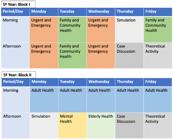
Illustration of the typical week of blocks I and II, corresponding to the fifth year of the longitudinal integrated clerkship.
In Block I, the students performed supervised practical activities in Basic Health Units, Family Health Strategy, Emergency Care Units (UPAs), Mobile Emergency Care Service (SAMU) and first aid.
In Block II, the students had supervised practical activities in medical wards, surgical wards, clinical/surgical outpatient clinics, intensive care units, Psychosocial Care Centres (CAPS), psychiatry and geriatrics outpatient clinics.
In both blocks, there are three fixed periods during the week when the student carries out face-to-face activities: urgent and emergency simulation, which takes place at the medical school’s simulation centre; discussion of clinical cases seen in the practical activities and theoretical activities related to the areas in which the student is working, which are carried out in the medical school classroom.
The clinical simulation took place weekly, lasting four hours and focussed on urgent and emergency clinical cases. These sessions were held at the school’s simulation centre, using high-fidelity mannequins and/or trained actors, providing realistic and immersive scenarios. Each meeting dealt with an average of two to four clinical cases, covering situations related to the areas of clinical medicine, general surgery, paediatrics, gynaecology and obstetrics. The simulations aimed to develop essential clinical skills, quick thinking, effective communication and teamwork, reinforcing practical learning and preparing students for the challenges of professional life.
Case discussions were held weekly, lasting an average of three to four hours, and were led by the professors on the basis of real cases observed by the students during their clerkship. When they identified subjects that needed more in-depth study, the lecturers selected scientific articles to be discussed at subsequent meetings, encouraging critical thinking and evidence-based updating. At the same time, the theoretical activities combined expository dialogue classes with the use of an online platform, which provided comprehensive content, including key topics covered in medical residency exams, commented questions and complete exams from previous years. This set of strategies aimed not only to complement the students’ clinical training, but also to prepare them for future academic challenges, such as selection processes for specialisation.
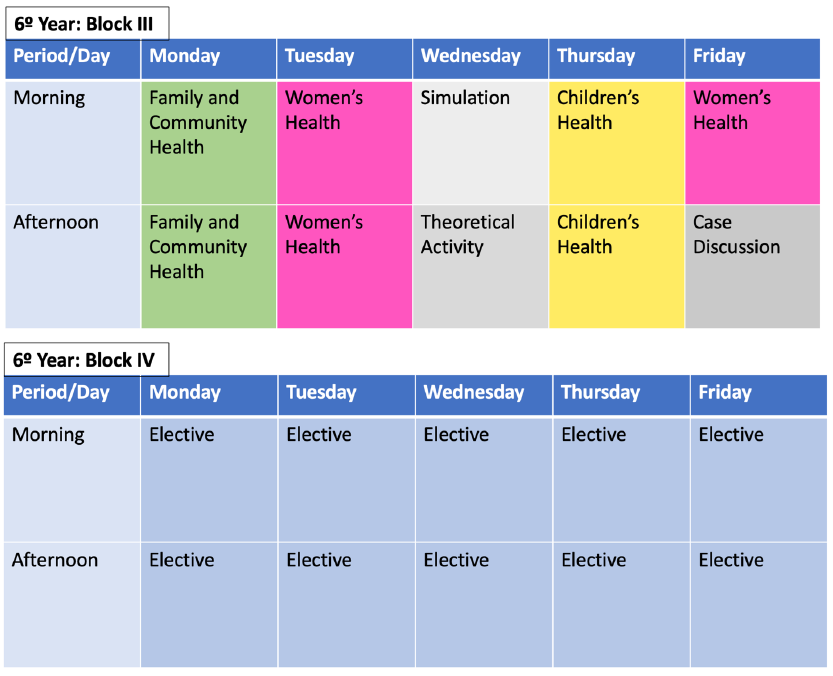
For the sixth-year students, two blocks were also established, distributed throughout the year, with different durations. Block III lasted 27 weeks, with 40 hours a week; Block IV lasted 9 weeks, with 40 hours a week. Figure 2 illustrates the typical week for the sixth year blocks.
-
Block III: women’s health, children’s health, family and community health, simulation, case discussion and theoretical activity
-
Block IV: elective work placement

Illustration of the typical week of blocks III and IV, corresponding to the sixth year of the longitudinal integrated clerkship.
In Block III, the students carried out supervised practical activities in the obstetric centre, delivery room, rooming-in unit, postnatal ward, paediatric ward, gynaecological surgeries, gynaecology outpatient clinic, paediatric outpatient clinic, obstetric emergency room, paediatric emergency room, Basic Health Units and in Family Health Strategy activities.
In Block IV, the students chose activities in external fields as an elective work placement, requiring proof of a weekly workload of 40 hours. In Block III, the students also carried out the fixed weekly face-to-face activities (simulation, case discussion and theoretical activity), as mentioned above.
The assessment model during the clerkship was multifaceted, trying to include summative and formative aspects, with greater weight given to practical activities than to theoretical ones. The evaluation tools included:
-
Theoretical Assessment: carried out at the end of the semester, covering all the content seen during that period; 60 questions.
-
Global Performance Score: carried out throughout the rotations by the preceptors who provided feedback/feedforward.
-
Mini Clinical Evaluative Exercise (Mini-CEX): carried out throughout the rotations by the preceptors, following the original adapted model, with feedback/feedforward.
Implementation of the longitudinal integrated clerkship model
The model was presented to the course coordinators and clerkship coordinators to study the feasibility and define partnerships with locations for the students’ practical work. There was some difficulty in sensitising the practice settings to this new model, as they were used to the traditional model in which students are stationed every day of the week for five to seven weeks. But by distributing the students over the days, we were able to ensure that the practice settings were always occupied by clerkship students most days of the week.
The students were actively involved from the initial planning phase for the implementation of the Longitudinal Integrated Clerkship (LIC). In the fourth year of the course, a preliminary presentation of the proposal was made to the classes, followed by specific meetings with student representatives, with approximately 10 students per class, to present the proposed model in detail, listen to opinions, clarify doubts and adjust expectations. During these meetings, it was emphasised that this was a pilot model, subject to ongoing adjustments based on practical experience. In addition, compliance with the minimum workload established by the National Curriculum Guidelines (DCN 2014) for the areas of Family and Community Medicine and Emergency Medicine was guaranteed. Throughout implementation, regular meetings with class representatives were held to continuously monitor students’ perceptions of the model adopted, identify positive points and tackle challenges identified during the process.
The two medical schools that took part in the implementation of the Longitudinal Integrated Clerkship are located in medium-sized cities in the state of São Paulo, with populations of approximately 423,000 and 697,000 inhabitants, which are part of the Mais Médicos (More Doctors) programme. The choice of these locations is relevant because medium-sized cities have particular contexts in terms of the availability of health services, the diversity of clinical scenarios and specific operational challenges. These characteristics allowed the students to experience different levels of health care, integrating teaching with the local needs of the communities. This contextualisation is fundamental to properly interpreting the results and the feasibility of implementing LICs in similar environments in Brazil.
Students’ perception of the longitudinal integrated clerkship model
During the clerkship, anonymous questionnaires were administered to assess the students’ perception of the model, including both closed and open questions. The weak points of the model identified were that it did not allow people to uniformly experience the routine of the basic health unit, since each day there was a different type of care (home visits, prenatal care, childcare, adult health, elderly health, child health, mental health, team meetings, among others). The change of setting was also pointed out as a difficulty, for example, one day of the week they were in family medicine outpatient care, which is somewhat more controlled; the next day they had to change their mindset to urgent and emergency care in the emergency room, which requires faster thinking in a more unpredictable environment. Another point of dissatisfaction with this model was that in the final year of the degree there was no rotation in clinical medicine and urgency and emergency, important areas for a medical graduate who will most likely work in adult emergency care.
On the other hand, integrating child health and women’s health in the same week was identified as a great experience. This provided an integrative experience of these two areas, as they dealt with prenatal, labour, postnatal and baby care. This allowed the students to appreciate the importance of each area, to see the longitudinal nature of care and the co-dependency of the different levels of care (primary, secondary and tertiary). In other words, they accompanied the pregnant woman from her prenatal stage onwards, and were able to take part in the delivery, postnatal care and then the care of the newborn.
Another aspect highlighted positively by the students was the compulsory weekly activity of clinical simulation in urgency and emergency. This activity accounted for one period of the typical week (approximately 4 hours), with an average of two to four cases a day. The themes were related to clinical medicine, general surgery, paediatrics and gynaecology and obstetrics. The simulations took place in the school’s simulation centre, using mannequins and trained actors, providing realism and effectiveness in the practical learning. The students reported that this activity contributed significantly to the development of essential clinical skills, decision-making capacity under pressure and effective communication with patients and healthcare teams, strengthening their preparation for professional practice.
DISCUSSION
This experience report describes the implementation of a longitudinal integrated clerkship model at two private medical schools, which began in 2022. To date, we have found no records of LICs in medical schools in Brazil, so this is the first experience in the country. Demarzo et. al, from the Federal University of São Carlos, proposed a longitudinal clerkship with the primary care clinic as its structuring axis, but we found no evidence that this model had been implemented.11 The implementation of our LIC model in two private Brazilian medical schools presents a marked contrast with the traditional block rotation model. Evidence suggests that LIC favours the development of in-depth clinical skills, greater patient-centredness and a more robust understanding of the healthcare system.1),(12 Compared to traditional rotations, which tend to fragment the educational experience, LIC offers a more holistic and continuous approach for both students and patients. 2),(13 The Brazilian initiative described here presents important parallels in relation to the international experiences already documented on LIC, which can contribute to future national implementations.14
The advantages of LICs in medical education are substantial and varied. Our results highlight several advantages also observed in other international studies. Students participating in the LIC showed greater satisfaction with the continuity of learning and the possibility of building more meaningful relationships with patients and preceptors, a finding consistent with previous studies carried out in the United States, the United Kingdom and Australia, which highlight these aspects as key benefits of the LIC.2),(5),(4 When comparing the performance of the individual progress test of these two schools in which the LIC was implemented, with the other ten courses that use the block clerkship, we observed that the performance of the two schools was superior, although not to a statistically significant degree. These findings tend to resemble international studies that often show similar or superior academic performance in LIC students when compared to students on traditional rotations.3
From an organisational point of view, LICs facilitate a more integrated approach to medical education, promoting better communication between levels of care and between different specialities.15 Our students reported the integration of family health, women’s health and children’s health as a positive point. In other words, they were able to accompany the pregnant woman during prenatal care, childbirth and then childcare for the newborn. This helps us to see the different levels of health and to see how each level interacts and is integrated. This integration is fundamental to building cohesive health teams and adapting to evolving health needs. This integration allowed for a more holistic and longitudinal view of health care, a point also emphasised by Brown et al. (2021) and Couper et al. (2021), who emphasise the relevance of contextual continuities and shared responsibility in the development of students’ professional identity throughout the LIC.2),(8) Another relevant finding refers to the potential community impact. Students exposed to the LIC showed greater awareness of local needs and an increased ability to offer targeted care adapted to the realities of the communities they served, corroborating findings in the literature.16
However, the implementation of LICs in the Brazilian context has faced significant challenges. Despite the advantages, LICs also present several challenges that need to be addressed for their successful implementation and sustainability.12),(13),(17 One of the main challenges identified in our implementation was institutional and cultural resistance by preceptors and teachers to changes in the pedagogical model. These people have been trained in a traditional model, and those who have worked in education have also always worked in the block clerkship model. It took several meetings to explain how LIC works and its objectives. One way to sensitise them was to show them the experience of internationally renowned schools such as Harvard and Duke Universities, which use this clerkship model.18 Another challenging point, especially for the clerkship coordinators, was the organisation of the practice sites, which often required substantial and unforeseen resources. These difficulties between the institution and the fields of practice have had a negative impact on students and teachers due to the constant changes. This difficulty may not be evident in public schools that have their own university hospital and outpatient clinic.
This model is concerned with ensuring a balanced exposure to all medical specialities, particularly in highly complex areas where student contact may be more sporadic compared to the block model.4),(6),(19. When setting up this longitudinal clerkship model, we took care to distribute the students in the different levels of care (primary, secondary and tertiary) and in different fields of practice (outpatient, urgent and emergency care, hospital and primary care). Our emphasis, however, was on primary care through the students’ work in the fields of family health strategy (ESF) and Urgency and Emergency, in hospital emergency rooms and emergency care units (UPAs). Ensuring adequate and balanced exposure remains an essential challenge for the sustainability and educational effectiveness of LICs.8),(17
One of the fundamental pillars of our pedagogical proposal is to prepare students for the challenges of professional life. In this context, we included a weekly clinical simulation activity in the longitudinal integrated clerkship, with a special focus on urgent and emergency situations. The simulated scenarios encompass both highly prevalent medical conditions such as acute coronary syndrome, sepsis, headache, polytrauma, pre-eclampsia, pneumonia, bronchiolitis and cardiac arrest, as well as less frequent but critical clinical situations in which rapid and precise action can determine the patient’s outcome, such as thyrotoxic crisis, cauda equina syndrome and febrile neutropenia. In addition, the simulations include the development of essential competences, such as effective communication with patients and healthcare teams, safe medical prescriptions, the correct preparation of death certificates and appropriate techniques for passing cases between professionals, thus promoting a complete medical education in line with the real demands of contemporary clinical practice.20
In short, the pioneering implementation of LICs in two private Brazilian medical schools demonstrates that it is feasible to diversify the medical clerkship models available in the country, broadening the pedagogical options in medical training. It’s important to emphasise that both traditional and longitudinal integrated clerkships have their own advantages and limitations, and the choice of one model or the other will depend on the institutional context, local needs and specific educational objectives. The experience reported here makes it clear that, despite the challenges and natural resistance to change, it is entirely possible to implement LICs in Brazil, enriching the national medical education scene with new perspectives and opportunities for students, teachers and communities. This initiative reinforces the importance of curricular and institutional flexibility, stimulating future experiences and comparative studies that contribute to the constant improvement of Brazilian medical training.
CONCLUSIONS OR FINAL CONSIDERATIONS
The experience reported in this study shows that the pioneering implementation of LIC in two Brazilian medical schools is a promising and feasible initiative, capable of broadening the spectrum of curricular possibilities in the country’s medical education. The results found reinforce that, despite the institutional, cultural and logistical challenges faced, the LIC offers important benefits for medical training, especially in relation to continuity of care, the patient-centred approach and curriculum integration. This initiative underlines the importance of careful planning, transparent communication and institutional flexibility to overcome obstacles. Finally, it is hoped that this experience will encourage other medical schools to explore innovative clerkship models, promoting medical training that is even more in tune with the contemporary needs of Brazilian society and its health.
References
- 1 John J, Brown ME. The impact of longitudinal integrated clerkships on patient care: a qualitative systematic review. Educ Prim Care. 2022;33:137-47.
- 2 Richards E, Elliott L, Jackson B, Khan T, Doyle R, Moore A, et al. Longitudinal integrated clerkship evaluations in UK medical schools: a narrative literature review. Educ Prim Care . 2022;33:148-55.
- 3 Brown MEL, Whybrow P, Kirwan G, Finn GM, Kellett J, Tiffin PA, et al. Professional identity formation within longitudinal integrated clerkships: a scoping review. Med Educ. 2021;55:912-24.
- 4 Walters L, Greenhill J, Richards J, Ward H, Campbell N, Ash J, et al. Outcomes of longitudinal integrated clinical placements for students, clinicians and society: outcomes of longitudinal integrated clinical placements. Med Educ . 2012;46:1028-41.
- 5 Hirsh D, Gaufberg E, Ogur B, Cohen P, Krupat E, Pelletier S, et al. Educational outcomes of the Harvard Medical School-Cambridge Integrated Clerkship: a way forward for medical education. Acad Med. 2012;87:643-50.
- 6 Brown ME, Anderson K, Finn GM. A narrative literature review considering the development and implementation of longitudinal integrated clerkships, including a practical guide for application. J Med Educ Curric Dev. 2019;6:2382120519849409.
- 7 O’Regan A, O’Doherty J, Green J, Hannigan A, Horgan M, O’Flynn S, et al. Symbiotic relationships through longitudinal integrated clerkships in general practice. BMC Med Educ. 2022;22:64.
- 8 Couper I, Coetzee F, Van Schalkwyk S. Longitudinal integrated clerkships: reframing assessment conventions. Med Educ . 2021;55:636.
- 9 Gheihman G, Callahan DG, Onyango J, Rittenberg E, Schwartzstein R, Ogur B, et al. Coproducing clinical curricula in undergraduate medical education: student and faculty experiences in longitudinal integrated clerkships. Med Teach. 2021;43:1267-77.
- 10 Poncelet A, Bokser S, Calton B, Hauer KE, Lai CJ, Jones T, et al. Development of a longitudinal integrated clerkship at an academic medical center. Med Educ Online. 2011;16:5939.
- 11 Demarzo MMP, Fontanella BJB, Melo DG, Ventura CAA, Andreoli PB, Nunes MHR, et al. Internato longitudinal. Rev Bras Educ Med. 2010;34:430-7.
- 12 Hirsh DA, Ogur B, Thibault GE, Cox M, Poncelet AN, Wilkerson L, et al. “Continuity” as an organizing principle for clinical education reform. N Engl J Med. 2007;356:858-66.
- 13 Norris TE, Schaad DC, DeWitt D, Ogur B, Hunt DD, Poncelet AN, et al. Longitudinal integrated clerkships for medical students: an innovation adopted by medical schools in Australia, Canada, South Africa, and the United States. Acad Med . 2009;84:902-7.
- 14 Mazotti LA, Adams JE, DeWitt DE. A value analysis of longitudinal integrated clerkships: consideration of costs and benefits. Educ Prim Care . 2024;35:130-6.
- 15 Ogur B, Hirsh D. Learning through longitudinal patient care - narratives from the Harvard Medical School-Cambridge Integrated Clerkship. Acad Med . 2009;84:844-50.
- 16 Dodsworth A, Munro K, Alberti H, Stanley P, Sheehan D, Elhassan H, et al. Patient outcomes in a longitudinal integrated clerkship: a systematic literature review. Med Educ . 2023;57:820-32.
- 17 Moya-Mendez ME, Thornton S, Rhodin KE, Arnett JL, Reines HD, Lehmann LS, et al. Longitudinal integrated clerkships and undergraduate surgical education: a scoping review and gap analysis. J Surg Educ. 2024;81:367-72.
-
18 LIC Programs [Internet]. CLIC - Consortium of Longitudinal Integrated Clerkships; [cited 2024 Jan 28]. Available from: Available from: https://clicmeded.com/lic-programs/
» https://clicmeded.com/lic-programs/ - 19 Greenhill J, Fielke KR, Richards JN, Walters L, Ward H, Campbell N, et al. Towards an understanding of medical student resilience in longitudinal integrated clerkships. BMC Med Educ . 2015;15:137.
- 20 Motola I, Devine LA, Chung HS, Sullivan JE, Issenberg SB, Kaye W, et al. Simulation in healthcare education: a best evidence practical guide. AMEE Guide No. 82. Med Teach . 2013;35:e1511-e1530.
Research data is available in the body of the document

 Source: Developed by the authors.
 Source: Developed by the authors.