
 Approaches and perceptions of health inequalities in medical training: a scope review
ABSTRACT
Introduction: Research points to the existence of a gap between medical training and the needs of populations and health systems, by not considering health inequalities in the training process of students, which results in a workforce that is ill-prepared for the challenges of the XXI century. Thus, studies are needed to monitor and evaluate training actions and strategies that can support policy makers, managers and social control in a reorientation of the medical training model that contributes to equitable, epidemiologically efficient and socially fair health care.
Objective: To map the international scientific production on addressing health inequalities in medical training, considering themes, strategies and perceptions about their importance for care in the health-disease process.
Method: This is qualitative research of the scope review type, carried out in the databases or virtual libraries PubMed, Lilacs, SciELO, Web of Science, in addition to consultation with specialists. Articles in English, Spanish and Portuguese were considered, in which, after the inclusion and exclusion criteria, a corpus of 27 articles was formed.
Results: The articles included represent twelve countries from three continents, which address health inequities according to different markers such as race, ethnicity, gender and sex. Strategies for approaching inequalities during medical training are distributed in mandatory and elective disciplines, through clinical simulations, transversally to the course, in lectures, workshops, tutorials or extracurricular activities. However, most studies show little socio-historical contextualization of these approaches, reaffirming stereotypes, negative perceptions of students in relation to social markers or little understanding of their relationship with the health-disease process. On the other hand, when health inequalities are addressed in an effective and critical way, there seem to be important gains in the acquisition of clinical skills, social responsibility, empathy and sensitivity to the social history of patients.
Final considerations: There is an urgent need to move forward in reorienting medical courses towards care capable of recognizing the general and specific needs of individuals and social groups in their different life trajectories, supported by theoretical and political supports of health inequities.
Keywords:
Medical Education; Health Inequities; Health Policy; Health Human Resource Training; Unified Health System
RESUMO
Introdução: Pesquisas apontam a existência de um abismo entre a formação médica e as necessidades das populações e dos sistemas de saúde, ao não considerarem as iniquidades em saúde no processo formativo dos estudantes, cujo resultado é uma força de trabalho mal preparada para os desafios do século XXI. Assim, são imprescindíveis estudos de monitoramento e avaliação de ações e estratégias formativas que possam subsidiar formuladores de políticas, gestores e controle social em uma reorientação do modelo formativo médico que contribua para uma atenção à saúde equitativa epidemiologicamente eficiente e socialmente justa.
Objetivo: Este estudo teve como objetivo mapear a produção científica internacional sobre a abordagem das iniquidades em saúde na formação médica, considerando temas, estratégias e percepções acerca da sua importância para o cuidado no processo saúde-doença.
Método: Trata-se de uma pesquisa qualitativa do tipo revisão de escopo, realizada nas bases de dados ou bibliotecas virtuais PubMed, Lilacs, SciELO, Web of Science, além de consulta a especialistas. Foram considerados artigos em inglês, espanhol e português, os quais, após os critérios de inclusão e exclusão, conformaram um corpus de 27 artigos.
Resultado: Os artigos incluídos representam 12 países de três continentes que abordam iniquidades em saúde segundo diversos marcadores, como raça, etnia, gênero e sexo. As estratégias de abordagem das iniquidades durante a formação médica são distribuídas em disciplinas obrigatórias, eletivas, por meio de simulações clínicas, de maneira transversal ao curso, em palestras, workshops, tutorias ou ações extracurriculares. Todavia, a maioria dos estudos demonstram a pouca contextualização sócio-histórica dessas abordagens, reafirmando estereótipos, percepções negativas dos estudantes em relação aos marcadores sociais ou pouca compreensão de sua relação com o processo saúde-doença. Contudo, quando as iniquidades em saúde são abordadas de uma forma efetiva e crítica, parece haver ganhos importantes na aquisição de habilidades clínicas, responsabilização social, empatia e sensibilidade à história social dos pacientes.
Conclusão: Há uma urgência em se avançar na reorientação de cursos médicos para um cuidado capaz de reconhecer as necessidades gerais e específicas dos indivíduos e grupos sociais nas suas diferentes trajetórias de vida, amparados nos suportes teóricos e políticos das iniquidades em saúde.
Palavras-chave:
Educação Médica; Iniquidades em Saúde; Política de Saúde; Recursos humanos em Saúde; Sistema Único de Saúde
INTRODUCTION
Health inequities have been studied in the field of public health, where there is a historical concern to understand the relationships between health, disease and care, based on the analysis of the unfair and avoidable inequalities by which different populations are born, live, get sick and die1),(2. Throughout their life trajectories, people need health care, and the practices carried out by the medical profession are dominant and hegemonic, which ends up influencing and even defining the course of the practices of other health professionals and, consequently, the flows of the therapeutic processes experienced by health service users3.
Since 1970, medical education and the medical profession in the Latin American context have been the object of several pioneering studies that proposed a sociological-critical reflection based on the Marxist framework, considering a mode of production of health professionals in modern capitalist societies. As an example, we cite the famous study “La Educación Médica en la América Latina”4, where Juan César García makes important considerations about the need for a medical education capable of breaking with the positivist ideals that reduce subjects to a mere biological structure with productive capacity5.
In the same decade, Cecília Donnangelo6),(7, Ricardo Bruno Mendes-Gonçalves8, Madel Luz9 and Sérgio Arouca10 analyzed the medical professional and the practice of medicine in Brazil from several theoretical-conceptual perspectives that converge in the society-health-work-capital interaction, where the physician’s role is interpreted, in some way, as an instrument for perpetuating or reducing health inequities.
Fifty years after these studies, international consensuses still indicate the existence of an chasm between medical training and the needs of populations and health systems, the result of which is a workforce that is poorly prepared for the challenges of the 21st century, with a strong hospital-centric orientation and that does not consider health in its broader concept or in its most equitable practices11), (12.
In a favorable political situation, Brazil tried to make progress in overcoming this challenge. In 2014, new National Curriculum Guidelines (DCN, Diretrizes Curriculares Nacionais) for medical courses were created aiming at improving competencies, values and perspectives for the achievement of the medical graduate profile in the fields of education and health, with the inclusion in the medical curriculum of approaches and discussions considering the concepts of race, ethnicity, gender, sex and class, among others, as transversal topics. These changes intended to value social responsibility as a central element in the practice of medicine aiming at reducing inequities and inequalities in health13, thus dialoguing with the recommendations of the World Health Organization in recognizing the impact of Social Determinants of Health (SDH) on population health14.
In this sense, it is worth highlighting both the students’ curriculum-learning interaction and the reproduction of inequalities and inequities that tend to be perpetuated from the interior of the courses to professional practice. Knowledges and practices are constituted from intentionalities, explicit or not, that manifest conceptions of health in their broadest concept, the plurality of the human condition, its intersectionalities and the presence of critical reflection4.
In Brazil, especially since the 2000s, policies to expand access to higher education have been implemented, such as the Quota Law, the Program University for All, and the Student Financing Fund, with a consequent increase in the number of medical professionals in the country15. However, this process is added to a global trend of medical education privatization, especially in middle and low-income countries16, where this expansion associated with the financialization of the sector confers a commodity characteristic not only to the professional, but to the final product of their care, health17.
Given the old and recent disputes involved in medical education and practice, the expansion of medical schools in Brazil, and the need to subsidize policymakers, managers, and social control for the development of alternatives that break with a professional pattern of scarce social reach and effectiveness in health18, this article aims to map the international scientific production on the approach to health inequities in medical education, considering topics, strategies and perceptions about its importance for care in the health-disease process.
METHOD
This is a qualitative research of the scoping review type, following the structured assumptions of the Joanna Briggs Institute (JBI)19, having as characteristics the capacity to map concepts, theories, synthesize evidence and point out gaps in an area of knowledge20),(21.
To support the performance of this review, a research question was created based on the Population, Concept and Context (PCC)19 strategy, as follows: P=medical students C=health inequities C=training, converging to the following question: how do medical students relate to health inequities in the health-disease process during their training?
An electronic search was carried out between March 10 and May 13, 2023, in the following databases and/or virtual libraries: PubMed, for access to studies published in the Medical Literature Analysis and Retrieval System Online (Medline); Latin American and Caribbean Literature in Health Sciences (Lilacs); Scientific Electronic Library Online (SciELO); Web of science. Additionally experts were consulted on the subject so that they could indicate studies that could also be included in the analysis.
In the search strategy, the terms inequities in health and medical education referenced in the Health Sciences Descriptors/Medical Subject Headings (DeCS/MeSH) were used as the main descriptors, adapting them as needed to English and/or Spanish, also conjugating them with the Boolean operators AND and OR20. Thus, the following key was obtained, for instance, used in PubMed: ((((((((health inequities[Title/Abstract]) OR (health inequity[Title/Abstract])) OR (inequities, health[Title/Abstract])) OR (inequity, health[Title/Abstract])) OR (health inequalities[Title/Abstract])) OR (health inequality[Title/Abstract])) OR (inequalities, health[Title/Abstract])) OR (inequality, health[Title/Abstract])) AND ((Medical students[Title/Abstract]) OR (medical education[Title/Abstract])).
Articles in Portuguese, Spanish, or English were filtered, without the delimitation of an initial publication date, to retrieve the first study published on the subject within the historical conjuncture, but with the deadline of December 31, 2022.
The searches were carried out by two independent researchers (R.C. and J.L.) guided by the eligibility criteria: i) inclusion: studies that mentioned how health inequities are addressed, worked on or perceived during medical training. ii) exclusion: studies in duplicate; Documents issued by the public administration; theses; dissertations; reviews; essays or conference proceedings; studies that, although dealing with medical training and health inequities, do not address inequity in the care or health-disease process, but other issues that do not provide any information for the researched topic. The disagreements were resolved by a third researcher (L.S.).
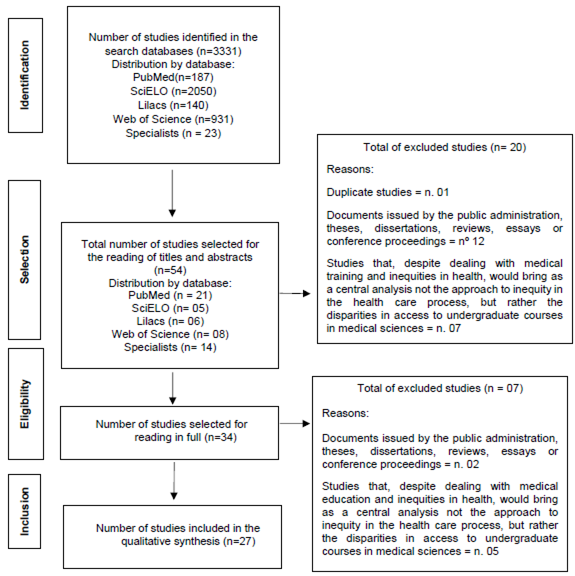
As referenced in the reviews by Santos et al.21),(22, Méllo et al.20 and the JBI guidelines19, the search process followed the operational precepts of the checklist adapted from the Preferred Reporting Items for Systematic Reviews and Meta-Analyses (Prisma) (Figure 1).

After the creation of the review corpus, with the studies included by the two independent researchers, both, in a collaborative way, systematized the information of the articles in a standardized form using Excel®; a third researcher was called to resolve doubts. The following data were collected: author/year, country where the study was conducted, journal in which the article was published, addressed topic, method, unit of analysis, strategy for addressing inequity in medical education, perception of health inequity in medical education or in the approach taught. Subsequently, also following the precepts of the review technique19, the process of creation of the results and discussions was also collaborative, following the stages of data synthesis and thematic organization, based on the analytical categories described below.
The categorization of the studies was constructed based on several concepts from the social and human sciences in health, which address different social markers as indicators of the differential positions and opportunities of subjects and groups in society14. These concepts, applied by collective health, allow analyzing the different access and treatment of certain subjects and groups in relation to the social production of the health-disease-care process23.
Studies categorized as race-related are those that mention characteristics or behaviors differentiated between groups based on or related to supposed biological traits, i.e., physiognomic, phenotype, or genotype. It should be clarified that this argument is currently not considered valid in scientific terms, since the concept of race refers sociologically to a discursive and historically dated construction of the origin and social identities of groups24),(25. However, the use of the concept allows us to highlight inequities that are not the product of biological differences, but of socio-historical inequalities that can be transformed/fought.
Considering the warning by Santos et al.26 about the tendency of health research to use the terms race and ethnicity as synonyms, we reserve the latter for studies that focus on cultural and linguistic specificities and traditions of certain groups to the detriment of phenotypic or genotypic aspects, for example, of indigenous populations.
In the gender category, articles that mention roles and values (stereotyped or not) attributed to the feminine and the masculine were grouped27, while the gender and sexuality category encompasses studies that address the organic specificities of male or female individuals and their consequences on health/disease, as well as the diversity of sexual practices and identities of individuals and groups28. Articles that address inequities in general deal with inequalities in the health-disease process without referring to any marker, both in the general population and in specific groups. In addition to the more traditional approaches to inequities, considered as previous categories, the study also sought to identify new categories and emerging approaches, such as the issue of people with disabilities, homeless people, etc.
RESULTS
Bibliometric characteristics of the articles
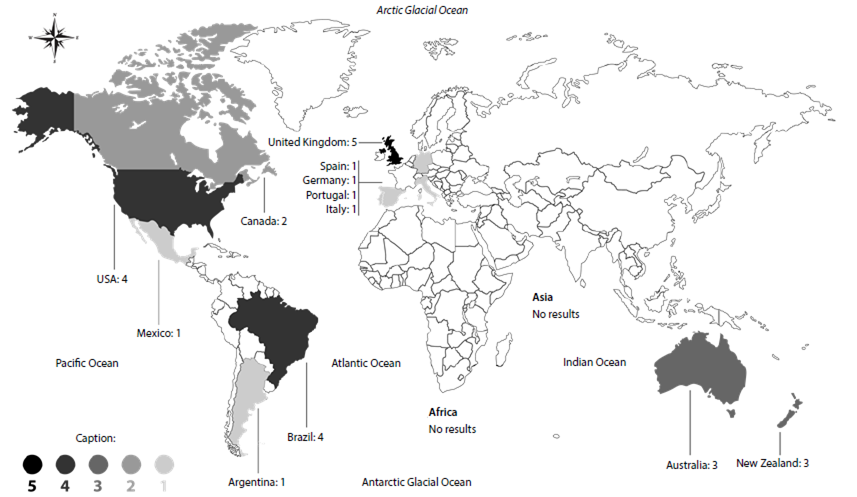
This study included 27 articles distributed in twelve countries and three continents, as shown in Figure 2.

Overall distribution of studies included in the review, according to country and number of findings.
As shown in Table 1, the first mapped article of the corpus is from 2014, and the highest concentration of productions is found in 2018 and 2022 (with 6 publications each year). Regarding the type of study, 19 are qualitative, 07 quantitative and 01 quantitative-qualitative. The data production showed several approaches, such as: the documentary analysis of pedagogical projects, curriculum matrices and slides of classes in medical schools; as well as analysis of interviews/questionnaires with medical school principals or students attending the first to the last year of medical course. It is noteworthy that the first and last years of the medical course concentrated the largest number of studies, with 09 and 06 studies, respectively. The sample size of these studies ranged from 25 to 302 students.
The thematic organization shown in Table 1 demonstrates that the discussions on health inequities in medical education worldwide, in decreasing numbers, depict the following cutting: race (07); ethnicity (05); inequities in general in specific populations, such as people with disabilities (PwD) (05) or homeless populations (01); inequities in general without indicating a specific audience (04); gender (03) and sex/sexuality (2). It is interesting to note that only one research group, led by Trollor et al.29)-(31, concentrates three studies related to inequities in PwD in the training of physicians in Australia.
Three journals concentrated approximately 45% of the publications, being in decreasing order: BMC Med Educ. (06) from the United Kingdom29)-(34, PLoS One (03) from the USA35)-(37 and Rev. Bras. Educ. Med. (03) from Brazil38)-(40 (Table 1).
How are health inequities addressed in medical education?
Health inequities during medical education have been listed in mandatory29),(34),(39),(40),(45),(46),(50),(53, or elective disciplines29),(31),(34),(39),(40),(45),(50, through clinical simulations41, in a transversal way to the course40),(44, in lectures, workshops, tutorials30 or extracurricular actions such as discussion forums42, book clubs43, summer internships51, territorial activities38 or academic extension programs40 (Table 2).
Some studies reviewed herein also detail which health inequity elements are debated during medical training in its various approaches. For example, in terms of race, medical courses seem to discuss discrimination and prejudice; stereotypes; racism42),(44, social inequalities43, health of the black population and epidemiology of their diseases44. Regarding sex and sexuality, a specific focus has emerged for the so-called LGBTQ+ population. The topics addressed in the classroom are mental health, gender identity, sexual orientation, and awareness of inequalities and discrimination34. Regarding general inequities, without reference to a specific population, one study indicated the development of clinical training to improve patient listening and social history during anamnesis53. In inequities focused on PwD, the contents taught are addressed in several departments of Australian schools, such as pediatrics, psychiatry and general practice31. Finally, a study demonstrates the operationalization of territorial clinical activities for comprehensive care aimed at homeless populations38 (Table 2).
Perceptions of approach strategies or of health inequities in medical education: what do the studies say?
Although studies indicate different approaches to health inequities throughout medical education, the literature has mentioned contradictions in its operationalization with scarce critical contextualization of its relations with the individuals’ health-disease process. For instance, we have the race issues in the study by Tsai et al45, gender in the study by Bert et al37, sexuality in the study by Barber et al50 and inequities in general related to PwD in the study by Trollor et al29.
It is noteworthy that in clinical simulations with white and black patients in the study by Soler-González et al41 there was an evident predilection for white patients to the detriment of black ones, which even influenced the students’ therapeutic and clinical decision-making. The stereotypes involved in the concept of race among medical students are also noteworthy, due to the association between black Africans and social traits of promiscuity, less intelligence, irresponsibility, ignorance, carelessness and laziness36.
The above considerations also seem to emerge for the ethnic marker of indigenous populations, who are treated by medical students with less cordiality and characterized as less malleable to therapeutic processes, when compared to European patients32),(35. In turn, the study by Ly and Crowshoe47) raises a warning about the role of the university in the reproduction of inequities, since the interviewed students mention that they are commonly exposed to negative views of the indigenous population during medical school.
According to Soledad48, when addressing gender issues in medical education, the disciplines reproduce stereotypes, such as female roles in family care and domestic chores, and male roles as family providers or resistance to pain. The limitations in identifying this social marker as an important cause of public health problems are reproduced in the scarce critical awareness of medical students49 or in their disregard for the organization of medical practice37.
Regarding inequities related to PwD, a set of studies carried out with Australian medical schools was identified29)-(31. The first study raises the hypothesis that the non-mandatory teaching about PwD may contribute to the poor health indicators of this population, ultimately resulting from what the authors call inconsistent teaching in the training of doctors29. Regarding the approaches to health inequities in this group, the authors mention, in a later study, the scarce progress in relation to the contents taught on the topic of disability between 1995 and 201431.
Other studies identified in this review point to gaps in professional training, such as preparation to work in indigenous communities33, with LGBTQ+50 people, with people in social vulnerability54 and with PwD55, which translates into feelings of anxiety when students come into contact with these realities.
On the other hand, some articles show important gains for the training of physicians when inequities, in their various markers, are efficiently operationalized throughout the course, for example in the acquisition of clinical skills46),(53),(55, development of equitable health practices that contextualize the patient in their ways of life43, critical reflection43),(44, social accountability46 and empathy and sensitivity to the patients’ social history37), (38),(53.
DISCUSSION
Health inequities are addressed in some way and through various strategies in medical education worldwide. However, criticisms and limitations have been shown about the way they are approached29),(33),(37),(45),(50),(54),(55. In principle, it is worth calling attention to the fact that, although many of the strategies reported contemplate elements of race, ethnicity, gender and sexuality, they do not contextualize these markers in the social and historical reality of individuals, thus running the risk of reinforcing an essentialist, reductionist or uncritical view of them. In other words, there seems to be no problematization of the way in which our societies understand, explain and treat social differences, translating them into hierarchies and asymmetries of power and opportunities between certain subjects and groups1),(2.
Considering the classic analytical categories applied to the analysis of social inequities in health, it is worth highlighting the lack of studies that addressed the teaching of health inequities in medical courses from the concept of social class. This concept is recognized by the World Health Organization as a structuring element of the processes of social determination of health14, in addition to being an analytical construct that is especially relevant to health, which has been previously discussed by pioneering studies based on historical materialism4, as well as in the theses by Georges Canguilhem56, who, although he did not systematically use the concept of social class, asserted that human norms are not simply functions of an organism linked to a physical environment, but expressions of the ways of living in social situations, including nutrition, working conditions, economic situation, and the education of different classes.
It is also noteworthy the absence of studies that address health inequities from an intersectional perspective. The theory of intersectionality postulates that general analytical categories, such as gender, race, or social class, when applied alone, are limited to account for specific social identities and internal differences in societie57. To overcome this obstacle, this perspective, absent from the studies reviewed herein, addresses the articulation or intersection of social identities and systems of oppression in different realities58),(59.
Thus, our results converge on a critical node of health education previously pointed out by Figueiredo and Orrillo60. These authors comment that the theoretical frameworks of health education in higher education have been based on uncritical cognitive domains supported by assumptions of the hegemonic medical model that dissociate and fragment individuals into specialties and subspecialties, disregarding their historicity. In this sense, the formative process ends up “without the expanding capacity to question and reflect on the human condition, which permeates scientific and humanistic knowledge necessary for the understanding of man, who is a biological being, but also a social and cultural one”61)(287) .
Given the negative perceptions that students project on patients, exemplified by some studies discussed here32),(35),(36),(41, it is necessary that the teaching-learning process of the medical course be disarticulated from retrograde ideas that construct the figure of a totally verticalized health professional with knowledges and practices that are not very affective and with authoritarian practices. Thus, attributing to the patient only a role of passivity and unquestionable adherence in a therapeutic path devoid of bond and autonomy62 within a power structure that is built, above all, inside the classroom63.
If classrooms reflect power structures63, the characteristics of the teaching staff become important to influence the direction of students’ professional projects. As emphasized by Rios and Schraiber64, in the educational model of medicine, teachers are references in the students’ imagination. However, if this is not articulated with humanistic development with alterity, students reproduce behaviors that are “cold, distant, disinterested in the patient, even if technically interested in their disease” 64)(40, issues that are considered historical in the medical field and work6)-(10.
The positive experiences of addressing health inequities in the process of medical education are signs of a capacity for medical social transformation that needs to be stimulated and enhanced, because from the perspective of the participants of the reviewed studies, these activities and experiences provide a medical practice that is more focused on an effective, comprehensive and humanized type of care37), (38),(43),(44),(46),(53),(55.
As an alternative to the negative scenario of approaches and perceptions, it is pointed out the need for medical schools to stimulate a practice and a teaching profile that is also clothed with humanity, beyond the academic productivism expressed in the titles and numbers of published articles, and the hyper-specialization of care. In addition to the pedagogical, cognitive and social skills highlighted by Ribeiro and Medeiros62, political skills are expected for the twenty-first century, especially when thinking of health as a human right.
To avoid reinforcing stereotypes, curricula should promote exposure to diversity and reflection on attitudes and beliefs, as well as awareness of the participation of medicine and medical education institutions in structures of power and privilege65. Thus, medical schools will enable the production of socially accountable, sensitive, and competent professionals to deal with diversity, breaking with a conservative medical education that is alienated from political and social struggles and with health practices that are far from the values of health promotion, solidarity, and empathy60),(66. One of the direct results would be to emphasize and legitimize the individuals’ social struggles in guaranteeing their health and rights, avoiding the limited political understanding of health, as evidenced in the study by Yeung et al33 on indigenous issues in Australia.
It should be noted that although the approach to inequities in health education is recommended by international organizations such as the WHO67, it is not mandatory, varying according to the laws, guidelines and recommendations of the regulatory bodies and institutions of each country. Thus, depending on the country, such discussions may vary in their degree of implementation in medical courses, and within the curricula, which are generally closed, without inter, trans or multidisciplinary contact during the training of students, with strong characteristics of early specialization66.
It is recognized that an undergraduate curriculum is also a political territory that can be hegemonic and regressive or a place of resistance and subversion. It can be identified objectively, explicitly, in pedagogical projects39),(40, in curricula or syllabi28)-(30),(44, in discipline slides45, learning guides48 or in guidance documents for medical training from official associations52; or indirectly, through more hidden elements related to norms, beliefs and values, which are reproduced by students and teachers in the classroom60, as demonstrated in other studies of this review32)-(37),(41)-(43),(46),(47),(49),(50),(51),(53),(54).
Our findings also indicate that in the conjuncture reviewed herein, there is a lack of preparation or little desire by medical students to work with vulnerable populations or those with special conditions33),(50),(54),(55, evidencing a medical project that is not oriented towards the production of equitable health practices aimed at expanding and enforcing the populations’ right to health. In this sense, paraphrasing Almeida-Filho68, what would be the role of medical schools and future professionals, to serve the elites or to serve the people? It is necessary to rethink globally a medical education project that breaks with the historical ideal of profit and social privilege, whose main objective is financial return and not human care69.
FINAL CONSIDERATIONS
Specific markers of health inequities such as race, ethnicity, sexuality and gender are addressed in medical education, but the vast majority of studies point to a certain fragility and superficiality in their performance, which ends up contributing little to a critical perception of the individuals’ health-disease process.
On the other hand, studies have pointed to important gains in clinical, behavioral and affective skills for future physicians during their training when exposed to educational practices that enabled dialogical, contextualized and social-historically referenced discussion.
It is urgent to advance in the reorientation of medical courses towards care capable of recognizing the general and specific needs of individuals and social groups in their different life trajectories, maintained by the theoretical and political supports of health inequities. Here, we highlight the importance of including Human Sciences disciplines in medical education. The so-called “Medical Humanities” are not absent from the curricula of health schools, but their relevance is often contested and the content of these subjects is often diluted in expressions closer to technical rationality. The defense of the history, philosophy and sociology of medicine not as optional disciplines, but as an essential part of medical education, is not recent, and in recent decades these medical humanities have been recognized as a method for clinical decision-making70.
Far from having exhausted the discussions around the topic, with the intention of instigating other studies, we make the following suggestions: I- in the global distribution of the articles mapped here, a predominance of studies in middle and high-income countries, with a low prevalence of studies in the Global South, was noticeable; thus, the following question arises: what is the perspective of health inequities in medical courses in low-income countries or in the Global South? Latin America has an important tradition in the field of social medicine with discussions about health inequities, so the scarcity of studies in this geographical location draws attention. II- What is the influence of the colonization process, and the intersections that coloniality has influenced in the very conceptions of health and in the medical training model?
The limitations of this article are expressed in the lack of contextualization of the social protection and health systems of the addressed countries with their educational system, as they reflect the very conception of health and care exercised by medical professionals which, without a doubt, converge to a project of society in dispute.
ACKNOWLEDGEMENTS
We would like to thank Professor Naomar de Almeida Filho, for the inspiration, support and careful final review of the manuscript and Professor Carmen Teixeira, for her constant presence during project execution and support in defining the descriptors for this review.
References
-
1 Buss PM, Pellegrini Filho A. Iniquidades em saúde no Brasil, nossa mais grave doença: comentários sobre o documento de referência e os trabalhos da Comissão Nacional sobre Determinantes Sociais da Saúde. Cad Saude Publica. 2006;22(9):2005-8. doi: https://doi.org/10.1590/S0102-311X2006000900033.
» https://doi.org/https://doi.org/10.1590/S0102-311X2006000900033 -
2 Fiorati RC, Arcêncio RA, Souza LB. As iniquidades sociais e o acesso à saúde: desafios para a sociedade, desafios para a enfermagem Rev Lat Am Enfermagem. 2016;24:e2683. doi: http://dx.doi.org/10.1590/1518-8345.0945.2687.
» https://doi.org/http://dx.doi.org/10.1590/1518-8345.0945.2687 -
3 Tesser CD, Luz MT. Racionalidades médicas e integralidade. Cien Saude Colet. 2008;13(1):195-206. doi: https://doi.org/10.1590/S1413-81232008000100024.
» https://doi.org/https://doi.org/10.1590/S1413-81232008000100024 - 4 García JC. La educación médica en la América Latina. Washington: Organización Panamericana de la Salud; 1972.
-
5 Almeida-Filho N. O pensamento político-pedagógico de Juan César García: Piaget-Gramsci-Freire e a formação profissional em Saúde na América Latina. Interface (Botucatu). 2022; 26: e220285. doi: https://doi.org/10.1590/interface.220285.
» https://doi.org/https://doi.org/10.1590/interface.220285 - 6 Donnangelo MCF. Medicina e sociedade. O médico e seu mercado de trabalho São Paulo: Pioneira; 1975.
- 7 Donnangelo MC, Pereira L. Saúde e sociedade São Paulo: Duas Cidades; 1976.
- 8 Mendes-Gonçalves RB. Medicina e história. Raízes sociais do trabalho médico [dissertação]. São Paulo: Universidade de São Paulo; 1979.
- 9 Luz MT. As instituições médicas no Brasil: instituição e estratégia de hegemonia. Rio de Janeiro: Graal; 1979
- 10 Arouca ASS. O dilema preventivista contribuição para a compreensão e crítica à medicina preventiva [tese]. Campinas: Universidade Estadual de Campinas; 1975.
-
11 Skochelak SE, Lomis KD, Andrews JS, Hammoud MM, Mejicano GC, Byerley J. Realizing the vision of the Lancet Commission on Education of Health Professionals for the 21st century: Ttansforming medical education through the Accelerating Change in Medical Education Consortium. Med Teach. 2021;43(Supl 2):S1-S6. doi: https://doi.org/10.1080/0142159X.2021.1935833.
» https://doi.org/https://doi.org/10.1080/0142159X.2021.1935833 -
12 Frenk J, Chen L, Bhutta ZA, Cohen J, Crisp N, Evans T, et al. Health professionals for a new century: transforming education to strengthen health systems in an interdependent world. Lancet. 2010;376(9756):1923-58. doi: https://doi.org/10.1016/S0140-6736(10)61854-5.
» https://doi.org/https://doi.org/10.1016/S0140-6736(10)61854-5 -
13 Raimondi GA, Tourinho FSV, Souza FGR, Pereira DVR, Oliveira DOPS, Rosa LM. Análise crítica das DCN à luz das diversidades: educação médica e pandemia da Covid-19. Rev Bras Educ Med. 2020;44:e135. doi: https://doi.org/10.1590/1981-5271v44.supl.1-20200361.
» https://doi.org/https://doi.org/10.1590/1981-5271v44.supl.1-20200361 -
14 Brasil. Relatório final da Comissão Nacional sobre Determinantes Sociais da Saúde. Brasília: Ministério da Saúde; 2008 [acesso em 3 dez 2024]. Disponível em: Disponível em: https://bvsms.saude.gov.br/bvs/publicacoes/causas_sociais_iniquidades.pdf
» https://bvsms.saude.gov.br/bvs/publicacoes/causas_sociais_iniquidades.pdf -
15 Figueiredo AM, Lima KC, McKinley DW, Del-Carmen JGM, Azevedo GD. Impact of educational policies on access to health care in Brazil: a cross-sectional study. Med Educ. 2023;57(6):587-594. doi: https://doi.org/10.1111/medu.15012.
» https://doi.org/https://doi.org/10.1111/medu.15012 -
16 Poz MRD, Maia LS, Costa-Couto MH. Financeirização e oligopolização das instituições privadas de ensino no Brasil: o caso das escolas médicas. Cad Saude Publica . 2022;38:e00078720. doi: https://doi.org/10.1590/0102-311X00078720.
» https://doi.org/https://doi.org/10.1590/0102-311X00078720 -
17 Paim JS. Da capitalização da medicina à financeirização da saúde. Cad Saude Publica 2022;38(sup 2):e00024021. doi: https://doi.org/10.1590/0102-311x00024021.
» https://doi.org/https://doi.org/10.1590/0102-311x00024021 -
18 Batista KBC, Gonçalves OSJ. Formação dos profissionais de saúde para o SUS: significado e cuidado. Saude Soc. 2011;20(4):884-99. doi: https://doi.org/10.1590/S0104-12902011000400007.
» https://doi.org/https://doi.org/10.1590/S0104-12902011000400007 - 19 Joanna Briggs Institute. Methodology for JBI Scoping Reviews - Joanna Briggs 2015. Australia: JBI; 2015.
-
20 Méllo LMBD, Santos RC, Albuquerque PC. Agentes comunitárias de saúde na pandemia de Covid-19: scoping review. Saúde em Debate. 2022;46(esp 1):368-84. doi: https://doi.org/10.1590/0103-11042022E125.
» https://doi.org/https://doi.org/10.1590/0103-11042022E125 -
21 Santos RC, Gurgel AM, Silva LlM, Santos L, Rêgo RCF, Gurgel IGD, et al. Desastres com petróleo e ações governamentais ante os impactos socioambientais e na saúde: scoping review. Saúde em Debate . 2022;46(esp 8):201-20. doi: https://doi.org/10.1590/0103-11042022E815.
» https://doi.org/https://doi.org/10.1590/0103-11042022E815 -
22 Santos RC, Silva LIM, Santos LDPJ, Méllo LMBD, Santos L. O uso de tecnologias digitais nas práticas de trabalhadores comunitários de saúde: uma revisão internacional de escopo. Trab Educ Saude. 2023;21:e02146220. doi: https://doi.org/10.1590/1981-7746-ojs2146.
» https://doi.org/https://doi.org/10.1590/1981-7746-ojs2146 -
23 Vieira-da-Silva LM. Subcampos e espaços na saúde coletiva: fronteiras e integração. Interface (Botucatu) . 2023;27:e220380. doi: https://doi.org/10.1590/interface.220380.
» https://doi.org/https://doi.org/10.1590/interface.220380 - 24 Guimarães ASA. Como trabalhar com “raça” em sociologia. Educação e Pesquisa. 2003; 29:93-107.
- 25 Schwarcz LM. O espetáculo das raças: cientistas, instituições e questão racial no Brasil. 1870-1930. São Paulo: Companhia das Letras; 1993.
-
26 Santos DJS, Palomares NB, Normando D, Quintão CCA. Raça versus etnia: diferenciar para melhor aplicar. Dental Press J Orthod. 2010;15(3):121-4.doi: https://doi.org/10.1590/S2176-94512010000300015.
» https://doi.org/https://doi.org/10.1590/S2176-94512010000300015 - 27 Alves RF, Silva RP, Ernesto MV, Lima AGB, Souza FB. Gênero e saúde: o cuidar do homem em debate. Psicol Teor Prat. 2011;13(3):52-166.
-
28 Neves DM. Sexualidade: saber e individualidade. Rev Estud Fem. 2019;27(2):e54146. doi: https://doi.org/10.1590/1806-9584-2019v27n254146.
» https://doi.org/https://doi.org/10.1590/1806-9584-2019v27n254146 -
29 Trollor JN, Eagleson C, Ruffell B, Tracy J, Torr JJ, Durvasula S, et al. Has teaching about intellectual disability healthcare in Australian medical schools improved? A 20-year comparison of curricula audits. BMC Med Educ . 2020;20:321. doi: https://doi.org/10.1186/s12909-020-02235-w.
» https://doi.org/https://doi.org/10.1186/s12909-020-02235-w -
30 Trollor JN, Eagleson C, Turner B, Tracy J, Torr JJ, Durvasula S, et al. Intellectual disability content within tertiary medical curriculum: how is it taught and by whom? BMC Med Educ . 2018;18(1):182. doi: https://doi.org/10.1186/s12909-018-1286-z.
» https://doi.org/https://doi.org/10.1186/s12909-018-1286-z -
31 Trollor JN, Ruffell B, Tracy J, Torr JJ, Durvasula S, Iacono T, et al. Intellectual disability health content within medical curriculum: an audit of what our future doctors are taught. BMC Med Educ . 2016;16:105. doi: https://doi.org/10.1186/s12909-016-0625-1.
» https://doi.org/https://doi.org/10.1186/s12909-016-0625-1 -
32 Harris R, Cormack D, Stanley J, Curtis E, Jones R, Lacey C. Ethnic bias and clinical decision-making among New Zealand medical students: an observational study. BMC Med Educ . 2018;18(1):18. doi: https://doi.org/10.1186/s12909-018-1120-7.
» https://doi.org/https://doi.org/10.1186/s12909-018-1120-7 -
33 Yeung S, Bombay A, Walker C, Denis J, Martin D, Sylvestre P, et al. Predictors of medical student interest in Indigenous health learning and clinical practice: a Canadian case study. BMC Med Educ . 2018;18:307. doi: https://doi.org/10.1186/s12909-018-1401-1.
» https://doi.org/https://doi.org/10.1186/s12909-018-1401-1 -
34 Tollemache N, Shrewsbury D, Llewellyn C. Que(e) rying undergraduate medical curricula: a cross-sectional online survey of lesbian, gay, bisexual, transgender, and queer content inclusion in UK undergraduate medical education. BMC Med Educ . 2021;21(1):100. doi: https://doi.org/10.1186/s12909-021-02532-y.
» https://doi.org/https://doi.org/10.1186/s12909-021-02532-y -
35 Cormack D, Harris R, Stanley J, Lacey C, Jones R, Curtis E. Ethnic bias amongst medical students in Aotearoa/New Zealand: Findings from the Bias and Decision Making in Medicine (BDMM) study. PLoS One. 2018 Aug 10;13(8):e0201168. doi: https://doi.org/10.1371/journal.pone.0201168.
» https://doi.org/https://doi.org/10.1371/journal.pone.0201168 -
36 Madeira F, Costa-Lopes R, Bú EA, Tato Marinho R. The role of stereotypical information on medical judgements for black and white patients. PLoS One . 2022;17(6):e0268888. doi: https://doi.org/10.1371/journal.pone.0268888.
» https://doi.org/https://doi.org/10.1371/journal.pone.0268888 -
37 Bert F, Boietti E, Rousset S, Pompili E, Franzini Tibaldeo E, et al. Gender sensitivity and stereotypes in medical university students: An Italian cross-sectional study. PLoS One . 2022;17(1):e0262324. doi: https://doi.org/10.1371/journal.pone.0262324.
» https://doi.org/https://doi.org/10.1371/journal.pone.0262324 -
38 Cunha ATR, Silva JI, Oliveira GS, Souto RD, Souza LFF, Solano LC. População em situação de rua: o papel da educação médica ante a redução de iniquidades. Rev Bras Educ Med . 2020;44:e136. doi: https://doi.org/https://doi.org/10.1590/1981-5271v44.supl.1-20200376.
» https://doi.org/https://doi.org/https://doi.org/10.1590/1981-5271v44.supl.1-20200376 -
39 Freitas-Júnior RAO, Freitas RASO, Carvalho MP, Maranhão SSA, Lisboa LL, Azevedo GD. Inclusion of health care for people with disabilities in Brazilian undergraduate medical education. Rev Bras Educ Med . 2021;45(3):e156. doi: https://doi.org/10.1590/1981-5271v45.3-20210072.ING.
» https://doi.org/https://doi.org/10.1590/1981-5271v45.3-20210072.ING. -
40 Cabral MPG, Batista MH, Gomes NA, Fontenele ACT, Rocha RC. Educação médica, raça e saúde: o que falta para a construção de um projeto pedagógico antirracista? Rev Bras Educ Med . 2022;46(4):e133. doi: https://doi.org/10.1590/1981-5271v46.3-20210343.
» https://doi.org/https://doi.org/10.1590/1981-5271v46.3-20210343 -
41 Soler-González J, Rodríguez-Rosich A, Marsal-Mora JR. Racial stereotyping and cultural competence: improving medical education. FEM. 2014;17(2):69-74. doi: https://dx.doi.org/10.4321/S2014-98322014000200003.
» https://doi.org/https://dx.doi.org/10.4321/S2014-98322014000200003 -
42 Bright HR, Nokes K. Impact of a discussion series on race on medical student perceptions of bias in health care. PRiMER. 2019;3:29. doi: https://doi.org/10.22454/PRiMER.2019.142917.
» https://doi.org/https://doi.org/10.22454/PRiMER.2019.142917 -
43 Novak DA, Hallowell R, Llobrera K, Schreiber J, Wright E, Elliott D. Stances toward anti-racist medical education: a qualitative analysis of critical consciousness in first-year medical students. AERA. 2022;8(1):01-20. doi: https://doi.org/10.1177/23328584221103878.
» https://doi.org/https://doi.org/10.1177/23328584221103878 -
44 Carrijo APB, Moura ALDB, Oliveira ACPE, Rodrigues LV, Oliveira J de, Castro TF, et al. Teaching of the black population’s health: anti-racist lenses for a paradigm shift to address racial inequities. Int J Environ Res Public Health. 2022;19(24):16784. doi: https://doi.org/10.3390/ijerph192416784.
» https://doi.org/https://doi.org/10.3390/ijerph192416784 -
45 Tsai J, Ucik L, Baldwin N, Hasslinger C, George P. Race matters? Examining and rethinking race portrayal in preclinical medical education. Acad Med. 2016;91(7):916-20. doi: https://doi.org/10.1097/ACM.0000000000001232.
» https://doi.org/https://doi.org/10.1097/ACM.0000000000001232 -
46 Pitama S, Beckert L, Huria T, Palmer S, Melbourne-Wilcox M, Patu M, et al. The role of social accountable medical education in addressing health inequity in Aotearoa New Zealand. J R Soc N Z. 2019;49(Supp 1):58-71. doi: https://doi.org/10.1080/03036758.2019.1659379.
» https://doi.org/https://doi.org/10.1080/03036758.2019.1659379 -
47 Ly A, Crowshoe L. “Stereotypes are reality”: addressing stereotyping in Canadian Aboriginal medical education. Med Educ . 2015;49(6):612-22. doi: https://doi.org/10.1111/medu.12725.
» https://doi.org/https://doi.org/10.1111/medu.12725 - 48 Soledad SM. Gender stereotypes hidden in the learning of medical students: a necessary analysis. EduMeCentro. 2018;10(4):20-36.
-
49 Hernández-Chablé A, Toraya-Vargas J, Maldonado-Salazar T, Muñoz-Cano JM. Perceptions, concepts, attitudes and values of Mexican medicine students about gender: a descriptive study. Rev Fac Med. 2016;64:21-26. doi: http://dx.doi.org/10.15446/revfacmed.v64n1.53678.
» https://doi.org/http://dx.doi.org/10.15446/revfacmed.v64n1.53678 -
50 Barber A, Flach A, Bonnington J, Pattinson EM. LGBTQ+ healthcare teaching in UK medical schools: an investigation into medical students’ understanding and preparedness for practice. J Med Educ Curric Dev. 2022;10:1-13. doi: https://doi.org/10.1177/23821205231164893.
» https://doi.org/https://doi.org/10.1177/23821205231164893 -
51 Bunting SR, Benjamins M. Teaching health equity: a medical school and a community-based research center partnership. Prog Community Health Partnersh. 2022;16(2):277-291. doi: https://doi.org/10.1353/cpr.2022.0031.
» https://doi.org/https://doi.org/10.1353/cpr.2022.0031 -
52 Hommes F, Drees S, Geffert K, Philipsborn PV, Stratil JM. How are social determinants of health represented in German medical education?: a qualitative content analysis of key-curricular documents. BMJ Open 2020;10:e036026. doi: https://doi.org/10.1136/bmjopen-2019-036026.
» https://doi.org/https://doi.org/10.1136/bmjopen-2019-036026 -
53 Gostelow N, Barber J, Gishen F, Berlin A. Flipping social determinants on its head: medical student perspectives on the flipped classroom and simulated patients to teach social determinants of health. Med Teach . 2018;40(7):728-35. doi: https://doi.org/10.1080/0142159X.2018.1436757.
» https://doi.org/https://doi.org/10.1080/0142159X.2018.1436757 -
54 Dixon H, Povall A, Ledger A, Ashwell G. Medical students’ experiences of health inequalities and inclusion health education. Clin Teach. 2021;18(5):529-34. doi: https://doi.org/10.1111/tct.13388.
» https://doi.org/https://doi.org/10.1111/tct.13388 -
55 Ryan TA, Scior K. Medical students’ attitudes towards health care for people with intellectual disabilities: a qualitative study. J Appl Res Intellect Disabil. 2015;29(6):508-18. doi: https://doi.org/10.1111/jar.12206.
» https://doi.org/https://doi.org/10.1111/jar.12206 - 56 Canguilhem G. Lo normal y lo patologico. Traducción Ricardo Potschart. Buenos Aires: Siglo XXI; 1971.
-
57 Pereira BCJ. Sobre usos e possibilidades da interseccionalidade. Civitas: Revista de Ciências Sociais. 2021;21(3):445-54. doi: https://doi.org/10.15448/1984-7289.2021.3.40551.
» https://doi.org/https://doi.org/10.15448/1984-7289.2021.3.40551 -
58 Crenshaw K. Documento para o encontro de especialistas em aspectos da discriminação racial relativos ao gênero. Revista Estudos Feministas. 2002; 10:171-88. doi: https://doi.org/10.1590/S0104-026X2002000100011.
» https://doi.org/https://doi.org/10.1590/S0104-026X2002000100011 -
59 Biroli F, Miguel LF. Gênero, raça, classe: opressões cruzadas e convergências na reprodução das desigualdades. Mediações - Revista de Ciências Sociais. 2015;20(2):27-55. doi: https://doi.org/10.5433/2176-6665.2015v20n2p27.
» https://doi.org/https://doi.org/10.5433/2176-6665.2015v20n2p27 -
60 Figueiredo GO, Orrillo YAD. Currículo, política e ideologia: estudos críticos na educação superior em saúde. Trab Educ Saude . 2020;18:e0024880. doi: https://doi.org/10.1590/1981-7746-sol00248.
» https://doi.org/https://doi.org/10.1590/1981-7746-sol00248 -
61 Baltazar MMM, Moysés SJ, Bastos CCBC. Profissão docente de odontologia: o desafio da pós-graduação na formação de professores. Trab Educ Saude . 2010;8(2):285-303. doi: https://doi.org/10.1590/S1981-77462010000200007.
» https://doi.org/https://doi.org/10.1590/S1981-77462010000200007 -
62 Ribeiro IL, Medeiros JA. Graduação em saúde, uma reflexão sobre ensino-aprendizado. Trab Educ Saude , 2016;14:33-53. doi: https://doi.org/10.1590/1981-7746-sip00099.
» https://doi.org/https://doi.org/10.1590/1981-7746-sip00099 - 63 Moura TM. Foucault e a escola: disciplinar, examinar, fabricar [dissertação]. Goiânia: Universidade Federal de Goiás; 2010.
-
64 Rios IC, Schraiber LB. A special relationship: a study on teacher-student encounters. Interface Comun Saude Educ. 2011;15(36):39-51. doi: https://doi.org/10.1590/S1414-32832010005000038.
» https://doi.org/https://doi.org/10.1590/S1414-32832010005000038 -
65 Méllo LMBD, Santos RC, Albuquerque PC. Agentes comunitárias de saúde com ensino superior: normas, saberes e currículo. Trab Educ Saude . 2022;20:e00517188. doi: https://doi.org/10.1590/1981-7746-ojs517.
» https://doi.org/https://doi.org/10.1590/1981-7746-ojs517 -
66 Almeida-Filho N, Nunes TCM. Inovações curriculares para formação em saúde inspiradas na obra de Anísio Teixeira. Trab Educ Saude . 2020;18:e0025486. doi: https://doi.org/10.1590/1981-7746-sol00254.
» https://doi.org/https://doi.org/10.1590/1981-7746-sol00254 - 67 Comission on Social Determinants of Health. Closing the gap in a generation: health equity through action on the social determinants of health. Final report of the Comission on Social Determinants of Health. Geneva, Switzerland: WHO; 2008.
-
68 Almeida-Filho N. Nunca fomos flexnerianos: Anísio Teixeira e a educação superior em saúde no Brasil. Cad Saude Publica . 2014;30(12):2531-53 doi: https://doi.org/10.1590/0102-311XET011214.
» https://doi.org/https://doi.org/10.1590/0102-311XET011214 -
69 Machado CDB, Wuo AS. Processo de socialização na formação identitária do estudante de medicina. Trab educ Saude. 2019;17(2):e0020840. doi: https://doi.org/10.1590/1981-7746-sol00208.
» https://doi.org/https://doi.org/10.1590/1981-7746-sol00208 -
70 Ayres JRCM, Rios IC, Schraiber LB, Falcão MTC, Mota A. Humanidades como disciplina da graduação em Medicina. Rev Bras Educ Med . 2013;37(3):455-63. doi: https://doi.org/10.1590/S0100-55022013000300019.
» https://doi.org/https://doi.org/10.1590/S0100-55022013000300019
-
8
Evaluated by double blind review process.
-
SOURCES OF FUNDING
The research received funding through call MS-SCTIE-Decit/CNPq number 12/2018 - Research on health innovation and from Coordination for the Improvement of Higher Education Personnel (Capes), through a master’s degree scholarship (funding code 001) granted to Romário Correia dos Santos and a subsidy of resources by CA SCON2024-00149.

 Source: the authors.
 Source: The authors.