
 From the microscope to meaningful learning: Medical students’ perceptions of pathology teaching
ABSTRACT
Introduction: Pathology education is fundamental in medical training as it integrates knowledge from both basic and clinical cycles. It is traditionally conducted through lectures and practical laboratory sessions. However, active learning, using flipped classroom, case-based learning, and gamification, centered on the student, has increasingly transformed this scenario.
Objective: To evaluate medical students’ satisfaction and perception regarding the use of active learning strategies in Pathology teaching.
Methods: A cross-sectional observational study was conducted at a Higher Education Institution between March and April 2025, after approval by the Research Ethics Committee (CAAE 86813724.6.0000.5580). A total of 201 students from the 3rd to the 8th semesters participated. Data were collected through a structured electronic questionnaire composed of five thematic blocks using a Likert scale, in addition to an open-ended comment field. Quantitative analysis included relative frequencies, chi-square test, and ordinal logistic regression (p < 0,05). For qualitative analysis of discourse exploration, content analysis according to Minayo was performed, including pre-analysis (floating reading), categorization, and interpretation of open-ended responses.
Results: High acceptance of active learning strategies was observed, with agreement rates exceeding 84% in all blocks. Ordinal regression showed a significant association of overall satisfaction with Structure and Engagement (p < 0,001), Methodological Aspects (p = 0,018), and Feedback and Evaluation (p = 0,010). Qualitative analysis of the comments identified four themes: faculty appreciation, didactic clarity, practical classes and the use of microscopy, and suggestions for improvement. Students highlighted admiration for the professors, we-structured lessons, and the relevance of laboratory practices with histopathological slides. Suggestions emphasized interest in greater integration between theory and practice, demonstrating student engagement and active participation in the learning process.
Conclusion: Students demonstrated high satisfaction with Pathology teaching and the active learning strategies employed. Didactic structure, faculty engagement, and methodological clarity were key factors for a positive perception of the teaching-learning process. Continuous improvement in assessment methods and the practical application of content is recommended to strengthen meaningful learning and the link between theory and medical practice.
Keywords:
Medical Education; Pathology; Learning; Personal Satisfaction; Educational Measurement
RESUMO
Introdução: O ensino da Patologia é fundamental na formação médica por integrar conhecimentos dos ciclos básico e clínico. É tradicionalmente realizado por aulas expositivas e práticas. No entanto, as metodologias ativas, como sala de aula invertida, aprendizagem baseada em casos e gamificação, com o ensino centrado no estudante, vêm mudando esse cenário.
Objetivo: Este estudo teve como objetivo avaliar a satisfação e percepção dos estudantes de Medicina em relação ao uso de metodologias ativas no ensino da Patologia.
Método: Trata-se de um estudo observacional transversal realizado em uma instituição de ensino superior, entre março e abril de 2025, e aprovado pelo Comitê de Ética em Pesquisa (CAAE nº 86813724.6.0000.5580). Participaram 201 estudantes do terceiro ao oitavo período do curso de Medicina. A coleta ocorreu por questionário eletrônico estruturado, composto de cinco blocos temáticos avaliados em escala de Likert e um campo para comentários. A análise quantitativa foi realizada por frequências relativas, teste do qui-quadrado e regressão logística ordinal (p < 0,05). Para exploração do discurso, utilizou-se análise de conteúdo segundo Minayo, com leitura flutuante, categorização e interpretação das respostas abertas.
Resultado: Observou-se elevada aceitação das metodologias ativas, com índices de concordância, entre os estudantes, superiores a 84% em todos os blocos. A regressão ordinal indicou associação significativa da Satisfação Geral com Estrutura e Engajamento (p < 0,001), Aspectos Metodológicos (p = 0,018) e Feedback e Avaliação (p = 0,010). A análise qualitativa dos comentários resultou em quatro eixos: valorização docente, clareza didática, aulas práticas e uso de microscopia e sugestões de aprimoramento. Os comentários evidenciaram admiração pelos professores, boa estrutura das aulas e relevância das práticas laboratoriais com lâminas histopatológicas. As sugestões destacaram o interesse em maior integração entre teoria e prática, demonstrando engajamento e participação ativa dos estudantes no processo de aprendizagem.
Conclusão: Os estudantes apresentaram alta satisfação com o ensino da Patologia e com as metodologias ativas utilizadas. A estrutura didática, o engajamento docente e a clareza metodológica mostraram-se determinantes para a percepção positiva do processo de ensino-aprendizagem. A melhoria contínua das práticas avaliativas e da aplicação prática do conteúdo é recomendada para fortalecer a aprendizagem significativa e o vínculo entre teoria e prática médica.
Palavras-chave:
Educação Médica; Patologia; Aprendizagem; Satisfação Pessoal; Avaliação Educacional
INTRODUCTION
Pathology is a central discipline in medical training and plays an integrative role between the learnings from the basic and clinical cycles. This area involves the study of general pathological processes and the various diseases of organs and systems. Traditionally, this is done through a combination of theoretical lectures, macroscopic analysis of formalin-fixed specimens and microscopic observation of histological slides. This model supports the unidirectional and non-interactive transmission of content, which in many contexts can limit the depth of understanding of disease mechanisms and the clinical applicability of this knowledge1.
In recent years, however, the landscape of pathology teaching has been transformed. New methodologies and educational resources - such as the flipped classroom, gamification, case-based learning, digitised slides, virtual microscopy, online forums, educational social media, and hybrid teaching - have been incorporated to make the teaching-learning process more active, dynamic and student-centred2),(3. These innovations aim to increase not only engagement, but also content retention, critical thinking and motivation4.
A need therefore arises to investigate the academic results of using these new methodologies. However, the students’ perception of the teaching-learning process is also of great importance. Evaluating the satisfaction, usability and suitability of the methodologies used is essential to validate or adjust pedagogical interventions, as well as to ensure that the curriculum trains doctors with a solid understanding of pathology and preparedness for clinical challenges5.
This research is justified by the relative scarcity of recent studies that systematically verify the perception and satisfaction of medical students with the active methodologies used to teach pathology. Understanding how they evaluate the tools used in class can guide improvements in curriculum design and teaching practices.
METHOD
This is a cross-sectional observational study carried out with medical students at a Higher Education Institution (HEI) located in the southern region of Brazil, with the aim of assessing students’ perception and satisfaction with teaching-learning methodologies in Pathology, considering aspects related to the practical application of content, didactic organisation and interaction with teachers.
This study was approved by the Research Ethics Committee, in compliance with Resolution 466/2012 of the National Health Council, under CAAE number 86813724.6.0000.5580. After the favourable opinion was issued, data collection took place between March and April 2025.
Census sampling was adopted with all students enrolled between the 3rd and 8th semesters who were taking Pathology modules invited to take part. Students from the first and second semesters, as well as those in the internship programme, were excluded because they were not yet taking or were no longer taking Pathology modules. A total of 201 students took part in the study, answering all the questions. All the research participants signed an Informed Consent Form (ICF) prior to responding to the questionnaire.
Data was collected using a structured electronic questionnaire prepared by the researchers and made available on the Google Forms platform. The instrument contained questions organised into thematic blocks (1 - Structure and Engagement; 2 - Practical Application and Relevance; 3 - Methodological Aspects; 4 - Feedback and Assessment; 5 - Overall Satisfaction) and structured on a five-point modified Likert scale (1 - Strongly Agree; 2 - Agree; 3 - Neutral; 4 - Disagree; 5 - Strongly Disagree), as well as space for free comments.
The data was treated confidentially, guaranteeing anonymity, and stored on password-protected devices, with access restricted to the research team for five years. The risks included the possibility of indirect identification and possible discomfort, mitigated by the use of numerical codes and the preservation of institutional anonymity. The study provided indirect benefits, allowing for the critical evaluation of methodologies, tools, content relevance, interdisciplinary integration and teacher-student interaction, subsidising improvements to the curriculum and teaching practices.
For the descriptive analysis, the relative frequencies (%) of responses were calculated for each point on the Likert scale, per question and per thematic block. The profile of the participants was described by simple proportions, according to the period of the course.
The association between course period and responses was assessed using Pearson’s chi-squared test, considering p < 0.05 as the level of significance. When the expected frequency in any cell was less than 5, Fisher’s exact test was applied.
The Overall Satisfaction thematic block was considered the primary outcome, while the other blocks were treated as predictor variables. For each student, the average score for each thematic block was calculated. An ordinal cumulative logistic regression (proportional odds model) was applied, appropriate for ordinal dependent variables, estimating the β coefficients, 95% confidence intervals (95%CI), standard errors, z values and p values. The overall fit of the model was assessed by McFadden’s pseudo R².
Statistical analyses were carried out using Jamovi (version 2.6.26.0) and GraphPad Prism (version 9.0.1) software, adopting a significance level of 5% (α = 0.05).
The free comments were subjected to qualitative Content Analysis, according to the methodological procedures described by Minayo6. The material analysed consisted of comments and suggestions written by the students. The process involved organising the answers, followed by reading and re-reading the content in order to constantly revisit the research objectives. The results were then analysed, with inference and interpretation of the findings. This approach made it possible to identify and group together thematic categories emerging from the participants’ notes, giving greater meaning and depth to the analysis.
RESULTS
The results were organised into two complementary dimensions, according to the nature of the data obtained: quantitative results, referring to the statistical analysis of the instruments applied, and the qualitative discourse analysis results, which emerged from the interpretation of the open-ended responses and the observations recorded during the execution of the activities. This organisation aims to provide a comprehensive understanding of the impact of the proposed methodology on the teaching-learning process in Pathology.
Quantitative analysis of students’ perceptions of pathology teaching
The distribution of the students taking part in the survey according to their period of study was as follows: 3rd semester (n = 30); 4th semester (n = 42); 5th semester (n = 44); 6th semester (n = 30); 7th semester (n = 30) and 8th semester (n = 27). There was a slight predominance of students enrolled in the 4th and 5th semesters, and the 8th semester had the lowest number of participants.
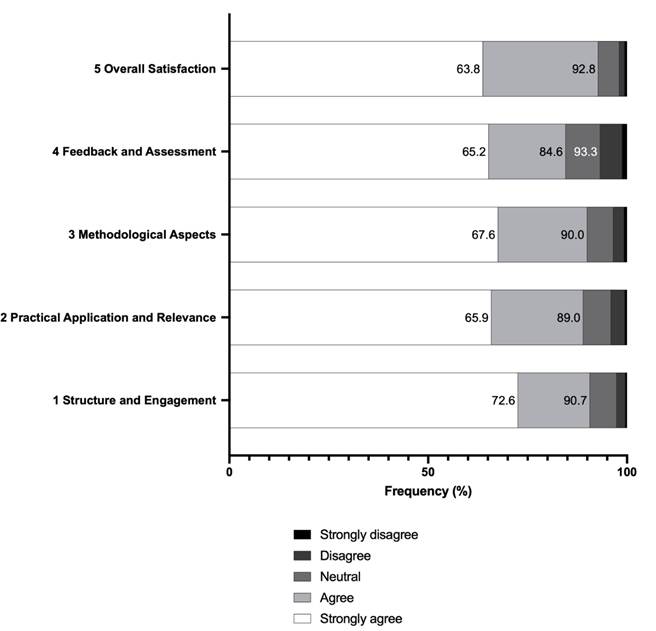
Figure 1 shows the relative frequency (%) of the participants’ responses in each thematic block, according to the Likert scale (1 - Strongly agree; 5 - Strongly disagree). There was a higher proportion of positive responses (strongly agree or agree) in the Overall Satisfaction (92.8%), Structure and Engagement (90.7%) and Methodological Aspects (90.0%) blocks. On the other hand, the Practical Application and Relevance (89.0%) and Feedback and Assessment (84.6%) blocks had lower agreement rates, although still high, indicating an overall favourable perception among students regarding the use of active methodologies.

Relative frequency (%) of student responses per thematic block, according to the Likert scale 1-5.
Figure 2 shows the relative frequency of responses per question. The highest proportions of agreement (strongly agree or agree) were observed in questions Q11 (97.0%), Q10 (96.5%) and Q6 (95.5%). These questions refer, respectively, to the effectiveness of using clinical cases as a strategy for integrating theory and practice, the benefits of lectures in understanding pathology concepts, and the ability of teachers to relate theory and clinical practice.

Relative frequency (%) of student responses to each question, according to the Likert scale 1-5. Values represent the proportion (%) of students per response.
By contrast, the lowest frequencies of agreement were recorded in questions Q15 (76.1%), Q12 (80.6%) and Q8 (81.6%). These items deal, respectively, with review and feedback in assessments, the organisation and use of histological slides in the learning process, and the contribution of clinical case discussions to the practical application of pathology knowledge.
In general, however, the results indicate a high level of acceptance and engagement by participants with the active methodologies used, with occasional variations that suggest opportunities for improvement in aspects related to assessment and the practical integration of content.
In order to check whether the students’ level of agreement varied according to the period of the course, their association with the answers to each of the instrument’s 18 questions was analysed. A statistically significant association was identified in 9 of the 18 questions (50.0%), as shown in Table 1, indicating that the semester of study influenced the participants’ level of agreement. The questions with a significant association were Q1 to Q4, Q12, Q14, Q15, Q17 and Q18. They are contained in blocks 1, 3, 4 and 5. Only block 2 had no questions with a significant association.
Figure 3 illustrates the relative distribution of responses per semester on the questions mentioned, based on the Likert scale. There was a progressive upward trend in the frequency of “I strongly agree” responses from the 3rd to the 5th semester, with agreement peaking in the 5th semester. There was then a reduction in the degree of agreement in the 6th semester, followed by a further increase between the 7th and 8th semesters, although without reaching the maximum levels seen in the 5th semester.

Relative frequency (%) of student responses to the Likert scale (1-5), in the questions that showed a statistically significant association with the period of the course (p < 0.05), as identified by the chi-squared test.
Finally, the impact of the different thematic blocks on the Overall Satisfaction block was assessed. For this analysis, ordinal regression was used, considering the other four blocks, (1) Structure and Engagement, (2) Practical Application and Relevance, (3) Methodological Aspects and (4) Feedback and Assessment, as predictor variables, and Overall Satisfaction (5) as the dependent variable (Table 2).
The results indicated a direct and statistically significant association between Overall Satisfaction and three of the four blocks assessed: Structure and Engagement (p < 0.001), Methodological Aspects (p = 0.018) and Feedback and Assessment (p = 0.010). There was no statistical evidence of a significant association between the Practical Application and Relevance block and Overall Satisfaction (p > 0.05).
Analysis of the estimated coefficients (β) revealed that the factor with the greatest impact on the Overall Satisfaction block was Structure and Engagement (β = 0.85), followed by Methodological Aspects (β = 0.71) and Feedback and Assessment (β = 0.41).
Qualitative analysis of students’ views on the teaching of pathology
The space at the end of the structured electronic questionnaire was used for comments and suggestions by 55 of the 201 students. The qualitative analysis of the open-ended answers, based on Minayo’s (2013) framework, enabled us to understand the participants’ representations and experiences in relation to the teaching-learning process in Pathology. An examination of the comments revealed recurring nuclei of meaning, organised around four main axes: (1) Valuing Teaching and Teachers, (2) Clarity and Teaching Structure, (3) Practical Classes and Use of Microscopy, and (4) Suggestions for Methodological Improvement.
The first axis, “Valuing Teaching and Teachers”, was predominant. The students’ opinions expressed admiration and recognition for the teachers’ work, highlighting their mastery of the content and the didactics applied. Terms such as “excellent teachers”, “great lessons”, show a relationship of respect and gratitude, which reflects the perception of the quality of teaching.
The second axis refers to “Clarity and Didactic Structure”. The students highlighted the organisation of the content and the coherence between theory and practice. Comments such as “the lessons are well structured and easy to follow” and “the slides help a lot in understanding” reinforce the importance of the planned teaching strategies.
Regarding the third axis, “Practical Classes and Use of Microscopy”, several students showed appreciation for the practical classes, recognising the value of laboratory sessions and the observation of histological slides for understanding the content. Comments such as “the practical classes help to consolidate learning of the content”, “I like to see the slides and understand what has been shown in the theory” express that the practical classes are seen as moments of learning consolidation. There were also positive remarks about the organisation of the laboratories and the use of microscopes. Some comments, such as “the slides are well chosen” and “the use of the microscope helps a lot in visualising the lesions”, show the perception that practical teaching favours the development of interpretative and diagnostic skills.
Finally, “Suggestions for Methodological Improvement” emerged, centred on theory-practice integration. Some students suggested increasing applied activities, with greater use of clinical cases and interactive discussions. This discursive nucleus reflects a reflective and participatory attitude, signalling the students’ interest in more dynamic and integrative teaching practices.
DISCUSSION
This study was conducted at an HEI whose medical programme is based on an integrated curriculum. The main methodology is Problem-Based Learning. Students take Pathology modules over three years, from the 3rd to the 8th semesters. In these modules, teachers use a variety of active methodologies to complement lectures and practical macroscopy and microscopy classes. These methodologies include, for example, clinical case approaches focusing on pathophysiological and diagnostic aspects, gamification and the inverted classroom. These findings are in line with international literature on pathology teaching and active learning in medical education. Studies conducted in different medical schools have shown that strategies such as clinical case discussions, problem-based learning and interactive activities support greater student engagement and better integration between morphological concepts and clinical application2. In line with the observations of this study, these approaches are usually associated with higher levels of student satisfaction and learning perceived to be more meaningful compared to predominantly expository models1.
Regarding student participation in the survey, the results were heterogeneous. The 5th semester had the highest number of participants (n = 45), while the 8th semester had the lowest (n = 27). Studies show that the expected percentage of participants in surveys with online questionnaires is around 30%7. Considering that the average number of students in each semester cohort at this HEI is around 50, even the semesters with the lowest participation exceeded 50%, which adds to the robustness of the results.
When the degree of agreement in each of the blocks was assessed, it was found that the Overall Satisfaction block totalled 92% of students who responded positively (agree or strongly agree). This reflects the students’ positive perception of the activities conducted in the Pathology modules. For the block related to perceived Practical Application and Relevance, 89% of the responses were positive, indicating recognition of the importance of Pathology in medical training. The integrated curriculum supports the inclusion of content from other modules in Pathology classes, which makes the interrelationship between knowledge in the various medical areas more obvious to the student. The block that generated the lowest percentage of positive responses was the Feedback and Assessment block. Although the percentage of positive responses is still high (84.6%), this is in line with the anxieties recognised by the teachers themselves, such as the difficulty in designing relevant questions that adequately assess the student’s knowledge. In addition, the scarcity of feedback to the student, for the most diverse reasons, including the lack of time during activities, the number of students in each class, the lack of experience of the teachers, among others, contributed to the lower percentage of agreement in the answers to this block.
Regarding the individual assessment of each of the questions, the two with the best results were those that rated the methodological processes. For 97% of students, the use of clinical cases contributes to the practical application of theory, while 96% recognise that lectures help them to understand pathology concepts. At this HEI, the medical course curriculum is based on active methodologies and lectures are rare. Furthermore, when they are given, they adopt a dialogue format and require constant student participation, in an attempt to make the process student-centred. In the third question with the highest level of agreement, 95% of students recognise the ability of teachers to relate theory and clinical practice. This, once again, reflects the importance of the comprehensiveness of the medical curriculum, ensuring that the contents are applied together in the modules and curricular units.
On the other hand, the questions with the lowest agreement rates are contained in the thematic block of Feedback and Assessment. For 76.1% of the students, assessments are reviewed and corresponding feedback is given. This result is extremely important and shows that around a quarter of students believe that there is a flaw in this area, which requires attention from teachers in an attempt to find strategies for improvement, since assessment is also a time for learning, through reviewing performance and offering feedback. Another question with a lower level of agreement concerns the organisation and use of histological slides in the learning process. Around 80% of students agree or strongly agree that this is done adequately. For the almost 20% who were neutral or did not agree, the authors believe that this result may reflect the current difficulty in acquiring histological slides of human pathological processes. Consequently, sometimes the number of students exceeds the number of histological slides available, which reduces the dynamism of the practical activity. In most medical schools, slides are used as a result of autopsies executed at teaching hospitals. With the drastic reduction in the number of autopsies in recent decades, anatomopathological specimens and histological slides are increasingly scarce8. Alternatives to this reality are the use of 3D parts and free virtual slides, made available by some HEIs9),(10.
When the degree of agreement with the questions was correlated with the period in which the student was enrolled, statistically significant results were obtained for 9 of the 18 questions, as shown in Table 1. When these questions were assessed per semester, as seen in Figure 3, it was observed that the level of agreement rose from the 3rd to the 5th semester. This behaviour suggests that the positive perception of the organisation of Pathology practical units and active methodologies tends to consolidate halfway through the course, possibly as a result of greater contact with practical activities and theory-practice integration. The reduction observed in subsequent semesters may reflect greater demands from more advanced students, due to their greater proximity to clinical practice and mastery of content, as well as more critical judgements regarding teaching and learning processes. On the other hand, it should be considered that the topics covered in the Pathology modules, as well as the degree of integration with the other modules in the best evaluated semesters, may have contributed to the degree of agreement in the responses.
Finally, logistic regression showed that only the block with questions involving Practical Application and Relevance had no impact on the Overall Satisfaction block. The importance of pathology for professional practice needs to be highlighted even more, regardless of the medical speciality, so that students value its teaching.
Regarding the other blocks, the results suggest that students who perceive greater clarity in lessons, opportunities for interaction, freedom to question and diversity of learning methods are more likely to be generally satisfied with the pathology teaching-learning process.
In addition, the Methodological Aspects block showed a significant contribution to student satisfaction, reinforcing the importance of the variety and coherence of the teaching strategies used. The Feedback and Assessment block, in turn, also exerted a positive influence, indicating that reviewing and understanding one’s own performance in evaluations are relevant elements for perceived overall satisfaction.
To summarise, the results of the ordinal regression show that participants’ satisfaction is strongly determined by the quality of interactions in the classroom and the teaching structure adopted, rather than by the practical application of the content in isolation.
When interpreting the opinions expressed, there was a prevalence of positive feelings, marked by recognition, respect and satisfaction. The criticism was constructive, indicating a healthy and collaborative learning environment. All the statements revealed a collective discourse of valuing the teaching of pathology, in which the teacher is an important mediating figure and the pedagogical experience is lived in a meaningful and affective way. In summary, the students’ discourse show that the teaching-learning process in Pathology is perceived as organised, effective and inspiring, promoting cognitive training. The views expressed also pointed to the importance of strengthening practices that bring theory and clinical experience closer together, supporting the consolidated learning and the critical development of future health professionals.
Although the results indicate a high level of acceptance of active methodologies by the students evaluated, their extrapolation to other medical schools should be developed with caution. Differences in curriculum organisation, institutional infrastructure and the degree of teaching experience with active methodologies can influence student perception and engagement. Nonetheless, the findings suggest that elements such as methodological clarity, classroom interaction and structured feedback tend to be valued by students in different educational contexts, which points to the potential applicability of these strategies in other medical training scenarios.
This study has some limitations that should be taken into account when interpreting the results. Firstly, the investigation was conducted at a single educational institution, which may limit the generalisability of the findings to other educational settings. Furthermore, as the questionnaire was voluntary, the possibility of response bias cannot be ruled out, as more engaged students may have been more inclined to take part. The analyses were also based on self-reported measures of student satisfaction and perception, which reflect subjective experiences and may not necessarily correspond to objective academic performance. Finally, the study did not include objective metrics of learning outcomes, which limits the ability to establish direct associations between the methodologies employed and actual learning gains.
CONCLUSION
In general, the results show a high level of acceptance among participants for the use of active methodologies, with significant levels of agreement in all the thematic blocks analysed. It was observed that students’ overall satisfaction is strongly associated with factors related to the structure of the classes, the engagement promoted by the lecturers and the methodological clarity of the proposed activities. Although agreement remained high in all semesters, a significant variation in the pattern of responses was identified in half of the questions assessed, suggesting that the stage of academic training influences students’ perception of and engagement with different pedagogical approaches. The ordinal regression analysis confirmed the preponderant impact of the Structure and Engagement, Methodological Aspects and Feedback and Assessment blocks on Overall Satisfaction, indicating that interaction in the classroom, the diversity of teaching strategies and constructive feedback on performance are determining factors for a positive student experience. These findings reinforce the relevance of active methodologies as tools for promoting meaningful learning and strengthening the link between theory and practice.
However, the results should be interpreted in the light of some limitations, such as the design based on a single institution, the use of self-reported measures of satisfaction and the potential response bias associated with students’ voluntary participation. Future studies, preferably multicentre and with longitudinal follow-up, could expand on these findings by comparing different active methodologies and incorporating objective metrics of academic performance and learning outcomes.
References
- 1 Oqbani K, Birouk M, Abbaoui S, Chaouir S, Al Idrissi N, Ahid S. Attitude, perception, and feedback of graduate medical students on teaching-learning methodology in pathology courses: a call for curricular modernization in Morocco. J Educ Health Promot. 2023;12(1);368.
- 2 Do M, Sanford K, Roseff S, Hovaguimian A, Besche H, Fischer K. Gamified versus non-gamified online educational modules for teaching clinical laboratory medicine to first-year medical students at a large allopathic medical school in the United States. BMC Med Educ. 2023;23(1);959.
- 3 Blesile SS, Tecson JV. Satisfaction of medical students in studying histology using virtual and light microscopy: a cross-sectional study. Acta Med Philipp. 2023;57(10);26.
- 4 Cai L, Li YL, Hu XY, Li R. Implementation of flipped classroom combined with case-based learning: A promising and effective teaching modality in undergraduate pathology education. Medicine. 2022;101(5);e28782.
- 5 Abbasi F, Parvin A, Zahra N. From classroom to clinic: evaluating a clinical pathology course to strengthen pathology report literacy of medical interns. BMC Med Educ . 2025;25(1);490.
- 6 Minayo MCS. O desafio do conhecimento: pesquisa qualitativa em saúde. 13a ed. São Paulo: Hucitec, Abrasco; 2013.
- 7 Nulty DD. The adequacy of response rates to online and paper surveys: what can be done? Assessment & Evaluation in Higher Education. 2008;33(3);301-314.
- 8 Pompilio CE, Vieira JE. The technological invention of disease and the decline of autopsies. Sao Paulo Med J. 2008;126(2):71-2.
- 9 Ordi O, Bombí JA, Martínez A, Ramírez J, Alòs L, Saco A, et al. Virtual microscopy in the undergraduate teaching of pathology. J Pathol Inform. 2015;6(1);1.
- 10 Perez AN, Sharif KF, Guelfi E, Li S, Miller A, Prasad K, et al. Ex vivo 3D scanning and specimen mapping in anatomic pathology. J Pathol Inform . 2023;14:100186.
Research data is available in the body of the document.

 Source: Prepared by the authors.
 Source: Prepared by the authors.
