 Evaluation of a medical counseling and experiential learning program for public school students
ABSTRACT
Introduction: The lack of vocational guidance for high school students is a problem in Brazil. Furthermore, access to higher education, especially for public school students, presents significant challenges, particularly for medical degrees. This study investigated the impact of a short, low-cost educational program conducted with elementary, high school, and pre-university students to provide experiences related to the health professions.
Objective: To investigate the impact of the MedProject educational program on perceptions of the medical career and confidence in career choice among public school students.
Method: This was a cross-sectional, quali-quantitative study, based on responses to evaluation questionnaires administered at the end of four editions of the program at different public educational institutions.
Result: 134 responses were obtained. The quantitative results demonstrated high levels of satisfaction with the program, and the qualitative analysis highlighted enhanced career perceptions and knowledge acquisition.
Conclusion: This study presents an educational program model that significantly enhanced career perceptions among Brazilian public school students, offering valuable insights into higher education and career paths, especially in the medical field.
Keywords:
Education, Medical; Vocational Guidance; Career Choice; Education, Secondary
RESUMO
Introdução: A falta de orientação profissional para alunos do ensino médio é um problema no Brasil. Além disso, o acesso à educação superior, principalmente para alunos de escolas públicas, apresenta desafios significativos, sobretudo no curso de Medicina. Este estudo investigou o impacto de um programa educacional curto e de baixo custo realizado com estudantes dos ensinos fundamental e médio e de pré-vestibular, a fim de oportunizar vivências sobre as profissões da saúde.
Objetivo: Este estudo teve como objetivo investigar o impacto do programa educacional MedProject nas percepções sobre a carreira médica e na confiança para a escolha da profissão em estudantes de escolas públicas.
Método: Trata-se de um estudo transversal, qualiquantitativo, baseado em respostas de questionários avaliativos aplicados ao final de quatro edições do programa em datas e instituições públicas de ensino distintas.
Resultado: Foram obtidas 134 respostas. Os resultados quantitativos demonstraram altos níveis de satisfação com o programa, e a análise qualitativa destacou percepções aprimoradas de carreira e aquisição de conhecimento.
Conclusão: Apresentamos um modelo de programa educacional que aprimorou significativamente as percepções de carreira entre estudantes de escolas públicas brasileiras, oferecendo insights valiosos sobre o ensino superior e os caminhos profissionais, especialmente na área médica.
Palavras-chave:
Educação Médica; Orientação Vocacional; Escolha da Profissão; Ensinos Fundamental e Médio
INTRODUCTION
There are few studies that address career choice by high school students. In Brazil, career counseling and the application of vocational tests at the end of school are uncommon1, although there is an extensive national literature on career guidance2), (3.
Higher education is still considered unattainable by many students from public schools. Such is the disparity between public and private education that several affirmative policies have been adopted in the country in recent decades - such as quotas, the Student Financing Fund (FIES, Fundo de Financiamento Estudantil) and the University for All Program (PROUNI, Programa Universidade para Todos) - with the aim of democratizing the access of students from public schools to quality higher education4. In addition, several universities began to have student retention policies on their agenda, aiming to retain students in the academic environment until the conclusion of their course5. However, student access to higher education, especially in low-income populations, can often be costly, due to the cost of a college when private. And even in public institutions, attending a higher education institution means spending hours from one’s day without a direct monetary gain. Such factors stand out in the medical course, due to its comprehensive curriculum, with a duration of 6 years and with private colleges often charging monthly fees of more than ten thousand reais6.
However, in addition to these concrete issues, the career decision construct establishes that self-efficacy7 is an important factor in the decision. Self-efficacy, in a simplified way, represents the student’s own perception of their ability to pursue a career. The medical career has a low perception of self-efficacy among high school students8. Understanding the ways to expand access to information about different careers is essential in the promotion of higher education in the country. Thus, programs that disseminate or provide opportunities for these young students to learn about the possibilities of a professional career in the health area are of great value not only for the democratization of higher education but also for the formation of citizens who understand their role in society.
The present study aimed to investigate the global impact of an educational program based on practical experiences and on the approximation of high school students with higher education, called “MedProject”, and the effects of participation in this project on confidence in career choices.
MATERIALS AND METHODS
This is an observational cross-sectional research, using qualitative-quantitative methods, based on answers to evaluation questionnaires applied at the end of the educational program called “MedProject”. The procedures adopted in this research were in accordance with the Criteria for Ethics in Research with Human Beings, in accordance with Resolution N. 466/2012 of the National Health Council and the ethical principles established in the Declaration of Helsinki. The project was approved by the Research Ethics Committee (REC) of the proposing institution (Faculdade de Medicina da Universidade de São Paulo). All the data used were anonymized from storage to the end of the analysis, the results were calculated and presented in aggregate form, without the possibility of identifying the subjects involved.
The authors declare the use of artificial intelligence tools (Grok, xAI; Gemini, Google) as an aid in the preparation of this manuscript, especially in the abstract, introduction, discussion, and conclusion sections. The tools were used to search for references in the literature, refine the language, restructure paragraphs, check the format of references and translate text excerpts. The human authors have reviewed all generated content and take full responsibility for the final version of the study.
MedProject Program
MedProject is a project that was created in 2015 to provide students at the end of elementary school, high school and graduates with an experience in the health area. The project was publicized on social networks and used the snowball methodology, where one person indicated two others to participate. To be included in the project, the school had to be of public economic nature.
After being selected, those responsible for the MedProject met with the school principals to present the project and program the activities that were carried out in the school itself, lasting 3 hours. The school boards were responsible for selecting the participants.
The MedProject team consisted of a teacher of medicine, who is also a physician, and three to four medical students who will be called monitors here. The teacher guided the meeting and led the conversation circle. The monitors, on the other hand, were responsible for assisting the activities in the practical modules.
The activities were structured in two modules. The first was called “The Medical Career and Health”. The objective of this stage was to discuss the characteristics that are expected of a medical student and a future doctor (resilience, dedication, empathy, communication, leadership); present the structure of medical and health schools and what elements should be observed in their choice, for example, national or international; share how the development in the medical career takes place (time to enter the job market and its characteristics). For this purpose, a dialogued lecture was offered to up to 100 students, in the participating school itself. It was led by the medical teacher and shared with at least one medical student.
The second module, called “Medical Experience”, had the following main objectives: to discuss basic health concepts that are important for the general knowledge of the adolescent population and to discuss the aspects that a future doctor should pay attention to in their practice, which go beyond exams and objective data. For this module, we offer the possibility of providing three different topics, to be chosen by the school board as needed: Basic Life Support (BLS), Mental Health and Sex Education. These activities were conducted by monitors (medical students), previously trained by the project manager. The topic chosen by the school board in all 4 editions analyzed was Basic Life Support (BLS).
Study design
Data collection
At the end of each edition, students were invited to fill out a form with their own cell phones. The questionnaire used was presented to the students, with the authorization of the parents and the school coordination and answered digitally (via Google Forms) in person at the end of the MedProject activities. To compose the sample, the inclusion criteria were: being a student of a Brazilian public school (attending from the 9th year of elementary school to the 3rd year of high school), or of a pre-university course, and having participated in one edition of the MedProject program. No exclusion criteria were applied.
The questionnaire involved demographic data, such as age, gender, and year of high school. In addition, it contained two closed questions about the impact of the activity on the students’ lives; an open-ended question (How do you think MedProject has contributed to your knowledge of medicine? What did you learn?) and, finally, six statements to be graded on the Likert scale related to career experience, skills and knowledge in the health area.
Data analysis
Numerical data were processed through descriptive statistical analysis, with calculation of mean and standard deviation of the scores given using the Google Sheets application. For the calculation of the Net Promoter Score, we considered detractors to be those who assigned scores 1 to 6, indifferent scores of 7 and 8, and promoters as scores 9 and 10. The data obtained from the six statements graded on the Likert scale were used to obtain a general index of favorability, understood as the overall statistical value of positive acceptance of the proposed sentences. The qualitative data were classified into categories of responses and presented in a descriptive way.
Data supporting the results of this study are available upon reasonable request to the corresponding author.
RESULTS
For this study, we considered data from the last four editions of MedProject held in 2022 and 2023. The interventions took place in four different educational institutions: a state school, a municipal school and two community pre-university courses. The estimated number of students who participated in the project was about 280. The sample size obtained from the database of the forms applied at the end of these editions was equal to 134 (answers to the questionnaire).
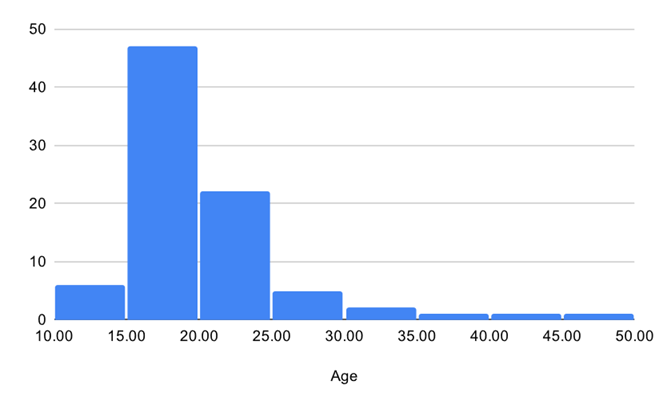
The sample consisted mostly of women (n=101, 75.3%). The mean age was 20.17 (standard deviation (SD) = 5.4 years) (Figure 1).
Regarding the level of schooling, most of the sample (n=66, 77.6%) had already finished high school, while the other students were in the last year of elementary school (n=8, 9.4%) or in the last year of high school (n=11, 12.9%).
When asked to assign a grade to the following activities: Chat: the medical career and ‘Medical experience’, we obtained the following averages, respectively: 9.69 (SD=0.63) and 9.56 (SD=1.16). On the other hand, for the question: “What is the chance that you recommend that the MedProject be carried out in other schools?” also on a scale of 0 to 10, it was possible to calculate the Net-Promoting-Score (NPS)9, with an average result of 94.0%, with the sample divided into 129 (96.3%) promoters, 2 (1.5%) indifferent, and 3 (2.2%) detractors.
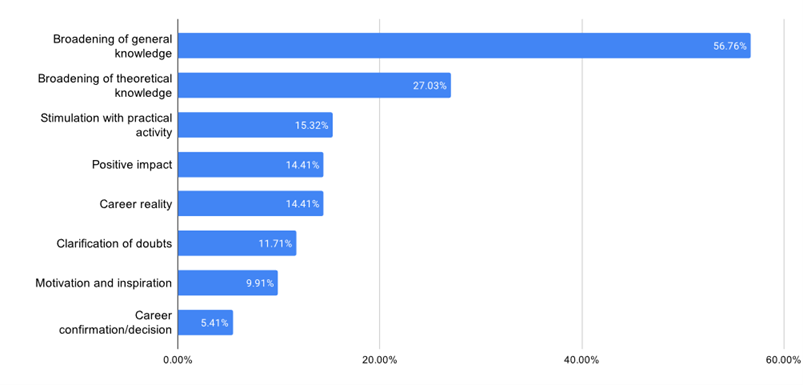
Regarding the second group of questions: “How do you believe MedProject has impacted your view of the medical career?” (Figure 2); “How do you believe MedProject has impacted your view of career in general?” (Figure 3) and “How do you think MedProject has contributed to your knowledge of medicine? What did you learn?” (Figure 4), similar response patterns were observed, with most participants understanding that the intervention broadened their vision or knowledge.

Graph related to the answers to the question “How do you believe MedProject has impacted your vision of the medical career?”.

Graph related to the answers to the question “How do you believe MedProject has impacted your view on career in general? (in any area or profession)”.

Graph related to the answers to the question “How do you think MedProject contributed to your knowledge about medicine? What did you learn?”.
To analyze these open questions, we also used the digital tool “Wordclouds” to group the most frequent keywords. Thus, considering the responses received, a cloud was formed with the size of each word being representative of the frequency with which it appeared in the responses (Figure 5).

Finally, regarding the six statements evaluated by the participating students using the Likert Scale, a Favorability Index corresponding to a value of 87.08% was obtained.
DISCUSSION
As pointed out in the introduction, low self-efficacy is a structuring obstacle for high school students considering a medical career8. To address this issue, experiences such as mentoring and practical experiences (shadowing) are internationally recognized as powerful tools to increase the confidence and interest of young people in this area10),(11. In a complementary way, community engagement programs have also been shown to be effective in expanding the repertoire and motivation of students from underrepresented groups12),(13. However, there is a notable gap in publications that document and evaluate initiatives for this purpose in the Brazilian educational scenario. The MedProject, evaluated in this study, is inserted precisely in this space, by adapting successful models to the reality of students from public schools in the country, promoting, according to our results, greater confidence and autonomy in career decisions.
This perception of greater trust and autonomy is corroborated by the analysis of the results, with quantitative and qualitative data complementing each other to explain the impact of the program. Participant satisfaction, evidenced by the favorability index (87.08%) and the Net-Promoter-Score (NPS) of 94.0%, reaches Kirkpatrick’s first level of evaluation, the ‘reaction’. This positive receptiveness can be attributed to the presence of university mentors, a factor that reduces the students’ “strangeness” with the academic environment, as pointed out in the literature14, and whose approach is corroborated by international models15. However, the impact transcends the reaction. The qualitative analysis reveals an advance to Kirkpatrick’s second level, ‘learning’, where ‘I learned’ and ‘broadening the vision’ emerge as the most prominent topics. This expansion of the repertoire is vividly illustrated by a participant’s statement: “In everything, I had very little idea about what life is like for a person who studies or works in the field of Medicine, we usually see on TV a very short version of what it is like and hear a person talking about [sic] what life is like, It’s very gratifying.” This indicates that the interaction with the monitors not only generated a positive experience, but also significantly expanded the students’ repertoire about their career and university, a finding consistent with studies that correlate practical exposure with increased interest in scientific careers16.
The findings of this study transcend the evaluation of an isolated initiative and point to the value of a two-way street between the university and the public school. For the higher education institution, programs such as MedProject are not just a form of extension, but an active strategy for the democratization of access, allowing the identification of vocations and the breaking of stereotypes that drive away potential talents. On the other hand, for elementary school students, direct contact with university mentors materializes the possibility of a medical career, transforming “strangeness” into a sense of belonging and doubt into self-efficacy. Thus, the main implication is that such partnerships represent a high-impact, low-cost investment in human capital formation and the construction of a fairer and more integrated educational ecosystem.
Despite the promising results, there are limitations that must be considered. The main methodological constraint lies in the program evaluation, which focused on the first two levels of Kirkpatrick’s model17 - reaction and learning. This currently precludes conclusions about the application of learning to new attitudes (level 3) or about the long-term impact on the participants’ career trajectory (level 4). Furthermore, the scope of the study limits the generalization of the findings, since it was restricted to public schools in a single region and maintained the focus on the medical career, exploring other health professions in a less in-depth way. Finally, a potential researcher bias is recognized, given that the conduction and analysis were carried out by the program’s creators themselves18.
The limitations pointed out do not diminish the study results, but, on the contrary, open promising paths for future research. The main one would be to conduct a longitudinal study to follow up the participants, thus allowing the evaluation of Kirkpatrick levels 3 (behavior) and 4 (results) and to measure the real impact of the program on the choice and entry into health careers. In addition, future initiatives could expand the scope of MedProject to different contexts (such as rural areas or private schools) and investigate the effects of the program on the mentors themselves - medical students. Such expansions would consolidate MedProject as a two-way and scalable pedagogical model, reinforcing the value of initiatives that build bridges between the different levels of the Brazilian education system.
CONCLUSION
The MedProject program has shown to be an effective and low-cost intervention to increase the repertoire and self-efficacy of public school students in relation to a medical career. Through practical experiences and mentoring with university students, the program acts as a bridge between basic and higher education, combating strangeness and strengthening students’ confidence in their trajectories. Therefore, the study validates a scalable intervention model, with the potential to be replicated by other institutions as a valuable tool in democratizing access to medical education in Brazil.
References
-
1 Campos VB. A importância das ações de orientação profissional/vocacional aos estudantes da etapa final da educação básica nas escolas públicas brasileiras. Nova Paideia: Revista Interdisciplinar em Educação e Pesquisa. 2022;4(3):548-59. doi: https://doi.org/10.36732/riep.vi.184.
» https://doi.org/https://doi.org/10.36732/riep.vi.184 -
2 Lemos Abade F. Orientação profissional no Brasil: uma revisão histórica da produção científica. Revista Brasileira de Orientação Profissional. 2005;6(1):15-24 [acesso em 25 abr. 2026]. Disponível em: Disponível em: https://www.redalyc.org/articulo.oa?id=203016890003
» https://www.redalyc.org/articulo.oa?id=203016890003 - 3 Sparta M. O desenvolvimento da orientação profissional no Brasil. Revista Brasileira de Orientação Profissional . 2003;4(1-2):1-11.
-
4 Vargas Carneiro LA, Bridi FR de S. Políticas públicas de ensino superior no Brasil: um olhar sobre o acesso e a inclusão social. Revista Ibero-Americana de Estudos em Educação. 2020;15(1):146-58 [acesso em 25 abr. 2026]. Disponível em: Disponível em: https://periodicos.fclar.unesp.br/iberoamericana/article/view/12059
» https://periodicos.fclar.unesp.br/iberoamericana/article/view/12059 -
5 Estrada AA. Permanência na educação superior: aspectos da assistência estudantil. Revista Atlante: Cuadernos de Educación y Desarrollo, fev 2014. ISSN: 1989-4155. [acesso em 25 abr. 2026]. Disponível em: Disponível em: https://www.eumed.net/rev/atlante/2014/02/assistencia-estudantil.html
» https://www.eumed.net/rev/atlante/2014/02/assistencia-estudantil.html -
6 Araujo B. Quanto custa uma faculdade de Medicina no Brasil? Descubra! Terra; 2023 [acesso em 10 mar 2024]. Disponível em: Disponível em: https://www.terra.com.br/noticias/educacao/quanto-custa-uma-faculdade-de-medicina-no-brasil-descubra,747be7075a2f8f72132e6c7279c576f51hll4klw.html
» https://www.terra.com.br/noticias/educacao/quanto-custa-uma-faculdade-de-medicina-no-brasil-descubra,747be7075a2f8f72132e6c7279c576f51hll4klw.html - 7 Ambiel RAM, Noronha APP. Autoeficácia para escolha profissional: teoria, pesquisas e avaliação. Rev Psicol Pesqui. 2012;6(2):171-8.
- 8 Dantas MA, Azzi RG. Autoeficácia ocupacional e interesses percebidos por estudantes do ensino médio público. Psicol Ensino Form. 2015;6(1):52-71.
- 9 Reichheld FF. The one number you need to grow. Harv Bus Rev. 2003 Dec;81(12):46-54.
-
10 Baveja RD, Fonkeu Y, Kelly 4th JD. The value of medical shadowing for high school students: a three-dimensional view. Med Teach. 2024 Apr;46(4):584-9. doi: https://doi.org/10.1080/0142159X.2023.2243024.
» https://doi.org/https://doi.org/10.1080/0142159X.2023.2243024 - 11 Robinson MA, Douglas-Vail MB, Bryce JN, van Zyl TJ. Medical school outreach and mentorship for rural secondary school students: a pilot of the Southwestern Ontario Medical Mentorship Program. Can J Rural Med. 2017;22(2):62-7.
-
12 Patel SI, Rodríguez P, Gonzales RJ. The implementation of an innovative high school mentoring program designed to enhance diversity and provide a pathway for future careers in healthcare related fields. J Racial Ethn Health Disparities. 2015;2(3):395-402. doi: https://doi.org/10.1007/s40615-015-0086-y.
» https://doi.org/https://doi.org/10.1007/s40615-015-0086-y -
13 Quan IL, Sriram N, Lam E, Jain R, Boadi N, Singh A, et al. Project MED (Medicine, Exposure, and Development): promoting access to healthcare education for historically underrepresented groups through community engagement, sustainability, and technology. Clin Obstet Gynecol. 2023 Mar 1;66(1):4-13. doi: https://doi.org/10.1097/GRF.0000000000000743.
» https://doi.org/https://doi.org/10.1097/GRF.0000000000000743 -
14 Piedade CHP. Pelo diálogo e aproximação entre universidade e ensino médio: condições necessárias e efetivação democrática. Res Soc Dev. 202110(9):e34710917513 [acesso em 10 mar 2024]. Disponível em: Disponível em: https://rsdjournal.org/index.php/rsd/article/view/17513
» https://rsdjournal.org/index.php/rsd/article/view/17513 - 15 Veber V, Ershevskaya A, Okonenko T, Antropova G, Rumyantsev Y. Modern forms of career guidance: partnership between schools and higher education institutions. In: Toropova EV, Zhukova EF, Malenko SA, Kaminskaya TL, Salonikov NV, Makarov VI, et al., editors. Man, society, communication. London: European Publisher; 2021. p. 1649-55. (European Proceedings of Social and Behavioural Sciences, v. 108).
- 16 Grinnell F, Dalley S, Hill J, Kennedy M, Myers P. High school science fair: experiences of two groups of undergraduate bioscience students. PLoS One. 2021;16(6):e0252627.
- 17 Kirkpatrick DL. Evaluating training programs: the four levels. San Francisco: Berrett-Koehler; 1998.
-
18 Boet S, Sharma S, Goldman J, Reeves S. Review article: medical education research: an overview of methods. Can J Anaesth. 2012 Feb;59(2):159-70. doi: https://doi.org/10.1007/s12630-011-9635-y.
» https://doi.org/https://doi.org/10.1007/s12630-011-9635-y
Research data are only available upon request.

 Source: Prepared by the authors.
 Source: Prepared by the authors.
 Source: Prepared by the authors.
 Source: Prepared by the authors.
 Source: Prepared by the authors.