
 Medical residency in oncology and related specialties in Brazil: an overview of 2022
ABSTRACT
Introduction: The medical residency is a complementary education of advanced training in a specialty with work field supervised by preceptors.
Objective: To analyze the availability of Brazilian programs and vacancies for medical residency in oncology in 2022, considering resource distribution and capacity for oncology training according to regions, and correlating data from 2010 and 2003.
Methods: A cross-sectional study using data provided by the Brazilian Ministry of Education concerning oncology programs. The study analyzed the installed capacity at High Complexity Oncology Centers and High Complexity Oncology Units, total population, cancer incidence, and cancer-related deaths by region.
Results: A total of 562 programs and 3,558 vacancies were found, with the Southeast region accouting for 300 programs (53.48%), the South for 110 (19.61%), the Midwest for 41 (7.31%), the Northeast forh 88 (15.51%), and the North for 23 (4.09%). Of 562 programs, 201 (35.83%) were offered by High Complexity Oncology Centers and 193 (34.40%) by High Complexity Oncology Units. Philanthropic institutions offered 232 (41.28%) programs, and federal institutions offered 203 (36.12%).
Conclusions: A strong correlation was demonstrated between vacancies, population, cancer incidence, and cancer-related deaths by region (Spearman test, r = 0.9) despite the uneven distribution of programs and vacancies.
Keywords:
Internship and Residency; Medical Education; Oncology
RESUMO
Introdução: A residência médica é um meio de formação que tem por objetivo complementar a formação dos médicos em alguma especialização, por meio de uma atuação direta no campo de trabalho, mediante a supervisão de preceptores.
Objetivo: Este estudo teve como objetivos analisar a oferta de programas e vagas de residência médica em oncologia no Brasil, em 2022, observando aspectos relativos à concentração de recursos e à capacidade instalada da formação em oncologia, segundo macrorregiões, e correlacionar essa oferta com dados de 2010 e 2003.
Método: Trata-se de um estudo transversal que utilizou dados encaminhados pelo Ministério da Educação do Brasil concernentes aos programas oncológicos. Analisaram-se a capacidade instalada em centros e unidades de alta complexidade em oncologia, a população total, a incidência de câncer e os óbitos por câncer por região.
Resultado: Encontraram-se 562 programas e 3.558 vagas. O Sudeste congrega 300 programas (53,48%); o Sul, 110 (19,61%); o Centro-Oeste, 41 (7,31%); o Nordeste, 88 (15,51%); e o Norte, 23 (4,09%). Dos 562 programas, 201 (35,83%) são oferecidos por centros de alta complexidade em oncologia e 193 (34,40%) por unidades de alta complexidade em oncologia. As instituições filantrópicas ofertam 41,28% (n = 232) dos programas, e as federais, 36,12% (n = 203).
Conclusão: Há uma distribuição desigual dos programas e das vagas, apesar de o teste de Spearman (r = 0,9) ter mostrado uma forte correlação entre vagas, população, incidência de câncer e óbitos por câncer por região.
Palavras-chave:
Internato e Residência; Educação Médica; Oncologia
INTRODUCTION
Medical Residency (MR) is a program of specialized training for physicians with field work supervised by preceptors 1)-(2.
Together with the development of MR programs, oncology was recognized as a medical specialty. Cancer was treated with radical surgical resections and developed over the last two centuries in medical centers, such as Johns Hopkins Hospital in the United States of America 3)-(5.
Therefore, the emergence of MR programs related to oncology in high-complexity centers was expected 6. The first oncology programs in Brazil were established at the National Cancer Institute (INCA) in Rio de Janeiro state in 1946 (7) and at A. C. Camargo Hospital in São Paulo in 1953.
Studies from 2005 and 2013 related MR vacancies with indicators of cancer incidence and mortality, the number of high-complexity oncology care centers (CACON) and high-complexity oncology care units (UNACON), and the national distribution of these programs 8)-(9. In 2003, 48 residency programs were identified in oncology (encompassing surgical, clinical, and pediatric oncology, and radiotherapy), whilst in 2010, this number increased to 209.
This study aimed to analyze and compare the MR vacancies inn oncology in Brazil in 2022, observing the concentration of resources, incidence, and mortality of cancer, and the capacity of training in oncology, considering macro-regions. In addition, a parallel was established with data on the distribution and offer of MR vacancies in oncology in 2003 and 2010.
METHODS
This descriptive and quantitative cross-sectional study evaluated data from Brazilian MR programs and vacancies in 2022 of specialties related to the care of patients with cancer: clinical, surgical, and pediatric oncology, radiotherapy, head and neck surgery, mastology, hematology, pediatric hematology, and pathology.
Information from the database of the National Medical Residency Commission System was obtained from a request filed via the digital desk of the Brazilian Ministry of Education and answered by the support coordination of the office of the Secretariat of Higher Education. The data was received in spreadsheets presenting data of all MR programs registered in 2022, such as administrative dependence, location, program characteristics related to oncology, and the annual offer of vacancies.
The data was reorganized in Microsoft Excel spreadsheets. Comparisons of the installed capacity of CACON and UNACON10 were performed based on recent records available. Additionally, regional indicators of population, deaths, and expected cancer cases were considered, and compared with data from the previous studies “Medical residency in the area of oncology in Brazil: distribution of programs and the supply of vacancies by region in 2003”8 and “Medical residency in the area of oncology in Brazil: distribution of programs and the supply of vacancies by region in 2010” 9.
Secondary data from the Brazilian Ministry of Health were used to contextualize the distribution of MR programs and vacancies, using the mortality information system 11 and estimates of cancer incidence in Brazil12 from INCA, and demographic data from the Population Census of 2022 of the Brazilian Institute of Geography and Statistics 13.
As this study used publicly available data with no identifiable personal information, submission to a research ethics committee was considered unnecessary.
RESULTS
A total of 562 MR programs were identified in areas related to oncology. Considering Brazilian regions, the Southeast offered 300 (53.48%), the South with 110 (19.61%), the Central-West with 41 (7.31%), the Northeast with 88 (15.51%), and the North with 23 (4.09%) (Table 1).
Distribution of oncology residency programs and vacancies (all areas) by region and state in Brazil in 2022.
The São Paulo state had the highest representation, with 163 programs (29.05%), followed by Minas Gerais with 77 (13.72%), and Rio de Janeiro with 50 (8.91%).
The distribution of annual vacancies by state and region showed an imbalance. The North offered 111 vacancies; the Central-West, 206 (5.79%); the Northeast, 454 (12.76%); the South, 531 (14.92%); and the Southeast, 2,256 (63.41%).
Philanthropic institutions presented 232 (41.28%) programs; federal universities, 203 (36.12%); and state universities, 138 (24.55%). Private institutions, in the strict sense, comprised 50 (8.89%), and municipal companies 17 (3.02%).
In 2022, 365 institutions were identified as cancer care centers, 265 (73.8%) were qualified as UNACON, 44 (12.3%) as CACON, and 50 (13.9%) with other designations, such as general hospitals with oncological surgery or hospital complexes with radiotherapy services.
These cancer care centers were mainly located in the Southeast and South regions (Table 2). The Midwest and North regions had two (4.55%) institutions each, qualified as CACON; 10 (22.73%) in the Northeast, 9 (20.45%) in the South, and 21 (47.73%) in the Southeast. The North and Midwest regions were below 20% of the national average.
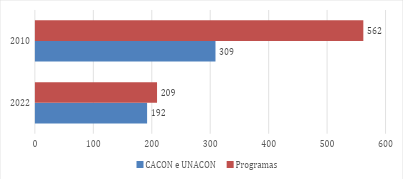
This study identified 209 MR programs in oncology and 192 CACON and UNACON in 2010. However, the number had increased to 562 programs and 309 CACON and UNACON in 2022 (Figure 1).

Distribution of the number of CACON, UNACON, and medical residency programs in oncology in 2010 and 2022, in Brazil.
Of 562 MR programs in oncology, 201 (35.83%) were offered on CACON and 193 (34.40%) on UNACON. Only three (6.82%) CACON lacked residency programs in oncology, whereas 182 (68.68%) of the 265 UNACON programs did not offer MR vacancies in oncology.
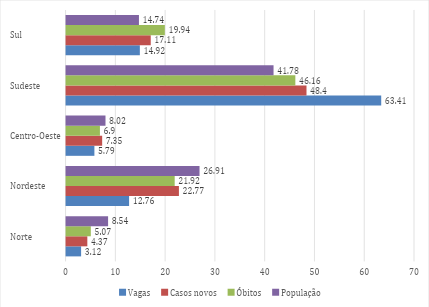
Regarding the MR vacancies in oncology related to the national population, the North region represented 8.95% of the population and 3.12% of vacancies; in the Northeast region, inequality was greater, with 26.92% of the population and 12.76% of vacancies. The Midwest region had 7.91% of the population and 5.79% of vacancies. Conversely, the Southeast region had 41.98% of the population and 63.41% of vacancies, and the South region had 14.24% of the population and 14.92% of vacancies (Figure 2).

Distribution of residency vacancies in oncology (any program) in 2022 and the population, the estimated number of new cancer cases and cancer deaths, by region and in percentage in 2022, in Brazil.
The correlation test of Spearman evaluated the relation between population by region and MR vacancies, with populational values per region: North (17,349,619), Northeast (54,644,582), Midwest (16,287,809), Southeast (84,847,187), and South (29,933,315), with a strong correlation between the MR vacancies in oncology and population by region (r = 0.905, p = 0.035).
Comparing these data with the estimated number of new cancer cases, the imbalance was smaller (Figure 2). However, the Southeast region had the highest percentage of vacancies (63.41%) related to new cases (48.4%). The North accounted for 4.37% of new cancer cases and 3.12% of cancer-related vacancies, and the Northeast had 21.72% of new cases and 12.76% of vacancies. The Midwest had 7.29% of new cases and 5.79% of vacancies, and the South had 17.11% of the new cases and 14.92% of vacancies (Table 2).
The Spearman correlation test was performed for the following incidence values per 100,000 inhabitants: North (117.73), Northeast (165.75), Midwest (213.10), Southeast (295.94), and South (357.53). The result indicated a strong correlation between the incidence of cancer and MR vacancies per region (r = 0.9, p = 0.037) (Figure 2).
Considering the total cancer deaths in Brazil, 46.16% were in the Southeast region. However, the Southeast showed a higher percentage of vacancies (63.41%) than the percentage of cancer deaths (46.16%). Other regions had a higher percentage of cancer deaths related to vacancies (Figure 1). The Spearman correlation test was performed for the following raw values of deaths per region: North (5,963), Northeast (25,763), Midwest (8,113), Southeast (54,238), and South (23,435), and indicated a strong correlation between the number of deaths and the MR vacancies (r = 0.9581, p = 0.01).
A comparison was performed between the number of vacancies in the following areas of cancerology considered in the 2005 study: clinical, pediatric, and surgical oncology, and radiotherapy, in 2003 and 2010. The North region showed 12 MR vacancies between 2003 and 2010. In the South, the number was almost two-fold, from 50 in 2003 to 98 in 2010. The Central-West had the smallest increase, from 20 vacancies in 2003 to 29 in 2010. The Northeast had 26 vacancies in 2003 and reached 61 in 2010. The Southeast had 265 vacancies in 2003 and increased to 489 in 2010, an increase of 84.5%. Thus, Brazil had 361 vacancies in 2003, 689 in 2010, and 1,965 in 2022, increasing 90.9% from 2003 to 2010 and 254% from 2010 to 2022.
The distribution of programs by medical specialty showed clinical oncology as the first, with 127 (22.6%). Mastology was the second, representing 88 (15.66%), followed by pathology with 71 (12.63%). Pediatric hematology had the lowest representation among medical specialties related to oncology, with 22 (3.91%) of all programs (Table 3).
The distribution of vacancies in the programs by medical specialty showed that clinical oncology offered the largest number, with 1,074 (30.19%). Pathology was in second, with 494 (13.85%) of all vacancies, followed by surgical oncology with 490 (13.77%). Pediatric hematology had fewer vacancies, followed by head and neck surgery, which ranked second to last (Table 3).
The specialty clinical oncology presented more programs in the North, Southeast, and South regions. In addition, mastology was more offered in the Northeast, and pathology in the Midwest region.
DISCUSSION
The density of professionals per 1,000 inhabitants is an indicator of medical demography widely used to compare countries 14. In January 2023, Brazil had 2.60 doctors per 1,000 inhabitants, which was lower than 3.36, the mean of countries evaluated by the Organization for Economic Cooperation and Development (OECD). However, Brazil is close to Japan with 2.60, and South Korea with 2.51 15.
In 2022, Brazil presented 62.3% specialist physicians of total professionals, close to the mean of OECD countries (63.5%).
International studies predicted a shortage of oncologists in European countries and the United States of America 16. Nevertheless, Brazil showed an increase of almost 50% of clinical oncologists between 2013 and 2020, thereby decreasing the cancer incidence ratio per clinical oncologist, a global standard that evaluates cancer care. In 2013, Brazil had 2,577 clinical oncologists, with a ratio of 170 new cancer cases per oncologist. In 2020, the number of clinical oncologists was 4,730 15, and the cancer incidence ratio reduced to 102. The United States, Canada, Italy, and Germany have an incidence ratio of 137, 352, 130, and 170 new cases of cancer for each clinical oncologist, respectively 17.
Therefore, Brazil presents an adequate number of clinical oncologists compared with world standards, surpassing developed countries in absolute terms and the ratio of cancer incidence related to clinical oncologists. Consequently, the problem lies in the distribution rather than the number of professionals.
Over the years, Brazil demonstrated a gradual increase in the number of oncological cases in specialties such as hematology, pathology, and head and neck surgery, leading to the consideration of these areas as related to oncology. As a result, in 2010 and 2022, these areas aligned with oncology and were included in the scope of programs.
The concentration of programs in the South-Southeast axis decreased in 2010, especially in São Paulo state, from 39.2% to 29%, and with an increase in the North and Northeast regions.
However, the Spearman correlation test evidenced a strong correlation between population, cancer incidence, cancer deaths by region, and the MR vacancies in oncology, indicating that the inequality between regions in percentage was not statistically significant.
Regarding the distribution of programs according to administrative dependence, philanthropic institutions were highlighted since they have a key role in cancer care in Brazil. These entities are assembled in the Brazilian Association of Philanthropic Institutions to Fight Cancer, and in 2022, they represented 41.28% of the programs, compared with 18% in 2010.
This study did not include an individualized analysis of funding for MR programs, according to federal guidelines. The Ministry of Health funds most Brazilian scholarships through induction and cooperation programs with public and philanthropic institutions. This information contributes to the understanding of the sustainability of the programs and reinforces the role of the State in the national policy for specialized medical training.
Resident physicians who relocate to the South-Southeast axis searching the best programs often settle in these regions due to job opportunities that match their residency training, thereby reinforcing the concentration of oncologists in these regions.
Considering oncological outcomes, regions with large-volume hospital centers provide better treatment and results, given the service experience 18),(19.
The care for patients with cancer in Brazil is structured in oncology hospitals classified as CACON and UNACON, a reference for cancer treatment due to infrastructure and service competence.
However, Brazil has continental dimensions, and patients with complex pathologies in the North and Northeast face challenges when treating in large centers of the South and Southeast regions, which together represent 68.2% of CACON, with 47.72% in the Southeast region.
Most CACON and almost half of UNACON offer MR programs. Thus, the increased number of programs, vacancies, and professionals in the South and Southeast regions is linked to the superior hospital and educational infrastructure.
Despite clear criteria for accrediting residency programs, Brazil lacks a national exam that addresses the expansion of cancer in Brazil and populational needs, which would guide the establishment of cancer centers and training programs nationwide.
References
- 1 Rutkow IM. Illustrated history of surgery. San Anselmo: Norman Publishing; 1993.
- 2 Barr J. The education of American surgeons and the rise of surgical residencies, 1930-1960. J Hist Med Allied Sci. 2018;73(3):274-302.
- 3 Stevens RA. Graduate medical education: a continuing history. J Med Educ. 1978;53(1):1-18.
- 4 Howell JD. A history of medical residency. Rev Am Hist. 2016;44(1):126-31.
- 5 Mayberry JC. Residency reform Halsted-style. J Am Coll Surg. 2003;197(3):433-5.
- 6 Sousa EG. A residência médica no Brasil. Rev Bras Educ Med. 1985;9(2):112-4.
- 7 Instituto Nacional de Câncer. Histórico do controle do câncer no Brasil. In: Instituto Nacional de Câncer. A situação do câncer no Brasil. Brasília: Instituto Nacional de Câncer; 2011. p.12-5.
- 8 Silva MGC, Arregi MMU. Residência médica na área de cancerologia no Brasil: distribuição dos programas e da oferta de vagas por região em 2003. Rev Bras Cancerol. 2005;51(1):5-13.
- 9 Silva MGC, Arregi MMU, Matos CMM. Residência médica na área de cancerologia no Brasil: distribuição dos programas e da oferta de vagas por região em 2010. Rev Bras Cancerol . 2013; 59(1):25-31.
- 10 Oncoguia. Atlas dos centros de cuidados do câncer. São Paulo: Oncoguia; 2024.
- 11 Instituto Nacional de Câncer. Atlas on-line de mortalidade. Brasília: Instituto Nacional de Câncer ; 2024.
- 12 Instituto Nacional de Câncer. Estimativa de 2023: incidência de câncer no Brasil. Brasília: Instituto Nacional de Câncer ; 2022.
- 13 Instituto Brasileiro de Geografia e Estatística. Censo Demográfico - 2022Brasília: Instituto Nacional de Câncer ; 2023
- 14 Organistion for Economic Co-operation and Development. Health at a glance 2023: OECD Indicators. Paris: OECD; 2023.
- 15 Scheffer M. Demografia médica no Brasil 2023. São Paulo: FMUSP; 2023.
- 16 Montes AF, Elez E, Haba-Rodriguez J, Paez D, Mendez-Vidal MJ, Felip E, et al. Medical oncology workload, workforce census, and needs in Spain: two nationwide studies by the Spanish society of medical oncology. Clin Transl Oncol. 2024;26(1):98-108.
- 17 Mathew A. Global survey of clinical oncology workforce. J Glob Oncol. 2018;(4):1-12.
- 18 Begg CB, Cramer LD, Hoskins WJ, Brennan MF. Impact of hospital volume on operative mortality for major cancer surgery. JAMA. 1998;280(20):1747-51.
- 19 Szor DJ, Tsutumi F. The influence of institutional pancreaticoduodenectomy volume on short-term outcomes in the Brazilian public health system: 2008-2021. Rev Col Bras Cir. 2023;50: e20233569.
All research data is available in the document.
Data citations
Instituto Brasileiro de Geografia e Estatística. Censo Demográfico - 2022Brasília: Instituto Nacional de Câncer ; 2023
Organistion for Economic Co-operation and Development. Health at a glance 2023: OECD Indicators. Paris: OECD; 2023.
Scheffer M. Demografia médica no Brasil 2023. São Paulo: FMUSP; 2023.

 Source: Oncoguia
  Source: prepared by the authors with data from the Brazilian Ministry of Education