
 National EPAs of Family Medicine in Brazil
ABSTRACT
Introduction: The development and validation of the National EPAs in Family Medicine (FM) serve as a strategy to enhance the quality of postgraduate training by identifying units of professional practice that clearly represent the specialty’s core identity and guide gradual entrustment decisions throughout residents’ training trajectories. This initiative addresses the complexity of Primary Health Care (PHC) and in-service training, both characterized by diverse curricula and difficulties in directly assessing clinical performance.
Objective: To describe the process of developing and validating the FM EPAs, presenting the resulting panel and its implications.
Method: The process adhered to international guidelines for EPAs development and validation. It involved creating a steering core group; using the nominal group technique for initial idea generation; refining the technical and descriptive aspects; evaluating the structure with the EQualRubric; and validating through the Delphi method, including calculating content validity indices, intraclass correlation coefficients, and analyzing qualitative data. All phases maintained regional diversity, professional representation, and methodological rigor.
Results: The initial stage produced 26 EPAs, later refined to 15 after technical review. The EQual Rubric analysis identified structural aspects needing improvement, which were incorporated before the next phase. In the Delphi study, with 45 participants, 14 EPAs reached consensus in the first round, while the remaining EPA was revised and validated in the second. Validity and reliability indicators demonstrated strong structural integrity, leading to a national panel of units of professional practice for the specialty.
Conclusion: The national FM EPAs represent a strategic advancement in training quality by enhancing curricular coherence, refining assessment processes, and strengthening educational governance. They serve as a foundational tool for aligning medical residency training with current PHC demands and the ethical and social commitments of the specialty.
Keywords:
competency-based education; family practice; medical residency
RESUMO
Introdução: A elaboração e validação das EPAs nacionais de Medicina de Família e Comunidade (MFC) são estratégias para a qualidade na residência médica, ao definirem unidades de prática profissional que expressam, operacionalmente, o escopo identitário da especialidade e orientam decisões progressivas de atribuição de confiança ao longo da trajetória formativa do residente. Essa iniciativa responde à complexidade da atenção primária à saúde (APS) e à própria formação em serviço, em sua heterogeneidade curricular e pelas dificuldades de avaliação direta do desempenho clínico.
Objetivo: Este estudo teve como objetivo descrever o processo de elaboração e validação das EPAs de MFC, apresentando o painel resultante e suas implicações.
Método: O processo seguiu as recomendações internacionais para construção e validação de EPAs. Abrangeu a constituição de um grupo gestor, a aplicação da técnica de grupo nominal para geração inicial, o refinamento técnico-descritivo, a avaliação estrutural pelo EQual Rubric e a validação por método Delphi, com cálculo dos índices de validade de conteúdo, coeficientes de correlação intraclasse e análise de dados qualitativos. Todas as etapas asseguraram diversidade regional, representatividade profissional e rigor metodológico.
Resultado: A etapa inicial produziu 26 EPAs, posteriormente refinadas para 15 após revisão técnica. A análise pelo EQual Rubric identificou pontos estruturais a serem aprimorados, que foram incorporados antes da etapa subsequente. No Delphi, com 45 participantes, 14 EPAs alcançaram consenso na primeira rodada, enquanto a EPA remanescente foi ajustada e validada na segunda rodada. Os indicadores de validade e confiabilidade demonstraram robustez estrutural, o que resultou em um painel nacional de unidades de prática profissional da especialidade.
Conclusão: As EPAs nacionais de MFC constituem um avanço estratégico para a qualidade da formação, ao fortalecerem a coerência curricular, aprimorarem os processos avaliativos e consolidarem a governança educacional. Tratam-se de um instrumento estruturante para alinhar a residência médica às demandas contemporâneas da APS e aos compromissos éticos e sociais da especialidade.
Palavras-chave:
Educação Baseada em Competências; Medicina de Família e Comunidade; Residência Médica
INTRODUCTION
Brazilian Primary Health Care (PHC) constitutes a scenario of increasing epidemiological, demographic, and organizational complexity, which demands professionals able to manage, in an integrated manner, the multiple population needs and dynamics1), (2. Family Medicine (FM), as a medical specialty, plays a central role in providing problem-solving care, incorporating the essential attributes of PHC3. Its core action is the provision and coordination of continuous, inclusive, and comprehensive care for people, families, and communities, distinguished by its person-centered approach across all age groups and life cycles4),(5.
Medical residency (MR), as part of a continuum that sustains safe professional progression, is articulated with previous training and, in a decisive and irreplaceable way, offers a supervised training environment that enables the consolidation of the competencies necessary for the training of specialist physicians6. It is precisely in this articulation between training, supervised practice, and increasing performance in the service and in the system that the quality of the specialized workforce is ensured, an essential condition for responding consistently and responsibly to contemporary health challenges7),(8.
In the case of FM, specialized training assumes strategic relevance due to its direct relationship with the implementation of the organizational principles and guidelines of PHC9), (10. Although the specialty has experienced a wide expansion of its training capacity in Brazil, structural challenges persist in MR11 programs, such as curricular heterogeneity, the fragility of systematic supervision mechanisms and evaluation processes12. Such challenges compromise the consistency of certification and highlight the need to qualify and develop guiding resources to ensure the effectiveness of competency-based education, sustaining training trajectories consistent with the contemporary demands of PHC and the Brazilian Unified Health System (SUS, Sistema Único de Saúde) 13), (14.
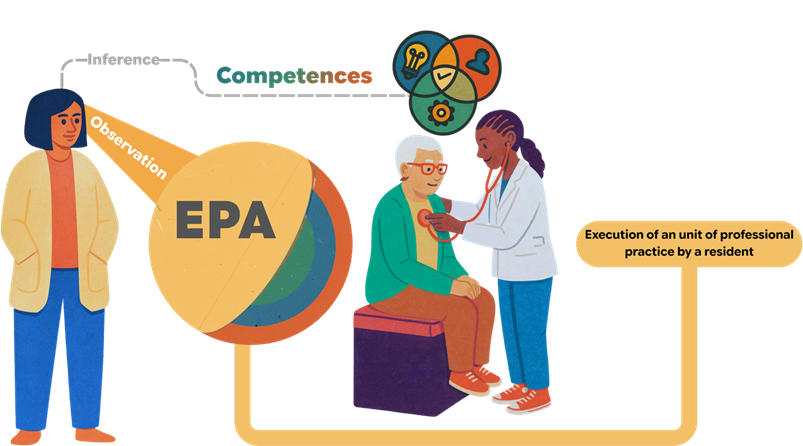
Entrustable Professional Activities (EPAs) correspond to essential and routine activities performed by specialized and competent professionals in their area of expertise15. In the context of competency-based education, an EPA constitutes a unit of professional practice: an observable, measurable activity whose performance can only be entrusted to adequately trained and evaluated professionals16. Although the concept of “unit of professional practice” may, at first sight, seem abstract, it becomes more comprehensible when understood as a descriptor of work: units are tasks that, when enunciated, immediately refer to the professional identity and scope of action of a given specialist, expressing, in a concrete and operational way, the nature of their practice17.
Competencies, in turn, refer to what the learner mobilizes and develops throughout the education (knowledge, skills, and attitudes) and characterize personal attributes that underlie their performance18. It is, therefore, essential to distinguish: one does not “acquire” an EPA; they are able to perfom it autonomously due to the effectively acquired competencies19.
EPAs specify what must be accomplished, while competencies describe what the learner mobilizes to perform them20. Observing an EPA performed by an apprentice allows us to infer the acquisition of the competencies related to it (Figure 1).
The competency matrix for MR programs in FM, defined by the National Commission of Medical Residency (CNRM, Comissão Nacional de Residência Médica), lists 390 competencies distributed over the two years of training organized in multiple domains21. Although comprehensive and informative, its extension and markedly analytical character22 introduce relevant complexities and risks to the assessment and educational process: difficulties in prioritization and hierarchization, fragmentation of the components to be observed, and restrictions on assessment feasibility through direct observation in clinical practice23. Consequently, the ability to verify the residents’ readiness to perform the essential professional practice units that define the FM specialist is limited.
In this context, the Brazilian Society of Family Medicine (SBMFC, Sociedade Brasileira de Medicina de Família e Comunidade), the national representative entity for the specialty, promoted the creation and validation of the National EPAs in FM24. This article details the methodological path and process adopted, presenting the developed EPAs and discussing their perspectives and implications for the educational qualification of MR programs in FM, in dialogue with the specialty’s social commitment and its structuring influence on Brazilian PHC and the SUS10.
METHOD
The development and validation of the National EPAs in Family Medicine followed international recommendations that emphasize systematic processes of construction, content analysis, consensus, and validity evidence25), (26. The process, structured in successive and interdependent stages, began in October 2023 and was completed in March 2025.
The SBMFC established a management core group (CG) for the process, with support and academic guidance from an educator with expertise in EPAs. To ensure the diversity of perspectives, a public call was issued to assemble a group of specialists with degrees in FM and with educational or healthcare experience in the SUS. It sought to ensure territorial, institutional, and gender representativeness, minimize technical-institutional biases, and expand the panel’s legitimacy. A Nominal Group (NG) was formed for the first stage of creation.
In a face-to-face session, facilitated by the invited educator, the nominal group technique27 was applied, a structured method of discussion and consensus-building, resulting in a preliminary panel of EPAs. From this preliminary panel, the first refinement cycle began, conducted by the CG, preserving the conceptual core of the created EPAs, improving and expanding the descriptive elements to meet the structural, conceptual and operational criteria recommended by the literature15), (25. Each member of the CG produced an individual review report, the consolidation of which supported the definitive changes to the preliminary panel, which were collectively deliberated. Next, the CG drew up the list of tasks and limitations for each EPA from the refined panel.
The refined panel was submitted to evaluation by the NG through the EQualRubric28, a validated instrument for the analysis of the structural quality of EPAs, consisting of 14 criteria distributed in three domains: delimitation and measurement of professional practice, essentiality and reliability of the activity, and curricular integration in the educational program. Scores were generated by criterion, aggregated scores by domain, and a global mean score by EPA, all of which range from 0 to 5 points. For interpretation, the mean reference cutscore of 4.07 was adopted, establishing the cutoff point at which an EPA is considered adequately structured. The use of EQual Rubric allowed us to identify, with greater precision, the EPAs and which of their aspects required adjustments before advancing to the subsequent methodological stage.
The post-EQualRubric reviewed panel proceeded to apply the electronic version of the Delphi method29), (30. The study questionnaire initially contained items of sociodemographic characterization and, for each EPA, three questions with a numerical scale of agreement related to the structural dimensions that determine validity15), (31: comprehensiveness of the EPA title, tasks, and limitations; prevalence of the EPA in clinical practice; essentiality for FM work. Additionally, for each EPA, an optional open field was included for comments.
Data analysis used descriptive statistics for numerical variables and frequency tables for categorical variables. For the agreement items, the Content Validity Index (CVI) for the three evaluated dimensions, the mean CVI (S-CVI/AVE), and the CVI for universal agreement (S-CVI/UA) were calculated. When using a Likert scale, the CVI corresponded to the proportion of responses located at the upper levels of the scale (4 or 5). The mean CVI was obtained by averaging the dimensional CVI, serving as a global measure of the validity of each EPA. The CVI for universal agreement represents the proportion of dimensions that received the maximum score from all experts, constituting a stricter indicator of consensus. This set of metrics allowed us to estimate the structural robustness of the EPAs, identify convergence patterns, and guide the need for new iterations in the process. The answers to the open fields were organized with the support of an artificial intelligence tool, used exclusively for linguistic standardization, thematic categorization, and sequential reorganization of the content, while fully preserving the original meaning for later analysis by the CG.
The research method did not define a fixed number of rounds, establishing as a criterion for the end of the Delphi study the achievement of an S-CVI/AE higher than 80%, a parameter widely accepted in the literature as an adequate content validity threshold32. As an additional measure of inter-rater reliability, the intraclass correlation coefficient (ICC) was used by the model (2,1), allowing the decomposition of total variability into components attributable to differences between EPAs and residual variability, which allows estimating the stability of the judgments attributed beyond chance33. Statistical analyses were performed using SAS software, version 9.4 (SAS Institute Inc., USA), adopting a significance level of p<0.05.
Data collection and analysis followed Resolution N. 466/12 of the National Health Council, within the scope of the research project “National Validation of EPAs (Entrustable Professional Activities) for Medical Residency in Family Medicine”, approved by the Research Ethics Committee of the School of Medical Sciences at the University of Campinas (CAAE N. 82395724.2.0000.5404). All participants were previously informed about the objectives of the study, signed an Informed Consent Form and had their data anonymized to ensure privacy and confidentiality.
RESULTS
The development of the EPAs included the constitution of a CG - authors - and an NG, formed by 13 specialists, selected to ensure gender parity and representativeness of the Brazilian macro-regions. Using the nominal group technique, a preliminary panel with 26 EPAs was produced. After the first refinement cycle by the CG, a panel with 15 EPAs was consolidated, each one accompanied by its tasks and respective limitations. To those sent for the NG evaluation, the EQual Rubric scores allowed them to identify, in a structured way, aspects that still required refinement (Table 1).
The sample of the Delphi study consisted of 45 participants. The age distribution showed that 40% were between 25 and 35 years old, 31% between 36 and 45 years old, 24% between 46 and 55 years old and 4% between 56 and 65 years old. The length of time working in PHC ranged from 2 to 35 years (mean of 12.9 years). Regarding ethnic-racial self-declaration, 57.8% identified themselves as white, 28.9% as “pardo”, 8.9% as black, and 4.4% as indigenous. Balance was observed in the gender distribution, with 51% of cisgender women and 49% of cisgender men. All Brazilian macro-regions were represented, with a greater concentration in the Southeast and South, accompanied by a consistent participation of the Northeast, North and Midwest regions. Among the federation units, Rio de Janeiro (17.8%), São Paulo (11.1%), Minas Gerais (8.9%) and Rio Grande do Sul (8.9%) stood out, in addition to Pernambuco, Pará, Bahia, the Federal District and Rio Grande do Norte (6.7% each).
Two rounds were conducted in the Delphi Study, with a dropout rate of 17.8% relative to the initial number of participants. In the first round, 14 of the 15 EPAs achieved the required level of consensus. EPA 15 did not reach the minimum score and was reviewed based on statistical analysis and qualitative comments; After adjustments, it reached consensus in the second round. The inter-rater reliability analysis showed statistically significantly greater agreement in the essentiality dimension (ICC = 0.8667), followed by the prevalence dimension (ICC = 0.7902). The clarity dimension showed less interpretative uniformity (ICC = 0.4367), indicating greater variability among participants. Table 2 shows the calculated final CVIs, which supported the consensus decision for each EPA.
Chart 1 lists the titles of the National EPAs in FM - units of professional practice that the resident must be able to perform autonomously at the end of training - along with their descriptions, which summarize the scope, purpose, and relevance. The complete panel includes: each EPA’s list of essential tasks, which operationalizes observable criteria for trust assignment decisions; limitations, which delimit the scope of the unit of professional practice and prevent overlaps; and correlation with the domains of the CNRM competency matrix, guiding the residency programs in identifying the knowledge, skills, and attitudes required for the performance of the EPA. All material is available in open access, in digital book format34, in the institutional domains of the SBMFC.
DISCUSSION
The development of the National EPAs in Family Medicine (FM) is a milestone for the specialty in Brazil24), (34. The process, conducted with methodological and scientific rigor, ensured internal consistency, content validity, and professional consensus25), (26), (32), (35. In addition, it aligns with the recommendations of Ten Cate et al.15), (25), (26, who emphasize that the development of EPAs should preferably occur at the national level or within specialty societies to ensure conceptual unity, representativeness, and legitimacy, although local initiatives and independent studies can offer relevant complementary contributions36)-(39.
A decade after the publication of the first curricular framework for the specialty40, profound epidemiological, social, and technological transformations have redefined the role of Primary Health Care (PHC) and expanded its problem-solving capacity5), (10. In this scenario, it is essential to update the training framework, qualify the evaluation processes, and align FM with the global agendas of sustainable development, universal coverage, and strengthening of health systems41)-(43.
The EPAs reflect this structuring position by organizing activities that express the core identity of the specialty and by describing, in an operational way, the responsibilities that characterize the full performance of the family physician44), (45. By articulating individuals, families, territories, health systems, and social and environmental determinants, the EPAs translate a care model that is consistent with the complexity of the population’s needs.
The resulting set incorporates contemporary dimensions that expand and tension the specialty’s training scope, reinforcing the demand for professionals capable of working in scenarios of increasing multidimensional complexity46. It is explicit that qualified clinical care is inseparable from social accountability, anti-racist commitment, the promotion of inclusion, diversity, and equity, as well as the incorporation of the planetary health perspective47)-(49. These commitments are made in the care of individuals and families, at home, in the community, and in the intersectoral and interinstitutional actions that structure the practice of FM -a practice that, ultimately, constitutes an expression of social justice in access to health1.
At the same time, the EPAs bring FM closer to international trends that define standards of professional practice oriented to safety, quality, and educational predictability50), (51, preserving the specificities and needs of the Brazilian context52.
By complementing the national competency matrix, the EPAs become a direct, observable instrument aligned with the clinical reasoning in practice, guiding decisions about the resident’s progressive autonomy53. However, its transformative potential goes beyond the assessment function. The adoption of EPAs acts as an inducer of educational reorganization by allowing the detailed mapping of the curriculum and its formative agents, making visible congruences and incongruences between the educational offer and the resident’s effective experience12), (54. This process guides adjustments to the matrix of educational scenarios, strengthens assessment systems through triangulation of evidence, and identifies needs for the development of educators, both in the pedagogical dimensions - competency-based assessment, entrustment decisions, and quality in feedback practices - and in the clinical dimension, ensuring that supervisors can reflect contemporary patterns of FM.
Finally, by establishing national parameters for educational quality, the EPAs also fulfill a political function, especially in a context marked by policies to expand training, which have historically been little accompanied by robust quality assurance mechanisms14), (56), (57. Thus, the EPAs not only guide the assessment of individual competence but also serve as an instrument of educational governance and as a structuring axis for the strengthening of FM and PHC in the country10.
CONCLUSION
The development of the National EPAs in Family Medicine is an unequivocal affirmation of the specialty’s - and the SBMFC’s - commitment to educational quality. The transformative potential of this framework stems precisely from its affirmative force: by making explicit the units of professional practice that define the full exercise of FM, with their ethical, technical, and social dimensions, it renews the debate on training and strengthens the governance of educational processes in the country. In doing so, they reaffirm the need for valorization, structuring, and continuous investments in medical residency, the central and sustainable path for training specialists capable of responding, with competence, to the real needs of the population and health systems. The EPAs, therefore, open a horizon of permanent responsibility and demand: for quality, coherence, and commitment to a truly transformative medical education for Brazilian health.
ACKNOWLEDGEMENTS
The authors would like to thank Gustavo Salata Romão, a medical educator and national reference on EPAs in Brazil, whose voluntary work, marked by constant availability and qualified academic guidance, supported the various stages of this study. His contribution exemplifies an unequivocal personal commitment to science as a public good and to professional training guided by educational quality. The authors also express their gratitude to the Board of Directors of SBMFC (2024-2026 term), represented by its president, Fabiano Gonçalves Guimarães, for their support for the Management Group of National EPAs in Family Medicine and for the institutional support that enabled the articulation of this project with the entity’s management plan.
References
-
1 Castro MC, Massuda A, Almeida G, et al. Brazil’s unified health system: the first 30 years and prospects for the future. Lancet. 2019;394:345-56. doi: https://doi.org/10.1016/S0140-6736(19)31243-7.
» https://doi.org/https://doi.org/10.1016/S0140-6736(19)31243-7 -
2 Oliveira Andrade R de. Brazil’s struggle to reconstruct healthcare post-Bolsonaro. BMJ. 2023; 381:805. doi: https://doi.org/10.1136/bmj.p805.
» https://doi.org/https://doi.org/10.1136/bmj.p805 - 3 Stephens GG. The intellectual basis of family practice. J Fam Pract. 1975; 2:423-28.
- 4 World Health Organization. Defining essential public health functions and services to strengthen national workforce capacity. Geneva: WHO; 2024.
-
5 Frenk J, Chen L, Bhutta ZA, et al. Health professionals for a new century: transforming education to strengthen health systems in an interdependent world. Lancet . 2010;376:1923-58. doi: https://doi.org/10.1016/S0140-6736(10)61854-5.
» https://doi.org/https://doi.org/10.1016/S0140-6736(10)61854-5 - 6 Romão GS, Sá MFSd, Fernandes CE, et al. Residência médica: ensino e avaliação de competências. Barueri: Manole; 2022.
-
7 Campbell J, Buchan J, Cometto G, et al. Human resources for health and universal health coverage: fostering equity and effective coverage. Bull World Health Organ. 2013;91:853-63. doi: https://doi.org/10.2471/blt.13.118729.
» https://doi.org/https://doi.org/10.2471/blt.13.118729 - 8 Taha MH, Mukhtar WNO, Preston R. The evolving role of the medical profession and medical graduates. In: Abdalla ME, Taha MH, Boelen C, editors. Social accountability of medical schools. Cham: Springer Nature Switzerland; 2025. p.17-29.
- 9 World Health Organization. Global competency and outcomes framework for universal health coverage. Geneva: WHO ; 2022.
-
10 Allen LN, Rasanathan K, Mash R, et al. Models of global primary care post-2030. The Lancet Primary Care. 2025;1. doi: https://doi.org/10.1016/j.lanprc.2025.100027.
» https://doi.org/https://doi.org/10.1016/j.lanprc.2025.100027 - 11 Scheffer M. Demografia médica no Brasil. Brasília: Ministério da Saúde, 2025.
- 12 Caramori U, Cunha ATR da, Brito L de AR, et al. Ecos do fórum: passos iniciais da implementação das EPAs. Rio de Janeiro: Sociedade Brasileira de Medicina de Família e Comunidade; 2025.
-
13 Campbell J, Cleland J, Janczukowicz J, et al. Health worker education, employment and equity: aligning markets and strategies. Med Teach. 2025;47:763-5. doi: https://doi.org/10.1080/0142159X.2025.2469604.
» https://doi.org/https://doi.org/10.1080/0142159X.2025.2469604 -
14 Caramori U. Medical education in Brazil: more schools, but what for? Med Teach . 2025;47: 1857-8. doi: https://doi.org/10.1080/0142159X.2025.2503378.
» https://doi.org/https://doi.org/10.1080/0142159X.2025.2503378 -
15 Ten Cate O, Taylor DR. The recommended description of an entrustable professional activity: AMEE Guide No. 140. Med Teach . 2021;43:1106-14. doi: https://doi.org/10.1080/0142159X.2020.1838465.
» https://doi.org/https://doi.org/10.1080/0142159X.2020.1838465 -
16 Ten Cate O, Chen HC. The ingredients of a rich entrustment decision. Med Teach . 2020;42: 1413-20. doi: https://doi.org/10.1080/0142159X.2020.1817348.
» https://doi.org/https://doi.org/10.1080/0142159X.2020.1817348 -
17 Ten Cate O, Carraccio C, Damodaran A, et al. Entrustment decision making: extending Miller’s pyramid. Acad Med. 2021;96:199-204. doi: https://doi.org/10.1097/ACM.0000000000003800.
» https://doi.org/https://doi.org/10.1097/ACM.0000000000003800 -
18 Englander R, Frank JR, Carraccio C, et al. Toward a shared language for competency-based medical education. Med Teach . 2017;39:582-7. doi: https://doi.org/10.1080/0142159X.2017.1315066.
» https://doi.org/https://doi.org/10.1080/0142159X.2017.1315066 -
19 Schumacher DJ, Cate OT, Damodaran A, et al. Clarifying essential terminology in entrustment. Med Teach . 2021;43:737-44. doi: https://doi.org/10.1080/0142159X.2021.1924365.
» https://doi.org/https://doi.org/10.1080/0142159X.2021.1924365 - 20 Ten Cate O, Hennus MP, Khursigara-Slattery N, et al. Entrustable professional activities, entrustment, and the conceptualization of competence in the health professions. In: Entrustable professional activities and entrustment decision-making in health professions education. Ubiquity Press; 2024. p.15-24.
- 21 Brasil. Resolução CNRM nº 9, de 30 de dezembro de 2020. Aprova a matriz de competências dos Programas de Residência Médica em Medicina de Família e Comunidade no Brasil. Diário Oficial da União; 2020.
-
22 Pangaro L, ten Cate O. Frameworks for learner assessment in medicine: AMEE Guide No. 78. Med Teach . 2013;35:e1197-210. doi: https://doi.org/10.3109/0142159X.2013.788789.
» https://doi.org/https://doi.org/10.3109/0142159X.2013.788789 - 23 Holmboe ES, Durning SJ. Direct observation. In: Practical guide to the assessment of clinical competence. Philadelphia: Elsevier; 2025. p.90-117.
- 24 Caramori U, Cunha ATR da, Brito L de AR, et al. EPAs nacionais em medicina de família e comunidade: estratégias e ações para elaboração de EPAs na Sociedade Brasileira de Medicina de Família e Comunidade (SBMFC). Rio de Janeiro: Sociedade Brasileira de Medicina de Família e Comunidade ; 2025.
- 25 Hennus MP, Holzhausen Y, Ladenheim RI, et al. Approaches to identifying and elaborating entrustable professional activities. In: Entrustable professional activities and entrustment decision-making in health professions education . Ubiquity Press; 2024. p.101-10.
-
26 Hennus MP, Jarrett JB, Taylor DR, et al. Twelve tips to develop entrustable professional activities. Med Teach . 2023;45:701-7. doi: https://doi.org/10.1080/0142159X.2023.2197137.
» https://doi.org/https://doi.org/10.1080/0142159X.2023.2197137 -
27 McMillan S, King M, Tully M. How to use the nominal group and Delphi techniques. Int J Clin Pharm. 2016;38:655-62. doi: https://doi.org/10.1007/s11096-016-0257-x.
» https://doi.org/https://doi.org/10.1007/s11096-016-0257-x -
28 Taylor DR, Park YS, Egan R, et al. EQual, a Novel Rubric to Evaluate Entrustable Professional Activities for Quality and Structure. Acad Med . 2017;92:S110-S117. doi: https://doi.org/10.1097/acm.0000000000001908.
» https://doi.org/https://doi.org/10.1097/acm.0000000000001908 - 29 Schifano J, Niederberger M. The Delphi technique in the health sciences. In: Liamputtong P, editor. Handbook of concepts in health, health behavior and environmental health. Singapore: Springer Nature Singapore; 2025. p.1-22.
- 30 Jorm A. Steps in Carrying out a Delphi Study. In: Using the Delphi method to establish expert consensus. Singapore: Springer Nature Singapore ; 2025. p.41-93.
-
31 Ten Cate O, Schumacher DJ. Entrustable professional activities versus competencies and skills: Exploring why different concepts are often conflated. Advances in Health Sciences Education. 2022;27:491-9. doi: https://doi.org/10.1007/s10459-022-10098-7.
» https://doi.org/https://doi.org/10.1007/s10459-022-10098-7 - 32 Jorm A. Conditions for a valid consensus. In: Using the Delphi method to establish expert consensus . Singapore: Springer Nature Singapore ; 2025. p.29-39.
- 33 Fabricant PD. Interrater and intrarater reliability studies. In: Practical clinical research design and application. Cham: Springer Nature Switzerland ; 2024. p.89-95.
- 34 Cunha ATR da, Caramori U, Brito L de AR, et al. EPAs nacionais em medicina de família e comunidade: marco zero. Rio de Janeiro: Sociedade Brasileira de Medicina de Família e Comunidade ; 2025.
- 35 Touchie C, ten Cate O, Park YS, et al. Validity theory applied to entrustment as an approach to assessment. In: Entrustable professional activities and entrustment decision-making in health professions education . Ubiquity Press; 2024. p.51-63.
-
36 Shaughnessy AF, Sparks J, Cohen-Osher M, et al. Entrustable professional activities in family medicine. J Grad Med Educ. 2013;5:112-8. doi: https://doi.org/10.4300/jgme-d-12-00034.1.
» https://doi.org/https://doi.org/10.4300/jgme-d-12-00034.1 -
37 Garvin R, Mazzone M. Entrustable professional activities (Epas): the next step. Ann Fam Med. 2017;15:283-283. doi: https://doi.org/10.1370/afm.2082.
» https://doi.org/https://doi.org/10.1370/afm.2082 -
38 Valentine N, Wignes J, Benson J, et al. Entrustable professional activities for workplace assessment of general practice trainees. Med J Aust. 2019;210:354-9. doi: https://doi.org/10.5694/mja2.50130.
» https://doi.org/https://doi.org/10.5694/mja2.50130 - 39 Brito L de AR, Caramori U, D’Abreu NB, et al. Atividades profissionais confiáveis para a residência em medicina de família e comunidade no contexto brasileiro. Rev Bras Educ Med. 2025; 49.
- 40 Sociedade Brasileira de Medicina de Família e Comunidade. Currículo baseado em competências para a medicina de família e comunidade. Rio de Janeiro: SBMFC; 2014.
- 41 World Health Organization. Global strategy on human resources for health: workforce 2030. Geneva: WHO ; 2016.
- 42 World Health Organization. Defining essential public health functions and services to strengthen national workforce capacity. Geneva: WHO ; 2024.
- 43 World Health Organization. World health statistics 2025: monitoring health for the SDGs, Sustainable Development Goals. Geneva: WHO ; 2025.
-
44 Burford B, Vance G. When I say ... preparedness. Med Educ. 2014;48:849-50. doi: https://doi.org/10.1111/medu.12427.
» https://doi.org/https://doi.org/10.1111/medu.12427 - 45 Cate Ot. An updated primer on entrustable professional activities (EPAs). Rev Bras Educ Med . 2019;43:712-20.
-
46 Hennus MP, van Dam M, Gauthier S, et al. The logic behind entrustable professional activity frameworks: a scoping review of the literature. Med Educ . 2022;56:881-91. doi: https://doi.org/10.1111/medu.14806.
» https://doi.org/https://doi.org/10.1111/medu.14806 -
47 Thoma B, Karwowska A, Samson L, et al. Emerging concepts in the CanMEDS physician competency framework. Can Med Educ J. 2022. doi: https://doi.org/10.36834/cmej.75591.
» https://doi.org/https://doi.org/10.36834/cmej.75591 -
48 Rasheed MA. The case for a Global South centred model in global health. BMJ. 2023;383: 2256. doi: https://doi.org/10.1136/bmj.p2256.
» https://doi.org/https://doi.org/10.1136/bmj.p2256 -
49 Rashid MA, Grant J. Power and place: uncovering the politics of global medical education. Med Educ . 2024;58:930-8. doi: https://doi.org/10.1111/medu.15459.
» https://doi.org/https://doi.org/10.1111/medu.15459 -
50 Mahat A, Dhillon IS, Benton DC, et al. Health practitioner regulation and national health goals. Bull World Health Organ . 2023;101:595-604. doi: https://doi.org/10.2471/blt.21.287728.
» https://doi.org/https://doi.org/10.2471/blt.21.287728 -
51 Aftab W, Khan M, Rego S, et al. Variations in regulations to control standards for training and licensing of physicians: a multi-country comparison. Human Resour Health. 2021;19(1):91. doi: https://doi.org/10.1186/s12960-021-00629-5.
» https://doi.org/https://doi.org/10.1186/s12960-021-00629-5 -
52 Nel D, Romao GS, Peters S, et al. The importance of selecting contextually relevant EPAs. Med Teach . 2025:1. doi: https://doi.org/10.1080/0142159X.2025.2495641.
» https://doi.org/https://doi.org/10.1080/0142159X.2025.2495641 -
53 Kinnear B, Warm EJ, Caretta-Weyer H, et al. Entrustment unpacked: aligning purposes, stakes, and processes to enhance learner assessment. Acad Med . 2021;96:S56-S63. doi: https://doi.org/10.1097/ACM.0000000000004108.
» https://doi.org/https://doi.org/10.1097/ACM.0000000000004108 -
54 Ten Cate O. Competency-based education, entrustable professional activities, and the power of language. J Grad Med Educ . 2013;5:6-7. doi: https://doi.org/10.4300/JGME-D-12-00381.1.
» https://doi.org/https://doi.org/10.4300/JGME-D-12-00381.1 -
55 Ten Cate O, Chen HC, Hoff RG, et al. Curriculum development for the workplace using Entrustable Professional Activities (EPAs): AMEE Guide No. 99. Med Teach . 2015;37:983-1002. doi: https://doi.org/10.3109/0142159X.2015.1060308.
» https://doi.org/https://doi.org/10.3109/0142159X.2015.1060308 -
56 Avena KM, Quintanilha LF, Luzardo RL, et al. Lessons learned from the expansion of medical schools in Brazil: a review of challenges and opportunities. Front Educ. 2025;9:10. doi: https://doi.org/10.3389/feduc.2024.1494445.
» https://doi.org/https://doi.org/10.3389/feduc.2024.1494445 -
57 Amaral E, Norcini J. Quality assurance in health professions education: role of accreditation and licensure. Med Educ . 2023;57:40-8. 20220729. doi: https://doi.org/10.1111/medu.14880.
» https://doi.org/https://doi.org/10.1111/medu.14880
-
9
Evaluated by double blindo review process.
-
SOURCES OF FUNDING
The funding of the operational costs was provided by the Brazilian Society of Family Medicine, without any form of remuneration, payment or financial transfer to individuals, including research participants and researchers.
-
DECLARATION OF DATA AVAILABILITY
Research data are only available upon request.
Research data are only available upon request.

 Source: The authors