
 Pioneering medical training: experience of Brazil’s first residency program in parenteral and enteral nutrition
ABSTRACT
Introduction: Medical education still shows significant gaps in nutritional therapy training, despite the proven impact of clinical nutrition on patient outcomes.
Experience report: Since 2013, the program has offered an additional optional year for physicians previously trained in related specialties, emphasizing supervised clinical practice, participation in multidisciplinary nutrition support teams (EMTN), and management of enteral and parenteral nutrition. To date, nine physicians have completed the residency; three have earned the Sociedade Brasileira de Nutrição Parenteral e Enteral (SBNPE/Braspen) certification, others are in progress, and all are currently involved in clinical practice and teaching within public and private hospitals.
Discussion: The experience gained by the HUWC/UFC Medical Residency Program in Parenteral and Enteral Nutrition demonstrates the importance of incorporating formal training in nutritional therapy into advanced medical education. The model reported represents an innovative institutional response, integrating practical learning in EMTN into the routine of hospital care. The results observed, with a high rate of professional certification and placement in preceptorship and management positions, suggest a positive impact of the program on the consolidation of clinical nutrition as a strategic area in the health system.
Conclusion: The HUWC/UFC experience demonstrates that a residency focused on clinical nutrition is a feasible and effective strategy for integrating education and healthcare, strengthening nutrition support teams, and improving the quality of hospital nutritional care.
Keywords:
Internship and Residency; Parenteral Nutrition; Enteral Nutrition; Nutrition Therapy; Education Medical
RESUMO
Introdução: A formação médica ainda apresenta lacunas no ensino da terapia nutricional, apesar do impacto da nutrição clínica sobre os desfechos de pacientes hospitalizados.
Relato de experiência: Desde 2013, o programa oferece um ano adicional opcional para médicos previamente especialistas em áreas afins, com atuação em equipe multiprofissional de terapia nutricional (EMTN) e ênfase em prática clínica supervisionada, manejo de nutrição enteral e parenteral e atividades teórico-científicas. Até o momento, nove médicos concluíram a residência; três obtiveram o título de especialista pela Sociedade Brasileira de Nutrição Parenteral e Enteral (SBNPE/Braspen), outros seguem com esse propósito, e todos estão envolvidos, entre hospitais públicos e privados, com o ensino e a assistência em nutrição clínica.
Discussão: A experiência acumulada pelo Programa de Residência Médica em Nutrição Parenteral e Enteral do HUWC/UFC demonstra a relevância de incorporar o treinamento formal em terapia nutricional à formação médica avançada. O modelo relatado representa uma resposta institucional inovadora ao integrar o aprendizado prático em EMTN à rotina de cuidado hospitalar. Os resultados observados, com elevada taxa de busca por certificação profissional e inserção em cargos de preceptoria e gestão, sugerem impacto positivo do programa na consolidação da nutrição clínica como área estratégica no sistema de saúde.
Conclusão: A experiência do HUWC/UFC evidencia que a residência médica voltada à nutrição clínica é uma estratégia viável e eficaz de integração ensino-serviço, capaz de qualificar profissionais, fortalecer as EMTN e aprimorar a qualidade do cuidado nutricional hospitalar.
Palavras-chave:
Internato e Residência Médica; Nutrição Parenteral; Nutrição Enteral; Terapia Nutricional; Educação Médica
INTRODUCTION
Nutritional therapy is an essential part of caring for critically ill and/or malnourished patients, directly impacting morbidity, mortality and length of hospital stay1. Despite this importance, traditional medical education has significant shortcomings in terms of training in clinical nutrition. Studies show that doctors and medical students perceive the nutritional education they receive as insufficient, with no significant progress since the mid-twentieth century2),(3. The reduction in the number of hours dedicated to nutrition in curricula and the lack of interest among undergraduates in the area reflect this training gap4. At the same time, robust evidence indicates that specialized nutritional interventions improve clinical outcomes, reinforcing the need for professionals trained in clinical nutrition and nutritional therapy5),(6.
In the international context, various initiatives have sought to make up for this shortfall. In the United States, for example, the American Board of Physician Nutrition Specialists (ABPNS) established one-year clinical nutrition fellowship programs in 2001, usually taken after residency in Internal Medicine or Surgery7. However, in the following decade, almost half of these programs were discontinued8. The factors responsible for this decline include the lack of recognition of nutrition as a formal medical specialty, the limited number of qualified teachers, unattractive scholarship grants and low professional returns7),(3. Additionally, some of the candidates saw the training only as a competitive edge for entry into other subspecialties, such as gastroenterology or endocrinology, and not as an independent career8.
In this scenario, short-term alternatives have been developed, such as intensive courses and immersion programs aimed at updating nutritional therapy. In Brazil, Total Nutritional Therapy (TNT), supported by the Brazilian Society of Parenteral and Enteral Nutrition (SBNPE/Braspen) and hospital institutions, represented a model of continuing education with good level of adherence among doctors interested in the field9. However, these courses have important structural limitations, as they do not offer prolonged monitoring of clinical cases or daily experience with specialized preceptors, which are fundamental aspects that distinguish medical residency programs in clinical nutrition and nutritional therapy10.
The Medical Residency in Parenteral and Enteral Nutrition, as an optional year, emerged as a strategy to train specialists capable of coordinating hospital nutritional support, as part of Multiprofessional Nutritional Therapy Teams (EMTN). The area of Parenteral and Enteral Nutrition was recognized by the agreement signed on 11 April 200211 between the Federal Council of Medicine (CFM), the Brazilian Medical Association (AMB) and the National Commission of Medical Residency (CNRM), published in CFM Resolution No. 2,005/201212, and updated by CFM Resolution No. 2,068/201313. Despite this recognition, few centers have developed structured programs. The Walter Cantídio University Hospital of the Federal University of Ceará (HUWC/UFC) stood out as a pioneer when, in 2013, it launched an optional year of medical residency in Parenteral and Enteral Nutrition, accredited by the CNRM and with a grant from the Ministry of Education (MEC). This innovative initiative met the demand for advanced training in nutritional therapy, taking advantage of the consolidated structure of medical residency and the expertise of the hospital’s clinical nutrition service14.
The aim of this paper is to report on the experience of the Medical Residency Program in Parenteral and Enteral Nutrition at HUWC/UFC, describing its implementation history, curricular structure, profile of graduates and challenges faced. This is an experience report that seeks to share the lessons learned during the development of this pioneering and unique program, contributing to the discussion on specialized medical training in nutritional therapy in Brazil.
EXPERIENCE REPORT
Context of the program’s creation
The decision to implement a residency in Parenteral and Enteral Nutrition at HUWC/UFC stemmed from perceived local and national needs. In hospital practice, a high prevalence of malnutrition was observed among hospitalized patients, in addition to the growing complexity of nutritional care in the ICU. However, few critical care physicians or clinicians had formal training in nutritional therapy. In 2012, the management of the HUWC/UFC and the coordination of the Intensive Care Medicine Residency coordinated the creation of the subspecialization position. The program was launched in the 2013 call for applications, which was widely publicized in academic circles and numerous candidates expressed their interest14. The initiative had national repercussions as the first medical residency focused on parenteral and enteral nutritional therapy in the country, as an optional year, in line with the CFM resolution that already recognized the field, with CNRM and MEC accreditation.
Program structure and curriculum
The one-year Medical Residency program in Parenteral and Enteral Nutrition at HUWC/UFC is currently conditional to the completion of a previous residency program, which may be, in addition to Intensive Care Medicine, in Nutrology, Internal Medicine, General Surgery, Gastroenterology and Digestive System Surgery. This ensures that the new residents already have some experience in caring for critical, clinical and surgical patients, which favors the use of advanced nutritional training. During the additional year, the resident doctor works 60 hours a week as part of the hospital’s Multiprofessional Nutritional Therapy Team, alongside senior physicians, nutritionists, pharmacists, nurses and speech therapists. Under supervision and with medical preceptors who hold the title of specialist in Parenteral and Enteral Nutrition from SBNPE/Braspen, recognized by AMB/CFM, the resident plays an active role in the nutritional care of patients in intensive care units, medical and surgical wards, as well as rotations in specialized maternal and child care units at the UFC Assis Chateaubriand Maternity School (MEAC/UFC) and trauma and burn care units at the Dr. José Frota Institute.
The curriculum is comprehensive and competency-oriented. It includes care, theoretical and research activities. In terms of care, the residents perform complete nutritional assessments of patients in different contexts (oncology, hematology, transplants, post-surgery, ICUs and general wards), prescribes enteral diets and personalized parenteral formulas, monitors metabolites and adjusts nutritional therapy according to up-to-date protocols. Their activities also now include experience in the application of advanced body assessment methods with bioimpedance analysis and whole-body bone densitometry (dual-energy x-ray absorptiometry - DEXA). They take part in daily multi-professional visits, discussing the nutritional evolution of patients and intervening with the care team to optimize nutritional support (for example, identifying when to start early parenteral nutrition in patients with contraindications to the enteral route, management of refeeding syndrome, etc.). The resident also participates in the discussion of interconsultations requested by other hospital specialties, broadening their experience in different clinical and surgical specialties. Other experiences offered to the resident during the program are technical visits by the hospital’s Parenteral Nutrition Committee to parenteral nutrition compounding service providers, applying Ministry of Health ordinances 272 and 50315),(16, as well as experience in parenteral nutrition compounding under the supervision of the pharmacist and in enteral nutrition compounding under the supervision of the nutritionist. The program also includes a month of optional service and a month’s vacation.
Theoretical activities include weekly update sessions on nutritional therapy, based on discussion of recent scientific articles and classes given by the preceptor or guests (nutrition specialists, surgeons, gastroenterologists, endocrinologists). Topics such as physiology and metabolism, subjective and objective nutritional assessment, nutraceuticals and inflammatory response modulators, nutritional pharmacotherapy, enteral and parenteral access techniques, parenteral nutrition complications, among others, are part of the syllabus. The teaching methodology emphasizes active learning, encouraging the resident to bring challenging cases for discussion and to participate in external courses, such as workshops on venous access for parenteral nutrition and congresses in the field.
The research component and academic activities are also encouraged. Each resident undertakes at least one supervised research project, with the aim of developing a final paper for the program, related to nutritional therapy in clinical or surgical patients. As a requirement of the program, according to a resolution of the hospital’s Residency Committee (Coreme), the work is submitted in the form of a research article for publication in a scientific journal.
Graduate profile
Since its implementation, nine doctors have successfully completed the HUWC/UFC Medical Residency in Parenteral and Enteral Nutrition, according to updated data up to 2025. The majority of entrants were critical care physicians who were motivated to deepen their knowledge of nutritional therapy in order to improve their practice in critical care units. It is noteworthy that there were no dropouts during the training year and all the residents who started the program completed it, showing high retention, satisfaction and adherence to the training model.
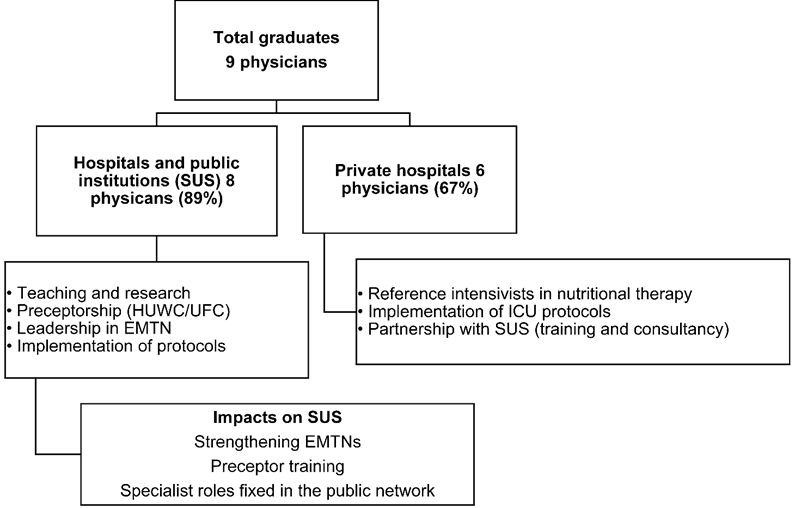
In terms of their professional career, the graduates followed different paths, but they converged in the area of nutritional therapy. One of the graduates was hired by HUWC/UFC as a preceptor and went on to coordinate the hospital’s EMTN. Another became a preceptor for the MEAC/UFC, part of the UFC Hospital Complex. Another two graduates work in the ICUs at HUWC/UFC with roles in the residency teaching process. These examples illustrate a virtuous cycle of training and retention of qualified professionals, since former residents have become preceptors and multipliers of knowledge, strengthening the continuity and sustainability of the program.
Currently, eight (88.9%) of the graduates continue to work in public teaching institutions and hospitals linked to the Unified Health System (SUS), combining care, teaching and research activities. This insertion highlights the structuring role of graduates in the SUS, not only as part of the care network, but also as players in the field of training new specialists. The work of these professionals contributes directly to strengthening the EMTNs, implementing evidence-based protocols and improving safety and quality of care indicators, in line with Ministry of Health guidelines. Furthermore, by disseminating standardized practices and promoting the training of local multi-professional teams, graduates play a technical and educational leadership role within the public network, reinforcing the SUS’s capacity to generate innovation and excellence.
At the same time, some also work in private hospitals, where they have become references in clinical nutrition, replicating the knowledge and practices acquired in their training within public apparatus. This dual insertion demonstrates the multiplying and integrating effect of public medical residency, capable of spreading knowledge and improving the quality of nutritional care throughout the Brazilian health system.
In the field of professional certification, all the graduates obtained the Specialist Qualification Registration (RQE) from the Federal Council of Medicine in the area of Parenteral and Enteral Nutrition, accounting for 42.1% of the RQEs in the state of Ceará. Of those, three have already obtained the Specialist Title issued by SBNPE/Braspen through a national exam, while the others are pursuing the same goal. These results show commitment to the formal recognition of the specialty and reaffirm the academic and care excellence of the program, which contributes to the consolidation of a network of specialists committed to the principles of the SUS and to the continuous improvement of the quality of hospital nutritional care.

Flowchart showing the destination and roles of graduates from the Medical Residency in Parenteral and Enteral Nutrition (HUWC/UFC, 2013-2025).
Operational challenges and lessons learned
The implementation and maintenance of a pioneering program also brought challenges. One of the initial obstacles was the limited number of places offered, with only one place made available each year for the one area of expertise, thus restricting the number of specialists trained each year. During the twelve years of the residency, in three years the place remained vacant due to a lack of applicant candidates, possibly due to ignorance of the program’s existence or preference for other subspecialties. To resolve this, outreach efforts were made to medical and intensive care residents from other centers, as well as presentations at regional congresses highlighting the importance of training in clinical nutrition.
Another challenge was to ensure qualified and dedicated preceptors. Since it was a new program, it initially had a single medical preceptor to supervise the resident, who also had other care activities. With the training of graduates and the hiring of assistant preceptors, this load was lightened and teaching enriched, creating a larger teaching staff. The experience has shown the importance of planning the succession of preceptors, so as not to overload a single professional and to ensure continuity even with any periods of absence or leave from work. Integrating the resident into the existing EMTN also required aligning routines - it was necessary to clarify the resident’s roles vis-à-vis the nutritionists and other team members, consolidating a collaborative approach in which the resident doctor does not replace but complements the multi-professional team.
During the development of the program, the need for curricular flexibility was identified in order to cater for different resident profiles. For example, some had a greater interest in research and chose to devote time to scientific projects, while others focused on improving technical skills (such as inserting central access for parenteral nutrition and feeding tubes or handling enteral feeding pumps). The program sought to accommodate these individual interests without compromising the minimum objectives, showing that personalizing training can increase resident satisfaction and produce exceptional results (publications, improved protocols, etc.).
Finally, obtaining ongoing institutional support was crucial. Fortunately, HUWC/UFC has remained committed to the initiative over the years, recognizing it as part of its social role of training specialists for the SUS. This support was reflected in investment in inputs (such as the acquisition of nutrition teaching materials, the availability of special diets for training, etc.) and in prioritizing the hiring of graduates to retain talent in the institution.
DISCUSSION
The experience accumulated by the HUWC/UFC Medical Residency Program in Parenteral and Enteral Nutrition demonstrates the importance of incorporating formal training in nutritional therapy into advanced medical training. The literature shows that nutritional education is still insufficient in medical curricula, which limits the clinical competency to prescribing and monitoring nutritional therapy1)-(4. In this context, the residency model reported here represents an innovative institutional response by integrating practical learning in NDT into the hospital care routine.
The results observed, with a high rate of search for professional certification and insertion in preceptorship and hospital management positions, suggest a positive impact of the program on the qualification of human resources and the consolidation of clinical nutrition as a strategic area in the health system. This trend is in line with international experiences, in which Clinical Nutrition Fellowship programs have demonstrated objective gains in adherence to protocols, patient safety and a reduction in complications associated with hospital malnutrition5),(7.
Structured training in nutritional support favors not only technical development, but also interdisciplinary skills that are essential to contemporary clinical practice, such as leadership of NDT and performance in quality audits8),(9. At HUWC/UFC, practical immersion in intensive care units and wards allowed us to consolidate our knowledge of enteral and parenteral nutrition prescriptions, in accordance with European Society for Clinical Nutrition and Metabolism (Espen) and American Society for Parenteral and Enteral Nutrition (Aspen) guidelines6),(7. This daily experience of complex cases sets the residency apart from theoretical or short-term courses, broadening clinical reasoning and evidence-based decision-making skills.
Despite the progress made, structural challenges remain, such as the limited places, the need for formal recognition of the subspecialty in the public examination notices and the lack of specific funding for programs in the area of expertise. These barriers are also reported in other countries, where the sustainability of clinical nutrition programs depends on incentive policies and greater integration with undergraduate curricula17. In addition, the continued training of preceptors and the strengthening of EMTNs are fundamental to guaranteeing the quality and expansion of the field.
Finally, the HUWC/UFC report reinforces the role of medical residency as a tool for social responsibility and educational innovation in the SUS. The creation and maintenance of similar programs in other university hospitals could generate a national network of specialists capable of reducing the incidence of hospital malnutrition, optimizing costs and promoting safer and more humane care practices. Accordingly, the model is in line with international guidelines for promoting hospital nutritional safety and valuing interprofessional health education18)-(21.
CONCLUSION
The HUWC/UFC experience shows that the Medical Residency in Parenteral and Enteral Nutrition is a viable and effective teaching-service integration strategy, capable of filling gaps in medical training and improving the quality of hospital nutritional care. The program has been established as a replicable model, qualifying doctors for advanced nutritional support and strengthening multi-professional work in EMTNs. Its continuity and expansion represent a concrete opportunity to expand the care, educational and scientific impact of clinical nutrition in the SUS and other institutional contexts.
References
- 1 Weimann A, Bezmarevic M, Braga M, Correia MITD, Funk-Debleds P, Gianotti L, et al. ESPEN guideline on clinical nutrition in surgery - update 2025. Clin Nutr. 2025:53:222-61.
- 2 Crowley J, Ball L, Hiddink GJ. Nutrition in medical education: a systematic review. Lancet Planet Health. 2019;3(9):e379-e389.
- 3 Berkow S, Palmer S. Nutrition in medical education: current status and future directions. J Nutr. 1986;116(3):341-2.
- 4 Macaninch E, Buckner L, Amin P, Broadley I, Crocombe D, Herath D, et al. Time for nutrition in medical education. BMJ Nutr Prev Health. 2020;3(1):40-48.
- 5 Krishnan S, Sytsma T, Wischmeyer PE. Addressing the Urgent Need for Clinical Nutrition Education in PostGraduate Medical Training: New Programs and Credentialing. Adv Nutr. 2024;15(11):100321.
- 6 Waitzberg DL, Caiaffa WT, Correia MI. Hospital malnutrition: the Brazilian national survey (IBRANUTRI): a study of 4000 patients. Nutrition. 2001 Jul-Aug;17(7-8):573-80.
- 7 Singer P, Blaser AR, Berger MM, Calder PC, Casaer M, Hiesmayr M, et al. ESPEN practical and partially revised guideline: Clinical nutrition in the intensive care unit. Clin Nutr . 2023;42:1671-89.
- 8 Compher C, Bingham AL, McCall M, Patel J, Rice TW, Braunschweig C, et al. Guidelines for the provision of nutrition support therapy in the adult critically ill patient: The American Society for Parenteral and Enteral Nutrition. J Parenter Enteral Nutr. 2022;46(1):12-41.
- 9 Waitzberg DL, Campos AC. Nutrition support in Brazil: past, present, and future perspectives. J Parenter Enteral Nutr . 2004;28(3):184-91.
- 10 Thiele RH, Huffmyer JL, Raphael J. Perioperative morbidity: lessons from recent clinical trials. Curr Opin Crit Care. 2012;18(4):358-65.
- 11 Brasil. Resolução CFM nº 1634/2002. Diário Oficial da União; 29 abr 2002. Seção I, p. 81.
- 12 Brasil. Resolução CFM nº 2.005/2012. Diário Oficial da União ; 21 dez 2012. Seção I, p. 937-40.
- 13 Brasil. Resolução CFM nº 2.068/2013. Diário Oficial da União ; 3 jan 2014. Seção I, p. 76.
-
14 Universidade Federal do Ceará. Residência médica é pioneira em medicina intensiva - nutrição parenteral e enteral. UFC; 14 dez 2012 [acesso em 1 mar 2026]. Disponível em: Disponível em: https://www.ufc.br/noticias/noticias-de-2012/3137-residencia-medica-e-pioneira-em-medicina-intensiva-nutricao-parenteral-e-enteral
» https://www.ufc.br/noticias/noticias-de-2012/3137-residencia-medica-e-pioneira-em-medicina-intensiva-nutricao-parenteral-e-enteral - 15 Brasil. Portaria nº 272, de 8 de abril de 1998. Brasília: Ministério da Saúde; 1998.
- 16 Brasil. Resolução de Diretoria Colegiada - RDC nº 503, de 27 de maio de 2021. Brasília: Ministério da Saúde ; 2021.
- 17 Cederholm T, Barazzoni R, Austin P, Ballmer P, Biolo G, Bischoff SC, et al. ESPEN guidelines on definitions and terminology of clinical nutrition. Clin Nutr . 2017;36(1):49-64.
- 18 Kris-Etherton PM, Akabas SR, Bales CW, Bistrian B, Braun L, Edwards MS, et al. The need to advance nutrition education in the training of health care professionals and recommended research to evaluate implementation and effectiveness. Am J Clin Nutr . 2014;99(5):1153S-66S.
- 19 Martindale, RG, Hurt, RT, Mundi, M, McClave, SA. The history of critical care nutrition: seventy-five years of evolution. Crit Care Clin. 2025;41(2):199-211.
- 20 World Health Organization. Framework for action on interprofessional education and collaborative practice. Geneva: WHO Press; 2010.
- 21 Brasil. Política Nacional de Educação Permanente em Saúde. Brasília: Ministério da Saúde ; 2018.
Research data is available in the body of the document.

 Source: prepared by the authors.