
 Dialogues with Child of the dark and the experiences of black female medical residents
ABSTRACT
Introduction: Medical residency, recognized as the gold standard for specialist training, is a setting that can paradoxically reproduce structural inequalities. This study focuses on the trajectories of Black women, examined through Carolina Maria de Jesus’s metaphor of the “quarto de despejo” (“junk room”) as an analytic lens for investigating mechanisms of institutional marginalization.
Objective: To analyze, based on Carolina Maria de Jesus’s metaphor, the mechanisms of exclusion and epistemic violence in medical residency, as well as the strategies of resistance and solidarity employed by Black women physicians to confront them.
Method: Qualitative, theoretical-analytical study grounded in a critical hermeneutic approach. The intertextual analysis assembled a tripartite corpus comprising Quarto de Despejo, scholarly literature on racism and sexism in medical education, and institutional documents. The analytic process followed the hermeneutic circle, integrating descriptive-categorical analysis with an analogy-based synthesis guided by the central metaphor.
Result: Exclusion operates through disciplinary power, the hidden curriculum, and “politics of the negative,” materialized in institutional absences and omissions. Mental health emerges as a sensitive marker of these conditions. In response, Black residents develop tactics of resistance that reframe pain and convert it into collective strength through bonds of solidarity, such as those articulated by the concept of dororidade.
Conclusion: The “quarto de despejo” metaphor proves to be a powerful heuristic tool, revealing medical residency simultaneously as a space for the reproduction of inequalities and for micro-practices of counter-power. The findings indicate the need for further research on these processes, which is relevant to informing an anti-racist and socially accountable medical pedagogy.
Keywords:
Internship and Residency; Racism; Sexism; Medical Education; Social Isolation
RESUMO
Introdução: A residência médica, reconhecida como padrão ouro para a formação de especialistas, é um espaço que, paradoxalmente, pode reproduzir desigualdades estruturais. Este estudo focaliza trajetórias de mulheres negras, analisadas por meio da metáfora do “quarto de despejo”, de Carolina Maria de Jesus, como operador analítico para examinar mecanismos de marginalização institucional.
Objetivo: Este estudo analisa, a partir da metáfora caroliniana, os mecanismos de exclusão e a violência epistêmica na residência médica, bem como as estratégias de resistência e solidariedade empregadas por médicas negras para confrontá-los.
Método: Trata-se de um estudo qualitativo, de natureza teórico-analítica, ancorado em abordagem hermenêutico-crítica. A análise intertextual articulou um corpus tripartite, composto da obra Quarto de despejo, da produção acadêmica sobre racismo e sexismo na educação médica, e de documentos institucionais. O processo analítico seguiu o círculo hermenêutico, integrando análise descritivo-categorial e síntese analógica orientada pela metáfora central.
Resultado: A exclusão opera por meio de poder disciplinar, currículo oculto e “políticas do negativo”, materializados em ausências e omissões institucionais. A saúde mental emerge como marcador sensível dessas condições. Em resposta, as residentes negras desenvolvem táticas de resistência que ressignificam a dor e a convertem em força coletiva por meio de laços de solidariedade, como os articulados pelo conceito de “dororidade”.
Conclusão: A metáfora do “quarto de despejo” revela-se uma ferramenta heurística potente, expondo a residência médica simultaneamente como espaço de reprodução de desigualdades e de micropráticas de contrapoder. Os achados indicam a necessidade de novas investigações sobre esses processos, relevantes para subsidiar uma pedagogia médica antirracista e socialmente responsável.
Palavras-chave:
Internato e Residência; Racismo; Sexismo; Educação Médica; Exclusão Social
INTRODUCTION
The medical residency is established as an immersive rite of passage in Brazil, essential in specialist training. However, under the hallowed glow of the “gold standard” resides a process impregnated with rigid hierarchies and a competitiveness that reproduces the country’s structural inequalities. For black women, who enter these spaces as a demographic and symbolic minority1),(2 the residency transcends technical learning, becoming an arena of daily confrontation with the intersectional oppressions of race, gender and class3.
This oppressive overload manifests the structural racism and sexism ingrained in society, which crystallise with particular virulence in health and educational institutions. The literature shows that black female medical students face constant violence, from microaggressions to severe delegitimization of their authority, severely damaging their mental health4 a phenomenon elucidated by Kilomba5 as “genderised racism”. In the residency, these experiences are intensified under a cloak of supposed normality.
Given the lack of narratives that capture the depth of this experience, this study proposes a dialogue with Brazilian literature. The ground-breaking book “Child of the Dark” (original title: “Quarto de Despejo: Diário de uma Favelada”), by Carolina Maria de Jesus6 brings a unique and powerful insight. Her testimony goes beyond a sociological account to become a visceral treatise on the struggle for humanity in a system of symbolic confinement.
From this nuclear metaphor, the “quarto de despejo” (“junk room”), we draw the analytical lens that guides this investigation, projecting it onto medical training. The study thus converges on a central question: how does this concept-image make it possible to decipher the mechanisms whereby the transmissive logic and epistemic violence in residency are confronted by strategies of resistance and solidarity, embodied in dororidade (a Brazilian concept that can be defined as black women’s sisterhood against pain”), on the part of black female doctors? In other words, the aim is to analyse how normative guidelines, pedagogical practices, including their hidden dimensions, and daily interactions are intertwined in the production of exclusion, while also shedding light on the ways of coping and holding firm constructed by these professionals.
To answer this question, excerpts from Jesus’ diary6 are examined in light of the concept of escrevivência, a term coined by Evaristo7, and in conjunction with academic production on racism and sexism in medical education and relevant institutional documents. It is consciously assumed that opting for a theoretical-textual dialogue supports hermeneutic depth and represents a valid methodological path for weaving a dense critique in which the strength of the texts, conceptual acuity and the cracks in institutional reality meet and bounce off each other.
METHOD
Type of study and research horizon
Anchored in a hermeneutic-critical approach8),(9 this qualitative research of a theoretical-documentary nature is based around interpretation. Its focus shifts from verifying hypotheses to understanding the meanings and regimes of truth that run through in-service training. The figure of the “quarto de despejo” is engaged as an operative concept-image, as developed in Child of the Dark 6, to analyse the mechanisms of erasure and epistemic violence in medical residency and discuss the coping and resistance strategies built by black female doctors within training institutions.
The intertextual analysis of narrated experience, academic discourses and institutional statements8),(10),(11 is organised on three interconnected analytical levels: the guidelines and regulatory provisions; the training and pedagogical practices, including the dimensions of the hidden curriculum; and the day-to-day interactions and interpersonal relationships that form the work-learning spaces.
Constitution and architecture of the set of sources
A tripartite corpus of complementary sources was configured. Carolina Maria de Jesus’ diary was adopted as the core catalyst6, understood as a text-document that inaugurates a “world of the work” open to interpretation8. In permanent dialogue with this work, academic literature on racism, sexism, mental health and medical education was added, as well as institutional documents, regulations and demographic reports pertinent to health training in Brazil. Based on this set the examined practices were contextualized historically, normatively and institutionally.
Screening, selection and refinement
The dialectical movement of the Gadamerian “hermeneutic circle”9 was followed, starting with an immersive reading of the base work and the extraction of excerpts that generated initial codes and sensitising concepts. These, in turn, guided the systematised literature review and the subsequent documentary screening. The materials were selected according to their capacity to dialogue with central analytical categories, such as “banking model of education”12) and “policies of the negative”5 and “dororidade”13.
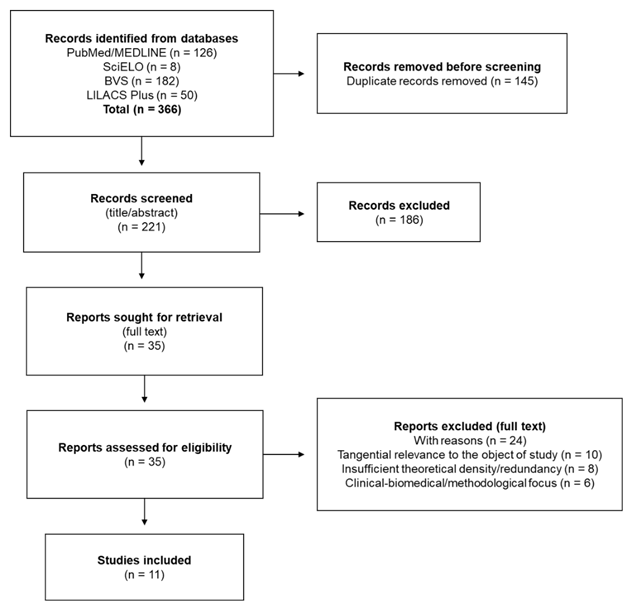
To ensure transparency and reproducibility, complementary sources were screened between July and October 2025 on the Medical Literature Analysis and Retrieval System Online (PubMed/MEDLINE), Scientific Electronic Library Online (SciELO) and Virtual Health Library (BVS) databases, combining descriptors in Portuguese and English with the Boolean operators “AND” and “OR”. The search strategy was refined iteratively as the codes and interpretative categories matured. Without the intention of being exhaustive, the aim was to achieve interpretative sufficiency and internal coherence of the selected material. The initial survey identified records in PubMed/MEDLINE (n=126), SciELO (n=8), the LILACS Plus collection (n=50) and the complete BVS collection (n=182). The search was complemented by a chain of references to and consultations on institutional portals.
The screening and selection of the material followed a sequential process, conducted with the support of Rayyan software14 to organise and initially screen the identified records. After removing duplicates (n=145), the remaining studies were screened by title and abstract, based on the exclusion criteria: strictly clinical-biomedical focus (without formative-institutional discussion) or merely passing relevance to the subject. The records classified as “maybe” (n=35) were then read in full and subjected to more rigorous interpretative scrutiny, taking into account their direct relevance to residency/medical education and the theoretical density needed to support the proposed analysis.
From this refinement, the documentary base of articles (n=11) was consolidated. Additionally, for contextualisation and analytical support, supporting documents were consulted (n=4), including a doctoral thesis (n=1) and institutional/normative documents (n=3), which are not included in the main set. The complete traceability of this process, including the criteria for each stage, is detailed in the analytical matrix deposited in the OSF repository15),(16. The selection process is summarised in Figure 1, and the characteristics of the studies that make up the main corpus are summarised in Table 1.
Data processing and analysis
In this research, “data” is defined as significant textual excerpts taken from the three selected sources. Taguette software28 was used as an auxiliary tool to organise the material, coding and retrieving excerpts, without ever replacing the central role of interpretation. The analysis was developed in cyclical movements and organised in two complementary stages.
Firstly, a descriptive-categorical analysis was carried out of the material collected in the literature review. The texts were then inductively coded to identify recurring patterns of exclusion and resistance in the context of medical residency.
An analogue and interpretative synthesis was then conducted, in which the findings of the scientific literature were tested by Carolina Maria de Jesus’ metaphor of the “junk room”. This “fusion of horizons” exercise9 allowed the experience narrated by Jesus6 to function as a critical lens for interpreting both the micro-social and institutional dimensions of medical training. Accordingly, the analogy was not a prior starting point, but the culminating stage of the analytical process, ensuring traceability between the textual evidence of the literature and the critical interpretative inferences proposed by the study.
Methodological rigour and limitations
Methodological soundness was supported by the reliability criteria proposed by Guba and Lincoln29. Its credibility is based on the triangulation of literary, academic and normative sources, as well as on making explicit the link between interpretations and textual evidence. Transferability was treated as being subject to critical reading in similar contexts, supported by dense documentary contextualisation, rather than direct field observation. Dependability and confirmability were ensured by the public audit trail and the analytical matching matrix available on the OSF (record g6eqv),15),(16) which documents the link between the central argument, thematic codes and excerpts.
It is therefore recognised that the design adopted, without direct empirical collection, does not capture voices in concrete training and work situations. Thus, the conclusions presented here are analytical and conceptual in nature: they do not aim to be statistically representative, but rather to offer interpretative keys for critically rethinking the tensions that permeate medical residency and its conditions of permanence.
RESULTS
The intertextual reading, guided by the metaphor of the “junk room”, suggests that exclusion in medical residency cannot be reduced to a succession of isolated episodes. More than one-off events, it is consolidated as an institutional arrangement that operates through symbolic segregation: a fabric in which formal devices and the hidden curriculum intertwine, naturalising hierarchies and outlining whose voice is given a central platform and who is relegated to the margins of knowledge and authority11),(30. In this dynamic, the supposed institutional “neutrality” turns out to be a tacit rule. Merit criteria, assessment systems and work-learning routines act as filters of belonging and credibility, reproducing inequalities under the guise of objectivity17),(21),(27. What is presented as a mere procedure actually governs power relations: its effects materialise in injustice and epistemic violence, practices of de-authorisation, erasure and repeated discrediting that publicly invalidate the experience and knowledge produced by black residents19),(26),(31),(32.
It is in this same scenario of institutional confinement, where norm and everyday life meet, that a sensitive connection emerges between intersectional positions, intensified performance demands and symbolic and material precariousness in the training process, an experience that echoes the “daily scavenging” described by Jesus3),(6, understood here as the daily work of institutional survival in the face of absences, omissions and micro-violence.
Accordingly, mental health appears not as an individual trait, but as a sensitive indicator of the quality of the learning environment and the asymmetries that structure it. Burnout and depersonalisation are associated with modes of relational distancing that erode bonds and care; microaggressions and sexual harassment act as discrete technologies for regulating daily life, producing non-belonging; and concepts such as moral injury and discrimination trauma allow suffering to be named as an ethical and racialised wound, beyond the reductionist grammar of “tiredness”22),(24)-(26),(33. In line with previous summaries33),(34) the findings reinforce that exhaustion and psychological distress are part of pedagogical-institutional arrangements and unequal power relations and cannot be explained by individual weakness.
However, and precisely because the institution is not monolithic, the study also reveals resistance tactics that reconfigure pain into daily sustenance and collective agency, challenging the structures that confine them. On the micro-social level, support networks and solidarity pacts between black women stand out, with an emphasis on dororidade13 and narrative and epistemic elaboration exercises that affirm the legitimacy of knowledge produced from the margins. When these responses find institutional gaps, they become micro-practices of counter-power and pedagogical counter-devices: curricular interventions that name racism as a process of social determination35, redefinitions of professionalism anchored in the ethics of care and anti-racism, capable of challenging the culture of silence and self-sacrifice17),(20),(23),(27.
Considered as a whole, the results indicate that exclusion and epistemic violence, on the one hand, and permanence and resistance, on the other, are constituted relationally, cutting across norms, pedagogical practices and everyday interactions. In this context, mental health operates as a sensitive marker of the institutional conditions of in-service training, inviting a reading of suffering that goes beyond the individual dimension to recognise it as a direct expression of structurally unequal training environments.
DISCUSSION
“Junk yard”: institutional architectures of exclusion
From Jesus’ work a fundamental analogy for understanding the experience of the black female resident emerges, situating it as a particular expression of structural racism, the “normal” way in which social relations are constituted, and not a pathology or disorder36. The lucidity displayed by Jesus6 in relation to this dynamic transpires in direct statements, such as “Brazil is predominantly white”, and in her spatial classification of São Paulo: “The Palacio is the parlour. (...) And the favela is the yard where they dump their rubbish”. Under the imposing façade of its institutional “palace”, medicine operates with an analogous logic, assigning certain bodies to its symbolic “junk rooms”, a psychic and political territory that Kilomba5 associates with the “plantation”, where the colonial order endures, regulating who has the right to speak and who must remain silent.
Data from the study Medical Demography in Brazil2 give materiality to this exclusion: although women already constitute a majority (61.8%) in undergraduate courses, the presence of black people remains under-represented (29.2% brown and black people combined, compared to 68.6% white people). The higher concentration of black students in public institutions (44.4%) compared to private ones (24.5%) indicates that access policies are having an effect, without overcoming the barriers to symbolic mobility. Symptomatic of this institutional resistance is the lawsuit filed by the Federal Council of Medicine (CFM) against racial quotas37),(38 shows how medical training is actively disciplined to contain the rise of subaltern groups.
This exclusionary landscape is based on the “banking model of education” model12) in which knowledge is a deposit transferred to a passive recipient, nullifying dialogue. Its anti-dialogical character materialises the hidden curriculum30 which naturalises hierarchies and conformism. In this context, Foucauldian disciplinary power39 operating through constant surveillance and incessant evaluations, forges “docile” bodies and minds, functionally adapted to the system. In opposition to this logic, Hooks40 proposes “education as the practice of freedom”, a vision that radically destabilises the banking pedagogical model and rethinks medical residency as a potential space for emancipation, and not just for the reproduction of inequalities.
The appropriation of medical knowledge thus imposes epistemic violence. The hegemonic biomedical model, which reifies illness and displaces the subject of care41 is a historical construction moulded by power struggles that have served the interests of white, male medical elites42. Hierarchical rigidity and the prioritisation of a specific type of “science” are therefore legacies of a political arrangement that the black resident questions and challenges with her mere presence.
“What is hard is the bread we eat”: precariousness and intersectional resistance
The routine of the black female resident mirrors the daily work of institutional survival described by Jesus6. When the author writes in her diary, “What a hardship it is to gather paper these days!”, not only the material struggle, but the resistance that permeates every gesture. Similarly, the resident undertakes an incessant search, both symbolic and concrete, for knowledge and resources, but above all for professional recognition and respect. Coping with these daily acts of violence is a ritual of resistance against the dehumanising culture of the institution43 intensified by the intersection of oppressions that embodies the trauma of “genderised racism”. In this context, the black woman is doubly objectified, subjected to episodes of everyday racism that act as attempts to “re-establish a lost colonial order”6.
Her experience is marked by an exhausting dialectic between invisibility, when her contributions are ignored, and hypervisibility, when she is taken as the sole representative of an entire group. Such oscillation renders the search for validation an exhausting task, generating psychological precariousness and institutional helplessness44)-(46 aggravated by the dual requirement of proof of competence. Invisibility itself takes on methodological contours: the absence of cross-referenced race and gender data in the Medical Demography report2 makes it impossible to quantify precisely how many black women reach this stage of their education, thus statistically erasing them.
This understanding of pain as a collective and politicised experience is anchored in the intersectional perspective. For Collins and Bilge3) intersectionality acts as an analytical tool by considering that race, class and gender, among other categories, “are intertwined and mutually constructing”, also constituting a critical praxis. For the black resident, oppression is not a juxtaposition of factors, but rather a qualitatively distinct experience in which power structures intertwine synergistically, creating insurmountable barriers for white women or black men.
Although oppression is central to this analysis, restricting it exclusively to this dimension would be tantamount to running into the problem pointed out by Apple47 in correspondence theories, a conception that reduces education to a mere passive reflection of dominant social demands. The phenomenon studied, however, crosses the entire training continuum, placing medical residency as a privileged space not only for reproduction, but also for potential institutional transformation.
From this recognition of shared pain emerges the power of the concept of dororidade, coined by Piedade. Far from romanticising suffering, dororidade contains “the shadows, the emptiness, the absence, the silenced speech, the pain caused by Racism”13. It corresponds to the acute realisation that the common experience, forged at the intersection of racism and sexism, weaves indestructible bonds of solidarity and resistance. Reaffirming this fundamental distinction, the author emphasises: “It’s not just sorority, it’s Dororidade”13. By sharing her experiences, the black resident turns this theoretical reference into a concrete survival strategy, transforming individual suffering into a collective political force.
In this territory, the search for medical knowledge takes on a profound political dimension. According to Saviani48, the function of the school is to socialise “systematised knowledge”, enabling the subaltern classes to appropriate cultural tools to transform their reality. The black female resident’s struggle for the appropriation of medical knowledge is configured as a dispute over the possession of symbolic and material means of production, challenging the historical withholding of this knowledge from black, poor and female populations.
Hunger is omnipresent in Jesus’ diary6: “The daze of hunger is worse than that of alcohol. The daze of alcohol makes us sing but one of hunger makes us shake,” resonates in the residential experience both literally, in the endless shifts without a break for food, and metaphorically, as a hunger for rest, recognition and justice. The exhaustion, anguish and falling sick of the black female resident biologically manifests her position at the intersection of oppressions, conforming to what critical epidemiology49 understands as a process of social determination of health, which can be compared to an “existence condemned” by the coloniality of Being50.
This process is actively constructed by the “Policies of the Negative”51, a mechanism by which racism in the health system operates through institutional “absences, lapses and holes”. The female resident’s journey through the “junk room” symbolises her daily struggle against these policies, where the scarcity of resources and institutional silences embody the very mechanisms of exclusion that perpetuate her condition of being dumped within the medical structure.
“An out-of-use object”: the production of dehumanisation
In the architecture of medical training, the transmissive logic is based on the foundations of a viscerally patriarchal institutional culture. From a Foucauldian perspective, the medical hierarchy would be consolidated as a machine that produces not only knowledge, but a specific type of professional subject: the docile body that incorporates the norms of the system39.
Androcentric biases are apparent in the training in this field; for example, “andragogy” favours individual autonomy over collaboration, and a culture of “male protest” that values objectification and emotional detachment as defences against suffering52. For the black female resident, this reality translates into inhabiting an environment that not only racially dehumanises her, but systematically invalidates forms of knowledge and modes of existence historically associated with women.
Kilomba describes this process with the metaphor of the “mask”, which “silences our voices as soon as we speak”5. It is a compulsory performance that forces the black subject to adopt a norm that fundamentally rejects them, undermining their identity. The medical curriculum reinforces this dynamic by making gender invisible as an analytical category and associating women with roles of “care” (nursing) as opposed to “cure” (medicine), systematically undermining their professional authority53.
Added to this scenario is the lack of representation: with only 1.7 % of black teachers2) there is not just a numerical void, but an immensity of absences, of mentoring, of possible mirrors, of interrupted legacies. This gap embodies what Apple47 conceptualises as selective tradition, a subtle mechanism by which the official curriculum progressively silences the contributions of subaltern groups.
Accordingly, curricular exclusion feeds directly into the hidden curriculum, codifying in everyday experience the implicit lesson that power and epistemic authority are not attributes of black bodies. It is in this implicit code that the category of gender, as described by Scott54, is structured as the “primary form of giving meaning to power relations”, revealing how the hierarchies of the residency simultaneously represent professional, racial and gender structures. The hospital can therefore be understood as a symbolic “junk room”, a space of precariousness where the black female resident is reduced to a disposable object, echoing the founding experience of Jesus6: “I am living in the junk room. And that which is in the junk room is either burned or thrown in the trash.”
“Instead of cursing, I write”: epistemologies of resistance
The analyses conducted reveal that the experience of black female medical residents is a blind spot in studies on medical education. Although the literature includes research into racial and gender inequalities, the intersection of these oppressions in the specific context of residency remains substantially under-theorised. The analogy with “Quarto de Despejo” therefore transcends the mere illustration of suffering, signalling the urgency of investigations that capture the resistance strategies and identity construction processes of black female doctors. Carolinian writing itself manifests itself as an act of resistance: “When I have nothing to eat, instead of cursing, I write”6. Likewise, Kilomba5 offers the “decolonisation of the self” as a way of overcoming colonial trauma, an intimate movement of becoming a “speaking subject, talking about one’s own reality” that subverts the oppressive order of silence.
The lack of quantitative data on black women residents2 represents not only an empirical obstacle, but also a call for qualitative research that gives analytical depth to these experiences. Such investigations are crucial to a deeper understanding of what Gonçalves51 conceptualises as “policies of the negative”. This mechanism, by which racism operates through institutional “absences, gaps and holes”, reveals that discrimination materialises precisely where care and assistance fail to exist. The “junk room” thus embodies the materialisation of this negative: a space defined by omission, neglect and institutional invisibility.
Future studies could explore how these care gaps materialise in the different medical specialties; how black female residents negotiate the lack of mentoring and resources; and how they subvert the culture of “male protest”52 in their daily practice. Beyond these questions, we need to understand how these training trajectories are inscribed in the mental health and career choices of these women. Responding to these absences would mean helping to forge a radically anti-racist and anti-sexist medical pedagogy, based on retention and teacher training policies that transcend the mere reservation of places and begin to remedy these structural gaps.
FINAL CONSIDERATONS
The analytical journey demonstrated the remarkable heuristic power of the “junk room” metaphor to unveil the mechanisms of racial and gender exclusions in medical residency. Far from being a mere dumping ground for marginalised bodies, this symbolic space is an active construction, operated both by Foucauldian disciplinary power and, more insidiously, by the “policies of the negative”. Exclusion materialises not only in explicit acts, but fundamentally in the absences, silences and institutional gaps that mark the formative trajectory of the black female resident.
Whereas, on the one hand, this study has mapped these oppressive mechanisms, on the other, it has refused to remain silent about them. By integrating theories of resistance into the analysis, we realise that the “junk room” can also be read as a space of counter-power: there, the daily work of institutional survival resonates in the persistent search for recognition, and “dororidade” flourishes as a political architecture of solidarity that tackles the hidden curriculum of isolation. The main contribution of this work lies in this double movement: shifting the perspective from pure exclusion to the tense and creative dynamic between structure and agency.
Deep and urgent implications for medical education emerge from this dialectical duel. It is clear that access policies, although necessary, exhaust their potential when they fail to question the foundations of institutional culture. Overcoming the “banking model of education” and “epistemic violence” requires a pedagogy that not only includes but centralises and validates the experiences and knowledge of historically silenced groups. To this end, the findings of this analysis point to the need for structural changes in multiple dimensions of residency programmes.
At the pedagogical-curricular level, it is imperative to implement a compulsory, longitudinal anti-racist curriculum that articulates racism as a process of social determination of health in clinical practice, and that redirects the concept of medical professionalism to include social justice and anti-racist action as fundamental competences. It is simultaneously essential to train residents and preceptors to recognise and deal with microaggressions and implicit biases.
At the institutional level, strict policies are needed, with safe reporting mechanisms against harassment and discrimination, coupled with a critical review of assessment processes to eliminate racial and gender bias. Equally vital is promoting affirmative action to increase the representation of black teachers and people in positions of coordination and decision-making, creating references and combating isolation.
In the field of support, programmes should recognise the suffering of black female residents as a trauma of discrimination and moral injury, and not as an individual failure, offering specialised psychological support. Creating and fostering affinity spaces and peer support networks are essential strategies for collective care and resistance. Finally, the transformation of the organisational culture depends on continuous monitoring of the institutional climate with disaggregated data and the provision of structured mentoring to help navigate the invisible career barriers.
For the Brazilian context, it is clear that merely importing purely normative or regulatory compliance models is insufficient. We need to decolonise medical residency by directly confronting the elitist, white medical habitus that structures its hierarchies. The biggest challenge lies in building an institutional culture in which whistleblowing does not mean the end of the whistleblower’s career, and where dororidade becomes collective power and a truly emancipatory medical practice.
Within this horizon of transformation, the paths for future research are outlined. The persistent gap in the trajectories of black female residents calls for qualitative research that captures the full texture of these experiences. There is an urgent need to monitor how the “policies of the negative” manifest in different specialities, how spaces of dororidade weave networks of counter-power and, above all, how to translate this knowledge of resistance into anti-racist curatorial proposals. At the end of this journey, we realise that listening to Carolina is not just about diagnosing the structures of confinement, but about finding in her writing the keys to a medical practice as a daily exercise in freedom.
References
- 1 Santos PS dos, Becker KL, Oliveira SV de. Race‐based affirmative action for higher education in Brazil: impact assessment on performance, time, and delay in completion. Rev Dev Econ. 2023;27:247-67.
-
2 Scheffer M, coordenador. Demografia médica no Brasil 2025. Brasília: Ministério da Saúde, Faculdade de Medicina da Universidade de São Paulo, Associação Médica Brasileira; 2025 [acesso em 29 ago 2025]. Disponível em: Disponível em: http://bvsms.saude.gov.br/bvs/publicacoes/demografia_medica_brasil_2025.pdf
» http://bvsms.saude.gov.br/bvs/publicacoes/demografia_medica_brasil_2025.pdf - 3 Collins PH, Bilge S. Interseccionalidade. São Paulo: Boitempo; 2020.
-
4 Martins MT de SL, Taquette SR. O racismo e o sexismo na trajetória das estudantes de Medicina negras: uma revisão integrativa. Interface - Comunicação, Saúde, Educação. 2024;28. doi: https://doi.org/10.1590/interface.230343.
» https://doi.org/https://doi.org/10.1590/interface.230343 - 5 Kilomba G. Memórias da plantação: episódios de racismo cotidiano. Rio de Janeiro: Cobogó; 2019.
- 6 Jesus CM de. Quarto de despejo: diário de uma favelada. 10a ed. São Paulo: Ática; 2015.
- 7 Evaristo C. A escrevivência e seus subtextos. In: Evaristo C. Escrevivência: a escrita de nós - reflexões sobre a obra de Conceição Evaristo. Rio de Janeiro: Mina Comunicação e Arte. p. 26-46; 2020.
- 8 Ricoeur P. Teoria da interpretação: o discurso e o excesso de significação. Rio de Janeiro: Edições 70; 2009.
- 9 Gadamer H-G. Verdade e método: traços fundamentais de uma hermenêutica filosófica. 15a ed. Petrópolis: Vozes; 2015. v. 1
- 10 Creswell JW. Investigação qualitativa e projeto de pesquisa: escolhendo entre cinco abordagens. 3a ed. Porto Alegre: Penso; 2014.
- 11 Hafferty FW. Beyond curriculum reform. Acad Med. 1998;73:403-7.
- 12 Freire P. Pedagogia do oprimido. Rio de Janeiro: Paz e Terra; 1987.
- 13 Piedade V. Dororidade. São Paulo: Nós; 2017.
-
14 Ouzzani M, Hammady H, Fedorowicz Z, Elmagarmid A. Rayyan - a web and mobile app for systematic reviews. Syst Rev. 2016;5:210. doi: https://doi.org/10.1186/s13643-016-0384-4
» https://doi.org/https://doi.org/10.1186/s13643-016-0384-4 -
15 Foster ED, Deardorff A. Open Science Framework (OSF). Journal of the Medical Library Association; doi: https://doi.org/10.5195/jmla.2017.88.
» https://doi.org/https://doi.org/10.5195/jmla.2017.88 -
16 Pantoja JC, Machado JLM, Manso MEG. The “quarto de despejo” metaphor: racial and gender exclusion in medical residency. Open Science Framework. 2025. doi: https://doi.org/10.17605/OSF.IO/G6EQV.
» https://doi.org/https://doi.org/10.17605/OSF.IO/G6EQV -
17 Borret RH, Araujo DHS de, Belford PS, Oliveira DOPS de, Vieira RC, Teixeira DS. Reflexões para uma prática em saúde antirracista. Rev Bras Educ Med. doi: https://doi.org/10.1590/1981-5271v44.supl.1-20200405.
» https://doi.org/https://doi.org/10.1590/1981-5271v44.supl.1-20200405 - 18 Dyrbye L, Herrin J, West CP, Wittlin NM, Dovidio JF, Hardeman R, et al. Association of racial bias with burnout among resident physicians. JAMA Netw Open. 2019;2:e197457.
- 19 Law M, Lam M, Wu D, et al. Changes in personal relationships during residency and their effects on resident wellness: a qualitative study. Acad Med . 2017;92:1601-6.
-
20 Medlock M, Weissman A, Wong SS, Carlo A, Zeng M, Borba C, et al. Racism as a unique social determinant of mental health: development of a didactic curriculum for psychiatry residents. MedEdPORTAL. doi: https://doi.org/10.15766/mep_2374-8265.10618.
» https://doi.org/https://doi.org/10.15766/mep_2374-8265.10618 -
21 Nguemeni Tiako MJ, Ray V, South EC. Medical schools as racialized organizations: how race-neutral structures sustain racial inequality in medical education - a narrative review. J Gen Intern Med. 2022;37:2259-66. doi: https://doi.org/10.1007/s11606-022-07500-w
» https://doi.org/https://doi.org/10.1007/s11606-022-07500-w -
22 Ogunnowo S, Zakrison TL, Baird B, Erben Y, Tung EL, Yang JP, et al. Exploring experiences of traumatic microaggressions toward surgeons and surgical residents. J Surg Res. 2024;295:191-202. doi: https://doi.org/10.1016/j.jss.2023.10.018
» https://doi.org/https://doi.org/10.1016/j.jss.2023.10.018 - 23 Owusu-Akyaw K. The forward movement: amplifying black voices on race and orthopaedics - who is the imposter? Clin Orthop Relat Res. 2022;480:244-5.
- 24 Pololi LH, Brennan RT, Civian JT, Shea S, Brennan-Wydra E, Evans AT. Us, too. Sexual harassment within academic medicine in the United States. Am J Med. 2020;133:245-8.
-
25 Thibodeau P, Bosma GN, Hochheimer CJ, et al. The moderating effects of moral injury and discrimination trauma on women physician trainees’ well-being. J Gen Intern Med 2025;40:2679-86. doi: https://doi.org/10.1007/s11606-025-09434-5
» https://doi.org/https://doi.org/10.1007/s11606-025-09434-5 -
26 Tokeshi AB, Santos RA dos, Nogueira-Martins LA, et al. Moral harassment and mental health in medical residents: a longitudinal study. Braz J Psychiatry. doi: https://doi.org/10.47626/1516-4446-2024-3579.
» https://doi.org/https://doi.org/10.47626/1516-4446-2024-3579 - 27 Zaidi Z, Razack S, Kumagai AK. Professionalism revisited during the pandemics of our time: covid-19 and racism. Perspect Med Educ. 2021;10:238-44.
- 28 Rampin R, Rampin V. Taguette: open-source qualitative data analysis. J Open Source Softw. 2021;6:3522.
- 29 Guba EG, Lincoln YS. Epistemological and methodological bases of naturalistic inquiry. ECTJ 1982;30:233-52.
- 30 Santomé Torres J. El currículum oculto. 8a ed. Madrid: Morata; 2013.
-
31 Fricker M. Epistemic injustice. Oxford University Press; 2007. doi: https://doi.org/10.1093/acprof:oso/9780198237907.001.0001.
» https://doi.org/https://doi.org/10.1093/acprof:oso/9780198237907.001.0001 - 32 Carel H, Kidd IJ. Epistemic injustice in healthcare: a philosophial analysis. Med Health Care Philos. 2014;17:529-40.
- 33 Dyrbye LN, West CP, Satele D, Wittlin NM, Dovidio JF, Hardeman R, et al. Burnout among U.S. medical students, residents, and early career physicians relative to the general U.S. population. Acad Med . 2014;89:443-51.
- 34 Rodrigues H, Cobucci R, Oliveira A, Cabral JV, Medeiros L, Gurgel K, et al. Burnout syndrome among medical residents: a systematic review and meta-analysis. PLoS One. 2018;13:e0206840.
-
35 Sevalho G. Determinação social da saúde, complexidade, colonialidade e longa duração. Cad Saude Publica. doi: https://doi.org/10.1590/0102-311xpt035724.
» https://doi.org/https://doi.org/10.1590/0102-311xpt035724 - 36 Almeida SL de. Racismo estrutural. São Paulo: Sueli Carneiro, Pólen; 2019.
-
37 Conselho Federal de Medicina. CFM se posiciona contra cotas em residências médicas. CFM; 2024 [acesso em 7 nov 2024]. Disponível em: Disponível em: https://portal.cfm.org.br/noticias/cfm-se-posiciona-contra-cotas-em-residencias-medicas
» https://portal.cfm.org.br/noticias/cfm-se-posiciona-contra-cotas-em-residencias-medicas -
38 Rodrigues B. Após repercussão negativa, CFM desiste de recorrer contra cotas para negros e indígenas em exame de residência médica. Cable News Network Brasil; 2024 [acesso em 2 set 2025]. Disponível em: Disponível em: https://www.cnnbrasil.com.br/blogs/basilia-rodrigues/politica/apos-repercussao-negativa-cfm-desiste-de-recorrer-contra-cotas-para-negros-e-indigenas-em-exame-de-residencia-medica/
» https://www.cnnbrasil.com.br/blogs/basilia-rodrigues/politica/apos-repercussao-negativa-cfm-desiste-de-recorrer-contra-cotas-para-negros-e-indigenas-em-exame-de-residencia-medica/ - 39 Foucault M. Vigiar e punir: nascimento da prisão. 27a ed. Petrópolis: Vozes ; 1987.
- 40 hooks b. Ensinando a transgredir: a educação como prática da liberdade. São Paulo: WMF Martins Fontes; 2013.
- 41 Camargo Jr. KR de. As armadilhas da “concepção positiva de saúde”. Physis. 2007;17:63-76.
- 42 Kemp A, Edler FC. A reforma médica no Brasil e nos Estados Unidos: uma comparação entre duas retóricas. Hist Cienc Saude Manguinhos. 2004;11:569-85.
- 43 McLaren P. Life in schools: an introduction to critical pedagogy in the foundations of education. 5th. New York: Prentice Hall; 2006.
- 44 Klein R, Ufere NN, Schaeffer S, Julian K, Rao SR, Koch J, et al. Association between resident race and ethnicity and clinical performance assessment scores in graduate medical education. Acad Med . 2022;97:1351-9.
- 45 GiglioAyers P, Foley CE, Cronin B, Burrell D. Investigating racial/ethnic differences in procedure experience in obstetrics & gynecology trainees at a single academic institution: a retrospective cohort study. BMC Med Educ. 2024;24:561.
- 46 Venkataraman S, Nguyen M, Chaudhry SI, Desai MM, Hajduk AM, Hyacinth, et al. Racial and ethnic discrimination and medical students’ identity formation. JAMA Netw Open . 2024;7:e2439727.
- 47 Apple MW. Ideologia e currículo. 3a ed. Porto Alegre: Artmed; 2016.
- 48 Saviani D. Pedagogia histórico-crítica: primeiras aproximações. 8a ed. Campinas: Autores Associados; 2013.
- 49 Breilh J. Epidemiologia crítica: ciência emancipadora e interculturalidade. Rio de Janeiro: Fiocruz; 2006.
- 50 Santos GAO. Quarto de despejo de Carolina Maria de Jesus: testemunho de uma existência condenada. PragMATIZES. 2018;77.
-
51 Gonçalves MM. Raça, racismo e saúde: políticas do negativo. Universidade de São Paulo; 2023. doi: https://doi.org/10.11606/T.6.2023.tde-22022024-143253.
» https://doi.org/https://doi.org/10.11606/T.6.2023.tde-22022024-143253 - 52 Bleakley A. Gender matters in medical education. Med Educ. 2013;47:59-70.
- 53 Leite AF dos S, Oliveira TRM de. Sobre educar médicas e médicos: marcas de gênero em um currículo de Medicina. Estud Fem. 2015;23:779-801.
- 54 Scott J. Gênero: uma categoria útil de análise histórica. Educ Real. 2017;20:71-99.

 Source: Developed by the authors (2025).