 The Goiânia radiological accident: a proposal for a didactic sequence on the use of mobile technologies in emergency preparedness and response today
Abstract
The knowledge acquired by professionals in the nuclear field can be significantly impacted by the emergence of new technologies that assist in actions during a nuclear or radiological accident. This is because the search for faster solutions leads to the development of skills and technical training that find in new technologies a powerful ally in Emergency Preparedness and Response. In this context, this paper aims to propose a Didactic Sequence that incorporates concepts related to Radiation Protection, based on the Meaningful Learning Theory, given that this approach facilitates knowledge retention. The proposed activity integrates theory and practice, starting from the first records of the Goiânia accident in 1987, through a historical review, in order to simulate what the response would be like today, using new mobile technologies, addressing some aspects of Nuclear Forensics. This is a qualitative/quantitative action research study, in which a semi-structured questionnaire was applied before and after the practical activities to students of a Postgraduate Program in Radiation Protection and Safety of Radioactive Sources (PGEC), offered in Brazil by the Institute of Radiation Protection and Dosimetry (IRD), in partnership with the International Atomic Energy Agency (IAEA). Students were encouraged to actively participate in the learning process, relating their prior knowledge to new knowledge, in order to stimulate curiosity and reflection. The aim was to confront and discuss precisely the relevance of new technologies in the face of possible events, always taking into account the complexities of scenarios, and also bearing in mind the fact that these technologies are accessible to the population. It was observed that the students were able to learn and interact with phenomena related to the content covered in the classroom and, in this way, develop a critical sense that enables their decision-making. Thus, it is understood that teaching through history is a powerful tool in simulating for Emergency Preparedness and Response today
Keywords:
Goiânia Radiological Accident; Mobile Technologies; Emergency Preparedness and Response; Nuclear Forensics; Meaningful Learning; Didactic Sequence
Resumo
O conhecimento adquirido por profissionais da área nuclear pode ser significativamente impactado pelo surgimento de novas tecnologias, que auxiliam nas ações durante um acidente nuclear ou radiológico. Isso ocorre porque a busca por soluções mais ágeis leva ao desenvolvimento de habilidades e treinamentos técnicos que encontram nas novas tecnologias um poderoso aliado na Preparação e Resposta a Emergências. Nesse contexto, este artigo visa propor uma Sequência Didática que incorpore conceitos relacionados à Proteção Radiológica, baseada na Teoria da Aprendizagem Significativa, visto que essa abordagem facilita a retenção do conhecimento. Aatividade proposta integra teoria e prática, partindo dos primeiros registros do acidente de Goiânia em 1987, por meio de uma revisão histórica, a fim de simular como seria a resposta hoje, utilizando novas tecnologias móveis, abordando alguns aspectos da Análise Forense Nuclear. Trata-se de uma pesquisa qualitativa/quantitativa, do tipo pesquisa-ação, onde foi aplicado um questionário semiaberto, antes e após aplicação da prática, aos discentes de um Programa de Pós-Graduação em Proteção Radiológica e Segurança de Fontes Radioativas (PGEC), oferecido no Brasil pelo Instituto de Proteção Radiológica e Dosimetria (IRD), em parceria com a Agência Internacional de Energia Atômica (AIEA). Os alunos foram incentivados a participar ativamente do processo de aprendizagem, relacionando seus conhecimentos prévios com os novos, de maneira a estimular a curiosidade e a reflexão. Busca-se, assim, confrontar e discutir com precisão a relevância das novas tecnologias diante de possíveis eventos, sempre levando em consideração as complexidades dos cenários, tendo em mente também o fato de que essas tecnologias estão ao alcance da população. Foi possível observar que o aluno pôde ser capaz de aprender e interagir com fenômenos que tivessem relação com os conteúdos abordados em sala de aula e, dessa maneira, desenvolver um senso crítico que possibilite a sua tomada de decisão. Assim, entende-se que o ensino por meio da história é uma grande ferramenta na simulação para Preparação e Resposta a Emergências nos dias de hoje.
Palavras-chave:
Acidente Radiológico de Goiânia; Tecnologias Móveis; Preparação e Resposta a Emergências; Análise Forense Nuclear; Aprendizagem Significativa; Sequência Didática
1. Introduction
According to the International Atomic Energy Agency (IAEA), an accident can be considered an unintentional event, including operational errors and equipment failures, whose actual or potential consequences are relevant. From the point of view of radiation protection, nuclear accidents are those that occur in facilities such as nuclear reactors and nuclear fuel cycle facilities. On the other hand, radiological accidents can also involve sources of ionizing radiation used in various practices and can occur anywhere [1].
The study of an accident is directly related to Nuclear Forensics. This is because Nuclear Forensics has been incorporated into radiological protection education, as proposed by the IAEA since the 1990s. This approach is important because it encompasses not only nuclear safety but also the entire investigative aspect of an incident, an element that can prevent new accidents or even crimes involving radioactive or nuclear materials [2].
Forensic science is the examination of physical, biological, behavioral and documentary evidence in the context of international or national law, with the aim of discovering connections between people, places, things and events. In this case, Nuclear Forensic Science is a subdiscipline of forensic science and can also be called nuclear expertise, which is the examination of nuclear or radioactive material, aiming at nuclear safety [2].
Its importance stems from the fact that, since the 1990s, there has been an increase in the notification of nuclear or radioactive materials outside of regulatory control, which has been considered an indication of an increase in the illicit trafficking of these materials. Thus, it is the Member State’s responsibility to implement a nuclear security infrastructure to protect these materials, including measures aimed at preventing, detecting, and responding to nuclear security incidents. When these materials are detected outside of regulatory control, Member States must be prepared to respond appropriately, including applying nuclear forensic analysis techniques in support of investigations [2].
According to the IAEA, it is known that 87% of reported disasters and 98% of their victims are concentrated in developing countries. The most affected social groups are those with fewer economic resources, as they have greater difficulty accessing health services and face greater problems in social rehabilitation after the disaster [1, 2].
One of the most notorious cases involved the material Cs-137 (Cesium-137 or 137Cs), known as “The Radiological Accident in Goiânia”, in the capital of the state of Goiás, Brazil, in September 1987. To this day, it is considered by the IAEA to be the world’s largest radiological accident, classified on the International Nuclear and Radiological Event Scale (INES) as level 5 – being the only radiological accident outside of nuclear facilities with this classification – placing Brazil on the list of countries involved in a tragic radiological accident [1, 2, 3, 4, 5, 6, 7, 8, 9, 10].
The accident occurred due to the abandonment of an irradiator used in the radiotherapy service of a local hospital that contained a capsule of Cesium-137 chloride, a highly soluble chemical compound. Because it contained lead, a material of relative financial value, the source was sold to a scrapyard, whose owner passed it on to two other deposits, in addition to distributing the fragments of radioactive material to relatives and friends who, in turn, took them home [1, 2, 3, 4, 5, 6, 7, 8, 9, 10].
The accident began with the uncontrolled release of highly radioactive Cesium-137 – with an activity of 50.9 Terabecquerel (TBq) or 1375 Curie (Ci), causing contamination in several locations, mainly those where the material was handled and where the various parts of the radiotherapy equipment were removed [1, 2, 3, 4, 5, 6, 7, 8, 9, 10, 11].
Cesium-137, whose physical half-life is approximately 30 years, is an artificial radioactive isotope of Cesium. It behaves in the environment in a similar way to potassium and other alkaline metals, and can be concentrated in animals and plants [1, 2, 3, 4, 5, 6, 7, 8, 9, 10, 11].
Due to a lack of information from local residents, the capsule was passed on to several other individuals, exposing more than a thousand individuals and creating a trail of contamination that affected 129 people. Of these, 49 were hospitalized with severe symptoms and, after intensive treatment, 4 did not respond to treatment and ended up dying [1, 2, 3, 4, 5, 6, 7, 8, 9, 10, 11].
Over time, people began to arrive out of curiosity and panic, seeking information, as the negative impression caused by sensationalist press coverage of the effects of radiation was overcome by information and professionalism. The rapid dissemination of facts and the lack of adequate information fueled fear of the unknown.
In addition, it took 15 days for the Brazilian National Nuclear Energy Commission (CNEN) to be informed by the local authorities about the incident, which in turn notified the IAEA. After that, an Emergency Preparedness and Response plan was then launched, with the participation of CNEN and several institutions, including the Institute of Radiation Protection and Dosimetry (IRD) [1, 2, 3, 4, 5, 6, 7, 8, 9, 10, 11].
Therefore, approximately 112,000 people were monitored at the Goiânia Olympic Stadium between September 30 and December 21, 1987, of whom five thousand showed symptoms of radiodermatitis, although they were not contaminated [1, 2, 3, 4, 5, 6, 7, 8, 9, 10, 11].
In some aspects, the initial psychological effects were similar to what occurred in other events involving nuclear radiation, such as Hiroshima and Nagasaki and Three Mile Island. In this situation, forming a health team to act in the emergency is the first major difficulty associated with the event, since few professionals are available [1, 2, 3, 4, 5, 6, 7, 8, 9, 10, 11].
Major disasters are situations that also put all health professionals to the test, including those who are best prepared to resolve medical, surgical and traumatic emergencies. Disasters have produced a precarious emotional state in first responders, which reduces their ability to work [1, 2].
Thus, the technical and human aspects involved in the accident in Goiânia stand out when seeking to draw a parallel between what is available in terms of technology, use of information and data speed today and what was available in the 1980s. In today’s world, with all the technology available to the public and authorities, such as the internet, the Global Positioning System (GPS), and databases, what would be the appropriate timeframe for notifying the CNEN (Brazilian National Nuclear Energy Commission) about a cesium capsule leak? What would be the timeframe for an Emergency Preparedness and Response Plan? And how would authorities react to the dissemination of information without scientific backing, thus preventing panic among the population?
This is because, in this paper, it is understood that history promotes a better understanding of scientific concepts and methods, connecting the development of individual thought with the development of scientific ideas, so that important episodes in the History of Science and Culture should be familiar to all. In this way, it helps in the understanding of the nature of science, favoring connections to be made within scientific themes and disciplines [12].
In this context, this paper aims to propose a Didactic Sequence (DS) that incorporates concepts related to radiation protection, based on the Theory of Meaningful Learning, given that this approach facilitates knowledge retention [13], among students of the Postgraduate Educational Course in Radiation Protection and the Safety of Radiation Sources (PGEC), offered by IRD in partnership with IAEA [11].
The PGEC is free and was designed to serve professionals with higher education in various fields, such as Engineering, Physics, Chemistry, Biology, Health, Radiology and related areas, who work in the field of radiological protection and safety of radioactive sources. The course program covers technical and scientific aspects, as well as national and international recommendations and standards on radiological protection, providing participants with a solid foundation in radiological protection and safety of radioactive sources, who can also act as multipliers in the sector. The student graduates with a Specialist Diploma and is classified as a Qualified Expert (QE) [11].
It is understood that the importance and need for critical analysis and strong proposals for qualified actions for physics education in Brazil is reiterated, since, in contemporary education, the adoption of diversified and engaging teaching strategies is essential to promote meaningful learning, stimulating the active participation of students, promoting deeper and more lasting construction and understanding of knowledge [14, 15]. The so-called Active Teaching and Learning Methodologies, such as the Didactic Sequence, are methods in which students are encouraged to actively participate in the teaching-learning process, based on the theoretical principle of autonomy, based on ways of developing the learning process using real or simulated experiences, aiming at the conditions to successfully solve challenges arising from the essential activities of social practice, in different contexts [16, 17].
With this, the student becomes the center of the teaching and learning process, providing an environment in which they can recognize and reflect on their own ideas, triggering their role as the protagonist of the learning process. In this case, DS is characterized by the ordering of planned activities, which have articulation with each other and pedagogical objectives defined and clear to the subjects involved in the process. In this way, it is a pedagogical planning tool, understood as a set of ordered activities, in a structured and articulated way, for the achievement of educational objectives, known by the participating subjects, and composed of three phases: planning, application and evaluation [16, 17].
In addition, it is understood here that DS should be incorporated within the cognitive structure of the most fundamental concept of Ausubel’s Theory of Meaningful Learning. According to Ausubel’s theory, learning occurs when, by assigning meanings to new knowledge (learned by the student), there is interaction with prior knowledge (what the student already knows), resulting in the acquisition of new meanings and a new understanding of a given subject, which are the products of this process. Therefore, meaningful learning is defined as the acquisition of new meanings that are the final products of meaningful learning [17, 18].
Thus, the proposed activity integrated theory and practice through a historical review, based on the first records of the Goiânia accident of 1987, highlighting aspects related to the time of the accident, such as the location of the events and the reactions of the population. The objective is to accurately compare and discuss the relevance of new technologies in the face of potential events, always considering the complexities of new scenarios and the fact that these technologies are within reach of the general public, considering that the use of new publicly accessible mobile technologies is a facilitating means of supporting the acquisition of knowledge in radiological protection and with the expectation of contributing to reducing the gap between historical facts and the present.
It is worth noting that, according to FGV, Brazil has more digital devices in use than inhabitants, reveals research by FGV. In May 2026, 502 million were counted, with 2.4 digital devices per person. Based on this information, it is understood that there is a high probability that every Brazilian owns a cell phone and that, therefore, this means of communication becomes quite efficient for the purpose of communicating information about the accident [19].
2. Materials and Methods
This is a qualitative-quantitative, action-research study [20], conducted with 10 (ten) students (5 radiology technologists, 2 physicists, 1 biologist, and 2 nuclear engineers) and coordinated by 1 (one) professor of the PGEC, and 1 (one) other student from PGEC itself, who used this DS for his Course Completion Work, acting as Assistant Professor (therefore, this work was part of the student’s final project).
In the case of qualitative research analysis, this is responsible for providing data to understand the prior knowledge of the students involved, using potentially meaningful materials and analyses that sought to investigate the presence of evidence of meaningful learning. The quantitative study, on the other hand, focused on comparing learning outcomes before and after the DS [13, 14, 15, 20].
Students in the program were voluntarily invited to participate in this activity, during their after-school period, given that the Goiânia accident was the topic of the class and in light of the 35th anniversary of the accident, which occurred in 2022. All participants signed a written agreement. Students were encouraged to actively participate in the learning process, connecting their prior knowledge with new knowledge in order to stimulate curiosity and reflection. This study followed all the requirements of Resolution No. 466/12 of the National Health Council [21].
The DS – divided into 4 classes, totaling 20 hours – is presented in Table 1. The activities were carried out outside of PGEC class hours (in the afternoon).
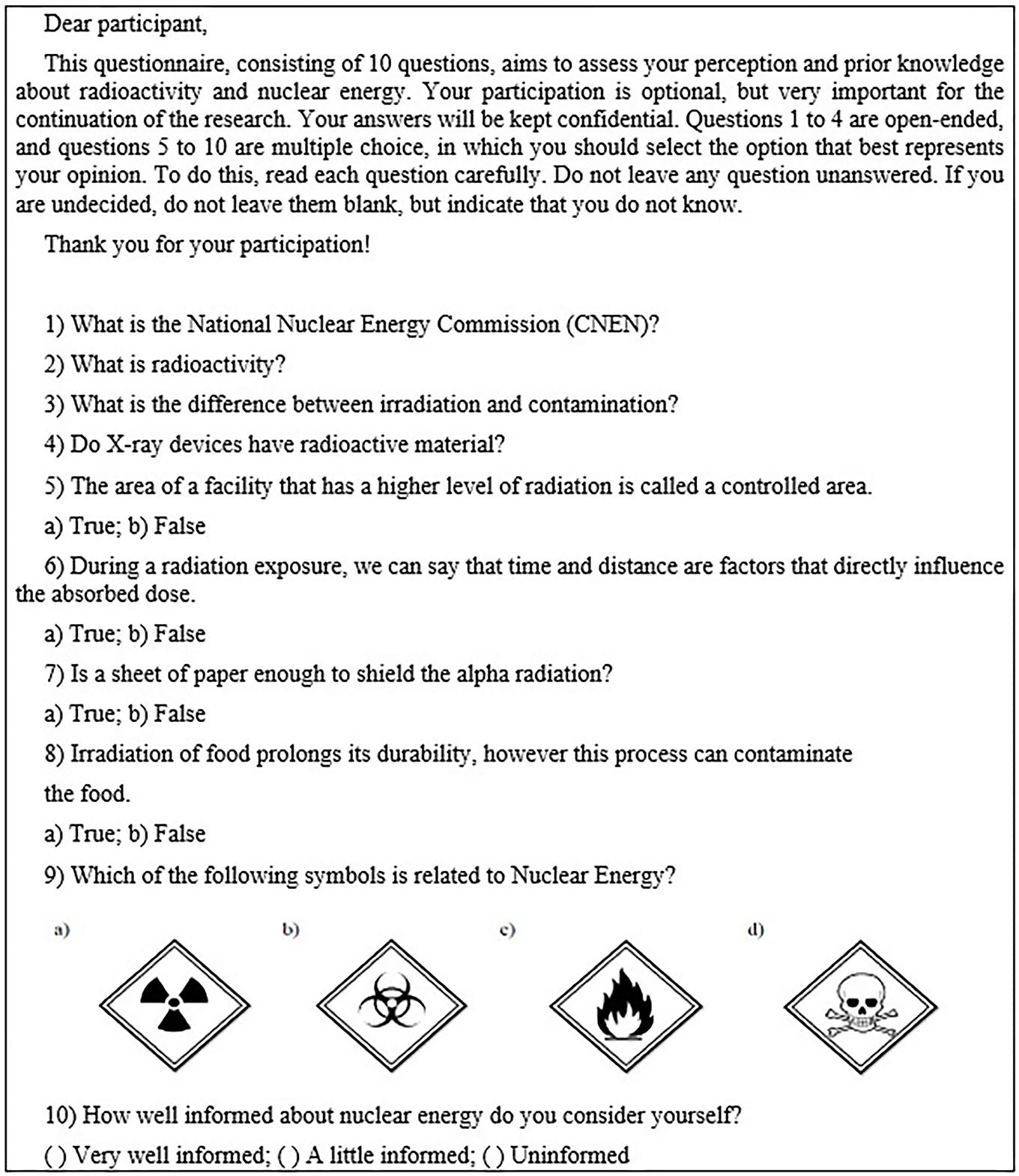
Regarding the data collection instrument, a questionnaire was used to assess the students’ level of knowledge about nuclear energy before and after the DS program. This questionnaire is already used by IRD itself during its technical visits [22], with a total of 10 questions (Figure 1).

It is worth noting that the semi-open questionnaire contained four open, discursive and qualitative questions (1 to 4), which gave students the freedom to develop their own analysis of the question, and six closed, objective and quantitative questions (5 to 10), which aimed to assess technical knowledge about nuclear energy, with correct or incorrect answers.
3. Results and Discussion
3.1. Introduction – presentation of the work proposal; review class about radioactivity and nuclear energy; initial response to the semi-open questionnaire (pre-test), before applying the practice, to assess priorknowledge
Initially, the Professor of the PGEC explained the DS, along with one of the students, who explained that it was part of the research he was doing for his Final Project in order to obtain the Specialization Diploma.
A lecture was then given, reviewing some key concepts about Radioactivity and Nuclear Energy, including:
-
Historical aspects of the discovery of radioactivity;
-
Definition of Radiation;
-
Types of Ionizing Radiation (alpha, beta, gamma, X-rays and neutrons);
-
Structure of Matter and Ionizing Radiation;
-
Natural and Artificial Sources of Radiation;
-
Radioactive Decay;
-
Principles of Radiation Protection;
-
Biological Effects;
-
Radiological and Nuclear Accidents in the world;
-
Emergency Preparedness and Response;
-
Nuclear Forensics;
-
Applications of Ionizing Radiation in daily lives.
After that, the students had 1 hour to answer the questionnaire. Regarding the analysis of the questionnaire administered before the DS, the responses had the following number of acceptances: Q1 (6); Q2 (7), Q3 (6), Q4 (7), Q5 (6), Q6 (10), Q7 (6), Q8 (5), Q9 (9), and Q10 (“very well informed”), indicating an average score of 6.2. Most of the errors were concentrated in the discursive questions.
Based on the analysis of the initial responses, it was possible to verify that all students already had a background in Radioactivity and Nuclear Energy (considering their training in related areas and the classes offered by the PGEC in the morning shift).
3.2. Preliminary discussion – expository class about the accident; review of literature and events, through reading and discussion about materials and papers searched on google scholar; discussion about the accident and assessment of lessons learned
The Professor gave a lecture about the Goiânia radiological accident, mainly highlighting the role of CNEN. After that, the Professor gave another lecture on how a literature review should be carried out, and after taking the students to the IRD computer lab, he divided the students into 2 groups of 5, who did a search on Google Scholar about the accident.
Together, they all chose 10 references [1, 2, 3, 4, 5, 6, 7, 8, 9, 10] to read until the following week, to begin the discussions. The following week, a group discussion was held, highlighting the lessons learned from the accident, as shown in Chart 1, as well as its impacts through actions adopted today, as exemplified in Chart 2.
Three areas of activity were identified: Operational, Communication, and Radiological Protection. Based on these historical facts, it was possible to discuss and develop an Emergency Preparedness and Response Plan in case the event was to occur in the future.
Finally, the exercise (practical activity) was carried out based on the Lessons Learned, regarding Geolocation and Conversion of Radiation Measurement Units, simulating the actions if the accident had occurredtoday.
3.3. Practical simulation
3.3.1. Implementation of the practice, with the simulation of emergency preparedness and response using mobile technologies
In the initial stages of the work in Goiânia, when the monitored individuals were selected, the identifications followed random rules that made dating difficult, which today could be done in real time using spreadsheet data, while the tracking and processing of information would be easily managed by GPS location programs, in addition to instant messaging by those involved.
Currently, on mobile devices, it is possible to optimize the time for disseminating information, obtaining greater precision in terrestrial positioning and especially the sharing of data in real time. This evolution can be demonstrated and compared by Figure 2, which shows the affected regions from the descriptive documents about the accident, and the same regions, but now seen through a mobile device by the Google Maps location program (Figure 3) [23].


The same regions, but now seen through a mobile device by the Google Maps location program. Source: [23].
Based on this information, a terrestrial location system can be created using latitude and longitude data and a map of the region, from the IRD, which would facilitate and optimize the time to locate the seven main isolated hotspots in Goiânia in 1987 (Figure 4), with less metrological uncertainty, associating radiation monitors and the location system.
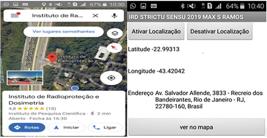
Furthermore, the GPS location and positioning system would not only allow the location of risk areas, but could also be used to allocate personnel, generate risk maps in real time, quickly and objectively guide security forces in the evacuation of personnel, etc. [24, 25].
With this data in hand, it is possible to make an immediate association, from the precise location with latitude, longitude and address, with the count per second of a radioactive source on a monitor at the IRD (Figure 5).

In this case, the data is sent to the IRD to be measured with its radiation monitors because the IRD was, at the time of the Goiânia accident, and still is today, responsible for the area monitoring and radiological protection process for individuals and the environment, being a national reference in ionizing radiation metrology.
Metrology activities are centralized at the National Laboratory of Ionizing Radiation Metrology (LNMRI). Thus, the calibration of a system for Cesium-137 at the IRD uses detection and gamma spectrometry systems, from a standard Cesium-137 source traceable to national or international standards, with known activity, under controlled temperature and background radiation conditions. Therefore, the LNMRI acts in the primary standardization of radionuclides and calibration of sources (secondary) by gamma spectrometry, alpha spectrometry and ionization chambers.
Therefore, with the data values sent to the IRD, these could be compared with a primary source of radionuclides, thus obtaining values with minimal errors for monitoring the actions.
3.3.2. Construction and implementation of an app for converting radiation measurement units
Another point highlighted in the lessons learned from the accident was the issue of converting units of different equipment during an emergency. Currently, some applications can assist first responders in their actions at the emergency site.
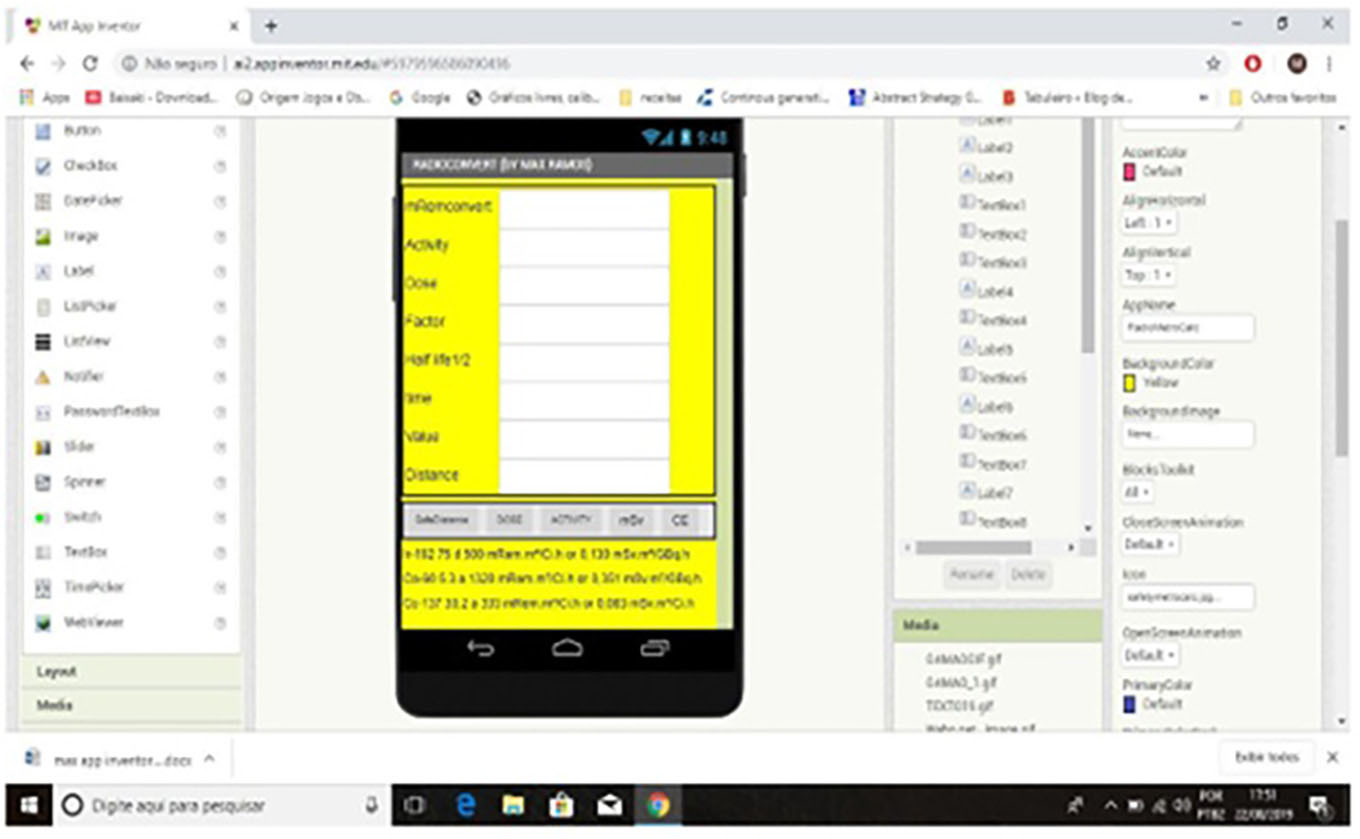
Among them, could be mentioned an open-source application, in this case App Inventor, freely available from the Massachusetts Institute of Technology (MIT), which was used to build the “RadioMetroCalc” App, that allows real-time calculation of the activity and dose of a given source.
The Figure 6 shows the process of building “RadioMetroCalc” (the App was previously created by DS teachers [26]. However, its development was demonstrated to the students), while Figure 7 demonstrates its application.
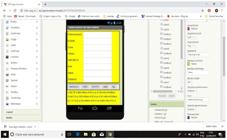

Screenshots of the “RadioMetroCalc” application installed and launched with the Qwerty keyboard. Source: [26].
3.4. Final discussion
3.4.1. Final response to the semi-open questionnaire, after applying the practice
Regarding the analysis of the questionnaire administered before and after the DS, the responses had the following number of acceptances (before and after the DS): Q1 (6/9); Q2 (7/10), Q3 (6/9), Q4 (7/10), Q5 (6/10), Q6 (10/10), Q7 (6/10), Q8 (5/10), Q9 (9/10), and Q10 (“very well informed”), indicating an increase of over 57% in the total number of correct answers.
The high scores before the activities were due to the fact that all students already had a background in radioactivity and nuclear energy (given that they have degrees in related fields), resulting in an average score of 6.2. After the practical exercises, this average rose to 9.8, an increase of almost 50% in correct answers, showing that the learning was meaningful. Even so, not everyone answered all the questions correctly, showing that some concepts remain ingrained, especially regarding the open-ended questions.
The questions with the lowest initial success rate (below 7 correct answers) were questions 1 to 4 (essay questions), 5, 7, and 8. Regarding the essay questions, this is due to students getting some term or concept wrong, often because they are not familiar with the subject matter. In question 5, some students had never performed practical activities involving the classification of areas. Questions 7 and 8 were more theoretical, and some students still had some conceptual doubts.
3.4.2. Analysis of the results obtained andgeneral discussion about the DS, in order to verify whether the activities impacted student learning
Thus, the facts that stood out most after the correlations between the events and the possible technological solutions were:
-
Registration of monitored individuals without the use of technical files;
-
Ground tracking using residents’ testimonies;
-
Use of pagers (beepers) for the initial mobilization of Emergency Preparedness and Response teams;
-
Operations carried out simultaneously with the arrival of unmanaged information.
Some relevant aspects that serve as criticisms of the proposals for new technologies were also:
-
In large events, it is found that the speed of information on the world wide web can interrupt database clusters; and
-
Misinformation can also spread rapidly. This is because incorrect information, coming from a source without institutional guarantees, can be quickly disseminated without any filter to evaluate it, considering the large number of cell phones and access to social media. Therefore, it is necessary to designate a “communicator” to transmit information reliably and immediately, becoming an open channel of dialogue with the public and the media.
-
Specifically, with regard to the long time for detection of the source and the response by the competent authorities, this time would certainly be shorter today, either due to the fact that radioactive facilities are constantly monitored and included in a database; either because there is a national emergency network, with trained professionals throughout the country; or because detection equipment is now more accessible and available in greater numbers. Therefore, it can be said that, currently, through new technologies, it is possible to have more agile solutions from a simple mobile device, whether for communication with the public or for the actions of first responders.
-
The theoretical issues regarding radiation protection were presented in the inaugural DS class. However, dosimetry was not applied in the practical activity, since the idea was to start the activities in case of an emergency. Dosimetry would be applied at a later stage, already in the field and at the accident site.
Finally, it is worth highlighting that for students, understanding the history of the accident helps in preparing simulations for possible future emergencies.
According to student A., “By understanding the past, it is possible to glimpse the difficulties and actions taken by rescuers, which will greatly help in response training”.
For student B., new technologies should be used in an organized manner by rescue teams: “All information is welcome! However, everything must be done in an articulated manner so that there is better coordination, making the response faster”.
Finally, for student C., “Technologies are constantly evolving. Therefore, we must always be studying and training ourselves, to stay up to date”.
4. Conclusion
This paper aimed to verify the promotion of Meaningful Learning on the topic of Radiation Protection among students of a Specialization Course in the area, using as a teaching tool a Didactic Sequence (DS) on the Goiânia Radiological Accident, and with a practical simulation of what Emergency Preparedness and Response would be like today with the use of available and easily accessible technological tools.
The DS began with a historical overview of the accident, through a literature review. It is understood that the approach through the history, philosophy and sociology of science helped to bring the student closer to reality, and served to contextualize the facts for the performance of the other activities. Thus, students were able to discuss, for example, aspects of what the legislation on radioactive waste was like at the time and why the material spread easily, from the sale and opening of the material in a junkyard – a practice that is still common today, as in the case of the sale of stolen power cables, which is part of the country’s reality.
From this survey, some Lessons Learned were identified, such as suggestions for actions in the event of future radioactive or radiological accidents, involving not only technical aspects, such as operational issues of radiological protection itself, but also social aspects, such as how communication with society should be carried out, for example, avoiding negative aspects such as Fake News.
With the practical simulation of what the response to the accident would be like with the technologies available today, it was possible to have an overview of the entire accident scenario and, collaboratively, develop an Emergency Preparedness and Response strategy. With the use of the App for calculating unit conversion and communication via the internet, for example, participants verified that communication and the creation of an emergency center is essential for a quick and effective response, always keeping in mind the issue of radiological protection.
Another aspect that should be highlighted is the introduction of Nuclear Forensic Science into the discussions, since this is a new topic that should be addressed in the PGEC. Furthermore, it is an area of great importance to the IAEA and should be taken into account when studying the causes and consequences of a radiological accident. It is understood that the study through Nuclear Forensics covers all investigative aspects of a nuclear accident, and may be useful in the event of a new accident.
Upon analyzing the data, it was found that the students had a very active participation, mainly due to the practical activities and the collective discussion. It is understood, therefore, that the implementation of the DS, applied as an Active Teaching and Learning Methodology, achieved its main objective, which was to promote meaningful learning regarding aspects of radiological protection among the students. This can be observed quantitatively in the greater number of correct answers in relation to the questionnaire applied before and after the DS (an increase of more than 50%) and qualitatively, in relation to the satisfaction of carrying out the DS in the students’ testimonials.
Thus, a well-designed DS, starting from the students’ prior knowledge, inserting this knowledge into historical and social aspects to contextualize the topic to be studied, moving on to a practice where the knowledge is discussed in order to highlight the lessons learned from past actions, transposing it to a current approach, using accessible technological tools, contributed significantly to learning.
It was observed that the student was able to learn and interact with phenomena related to the content covered in the classroom and, in this way, develop a critical sense that enabled their decision-making. Thus, it is understood that teaching through history is a great tool in simulating and preparing for Emergency Preparedness and Response in future situations.
This point becomes relevant to the teaching of Physics, and even more so in matters related to radioactivity, considering that fear and prejudice can generate fear, doubts, and Fake News due to a lack of knowledge about the subject. Even more so if the subject involves accidents, as was the case in Goiânia. However, a more in-depth discussion of the aspects of the accident, historical points, and lessons learned can generate knowledge.
This is because, in this article, the importance and need for critical analyses and robust proposals for qualified actions for the teaching of Physics is reiterated, since, in contemporary education, the adoption of diversified and participatory teaching strategies and approaches is essential to promote meaningful learning, stimulating the active participation of students, aiming at the construction of knowledge.
Furthermore, it enabled the alignment of theory with practice. In this sense, this article may contribute to the professional practice of teachers in the development of pedagogical activities related to the dissemination of knowledge about radioactivity and radiological protection, as well as to Emergency Preparedness and Response.
Therefore, it can be stated that, in the face of a tragedy, it is also possible to learn lessons that will serve as guiding tools so that events of this nature do not repeat themselves – and, if they do repeat themselves, there will be coordinated action by the Emergency Preparedness and Response teams.
So, generally, a radiological accident ends up causing damage to society, whether to people or the environment. However, the term accident, which usually refers to damage, can also lead to discussion about social issues, generating knowledge. However, the knowledge acquired by radiology professionals, and by society in general, can be greatly impacted by the emergence of new technologies, which can also affect actions during a nuclear or radiological accident. The search for more agile solutions leads to the development of skills and technical training that find in new technologies a strong ally in an emergency.
Therefore, the learning acquired by professionals in the nuclear field can be greatly impacted by the emergence of new technologies, assisting in actions during a nuclear or radiological accident. This is because the search for more agile solutions leads to the development of skills and technical training that find in new technologies a strong ally in Emergency Preparedness and Response, for example.
Thus, the accident in Goiânia cannot be forgotten, as preserving the past and telling its story is a way to avoid new mistakes. Undoubtedly, the Cesium-137 Radiological Accident brought lessons and possible learnings for the entire world, in all areas of human knowledge.
In this sense, the technological tools presented end up leading to discussions about the various aspects of an accident, in addition to leading to new learning perspectives that involve the evolution of the possibilities of an accident, together with society. The aim is, therefore, to confront and discuss with precision the relevance of new technologies in the face of possible events, always taking into account the complexities of new scenarios, also bearing in mind the fact that these technologies are within reach of the population.
Acknowledgments
The authors would like to thank the Editor and the Reviewers for their invaluable comments and suggestions on this work and the Institute of Radiation Protection and Dosimetry (IRD) for the provision of space for the work to be carried out.
Data Availability
The entire dataset supporting the results of this study is published in the article.
References
- [1] INTERNATIONAL ATOMIC ENERGY AGENCY, The Radiological Accident in Goiânia (IAEA, Vienna, 1988).
- [2] INTERNATIONAL ATOMIC ENERGY AGENCY, Nuclear forensics in support of investigations: implementing guide (IAEA, Vienna, 2015).
- [3] S. Helou and S.B. Carvalho Neto, Césio-137: consequências psicossociais do acidente de Goiânia (Editora UFG Digital, Goiânia, 2014).
- [4] L.C. Jansen and F.B. Razuck, Brazilian Journal of Radiation Sciences 6, 1 (2018).
- [5] L.C. Jansen and F.B. Razuck, Brazilian Journal of Health Review 3, 16108 (2020).
- [6] E. Okuno, Estudos Avançados 27, 185 (2013).
- [7] COMISSA O NACIONAL DE ENERGIA NUCLEAR, Relatório do acidente radiológico em Goiânia (CNEN. Rio de Janeiro, 1988).
- [8] S.D.A. Vieira, Estudos avançados,27, 217 (2013).
- [9] M.P. Curado and M.P. Silva, História do Acidente Radioativo de Goiânia (FunLeide, Goiânia, 1989).
-
[10] REVISTA-CÉSIO 25 ANOS, Uma história para recordar e prevenir, available in: https://goias.gov.br/saude/wp-content/uploads/sites/34/2016/12/revista-cesio-25-anos-60e.pdf
» https://goias.gov.br/saude/wp-content/uploads/sites/34/2016/12/revista-cesio-25-anos-60e.pdf -
[11] INSTITUTO DE RADIOPROTEÇÃO E DOSIMETRIA, available in: http://www.ird.gov.br
» http://www.ird.gov.br - [12] M.R. Matthews, Science teaching: the role of history and philosophy of science (Routledge, New York, 1994).
- [13] F.A. Silveira, A.K.P. Vasconcelos and A.O. Nunes, Ciência & Educação (Bauru) 31, 1 (2025).
- [14] O.L. Silva Filho and M. Ferreira, Revista de Eseñanza de al Física 35, 63 (2023).
- [15] M. Ferreira, S.N. Ribas, A.L. Silva, P.A. Nogara, A.L. Coelho, O.L. Silva Filho and K.O. Portugal, Ensino de Ciências e Tecnologia em Revista– ENCITEC 14, 181 (2024).
- [16] A. Zabala, A prática educativa: como ensinar (Penso Editora, São Paulo, 2015).
- [17] A. Diesel, A.L. Baldez and S.N. Martins, Revista Thema 14, 268 (2017).
- [18] G.H. Schinzel, V.C. Andrade, M. Ferreira, O. Luiz Filho, L.L.D. Santos and R.G. Quartieri, Revista do Professor de Física 6, 386 (2022).
-
[19] FUNDAÇÃO GETÚLIO VARGAS, Brasil tem mais dispositivos digitais em uso do que habitantes, revela pesquisa da FGV, available in: <ref class="ltx_nolink ltx_url" href="https://portal.fgv.br/noticias/brasil-tem-mais-dispositivos-digitais-em-uso-do-que-habitantes-revela-pesquisa-da-fgv">https://portal.fgv.br/noticias/brasil-tem-mais-dispositivos-digitais-em-uso-do-que-habitantes-revela-pesquisa-da-fgv</ref>.
» https://portal.fgv.br/noticias/brasil-tem-mais-dispositivos-digitais-em-uso-do-que-habitantes-revela-pesquisa-da-fgv - [20] A. Gil, Métodos e Técnicas de Pesquisa Social (Atlas, São Paulo, 2009).
-
[21] MINISTÉRIO DA SAÚDE, Resolução n∘ 466, de 12 de dezembro de 2012, available in: https://bvsms.saude.gov.br/bvs/saudelegis/cns/2013/res0466\_12\_12\_2012.html
» https://bvsms.saude.gov.br/bvs/saudelegis/cns/2013/res0466\_12\_12\_2012.html - [22] F.B. Razuck, P.R. Perrotta and D.M. Rodrigues, in: Anais of International Joint Conference Radio 2019 (São Paulo, 2019).
-
[23] GOOGLE MAPS, available in: https://www.google.com.br/maps/preview
» https://www.google.com.br/maps/preview - [24] R. Ferreira Junior, G.L. Luvizotto and V. Rosolen, Geociências 37, 555 (2018).
- [25] S.P. Martins, Geociências 43 (2024), 29.
- [26] M. Ramos and F.B. Razuck, Journal of Physics: Conference Series 1826, 012043 (2021).
Edited by
-
Editor-in-Chief:
Marcello Ferreira https://orcid.org/0000-0003-4945-3169