 Public student funding in higher education: a look at student assistance in Brazil and the social support service in Portugal (2015-2022)
ABSTRACT
This article aims to understand how public funding is set up to maintain assistance policies for higher education students in Brazil and Portugal. The research is qualitative in nature and used bibliographical review and documentary analysis as its technical methodological procedures. The research revealed that it is essential to strengthen the funding of Student Assistance in Brazil and the Student Support Service in Higher Education in Portugal. This funding needs to be intertwined with an idea of a continuous flow of investment, under the right to education and the promotion of equal opportunities for students, to the detriment of the path that is paved in current contexts - unstable funding, built on meritocratic, procedural and compensatory paradigms.
Keywords:
Student Assistance; Financing of Student Assistance Programs; Higher Education
RESUMO
Este artigo objetiva compreender como se configura o financiamento público direcionado à manutenção de políticas assistenciais voltadas aos estudantes da educação superior no Brasil e em Portugal. A pesquisa é de cunho qualitativo e utilizou como procedimentos técnico-metodológicos a revisão bibliográfica e a análise documental. A pesquisa revelou ser imprescindível fortalecer os caminhos do financiamento da Assistência Estudantil no Brasil e do Serviço de Apoio ao Estudante no Ensino Superior em Portugal. Esse financiamento necessita estar entrelaçado a uma ideia de fluxo contínuo de investimento, sob a via do direito à educação e à promoção das igualdades de oportunidades dos estudantes, em detrimento do caminho que é pavimentado nos contextos atuais - um financiamento instável, construído com base nos paradigmas meritocrático, procedimental e compensador.
Palavras-chave:
Assistência Estudantil; Financiamento dos Programas de Assistência estudantil; Educação Superior
RESUMEN
El objetivo de este artículo es comprender cómo se establece la financiación pública para mantener las políticas de asistencia a los estudiantes de enseñanza superior en Brasil y Portugal. La investigación es de naturaleza cualitativa y utilizó como procedimientos técnicos metodológicos la revisión bibliográfica y el análisis documental. La investigación reveló que es esencial reforzar la financiación de la Asistencia al Estudiante en Brasil y del Servicio de Apoyo al Estudiante de Enseñanza Superior en Portugal. Esta financiación necesita entrelazarse con una idea de flujo continuo de inversión, en virtud del derecho a la educación y la promoción de la igualdad de oportunidades para los estudiantes, en detrimento del camino que se pavimenta en los contextos actuales - financiación inestable, construida sobre paradigmas meritocráticos, procedimentales y compensatorios.
Palabras clave:
Asistencia a Estudiantes; Financiación de Programas de Asistencia a Estudiantes; Enseñanza Superior
INTRODUCTION
The structural crisis of capital, particularly since the 1970s, reflecting the weakening of the welfare state and the Fordist/Taylorist model of production, has driven capital to adopt restructuring processes with a view to recovering its reproductive cycle (Antunes, 2002). These processes were intensified by the internationalization of capital, the implementation of a more flexible mode of capitalist accumulation, and the adoption of neoliberal policies, resulting in changes in all spheres of social life. The role of the state and educational systems took shape in these changes.
In the context of neoliberal reforms, the role of the State, “which, until then, had been that of regulating the economy, prescribing rules to guide market development and ensure the provision of social public policies aimed at the well-being of the population” (Silva and Bezerra, 2019, p. 81), has been redefined. This new paradigm is anchored in the primacy of “privatization, liberalization, and deregulation” (Tavares da Silva, 2008, p. 5), ceasing to be an executor of social policies and assuming the role of regulator and evaluator of such policies.
Based on these new configurations, higher education becomes circumscribed by the need to respond to constant changes in the world of work and the challenges of the so-called knowledge society, embedded with a discourse that views it as responsible for the social advancement of individuals and the economic development of nations. Higher education thus finds itself in a prominent position in the face of repeated changes to the State under neoliberalism. New scenarios are being planned for higher education: differentiation and diversification of funding are some of the elements established in these new processes.
In the face of these new scenarios, a process of expansion of higher education has been observed, particularly since the 1990s in Brazil and the 1970s in Portugal. However, while Brazil and Portugal have expanded access to higher education, enabling students from historically excluded social strata to enter the highest levels of the educational system, it has been possible to observe that, upon accessing such levels, these students encounter numerous difficulties that limit or prevent them from remaining in these segments and meeting expectations for permanence, continuity, and academic performance.
Therefore, Student Assistance (AE, acronym in Portuguese) policies in Brazil and Social Action for Higher Education (ASES, acronym in Portuguese) policies in Portugal have been created with a view to enhancing the mechanisms for democratizing higher education. This takes into account not only an expansion in the number of vacancies, but also the promotion of conditions for access, permanence and completion for the most economically disadvantaged populations.
In Brazil, it is possible to deliberate on AE, in recent contexts, as an educational policy strategy that aims to confront the elitist nature of Brazilian higher education, since it seeks to offer conditions for low-income students to access, remain in, and complete this stage, thus converging with mechanisms of equity and guaranteeing rights to education.
Amaral and Nascimento (2010, p. 3) reiterate the indispensability of AE, arguing that it is “an essential policy in the context of teaching, research, and extension.” In addressing AE from this perspective, the authors assume the relevance of this policy in the context of social inequality present in Brazilian society.
In Portugal, the ASES’s fundamental objective is “to enable all students to attend higher education, regardless of their socioeconomic conditions, by providing financial support and subsidized services” (Pereira, 2019, p. 113).
As for the financing of these welfare policies in both Brazil and Portugal, this public financing is understood to be a contentious process that reflects the contrasting categories of maintenance or change (Mészáros, 2005) of social inequality processes. Thus, looking at AE from this perspective enables us to understand the various socio-historical and political connotations of this theoretical framework.
In these initial propositions, it is important to emphasize that the AE policies of Brazil and Portugal will not be compared. Instead, this study will take a parallel approach to examine these two countries, seeking to understand the composition of the social fabric through social mediations. As Ciavatta (2009, p. 148) teaches us, this involves “the relationships, tensions, and conflicts between conjunctural changes and the structural materiality of a given society, which allows us to grasp, in a dialectical way, the meaning and nature of events at a given historical moment.”
By taking Brazil and Portugal as a reference to understand AE and the vicissitudes of this policy, we seek, through “getting to know the other and, in doing so, deepening our knowledge of ourselves and the other” (Ciavatta, 2016, p. 14), new interpretations that enable us to construct the provisional syntheses that the educational reality requires.
This article is part of an ongoing doctoral research project on AE in Brazil and the ASES in Portugal, with a focus on public funding for these policies. The objective of the article is to understand how public funding is configured for the maintenance of assistance policies aimed at higher education students in Brazil and Portugal, with an emphasis on the National Student Assistance Program (PNAES, acronym in Portuguese) in Brazil and the ASES in Portugal.
This qualitative research study employed a literature review as a technical-methodological procedure. The goal of this procedure was to compare the theoretical constructs addressing the financing of the PNAES in Brazil and the ASES in Portugal, as well as to gather information that would contribute to a comprehensive understanding of the subject. To this end, research was conducted in books, journals, scientific articles, and websites. References included Kowalski (2012), Santos (2017), and Pereira (2019).
Documentary research was also employed as a technical-methodological procedure, with statistical records serving as its primary source. For this procedure, official, open-source data from internet repositories were used, particularly from the Integrated Planning and Budgeting System (SIOP, acronym in Portuguese) in Brazil and the Contemporary Portugal Database (PORDATA, acronym in Portuguese) in Portugal.
Thus, this article will consist of five sections. In addition to this introductory section, the second section presents considerations about AE in Brazil for undergraduate students, with an emphasis on the PNAES and its financing. Such a section discusses how the financing of this assistance policy is established in Decree n. 7.234/2010 and the challenges it faces in terms of its maintenance and continuity, given the policies of public spending constraints. The third section focuses on the ASES in the Portuguese context, and discusses the financing configurations established for these services. The fourth section addresses the financial resources allocated to PNAES in Brazil and ASES in Portugal, weighing considerations regarding such resources and the challenges these policies face in order to be consolidated as sustainable, lasting policies that uphold the right to higher education. Finally, the fifth section provides a summary of what has been discussed, presenting the provisional conclusions of the research.
STUDENT ASSISTANCE IN BRAZIL FOR UNDERGRADUATE STUDENTS AT FEDERAL PUBLIC UNIVERSITIES
When examining at AE in Brazil, it is necessary to take a brief historical step back and try to uncover the political subjects, civil segments, and legal milestones that, together, played a part in establishing AE as a public policy that seeks to promote the democratization of higher education and, consequently, the right to education.
It is important to note, in these initial propositions, that AE and Social Assistance policy have gone hand in hand throughout history, emerging primarily “from the social movements that fought to end the military regime and for a new constitution to be enacted” (Vasconcelos, 2010, p. 603).
In this context, the emergence of the National Forum of Vice-Rectors for Community and Student Affairs (FONAPRACE, acronym in Portuguese), in 1987, is noteworthy. This Forum “set as its priority goal to work on the systematization of a AE policy proposal that would guarantee access, permanence, and completion of courses at Federal Higher Education Institutions (HEIs), from the perspective of inclusion, social rights, and the democratization of education” (FONAPRACE, 2008, p. 1).
Also, during this period, the National Association of Directors of Federal HEIs (ANDIFES, acronym in Portuguese) emerged, presenting “the integration of federal HEIs, their valorization, and defense” (ANDIFES, 2008, p. 1) as one of its objectives.
These two segments - FONAPRACE and ANDIFES - established themselves as important sectors focused on discussing the conditions for student retention in higher education associated with socioeconomic profile.
Meanwhile, the promulgation of the 1988 Federal Constitution constituted a relevant legal tool that prompted new ways of thinking about education and social assistance. In relation to these ways of thinking, two key points were highlighted in such a Constitution. The first, in Chapter II, Article 6, treats education as a social right, and Chapter III, Article 205, expresses “equal conditions for access to and permanence in school” (Brasil, 1988, p. 122) among the principles of education. The second point is mentioned in Chapter II, Article 203, which states that social assistance should be provided to those who need it (Brasil, 1988, p. 122).
The promulgation of this Federal Constitution brought about new ways of thinking about education and social assistance, and new perceptions about affirmative action policies came to the fore. It could be argued that the 1988 Federal Constitution sparked debates and reflections on transforming AE into a social rights policy.
In this scenario, the political and social changes that have taken place since the 1990s are also worth highlighting. Looking at AE, especially during the Fernando Henrique Cardoso administration (1995-2002), we can see that AE policies during this period were “closely related to the guidelines of international organizations that defined goals and established criteria for dealing with social policies in developing countries, such as Brazil” (Pavan, 2014, p. 6). Subject to market logic and the ideologies of international organizations, and with the support of local political and governmental entities, AE policies remained tied to a focused and selective approach.
In line with this historical context, it is worth noting that only in 2007, in response to demands arising from the expansion of higher education and the strengthening of claims by civil entities, students, and leaders of federal public universities in favor of the democratization of this stage of education, was the PNAES created through Ordinance No. 39 of the Ministry of Education (Brasil, 2007). In December 2010, this ordinance was transformed into Presidential Decree No. 7,234/2010 (Brasil, 2010).
PNAES is currently the main AE program. It is especially aimed at students from the public basic education system or those whose per capita income is lower than 1.5 times the minimum wage. The program aims to improve the conditions for young people to remain in federal public higher education, with the following objectives:
-
I - to democratize the conditions for young people to remain in federal public higher education;
-
II - to minimize the effects of social and regional inequalities on retention and completion of higher education;
-
III - to reduce retention and dropout rates; and
-
IV - to contribute to the promotion of social inclusion through education (Brasil, 2010, p. 1).
The PNAES can be understood as a public policy that seeks to meet the socioeconomic needs of students and enable guaranteed access, retention, and completion of higher education (Macedo, 2014). Therefore, it is a rights-guaranteeing policy.
Importantly, although this program was established as a public policy, it has encountered an economic and political scenario in which tensions are deepening, especially regarding financial/budgetary issues and the reduction of social rights guarantees. The rhetoric of the need to contain public spending under the neoliberal state ultimately limits the implementation and continuity of this policy. These limits, as pointed out by Kowalski (2012), are expressed in the conditions imposed on:
equalization of human rights to education, which, in times of neoliberal policies and market hegemony, associates student assistance with the logic of service rather than rights. The possibilities and limits of guaranteeing rights to students at federal higher education institutions reveal the interplay between progress and missteps in formalizing student assistance in the country, in which the State’s role as a welfare guardian, the market’s influence on program design, and the normalization of social issues can be revealed (Kowalski, 2012, p. 9).
When it comes to financing, AE has been a challenge for federal public HEIs. Decree n. 7.234/2010, in Art. 8 states that:
PNAES expenses shall be covered by the budgetary appropriations annually allocated to the Ministry of Education or to federal higher education institutions, and the Executive Branch shall reconcile the number of beneficiaries with the existing budgetary appropriations, observing the limits stipulated in the form of the current budgetary and financial legislation (Brasil, 2010, p. 2).
Based on the provisions of Article 8, it can be said that the financing of AE in Higher Education depends on the existing budgetary amount rather than on the number of students who meet the criteria for receiving the benefit.
It should also be noted that Decree n. 7,234/2010 does not allocate a specific budget for AE. This mechanism keeps AE on constant alert. Depending on contingency and fiscal austerity policies and the will of government officials, for example, the financial resources for the implementation of PNAES actions may or may not be released.
The financing of AE in higher education therefore reflects the disputes that arise in social policies, including education, regarding the public budget. At the heart of such disputes are, on one hand, neoliberal precepts that call for a reduction in the role of the State in social policies, public resources directed to private initiative, and fiscal contingency that limits public spending; and, on the other hand, the demands of the most impoverished population for the strengthening of AE funding as a policy of the right to higher education.
Thus, we must emphasize that the establishment of the PNAES and its financing process cannot be consolidated without political clashes and divergent conceptions on the subject prevailing. In this dispute, there are questions that reveal that consensus is still a path under construction, as stated by Dutra and Santos (2017, p. 162):
Despite the progress resulting from the struggles and consequent institutionalization of AE at the national level, which led to a broader view of this object, one cannot speak of a single AE. In the proposed concepts, there are divergences regarding some aspects that still mobilize debates around the topic. Among the aspects around which the main controversies revolve, the following stand out: the target audience of AE; the scope of the actions developed in the area; and the management of the Program in Federal Higher Education Institutions.
In light of these conflicts, AE and, consequently, the mechanisms that guarantee its funding in Brazil seek to establish themselves as important instruments to ensure the rights of students in higher education and gain prominence as they attempt to respond to these students’ demands, as they see in this policy a possibility, albeit small, of equal opportunities in terms of access, retention, and completion of this level of education.
Social Action Service in Portuguese Higher Education System
In Portugal, the ASES is aligned with the ideals of equality and equity in higher education. The ideal of equality can be represented, among others, by what is stated in the Basic Law of the Educational System (LBSE, acronym in Portuguese) No. 46 of 1986, Art. 12, item 6: “the State must create conditions that guarantee citizens the possibility of attending higher education, in order to prevent the discriminatory effects resulting from economic and regional inequalities or previous social disadvantages” (Portugal, 1986, p. 9).
In this sense, equality presupposes access opportunities. Equity, in turn, can be repositioned based on the concepts presented by the Organisation for Economic Co-operation and Development (OECD). For this organization, equitable education systems can be assessed in two dimensions: the dimension of justice and the dimension of inclusion. From the perspective of justice, educational systems are equitable when they ensure that “personal and social circumstances - for example gender, socio-economic status or ethnic origin - should not be an obstacle to achieving educational potential” (OCDE, 2007, p. 11). With regard to the dimension of inclusion, education systems are inclusive when they ensure “a basic minimum standard of education for all - for example that everyone should be able to read, write and do simple arithmetic” (OCDE, 2007, p. 11).
This ideal of equality and equity in higher education in Portugal was challenged by the significant presence of students from lower social classes, a result of the massification of this stage of education beginning in the 1970s. This presence was responsible for pressuring governments to promote affirmative and compensatory policies that would contribute to strengthening higher education as a right. It is within this context that social support policies for students in Portuguese higher education have been strengthened.
It can be said that, in recent contexts, social support for higher education students in Portugal is defined by Decree-Law No. 129/93, of April 22. This Decree establishes the principles of social action in higher education, emphasizing that this action should be “developed within the respective educational institutions, which are responsible for defining the management model to be implemented and choosing the most appropriate instruments to execute the policy defined by the Government, through the Minister of Education” (Portugal, 1993, p. 1,967). In addition to public HEIs, the decree stipulates that such action should also be taken to support non-public higher education students.
Other regulatory milestones of the ASES include Law No. 37/2003, which establishes the Bases for the Financing of Higher Education; Law No. 62/2007, which deals with the Legal Regime of HEIs; Order No. 14,474/2010, which regulates the awarding of scholarships to higher education students; and, most recently, Order No. 9,619-A/2022, which amends the regulations for awarding scholarships to higher education students.
The State plays a leading role in social services in higher education in Portugal. It must “ensure the existence of a system of school social action that promotes access to higher education and successful attendance, with positive discrimination in favor of economically disadvantaged students with adequate academic performance” (Portugal, 2007, p. 6,362).
Following this line of thinking, the provision of support services to the most disadvantaged higher education students includes: direct support, which takes the form of scholarships and emergency aid; and indirect support, provided in the form of access to food and accommodation, health services, support for cultural and sporting activities, and other educational support (Portugal, 2007).
The financing of social support services in Portugal is established in Decree-Law 129/93, Art. 5, which specifies that, in addition to the annual appropriations allocated in the State budget, the following are included in the calculation of the budget for social support services for higher education students:
a) Revenue from the provision of services within the scope of school social action; b) Income from assets owned by social action services in any capacity; c) Subsidies, grants, contributions, donations, inheritances, and legacies awarded by any entities; d) Revenue from tuition fees that the competent body of the higher education institution allocates to social action; e) The proceeds from fees, charges, and fines; f) Balances from the management account of previous years; g) Any other revenue that, by law, contract, or other title, is allocated to them (Portugal, 1993, p. 1,968).
It is worth emphasizing that the need to earn their own revenues has placed excessive pressure on HEIs and requires social support systems, as mentioned in Santos (2017, p. 28), to implement practices that:
range from setting prices for the services they provide, monitoring sales and delivering services based on marketing strategies, to assessing the final balance of sales volume and costs. Therefore, the need to develop a culture of control and auditing is essential for assessing and correcting inconsistencies.
ASES services in Portugal, in terms of direct social support, are limited to the granting of scholarships. Such granting aims to enhance access, attendance, and academic success in higher education, in dialogue with the world of work and regional development. According to Cerdeira (2009), higher education support scholarships can be defined as “including all forms of non-reimbursable support aimed at reducing the costs of education that students have to bear” (Cerdeira, 2009, p. 139).
While scholarships can play a positive role in the access, retention, and completion of higher education students from the most economically vulnerable social strata, they can also camouflage the social injustices present in Portuguese society. In this sense, Cabrito (2004, p. 989) argues that the socioeconomic vulnerabilities of countless students in Portugal “can hardly [be overcome] without tackling the root of the problem, which is nothing more than the result of an unfair and asymmetrical distribution of national income and fiscal policies for income redistribution that generate social inequalities.”
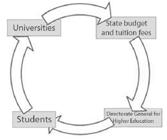
Attention is therefore drawn to the cyclical format in which the payment of support grants to higher education students in Portugal occurs. They are paid by the State to students, who use them to pay tuition fees, a system that is “purposefully constructed to foster a financial machine whose monetary flows are superimposed and respond to globalization” (Santos, 2017, p. 26).
The idea that the State subsidizes support grants masks the configurations it has assumed through neoliberalism - less participation in the provision of social policies. What actually happens with the prioritization of support grants is that the state transfers a financial amount to grant recipients so that they can pay their tuition fees, thereby relieving itself of the responsibility of financially supporting HEIs. “The cycle of monetary transfers is, [in this sense], initiated by the Portuguese State and finalized by it” (Santos, 2017, p. 26).
Figure 1 illustrates this cyclical movement that occurs in ASES services in Portugal.
Rather than investing directly in HEIs, primarily public ones, the Portuguese state chooses to grant financial aid to higher education students on an individual basis, which may or may not be awarded. Thus, the social support system in Portugal reflects the concepts based on the neoliberal State according to which the “universality of rights [is] transformed into individual privileges to be guaranteed to each person” (Carvalho et al., 2010, p. 240).
Through the allocation of support grants, there is a “precarious realization of the right to education” (Antunes and Peroni, 2017, p. 207). Instead of promoting the autonomy and emancipation of the individual, these scholarships, by being consolidated through selectivity, reinforce asymmetries and divisions and ultimately “undermine the democratization and citizenship promised by the expansion of access to education” (Ibid.), which are so widely touted in contemporary Portuguese society.
RESULTS AND DISCUSSION
In Brazil
The AE budget at federal public universities in Brazil for the PNAES primarily comes from the Federal Government, specifically the Ministry of Education (MEC, acronym in Portuguese). The program also receives budgetary support from the universities’ own revenues and from parliamentary amendment funds.
In the Annual Budget Law, Action 4002 - Higher Education Student Assistance1 - is where there is a budgetary link to the PNAES. This action is described as:
financial support for student assistance actions that contribute to the democratization of higher education, based on the implementation of measures aimed at reducing social and ethnic-racial inequalities, accessibility for people with disabilities, improvement of academic performance, and increase of access and retention rates in higher education, primarily for low-income students or those from the public basic education system, enrolled in on-campus undergraduate courses offered by federal and state higher education institutions, including foreign institutions, whose concession is legally relevant, through the provision of food, medical and dental care, accommodation, and transportation, among other typical student assistance initiatives (Brasil, 2022, p. 522).
Chart 1 below shows the amounts allocated to the PNAES for the years 2015 to 2022. Again, almost the entire budget for Action 4002 is allocated to this program, with an average of 97.5% of the committed amounts being allocated to it during the analyzed years.
As shown in Chart 1, the budget for PNAES has undergone reductions that jeopardize the program’s effectiveness and continuity. The current allocation, the committed and settled budget in 2015, in parallel with the year 2022, was reduced by 34, 24, and 24%, respectively. In all the years that were examined, when we look at the committed amounts, the budget amounts decreased except for 2016, 2019, and 2022. The amounts committed to the PNAES in 2022, when compared to 2015, showed a 24% reduction, figures that are equivalent to approximately R$ 327.2 million.
Pereira and Souza (2017, p. 75) argue in favor of the need to promote AE as a right and not as a benevolent policy, or “simply as aid or relief.” The authors subscribe to the view that the paradigm that AE is an intersectoral policy that orbits the fields of social assistance and education, and that it aims to curb the social inequality and injustice imposed by neoliberalism on contemporary society.
For these authors, the PNAES should be understood at the core of the “right to access, remain in, and complete a course, which in a country with profound social inequalities refers to a complex institutional structure in which both the financial aid provided by AE and other forms of support it offers” (Pereira and Souza, 2017, p. 68) will provide mechanisms to mitigate students’ conditions of socioeconomic vulnerability. By alleviating these conditions, the PNAES contributes to citizen autonomy and emancipation.
In this sense, the reduction of resources for the PNAES represents a denial of the right to education and a surrender to market logic, in which equal opportunities are intrinsically related to the merit and ‘ability’ of each individual.
Another point to be exemplified concerns the debate on cuts to social policies and, as outlined here, AE. This debate is linked to the narrative of the need for ‘fiscal adjustments’ and disputes over public funds, and responds to the pressures imposed by capital. As Brettas (2017) points out, these adjustments are made to benefit rentier capital, since:
fiscal austerity and changes in budget management are important tools for channeling public resources to big finance capital and, in this way, acting on the effects of a propagated “fiscal crisis” in order to ensure capitalist accumulation. Thus, public funds are becoming increasingly important in sustaining the profit rates of big capital, reinforcing their structural place in the dynamics of accumulation (Brettas, 2017, p. 66).
Therefore, the path to consolidating AE funding has been marked by both advances and setbacks. It is well known that this path has not been immune to the macroeconomic, political, and social structural determinants that have been in vogue in society at different moments in history.
Thus, the strengthening of AE policy and its funding as unrestricted rights (Salvador, 2012), even in times of fiscal crisis, cannot be reflected without paying attention to the mechanisms of commodification/commoditization of the human being that are prevalent in the new formats of flexible capitalism, based, above all, on neoliberal ideology.
Embarking on ethical political action and consolidating processes of collective resistance would be possible, albeit non-linear and unpredictable, paths to change that would help build new scenarios for AE policy and its financing in Brazil, as sustainable and lasting projects.
IN PORTUGAL
State funding for social support services in higher education in Portugal has faced macroeconomic and financial constraints imposed by neoliberal policies that advocate for the reduction of public spending. “Budget cuts, austerity measures, market insecurity with a weak presence abroad, lack of investment, changes in government, and changes in oversight promote instability and condition the activities of higher education institutions” (Leandro, 2017, p. 75), causing, in turn, a ‘domino effect’ on the financing of social support for students at this stage of education.
There has been a cooling of the State’s role in providing social policies, with direct repercussions on the financing of higher education and social support for students. As a result, there has been “a growing direct responsibility of Portuguese families [in this financing] through the payment of tuition fees, taxes, and other charges” (Partido Comunista Português, 2023), a situation that greatly affects families from the most impoverished social strata. This dynamic has increasingly urged social support services to become self-sustaining and self-financing.
Article 5 of Decree-Law No. 129/93, dated April 24, establishes the sources of funding for social action in higher education. The aforementioned article specifies that, in addition to the annual appropriations allocated through the State budget, the following are also included in the calculation of such budget: revenue from the provision of services within the scope of social action; income from assets owned by social action services in any capacity; revenue from tuition fees that the competent body of the HEI allocates to social action; subsidies, grants, contributions, donations, inheritances, and legacies granted by any entities; account balances from previous years, among other fees, emoluments, fines, or other revenues allocated to them (Portugal, 1993).
The budget for social action in higher education is part of the Portuguese State’s budgetary organization structure, through the Budget Program for Science, Technology, and Higher Education, having been designated as PO10 for the years 2016-2019 and PO13 for the years 2020-2022.
The programmatic guidelines for social support services for students in the Portuguese State Budget Law for higher education included the following guidelines: strengthening social support instruments for higher education attendance; strengthening social support for disadvantaged students through total allocations to the Social Action Fund, reducing the bureaucracy involved in the scholarship allocation process; strengthening the +Superior Program (Programa +Superior, in Portuguese) to support scholarship holders in rural areas; strengthening accommodation for displaced students through the implementation of the National Accommodation Plan for Higher Education; ensuring the promotion of social inclusion for minorities and citizens with special educational needs in scientific and HEIs (namely, by guaranteeing free higher education for students with a disability equal to or greater than 60%); among others.
The budget of the ASES service in Portugal is coordinated by a variety of funding sources, among which the following stand out: the State budget, own revenues, transfers within the public administration, and community funding. Together, these revenues are used to promote a successful academic career. It is through the budgetary composition of these sources of funding that the Portuguese ASES, by offering direct support to students through scholarships, or indirect support through food and accommodation subsidies, for example, seeks to promote access, retention, and completion of higher education, especially for those students coming from less advantaged socio-origins.
It is important to remember that direct social action services in higher education refer to the granting of scholarships and emergency aid, while indirect social support is related to the provision of access to food and accommodation, access to health services, support for cultural and sporting activities, and access to other educational support (Portugal, 2007). Chart 2 below details the amounts spent on direct social action services in higher education in Portugal.
Regarding the total amounts allocated to Direct Social Support, 2020 and 2021 saw the largest reductions in this budget compared to the other analyzed years. The data in Chart 2 show that financial contributions from community funds decreased by EUR 18.6 million in 2020 and by EUR 16.6 million in 2021, both compared to 2019, affecting the total amounts budgeted for this social action.
Chart 2 shows that Direct Social Support services in higher education have been receiving resources primarily from Community Funding. In 2022, these funds provided EUR 82.1 million for social support in Portugal, accounting for 56% of the budget for direct social action.
Despite the importance of revenue from Community Funds in expanding social action resources, these funds are due to “the need for [Portugal] to comply with European Union regulations” (Rolim, 2017, p. 306). Within these guidelines, the higher education system gains relevance and is combined as a “key part of smart specialization strategies” (Rolim, 2017, p. 306). It is important to mention that in order to meet these requirements, higher education systems needed to technically readjust their practices.
By aligning themselves technically with Community Fund projects, Portuguese HEIs and social action services receive a significant amount of financial resources, as shown in the data presented in Chart 2. However, receiving this financial support may be a disguised imposition of ‘choice’ - HEIs must follow the Community Funds requirements in order to complement their sources of funding and thus offer more effective social action services to students who request them.
As for the State budget allocated to this social action, the data in Chart 2 shows that 2019 was the year in which direct social action received the lowest state subsidy, with a contribution of EUR 55.9 million. It is clear from this table that the State budget for this action in 2022 was lower than in 2015.
Continuing with the analysis of the resources allocated to social action in Portugal, Chart 3, detailed below, shows the specifics of the resources allocated to indirect social action in higher education from 2015 to 2022.
From the analysis of Chart 3, it can be seen that, in 2022, the total amount of funds allocated to indirect social action increased by EUR 17.6 million when compared to 2021. The total budget for this action remained relatively stable in 2015, 2016, and 2017, with 2018 showing the highest budgeted resources for this action in the analyzed historical series. In 2020 and 2021, these resources decreased compared to 2018, representing the lowest budgets for this action in the years examined in this study.
As this table shows, Own Revenue sources were those that provided the most resources for indirect social action, except in 2020 and 2021, when they were surpassed by revenues from the State budget. The data in Chart 3 help us to reflect that ‘cost sharing’ in the financing of HEIs and, consequently, in social action services, places a burden on Portuguese families, who incur a large part of the costs of attending higher education. In this sense, and in accordance with Ferreira (2014, p. 29),
“cost sharing” in the face of the State’s progressive withdrawal from the financing of public universities, urging them to seek other sources of funding, resulting mainly in an increase in tuition fees, may constitute a form of discrimination against citizens and contribute to increasing social injustices and inequalities.
From what is shown in Chart 3, it is reasonable to say that indirect social action in higher education is underfunded, given that most of the resources allocated to this action come from the universities’ own resources, which derive largely from the payment of tuition fees by students and their families.
From this perspective, it is worth mentioning the considerations of Crespo (1993). When referring to support for students with regard to the costs of higher education in Portugal, this author highlights the importance of recognizing the value of higher education both for the individual and for society in general. He argues that obtaining a university degree is not only a personal investment, but also an asset that benefits society as a whole. When he sheds light on the idea that a truly developed society is one in which the majority of its population achieves a high level of education, Crespo (1993) recalls the importance of social action in higher education and, therefore, its financing. For him, the pursuit of equal opportunities, implemented in the national interest, is not justified if it excludes young people who, due to economic difficulties, are unable to pursue higher education. From this perspective, it would not be fair for the costs of education to fall exclusively on students and their families.
Thus, the State must not only continue to be the main supporter of social action in higher education, but also seek mechanisms that can consolidate this policy within the scope of the right to education. Therefore, the processes of universalizing this social support for higher education students should be priority agendas that, based on the idea of higher education as a public good and a right, encourage the construction of a more democratic, inclusive, and humane social project in Portugal.
Final considerations
In the course of the reflections outlined here, some conclusions about this subject of study are outlined. Although the research does not intend to compare the policies for financing AE in higher education in Brazil and Portugal, a parallel view allows us to highlight, based on the recognition of particularities (Ciavatta, 2016), similarities and differences in the configuration of financing for this public policy.
In Brazil, the PNAES, although it has established itself as an important policy for assisting undergraduate students, has weaknesses in terms of the continuity of its actions, since there is no specific law that guarantees the maintenance of resources for this policy in each fiscal year, via the public budget. Decree No. 7,234/2010, which established the PNAES, suggests that there is no obligation to provide resources for the implementation of PNAES actions. The budget allocated to this program is not determined by the demand from students at federal public universities, but rather by the availability of resources in the public budget.
In Portugal, the financing of the ASES shows that the State has experienced a decrease in the overall composition of this budget. The resources for maintaining social support have come mainly from Community Funding and Own Revenues from HEIs. In this context, it is possible to say that the budgetary share coming from the own revenues of HEIs in Portugal puts pressure on these institutions to maintain the service activities.
The research findings show that PNAES funding in Brazil, which consists mainly of resources from the federal government, has suffered budget cuts in terms of the amounts committed to this action in all the years of the analyzed historical series, except in 2016, 2019, and 2022.
It was also found that the amounts committed to PNAES in 2022, when compared to 2015, showed a 24% reduction in its budget, equivalent to approximately R$ 327.2 million. This reduction not only indicates the impracticability of increasing the coverage of this policy to serve students from the most impoverished social strata, but also calls into question the sustainability of this program as a policy of the right to higher education.
When looking at the resources allocated to financing the Direct Social Support Service in Portugal, which come from the State budget, it can be seen that they also decreased during the examined historical series, with the exception of the years 2018, 2020, and 2022. This action received funds mainly from Community Funds, which in 2022 contributed EUR 82.1 million to social support, equivalent to 56% of the total budget allocated to direct social action.
As for Indirect Social Support, Own Revenue sources provided the most resources in Portugal. This action highlights the impact of cost sharing in higher education in Portugal and, consequently, on ASES in this country, with direct repercussions for the most impoverished families, given that they are the ones who bear the costs of maintaining such action.
It should therefore be noted that the financing of PNAES in Brazil and ASES in Portugal, in being provided by the State, is subject to the vagaries of neoliberal policies that encourage less participation by this government entity in social policies.
Thus, it is essential to strengthen the financing of AE in Brazil and the ASES in Portugal. This funding needs to be intertwined, as Santos (2017) teaches us, with the idea of a continuous flow of investment, based on the right to education and the promotion of equal opportunities for students, rather than the path that is paved in the current contexts - unstable funding, built on meritocratic, procedural, and compensatory paradigms.
References
- AMARAL, Regiane da Silva; NASCIMENTO, Sara Diniz. Diagnóstico situacional da política de assistência estudantil no âmbito do Instituto Federal do Maranhão: estudo de caso nos Campi Buriticupu e Centro Histórico. In: CONGRESSO DE PESQUISA E INOVAÇÃO DA REDE NORTE NORDESTE DE EDUCAÇÃO TECNOLÓGICA, 2010. Anais [...]. Maceió: IFAL, 2010.
-
ANTUNES, Fátima; PERONI, Vera. Reformas do Estado e políticas públicas: trajetórias de democratização e privatização em educação. Brasil e Portugal, um diálogo entre pesquisas. Revista Portuguesa de Educação, v. 30, n. 1, p. 181-216, 2017. https://doi.org/10.21814/rpe.7399
» https://doi.org/https://doi.org/10.21814/rpe.7399 -
ANTUNES, Ricardo. As novas formas de acumulação do capital e as formas contemporâneas do estranhamento (alienação). Caderno CRH, Salvador, v. 15, n. 37, p. 23-45, jul./dez. 2002. https://doi.org/10.9771/ccrh.v15i37.18601
» https://doi.org/https://doi.org/10.9771/ccrh.v15i37.18601 -
ASSOCIAÇÃO NACIONAL DOS DIRIGENTES DAS INSTITUIÇÕES FEDERAIS DE ENSINO SUPERIOR (ANDIFES). Estatuto. Andifes, 2008. Disponível em: https://www.andifes.org.br/?p=88796 Acesso em: 3 jun. 2023.
» https://www.andifes.org.br/?p=88796 -
BASE DE DADOS DE PORTUGAL CONTEMPORÂNEO (PORDATA). Ação social no ensino superior. Ação social direta (2015-2022). Lisboa: Fundação Francisco Manuel dos Santos, 2022. Disponível em: https://www.pordata.pt Acesso em: 22 out. 2023.
» https://www.pordata.pt -
BRASIL. Constituição da República Federativa do Brasil. Diário Oficial da União, 5 out. 1988. Disponível em: http://www.planalto.gov.br/ccivil_03/constituicao/constituicao.htm Acesso em: 17 jan. 2023.
» http://www.planalto.gov.br/ccivil_03/constituicao/constituicao.htm -
BRASIL. Ministério da Educação. Portaria Normativa n. 39, de 12 de dezembro de 2007. Institui o Programa Nacional de Assistência Estudantil - PNAES. Brasília, DF: Ministério da Educação, 2007. Disponível em: https://portal.ifce.edu.br/documents/6289/Portaria_Normativa_n%C2%BA_39_-_Institui_o_Programa_Nacional_de_Assist%C3%AAncia_Estudan_BKBRn36.pdf Acesso em: 23 out. 2023.
» https://portal.ifce.edu.br/documents/6289/Portaria_Normativa_n%C2%BA_39_-_Institui_o_Programa_Nacional_de_Assist%C3%AAncia_Estudan_BKBRn36.pdf -
BRASIL. Decreto n. 7.234, de 19 de julho de 2010. Dispõe sobre o Programa Nacional de Assistência Estudantil. Brasília, 2010. Disponível em: http://www.planalto.gov.br/ccivil_03/_Ato2007-2010/2010/Decreto/D7234.htm Acesso em: 29 jan. 2023.
» http://www.planalto.gov.br/ccivil_03/_Ato2007-2010/2010/Decreto/D7234.htm -
BRASIL. Ministério da Economia. Lei de Diretrizes Orçamentárias (LOA). Informações complementares: anexo - volume V. 2022. Disponível em: https://www.soc.ufscar.br/consuni/2018/arquivos/pauta-consuni-233/siop_acao_4002.pdf Acesso em: 13 out. 2023.
» https://www.soc.ufscar.br/consuni/2018/arquivos/pauta-consuni-233/siop_acao_4002.pdf -
BRASIL. Ministério do Planejamento e Orçamento. Painel do Orçamento Federal - SIOP. Ação 4002: Assistência ao Estudante de Ensino Superior, 2015-2022. Brasília, DF: Ministério do Planejamento e Orçamento, [2023]. Disponível em: https://www.siop.planejamento.gov.br Acesso em: 21 out. 2023.
» https://www.siop.planejamento.gov.br - BRETTAS, Tatiana. Capitalismo dependente, neoliberalismo e financeirização das políticas sociais no Brasil. Temporalis, Brasília, v. 17, n. 34, jul./dez. 2017.
-
CABRITO, Belmiro Gil. O financiamento do ensino superior em Portugal: entre o estado e o mercado. Educação e Sociedade, Campinas, v. 25, n. 88, p. 977-996, out. 2004. https://doi.org/10.1590/S0101-73302004000300016
» https://doi.org/https://doi.org/10.1590/S0101-73302004000300016 - CARVALHO, Alba Maria Pinho de; BAPTISTA, Maria Manuel; CARVALHO, Maria Michol Pinho de; GRAÇA, Irlene Menezes. Estado e políticas públicas Brasil e Portugal: novas configurações desafios do presente. Revista de Políticas Pública, São Luís, v. 14, n. esp., p. 233-256, ago. 2010.
- CERDEIRA, Luisa. O financiamento do ensino superior português: a partilha de custos. Coimbra: Almedina, 2009.
- CIAVATTA, Maria. A historicidade da pesquisa em educação: desafios teórico metodológicos em trabalho e educação, 1992. In: MOURA, Dante Henrique (org.). Educação profissional: desafios teórico-metodológicos e políticas públicas. Natal: IFRN, 2016. p. 53-74.
-
CIAVATTA, Maria. Estudos comparados: sua epistemologia e sua historicidade. Trabalho, Educação e Saúde, Rio de Janeiro, v. 7, supl. 1, p. 129-151, 2009. https://doi.org/10.1590/S1981-77462009000400007
» https://doi.org/https://doi.org/10.1590/S1981-77462009000400007 - CRESPO, Vitor. Uma universidade para os anos 2000. Mem Martins: Inquérito, 1993.
-
DUTRA, Natalia Gomes dos Reis; SANTOS, Maria de Fátima de Souza. Assistência estudantil sob múltiplos olhares: a disputa de concepções. Ensaio: Avaliação e Políticas Públicas em Educação, Rio de Janeiro, v. 25, n. 94, p. 148-181, 2017. https://doi.org/10.1590/S0104-40362017000100006
» https://doi.org/https://doi.org/10.1590/S0104-40362017000100006 - FERREIRA, Filomena Machado da Cunha. Entre o abandono e o risco do abandono um estudo de caso no ensino superior. 2014. 130f. Dissertação (Mestrado) - Programa de Pós-graduação em Psicologia e Ciências da Educação, Universidade do Porto, Porto, 2014.
- FÓRUM NACIONAL DE PRÓ-REITORES DE ASSUNTOS COMUNITÁRIOS E ESTUDANTIS (FONAPRACE). FONAPRACE: 20 anos (1987-2007). Brasília: Fonaprace, 2008.
-
KOWALSKI, Aline Viero. Os (des)caminhos da política de assistência estudantil e o desafio na garantia de direitos. 2012. 180f. Tese (Doutorado) - Programa de Pós-graduação em Serviço Social, Pontifícia Universidade Católica do Rio Grande do Sul, Porto Alegre, 2012. Disponível em: https://repositorio.pucrs.br/dspace/handle/10923/5137 Acesso em: 22 jan. 2023.
» https://repositorio.pucrs.br/dspace/handle/10923/5137 - LEANDRO, Margarida Maria Ferreira Mota. Os desafios da diversificação das fontes de financiamento no ensino superior público português: o estudo de caso da Universidade do Algarve, da Universidade de Évora, do Instituto Politécnico de Portalegre e do Instituto Politécnico de Lisboa. 2017. 160f. Dissertação (Mestrado em Administração Pública) - Instituto Universitário de Lisboa, Lisboa, 2017.
- MACEDO, Georgia Dantas. Assistência estudantil no contexto da lei de cotas para o ensino superior. In: CONGRESSO NACIONAL DE EDUCAÇÃO, 1., 2014. Anais [...]. Campina Grande, 2014. v. 1.
- MÉSZÁROS, István. A educação para além do capital. Tradução: Isa Tavares. São Paulo: Boitempo, 2005.
-
ORGANIZAÇÃO PARA A COOPERAÇÃO E DESENVOLVIMENTO ECONÔMICO (OCDE). No more failures ten steps to equity in education. The ten steps - executive summary. OCDE, 2007. Disponível em: https://www.oecd-ilibrary.org/education/no-more-failures/the-ten-steps-executive-summary_9789264032606-2-en Acesso em: 2 out. 2023.
» https://www.oecd-ilibrary.org/education/no-more-failures/the-ten-steps-executive-summary_9789264032606-2-en -
PARTIDO COMUNISTA PORTUGUÊS (PCP). O financiamento do ensino superior público. Portugal: PCP. Disponível em: https://www.pcp.pt/financiamento-do-ensino-superior-publico-7 Acesso em: 14 out. 2023.
» https://www.pcp.pt/financiamento-do-ensino-superior-publico-7 - PAVAN, Flavia Rossi Vacari. Definições e rumos na implementação de uma política nacional de assistência ao estudante do ensino superior. 2014. 203f. Dissertação (Mestrado) - Programa de Pós-Graduação em Política Social, Centro de Ciências Jurídicas e Econômicas, Universidade Federal do Espírito Santo, Vitória, 2014.
- PEREIRA, Potyara Amazoneida Pereira; SOUZA, Jacqueline Domiense Almeida de. Assistência estudantil: direito ou mérito? O trabalho de equipes multidisciplinares na assistência estudantil: análise de experiência profissional na UnB. In: YANNOULAS, Silvia Cristina (coord.). O trabalho das equipes multiprofissionais na educação: 10 anos do grupo de pesquisa TEDis. Curitiba: CRV, 2017. p. 17-56.
- PEREIRA, Raquel Ferreira. Ação social no ensino superior português: práticas, estratégias e impactos socioeconômicos. 2019. 520f. Tese (Doutorado) - Universidade Aberta, Portugal, 2019.
-
PORTUGAL. Lei de Bases do Sistema Educativo n. 46 de 14 de outubro de 1986. Diário da República, Portugal, 1986. Disponível em: https://files.dre.pt/1s/1986/10/23700/30673081.pdf Acesso em: 8 out. 2023.
» https://files.dre.pt/1s/1986/10/23700/30673081.pdf -
PORTUGAL. Decreto-Lei n. 129/93, de 22 de abril. Estabelece os princípios da política de acção social no ensino superior. Portugal, 1993. Disponível em: https://diariodarepublica.pt/dr/detalhe/decreto-lei/129-1993-692654 Acesso em: 14 out. 2023.
» https://diariodarepublica.pt/dr/detalhe/decreto-lei/129-1993-692654 -
PORTUGAL. Lei n. 62/2007, de 10 de setembro. Regime jurídico das instituições de ensino superior. Portugal, 2007. Disponível em: https://diariodarepublica.pt/dr/detalhe/lei/62-2007-640339 Acesso em: 7 out. 2023.
» https://diariodarepublica.pt/dr/detalhe/lei/62-2007-640339 - ROLIM, Cássio Frederico Camargo. A experiência de Portugal no âmbito da política regional europeia. In: RESENDE, Guilherme Mendes (org.). Avaliação de políticas públicas no Brasil: uma análise da Política Nacional de Desenvolvimento Regional (PNDR). Brasília: Ipea, 2017. p. 263-309.
- SALVADOR, Evilasio. Fundo público e o financiamento das políticas sociais no Brasil. Serviço Social em Revista, [S. l.], v. 14, n. 2, p. 4-22, 2012.
- SANTOS, Cláudia Priscila Chupel dos. A assistência estudantil brasileira e a ação social portuguesa nas universidades públicas: do conhecimento à prática informada em serviço social. 2017. 396f. Tese (Doutorado) - Instituto Universitário de Lisboa, Lisboa, 2017.
- SILVA, Sirneto Vicente; BEZERRA José Eudes Baima. A reverberação do neoliberalismo na reforma administrativa do Estado Brasileiro. In: NOVAES, Marcos Antônio Barbosa; MADEIROS, Jarles Lúcio; FREIRE, Leiliane Rebouças; SILVA, Daniela Glicea de Oliveira (org.). Educação, Estado e políticas públicas. João Pessoa: Ideia, 2019. p. 137-160.
- TAVARES DA SILVA, Susana Maria Calvo Loureiro. O sector elétrico perante o Estado incentivador, orientador e garantidor. 2008. Tese (Doutorado) - Programa em Ciências Jurídico-Políticas, Faculdade de Direito, Universidade de Coimbra, Coimbra, 2008.
-
VASCONCELOS, Natalia Batista. Programa Nacional de Assistência Estudantil: Uma análise da evolução da assistência estudantil ao longo da história da educação superior no Brasil. Ensino Em-Revista, Uberlândia, v. 17, n. 2, p. 599-616, jul./dez. 2010. https://doi.org/10.14393/ER-v17n2a2010-12
» https://doi.org/https://doi.org/10.14393/ER-v17n2a2010-12
-
1
We note that, in Budget Action 4002, financial resources are also allocated to the Promisaes and Incluir programs; however, in this section, we will only analyze the resources allocated to PNAES.
-
How to cite this article:
LIMA, Cristiane Praciano Lauriano de; FERREIRA, Maria Aparecida dos Santos. Public student funding in higher education: a look at student assistance in Brazil and the social support service in Portugal (2015-2022). Revista Brasileira de Educação, v. 31, e310012, 2026. https://doi.org/10.1590/S1413-24782026310013
-
Funding:
The study received no funding.
-
Declaration of data availability:
The research data are available in the body of the text.
-
Responsible editor:
Terezinha Oliveira https://orcid.org/0000-0001-5349-1059
The research data are available in the body of the text.

 Source: adapted from