
 Gender, race, school dropout and expulsion: why do girls and boys stop attending school?
ABSTRACT
This paper problematizes school dropout in a judicial district in Paraná State, Brazil. It analyzed information from the School Dropout Questionnaire, produced by the judiciary system, as well as efficiency and performance indicators from academic records, intersected with the social markers of race and gender. The theoretical basis drew upon Foucauldian, gender and ethnic-racial studies. The main reasons for dropout differ according to gender: for female students, they are related to family care, while, for male students, they are associated with disinterest. The paper points out that mother-students are displaced into caregiving roles until they are solely identified as mothers. It shows that racism is one of the main factors leading to dropout. And it concludes that, prior to dropout, there is academic failure, which is more common among the Black population, thereby naturalizing a systematic process of exclusion that culminates in the expulsion of certain populations from schools.
Keywords:
Expulsion; Judicialization of School Dropout; Race; Female Students; Male Students
RESUMO
O artigo problematiza a evasão escolar em uma comarca do sul do Paraná. Analisou informações contidas no Questionário Evasão Escolar, produzido pelo judiciário, e indicadores de eficiência e rendimento coletados nos históricos escolares, interseccionados com os marcadores sociais raça e gênero. A fundamentação teórica se utilizou dos estudos foucaultianos, estudos de gênero e de relações étnico-raciais. Os principais motivos da evasão diferem conforme o gênero: nas alunas são relacionados ao cuidado com a família, nos alunos com o desinteresse. Aponta-se que alunas-mães são deslocadas para o cuidado, até que sejam apenas mães. Discute-se como a figura do aluno desinteressado é produzida. Mostra-se que o racismo é um dos principais elementos que produz a evasão. Conclui-se que antes da evasão havia o fracasso escolar, mais intenso na população negra, naturalizando um processo de exclusão sistemático que termina com a expulsão de determinadas populações da escola.
Palavras-chave:
Expulsão; Judicialização da Evasão Escolar; Raça; Alunas; Alunos
RESUMEN
El artículo problematiza el absentismo escolar en una región del sur de Paraná. Se analizó la información del Cuestionario de Evasión Escolar, elaborado por el poder judicial, y los indicadores de eficiencia y desempeño, intersectados con los marcadores sociales de raza y género. La fundamentación teórica se utilizó de los estudios foucaultianos, estudios de género y de las relaciones étnico-raciales. Los principales motivos de absentismo difieren: en las alumnas se relacionan con el cuidado de la familia, en los alumnos se relacionan con el desinterés. Señala que las madres-estudiantes son desplazadas al cuidado, hasta quedar solo madres. Discute cómo se produce la figura del desinteresado. Muestra que el racismo es uno de los principales elementos que produce el absentismo. Concluye que antes de la deserción hubo fracaso escolar, más intenso en la población negra, naturalizándose un proceso de exclusión sistemática que termina con la expulsión de ciertas poblaciones de la escuela.
Palabras clave:
Expulsión; Judicialización del Absentismo Escolar; Raza; Alumnos; Alumnas
INTRODUCTION
School dropout and abandonment are characterized when male and female students stop going to school, without reasons justifiable by legislation. Even with the right to education guaranteed by law and the existence of a Psychosocial Care Network1 that monitors attendance, statistics show the disappearance of a large portion of the population from school desks, year after year, and show that it affects, in a much greater number, those who are Black, poor, mothers, or those who have informal, unpaid, and low-paid jobs. In this article we highlight this population.
The problematizations presented here result from ongoing research, carried out based on an agreement signed in 2022 between the Universidade Federal do Paraná (UFPR) and the Court of Justice of Paraná (Tribunal de Justiça do Paraná — TJPR), of which I was a proponent, and which analyzed the documents that turned the students mentioned in them into dropouts. This agreement allows access to data on dropout in a judicial district in the state of Paraná, Brazil. Michel Foucault teaches us that documents provide clues about practices and ways of living. They allow us "[…] to decipher the relations of power, domination and struggle within which discourses are produced and work" (Foucault, 1997, p. 13, free translation).
This judicial district was chosen because, between 2008 and 2023, it developed actions called "combating school dropout". Since 2015, I have been carrying out research analyzing quantitative data present in the Questionário Evasão Escolar [School Dropout Questionnaire] and enrollment data, which began during my doctorate and is now developed within the Research and Study Group on Trajectories of Female Students (PETRA/UFPR), coordinated by me, and which has monitored the dropout rate of female students in this region year after year. For this study, I will focus on the information collected in 2019, before the impacts of the new coronavirus (COVID-19) pandemic. The research was approved by Opinion 3.511.927 from the Health Sciences Ethics Committee, at UFPR.
The School Dropout Questionnaire was prepared by the judicial branch and is filled out by people who work there during extrajudicial hearings, to which families and students reported as having dropped out are summoned. Each family is called separately, and must address these people, answer questions about their school situation, the reason for dropping out, family composition, socioeconomic status, age, gender, race, and compliance with socio-educational measures. When rights are violated (for example, failure to enroll, alleged lack of daycare space for student-mothers, failure to pay child support, birth certificate without the father's name), the Psychosocial Care Network is communicated to take the necessary measures.
To investigate the school trajectory, I analyzed data contained in enrollments and school transcripts, checking whether before dropping out there was a history of academic failure, materialized in failing grades and withdrawals. I also present excerpts from speeches by students in a dropout situation who attended the extrajudicial hearings: a female student interviewed by me and who mentioned pregnancy as the reason, and a male student deemed as "disinterested", who spoke to the judicial district's judge. Therefore, I bring to this article fragments of the lives of those who are in a dropout situation.
THE ROUTE TO CRIMINALIZING SCHOOL DROPOUT
In this study, we include, in the school dropout concept, school abandonment and infrequent attendance, because this is how it is understood in the surveyed region. We know that these concepts refer to different conditions, but they have absence from school in common. According to the Anísio Teixeira National Institute of Educational Studies and Research (Instituto Nacional de Estudos e Pesquisas Educacionais Anísio Teixeira — INEP) (Brasil, 2020), school dropout is related to definitively leaving school, not completing the stage or level and not being enrolled in any school. School abandonment is defined as a consecutive period of unjustified absences, exceeding 30 days or when students stop going to school one year, but return to and enroll in it in the next. Conversely, school infrequency is characterized by a significant number of absences interspersed with attendance.
It is common to consider the reasons for dropping out as if they resulted from choices. The expression the student has dropped out is full of meanings. Grammar teaches us that the auxiliary verb have/has, along with the past participle form of the main verb, comprises one of the perfect tenses, which are used for events that have already happened in the past, but still have significant consequences in the present. Thus, in "the student has dropped out," there is an action that was performed by the student, a choice that was made by him/her in the past, but which persists in the present. In other words, students in these conditions are held responsible and accountable for a choice.
In this study, we show that dropout is a phenomenon produced by an intense process of classifications, hierarchies, positioning, micro-punishments that make staying at school unsustainable, as the relationship of belonging to learning and socialization spaces is destroyed or harmed. In these cases, there are no alternatives, as there is an entire biopolitical strategy2 that aims to culminate in the exclusion of certain populations that do not align with the economic demands of the benefits of schooling, and that have been operating systematically, year after year. Therefore, in line with the previously mentioned research, I have displaced the concept that explains this dropout process to the concept of expulsion (Célia Ratusniak, 2019; Célia Ratusniak, Maria Rita de Assis César and Carla Clauber da Silva, 2021).
Rosimeire Brito (2009), when researching the academic performance of Black students, uses the term soft expulsion to refer to school failure materialized in failure status. Berenice Bento (2011, p. 558), when analyzing the schooling of transgender people, also used the concept of expulsion, which is produced in school practices that create, in the subject, "[…] the uncomfortable and terrible certainty that he/she is not normal and that, if he/she feels out of place, it is because there is no place for him/her" (free translation). Isaías Oliveira Júnior and Eliane Rose Maio (2016), in turn, problematize how transphobia operates and removes travestis and transgender students, called TS, from school. For the authors, there is a daily rejection constantly manifested, for example, in the impediment to the use of the social name, which affects the feeling of belonging. Hence, dropout is the result of "[…] transphobic pedagogy in the compulsory expulsion of TS, camouflaged under the pretext of academic failure." For Saskia Sassen (2016), expulsion is produced by economic models in which the practices of producing useful subjectivities fail and this process does not result as expected. Thus, it is the result of conditions that make it impossible to stay in a certain space.
It is based on this concept that I will discuss how the school system has been systematically expelling a part of the population that should be in school, despite there being legislation that guarantees access to formal education since the Constitution of 1824 (Brasil, 1824). In its 8th title, called Das Disposições Geraes, e Garantias dos Direitos Civis, e Politicos dos Cidadãos Brazileiros [On General Provisions and Guarantees of Civil and Political Rights of Brazilian Citizens], article 179, item XXXII, determines the guarantee of "Primary and free Instruction to all Citizens"3 (Brasil, 1824, no page).
For Cynthia G. Veiga (2008), access and the right to education in Brazil have historically not guaranteed permanence. Mandatory attendance, as well as free public schools, are recent inventions, which emerged in the 19th century, with the aim of civilizing, producing social cohesion, and preparing bodies and subjectivities for extensive working hours in industries. Initially, they were aimed at poor, Black, and mixed-race children, but the records found by the author showed that many factors prevented children from attending school, from the lack of material to the derogatory way in which they and their families were described in pedagogical reports. In turn, children from more advantaged classes received their initial education through private lessons, as their families found it harmful to live with the uncivilized population.
Access to education in Brazil was regulated by the Constitution of 1824 (Brasil, 1824), which guaranteed the right to primary education, but determined attendance only for male students, which began to be required of female students only in 1882 (Veiga, 2008). The author draws attention to what she called a mistake in the history of education, in which it is common to say that Black children could not attend school. In 1854, there was a ban on the attendance of enslaved children, but the free Black population was considerable. According to records of that time, the number of Black and mixed-race people was greater than that of white people, and this fact led Veiga to verify, based on school records, that they were in schools. This production of discourses that subordinated these children "[…] in Brazilian society was carried out through various practices, including written records or as the domain of the group that called itself bearers of civilized attitudes" (Veiga, 2008, p. 506, free translation).
Education as a right guaranteed by the State and the family, free and mandatory, appears in the Constitution of 1934 (Brasil, 1934) with the role of strengthening the idea of nation, boosting development, and constituting the morality of the Brazilian population. These purposes made it necessary to build mechanisms that would induce or force families to enroll and guarantee the attendance of their sons and daughters at school, materialized in the crime of intellectual abandonment, provided for in the Civil Code of 1940 and defined as: "Failing, without appropriate cause, to provide primary education for a child of school age: Penalty — detention from fifteen days to one month, or fine" (Brasil, 1940, no page). It is the beginning of the criminalization of school dropout that, according to Cynthia G. Veiga (2008), already existed in the last century, with legislation regulated in Minas Gerais in 1835 that determined fines for families that did not enroll and send their sons and daughters to schools. If they failed to do so, fathers and mothers would have their names on lists of absentees that were posted in public places. The 1940's code regulated local practices that had already been taking place at the national level.
The Constitution of 1988 (Brasil, 1988) established mandatory schooling initially from the age of seven to 14, later extended with the 59/2009 Constitutional Amendment, from the age of four to 17. This right is regulated by the National Education Guidelines and Framework Law (Lei de Diretrizes e Bases da Educação Nacional — LDBEN), in article 12, which highlights the school's obligation to
notify the Municipal Guardianship Council, the competent judge of the Judicial District, and the respective representative of the Public Prosecutor's Office on the list of students who present a number of absences above fifty percent of the percentage allowed by law. (Brasil, 1996, no page)
It is in the Child and Adolescent Statute (Estatuto da Criança e do Adolescente — ECA) that the system of guaranteeing rights is structured, and which constitutes a network of institutions — such as the Guardianship Council, Public Prosecutor's Office, Children's Courts — that are responsible for guaranteeing these rights, monitoring their provision, and punishing those who are not guaranteeing them (Brasil, 1990).
These legislations, institutions, practices, and discourses compose what Michel Foucault called an apparatus:
[…] a decidedly heterogeneous set, which includes discourses, institutions, architectural arrangements, regulatory decisions, laws, administrative measures, scientific statements, philosophical, moral, and philanthropic propositions. (Foucault, 2014, p. 45, free translation)
The apparatus aims to guide conduct, govern children and adolescents based on a norm, transforming them into students, thus guaranteeing the production of human capital (Foucault, 2008). It also operates based on a reporting system that, with the intention of guaranteeing school attendance and capturing those who stay away from school, has attributed dropout with judicial value and made the families of those who do not attend school the defendants. The school, Guardianship Council, Public Prosecutor's Office, and the community denounce the dropout, investigate its causes, notify, and summon it. If none of this guarantees a return, the process for intellectual abandonment begins.
THE CAPTURE OF STUDENTS WHO DROP OUT
In the Constitution (Brasil, 1988), in the ECA (Brasil, 1990) and in the LDBEN (Brasil, 1996), the right to education has as one of its objectives the qualification for work. Based on the conception of the school as a promoter of insertion in the world of work, mechanisms are multiplying to capture those who can cause a failure in the production of qualified labor in line with the profile defined by the market. Therefore, several strategies for monitoring and denouncing individuals who deviate from this route are instituted — biopolitics that aim to produce ways of living and managing childhood, adolescence, and youth to generate the figure of a productive or entrepreneurial person. Let us look at some of the mechanisms by which they operate.
At a national level, the Sistema Presença [Attendance System], created by the Brazilian Ministry of Education in 2005, has as one of its objectives the control of the attendance of beneficiaries of Bolsa Família (social welfare program of the Brazilian Government). This project proposes school attendance as a conditionality related to education that is imposed on families to receive the benefit, monitoring absences and reasons for dropping out of school. It has a system that is fed by people responsible for Bolsa Família in schools and education networks. As of 2018, this project became the responsibility of the INEP (Brasil, 2018).
The Programa Fica Comigo [Stay with me Program] was created by the Public Prosecutor's Office. It started in Paraná in 2005, with the aim of combating school dropout rates. Its objectives were to create attendance control mechanisms, statistical surveys, studies with the Psychosocial Care Network, training and mapping of the causes for dropping out (Paraná, 2009). The program used the Absentee Student Communication Form (Ficha de Comunicação do Aluno Ausente — FICA), which had to be completed in the system, reporting the actions taken for those who dropped out of school to return. If this did not happen, the situation would be forwarded to the Guardianship Council and the Public Prosecutor's Office, which would also have to complete their actions and forward them to other sectors. Once all attempts were exhausted, the dropout complaint would be forwarded to the Children, Youth, Family and Related Departments Court.
The slowness of the procedures before reaching the judicial branch meant that the trial of cases for intellectual abandonment took place when there was no longer the possibility of a successful return, as dropout already represented more than 25%, the maximum limit of absences allowed by law. Therefore, in 2008, the judge of the researched judicial district developed the Projeto Combate à Evasão Escolar [Combating School Dropout Project], which involved the education and Psychosocial Care networks in the region's municipalities. These networks must inform the judicial branch of dropout and non-attendance by March. In April and May, the judge, prosecutor, and other judicial technicians organize extrajudicial hearings, and summon guardians and students who have dropped out. It is at these hearings that the School Dropout Questionnaire is completed.
These projects and programs show an entire apparatus for returning to the norm, with the aim of guaranteeing the population leaving school the development called by LDBEN (Brasil, 1996) as full, the exercise of citizenship, and entry into the world of work. But we should question it. Robert Castel (2005) and Ulrich Beck (2011) will alert us to the fallacy of schooling as an indisputable promoter of insertion in the world of work. Castel (2005) uses the term unemployable to refer to the population who have education, but no experience. Beck (2011) alerts us to the conversion of schools into a "[…] warehouse for unemployed young people. As an educational ‘juvenile home,’ it sits somewhere between the street and prison" (Beck, 2011, p. 226, free translation).
Both sociologists alert us to the mischaracterization of the social function of the school provided for in the legislation and its conversion into a space for risk protection and a passport for employment, which the current scenario does not confirm. Maria Andréia Parente Lameiras (2021), technician of the Applied Economic Research Institute (Instituto de Pesquisa Econômica Aplicada — IPEA) attests to this: in the fourth quarter of 2020, the unemployment rate between the population aged 18 and 24 years reached 29.8%. This means almost 4.1 million young people without jobs. If we analyzed this rate considering gender, race, and level of education, we would have a more worrisome scenario. I emphasize that the school does have a very great importance in the production of social mobility, but holding each student responsible for failure in this trajectory results in their expulsion, which materializes in the refusal to continue in a space that daily attests to their incompetence.
We can raise the issue that the attempts to capture those who are in a situation of dropout through these projects and programs appear much more like a control tactic to monitor certain childhoods and adolescences that continues through returns and leaves until they turn 18 years old, than effectively as an offer of re-insertion. The data that will be presented on school performance confirm this hypothesis.
The analysis of the alleged reasons for school dropout, mentioned in the School Dropout Questionnaire — an instrument produced and applied by the researched judicial district in the extrajudicial hearings to which students and their families are summoned —, brings as the biggest reason for the dropout of female students the care for the family. For male students, it is disinterest. I will deal with these two issues separately here, as a strategy to affirm that gender is a marker that produces social positions to which these students are displaced if they do not perform as expected. Gender, intersected with class and race, is a marker that produces disadvantages, which defines who is worth investing in and which determines the expulsion of certain populations from school, forming the group of unemployable people.
THE ERASURE OF THE FEMALE STUDENT AND THE INSCRIPTION OF THE MOTHER
Children take time. Children are no joke. Now she got pregnant, now she's going to be… once, I don't know who said it, one of the teachers: now she's a failure because she got pregnant… In this life, what future will you have? There's a lot of that, you know. And I've seen a lot too, from my friends… I have several friends who got pregnant at the age of 15, 14. They stopped studying, like, they lost a year of… because the teachers judged them. A year of her life was lost, because of the baby, because of the unexpected pregnancy. All of this matters, and also what they say to us at school. The teachers who are unfriendly, who say this, seem clueless… 4
When the reason for dropping out is pregnancy or motherhood, the processes for intellectual abandonment are suspended until the student-mother finds the conditions to return to school. The Social Care Network notifies the municipality where the student studies to make a place available in daycare, but this may be offered in an institution far from her residence, in a shift different from that attended by the student, or the place may not be made available. The low coverage of daycare centers means that criteria are created for access to the right to early childhood education, and being a student is hardly among them. In the largest municipality in the judicial district, for example, in 2019, one of the documents required to register for daycare centers was proof of school attendance, which already eliminated student-mothers who were not studying because they had no one to leave their children with.
In extrajudicial hearings, the Psychosocial Care Network acts to guarantee the rights of the child, even before they are born, referring the student to prenatal care and social projects, which guarantees surveillance of the mother-student's conduct, in order to transform her into a good enough mother.
Along with this initiative by the State, a process of moralization also takes place. Denunciation of pregnancy at a time incompatible with the provisions of the sexual apparatus5 that regulates women's bodies to ideal conditions for motherhood produces judgment and sentences the adolescent to the care of her family. "You made it, right? Take care of it!" Often, there is pressure to live with the child's father, materialized in expulsion from home and a transfer of control of the child's life from the father or mother to the partner. At hearings, they must be accompanied by these people appointed as guardians.
Pregnancy and motherhood in adolescence are the failure of the sexual apparatus that governs women's lives, and which recommends motherhood when you are an adult, with a heterosexual family and sufficient income to support the child or outsource the care. The penalty for anyone who dares to deviate from this route is to bear responsibility for the child, ratifying the social determination of family care as a primarily feminine task, which must be carried out by the mother.
Flávia Biroli (2018) warns us that discourses about strengthening families based on the heteronormative model produce social positions for men as providers and women as caregivers. These positions have decisive consequences for women's schooling. This is attested by the Education Module of the Continuous PNAD6 of 2016, which reported caring for the family as the second biggest reason for students dropping out of school: one in four young people aged 14 to 29 years who were out of school reported domestic work and caring for children and older people as the reason, a number 30 times higher than that of men in these conditions (Adriana Saraiva, 2018).
In the research I have been carrying out through an agreement with the TJPR, I found similar data. In 2019, the judicial district summoned 429 families to extrajudicial hearings, 190 of which reported students who had dropped out of school. A total of 65 students and/or family members attended the summons. Of these, 37% mentioned family care as a reason. Of this total, 10% were pregnant, 40% were mothers, and 55% were married or had a common-law marriage.
The most frequent reasons listed by students and their families are presented in Graph 1.

The intersectional analysis of the social markers gender, race, and economic status proposed by Kimberlé Crenshaw (2002) and by Patricia Hill Collins and Sirma Bilge (2021) makes clear who is the population penalized by the criminalization of school dropout. Data collected from the School Dropout Questionnaire showed that 3% have no income, 58% have a family income of less than one minimum wage, and 36% have up to two wages.
Of the 190 families of students summoned, it was possible to obtain information on the race/skin color of 157 students based on the data contained in the aforementioned questionnaire or in the State System for School Registry (SERE), totaling 42% Black people, 55% white people, 0.6% Indigenous people, and 3% unreported. The percentage of self-reported Black students in the region is 16.5%. This datum shows that, proportionally, school dropout is higher among Black female students. Let us now look at the condition of these students, specifically.
Black female students who were married or had a common-law marriage accounted for 70%. Of those who reported pregnancy as a reason for dropout, 53% were Black. Black student-mothers accounted for 85% of those summoned. Finally, 100% of the female students who were prohibited from attending school by their partners were Black. It is worth noting that it is possible to choose more than one option in the School Dropout Questionnaire. For instance, claiming to have young children and being married or having a common-law marriage.
By analyzing family care, dropout rates, race, and school performance, we trace the path of institutional racism (Sílvio de Almeida, 2021) that expels Black female students with greater emphasis from formal schooling. These data were collected from school transcripts and enrollment data (Table 1).
It should be noted that 16.5% of female students in the surveyed region reported to be Black. The high percentage of failure by grade and attendance shows us that, before these students became pregnant, became mothers or got married/entered into a common-law marriage, there was a condition of non-learning. Another fact that draws attention in this table is the "passed by the Class Council" status: 18% were Black pregnant students and 83% were white. For those who are married or have a common-law marriage, this difference is also large: only 28% were Black students. The Class Council is a meeting of teachers that can decide to pass a student, even if their performance during the year has not reached the minimum required performance. This passing status is a new chance, given to those believed to be capable of following the learning process in the new class, to have potential. Our data evidence what Marília Pinto de Carvalho (2004; 2005) had already found in her research on how assessment processes reflect class, gender, and race relations, and are permeated by conceptions about who is a good student and, in our case, who deserves another chance.
In the scientific initiation research carried out by me together with Natália Amorim (Amorim and Ratusniak, 2022), we found that it is very difficult for student-mothers who reported pregnancy or motherhood as the reason for dropping out to resume their studies and complete high school. Analyzing the data produced by the 2019's Projeto Combate à Evasão Escolar, we found that of the 25 students in these conditions 14 did not renew their enrollment, five enrolled in youth and adult education (educação de jovens e adultos — EJA), two were transferred, and two returned to regular education. All female students who enrolled in EJA dropped out, and one, who enrolled in high school, also dropped out. Of the 25 students surveyed, only one graduated from high school. When analyzing race, we found that 56% were Black. It is worth resuming that that the percentage of Black students in the region is 16.5%.
These data show us racism operating in schools and producing school failure. It works so well because it operates in a subtle, fine, almost imperceptible way, but which gains strength due to its constancy. Sueli Carneiro (2005) coined the term "raciality apparatus" to refer to the practices of discrimination that operate racism, based on a displacement of Michel Foucault's (2014) concept of apparatus. The raciality apparatus encompasses practices, norms, discourses, structures, and policies that produce subalternities. For the sociologist, this concept is a tool that
offers theoretical resources capable of understanding the heterogeneity of practices that racism and racial discrimination engender in Brazilian society, the nature of these practices, the way in which they are articulated and fed back or realigned to fulfill a certain strategic objective. (Carneiro, 2005, p. 39, free translation)
Before dropout and abandonment there is school failure, produced by a long system of exams, classifications, and micro-punishments addressed to these students. Apparently, academic performance would result from personal effort, from interest, but our analyses point to it as one of the effects of institutional racism. The research by Fúlvia Rosemberg and Regina Pahim Pinto (1997), Marília Pinto de Carvalho (2004; 2005), Fúlvia Rosemberg (2005), Rosemeire Brito (2009), Andreia Botelho Rezende and Marília Pinto De Carvalho (2012) emphasizes that the intersection of social markers gender, race, and social class produce school failure. Their analyses offer us elements to understand the route of expulsion and how the accumulation of these social markers produces barriers in the learning and socialization process. For Kimberlé Crenshaw,
Intersectional discrimination is particularly difficult to identify in contexts in which economic, cultural, and social forces silently shape the background in ways that place women in a position where they are affected by other systems of subordination. Because it is so common, to the point of seeming a fact of life, natural or at least immutable, this (structural) background is often invisible. […] To grasp discrimination as an intersectional problem, the racial or gender dimensions, which are part of the structure, would have to be placed in the foreground, as factors that contribute to the production of subordination (Crenshaw, 2002, p. 176, free translation).
The use of intersectionality as an analytical tool allows us to understand how school trajectories permeated by non-learning and institutional racism create in these students a feeling of incompetence, non-belonging, and non-recognition, causing a shift in their life projects of social mobility promised by schooling for the social recognition offered by the constitution of a family, meeting the demand for motherhood that the sexual apparatus attributes to women. Therefore, the female student is erased and the mother is inscribed in her place.
MALE STUDENTS’ DROPOUT: EDUCATION AS A SHIELD FOR VIOLENCE
Student – Sir, I work with yerba mate crops, and I don't want to go back to school. Why did we ask to talk to you here after all? To stop the Guardianship Council from coming to my house, because I'm not going to go back to school.
Judge – But the Council goes there because we care about you.
Student – Sir, it's a pain in the ass. They get there and piss me off.
Judge – But your work, why don't you study at night?
Student – Sir, I get home tired at night. There's no way… I wake up at 5 am, I arrive, eat, take a shower and go to bed. I sleep early. By 10 o'clock I'm sleeping. By 10 o'clock I'd still be at school. How would I do that? There's no way…
Judge – But you can do it by subject, you only go once a week, you go on Friday.
Student – But I also work on Saturdays. And there's another thing: I don't want to! I like what I do. If I leave my job there…
Judge – Wouldn't you like to be a boss?
Student – If I wanted to go back, there wouldn't be a place anymore. Someone will take my place, and I won't be able to return.
[…]
Student – Oh, and another thing, sir: my salary is good there, I don't need to earn more. […] And I'll say more, sir, there are a lot of my colleagues there, they're back to school, and when I take the bus there, everyone is smoking marijuana at the school entrance. I don't drink, I don't smoke cigarettes, I don't use any kind of drugs. And they're there… they're back to studying, but they're smoking marijuana outside the school, and I'm here. And I need to help my mother. My mother can't work, the family's only income is mine. And I have a 13-year-old brother. My brother is laying there on his cell phone all day. Why doesn't the Council go after him? He needs it, he does… Why didn't you call him here today?
[…]
Judge – Gee, so-and-so, wouldn't it be cool for you to get another job? They have several jobs on a rural property, how about taking an Agronomy course, you know?
Student – Sir, this thing about going back to school and continuing studying… I want to know where there will be jobs for everyone. There won't be jobs for everyone. 7
The need of the student who takes part in the above dialogue to seek support for his family has transformed him into a worker. His father was murdered, his mother is sick, his younger brother depends on his money. He has a family to support. He is 16 years old. Not everyone who is 16 years old can be a teenager. He is an adult. The adolescence of developmental psychology manuals does not accommodate this life.
Neoliberal economic rationality requires educational institutions to produce subjectivities regulated to the production of human capital, which construct profiles to be produced. These profiles are composed of characteristics such as resilience, proactivity, creativity, interest, emotional intelligence, and a series of adjectives that must be developed for one to be employable. In the schooling process, successive classifications and reclassifications select students who accumulate these characteristics, produced from interest: if they are interested, they guarantee their permanence in school and are worth the investment made in them. The logic of meritocracy deceives us with the equality of opportunities that would be taken advantage of by the interest in studying. One of the elements that feeds the production of inequalities at school is making people believe that school failure is the result of this lack of interest, of people who do not value education, who do not want to study, who are interested in other things.
In research on education carried out in the field of economics, such as in the works of Kalinka Becker and Ana L. Kassouf (2017), and Daniel Cerqueira et al. (2016), we found lack of interest as a risk factor for crime. Accordingly, the school would be a shield that would protect students against violence, a place where they would be protected and supervised. In the first years in which the judicial district developed actions to combat school dropout, one of the practices carried out was recording a statement from a young man convicted of drug trafficking and presenting this recording in extrajudicial hearings to which students and family members were summoned, warning them about the risks of being out of school and becoming involved in crime. If we consider that the Black population has the worst academic performance rates, as shown by Priscila Cruz and Luciano Monteiro (2020) in the Anuário Da Educação Básica [Basic Education Yearbook], we can conclude that the link between being a dropout and entering the world of crime fuels structural racism and youth criminalization.
This relationship between lack of interest, dropout, and crime is not confirmed by our analyses. In 2019, of the 239 students summoned to extrajudicial hearings, only 22 were complying or had complied with socio-educational measures, that is, 9.2%. Of these, five mentioned lack of interest as the reason for dropping out. What the data show and what draws attention is that school failure is strongly present. Of these 22 students, we obtained information about the academic trajectory of 20, of which 12 had failed by grade, 11 had passed by the Class Council, and 14 had failed due to attendance or had dropped out. Everyone was in at least one of these conditions. Regarding race, we obtained information from 19 students: 12 white and seven Black.
According to the Relatório da Pesquisa Nacional das Medidas Socioeducativas em Meio Aberto no Sistema Único de Serviço Social [Report of the National Survey on Socio-educational Measures in the Open Environment in the Unified Social Service System] (SUAS), in 2018, 11,207 adolescents and young people complied with socio-educational measures, but the item "race" was not included in the evaluation of measures in an open environment, only in the semi-freedom or hospitalization. Under these conditions, 60% are Black and 22%, white (Brasil, 2019). We still need to analyze the type of infraction and the socio-educational measure imposed to understand whether this condition could be a "gateway" into the world of crime, and whether the data from the region align with what was found in the national survey.
The justification for dropping out due to lack of interest hides a slow process of school failure, which has expulsion as one of its effects. The successive returns and dropouts prove that, for these students, the promise of school as an opportunity for social mobility is not fulfilled. The academic failure in which they persist for years shifts their life project to other interests, such as entering the world of work, materialized in the conditions of being employed, unemployed, informal worker, or even being within illegalisms. It should be noted that biopolitics produce the interests that guide the ways of being and living of children, adolescents, and young people, and which place the promise of employment and access to consumption in schooling. Therefore, being disinterested is a departure from the norm.
The school is an institution that aims to form productive subjectivities. Michel Foucault (2015) problematized the refusals to bend to this logic, which constituted what he called the illegalisms of dissipation. This refusal to become productive brings harm: "[…] the laborer should think about the harm to industry workers" (Foucault, 2015, p. 173, free translation). Thus, anyone who did not allocate their time to work was criminalized. Spare time is the ideal condition for the production of people called criminals, who began to call themselves vagrants: "[…] vagrancy is the element from which other crimes will be specified. It is the general matrix of crime" (Foucault, 2015, p. 43, free translation).
For the philosopher, illegalisms were materialized in the lack of savings, idleness, irregularity, waste, in the refusal to form or care for a family, intemperance, early marriages, disorderly living, non-obedience to the laws, not settling down, not going to school or not being interested in it, refusing to improve oneself for work, lack of hygiene and personal care, and in the inappropriate use of time off. The vagrant would be someone who does not settle down and does not produce (Foucault, 2015). By analyzing the transcripts of the so-called disinterested students, we found elements that compose these absences: successive withdrawals, transfers, non-attendance, failures. Hence, bringing them back to school would allow them to settle in.
The criminalization of illegalisms is a biopolitical strategy to return to the norm. The Brazilian Criminal Code of 1889 (Brasil, 1890), published in the year after the so-called slavery abolition, is an example of this. Chapter XIII, called Dos Vadios e Capoeiras [On Vagrants and Capoeiras], it determined punishments linking the crime of vagrancy to the lifestyles of Black populations who worked on city streets. The criminalization of vagrancy in Brazil was researched by Marina Vieira de Carvalho (2006), who tells us that these activities were not in line with capitalist modes of production: "[…] in the view of the deputies, when Black people were freed, instead of metamorphosing into salaried workers, they became vagrants, preferring a life of vice and idleness to pursuing a legal occupation" (Carvalho, 2006, p. 7, free translation).
This process of criminalization of the ways of life and cultural practices of the Black population, based on scientific racism and eugenic theories that had great support in Brazil, fueled structural racism (Almeida, 2021), and produced the belief in a lower intellectual capacity of Black people and a tendency toward idleness. The website Trajetórias de Sucesso Escolar [Trajectories of School Success] shows the result of these beliefs: of the 2.6 million students who fail in state and municipal schools in Brazil, 1.2 million are Black and mixed-race, who, together with Indigenous people, total 22%. The percentage of white students who fail is 6.5% (UNICEF, 2021).
This belief impacts the learning opportunities that are offered in schools. Marília Pinto de Carvalho (2005) shows that racial belonging has a direct influence on the evaluations made by teachers in the initial years, who whitened students with good performance and blackened those who performed below average (Carvalho, 2005). The research data presented here, taken from the School Dropout Questionnaire and enrollment information, show the effects of structural racism on producing the figure of the disinterested student. They show that there is a long path of exclusion, until they become dropouts.
Of the 429 students in a dropout situation summoned to extrajudicial hearings, 239 were male students, a percentage of 55%. Of these, 30% were Black male students. The most frequent reason for dropping out was lack of interest, with 29%, followed by work, with 12%, as shown in Graph 2.
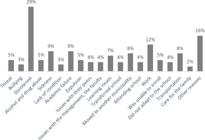
The most frequent reason for student dropout was lack of interest, at 29%. The second was work, which accounted for 12% of responses. When we analyzed the race of these students, we found something that surprised us: only 10% were Black. This finding raised a question that still needs to be further problematized: why do the discourses and practices that produce the figure of the disinterested student operate more intensely among white students? Why are Black students not appointed that way?
To better understand this issue, I analyzed the reasons for dropping out specifically among Black students. The conditions mentioned in the School Dropout Questionnaire point to performance, that is, they are not learning, considering that 14% mentioned failures or learning issues as reasons for dropping out. Secondly, 12.5% mentioned problems with the school, consisting of expulsion and the relationship with the management team. Thirdly, 12% mentioned transfers. These data lead us to infer that appointing students as disinterested means that they can still be re-included, they still have a chance. They just need to be interested in it. Unlike Black students, for white students it is not a matter of intellectual capacity, behavioral problems or changes, but of will. They just need to be interested in it.
The discourse of meritocracy, which bases and legitimizes the production of the figure of the disinterested student, legitimizes inequalities, as it places responsibility for the lack of opportunities on the subject. This logic hides the selection process that the school operates, and the fact that not even those who manage to advance in schooling have guaranteed social mobility. Ulrich Beck (2011) calls schools "waiting rooms," incapable of qualifying individuals for a job market that does not offer enough places for everyone, as the student in the epigraph rightly points out. The sociologist draws the analogy between the educational system and a ghost station:
Those who want to travel — and who wants to stay at home when staying at home means the end of any prospect of future — must join some of the lines at the counters that sell tickets for trains that are already full or will not even depart for the indicated direction (Beck, 2011, p. 219, free translation).
The economic model that has been imposed on us constantly tries to transform the school into this station. Subduing the ability to understand the world at hand, it offers passages with passing grades, awards, medals, advancement in stages and levels of schooling, in a competition that stimulates individualism and transforms the accumulation of advantages produced by the privileges of whiteness (Bento, 2022) into personal merit.
The dialogue between the judge and the dropout presented in the epigraph evidences what research in the field of economics hides, but which the adolescent has already established so well: there are no jobs for everyone. Remaining in school will only produce social mobility if there are opportunities. The discourse of meritocracy supported by institutional racism transforms lack of opportunities into a lack of interest and effort. Resigned to their failure, resigned to having an income, these youth submit themselves to conditions similar to slave labor.
This condition that pushes teenagers to work without proper employment follows many of those who, like the student mentioned here, claimed lack of interest as a reason for dropping out of school. They have already discovered that the school does not fulfill its promise of access to employment for all the people who pass through it. They have become disinterested, as they already know that this trip does not offer a passport to economic mobility. Regardless of what they do, there will not be jobs for everyone.
CONCLUSIONS
One of the criticisms I get about my research is that it sounds pessimistic. Fair enough: it is. Like Saramago (Dessa, 1997), I believe that pessimistic people are unhappy with the world. Optimists like it as it is.
Here I bring data that denounce the systematic expulsion of a certain portion of the population of mandatory schooling age. According to the data, the conformation of bodies and subjectivities is produced based on the social positions to which male and female students are destined, considering race as a fundamental marker to determine who stays and who leaves.
According to the main reasons for dropout of those who had their family summoned to the extrajudicial hearings of the Projeto Combate à Evasão Escolar in the surveyed judicial district, in the female students, they are related to care, in a student's erasure for the mother's inscription. Pushed into the domestic space, they take care of their family, waiting for favorable conditions for them to return, which often only comes when their sons and daughters are grown and their chances of entering the formal job market decrease. What they are left with, almost always, is low-paid employment, volunteering, or work that is not socially recognized.
In male students, the reasons are related to the production of the figure of the disinterested, whose interest would be shifting to attempts to enter the job market or occupations that would compose what Foucault (2015) called illegalisms. No matter how much we try to make them stay at school so that they can be monitored, avoiding the risks of becoming criminals or non-productive, the disadvantages caused by gender and race/skin color prevent them from staying. They are not inside and cannot be outside, as they are forced to return under the threat of their families being prosecuted and condemned. Every day expelled to the margins, they remain there until they drop out. If the school is a shield for violence, it is also a funnel where only those worth the investment remain.
Research on school dropout rates in the judicial district continues, and in 2022 we established a technical cooperation agreement with the Court of Justice of Paraná (TJPR) to investigate the impact of the COVID-19 pandemic on the school life of students in that district. When people ask me why continue studying such brutal inequalities in such difficult times, I answer: because it is necessary; so that, one day, we can all choose the train's destination.
-
1
Composed of specialists from the Municipal Departments of Education, Health, Social Initiatives, Guardianship Council, Public Prosecutor's Office, Children and Family Court, entities providing care and welcome for children and adolescents.
-
2
For Michel Foucault (1988, p. 134), we speak of biopolitics "[…] to designate what makes life and its mechanisms enter the domain of explicit calculations, and makes power-knowledge an agent of transformation of human life" (free translation). It is the knowledge that is transformed into practices and strategies that aim to guide conducts, that is, policies that aim to act on the lives of childhood, adolescence, and youth to produce the subject for the job market.
-
3
The spelling of the time was kept in the Portuguese title.
-
4
Student-mother in a situation of dropout interviewed in 2018 during doctoral research in the same judicial district (Ratusniak, 2019), and who in 2019 had not returned to school.
-
5
The concept is problematized by Foucault in a more systematized way in History of Sexuality, volume I. Silvana Darré (2013) also problematizes this concept, using it to discuss gender technologies that produce subjectivities linked to motherhood, highlighting that modernity has attributed the mother with the task of producing the future. The concept is also problematized by Silvia Alexim Nunes (2013), who discusses the biopolitics that regulate women's bodies in an intense process of medicalization to align them with the most appropriate conditions for motherhood, in which adolescence does not take part.
-
6
National Household Sample Survey, carried out by the Brazilian Institute of Geography and Statistics (IBGE).
-
7
Male student in a situation of dropout whose alleged reason was lack of interest. This conversation was reported by the judge, interviewed in 2018 in doctoral research (Ratusniak, 2019).
-
Funding:
The study didn't receive funding.
References
- ALMEIDA, Silvio Luiz de. Racismo estrutural São Paulo: Sueli Carneiro; Editora Jandaíra, 2021.
- AMORIM, Natália F.; RATUSNIAK, Célia. Estudantes grávidas na Educação Básica: trajetórias escolares Relatório (Iniciação Científica). Semana Integrada de Ensino, Pesquisa e Extensão (SIEPE). Curitiba: Universidade Federal do Paraná, 2022.
- BECK, Ulrich. Sociedade de risco São Paulo: Editora 34, 2011.
-
BECKER, Kalinca Léia; KASSOUF, Ana Lúcia. Uma análise do efeito dos gastos públicos em educação sobre a criminalidade no Brasil. Economia e Sociedade, v. 26, n. 1, p. 215-242, abr. 2017. Disponível em: https://www.scielo.br/scielo.php?script=sci_arttext&pid=S0104-06182017000100215&lng=pt&tlng=pt. Acesso em: 28 mar. 2018.
» https://www.scielo.br/scielo.php?script=sci_arttext&pid=S0104-06182017000100215&lng=pt&tlng=pt -
BENTO, Berenice. Na escola se aprende que a diferença faz a diferença. Revista Estudos Feminista, v. 19, n. 2, p. 549-559, ago. 2011. Disponível em: https://www.scielo.br/scielo.php?script=sci_arttext&pid=S0104-026X2011000200016&lng=pt&tlng=pt. Acesso em: 20 out. 2022.
» https://www.scielo.br/scielo.php?script=sci_arttext&pid=S0104-026X2011000200016&lng=pt&tlng=pt - BENTO, Cida. Pacto da branquitude São Paulo: Companhia das Letras, 2022.
- BIROLI, Flávia. Gênero e desigualdades: os limites da democracia no Brasil. São Paulo: Boitempo, 2018.
-
BRASIL. Constituição política do Império do Brazil de 25 de março de 1824 Disponível em: https://www.planalto.gov.br/ccivil_03/constituicao/constituicao24.htm Acesso em: 23 jun. 2023.
» https://www.planalto.gov.br/ccivil_03/constituicao/constituicao24.htm -
BRASIL. Decreto n° 847, de 11 de outubro de 1890 Código Penal dos Estados Unidos do Brasil. Disponível em: https://www.planalto.gov.br/ccivil_03/decreto/1851-1899/d847.htm#:~:text=DECRETO%20N°%20847%2C%20DE%2011%20DE%20OUTUBRO%20DE%201890.&text=Promulga%20o%20Codigo%20Penal.&text=Art.,que%20não%20estejam%20previamente%20estabelecidas. Acesso em: 23 jun. 2023.
» https://www.planalto.gov.br/ccivil_03/decreto/1851-1899/d847.htm#:~:text=DECRETO%20N°%20847%2C%20DE%2011%20DE%20OUTUBRO%20DE%201890.&text=Promulga%20o%20Codigo%20Penal.&text=Art.,que%20não%20estejam%20previamente%20estabelecidas -
BRASIL. Constituição da República dos Estados Unidos do Brasil, de 16 de julho de 1934 Disponível em: https://www.planalto.gov.br/ccivil_03/constituicao/constituicao34.htm Acesso em: 23 jun. 2023.
» https://www.planalto.gov.br/ccivil_03/constituicao/constituicao34.htm -
BRASIL. Decreto-Lei n° 2.848, de 7 de dezembro de 1940 Código Penal. Disponível em: https://www.planalto.gov.br/ccivil_03/decreto-lei/del2848.htm Acesso em: 18 jun. 2017.
» https://www.planalto.gov.br/ccivil_03/decreto-lei/del2848.htm -
BRASIL. Constituição da República Federativa do Brasil 1988. Disponível em: https://www.planalto.gov.br/ccivil_03/constituicao/constituicao.htm Acesso em: 20 nov. 2022.
» https://www.planalto.gov.br/ccivil_03/constituicao/constituicao.htm -
BRASIL. Lei n° 8.069, de 13 de julho de 1990 Dispõe sobre o Estatuto da Criança e do Adolescente e dá outras providências. Disponível em: https://www.planalto.gov.br/ccivil_03/Leis/L8069.htm Acesso em: 25 jun. 2017.
» https://www.planalto.gov.br/ccivil_03/Leis/L8069.htm -
BRASIL. Lei n° 9.394, de 20 de dezembro de 1996 Estabelece as diretrizes e bases da educação nacional. Disponível em: https://www.planalto.gov.br/ccivil_03/leis/l9394.htm Acesso em: 18 jun. 2017.
» https://www.planalto.gov.br/ccivil_03/leis/l9394.htm -
BRASIL. Bolsa Família. Projeto Presença 2018. Disponível em: https://calendariobolsafamilia2015.com.br/projeto-presenca/ Acesso em: 09 jul. 2018.
» https://calendariobolsafamilia2015.com.br/projeto-presenca/ -
BRASIL. Relatório da Pesquisa Nacional das Medidas Socioeducativas em Meio Aberto no Sistema Único de Serviço Social (SUAS) Brasília: Ministério do Desenvolvimento Social, 2019. Disponível em: https://www.mds.gov.br/webarquivos/publicacao/assistencia_social/relatorios/Medidas_Socioeducativas_em_Meio_Aberto.pdf Acesso em: 03 jul. 2023.
» https://www.mds.gov.br/webarquivos/publicacao/assistencia_social/relatorios/Medidas_Socioeducativas_em_Meio_Aberto.pdf -
BRASIL. Instituto Nacional de estudos e Pesquisas Educacionais Anísio Teixeira. Censo da Educação Básica 2020 Disponível em: https://download.inep.gov.br/publicacoes/institucionais/estatisticas_e_indicadores/resumo_tecnico_censo_escolar_2020.pdf Acesso em: 10. abr. 2023.
» https://download.inep.gov.br/publicacoes/institucionais/estatisticas_e_indicadores/resumo_tecnico_censo_escolar_2020.pdf -
BRITO, Rosemeire dos S. Masculinidades, raça e fracasso escolar: narrativas de jovens na educação de jovens e adultos em uma escola pública municipal de São Paulo. 2009. 335 f. Tese (Doutorado em Educação) – Faculdade de Educação, Universidade de São Paulo, São Paulo, 2009. Disponível em: https://www.teses.usp.br/teses/disponiveis/48/48134/tde-02092009-111837/publico/RosemeireBrito.pdf Acesso em: 23 out. 2022.
» https://www.teses.usp.br/teses/disponiveis/48/48134/tde-02092009-111837/publico/RosemeireBrito.pdf -
CARNEIRO, Sueli A. A construção do outro como não-ser como fundamento do ser 2005. 339 f. Tese (Doutorado em Educação) − Universidade de São Paulo, São Paulo, 2005. Disponível em: https://negrasoulblog.files.wordpress.com/2016/04/a-construc3a7c3a3o-do-outro-como-nc3a3o-ser-como-fundamento-do-ser-sueli-carneiro-tese1.pdf Acesso em: 23 out. 2022.
» https://negrasoulblog.files.wordpress.com/2016/04/a-construc3a7c3a3o-do-outro-como-nc3a3o-ser-como-fundamento-do-ser-sueli-carneiro-tese1.pdf -
CARVALHO, Marília Pinto de. O fracasso escolar de meninos e meninas: articulações entre gênero e cor/raça. Cadernos Pagu Campinas, n. 22, p. 247- 290, jun. 2004. Disponível em: https://www.scielo.br/scielo.php?script=sci_arttext&pid=S0104-83332004000100010&lng=pt&tlng=pt. Acesso em: 04 jun. 2019.
» https://www.scielo.br/scielo.php?script=sci_arttext&pid=S0104-83332004000100010&lng=pt&tlng=pt -
CARVALHO, Marília. Quem é negro, quem é branco: desempenho escolar e classificação racial de alunos. Revista Brasileira Educação, Rio de Janeiro, n. 28, p. 77-95, abr. 2005. Disponível em: https://www.scielo.br/j/rbedu/a/PHZCR8tTdbgDtFCbTQ7dL8z/ Acesso em: 02 maio 2019.
» https://www.scielo.br/j/rbedu/a/PHZCR8tTdbgDtFCbTQ7dL8z/ -
CARVALHO, Marina Vieira de. Vadiagem e criminalização: a formação da marginalidade social do Rio de Janeiro de 1888 a 1902. Usos do Passado. In Encontro Regional de História ANPUH, XII., 2006, Rio de Janeiro. Anais […]. Rio de Janeiro, ANPUH, 2006. p. 1-11. Disponível em: https://www.snh2011.anpuh.org/resources/rj/Anais/2006/conferencias/Marina%20Vieira%20de%20Carvalho.pdf Acesso em: 23 out. 2022.
» https://www.snh2011.anpuh.org/resources/rj/Anais/2006/conferencias/Marina%20Vieira%20de%20Carvalho.pdf - CASTEL, Robert. A insegurança social: o que é ser protegido? Petrópolis: Vozes, 2005.
-
CERQUEIRA, Daniel; RANIERE, Mariana; GUEDES, Erivelton; COSTA, Joana Simões; BATISTA, Filipe; NICOLATO, Patricia. Indicadores multidimensionais de educação e homicídios nos territórios focalizados Pelo Pacto Nacional pela Redução de Homicídios Rio de Janeiro: IPEA, 2016. Nota Técnica, n. 18. Disponível em: https://www.ipea.gov.br/portal/images/stories/PDFs/nota_tecnica/160510_notatecnica_diest_18.pdf Acesso em: 04 jun. 2018.
» https://www.ipea.gov.br/portal/images/stories/PDFs/nota_tecnica/160510_notatecnica_diest_18.pdf - COLLINS, Patrícia Hill; BILGE, Sirma. Interseccionalidade. São Paulo: Boitempo, 2021.
-
CRENSHAW, Kimberlé. Documento para o encontro de especialistas em aspectos da discriminação racial relativos ao gênero. Estudos Feministas, v. 10, n. 1, p. 171-188, 2002. Disponível em: https://www.scielo.br/pdf/ref/v10n1/11636.pdf Acesso em: 08 nov. 2019.
» https://www.scielo.br/pdf/ref/v10n1/11636.pdf -
CRUZ, Priscila; MONTEIRO, Luciano (orgs.). Anuário Brasileiro da Educação Básica São Paulo: Moderna, 2020. Disponível em: https://www.moderna.com.br/anuario-educacao-basica/2020/index.html Acesso em: 23 jun. 2023.
» https://www.moderna.com.br/anuario-educacao-basica/2020/index.html - DARRÉ, Silvana. Maternidad y tecnologías de género Buenos Aires: Katz Editores, 2013.
-
DESSA, Patrícia. Saramago lança ‘Todos os Nomes’ em SP. Folha de São Paulo Ilustrada São Paulo, nov. 1997. Disponível em: https://www1.folha.uol.com.br/fsp/ilustrad/fq181116.htm Acesso em: 06 fev. 2023.
» https://www1.folha.uol.com.br/fsp/ilustrad/fq181116.htm - FOUCAULT, Michel. História da sexualidade I: a vontade de saber. Rio de Janeiro: Graal, 1988.
- FOUCAULT, Michel. Eu, Pierre Rivière, que degolei minha mãe, minha irmã e meu irmã… um caso de parricídio do século XIX. 5. ed. Rio de Janeiro, Edições Graal, 1997.
- FOUCAULT, Michel. O nascimento da biopolítica São Paulo: Martins Fontes, 2008.
- FOUCAULT, Michel. O jogo de Michel Foucault. In: MOTTA, Manoel Barros de (org.). Genealogia da ética, subjetividade e sexualidade Rio de Janeiro: Forense Universitária, 2014. (Ditos & Escritos, v. IX).
- FOUCAULT, Michel. A sociedade punitiva São Paulo: WMF; Martins Fontes, 2015.
-
FUNDO DAS NAÇÕES UNIDAS PARA A INFÂNCIA (UNICEF). Enfrentamento da cultura do fracasso escolar - Reprovação, abandono e distorção idade-série. Dados publicados no site da estratégia Trajetórias de Sucesso Escolar (trajetoriaescolar.org.br) do UNICEF e parceiros. 2021. Disponível em: https://trajetoriaescolar.org.br/wp-content/uploads/2021/01/web_unicef-cultura-fracasso-escolar-vf.pdf Acesso em: 05 fev. 2021.
» https://trajetoriaescolar.org.br/wp-content/uploads/2021/01/web_unicef-cultura-fracasso-escolar-vf.pdf -
LAMEIRAS, Maria Andréia Parente. Desempenho recente do mercado de trabalho e perspectivas para o ano 2021. Divulgado em 14 de abril de 2021. Disponível em: https://www.ipea.gov.br/portal/images/stories/PDFs/conjuntura/210413_cc51_nota_mercado_de_trabalho.pdf Acesso em: 23 out. 2022.
» https://www.ipea.gov.br/portal/images/stories/PDFs/conjuntura/210413_cc51_nota_mercado_de_trabalho.pdf -
NUNES, Silvia Alexim. Maternidade na adolescência e biopoder. Revista EPOS, v. 4, n. 1, p. 1-17, jan./jun. 2013. Disponível em: https://pepsic.bvsalud.org/pdf/epos/v4n1/06.pdf Acesso em: 23 out. 2022.
» https://pepsic.bvsalud.org/pdf/epos/v4n1/06.pdf -
OLIVEIRA JÚNIOR, Isaias Batista de; MAIO, Eliane Rose. Re/des/construindo in/diferenças: a expulsão compulsória de estudantes. Revista da FAEEBA Educação e Contemporaneidade, Salvador, v. 25, n. 45, p. 159-172, jan./abr. 2016. Disponível em: https://www.revistas.uneb.br/index.php/faeeba/article/view/2292/1598 Acesso em: 12 ago. 2018.
» https://www.revistas.uneb.br/index.php/faeeba/article/view/2292/1598 -
PARANÁ. Programa Fica Comigo Enfrentamento à Evasão Escolar Secretaria da Educação. 2009. Disponível em: https://www.gestaoescolar.diaadia.pr.gov.br/arquivos/File/pdf/fica.pdf Acesso em: 25 jul. 2017.
» https://www.gestaoescolar.diaadia.pr.gov.br/arquivos/File/pdf/fica.pdf -
RATUSNIAK, Célia. Processos por abandono intelectual e os efeitos da judicialização da evasão escolar: gênero, raça, classe social e as biopolítica que produzem o fracasso escolar e as expulsões compulsórias. 2019. (Tese de Doutorado) – Universidade Federal do Paraná, Curitiba, 2019. Disponível em: https://acervodigital.ufpr.br/handle/1884/64371 Acesso em: 15 mar. 2022.
» https://acervodigital.ufpr.br/handle/1884/64371 -
RATUSNIAK, Célia; CÉSAR, Maria Rita de Assis; DA SILVA, Carla Clauber. É possível ser mãe-aluna? Notas sobre a moralização da gravidez/maternidade e as práticas de cuidado que favorecem a permanência nas instituições de ensino. Cadernos de Gênero e Tecnologia, Curitiba, v. 14, n. 43, p. 169-188, jan./jun. 2021. Disponível em: https://periodicos.utfpr.edu.br/cgt/article/view/11037/7992 Acesso em: 23 jun. 2023.
» https://periodicos.utfpr.edu.br/cgt/article/view/11037/7992 - REZENDE, Andreia Botelho; CARVALHO, Marília Pinto de. Formas de ser menino negro: articulações entre gênero, raça e educação escolar. In: CARVALHO, Marília Pinto de. Diferenças e Desigualdades na Escola Campinas: Papirus, 2012.
-
ROSEMBERG, Fulvia. Desigualdades de raça e gênero no sistema educacional. In: SILVÉRIO, Valter R.; MOEHLECKE, Sabrina. Ações afirmativas nas políticas educacionais brasileiras: o contexto pós-Durban. São Carlos: EDUFSCAR, 2009. Disponível em: https://educacaoinfantil.ceert.org.br/pdf/textos/DESIGUALDADES_DE_RAÇA_E_GÊNERO_NO_SISTEMA_EDUCACIONAL_BRASILEIRO_Fðlvia_Rosemberg.pdf Acesso em: 23 out. 2022.
» https://educacaoinfantil.ceert.org.br/pdf/textos/DESIGUALDADES_DE_RAÇA_E_GÊNERO_NO_SISTEMA_EDUCACIONAL_BRASILEIRO_Fðlvia_Rosemberg.pdf -
ROSEMBERG, Fúlvia; PINTO, Regina P. Criança pequena e raça na PNAD 87 Textos FCC, n° 13, 1997. Disponível em: https://www.anpocs.com/index.php/encontros/papers/15-encontro-anual-da-anpocs/gt-15/gt16-12/7012-fulviarosemberg-crianca/file Acesso em: 08 maio 2019.
» https://www.anpocs.com/index.php/encontros/papers/15-encontro-anual-da-anpocs/gt-15/gt16-12/7012-fulviarosemberg-crianca/file -
SARAIVA, Adriana. Das jovens fora da escola, 26% alegam cuidar da casa, de crianças ou idosos Agência IBGE de Notícias. 2018. Disponível em: https://agenciadenoticias.ibge.gov.br/agencia-noticias/2012-agencia-de-noticias/noticias/18993-das-jovens-fora-da-escola-26-alegam-cuidar-da-casa-de-criancas-ou-idosos Acesso em: 07 jul. 2019.
» https://agenciadenoticias.ibge.gov.br/agencia-noticias/2012-agencia-de-noticias/noticias/18993-das-jovens-fora-da-escola-26-alegam-cuidar-da-casa-de-criancas-ou-idosos - SASSEN, Saskia. Expulsões: brutalidade e complexidade na economia global. Rio de janeiro: Paz e Terra, 2016.
-
VEIGA, Cynthia Greive. Escola pública para os negros e os pobres no Brasil: uma invenção imperial. Revista Brasileira de Educação, v. 13 n. 39, p. 502-516, set./dez. 2008. Disponível em: https://www.scielo.br/scielo.php?script=sci_arttext&pid=S1413-24782008000300007&lng=pt&tlng=pt. Acesso em: 13 ago. 2018.
» https://www.scielo.br/scielo.php?script=sci_arttext&pid=S1413-24782008000300007&lng=pt&tlng=pt

 Source: School Dropout Questionnaire, 2019.
 Source: School Dropout Questionnaire, 2019.