 Substrate and nutrient solution frequency in strawberry soilless culture: fruit production, growth, and water consumption
ABSTRACT
The adoption of soilless systems has introduced challenges related to substrate and nutrient solution (NS) management. This study aimed to evaluate strawberry growth, production, and water consumption under substrate formulations and NS frequencies. The research was conducted in Caxias do Sul, RS, using the San Andreas strawberry cultivar. Three substrates were tested: 100% composted pine bark (0% parboiled rice husk - PRH); 80% pine bark + 20% PRH; and 60% pine bark + 40% PRH. NS application was studied at three frequencies across two phases: FI-1 (once a day in phase I - vegetative growth, twice a day in phase II - fruits production), FI-2 (twice a day in phase I, four times a day in phase II), and FI-3 (four times a day in phase I, eight times a day in phase II). The experimental design consisted of a randomized block design with split-plot and four replicates. Growth and production were quantified by biomass. A multivariate regression model was developed to estimate strawberry water consumption. NS frequency influenced vegetative growth; FI-3 promoted growth in 40% PRH, while FI-1 was more effective with 0% PRH. Substrate formulations did not affect total fruit production, which averaged 1,304.4 g per plant. Higher application frequencies and lower volumes led to greater fruit production. Water consumption ranged from 50.2 to 390.0 mL per plant per day. According to the model, leaf area, average temperature, and fruit production are the variables with the most significant influence on strawberry water consumption.
Key words:
Fragaria ×; ananassa; irrigation frequency; parboiled rice husk; composted pine bark
HIGHLIGHTS:
Strawberry plants grown in soilless culture require 50.2 to 390 mL of nutrient solution (NS) per plant per day.
More frequent applications of NS with reduced water volumes enhance fruit production.
More rice husk in the substrate demands more frequent NS applications to sustain plant growth.
resumo
A adoção de sistemas sem solo tem introduzido desafios relacionados ao substrato e ao manejo da solução nutritiva (SN). Este estudo teve como objetivo avaliar o crescimento, a produtividade e o consumo hídrico do morangueiro em diferentes substratos e frequências de SN. O estudo foi conduzido em Caxias do Sul, RS, utilizando a cultivar San Andreas. Três substratos foram avaliados: 100% casca de pinus (0% de casca de arroz parboilizada - CRA); 80% casca de pinus + 20% CRA; e 60% casca de pinus + 40% CRA. As frequências de aplicação de SN foram estudadas em duas fases: FI-1 (uma aplicação diária na fase I e duas aplicações na fase II), FI-2 (duas aplicações na fase I e quatro na fase II) e FI-3 (quatro aplicações na fase I e oito na fase II). O delineamento experimental consistiu em blocos ao acaso, em parcelas subdivididas, com quatro repetições. Crescimento e produtividade foram quantificados pela biomassa. Desenvolveu-se um modelo de regressão multivariado para estimar o consumo hídrico. A frequência de aplicação da SN influenciou o crescimento vegetativo; FI-3 favoreceu o desenvolvimento no substrato 40% CRA, enquanto FI-1 foi mais eficiente no substrato sem CRA. As formulações de substrato não afetaram a produtividade. Maiores frequências de SN, associadas a menores volumes, resultaram em maiores produtividades. O consumo hídrico variou de 50,2 a 390,0 mL por planta por dia. De acordo com o modelo, área foliar, temperatura média e a produtividade são as variáveis com maior influência sobre o consumo hídrico do morangueiro.
Palavras-chave:
Fragaria ×; ananassa; frequência de irrigação; casca de arroz parboilizado; casca de pinus compostada
INTRODUCTION
Strawberry (Fragaria x ananassa Duch.) is an important crop in several regions worldwide (Diel et al., 2018). Due to the limitations of conventional soil-based cultivation related to sanitary and ergonomic issues (Guy et al., 2022), farmers in southern Brazil have significantly increased their use of soilless growing systems. In this system, water and nutrients for the crop can be provided in a precise amount (Putra & Yuliando, 2015), increasing the efficiency of these inputs (Hernández-Martínez et al., 2023).
The amount and frequency of irrigation play an important role in plant growth and strawberry production (Hernández-Martínez et al., 2023). It is essential to optimize irrigation management based on the substrate type and the crop's water requirements (Choi et al., 2016). Water consumption varies throughout strawberry development, depending on meteorological conditions, particularly in Rio Grande do Sul, Brazil, where temperature, solar radiation, and cloud cover change across seasons. Although soilless systems enable intensive and efficient water and nutrient management, controlling irrigation for each crop and developmental stage remains challenging. Without reliable data on the timing and amount of irrigation required, both overand under-irrigation may occur (Choi et al., 2022).
The growth and fruit yield of strawberry plants are directly affected by the growing media used (Madhavi et al., 2021). The final physical and chemical properties are key determinants of a formulation’s quality (Othman et al., 2019). It is also relevant for efficient water management, as the aeration space must be optimally balanced with the available water (Massa et al., 2020).
These issues have become the most significant challenges in transitioning from soil-based strawberry cultivation to soilless systems (Gontijo et al., 2020). Studies on water consumption and irrigation frequency for strawberries in substrate soilless systems are limited. Some sensors can already measure moisture; however, they are calibrated for direct production in the soil, where parameters must be determined in advance based on the characteristics of each soil (Oguz et al., 2022). Several studies have evaluated strawberry growth under soilless cultivation systems, focusing mainly on nutrient solution (NS) composition (Yu et al., 2023) and substrate types (Madhavi et al., 2021). However, little is known about the combined effects of substrate formulation and nutrient solution frequency on yield. In practice, this management is often based on farmers’ experience, many of whom lack awareness of the substrate’s physical properties.
In this context, this study aimed to evaluate strawberry growth, production, and water consumption under substrate formulations and NS frequencies.
MATERIAL AND METHODS
The experiment was conducted in Santa Lúcia do Piai, a district of Caxias do Sul, RS, Brazil, on a commercial strawberry farm. The approximate location is 29° 13' S and 51° 01' W, at an altitude of 850 m. The climate is classified as Cfb according to the Köppen classification (Wrege et al., 2012), characterized by a temperate climate with no dry season, mild summers, relatively cold winters, and evenly distributed rainfall.
Strawberry plants were grown in a soilless substrate system under an arched greenhouse covered with 150 µm-thick transparent polyethylene plastic film, with open sidewalls - a traditional system adopted in the south of Brazil. 'San Andreas' strawberry seedlings were imported from Chile and rooted in a Brazilian nursery in trays with substrate. These seedlings were delivered with an average of 3 to 4 leaves and a developed root system.
The experiment was conducted from April 1, 2022, with seedlings transplanting, and concluded on May 15, 2023, with the final harvest. Strawberry plants were grown in eight-liter polyethylene pots (upper diameter of 24.0 cm, lower diameter of 19.3 cm, and height of 23.6 cm), filled with substrate and covered with double-sided agricultural plastic film, with the white side facing outward. The structure supporting the pots with substrate resembled the commercial system adopted in southern Brazil, consisting of four double benches (eight single rows in total), with 0.30 m spacing between rows and 0.70 m between the double benches.
Plants were spaced 0.20 m apart in each growing pot, resulting in a plant density of 6.4 plants m-2. The substrate-based soilless system was open, with no recirculation of the nutrient solution.
The nutrient solution used in the experiment was the same used by the commercial farm (adapted from Sonneveld & Straver, 1994), and had the following chemical composition: 9.07 mmol L-1 NO3-; 0.82 mmol L-1 NH4+; 2.61 mmol L-1 H2PO4; 3.66 mmol L-1 K+; 2.30 mmol L-1 Ca2+; 1.69 mmol L-1 Mg2+; 1.2 mmol L-1 SO4 2- ; 0.13 mg L-1 B; 1.04 mg L-1 Fe; 0.33 mg L-1 Mn, 0.3 mg L-1 Zn, 0.02 mg L-1 Cu, and 0.01 mg L-1 Mo. The nutrient sources used were calcium nitrate and a micronutrient mixture in solution A, and potassium sulfate, magnesium sulfate, and NPK formulations 11-40-11 and 12-06-36 in solution B. The same formulation was used in the vegetative and reproductive phases. The volume of nutrient solution was maintained uniformly across all treatments and monitored to keep electrical conductivity (EC) between 1.0 and 1.2 dS m-1 and pH between 5.5 and 6.5. If EC exceeded the target range, all irrigations on the following day were done only with water; if EC was too low, the volume of base solution was increased. The pH remained within the optimal range without the use of any pH-adjusting agents.
The experimental design was a randomized block with split-plot, aimed at minimizing potential positional effects of plant position in the greenhouse, such as solar radiation, rainfall, and wind. Each block comprised a double cultivation row. The nutrient solution application frequencies were assigned to the plots, and substrate formulations to the subplots. Four replicates were used for each treatment, resulting in 36 experimental units, with 42 plants per unit, totaling 1,512 plants in the entire experiment.
The experimental factors studied were substrate formulation and nutrient solution application frequencies, each with three levels. The substrate formulations evaluated comprised the same materials in differentiated proportions: substrate 100% composted pine bark (0% parboiled rice husk - PRH), substrate 80% composted pine bark + 20% PRH, and substrate 60% composted pine bark + 40% PRH. The choice of parboiled rice husk and composted pine bark for the formulations was based on the widespread use of these materials in commercial cultivation in the Serra Gaúcha region, owing to the suitable physical and chemical characteristics of their mixture for strawberry production. In addition, the high availability and low cost of these materials, compared with commercial substrates or ready-made formulations, motivated their selection.
Before substrate packaging, the substrates were chemically and physically analyzed, as described by Schafer & Lerner (2022) (Table 1).
The application of the nutrient solution was divided into three levels across two phases, as performed by Choi et al. (2016) in the “TIMER” treatment: Phase I began on April 1, 2022, and was maintained until January 24, 2023 (vegetative growth). Phase II started on January 25, 2023, and continued until the end of the experiment (fruit production). The following irrigation frequencies were used: FI-1 - once a day (11h00) during Phase I and twice a day (10h00 and 14h00) during Phase II; FI-2 - twice a day (10h00 and 14h00) during Phase I and four times a day (09h00, 11h00, 14h00, and 16h00) during Phase II; and FI-3 - four times a day (09h00, 11h00, 14h00, and 16h00) during Phase I and eight times a day (08h30, 09h30, 10h30, 11h30, 13h30, 14h30, 15h30, and 16h30) during Phase II. The experiment was divided into two phases, with an increase in frequencies in Phase II to account for the rise in temperature and the expansion of leaf area during the summer, which increased water demand by the plants.
The irrigation volume applied was adjusted throughout the cultivation period based on the substrate's water buffering capacity, targeting a drainage rate of approximately 30% (Table 2). This value follows the description by Gontijo et al. (2020), who consider it the most efficient leaching percentage for the crop.
Weekly average volume of nutrient solution applied daily per plant between the years 2022 and 2023
This analysis of drainage was performed daily on plants subjected to the treatment of 20% PRH and FI-2, to ensure a uniform application of the nutrient solution across all treatments, which consequently led to variations in drainage percentages in the other treatments.
Crop growth was quantified at the end of the experiment (349 days after transplanting) by destructive analyses, measuring the accumulated biomass as performed by Strassburger et al. (2010). Plant parts removed before the end of the experiment were also recorded. The substrate was removed from the root system, and then the plants were separated into root, stem (crown, peduncles, and runners), and leaves, which comprised the vegetative mass, and fruits (the reproductive part). The leaf area present at the end of the experiment was measured using a LI-COR LI3100C Area Meter. After that, leaves, stems, and roots were dried separately in a forced-air oven at 65 °C until constant mass, then weighed again using a precision scale. The leaf area index (LAI) was calculated as the ratio of the plants' leaf area to the available area per plant in the experiment.
The harvest began on July 11, 2022, and continued weekly until the end of the experiment. Total and commercial fruit production data were collected from five selected plants per experimental unit, for a total of 20 plants evaluated per treatment. Fruits were harvested when they exhibited at least 80% red coloration, weighed with a precision scale, and categorized as marketable (i.e., weighing over 7 g and without deformities) or non-marketable.
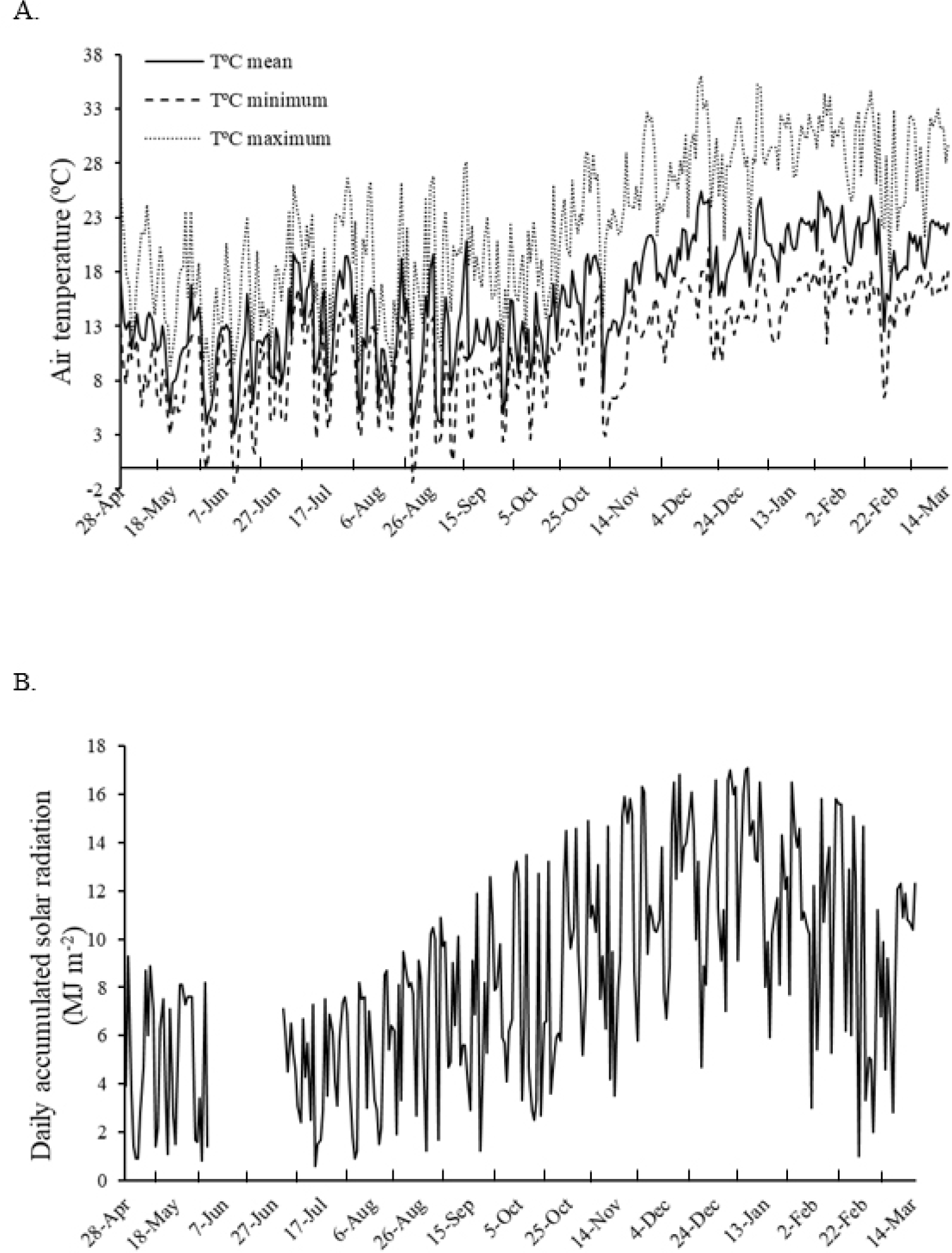
During the experimental period, the air temperature (Tº) (Figure 1A) and relative air humidity (RH) data were collected using an RK330-01 sensor from Rika, installed inside the greenhouse at the height of the plants. The data of daily accumulated solar radiation (Figure 1B) was obtained from the Agroclimatic Monitoring and Alerts System (SIMAGRO), located at the State Center for Diagnosis and Research in Viticulture (Cevitis) in Caxias do Sul/RS, approximately 13 km from the experimental area.

Daily average (T ºC mean), maximum (T ºC maximum), and minimum (T ºC minimum) air temperatures from April 2022 to March 2023 (A) and accumulated radiation from April 2022 to March 2023 (B)
According to Díaz (2012), the optimal temperature range for strawberry cultivation is between 18 and 26 °C during the day and between 8 and 13 °C at night. As shown in Figure 1A, the temperatures recorded throughout the experimental period did not remain consistent within these optimal limits. Negative temperatures were observed during winter, whereas in summer, values exceeded 30 °C.
To determine water consumption, daily records were taken of the nutrient solution volume applied via irrigation, calculated from the system’s operating time and the flow rate of the self-compensating dripper nozzles. All the drainage from the irrigation was collected, and water consumption was determined using Eq. 1 (Choi et al., 2016):
Where:
VNSCP - volume of Nutrient Solution Consumed by the Plant (mL per plant per day);
VNSAI - volume of Nutrient Solution Applied via Irrigation (mL per plant per day); and,
VDNS - volume of Drained Nutrient Solution (mL per plant per day).
The results were submitted to ANOVA, and means were compared using Tukey’s test (p ≤ 0.05) with the help of the R Program and the AgroR package. Additionally, daily water consumption by plants was quantified using the substrate composed of 80% pine bark and 20% PRH and a nutrient solution application frequency of 2 and 4 times per day (FI-2).
Given the considerable variability in the average water volume consumed by the crop during the cultivation cycle, especially across seasons, a multivariate statistical regression approach was employed to investigate the contribution of each variable to strawberries' water consumption. Independent variables representing meteorological conditions (average and minimum temperature, temperature range, average relative air humidity, and daily accumulated solar radiation), leaf area, and fruit production were used. In addition to these variables, the month of analysis was considered as a categorical variable and represented by a dummy variable (Detmann et al., 2012), with August as the base month.
The statistical analysis consisted of identifying outliers using box plots, followed by multivariate linear regression, with significance testing for each coefficient in the general model (p ≤ 0.05) and an assessment of multicollinearity among factors. The model reduction was performed using the Stepwise method (p ≤ 0.05) (Draper & Smith, 1966). Means were compared for biomass and yield using the Tukey test (p ≤ 0.05). All statistical analyses were conducted in R (R Core Team, 2017), with the results subjected to ANOVA.
RESULTS AND DISCUSSION
According to the analysis of variance, there was an interaction between the experimental factors (substrate and frequency of nutrient solution application) for the dry mass of leaves, stems, and vegetative parts (leaves plus stems) variables. Therefore, the main effects of each factor were evaluated (Table 3).
Dry mass of leaves, stem, and vegetative parts (stem + leaves) of strawberry plants grown in a soilless system according to nutrient solution management and substrate formulation
The highest frequency of nutrient solution application (FI-3) for the substrate with 40% PRH resulted in increased dry mass production of leaves, stems, and the vegetative parts compared to FI-1. On the same substrate, FI-2 also reduced the dry mass of stems and vegetative parts compared to FI-3, while leaf dry mass remained similar between treatments. In contrast, for substrates with 0 and 20% PRH, nutrient solution frequency did not affect the dry mass production of leaves, stems, or the vegetative parts of strawberry plants.
Increasing the proportion of PRH incorporation in the substrate from 0 to 40% reduced dry mass accumulation in leaves, stems, and the plant's vegetative parts under FI-1 management. In this case, the reduction in plant growth in the 40% PRH substrate depends on the FI-1 management. The opposite effect was observed under FI-3, except for stem dry mass. In FI-2 management, no differences were detected in the dry mass of leaves, stems, or vegetative parts among the tested formulations.
The reduced accumulation of dry mass in the leaves, stem, and overall vegetative parts under the lower frequency of nutrient solution (FI-1) applications with 40% PRH substrate (Table 3) suggests that this combination may have induced drought stress in the plants. Given that the same volume was applied in all treatments, the water deficit can be attributed to the drainage rate resulting from the combination of the two experimental factors (40% PRH × FI-1). This will likely reduce water availability to the plants due to the substrate's low water buffering capacity.
Due to drought stress, the inadequate water supply for cell division and growth, combined with limitations in carbon and nitrogen metabolism, negatively affects plant dry mass accumulation (Bertamini et al., 2006), which explains the reduced plant growth observed in the 40% PRH × FI-1 treatment.
However, vegetative dry mass increased when nutrient solutions were applied more frequently (FI-3) to the 40% PRH substrate, suggesting that a higher frequency of application enhanced plant growth under this substrate condition. This improvement may be associated with the increased aeration provided by the higher proportion of PRH, which improves nutrient availability by stimulating aerobic microbial activity and promotes better gas exchange (Prado, 2020).
Usually, in low-cost hydroponic greenhouses using open hydroponic systems, water and nutrients are supplied at a constant irrigation frequency, adjusting the dose to ensure that each irrigation cycle (each day) delivers the amount of nutrient solution needed for the plants, plus an additional 20 to 30% leaching fraction. Therefore, irrigation management typically does not consider the specific characteristics of the substrates used (Mavrogianopoulos, 2016), which may compromise high-potential formulation due to inefficient water management.
The high drainage rate of the substrate with a greater proportion of PRH, combined with the fast growth of the San Andreas strawberry cultivar under high-temperature and long-day conditions, required an increase in the nutrient solution frequency in phase II to avoid drought stress in plants.
This change was necessary because, in January, the rapid expansion of leaf area, combined with high evapotranspirative demand (high temperature and low relative air humidity), led to severe water deficit. This was evidenced by significant wilting in the plants under FI-1 treatment, particularly with the 40% PRH substrate. The excessive drainage of the nutrient solution when applied only once in the morning contributed to these issues, suggesting that simply increasing the volume applied would not be sufficient to maintain plant hydration throughout the day. Given that the substrate retains a maximum volume of nutrient solution based on its physical properties, the buffering capacity of water and solutions gradually declines over time. Therefore, adjustments were made to the frequency and volume of nutrient solution applied to meet the plant water requirements and prevent dehydration and plant losses upon detecting the first signs of water deficit.
Proper nutrient solution management enhanced the vegetative growth of plants that had previously experienced drought stress. These findings highlight that applying the nutrient solution twice a day, with the volume adjusted to achieve 30% drainage, is sufficient to promote growth and increase the leaf area index (LAI).
The treatments (frequency of nutrient solution application and the substrate formulation) and their interaction did not affect the root dry mass and leaf area index (LAI) at the end of the strawberry growth cycle (Table 4).
Root dry mass and leaf area index (LAI) of strawberry plants grown in a soilless system according to nutrient solution management and substrate formulation
The substrate formulations with different proportions of PRH did not differ in the root dry mass of strawberry plants. This finding contrasts with previous studies (Adak et al., 2018; Madhavi et al., 2021). The differences found in these studies may be attributed to discrepancies in the physical and chemical properties of the substrates.
Choi et al. (2022) also reported no differences in root dry mass with different irrigation frequencies. This outcome may be explained by the greater sensitivity of leaf growth to drought stress compared to root growth (Faaek & Pirlak, 2021). Under such conditions, reduced leaf expansion can be advantageous, as it allows excess energy and carbohydrates to be redirected toward root development, thereby increasing root volume (Taiz & Zeiger, 2017). This mechanism may help explain the lack of significant differences in root dry mass, despite the observed variation in vegetative dry mass between treatments.
These results can also be attributed to the growth dynamics of the crop's root system, as the most vigorous root development occurs in the initial months after transplanting. During this phase, the plant primarily invests in the formation of primary roots, which emerge directly from the crown. These roots are larger, play a crucial role in plant anchorage (Díaz, 2012), and significantly contribute to root dry mass accumulation. The establishment of these primary roots was facilitated by abundant irrigation in the early days following transplanting. Subsequently, the finer roots responsible for water and nutrient uptake develop (Díaz, 2012), but their contribution to the final root dry mass is comparatively less.
There was no interaction between the factors for the yield. Thus, the main effects of each factor were evaluated (Table 5). The substrate formulations did not alter the strawberry fruit production, despite differences in physical properties. Given the great adaptability of strawberry plants to substrates formulated from these materials, which are widely used in commercial production systems in southern Brazil, the physical differences among treatment factors may have been mitigated by the effective exploitation of the available volume by the roots. As shown in Table 4, no significant differences were observed in root system development. Still, the varying proportions of parboiled rice husk incorporated into the substrate did not significantly influence fruit production.
Total fruit production per plant and commercial fruit production of strawberry plants grown in a soilless system according to nutrient solution management
Several studies show differences in total strawberry fruit production using different materials and formulations for the substrate (Wysocki et al., 2017; Adak et al., 2018; Alsmairat et al., 2018). However, in the present study, differences in vegetative dry mass among plants were observed across substrate formulations, but these differences did not affect fruit production. This may be related to the more pronounced physical and chemical differences of the substrate in previous research (Wysocki et al., 2017; Adak et al., 2018; Alsmairat et al., 2018), likely due to the variety of materials employed.
Although some physical properties of the substrate formulated with pine bark and parboiled rice husk did not fall in the ranges described in the literature, the strawberry fruit production obtained for growth in a soilless system was high. This finding supports the viability of these substrate formulations for practical use.
In contrast, the management of the nutrient solution led to changes in production patterns. The increase in nutrient solution supply, FI-2 and FI-3, resulted in greater total and commercial fruit production (g per plant) in strawberry plants compared to FI-1 management. In these treatments, total production exceeded the expected fruit production of 1,300 g per plant for the San Andreas cultivar described by Villagrán & Duchesne (2012).
The high fruit production obtained in this experiment can be attributed to the extended evaluation period of approximately one year. The study aimed to assess the yield performance of a day-neutral strawberry cultivar under the distinct seasonal conditions of the Serra Gaúcha region, characterized by high climatic variability, to evaluate its performance over time.
The results observed are consistent with expectations: excessive drainage of the nutrient solution applied in a single irrigation would compromise water availability, leaving insufficient water to meet the plant's needs.
In Phase I of the experiment, the average drainage observed in the 40% PRH × FI-1 treatment was approximately 40%, substantially higher than that recorded for the 40% PRH × FI-3 treatment, whose mean drainage was around 30%, similar to the reference treatment. In the 0% PRH × FI-1 treatment, the average drainage was 36%, while in the 0% PRH × FI-3 treatment, it was also close to baseline. In Phase II, the differences between treatments were attenuated, converging on values near 30% due to the increased number of daily irrigations.
These results indicate that substrates with lower water-holding capacity are more susceptible to inadequate nutrient solution management, leading to greater variation in drainage. Conversely, the data show that increasing irrigation frequency offsets the substrate's high porosity, promoting more stable moisture conditions within the root zone.
Therefore, substrate formulations with high porosity can be commercially viable, provided that their physical properties are well characterized and the nutrient solution frequency is adjusted appropriately to ensure an adequate balance between aeration and water availability for the plants.
When subjected to drought stress, strawberry plants show a reduction in yield, attributed to osmotic stress and a decrease in photosynthetic rates, which results from stomatal closure and limited leaf expansion (Mozafari et al., 2019).
In addition to exposing the plants to water deficit, the combination of highly porous substrates with infrequent irrigation leads to reduced water-use efficiency, as the plants do not absorb a substantial portion of the nutrient solution. In practice, this management results in higher water and fertilizer consumption, while reducing crop yield.
Lalk et al. (2023) evaluated the effect of one and two daily irrigations per day, with the same water volume, on strawberry fruit production of different cultivars. Their results indicated no difference in yield between irrigation frequencies. According to the authors, the substrates’ physical characteristics may have influenced this result, firstly because the aeration space was high, ranging from 41.4 to 55.8%, facilitating the drainage of nutrient solution. Under such conditions, increasing irrigation frequency could enhance plants' nutrient uptake, as the continuous supply of nutrient solution ensures sustained availability in the root zone (Lalk et al., 2023).
The average nutrient solution consumption by the strawberry plant throughout the growing period was 215.98 mL per plant per day (Table 6), exceeding the values observed by Choi et al. (2022) with the cultivar Kuemsil under a 30% drainage rate, which averaged 128.66 mL per plant per day. This discrepancy may be attributed to differences in meteorological conditions between the experimental location and the study by Choi et al. (2022), which was conducted at significantly lower temperatures, averaging 15.3 °C. Additionally, the lower fruit production observed in their study (312 g per plant) may have contributed to the reduced nutrient solution uptake, as fruit production is associated with increased water and nutrient demand.
Average daily water consumption (mL per plant per day) of strawberry plants grown in a soilless system through a growing cycle
Given the variability in the strawberry plant’s water consumption and the challenge of determining the optimal daily nutrient solution volume, the present study incorporated meteorological data, growth indices, and fruit production parameters to develop a mathematical model to predict the crop's nutrient solution use.
The analyses showed that not all independent variables included in the initial model (Eq. 2) are suitable for quantifying daily water consumption in strawberry plants (mL per plant per day).
According to the Stepwise test, thermal amplitude and average relative air humidity were not significant (p > 0.05), suggesting that a reduced model could be used to predict nutrient solution consumption.
A possible explanation for the non-significance of the relative air humidity sensor’s position within the protected environment, near the crop, is that humidity levels remained consistently high with minimal variation throughout the growing cycle. This occurs mainly due to crop evapotranspiration and the reduced air circulation within the canopy (Lycoskoufis, 2025). The lack of significance of thermal amplitude is due to the presence of other temperature-related variables in the model, such as average and minimum temperatures. In this context, absolute temperature values may have a greater influence on nutrient solution consumption than thermal amplitudes alone. This occurs because thermal amplitude exerts a greater impact on plant vegetative and reproductive growth, as well as on fruit quality, than on water consumption itself (Wu et al., 2021).
The reduced model achieved an R2 value of 0.8743, demonstrating superior performance compared to the initial equation. To apply the model, the intercept value should be added to the product of each observed value of the relevant variables multiplied by their respective regression coefficients (β) (Table 7). For monthly estimates, only the value corresponding to the specific month is considered.
Coefficients of the independent variables from the reduced model to estimate the water consumption of strawberry plants
This strong relation highlights the alignment between the observed and estimated values by the model (Figure 2), indicating an excellent fit of the model to the experimental data.
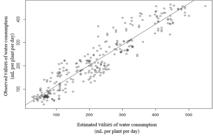
Observed and estimated values from the model to estimate the water consumption of strawberry plants in a soilless substrate system (20% PRH and 80% composted pine bark) with a nutrient solution application frequency of 2 and 4 times per day (FI-2)
The good agreement between observed and estimated values indicates that the model reliably represents plant water consumption across different developmental stages and under varying environmental conditions, based on easily measurable and routinely monitored variables.
Therefore, based on the parameters described in Table 7 and Figure 2, the model estimates daily water consumption for a strawberry plant grown in substrate in an open system (mL per plant per day), accounting for meteorological conditions, plant growth, and fruit production.
Although the model indicates the use of all variables listed in Table 7 to estimate strawberry water consumption, only a few were significant: average temperature, leaf area, and fruit production. This demonstrates that these variables are the main drivers of seasonal variation in strawberry water consumption.
Among the independent variables analyzed, only the minimum temperature influenced water consumption, resulting in a reduction. This effect is attributed to a decrease in plant transpiration at lower temperatures, which minimizes water loss to the atmosphere and consequently reduces water consumption by the plants.
The months were analyzed as dummy variables (Detmann et al., 2012), a method for numerically representing qualitative variables. Although statistical significance was observed only in September, July, and November (p < 0.05), all months were included in the equation through joint data analysis. It is hypothesized that the influence of months may be associated with photoperiod and the availability of solar radiation, a relevant factor for water consumption. Longer daylight duration generally leads to increased water consumption; however, this variable was not directly measured through any quantitative parameter in the study. As the experiment spanned nearly one year, the plants were subjected to variations in photoperiod, which may have influenced their water consumption patterns.
The high goodness-of-fit of the equation suggests its reliability as a method for estimating strawberry water consumption, providing a valuable tool for farmers and researchers to optimize nutrient solution management. Additionally, this formula can serve as a basis for automatic irrigation systems, either integrated with field-installed sensors or linked to weather forecasting platforms.
It is important to emphasize that the data estimated by the equation correspond to the volume of nutrient solution absorbed by the plant and retained in the substrate. Despite efforts to minimize water and nutrient losses in open soilless systems, a leaching fraction of at least 30% is recommended to prevent substrate salinization (Dufour & Guerín, 2005). This leaching requirement should be accounted for in irrigation management practices by adjusting the percentage of drainage relative to the volume estimated by the equation in Figure 2.
CONCLUSIONS
-
Considering the reduction in vegetative growth observed in the substrate with a higher proportion of parboiled rice husk (40% PRH) under lower nutrient solution application frequency (FI-1), it can be concluded that this formulation requires more frequent irrigations to sustain adequate plant development.
-
Regardless of the substrate, more frequent applications with smaller volumes of nutrient solutions promote higher fruit production.
-
Despite the high coefficient of determination (R2 = 0.8743) of the equation: Water consumption = -11.8027 + month × β1 + average temperature × 5.8491 - minimum temperature × -2.8893 + daily accumulated radiation × 1.5295 + leaf area × 0.0757 + production × 3.2966, only some of the independent variables were significant. According to the model, leaf area, average temperature, and fruit production are the variables with the most significant influence on strawberry water consumption. Therefore, nutrient solution management should prioritize monitoring these variables to ensure adequate application for the crop.
Acknowledgments:
We thank the Universidade Federal do Rio Grande do Sul (UFRGS) for the infrastructure and academic support and the Conselho Nacional de Desenvolvimento Científico e Tecnológico (CNPq) for the funding and support in conducting this study.
Data Availability Statement:
There are no underlying data associated with the texts of this article.
LITERATURE CITED
-
Adak, N.; Tozlu, I.; Gubbuk, H.; Influence of different soilless substrates to morpho-physiological characteristics and yield relations in strawberries. Erwerbs-Obstbau, v.60, p.341-348, 2018. https://doi.org/10.1007/s10341-018-0382-x
» https://doi.org/10.1007/s10341-018-0382-x -
Alsmairat, N. G.; Al-Ajlouni, M. G.; Ayad, J.; Y.; Othman, Y. A.; Hilaire, R. S. Composition of soilless substrates affect the physiology and fruit quality of two strawberry (Fragaria× ananassa Duch.) cultivars. Journal of Plant Nutrition, v.41, p.2356-2364, 2018. https://doi.org/10.1080/01904167.2018.1510508
» https://doi.org/10.1080/01904167.2018.1510508 -
Bertamini, M.; Zulini, L.; Muthuchelian, K.; Nedunchezhian, N. Effect of water deficit on photosynthetic and other physiological responses in grapevine (Vitis vinifera L. cv. Riesling) plants. Photosynthetica, v.44, p.151-154, 2006. https://doi.org/10.1007/s11099-005-0173-0
» https://doi.org/10.1007/s11099-005-0173-0 -
Choi, K. Y.; Choi, E. Y.; Kim, I. S.; Lee, Y. B. Improving water and fertilizer use efficiency during the production of strawberry in coir substrate hydroponics using a FDR sensor-automated irrigation system. Horticulture, Environment, and Biotechnology, v.57, p.431-439, 2016. https://doi.org/10.1007/s13580-016-0072-2
» https://doi.org/10.1007/s13580-016-0072-2 -
Choi, S. H.; Kim, D. Y.; Lee, S. Y.; Chang, M-S. Growth and quality of strawberry (Fragaria ananassa dutch. Cvs.‘kuemsil’) affected by nutrient solution supplying control system using drainage rate in hydroponic systems. Horticulturae, v.8, e1059, 2022. https://doi.org/10.3390/horticulturae8111059
» https://doi.org/10.3390/horticulturae8111059 -
Detmann, M. P.; Valadares Filho, S. C.; Gionbelli, M. P.; Paulino, P. V. R.; Paulino, M. F. Use of regression techniques in the evaluation, in beef cattle, of feed conversion efficiency into product: proposition of method and nutritional significance. Revista Brasileira de Zootecnia, v.41, p.138-146, 2012. https://doi.org/10.1590/S1516-35982012000100021
» https://doi.org/10.1590/S1516-35982012000100021 - Díaz, V. V. Morfología y fisiología. In: Reyes, M.; Zchau, B. (eds.). Strawberry, productive considerations and management. Villa Alegre: Instituto de Investigaciones Agropecuarias. 2012. Cap.4, p.63-74.
-
Diel, M. I.; Sari, B. G.; Krysczun, D. K.; Olivoto, T.; Pineiro, M. V. M.; Meira, D.; Scmidt, D.; Lucio, A. D. Nonlinear regression for description of strawberry (Fragaria x ananassa) production. The Journal of Horticultural Science and Biotechnology, v.94, p.259-273, 2018. https://doi.org/10.1080/14620316.2018.1472045
» https://doi.org/10.1080/14620316.2018.1472045 - Draper, N. R.; Smith, H. Applied regression analysis. 3.ed. New York: Wiley 1966. 407p.
-
Dufour, L.; Guérin, V. Nutrient solution effects on the development and yield of Anthurium andreanum Lind. in tropical soilless conditions. Scientia Horticulturae, v.105, p.269-282, 2005. https://doi.org/10.1016/j.scienta.2005.01.022
» https://doi.org/10.1016/j.scienta.2005.01.022 -
Faaek, M. F.; Pirlak, L. Morphological and physiological effects of drought stress on some strawberry cultivars. Selcuk Journal of Agriculture and Food Sciences, v.35, p.194-201, 2021. https://doi.org/10.15316/SJAFS.2021.248
» https://doi.org/10.15316/SJAFS.2021.248 -
Gontijo, M. L.; Souza, F. S.; Diotto, A. V.; Gontijo, F. L. Water productivity and agronomic performance of strawberries with different leaching fractions application. Scientia Plena, v.16, e050201, 2020. https://doi.org/10.14808/sci.plena.2020.050201
» https://doi.org/10.14808/sci.plena.2020.050201 - Guy, O.; Dai, N.; Cohen, S.; Bustan, A. Winter strawberries production in greenhouse soilless culture under an arid climate - cultivars, phenology, physiology, and consequent. In: Kafkas, N. E. (ed.). Recent studies on strawberries. Adana: Cukurova University. 2022. Cap.2, p.1-23.
-
Hernández-Martínez, N. R.; Blanchard, C.; Wells, D.; Salazar-Guriérrez, M. R. Current state and future perspectives of commercial strawberry production: a review. Scientia Horticulturae, v.312, e111893, 2023. https://doi.org/10.1016/j.scienta.2023.111893
» https://doi.org/10.1016/j.scienta.2023.111893 -
Lalk, G. T.; Bi, G.; Sstafne, E. T.; Li, T. Fertilizer type and irrigation frequency affect plant growth, yield, and gas exchange of containerized strawberry cultivars. Technology in Horticulture v.3, e3, 2023. https://doi.org/10.48130/TIH-2023-0003
» https://doi.org/10.48130/TIH-2023-0003 -
Lycoskoufis, I. Humidity optimization in greenhouses. In: Abdelhafez, A. A.; Grincharm W. J. Greenhouses - cultivation strategies for the future. 2025. 140p. https://doi.org/10.5772/intechopen.1010075
» https://doi.org/10.5772/intechopen.1010075 -
Madhavi, B. G. K.; Khan, F.; Bhujel, A.; Jaihuni, M.; Kim, N. E.; Moon, B. E.; Kim, H. T. Influence of different growing substrate on the growth and development of strawberry plants. Heliyon, v.7, e07170, 2021. https://doi.org/10.1016/j.heliyon.2021.e07170
» https://doi.org/10.1016/j.heliyon.2021.e07170 -
Massa, D.; Magán, J. J.; Montesano, F. F.; Tzortzakis, N. Minimizing water and nutrient losses from soilless cropping in southern Europe. Agricultural Water Management, v.241, e106395, 2020. https://doi.org/10.1016/j.agwat.2020.106395
» https://doi.org/10.1016/j.agwat.2020.106395 -
Mavrogianopoulos, G. N. Irrigation dose according to substrate characteristics, in hydroponic systems. Open Agriculture, v.1, p.1-6, 2016. https://doi.org/10.1515/opag-2016-0001
» https://doi.org/10.1515/opag-2016-0001 -
Mozafari, A.; Nasser, G.; Faride, H.; Sajede, D. Comparative investigation of structural relationships among morpho-physiological and biochemical properties of strawberry (Fragaria× ananassa Duch.) under drought and salinity stresses: A study based on in vitro culture. Scientia Horticulturae, v.256, e108601, 2019. https://doi.org/10.1016/j.scienta.2019.108601
» https://doi.org/10.1016/j.scienta.2019.108601 -
Oguz, I.; Oguz, H. I.; Kafkas, E. Strawberry cultivation techniques. In: Kafkas, N. E. (ed.). Recent studies on strawberries. Adana: Cukurova University. 2022. Cap.2, p.1-23. https://doi.org/10.5772/intechopen.104611
» https://doi.org/10.5772/intechopen.104611 -
Othman, Y.; Bataineh, K.; Al-Ajlouni, M.; Alsmairat, N. Ayad, J.; Shiyab, S.; Al-Qarallah, B.; Hilaire, R. S. Soilless culture: management of growing substrate, water, nutrient, salinity, microorganism, and product quality. Fresenius Environmental Bulletin, v.28, p.3249-3260, 2019. https://www.cabidigitallibrary.org/doi/full/10.5555/20203439358
» https://www.cabidigitallibrary.org/doi/full/10.5555/20203439358 - Prado, R. M. Plant nutrition. 2.ed. São Paulo: Unesp, 2020. 416p.
-
Putra, P. A.; Yuliando, H. Soilless culture system to support water use efficiency and product quality: a review. Agriculture and Agricultural Science Procedia, v.3, p.283-288, 2015. https://doi.org/10.1016/j.aaspro.2015.01.054
» https://doi.org/10.1016/j.aaspro.2015.01.054 -
R Core Team. R: A language and environment for statistical computing. Vienna: R Foundation for Statistical Computing, 2017. Available on: < https://www.rproject.org/ >. Accessed on: May. 2024.
» https://www.rproject.org/ -
Schafer, G.; Lerner, B. Physical and chemical characteristics and analysis of plant substrate. Ornamental Horticulture, v.28, p.181-192, 2022. https://doi.org/10.1590/2447-536X.v28i2.2496
» https://doi.org/10.1590/2447-536X.v28i2.2496 -
Strassburger, A. S.; Peil, R. M. N.; Schwengber, J. E.; Medeiros, C. A. B.; Martins, D. S.; Silva, J. B. Crescimento e produtividade de cultivares de morangueiro de “dia neutro” em diferentes densidades de plantio em sistema de cultivo orgânico. Bragantia, v.69, p.623-630, 2010. https://doi.org/10.1590/S0006-87052010000300014
» https://doi.org/10.1590/S0006-87052010000300014 - Sonneveld, C.; Straver, N. Nutrient solution for vegetables and flowers grown in water or substrates. 10.ed. Naaldwijk: Proefstation voor Tuinbouw onder Glas, 1994. 45p.
- Taiz, L.; Zeiger, E. Plant physiology. 6.ed. Porto Alegre: ArtMed, 2017. 888p.
- Villagrán, B. Z.; Duchesne, M. L. Varieties. In: Reyes, M.; Zchau, B. (eds.). Strawberry, productive considerations and management. Villa Alegre: Instituto de Investigaciones Agropecuarias, 2012. Cap.4, p.63-74.
- Wrege, M. S.; Steinmetz, S.; Reisser-Júnior, C.; Almeida, I. D. Climate atlas of the southern region of Brazil: estados do Paraná, Santa Catarina e Rio Grande do Sul. 2.ed. Pelotas: Embrapa Clima Temperado, 2012. 333p.
-
Wu, X.Y.; Han, W.; Yang, Z. Q.; Zhang, Y. X.; Zheng, Y. J. The difference in temperature between day and night affects the strawberry soluble sugar content by influencing the photosynthesis, respiration and sucrose phosphatase synthase. Horticultural Science, v.48, p.174-182, 2021. http://doi.org10.17221/158/2019-HORTSCI
» http://doi.org10.17221/158/2019-HORTSCI -
Wysocki, K.; Kopytowski, J.; Bieniek, A.; Bojarska, J. The effect of substrates on yield and quality of strawberry fruits cultivated in a heated foil tunnel. Zemdirbyste-Agriculture, v.104, p.283-286, 2017. http://dx.doi.org/10.13080/z-a.2017.104.036
» http://dx.doi.org/10.13080/z-a.2017.104.036 -
Yu, W.; Zheng, J.; Wang, Y.; Ji, F.; Zhu, B. Adjusting the nutrient solution formula based on growth stages to promote the yield and quality of strawberry in greenhouse. Internacional Journal Agricultural and Biological Enginering, v.16, p.57-64, 2023. https://doi.org/10.25165/j.ijabe.20231602.7797
» https://doi.org/10.25165/j.ijabe.20231602.7797
Edited by
-
Editors:
Ítalo Herbet Lucena Cavalcante & Hans Raj Gheyi