
 Extrato pirolenhoso como atenuador do déficit hídrico em plantas de pitanga
No clima semiárido, o crescimento de mudas frutíferas é desafiado pelo estresse hídrico característico da região, o que pode restringir seu desenvolvimento e, consequentemente, afetar a produção. Nesse contexto, o objetivo foi avaliar o efeito do extrato pirolenhoso nas características de troca gasosa, pigmentos fotossintéticos, crescimento e biomassa de pitangueira sob diferentes intensidades de déficit hídrico. O experimento foi conduzido em casa de vegetação utilizando um delineamento em blocos casualizados em um esquema fatorial 3 × 2, com quatro repetições, correspondendo a períodos de déficit hídrico foram de 7 e 14 dias, além do controle (irrigação diária), no substrato sem e com extrato pirolenhoso. As plantas foram avaliadas quanto às características de trocas gasosas foliares, índices de clorofila, crescimento e biomassa seca. A aplicação de extrato pirolenhoso aos 7 dias de déficit hídrico elevou a taxa fotossintética, a eficiência de carboxilação e o índice de qualidade de Dickson das mudas de pitanga em 40,04, 42,85 e 41,51%, respectivamente, em comparação aos 14 dias de déficit hídrico. O extrato pirolenhoso foi efetivo como um atenuante do estresse hídrico nas mudas de pitanga, especialmente durante os primeiros sete dias de exposição ao estresse. Assim, sua aplicação é recomendada como uma medida preventiva e de curto prazo para mitigar tais efeitos nas mudas de pitanga.
Palavras-chave:
Eugenia uniflora L.; vinagre de madeira; déficit hídrico; trocas gasosas; biomassa
 Thumbnail
 Thumbnail
 Thumbnail
 Thumbnail
 Thumbnail
 Thumbnail

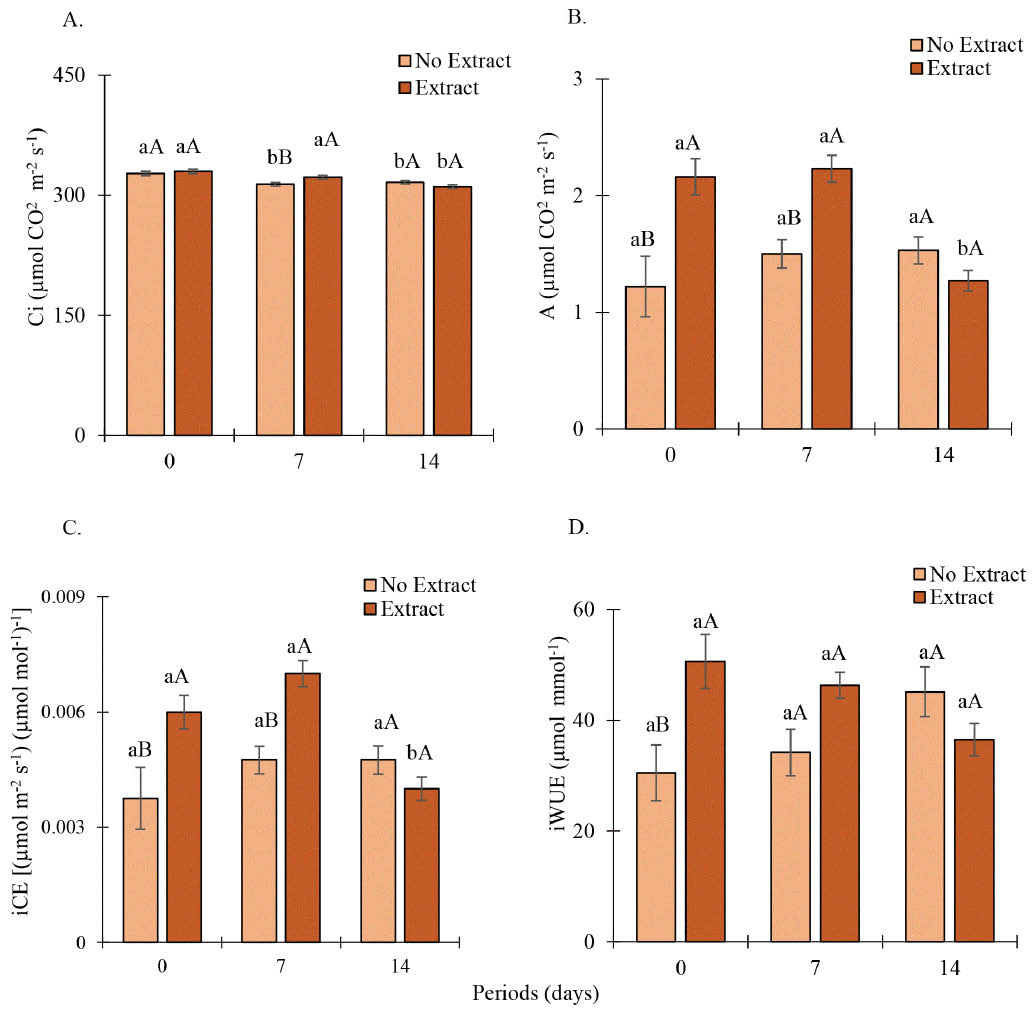 *Vertical bars represent the standard error (n = 4). Bars with equal lowercase letters do not differ for different irrigation intervals within each method of application of pyroligneous extract by the Tukey test (p ≤ 0.05). Bars with identical capital letters do not show significant differences between them for each method of application of pyroligneous extract within each irrigation interval by the Tukey test (p ≤ 0.05)
 Vertical bars represent the standard error (n = 4). Distinct lowercase letters indicate differences between the means of each studied factor (periods of water deficit and methods of PE application) according to Tukey’s test (p ≤ 0.05)
 *Vertical bars represent the standard error (n = 4). Lowercase letters indicate that there are no differences between the water deficit periods within each pyroligneous extract application method according to the Tukey test (p ≤ 0.05). Uppercase letters indicate that there are no significant differences between the pyroligneous extract application methods within each water deficit period according to the Tukey test (p ≤ 0.05). Distinct lowercase letters show differences between the means of each analyzed factor according to the Tukey test (p ≤ 0.05)
 *Vertical bars represent the standard error (n = 4). Lowercase letters indicate that there are no differences between the water deficit periods within each pyroligneous extract application method according to the Tukey test (p ≤ 0.05). Uppercase letters indicate that there are no significant differences between the pyroligneous extract application methods within each water deficit period according to the Tukey test (p ≤ 0.05). Distinct lowercase letters show differences between the means of each analyzed factor according to the Tukey test (p ≤ 0.05)
 *Vertical bars represent the standard error (n = 4). Lowercase letters indicate that there are no differences between the water deficit periods within each pyroligneous extract application method according to the Tukey test (p ≤ 0.05). Uppercase letters indicate that there are no significant differences between the pyroligneous extract application methods within each water deficit period according to the Tukey test (p ≤ 0.05). Distinct lowercase letters show differences between the means of each analyzed factor according to the Tukey test (p ≤ 0.05)