
 Pyroligneous extract as a mitigator of water deficit in pitanga plants
ABSTRACT
In the semi-arid climate, the growth of fruit seedlings is challenged by the water stress characteristic of the region, which can restrict their development and, consequently, affect production. In this context, the aim was to assess the effect of pyroligneous extract on gas exchange characteristics, photosynthetic pigments, growth, and biomass of pitanga under different intensities of water deficit. The experiment was conducted using a randomized block design in a 3 × 2 factorial scheme, with four replicates, corresponding to water deficit periods (7 and 14 days) and control (daily irrigation), in substrates with and without pyroligneous extract. The plants were evaluated for gas exchange characteristics, chlorophyll indices, growth, and dry biomass. Application of pyroligneous extract after 7 days of water deficit increased the photosynthetic rate, carboxylation efficiency and Dickson quality index of pitanga seedlings by 40.04, 42.85 and 41.51%, respectively, compared to 14 days of water deficit. Pyroligneous extract was effective as a water stress attenuator in pitanga seedlings, especially during the first seven days of exposure to stress. Therefore, its application is recommended as a preventive and short-term measure to mitigate such effects on pitanga seedlings.
Key words:
Eugenia uniflora L.; wood vinegar; water deficit; gas exchange; biomass
HIGHLIGHTS:
Application of 2% pyroligneous extract relieves water stress in pitanga.
Application of pyroligneous extract via soil increases biomass.
Moderate water deficit (7 days) and pyroligneous extract improve the efficiency of photosynthesis processes.
RESUMO
No clima semiárido, o crescimento de mudas frutíferas é desafiado pelo estresse hídrico característico da região, o que pode restringir seu desenvolvimento e, consequentemente, afetar a produção. Nesse contexto, o objetivo foi avaliar o efeito do extrato pirolenhoso nas características de troca gasosa, pigmentos fotossintéticos, crescimento e biomassa de pitangueira sob diferentes intensidades de déficit hídrico. O experimento foi conduzido em casa de vegetação utilizando um delineamento em blocos casualizados em um esquema fatorial 3 × 2, com quatro repetições, correspondendo a períodos de déficit hídrico foram de 7 e 14 dias, além do controle (irrigação diária), no substrato sem e com extrato pirolenhoso. As plantas foram avaliadas quanto às características de trocas gasosas foliares, índices de clorofila, crescimento e biomassa seca. A aplicação de extrato pirolenhoso aos 7 dias de déficit hídrico elevou a taxa fotossintética, a eficiência de carboxilação e o índice de qualidade de Dickson das mudas de pitanga em 40,04, 42,85 e 41,51%, respectivamente, em comparação aos 14 dias de déficit hídrico. O extrato pirolenhoso foi efetivo como um atenuante do estresse hídrico nas mudas de pitanga, especialmente durante os primeiros sete dias de exposição ao estresse. Assim, sua aplicação é recomendada como uma medida preventiva e de curto prazo para mitigar tais efeitos nas mudas de pitanga.
Palavras-chave:
Eugenia uniflora L.; vinagre de madeira; déficit hídrico; trocas gasosas; biomassa
Introduction
Pitanga (Eugenia uniflora L.) is a fruit tree with industrial potential due to its fruits, rich in bioactive phenolic compounds with antioxidant, anti-obesity, and nutritive properties (Fidelis et al., 2022). Although little commercially grown, its cultivation can boost investments in new industrial products and improve the food security of producing households (Feller et al., 2019).
In the commercial activity with fruit crops in the semi-arid Northeast, the production of seedlings faces challenges due to water scarcity caused by irregular rainfall (Medeiros et al., 2024). This generates multidimensional stress, with dry periods characterized by high temperatures, higher solar radiation, and low humidity, which can reduce seedling quality and crop yield (Staniak et al., 2023).
Lack of water and nutrients in the soil significantly affects plant growth, structure, and physiology, including organ ratios, shoot and root length, photosynthetic capacity, and transpiration loss (Seleiman et al., 2021; Zhu et al., 2022). Thus, it is necessary to develop sustainable strategies to mitigate water stress using ecologically viable inputs.
Studies indicate that wood bark byproducts, such as pyroligneous extract or wood vinegar, are rich in natural antioxidants and organic acids that are beneficial to plants (Zhu et al., 2022). In rapeseed (Brassica napus L.), pyroligneous extract mitigated the effects of water deficit (Zhu et al., 2022). In African calendula (Tagetes erecta L.), the combination of biochar and pyroligneous extract resulted in better morphophysiological characteristics when subjected to water deficit (Abbaszadeh et al., 2022).
Studies on the effects of pyroligneous extract on pitanga seedlings under water deficit are limited. Therefore, the aim of this study was to assess the effect of pyroligneous extract on gas exchange characteristics, photosynthetic pigments, growth, and biomass of pitanga under different intensities of water deficit.
Material and Methods
The research was conducted in November 2023 at the Federal Rural University of the Semi-Arid Region (UFERSA), located in Mossoró, RN, Brazil (5° 11′ 31” S and 37° 20′ 40” W), at average altitude of 18 meters above sea level. According to Köppen’s classification, the climate of Mossoró is classified as BSwh, which is characterized as a very hot, dry, and semi-arid tropical climate for most of the year (Alvares et al., 2013).
Data on temperature (maximum and minimum), relative humidity (RH) (maximum and minimum), daily evapotranspiration, and total insolation (Figure 1) were collected by monitoring meteorological parameters in Mossoró using information from the two Automatic Meteorological Stations (EMA) located at UFERSA.
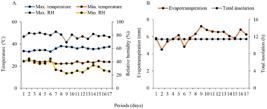
Air temperature, relative air humidity (RH) (maximum and minimum) (A), evapotranspiration, and total insolation (B) for November 2023, Mossoró-RN
The experiment was set up in a greenhouse covered with transparent material to minimize interference with light and solar radiation, with its sides protected with 50% shade net, lasted 17 days and was conducted in a randomized block design. The experimental arrangement followed a 3 × 2 factorial scheme, with four replicates, treating each plant as an experimental unit. Three irrigation periods (IP) were defined: IP0 (daily irrigation), IP2 (irrigation every 7 days), and IP3 (irrigation every 14 days). Each condition was evaluated both with and without pyroligneous extract.
The seeds were obtained from the fruits of pitanga trees of the didactic orchard of UFERSA (5° 12’ 17.49” S and 37° 19’ 17.72” W) and were extracted after pulping and cleaning. They were sown in tubes containing commercial substrate and remained under intermittent irrigation for 90 days. After this period, the plants were transplanted into pots with volume of 2.5 dm³, filled with a mixture of subsoil soil and commercial substrate based on pine bark, ash, vermiculite, peat, sawdust, and stabilizers in a ratio of 2:1. A sample was collected and analyzed for soil chemical attributes (Table 1).
Table 2 details the chemical characteristics of the concentrated pyroligneous extract and the water used for irrigation.
Upon reaching 200 days of age, the plants were acclimatized to the growth environment for 30 days before the beginning of differentiated water treatments. Irrigation maintenance was performed daily from 7:00 a.m. to 8:00 a.m. directly on the substrate, using a graduated beaker. In the control treatment, water lost through evapotranspiration was replaced daily and monitored by weighing on a digital scale (Filizola brand, model CS-15, with a maximum capacity of 15 kg). In the other treatments, irrigation was applied every 7 days over a total period of 14 days, using the same amount of water applied daily in the control.
The pyroligneous organic fertilizer, produced by SP Pesquisa e Tecnologia, was used according to the product packaging instructions regarding concentration. The plants received three applications of the concentrated extract at 2% via irrigation water, at 237 and 244 days after transplanting, with the first application at the beginning of the experiment. To prepare the application solution, 20 mL of the extract was diluted in 1 L of water. The solution’s electrical conductivity (EC) and pH were then measured using a digital conductivity meter and a benchtop pH meter, respectively, resulting in values of 0.57 and 3.89 dS m-1, respectively.
Gas exchange was determined using a portable gas exchange and fluorescence analyzer (model GFS-3000). The measurements were performed between 8:00 a.m. and 10:00 a.m., using artificial light (1.200 μmol m-2 s-1) at the ambient reference CO2 concentration of 400 μmol CO2 mol-1 of air and ambient temperature. Stomatal conductance (gs, mol H2O m-2 s-1), CO2 assimilation rate (A, μmol CO2 m-2 s-1), leaf transpiration rate (E, mmol H2O m-2 s-1) and internal carbon concentration (Ci, μmol CO2 mol-1) were evaluated. Furthermore, the instantaneous carboxylation efficiency (iCE) (A/Ci) and the intrinsic water use efficiency (iWUE) (A/gs) were calculated.
At the end of the experiment, the leaf chlorophyll indices and gas exchange of the pitanga seedlings were analyzed. Three chlorophyll a and b readings per plant, avoiding leaf veins, were taken with a portable meter (ChlorofiLOG® 1030). From the data, the ratio between the chlorophyll a and b indices and the total chlorophyll index (a + b) was calculated and the results were expressed in FCI (Falker Chlorophyll Index).
After each period of irrigation, conducted every 7 and 14 days, plant growth measurements were taken 72 hours after the end of each irrigation period, allowing the plants to respond accordingly. The variables analyzed included plant height (measured with a graduated ruler from the collar to the apex of the highest leaf), stem diameter (determined with a digital caliper with an accuracy of 0.01 mm), and number of leaves (obtained by counting).
The beaker method was used to determine the volume of the plant root systems. After washing and collecting the roots from each pot, they were carefully placed into a beaker filled with water. The volume of water displaced by the roots was measured in milliliters, using the unit equivalence (1 mL = 1 cm³), based on the method adopted by Ribeiro et al. (2023).
Leaf area was determined by capturing images of the leaves arranged on a surface with a numerical scale and then processed using the public domain software ImageJ®.
The material was placed in an oven at 65 °C and kept for 72 hours until it reached constant mass to quantify shoot dry mass (SDM), root dry mass (RDM), and total dry mass (TDM). The materials were weighed on a semi-analytical scale (0.001 g), and the results were expressed in g per plant.
Dickson quality index (DQI) was determined according to the methodology proposed by Dickson et al. (1960) (Eq. 1).
Where:
TDM - total dry mass (g),
SDM - shoot dry mass (g),
RDM - root dry matter (g),
PH - shoot height (cm), and;
SD - stem diameter (mm).
The data were subjected to analysis of variance at p ≤ 0.05. The means were compared using Tukey’s test at p ≤ 0.05. The analyses were performed using the R® software (R Core Team, 2023).
Results and Discussion
The interaction between water deficit and wood vinegar exerted a significant effect on variables related to gas exchange, such as the CO2 assimilation rate (A), internal CO2 concentration (Ci), instantaneous carboxylation efficiency (iCE), and intrinsic water use efficiency (iWUE), in addition to chlorophyll indices including chlorophyll b index (Chl b) and the ratio between chlorophyll a and b indices (Chl a/b), and plant growth: number of leaves (NL), stem diameter (SD), shoot dry mass (SDM), and Dickson quality index (DQI). The variables chlorophyll a index (Chl a), total chlorophyll index (Chl a + b), transpiration (E), leaf area (LA), and total dry mass (TDM), stomatal conductance (gs), root system volume (RSV), and root dry mass (RDM) responded to the individual factor, while plant height did not respond to the application of treatments, with an average value of 37.52 cm (Table 3).
In the leaf gas exchange variables, such as internal CO₂ concentration (Ci), CO₂ assimilation rate (A), instantaneous carboxylation efficiency (iCE), and intrinsic water use efficiency (iWUE), it was observed that plants under 7 and 14 days of drought stress, without the application of the pyroligneous extract, did not differ from irrigated plants. However, when the pyroligneous extract was applied, there was a statistically significant difference, with plants under 7 days of drought stress showing better results compared to irrigated plants (Figure 2).
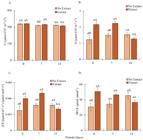
Internal CO₂ concentration (A), CO₂ assimilation rate (B), instantaneous carboxylation efficiency (C), and intrinsic water use efficiency (D) in pitanga seedlings as a function of irrigation periods with and without pyroligneous extract, 230 days after transplantation
The internal CO₂ concentrations (Ci) (Figure 2A) in pitanga plants, after 7 and 14 days of water deficit without pyroligneous extract (PE) treatment, were 313.82 and 316.20 µmol CO₂ m⁻² s⁻¹, respectively, which are relatively lower compared to the value obtained with 7-day water deficit period with PE, which was 322.42 µmol CO₂ m⁻² s⁻¹. This result represents a 3.61% increase compared to irrigated plants after 14 days of water deficit with PE. This indicates that irrigated pitanga plants with pyroligneous extract during a short period of stress can maintain a sufficient internal CO₂ concentration (Ci) to continue photosynthesis at lower levels, optimizing the efficiency of the available CO₂ (Toscano et al., 2019).
As observed in the analysis of the internal CO₂ concentration (Ci), the CO₂ assimilation rate (Figure 2B) in plants subjected to water deficit for 7 and 14 days without pyroligneous extract (PE) application showed a similar value, 1.5 µmol CO₂ m⁻² s⁻¹. In contrast, plants that experienced 7 days of water deficit and received PE application exhibited a CO₂ assimilation rate of 2.23 µmol CO₂ m⁻² s⁻¹, representing a 40.04% increase compared to the 14-day water deficit treatment with PE. This indicates that mild stress and application of pyroligneous extract have the potential to enhance the photsynthetic capacity of pitanga seedlings.
Zhu et al. (2022) investigated the effects of wood vinegar spraying on rapeseed seedlings (Brassica napus L.) subjected to low-temperature stress (LT, 10 °C during the day and 5 °C at night). They observed that the net photosynthetic rate increased with the addition of wood vinegar, rising from 17.7 to 18.2 µmol CO₂ m⁻² s⁻¹ under low-temperature conditions combined with wood vinegar (LT + WV).
In summary, pitanga seedlings treated with pyroligneous extract under water stress exhibited effects on internal CO₂ concentration and CO₂ assimilation rate. This influence also impacted the instantaneous carboxylation efficiency (iCE) (Figure 2C). Without pyroligneous extract application, during 7 and 14 days of water deficit, the average values were similar, around 0.005 [(µmol m⁻² s⁻¹) (µmol mol⁻¹)⁻¹]. However, with the application of pyroligneous extract after 7 days of water deficit, a 42.85% increase was observed compared to the 14-day water deficit with pyroligneous extract. This result suggests that pyroligneous extract may optimize CO₂ utilization under water stress conditions, up to the threshold that the plant can tolerate (Morales et al., 2020).
The intrinsic water use efficiency (iWUE) (Figure 2D), as described by Santos et al. (2021), reflects the ability of plants in the Caatinga vegetation, such as pitanga seedlings, to utilize water efficiently in their physiological processes. In the study, pitanga seedlings subjected to a 14-day water deficit without pyroligneous extract (PE) and a 7-day deficit with PE showed average efficiencies of 45.14 and 46.36 µmol mmol⁻¹, respectively, with no significant difference between them. The absence of a significant difference may be attributed to the limited effect of PE in altering iWUE under water stress. Although PE improved CO₂ assimilation rate under lower stress conditions, this effect was not sufficient to induce a significant change in iWUE.
When analyzing the individual effect of the factors studied on foliar gas exchange (Figure 3), a 7-day water deficit treatment compared to the more severe 14-day water deficit resulted in 40% increase in stomatal conductance (gs) (Figure 3A) and 26.12% increase in transpiration rate (E) (Figure 3B). This result is expected, as a shorter period of stress allows plants to make less severe physiological adjustments (Seleiman et al., 2021).

Stomatal conductance (A) and transpiration (B, C) of pitanga seedlings 230 days after transplanting
The individual effect of using pyroligneous extract on plant transpiration rate (Figure 3C) resulted in a 16.82% increase compared to the condition without the product. Ma et al. (2022) demonstrated that, with canola cultivars using Hoagland’s nutrient solution, pre-treatment with wood vinegar (WV) at an ideal concentration (diluted WV solution at a ratio of 1:500) effectively alleviated inhibition induced by salt stress.
The water treatment and pyroligneous extract significantly influenced, individually, only the chlorophyll a index and total chlorophyll index. However, the pyroligneous extract showed a significant interaction with the periods of water deficit, affecting chlorophyll b index and the chlorophyll a/b ratio index (Figure 4).

Chlorophyll a index (A, B), chlorophyll b index (C), chlorophyll a/b ratio index (D), and total chlorophyll index (E, F) of pitanga seedlings analyzed 230 days after transplanting
The chlorophyll a index (Chl a) of the pitanga plants (Figure 4A) revealed that a 14-day water deficit resulted in an 11.41% reduction compared to a 7-day water deficit. During water stress, the entry of CO₂ into the leaf mesophyll is impaired, which directly affects CO₂ assimilation and reduces photosynthesis processes, with the severity of the stress potentially amplifying these effects (Kaur et al., 2021). Souza et al. (2023) assessed the effects of drought, heat, and their combined effects on the photosynthesis of Psidium myrtoides O. Berg (Myrtaceae). At 1 and 4 days after treatment (DAT), no significant differences were found in the chlorophyll index among the treatments. However, at 7 DAT, water stress (T1) resulted in a 5% reduction in the chlorophyll index compared to the control and other treatments (T2 = thermal stress and T3 = drought + heat).
The application of pyroligneous extract increased the chlorophyll a index (Chl a) (Figure 4B) of pitanga seedlings by 6.17% compared to the treatment without the extract. Based on the product sample analysis, the pyroligneous extract contains essential macronutrients such as phosphorus, potassium, calcium, and magnesium, as well as organic matter. These nutrients enhance water and nutrient absorption by the cells, ensuring the structural stability of the leaves and thus promoting more effective photosynthetic activity (Wu et al., 2022).
In the analysis of chlorophyll b index (Figure 4C) for pitanga, no significant response was observed for plants treated with or without the extract under 7 days of water deficit, with averages of 8.02 and 7.41 FCI, respectively. Similarly, plants treated with or without the extract under 14 days of water deficit showed averages of 7.56 and 7.87 FCI, respectively, with no significant differences. It is possible that the absence of significant variations in the chlorophyll b index is related to the fact that chlorophyll b absorbs light at wavelengths not as efficiently absorbed by chlorophyll a, thereby broadening the light spectrum that plants can use for photosynthesis (Magney et al., 2020).
Regarding the chlorophyll a/b ratio index (Figure 4D), it was observed that in the absence of the extract, there was a continuous decrease in the water treatments (0, 7, and 14 days), with averages of 2.99, 2.96, and 2.90 FCI a/b, respectively. However, with the application of the extract under 7 days of water deficit, there was a significant increase, reaching 3.45 FCI a/b. This value represented a 16.95% increase compared to the 14-day period with extract application. This suggests that the extract may enhance the plant’s ability to cope with water stress, as both chlorophylls play complementary roles in light capture and protection against environmental stress (Magney et al., 2020).
The results of the total chlorophyll index (Figure 4E) revealed significant differences between the averages of plants subjected to 7 days of water deficit and those with 14 days of water deficit, showing a 9.13% increase in the total chlorophyll index due to short-term water stress. The comparison between plants treated with and without the pyroligneous extract regarding the total chlorophyll index (Figure 4F) showed that the application of the extract to pitanga seedlings resulted in approximately a 6% increase in the total chlorophyll index compared to plants that did not receive the extract. The results suggest that both factors, individually, can enhance the ability of pitanga seedlings by increasing chlorophyll maintenance and, consequently, photosynthetic efficiency.
The results of Ferreira et al. (2024) indicate that the application of a 1% pyroligneous solution resulted in a 20.47% increase in the total chlorophyll index of sunflower plants (Helianthus annuus L.), compared to plants that did not receive the extract.
The results obtained from the evaluation of the number of leaves and stem diameter indicate significant statistical differences between the water treatments and the application of the pyroligneous extract, while leaf area and root system volume were not affected by the combination of the studied factors (Figure 5).

Number of leaves (A), stem diameter (B), leaf area (C, D), and root system volume (E) of pitanga seedlings analyzed 230 days after transplanting
Pitanga seedlings subjected to a shorter irrigation interval and pyroligneous extract (7 days + PE) showed a significant increase in the number of leaves (Figure 5A) and stem diameter (Figure 5B), with averages of 113 leaves and 3.72 mm, representing an increase of 31.07 and 25%, respectively, compared to the same period without the extract. In contrast, after 14 days of water deficit, there were no significant differences between treatments with and without the extract, with averages of 77.75 and 76.12 leaves for the number of leaves and 2.58 and 2.79 mm for stem diameter, respectively.
Pyroligneous extract is effective in mitigating water stress during short periods, which makes it useful for irrigation management strategies and fertilizer applications in temporary water deficits. In the context of water stress, its application can be crucial in alleviating adverse effects on plant growth. Ferreira et al. (2024) observed that sunflower seedlings under mild salt stress, treated with pyroligneous extract, showed a 7.8% increase in stem diameter. Amnan et al. (2023) also reported a 3 mm increase in stem circumference in Pandanus amaryllifolius plants subjected to water stress and treated with Elaeis guineensis wood vinegar.
The 7-day water deficit was sufficient to meet the plants’ needs in terms of leaf area (Figure 5C), promoting a 22.22% increase compared to the 14-day water deficit. Figure 5D demonstrates that, under the individual effect of the pyroligneous extract (PE) application method, there was a 19.64% increase in leaf area in plants treated with the PE compared to those that did not receive the extract.
In the root system volume variable (Figure 5E), it is observed that the 7-day water deficit treatment showed a higher average of 3.75 cm³ compared to the 14-day water deficit treatments, resulting in a 31.55% increase in root volume. A larger root system allows the plant to utilize soil resources such as water and nutrients more efficiently, which can enhance its growth and yield (Lynch et al., 2021).
The interaction between water deficit and the application of pyroligneous extract caused significant changes in plant quality and growth, as evidenced by the shoot dry mass of the seedlings and the Dickson quality index. Furthermore, individual effects of the studied factors were observed on root dry mass and total dry mass (Figure 6).

Shoot dry mass (A), root dry mass (B), total dry mass (C, D) and Dickson quality index (E) of pitanga seedlings analyzed 230 days after transplanting
According to the analysis of shoot dry mass (Figure 6A), it was observed that the treatment with 7 days of water deficit combined with pyroligneous extract had significant effect, resulting in average of 4.84 g per plant. In contrast, during the same period, plants that experienced water deficit without the pyroligneous extract had a lower average of 3.64 g per plant. A similar reduction pattern was also observed in plants treated with the pyroligneous extract during 14 days of water deficit, with an average of 2.92 g per plant, compared to plants without the extract, which had an average of 3.29 g per plant. The reduction in dry biomass in plants without the extract during short periods of water deficit may negatively impact biomass. However, plants treated with pyroligneous extract tend to better preserve biomass, helping to more rapidly mitigate the effects of water deficit.
For root dry mass (Figure 6B), the 14-day water deficit period resulted in a 33.70% reduction compared to the 7-day water deficit period. The analysis of total dry mass (Figure 6C) showed that prolonged periods of water deficit (14 days) led to lower dry mass accumulation, with an average of 4.29 g per plant, representing a 28.73% reduction compared to the shorter water deficit period (7 days). Based on the analysis of the individual effect of the extract on total dry mass (Figure 6D), there was a 15.51% increase in total dry mass in plants treated with the extract compared to those that did not receive the extract. Water is crucial for nutrient transport and cellular growth (Lynch et al., 2021). Moreover, the pyroligneous extract alleviates the adverse effects of water stress and can potentially be applied in agriculture (Amnan et al., 2023).
The effect of the extract on the plants increased the Dickson Quality Index (DQI) by 41.51% under 7 days of water deficit compared to 14 days of water deficit with the extract. In contrast, during the 7-day period without the extract, there was a 19.36% reduction compared to 14 days of water deficit without the extract. Thus, applying the extract during a shorter water deficit period can effectively improve the quality of pitanga seedlings. The Dickson Quality Index is used to pre-select plants with high-quality standards and evaluates the overall quality of seedlings based on several morphological and physiological parameters, including plant height, stem diameter, dry biomass of the aerial part and roots, and the relationship between these parameters (Gallegos-Cedillo et al., 2021).
Conclusions
-
Pyroligneous extract applied in pitanga seedlings under water restriction for seven days promotes greater plant growth and optimizes gas exchange and chlorophyll content.
-
Moderate period of water stress (7 days) favors the growth and physiology of pitanga, with emphasis on the increase in total biomass and water use efficiency.
Literature Cited
-
Alvares, C. A.; Stape, J. L.; Sentelhas, P. C.; Gonçalves, J. L. de M.; Sparovek, G. Köppen’s climate classification map for Brazil. Meteorologische Zeitschrift, v.22, p.711-728, 2013. https://doi.org/10.1127/0941-2948/2013/0507
» https://doi.org/10.1127/0941-2948/2013/0507 -
Abbaszadeh, N.; Lajayer, H. M.; Gigli, M. T.; Poorbeyrami-eHir, Y.; Azarmi, R. A. S. Investigation of the effects of biochar and wood vinegar on morpho-physiological traits of African marigold under salt stress. Horticultural Plants Nutrition, v.5, p.151-161, 2022. https://doi.org/10.22070/hpn.2023.15912.1168
» https://doi.org/10.22070/hpn.2023.15912.1168 -
Amnan, M. A. M.; Teo, W. F. A.; Aizat, W. M.; Khaidizar, F. D.; Tan, B. C. T. Foliar Application of Oil Palm Wood Vinegar Enhances Pandanus amaryllifolius Tolerance under Drought Stress. Plants, v.12, e785, 2023. https://doi.org/10.3390/plants12040785
» https://doi.org/10.3390/plants12040785 -
Dickson, A.; Leaf, A. L.; Hosner, J. F. Quality appraisal of white spruce and white pine seedling stock in nurseries. The Forestry Chronicle, v.36, p.10-13, 1960. https://doi.org/10.5558/tfc36010-1
» https://doi.org/10.5558/tfc36010-1 -
Feller, D.; Ribas, L. C. C.; Amaral, F. M. Produtos derivados de pitanga (Eugenia uniflora L.) em Florianópolis (SC): análise comercial associada à aceitabilidade do suco tropical da fruta. Arquivos Brasileiros de Alimentação, v.4, p.358-383, 2019. https://doi.org/10.53928/aba.v4i2.3238
» https://doi.org/10.53928/aba.v4i2.3238 -
Ferreira, A. dos S.; Mendonça, V.; Ribeiro, J. E. da S.; Freire, R. I. da S., Amorim, P. E. C.; Sá, F. V. da S.; Alves, L. de S. Pyroligneous solution as a salt stress attenuator in BRS 323 sunflower. Revista Caatinga, v.37, e12302, 2024. https://doi.org/10.1590/1983-21252024v3712302rc
» https://doi.org/10.1590/1983-21252024v3712302rc -
Fidelis, E. M.; Savall, A. S. P.; Pereira, F. de O.; Quines, C. B.; Ávila, D. S.; Pinton, S. Pitanga (Eugenia uniflora L.) as a source of bioactive compounds for health benefits: A review. Arabian Journal of Chemistry, v.15, e103691, 2022. https://doi.org/10.1016/j.arabjc.2022.103691
» https://doi.org/10.1016/j.arabjc.2022.103691 -
Gallegos-Cedillo, V. M.; Diánez, F.; Nájera, C.; Santos, M. Plant agronomic features can predict quality and field performance: a bibliometric analysis. Agronomy, v.11, e2305, 2021. https://doi.org/10.3390/agronomy11112305
» https://doi.org/10.3390/agronomy11112305 -
ImageJ® National Institutes of Health, 2017. Available on: < Available on: https://imagej.net/ij/download.html >. Acessed on: Feb. 2024.
» https://imagej.net/ij/download.html -
Kaur, H.; Kohli, S. K.; Khanna, K.; Bhardwaj, R. Scrutinizing the impact of water deficit in plants: Transcriptional regulation, signaling, photosynthetic efficacy, and management. Physiologia Plantarum, v.172, p.935-962, 2021. https://doi.org/10.1111/ppl.13389
» https://doi.org/10.1111/ppl.13389 -
Lynch, J. P.; Strock, C. F.; Schneider, H. M.; Sidhu, J. S.; Ajmera, I., Galindo-Castañeda, T.; Klein S. P.; Hanlon, M. T.; Hanlon, M. T. Root anatomy and soil resource capture. Plant and Soil, v.466, p.21-63, 2021. https://doi.org/10.1007/s11104-021-05010-y
» https://doi.org/10.1007/s11104-021-05010-y -
Ma, J.; Islam, F.; Ayyaz, A.; Fang, R.; Hannan, F.; Farooq, M. A.; Ali, B.; Huang, O.; Sun, R.; Zhou, W. Wood vinegar induces salinity tolerance by alleviating oxidative damages and protecting photosystem II in rapeseed cultivars. Industrial Crops and Products, v.189, e115763, 2022. https://doi.org/10.1016/j.indcrop.2022.115763
» https://doi.org/10.1016/j.indcrop.2022.115763 -
Magney, T. S.; Barnes, M. L.; Yang, X.. On the covariation of chlorophyll fluorescence and photosynthesis across scales. Geophysical Research Letters, v.47, p.1-7, 2020. https://doi.org/10.1029/2020GL091098
» https://doi.org/10.1029/2020GL091098 -
Medeiros, M.; Wright, C. L.; Lima, A. L. A. de; Brito, N. D. da S.; Souza, R.; Silva, J. R. I.; Souza, E. Divergent hydraulic strategies of two deciduous tree species to deal with drought in the Brazilian semi-arid region. Trees, v.38, p.1-14, 2024. https://doi.org/10.1007/s00468-024-02506-9
» https://doi.org/10.1007/s00468-024-02506-9 -
Morales, F.; Ancín, M.; Fakhet, D.; González-Torralba, J.; Gámez, A.L.; Seminario, A.; Soba, D.; Ben Mariem, S.; Garriga, M.; Aranjuelo, I. Photosynthetic Metabolism under Stressful Growth Conditions as a Bases for Crop Breeding and Yield Improvement. Plants. v.9, e88, 2020. https://doi.org/10.3390/plants9010088
» https://doi.org/10.3390/plants9010088 -
R Core Team. R: A Language and Environment for Statistical Computing. R Foundation for Statistical Computing, Vienna, Austria, 2023. Available on: < Available on: https://www.r-project.org/ >. Accessed on: Feb. 2024.
» https://www.r-project.org/ -
Ribeiro, J. E. da S.; Coêlho, E. dos S.; Figueiredo, F. R. A.; Bezerra, F. T. C.; Dias, T. J.; Cavalcanti, M. L. F.; Albuquerque, M. B. D. Morphophysiological characteristics in Erythroxylum pauferrense Plowman plants under water stress. Ciência Florestal, v.33, e65886, 2023. https://doi.org/10.5902/1980509865886
» https://doi.org/10.5902/1980509865886 -
Santos, W. R. dos; Souza, L. S. B. de; Pacheco, A. N.; Jardim, A. M. da R. F.; Silva, T. G. F. da. Eficiência do Uso da Água para Espécies da Caatinga: Uma Revisão Para o Período de 2009-2019. Revista Brasileira de Geografia Física, v.14, p.2573-2591, 2021. https://doi.org/10.26848/rbgf.v14.5.p2573-2591
» https://doi.org/10.26848/rbgf.v14.5.p2573-2591 -
Seleiman, M. F.; Al-Suhaibani, N.; Ali, N.; Akmal, M.; Alotaibi, M.; Refay, Y.; Dindaroglu, T.; Abdul-Wajid, H. H.; Battaglia, M. L. Drought stress impacts on plants and different approaches to alleviate its adverse effects. Plants, v.10, e259, 2021. https://doi.org/10.3390/plants10020259
» https://doi.org/10.3390/plants10020259 -
Souza, I. L.; Santos Junior, R. N.; Faria-Silva, L.; Silva, D. M. Drought, heat, and their combined effect on the photosynthetic performance of Psidium myrtoides O. Berg (Myrtaceae). Revista Ceres, v.70, e70502, 2023. https://doi.org/10.1590/0034-737x202370050002
» https://doi.org/10.1590/0034-737x202370050002 -
Toscano, S.; Ferrante, A.; Romano, D. Response of Mediterranean ornamental plants to drought stress. Horticulturae, v.5, e6, 2019. https://doi.org/10.3390/horticulturae5010006
» https://doi.org/10.3390/horticulturae5010006 -
UFERSA - Universidade Federal Rural do Rio Grande do Norte. Estações Meteorológicas Automáticas (EMA). 2023. Available on: < Available on: https://siemu.ufersa.edu.br/hobolink/mossoro >. Accessed on: Fev. 2024.
» https://siemu.ufersa.edu.br/hobolink/mossoro -
Staniak, M.; Szpunar-Krok, E.; Kocira, A. Responses of soybean to selected abiotic stresses-Photoperiod, temperature and water. Agriculture, v.13, e146, 2023. https://doi.org/10.3390/agriculture13010146
» https://doi.org/10.3390/agriculture13010146 -
Wu, J.; Wang, J.; Hui, W.; Zhao, F.; Wang, P.; Su, C.; Gong, W. Physiology of plant responses to water stress and related genes: A review. Forests, v.13, e324, 2022. https://doi.org/10.3390/f13020324
» https://doi.org/10.3390/f13020324 -
Zhu, K.; Liu, J.; Luo, T.; Zhang, K.; Khan, Z.; Zhou, Y.; Cheng, T.; Yuan, B.; Peng, X.; Hu, L. Wood Vinegar Impact on the Growth and Low-Temperature Tolerance of Rapeseed Seedlings. Agronomy, v.12, e2453, 2022. https://doi.org/10.3390/agronomy12102453
» https://doi.org/10.3390/agronomy12102453
Financing statement
There are no supplementary sources.


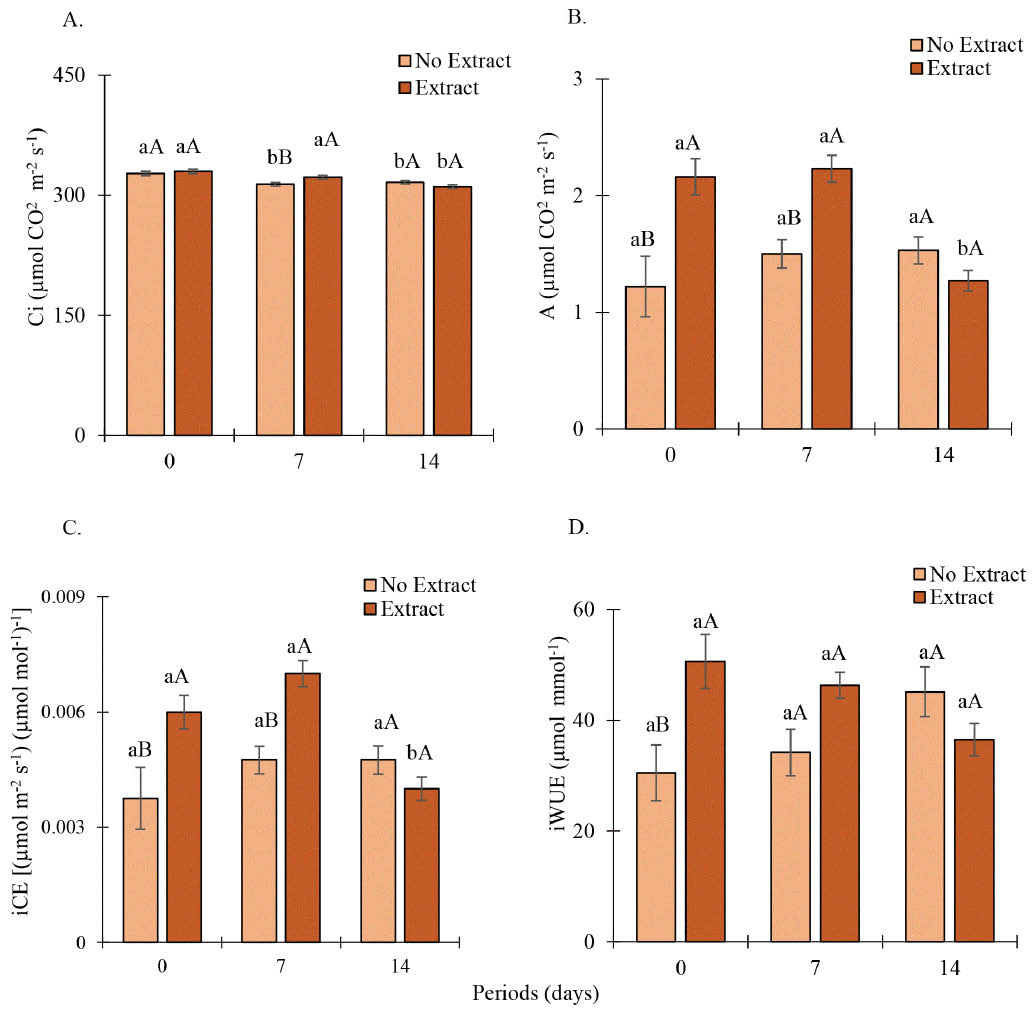 *Vertical bars represent the standard error (n = 4). Bars with equal lowercase letters do not differ for different irrigation intervals within each method of application of pyroligneous extract by the Tukey test (p ≤ 0.05). Bars with identical capital letters do not show significant differences between them for each method of application of pyroligneous extract within each irrigation interval by the Tukey test (p ≤ 0.05)
 Vertical bars represent the standard error (n = 4). Distinct lowercase letters indicate differences between the means of each studied factor (periods of water deficit and methods of PE application) according to Tukey’s test (p ≤ 0.05)
 *Vertical bars represent the standard error (n = 4). Lowercase letters indicate that there are no differences between the water deficit periods within each pyroligneous extract application method according to the Tukey test (p ≤ 0.05). Uppercase letters indicate that there are no significant differences between the pyroligneous extract application methods within each water deficit period according to the Tukey test (p ≤ 0.05). Distinct lowercase letters show differences between the means of each analyzed factor according to the Tukey test (p ≤ 0.05)
 *Vertical bars represent the standard error (n = 4). Lowercase letters indicate that there are no differences between the water deficit periods within each pyroligneous extract application method according to the Tukey test (p ≤ 0.05). Uppercase letters indicate that there are no significant differences between the pyroligneous extract application methods within each water deficit period according to the Tukey test (p ≤ 0.05). Distinct lowercase letters show differences between the means of each analyzed factor according to the Tukey test (p ≤ 0.05)
 *Vertical bars represent the standard error (n = 4). Lowercase letters indicate that there are no differences between the water deficit periods within each pyroligneous extract application method according to the Tukey test (p ≤ 0.05). Uppercase letters indicate that there are no significant differences between the pyroligneous extract application methods within each water deficit period according to the Tukey test (p ≤ 0.05). Distinct lowercase letters show differences between the means of each analyzed factor according to the Tukey test (p ≤ 0.05)