 Contrasting first-crop corn hybrids with different growth cycles in response to defoliation levels and sowing dates
ABSTRACT
Damage caused by diseases, pests, or adverse weather conditions in the reproductive stages of corn crops results in reduced grain yield. However, studying the contribution of leaves in new hybrids is an alternative that makes it possible to reduce this damage. Therefore, this study aimed to contrast the effect of artificial defoliation at the R1 stage on the agronomic traits of four corn hybrids in a high-altitude region in two sowing seasons. The experimental design was randomized blocks in a 4 × 4 × 2 factorial scheme, referring to four defoliation levels (1- no removal of the leaf blade; 2- removal of all leaves; 3- removal of all leaves above the ear, and 4- removal of all leaves below the ear) × four hybrids (P1225 VYH, P3016 VYHR, DKB 345 PRO3, and P4285 VYHR) x two sowing dates (October and November), with four replicates. The loss of leaf area above the ear decreases the number of grains per ear by 19.5%, 1000-grain weight by 11%, and grain yield by 44.5% for the hybrids and sowing seasons studied in a high-altitude region. Grain yield was increased by sowing in October by 23% compared to November. The hybrid DKB 345 PRO3 obtained the highest grain yield at all defoliation levels at the R1 stage under the conditions of Guarapuava, PR.
Key words:
Zea mays; climatic zoning; yield performance; radiation interception
HIGHLIGHTS:
Removing the upper third leaf reduces the grain yield of corn hybrids of different cycles at high altitudes.
The edaphoclimatic conditions of October positively influence the agronomic traits compared to November.
The hybrid DKB 345 PRO3 had the highest grain yield in the different levels of defoliation studied at the R1 stage.
RESUMO
Os danos acometidos por doenças, pragas ou intempéries climáticas nos estádios reprodutivos da cultura do milho resultam em redução na produtividade de grãos, porém o estudo da contribuição das folhas em novos híbridos é uma alternativa que possibilita a redução desses danos. Sendo assim objetivou-se o estudo de contraste do efeito da desfolha artificial no estádio R1, nas características agronômicas de diferentes híbridos de milho, em região de alta altitude em duas épocas de semeadura. O delineamento experimental foi de blocos ao acaso, no esquema fatorial 4 × 4 × 2, referente a quatro níveis de desfolha (1- sem remoção do limbo foliar; 2- remoção de todas as folhas; 3- remoção de todas as folhas acima da espiga e 4- remoção de todas as folhas abaixo da espiga) × quatro híbridos (P1225 VYH, P3016 VYHR, DKB 345 PRO3 e P4285 VYHR) x duas épocas de semeadura (outubro e novembro), com quatro repetições. A perda da área foliar acima da espiga, diminui o número de grãos por espiga 19,5%, massa de mil grãos 11% e produtividade de grãos 44,5% para híbridos e época de semeadura. A produtividade de grão aumentou na semeadura em outubro em 23% frente a de novembro. Nas condições de Guarapuava, o híbrido DKB 345 PRO3 obteve maior produtividade de grãos em todos os níveis de desfolha no estádio R1.
Palavras-chave:
Zea mays; zoneamento climático; desempenho produtivo; interceptação da radiação
Introduction
When considering the harmful effects caused by loss of leaf area in corn crops, it is extremely important to search for new alternatives that can minimize the damage caused by pest attacks, the incidence of diseases, and climatic problems through the choice of hybrids that present greater tolerance to leaf loss, especially during the phases that most compromise grain yield and in different sowing seasons (Silva et al., 2020).
The preferred sowing season coincides with good availability of light, longer days, and without water limitations, as these factors depend on each region. However, the cultivation of the first harvest conducted in later seasons, from December onwards, can reduce the yield potential of hybrids due to unfavorable weather conditions (Cazarim et al., 2023).
In this context, high altitude also has a strong influence on the yield capacity of genotypes; corn yield at altitudes above 700 m is greater when compared to altitudes below 700 m due to climatic conditions being favorable for cultivation, as they have as characteristics the reduction of nighttime temperature and greater availability of light for plant development, which directly intervenes in net photosynthesis (Caron et al., 2017).
According to Nascimento et al. (2011), who studied the grain yield of corn genotypes in response to the sowing season, the seasons can influence the leaf area index since sowing conducted in December allowed for a greater number of leaves above the ear. Now, Lima et al. (2016), working in the region of Uberlândia (MG), observed that the contribution of leaves in different thirds of the plants assume different responses to hybrids, which demonstrates that the loss of leaf area above the ear is responsible for lower grain yield. Therefore, it is essential to understand the impacts caused by the stress to which the plant is subjected to conduct adequate management (Andrzejewski et al., 2020).
Vaz et al. (2016) demonstrated that the loss of leaf area above the main ear can reduce grain yield by up to 41.87%. In a study by Lima et al. (2016), defoliation below the ear reduced grain yield by up to 13%. Similarly, Silva et al. (2020) reported that leaves positioned at different locations along the stem contribute directly to metabolite synthesis, with 50% being produced in the upper third of the plant.
Nonetheless, several studies indicate that the loss of leaf area may limit several physiological processes due to the reduction in the interception of photosynthetically active radiation, where the reduction in leaf area in the post-flowering phases will cause losses in grain filling and, as a consequence, demand other plant reserves, which may favor the occurrence of diseases and may even cause the plants to fall over or become lodged (Sousa et al., 2015; Silva et al. 2020). Therefore, the objective was to study the contrast of the effect of artificial defoliation at the R1 stage on the agronomic traits of different corn hybrids in a high-altitude region in two sowing seasons.
Material and Methods
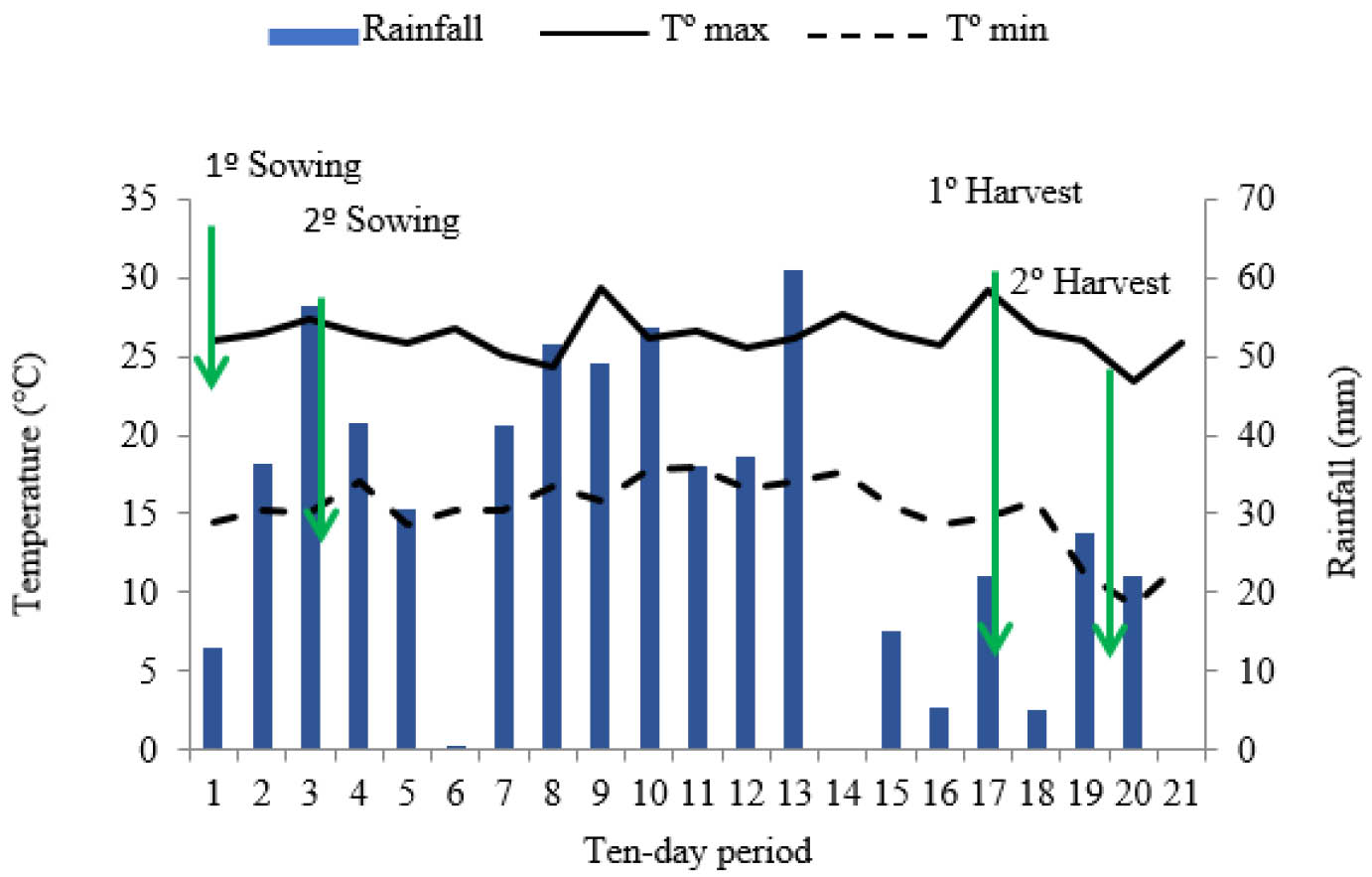
The experiment was installed and conducted under field conditions in an experimental area of the Department of Agronomy of the Universidade Estadual do Centro-Oeste - UNICENTRO, next to Fazenda Escola, Guarapuava, PR, at 25º 22’ 58” S, 51º 33’ 10” W, and altitude of 1,120 m. According to the Köppen-Geiger classification, the region’s climate is humid subtropical mesothermal (Cfb-type). Meteorological data on rainfall and maximum and minimum temperatures for the two sowing seasons were obtained from the meteorological station of the Instituto de Desenvolvimento Rural do Paraná - Iapar-Emater, located at UNICENTRO, approximately 10 km from Fazenda Escola. This station is considered a reference point, and provided data presented in Figure 1 as ten-day averages spanning from October 2019 to April 2020.
Rainfall (mm) and average air temperature (°C) per ten-day period in Guarapuava, PR, from October 1, 2019 to April 30, 2020
Initially, it is important to highlight that there were differences in climatic conditions between the periods studied, mainly concerning the rainfall index, whose values were different between them (season 1 - October/2019 and season 2 - November/2020). In season 1, throughout the crop cycle, the total rainfall was 506 mm, while in season 2, the total volume was 427 mm (Figure 1); as a response to this factor, the crop’s water requirements were met. The climatic values found in the study region are ideal for producing corn hybrids.
The soil in the region is classified as Dystroferric Brown Latosols (Oxisols), with a very clayey texture. The results of the chemical analysis of the soil conducted in the 0-20 cm layer were: pH (CaCl2): 4.32; O.M.: 34.15 g dm-3; P: 4.63 mg dm-3; K: 0.28 cmolc dm-3; Ca: 2.13 cmolc dm-3; Mg: 0.99 cmolc dm-3; Al: 0.5 cmolc dm-3; H+Al: 6.64 cmolc dm-3; CEC: 10.04; Base saturation (%): 33.9; S: 14.72 mg dm-3. The fertilization in the sowing furrow was conducted according to soil analysis, applying 250 kg ha-1 of the 8-20-20 NPK formulation. The topdressing fertilization was conducted at the V4 and V6 stages, with fully expanded leaves, with a dose of 200 kg ha-1 of urea in each application. Cultural treatments were conducted based on the requirements of the crop and phytosanitary management as necessary, emphasizing that irrigation was not conducted in this study.
The experimental design consisted of randomized blocks arranged in a 4 × 4 × 2 factorial scheme with four replicates. Four defoliation levels (1- without removal of the leaf blade; 2- total defoliation; 3- removal of all leaves above the ear and 4- removal of all leaves below the ear) x four hybrids (P1225 VYH, P3016 VYHR, DKB 345 PRO3 and P4285 VYHR) × two sowing seasons (October 23 and November 22, 2019) were evaluated.
To assess the effect of defoliation levels, a 4 × 4 × 2 factorial design was followed, which consisted of four defoliation levels (1- without removal of the leaf blade; 2- removal of all leaves; 3- removal of all leaves above the ear; and 4- removal of all leaves below the ear) × four hybrids (super early, early and late cycles) × two sowing seasons (October and November) and four replications. However, it was impossible to analyze the total defoliation for the trait of the number of grains per ear.
The plots consisted of four rows with spacing of 0.45 m between them and 5.0 m length, totaling a useful area of 9 m², with the two central rows being considered for data collection. In the same experimental area, the experiment was manually installed under a direct planting system in two sowing seasons, October 23 and November 22, 2019. After the emergence of plants, thinning with spacing between rows of 45 cm and between plants of 0.26 cm was performed to reach a final population of 85,000 plants ha-1.
The following corn hybrids were used in the experiment: P1225 VYH with a super early cycle (CRM 112 days), P4285 VYHR with a late cycle (CRM 142 days), P3016 VYHR with an early cycle (CRM 130 days) and DKB 345 PRO3 with an early cycle (CRM 130 days), with high yield potential, also being more recommended for high-altitude regions.
The defoliation levels were performed as follows: without removal of the leaf blade, removal of all leaves, removal of all leaves above the ear, and removal of all leaves below the ear. The removal was conducted in the two central rows of the plots, considering the two defoliation positions above and below the main ear and making cuts at the point where the leaf blade joins the stem at the time when 50% of the plants were in the R1 (flowering) stage of development.
For both sowing seasons, plant traits characterizing the hybrids were evaluated using six plants within the effective area of each plot. The traits assessed included ear insertion height (EIH), measured as the height of the first ear insertion; plant height (PH), measured from the ground to the flag leaf insertion; and stem diameter (SD), measured at the second internode above the ground using a caliper (mm). Subsequently, the number of grains per ear (NGE) was determined by estimating the number of grains per row and the total number of rows. The 1000-grain weight (1000W) was calculated as the average weight of eight samples of 100 grains, adjusted to 13% moisture, and expressed in grams. Grain yield (YLD) was also evaluated. Ears were threshed, grains weighed, and moisture content determined. Grain weight data were then converted to kg ha⁻¹ and standardized to a moisture content of 13%.
The data were subjected to analysis of normality and homogeneity of variances by using the Shapiro-Wilk and Bartlett tests, respectively. Afterwards, it was applied analysis of variance. The means were compared using the following non-orthogonal contrasts (control vs. total defoliation, control vs. defoliation above the ear, control vs. defoliation below the ear, total defoliation vs. defoliation above the ear, total defoliation vs. defoliation below the ear, defoliation above the ear vs. defoliation below the ear, P1225 VYH vs. P4285 VYHR, P1225 VYH vs. P3016 VYHR, P1225 VYH vs. DKB 345 PRO3, P4285 VYHR vs. P3016 VYHR, P4285 VYHR vs. DKB 345 PRO3, P3016 VYHR vs DKB 345 and Season 1 vs Season 2).
Results and Discussion
In the initial phase of crop implementation, a delay in seed germination was observed concerning the first season (October), justified by the lower rainfall, which may have affected the initial establishment of the plants since, during this period, the seed needs moisture in the soil to begin its germination process. Furthermore, another relevant fact was the difference between rainfall indexes during the flowering period, as 285 mm were observed for October and 158 mm for November, highlighting a lower water volume for season 2 in the course of maximum demand for the crop, which may have influenced grain yield (Figure 1).
Regarding air temperature (maximum and minimum), it was observed that the average maximum temperature was 26.31 °C, and the average minimum temperature was 15.18 °C, which were suitable for development since the corn plant produces better at temperatures of 10 to 30 °C (Kappes et al., 2014, Albert et al., 2023; Santos et al., 2023).
There were significant effects (p ≤ 0.05) of the corn hybrids on the plant height (PH), while for the ear insertion height (EIH), there were effects of corn hybrids and sowing seasons. For stem diameter, corn hybrids and sowing season had a significant effect. In this sense, it demonstrates the importance of assessing different corn hybrids in the same location at different sowing seasons to understand their behavior when environmental conditions change (Berghetti et al., 2020). Table 1 shows seven non-orthogonal contrasts which were performed (P1225 VYH vs. P4285 VYHR, P1225 VYH vs. P3016 VYHR, P1225 VYH vs. DKB 345 PRO3, P4285 VYHR vs. P3016 VYHR, P4285 VYHR vs. DKB 345 PRO3, P3016 VYHR vs. DKB 345 PRO3, and Season 1 vs. Season 2), as to compare the super early, early, and late cycle hybrids in both sowing seasons, the plant height, ear insertion height, and stem diameter.
For the contrasts involving the PH, EIH, and SD, the responses of the corn hybrids evidenced what was already expected due to the genetic modifications of each material. It was observed that the stem diameter and ear insertion height for the hybrid P4285 VYHR were significantly responsive, which demonstrated the superiority of the hybrid since the greater the stem diameter, the lower the probability of lodging and the greater the plant’s capacity to store photoassimilates that contribute to grain filling.
A smaller leaf area reduces the photosynthetic rate, thus affecting the formation of the stem during the vegetative process, which in turn can cause the stem to lose resistance and reduce its capacity to store photoassimilates (Sarturi et al., 2022; Correia et al., 2024).
As for the hybrids, it was observed (Table 1) that the PH and EIH were inferior for the P1225 VYH, a super-early cycle hybrid that presents lower vegetative growth than the later cycle ones (Vieira et al., 2015).
Concerning the sowing seasons, an increase in the ear insertion height and a reduction in the stem diameter were observed for the second sowing season (November), which evidences that this higher growth was also represented by greater competition for light among plants. It was also observed that the increase in population density favored plant etiolation, as the number of plants per unit area intensifies intraspecific competition for light, water, and nutrients (Santos et al., 2019).
Thirteen non-orthogonal contrasts were performed for NGE, 1000W, and YLD to compare different levels of defoliation during the sowing seasons, as shown in Table 2. With the assessed data, it was not possible to perform the contrast for the control plot vs. total defoliation, total defoliation vs. defoliation above the ear, and total defoliation vs. defoliation below the ear for the NGE since it was not assessed for the total defoliation treatment.
The NGE showed significant effects from defoliation levels and corn hybrids for both sowing seasons. In the 1000W and YLD, a significant interaction was observed between defoliation levels × corn hybrids × sowing seasons. For the total defoliation treatment, regardless of the sowing season and corn hybrid, greater losses in grain yield were observed.
Concerning the number of grains per ear, a significant effect of 99% probability was observed for the contrasts: control vs. defoliation above the ear, control vs. defoliation below the ear, and defoliation below the ear vs. defoliation above the ear (Sousa et al., 2015; Sand et al., 2023). Although the yield components, such as the number of rows and number of grains per row, are defined at vegetative stages, significant decreases of 21 and 18% were recorded for the NGE with defoliation above the ear for both sowing seasons, respectively. Significant differences still occur between the corn hybrids, except for P4285 VYHR, which presented lower NGE.
Similar results were reported by Vaz et al. (2016) in their study; when all leaves above the ear were removed immediately after flowering, NGE was reduced by approximately 28%. Sangoi et al. (2012) found similar results for the same assessed traits, although they observed that NGE drastically reduced when defoliation occurred during the V15 and VT stages, stating that insufficient photoassimilates associated with low leaf area promoted considerable reductions in the number of grains per ear. The defoliation process in different thirds of the plant will provide different responses, the most significant being the removal above the ear, which compromises grain yield (Sousa et al., 2015).
The analysis of the results showed that artificial defoliation performed below the ear compromised NGE by approximately 8% in the October season; in November, there were no differences in the reduction of NGE compared to the treatment without artificial defoliation. According to Trogello et al. (2017), although the impact on the number of grains per ear is smaller due to the defoliation below, it is of significant importance that the leaves in the lower third are present to obtain a good yield.
In both seasons, it was evident that the super-early and early cycle genotypes outperformed the late cycle genotypes (P4285 VYHR) for the NGE parameter. According to Klein et al. (2018), early-cycle corn hybrids, with smaller sizes, less stem elongation, and fewer leaves, have a greater participation in ear development, while late-cycle hybrids have higher percentages of leaves and stems.
When evaluating the contrasts for the defoliation levels, it is observed that 1000W (Table 2) is negatively influenced when subjected to the removal of all leaves, which resulted in a decrease of 29% for the first season concerning the treatment without artificial defoliation. Nevertheless, this reduction was more expressive in November, presenting a 1000W of 36% less concerning the treatment without defoliation, showing that the season interfered significantly in 1000W, with the October sowing season resulting in greater grain weight, which may be linked to the higher rainfall rates during the flowering stage of the crop. The stress caused by defoliation treatment can cause changes that interfere with the source-sink relationship and reduce the plant’s photosynthetic rate, thus causing damage to yield and the amount of biomass (Silva et al., 2020).
The results indicate that the artificial defoliation process conducted during the reproductive period may result in losses in ear length (Table 2), ear diameter, and 1000-grain weight. The ear length is influenced by environmental conditions that occur after flowering, so defoliation during this period has a greater influence on the yield and architecture of the plant (Sousa et al., 2015), agreeing with Brito et al. (2011), who verified that the obtained weight of 103.05 g in the treatment with total defoliation corresponds to less than a third of the value obtained by the control (without defoliation) of 331.77 g, what indicates that as the number of grains per ear and the number of rows were not altered by artificial defoliation, the reduction in 1000W contributed to lower grain yield.
Removing leaves from the upper and lower thirds showed significant reductions of approximately 11 and 10% for both sowing seasons, respectively. Nonetheless, the losses were more pronounced for the treatment with removing all leaves, being 28% for October and 35% for November. Concerning the hybrids in the second sowing season, P3016 VYHR and DKB 345 PRO3 did not present differences in 1000W for defoliation above and below the main ear concerning the treatment without defoliation.
According to Lima et al. (2016), who studied the effect of artificial defoliation on the yield components of corn hybrids, which were of contrasting size and cycle, adapted to the soil and climate conditions of the Minas Gerais region, the defoliation above the ear reflects in loss of yield, while defoliation below the ear has smaller effects, this occurs because the leaves above the ear have a greater contribution of photoassimilates for grain filling.
Artificial defoliation below the ear in the hybrid P1225 VYH (super early cycle) showed less interference in the 1000W, obtaining values similar to those of the control in the October and November sowing. The results analyzed show that a large part of the photoassimilates directed to grain filling is obtained by the photokinetic activity of the leaves in the upper third, therefore evidencing that the greatest impacts on 1000W come from the stress of artificial defoliation performed above the ear, as well as for the availability of environmental factors (Sand et al., 2023; Correia et al., 2024).
Concerning the hybrids P1225 VYH and P3016 VYHR, regardless of the sowing date that they were subjected to, they presented the lowest 1000W. These results show that the 1000-grain weight is influenced by the cultivar genotype, nutrient availability, and climatic conditions during the grain-filling phase (Shojaei et al., 2023; Sand et al., 2023).
For the contrasts of the grain yield trait, they presented significant data, reaching more than 99% probability in the contrasts between control and total defoliation, control and defoliation above the ear, control and defoliation below the ear, total defoliation and defoliation above the ear, total defoliation and defoliation below the ear, defoliation above the ear and defoliation below the ear, P1225VYH and P4285 VYHR, P1225VYH and P3016 VYHR, P1225VYH and DKB 345 PRO3, P4285 VYHR and DKB 345 PRO3, P3016 VYHR and DKB 345 PRO3, and Season 1 and Season 2.
In the total artificial defoliation of plants, there was a reduction in grain yield, with a reduction of 95% for the sowing in October and approximately 96% for the sowing in November. The total removal of the photosynthetically active leaf area in the reproductive phase of the plant caused an imbalance in the source-sink relationship. Being that, at this moment, the reproductive organs are externalized, the ovules are fertilized, and the grains are filled, which negatively influences the number of grains formed and the 1000-grain weight, thus contributing to the lower grain yield of the crop (Trogello et al., 2017).
By analyzing grain yield according to the position of artificial defoliation (above and below the main ear), it can be verified that when defoliation was performed above the main ear, there was a reduction in YLD of 46% for the first season (October) and 43% for the second season (November), providing an average reduction of 44.5%. At the same time, defoliation below the ear for the first and second sowing season resulted in yield losses of approximately 26 and 23%, respectively, demonstrating the importance of the contribution of the leaves to the middle and upper third in grain filling and obtaining high yield.
The removal of leaves above the ear during the grain filling period resulted in a greater reduction in grain yield when compared to removal below the ear. For Sangoi et al. (2014), who worked with corn hybrids of contrasting cycles and sizes under the vegetative and reproductive phenological stages, it can be concluded that the greatest damage to the crop occurs when artificial defoliation is performed close to the flowering stage.
For most of the results presented, it was found that removing leaves above the ear during the flowering period caused a significant reduction in yield, evidencing their importance in the final yield. The effect of removing the leaf blade below the ear was less pronounced; however, it negatively influenced grain yield when compared to the control treatment, where the leaf blade was not removed.
No matter how small the reduction in the photosynthetically active area of corn plants, it is enough to compromise photosynthetic efficiency, the source-sink ratio, and consequently, the distribution of photoassimilates, which reduces the final grain yield (Barbosa et al., 2019). It is also worth noting that in regions with altitudes below <700 m, yield losses are even more pronounced, as for the availability of solar radiation in smaller quantities for plants, as well as the increase in temperature at night. The sowing season significantly affected the yield index, with the average grain yield obtained in the October season being 23% higher than in November. The results corroborate those obtained by Mendes et al. (2015), who found that late sowing conducted in November in the Guarapuava-PR region leads to a decrease in yield, explained by the shortening of the cycle of some corn hybrids due to thermal summation and reduction of ideal conditions for crop development.
The location and altitude (1,120 m) at which the experiment was conducted may be related to the results obtained since the meteorological conditions for both sowing seasons were favorable for cultivating the hybrids assessed. Nevertheless, there was less variability among the corn hybrids concerning grain yield for the first sowing season, indicating that the October season coincides with the lowest probability of climatic stresses, especially during the flowering period.
Considering the three levels of artificial defoliation (total defoliation, defoliation above the ear, and defoliation below the ear) and by analyzing the two sowing seasons, the hybrid DKB 345 PRO3 showed an increase in grain yield concerning the super early cycle hybrid P1225 VYH, the final grain yield is dependent on the number of grains per ear and the 1000-grain weight (Uitzil et al., 2016).
The hybrid P1225 VYH, regardless of the sowing season, when subjected to different artificial defoliation levels, presented the lowest yield performance, differing from the other hybrids, both at the beginning and end of the cycle. This finding is supported by the smaller leaf area associated with the short cycle of the super-early genotypes, which hinders the recovery capacity of these plants when subjected to stress factors, causing significant losses even in conditions with lower defoliation intensity.
Conclusions
-
The loss of leaf area above the ear at the R1 stage (flowering) decreases the number of grains per ear by 19.5%, the 1000-grain weight by 11%, and grain yield by 44.5% for the hybrids and sowing seasons studied in a high-altitude region.
-
Grain yield increased by the sowing season in October by 23% compared to November.
-
In the October and November sowing seasons, the DKB 345 PRO3 hybrid obtained higher grain yield at all defoliation levels performed at the R1 stage.
Acknowledgments
This research was supported by CNPq (Conselho Nacional de Desenvolvimento Científico e Tecnológico) and CAPES (Coordenação de Aperfeiçoamento de Pessoal de Nível Superior).
Literature Cited
-
Albert, A. M.; Castelli, G.; Rodriges, C.; Cavalcante, T. J.; Nogueira, M. M.; Fonseca, A. Nitrogen management in second-crop maize in Southwestern Goiás. Ciência e Agrotecnologia, v.47, e011022, 2023. https://doi.org/10.1590/1413-7054202347011022
» https://doi.org/10.1590/1413-7054202347011022 -
Andrzejewski, J. H. S.; Bellettini, S.; Bellettini, N. M. T.; Oliveira, E. M. B. B. Influência do desfolhamento nos componentes de produção do milho/Influence of defoliation on maize production components. Brazilian Journal of Development, v.6, p.52334-52353, 2020. https://doi.org/10.34117/bjdv6n7-763
» https://doi.org/10.34117/bjdv6n7-763 -
Barbosa, A. P.; Zucareli, C.; Tsukahara, R. Y.; Kochinski, E. G.; Bazzo, J. H. B. Reaplicação de nitrogênio na mitigação do efeito da desfolha em diferentes fases fenológicas do milho. Revista Brasileira de Milho e Sorgo, v.18, p.30-46, 2019. https://doi.org/10.18512/1980-6477/rbms.v18n1p30-46
» https://doi.org/10.18512/1980-6477/rbms.v18n1p30-46 -
Berghetti, J.; Casa, R. T.; Coelho, A. E.; Sangoi, L.; Silva, F. N. da; Scheidt, B. T.; Martins, F. C.; Ludwig, A. H. Grain quality of maize hybrids submitted to different sowing times and nitrogen rates. Revista de Ciências Agroveterinárias, v.19, e26, 2020. https://doi.org/10.5965/223811711912020026
» https://doi.org/10.5965/223811711912020026 - Brito, C. H.; Silveira, D. L.; Brandão, A. M.; Gomes, L. S.; Lopes, M. T. G. Redução de área foliar em milho em região tropical no Brasil e os efeitos em caracteres agronômicos. Interciencia, v.36, p.291-295, 2011.
-
Caron, B. O.; Oliveira, D. M.; Elli, E. F.; Eloy, E.; Schwerz, F.; Souza, V. Q. Elementos meteorológicos sobre características morfológicas e produtivas do milho em diferentes épocas de semeadura. Científica, v.45, p.105-114, 2017. https://doi.org/10.15361/1984-5529.2017v45n2p105-114
» https://doi.org/10.15361/1984-5529.2017v45n2p105-114 -
Cazarim, P. H.; Schimizu, D. G.; Fantin, L. H.; Silva, M. A. de A. e; Zucareli, C. Grain yield performance of corn in different plant arrangements. Revista Caatinga, v.36, p.532-542, 2023. https://doi.org/10.1590/1983-21252023v36n306rc
» https://doi.org/10.1590/1983-21252023v36n306rc - Correia, A. A.; Freire, W. A.; Silva, T. P. da; Ferreira, J. T.; Gonçalves, M. A. B.; Souza, Ê. G. F. Características Agronômicas de híbridos de milho para grãos no sertão de Alagoas. EDUCTE: Revista Científica do Instituto Federal de Alagoas, v.15, p.51-69, 2024.
-
Kappes, C.; Arf, O.; Bem, E. A. D.; Portugal, J. R.; Gonzaga, A. R. Manejo do nitrogênio em cobertura na Cultura do milho em sistema plantio direto. Revista Brasileira de Milho e Sorgo , v.13, p.201-217, 2014. https://doi.org/10.18512/1980-6477/rbms.v13n2p201-217
» https://doi.org/10.18512/1980-6477/rbms.v13n2p201-217 -
Klein, J. L.; Viana, A. F. P.; Martini, P. M.; Adams, S. M.; Guzatto, C.; Bona, R. D. A.; Rodrigues, L. D. S.; Alves Filho, D. C.; Brondani, I. L. Desempenho produtivo de híbridos de milho para a produção de silagem da planta inteira. Revista Brasileira de Milho e Sorgo , v.17, p.101-110, 2018. https://doi.org/10.18512/1980-6477/rbms.v17n1p101-110
» https://doi.org/10.18512/1980-6477/rbms.v17n1p101-110 - Lima, S. F.; Alvarez, R. C. F.; Contardi, L. M. Influence of row spacing on agronomic parameters features and dry matter accumulation of maize hybrids. Ambiência, v.12, p.1027-1039, 2016.
-
Mendes, M. C; Gabriel, A.; Faria, M. V.; Rossi, E. S.; Possatto Junior, O. Época de semeadura de híbridos de milho forrageiro colhidos em diferentes estádios de maturação. Revista Agro@mbiente On-line, v.9, p.136-142, 2015. https://doi.org/10.18227/1982-8470ragro.v9i2.2316
» https://doi.org/10.18227/1982-8470ragro.v9i2.2316 -
Nascimento, F. M.; Bicudo, S. J.; Rodrigues, J. G. L.; Furtado, M. B.; Campos, S. Produtividade de genótipos de milho em resposta à época de semeadura. Revista Ceres, v. 58, p.193-201, 2011. https://doi.org/10.1590/S0034-737X2011000200010
» https://doi.org/10.1590/S0034-737X2011000200010 -
Pereira, M. J. R.; Bonan, E. C. B.; Garcia, A.; Vasconcelos, R. L.; Gíacomo, K. dos S.; Lima, M. F. Características morfoagronômicas do milho submetido a diferentes níveis de desfolha manual. Revista Ceres , v.59, p.200-205, 2012. https://doi.org/10.1590/S0034-737X2012000200008
» https://doi.org/10.1590/S0034-737X2012000200008 -
Rezende, W. S.; Brito, C. H. de; Brandão, A. M.; Franco, C. J. F.; Ferreira, M. V.; Ferreira, A. de S. Desenvolvimento e produtividade de grãos de milho submetido a níveis de desfolha. Pesquisa Agropecuária Brasileira, v.50, p.203-209, 2015. https://doi.org/10.1590/S0100-204X2015000300003
» https://doi.org/10.1590/S0100-204X2015000300003 -
Sand, A. L. V. D.; Carvalho, I. R.; Sangiovo, J. P.; Pradebon, L. C.; Freier, L.; Seifert, S. K. Desfolha nos diferentes estádios vegetativos no milho. Salão do Conhecimento, v.9, 2023. Disponível em: Disponível em: https://publicacoeseventos.unijui.edu.br/index.php/salaoconhecimento/article/view/24534 Acesso em: 22 jul. 2024.
» https://publicacoeseventos.unijui.edu.br/index.php/salaoconhecimento/article/view/24534 -
Sangoi, L.; Schmitt, A.; Silva, P. R. F. da; Vargas, V. P.; Zoldan, S. R.; Vieira, J.; Souza, C. A. de; Picoli Junior, G. J.; Bianchet, P. Perfilhamento como característica mitigadora dos prejuízos ocasionados ao milho pela desfolha do colmo principal. Pesquisa Agropecuária Brasileira , v.47, p.1605-1612, 2012. https://doi.org/10.1590/S0100-204X2012001100007
» https://doi.org/10.1590/S0100-204X2012001100007 -
Sangoi, L.; Vieira, J.; Eduardo, D.; Giordani, W.; Boniatti, C. M.; Dall’igna, L.; Souza, C.; Zanella, E. J. Tolerância à Desfolha de Genótipos de Milho em Diferentes Estádios Fenológicos. Revista Brasileira de Milho e Sorgo , v.13, p.300-311, 2014. https://doi.org/10.18512/1980-6477/rbms.v13n3p300-311
» https://doi.org/10.18512/1980-6477/rbms.v13n3p300-311 -
Santos, D. C. dos; Perreira, C. H.; Nunes, J. A. R.; Lepre, A. L. Adaptability and stability of maize hybrids in unreplicated multienvironment trials. Revista Ciência Agronômica, v.50, p.83-89, 2019. https://doi.org/10.5935/1806-6690.20190010
» https://doi.org/10.5935/1806-6690.20190010 -
Santos, F. C.; Figueiredo, J. I. F.; Pinheiro, R. B.; Cota, L.V.; Vasconcelos, A. A.; Albuquerque Filho, M. R. Effects of maize genotypes, nitrogen rates and sources in yield, nutritional status, and fumonisins incidence. Brazilian Journal of Biology, v.83, e274081, 2023. https://doi.org/10.1590/1519-6984.274081
» https://doi.org/10.1590/1519-6984.274081 -
Sarturi, M. V. da R.; Teixeira, C. A. M. B.; Carvalho, I. R.; Demari, G. H.; Loro, M. V.; Pradebon, L. C.; Port, E. D. Prediction of corn grain productivity as a function of altitude and plant population. Revista de Agricultura Neotropical, v.9, e7070, 2022.https://doi.org/10.32404/rean.v9i4.7070
» https://doi.org/10.32404/rean.v9i4.7070 -
Silva, R. S.; Campos, H. D.; Ribeiro, L. M.; Braz, G. B. P.; Magalhães, W. B.; Bueno, J. N. Damage to the corn crop due to the reduction of leaf area by artificial defoliation and diseases. Summa Phytopathologica, v.46, p.313-319, 2020. https://doi.org/10.1590/0100-5405/231093
» https://doi.org/10.1590/0100-5405/231093 -
Sousa, V. Q.; Carvalho, I. R.; Follmann, D. N.; Nardino, M.; Bellé, R.; Baretta, D.; Schmidt, D. Desfolhamento artificial e seus efeitos nos caracteres morfológicos e produtivos em híbridos de milho. Revista Brasileira de Milho e Sorgo , v.14, p.61-74, 2015. https://doi.org/10.18512/1980-6477/rbms.v14n1p61-74
» https://doi.org/10.18512/1980-6477/rbms.v14n1p61-74 -
Shojaei, S. H.; Mostafavi, K.; Bihamta, M.; Omrani, A.; Bojtor, C.; LLLes, A.; Szabo, A.; Vad, A.; Nagy, J.; Harsányi, E.; Mousavi, S. M. N. Selection of maize hybrids based on genotype × yield × trait (GYT) in different environments. Brazilian Journal of Biology , v.84, e272093, 2023. https://doi.org/10.1590/1519-6984.272093
» https://doi.org/10.1590/1519-6984.272093 -
Trogello, E.; Borges, L. F.; Oliveira, F. A. de; Mutaguti, Q. S.; Barros, I. G.; Modolo, A. J. Respostas morfoagronômicas de milho submetido a desfolha artificial. Revista Brasileira de Milho e Sorgo , v.16, p.460-468, 2017. https://doi.org/10.18512/1980-6477/rbms.v16n3p460-468
» https://doi.org/10.18512/1980-6477/rbms.v16n3p460-468 - Uitzil, A. M. P.; Marcel, A.; De Souza, V. Q.; OLivoto, T.; Nardino, M.; Carvalho, I. R.; Szareski, V. J. Yield components of hybrid based on the plant population and artificial defoliation. Australian Journal of Basic and Applied Sciences, v.10, p.136-142, 2016.
-
Vaz, P. F. T.; Simonetti, A. P. M. M.; Montiel, C. B. Efeito da desfolha de plantas de milho sobre parâmetros produtivos. Acta Iguazu, v.5, p.94-101, 2016. https://doi.org/10.48075/actaiguaz.v5i2.15498
» https://doi.org/10.48075/actaiguaz.v5i2.15498 -
Vieira, A. F.; Nunes, R. L. C.; Torres, R. A.; Dias, N. S.; Oliveira, A. B. Avaliação agronômica de híbridos de milho para silagem em baraúna, região semiárida nordestina. Revista Brasileira de Milho e Sorgo , v.14, p.283-290, 2015. https://doi.org/10.18512/1980-6477/rbms.v14n2p283-290
» https://doi.org/10.18512/1980-6477/rbms.v14n2p283-290
Supplementary documents
This study does not contain any additional research data and, where appropriate, provides a statement of availability regarding location and nature.