
 Potassium nutrition improves sweet sorghum yield under brackish water use in a semi-arid tropical climate
ABSTRACT
The adequate management of irrigation with brackish water associated with balanced nutrition with potassium (K) should be investigated to reduce the deleterious effects of salt stress and increase the yield of sweet sorghum, which is suitable for forage exploration and in the biofuel industry. This investigation evaluated the effects of irrigation depth of brackish water and different doses of potassium on the growth and production of sweet sorghum, with the aim of obtaining better performance of this crop under different management of these inputs in the semi-arid region of Pernambuco, Brazil. Thus, the growth and yield of sweet sorghum were investigated under five irrigation depths (IDand 40 kg ha-1) in a randomized complete block design. Plant height, stem diameter, fresh mass of the stem, leaves, panicle, and total 1 = 222, ID2 = 388, ID3 = 554, ID4 = 720, and ID5 = 886 mm) with brackish water and five K2O doses (0, 10, 20, 30, fresh mass were evaluated in this investigation. Total fresh mass exhibited a surface response, with the highest estimated value (39.10 Mg ha⁻1) observed under an irrigation depth of 760 mm combined with a K₂O application rate of 40 kg ha⁻1. The study of different irrigation depths and their interaction with doses of Kin the semi-arid region, enabling a more appropriate irrigation and nutrition regime for the crop in the region.2O indicates the requirements for a greater supply of nutrients and water to sweet sorghum
Key words:
Sorghum bicolor (L.) Moench; salinity; irrigation depth; fertilizer management
HIGHLIGHTS
Potassium and brackish water enhance sweet sorghum yield in semi-arid climates, optimizing water and nutrient management.
Doses of 20 kg ha-1 of K2O maximize yield of sweet sorghum under salt stress, indicating efficient management practices. Irrigation with 760 mm of brackish water increases the biomass of sweet sorghum in a semi-arid region.
RESUMO
O manejo adequado da irrigação com águas salobras associada a uma nutrição equilibrada com potássio (K) devem ser investigados para reduzir os efeitos deletérios do estresse salino e aumentar a produtividade do sorgo sacarino, que possui aptidão para a exploração forrageira e na indústria de biocombustíveis. Este trabalho avaliou os efeitos da lâmina de irrigação com água salobra e diferentes doses de potássio sobre o crescimento e a produção do sorgo sacarino, visando obter melhor desempenho desta cultura sob diferentes manejos destes insumos na região semiárida de Pernambuco, Brasil. Desse modo, investigou-se o crescimento e o rendimento do sorgo sacarino sob cinco lâminas de irrigação (ID-1) em delineamento de blocos completos casualizados. O crescimento em altura e em diâmetro do 1 =222, ID2 = 388, ID3 = 554, ID4 = 720 e ID5 = 886 mm) com água salobra e cinco doses de Kcolmo e o acúmulo em massa verde do colmo, folhas, panícula e total foram avaliados nessa investigação. A massa fresca total apresentou 2O (0, 10, 20, 30 e 40 kg ha uma superfície de resposta como ajuste, com o maior valor estimado (39,10 Mg ha⁻1) com uso de uma lâmina de irrigação de 760 mm combinada com uma taxa de aplicação de K₂O de 40 kg ha⁻1. O estudo de diferentes regimes de irrigação e sua interação com a nutrição potássica indica a necessidade de um maior aporte de nutrientes ou água à cultura do sorgo sacarino na região semiárida, possibilitando um regime de irrigação e nutrição mais adequado para a cultura na região.
Palavras-chave:
Sorghum bicolor (L.) Moench; salinidade; lâminas de irrigação; manejo da adubação
Introduction
Brackish water in agriculture is an increasingly common water source in semi-arid regions, where fresh water scarcity is a constant challenge. However, excess salts present in these waters can limit the physiological activity of plants, reducing agricultural quality and production. Studies indicated that 70% of wells in the semi-arid region contain brackish waters (Oliveira et al., 2017). In this context, adequate water management and fertilization strategies should be investigated to mitigate salinity effects on the yield of forage crops (particularly in salt-sensitive species like sweet sorghum), thereby addressing agricultural challenges posed by water scarcity.
Sweet sorghum (Sorghum bicolor L. Moench) has genetic origins in the African continent and, due to its adaptation to the semi-arid environment, its characteristics allow multiple uses (biofuel and animal fodder). Sweet sorghum has a C4 metabolism, short cycle (110 to 130 days) and can be cultivated in tropical, semitropical, and semiarid-tropical regions of the world (Shukla et al., 2017; Silva et al., 2019; Alencar et al., 2023). This crop has a high nutritional demand, in which nitrogen and potassium are extracted in large quantities (Oliveira et al., 2022).
Potassium (K) is the element that accumulates the most in sweet sorghum and is the most exported by the stalk, so increasing the doses of K2O in topdressing can increase the production per area of this forage (Bernardes et al., 2019; Oliveira et al., 2022; Dehnavi et al., 2024). Additionally, K has important functions in the physiology of sorghum, being essential for growth, yield, and resistance to abiotic stresses (Lima et al., 2018; Tittal et al., 2021).
Among abiotic stresses, salinity in plants is considered one of the main stress factors in semi-arid regions, due to the low quality of water used in irrigation, which often comes from wells and is characterized as brackish, as evidenced by Lira et al. (2022), who reported a sorghum yield of 44.24 Mg ha⁻1 using brackish water with an electrical conductivity of 1.73 dS m⁻1, in combination with organic matter application, for the BRS Ponta Negra cultivar in a single cut in Petrolina, Pernambuco state, Brazil. However, to avoid negative effects on the development of sorghum plants, Guimarães et al. (2022) suggest that the electrical conductivity of irrigation water should not exceed 4.0 dS m-1 under semi-arid conditions. Therefore, studies focusing on the investigation of interaction between potassium nutrition and salt stress are needed to better understand its effects on sweet sorghum yield, mainly under field conditions.
The degree of sweet sorghum tolerance to salt stress is influenced by the cultivated genotype (Silva et al., 2019) and the total amount of water applied. Lira et al. (2022), in a study using brackish water on the BRS Ponta Negra sorghum genotype with an irrigation depth of 146.20 mm, observed negative effects on growth variables and biochemical composition. Dehnavi et al. (2024) reported greater salinity tolerance in the Pegah and GS4 genotypes, indicating their potential for yield under such conditions. Guimarães et al. (2022) observed an irrigation depth of 364 mm for the 1011 IPA variety, whereas a total applied irrigation depth of 444.8 mm was recorded for the 2502 IPA variety, with different responses in yield for each genotype. In addition, few studies (Lira et al., 2022, Dehnavi et al., 2024) have investigated the interaction between fertilization and salt stress with brackish water on the production responses of sweet sorghum, mainly under field conditions.
Thus, this investigation evaluated the effects of irrigation depth with brackish water and different doses of potassium on the growth and production of sweet sorghum, with the aim of obtaining better performance of this crop under different management of these inputs in the semi-arid region of Pernambuco, Brazil.
Material and Methods
The study was carried out in a semi-arid tropical region in 2018, between July and October (112 days), in an area with a predominance of hyperxerophilic ‘Caatinga’ vegetation, located in the São Francisco mesoregion, municipality of Floresta, Pernambuco State, Brazil (08º 36’ 02” S, 38º 34’ 05” W and 316 m altitude).
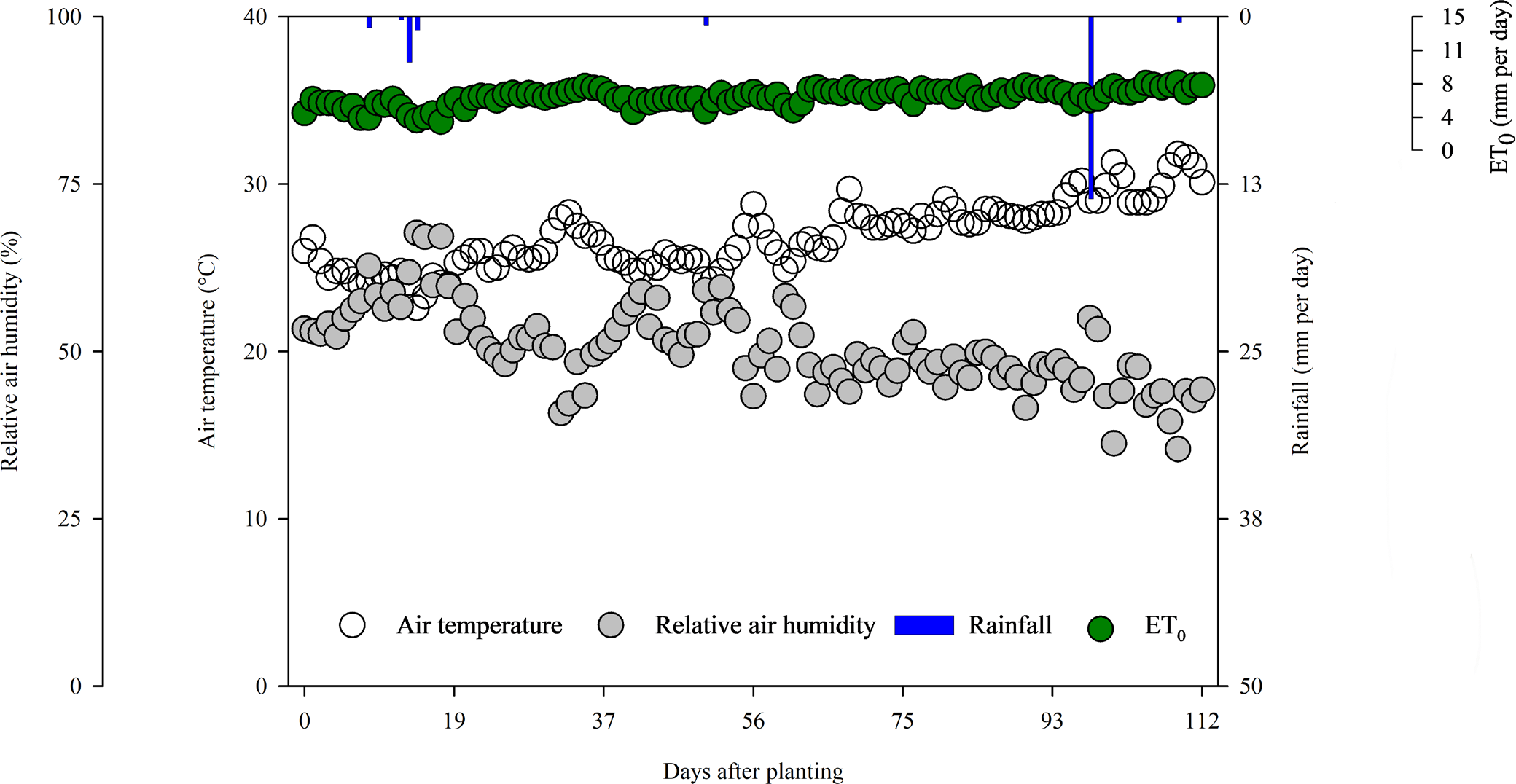
The region has a BSh type of climate (hot semi-arid), according to the classification proposed by Köppen adapted to Brazil (Lima et al., 2022). The average temperature is 26.5 °C and annual rainfall is 623 mm, concentrated between January and May. The average potential evapotranspiration is 1646 mm, with an annual water deficit of 1023 mm. During the experimental period, the accumulated rainfall was 20.0 mm and the average temperature was 26.9 °C (Figure 1).

Air temperature, relative air humidity, rainfall, and evapotranspiration during the experimental period (July to October, 2018)
The experiment was conducted in a Aridisol Argid (Soil Survey Staff, 2022), corresponding to Luvissolo Crômico in the Brazilian classification (EMBRAPA, 2018). The chemical characteristics of the soil are presented in Table 1.
A randomized complete block design was used, in a 5 × 5 factorial scheme, with four replications, totaling 100 experimental plots. The treatments consisted of the combination of five irrigation depths: ID1 = 222, ID2 = 388, ID3 = 554, ID4 = 720, and ID5 = 886 mm; distributed throughout the cycle, corresponding to 50, 75, 100, 125, and 150% of the crop evapotranspiration (ETc), respectively, with five K2O doses: 0, 10, 20, 30, and 40 kg ha-1, corresponding to 0, 50, 100, 150, and 200% of the K2O requirement of forage sorghum. The recommended K2O dosage was determined based on the soil analysis conducted prior to the study (Table 1), following the guidelines established by IPA (2008). The experimental plot comprised an area of 15.0 m2, consisting of three sorghum planting rows with 5.0 m in length and 1.0 m spacing between sweet sorghum rows. The observation area of the plot was represented by the central row excluding 1.0 m from each end. The genetic material of sweet sorghum IPA SF15 was used, with 15 seeds placed per linear meter in furrows at a depth of 5.0 cm during planting.
Urea (45% N) was used for nitrogen fertilization, applying 30 kg ha-1 at planting and 60 kg ha-1 as topdressing in a lateral furrow, 5.0 cm away from the planting row at a depth of 5.0 cm. Phosphate fertilization was carried out with single superphosphate (20% P2O5, 20% Ca, 12% S, pH - 2.5-3.0 in aqueous solution at 25 °C), and potassium fertilization (source of variation in this study) was carried out with potassium chloride (60% K2O and 45% Cl), both in the planting furrow with nitrogen fertilization. The average K+ concentration between the 0 - 20 and 20 - 40 cm soil layers was 0.38 cmolc dm-3, corresponding to the recommendation of 20 kg of K2O ha-1 when K+ concentrations in the soil are within the range of 0.12 to 0.38 cmolc dm-3 (IPA, 2008), characterizing the K2O dose = 100% recommended.
Water from a tube well with a depth of 50.0 m, with a discharge rate of 7.0 m3 h-1 and classified as C3S1, was used (Ayers & Westcot, 1994). The concentrations of Ca2+, Mg2+, Na+, K+, CO3-, HCO3-, SO42-, and Cl- were 6.55, 6.75, 10.87, 0.17, 0.00, 4.54, 3.21, and 22.00 mmolc L-1, respectively; pH = 7.58, ECwater = 1.92 dS m-1 and Sodium Adsorption Ratio = 4.21 (mmol L-1)1/2.
Irrigation was conducted using a drip system, with a 16-mm-diameter dripper tube and in-line emitters spaced 0.25 m apart with a nominal flow rate of 2.0 L h-1. Irrigation management was carried out according to the climate through crop evapotranspiration (ETc). ETc was determined based on the daily reference evapotranspiration (ETo) estimated by the Penman-Monteith FAO 56 (Allen et al., 1998), and the sorghum crop coefficient (Kc) used was proposed by Pereira Filho & Rodrigues (2015). The values of Kc were 0.40, 0.68, 1.14, and 1.10 for phases I, II, III, and IV, respectively. Climate data for the determination of ETo were obtained by an automatic weather station using a CR 1000 model data logger (Campbell Scientific, Inc.; Logan, Utah, USA), installed near the experimental area.
The irrigation depths were individualized by the irrigation time (IT) established for each treatment and estimated by Eq 1. The applications of irrigation depths began at 20 days after emergence (DAE) with 2-day intervals between irrigations.
where:
IT - irrigation time, min;
F - correction factor for irrigation depth (0.50, 0.75, 1.00, 1.25, or 1.50 for L1 = 50, L2 = 75, L3 = 100, L4 = 125, and L5 = 150% of ETc, respectively);
ETc-crop evapotranspiration, mm;
SLL - spacing between lateral lines, m;
Sd - spacing between drippers in the lateral line, m;
qd - dripper flow rate, L h-1; and,
AE - application efficiency of irrigation system, decimal (0.9).
At 101 DAE, sweet sorghum was harvested and analyzed for the following parameters: plant height (PH, m), before cutting, after separating two randomly chosen stalks from the observation area of each plot, measured with a graduated tape; stem diameter (SD, mm), measured with a digital caliper at 0.10 m from the soil surface; total fresh mass (TFM, Mg ha-1) of the plants, obtained by cutting of 1.0 linear meter of the observation area of the experimental plot and summing the values of leaf fresh mass (LFM, Mg ha-1), stem fresh mass (SFM, Mg ha-1) and panicle fresh mass (PFM, Mg ha-1), determined with a digital scale (0.5 g), according to Guimarães et al. (2022).
The data were subjected to analysis of variance using the ‘F‘ test at 0.01 and 0.05 probability levels. Multiple regression analyses were used to evaluate the interaction between factors, while linear and quadratic models were applied for the individual factors. The SAS 9.0 statistical package for Windows (SAS, 2024) was used with the procedures “PROC GLM” for analysis of variance and “PROC REG” for regression analysis.
Results and Discussion
The variables plant height (p < 0.01), stem diameter (p < 0.01), panicle fresh mass (p < 0.01), and total fresh mass (p < 0.05) were influenced by the interaction between the factors irrigation depths with brackish water and potassium doses (ID × KD). The factor ID influenced individually the variable stem fresh mass (p < 0.01); however, this variable did not respond to the KD factor (Table 2).
‘F’ test for plant height (PH), stem diameter (SD), stem fresh mass (SFM), leaf fresh mass (LFM), panicle fresh mass
(PFM), and total fresh mass (TFM) of sweet sorghum cultivated under different irrigation depths (ID) and potassium doses (KD)
Although the interaction between the factors (ID x KD) showed significance for the response variable PH, the multiple regression model tested was not adequate; therefore, regression within each factor was chosen. For the ID factor within each K₂O dose studied, no adequate fit was observed for ID at the 10 kg ha-1 K2O dose (ŷ = 2.111916 + 0.000263**x, R2 = 0.2015). For the 0 and 20 kg ha⁻1 K₂O doses, a linear fit was obtained, with increases of 0.07 and 0.08 m in the PH variable for each 100 mm increase in ID. At the 30 and 40 kg ha⁻1 K₂O doses, the fit was quadratic, with the highest PH values (2.94 and 2.03) observed at ID levels of 660 mm and 525 mm, respectively (Figure 2A). For the KD factor within each irrigation depth (ID), it was observed that for the irrigation levels of 222, 388, 720, and 886 mm, none of the regression models tested provided an adequate fit. For an ID of 554 mm, a linear fit was observed, with an increase of 0.0274 m in the PH variable for each unit (kg) increase in the K₂O dose (Figure 2B).
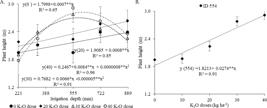
Sorghum plant height as a function of irrigation depths with brackish water (A) and K2O doses (B)
The results found are consistent with the studies by Sousa et al. (2017), who reported maximum PH value of 3.03 m, and are higher than those observed by Guimarães et al. (2022), who recorded a maximum PH of 1.09 m. These authors reported positive responses in plant height (PH) as irrigation depth increased, leading to greater plant development and demonstrating the need for adequate water supply even when using lower-quality water sources. Greater soil water replenishment (and consequent increase in the leaching fraction) through the use of irrigation depths results in several physiological changes in plants. These changes include greater stomatal opening, which in turn increases CO2 absorption in the mesophyll and boosts the photosynthetic process. Such changes can lead to greater growth in plant height, as already observed in studies with grain sorghum (Tardin et al., 2013; Guimarães et al., 2022), corroborating the findings of this study.
For the stem diameter (SD) variable, a response surface was obtained as a function of the K2O doses and irrigation depth factors (Figure 3). The maximum SD (24.52 mm) was obtained by combining irrigation depth of 886 mm (160% of ETc) and K2O doses of 37.86 kg ha-1. This result demonstrates that increased water application, even of lower quality, combined with the optimization of applied K₂O doses, can significantly influence the growth of sorghum, potentially enhancing the crop’s yield.

Response surface for stem diameter of sweet sorghum, as a function of irrigation depths (ID) and K2O doses
The variation of SD in response to the interaction between ID and KD factors may be linked to the availability of K+ in the soil solution, as the application of higher values of irrigation depths maintains soil moisture close to field capacity (Wang et al., 2021), which intensifies the opening of stomata and allows greater assimilation of CO2 (Singh & Reddy, 2018), stimulating diameter growth.
The quadratic response of SD to K2O doses is associated with the fact that K+ is the main nutrient related to the osmotic functions of plants. Therefore, under salt stress, the best performance of some genotypes has been associated with adequate potassium nutrition. This response may be related to external fertilization with potassium resulting in a higher K/Na ratio in plant tissues, facilitating the regulation of its transport in vascular systems to improve stress tolerance (Hussain et al., 2021; Mansour et al., 2021). However, increasing the proportion of K+ in a medium containing NaCl does not always result in beneficial effects for plants. Thus, high concentrations of K+ can potentiate the osmotic effect caused by already existing sodium concentrations.
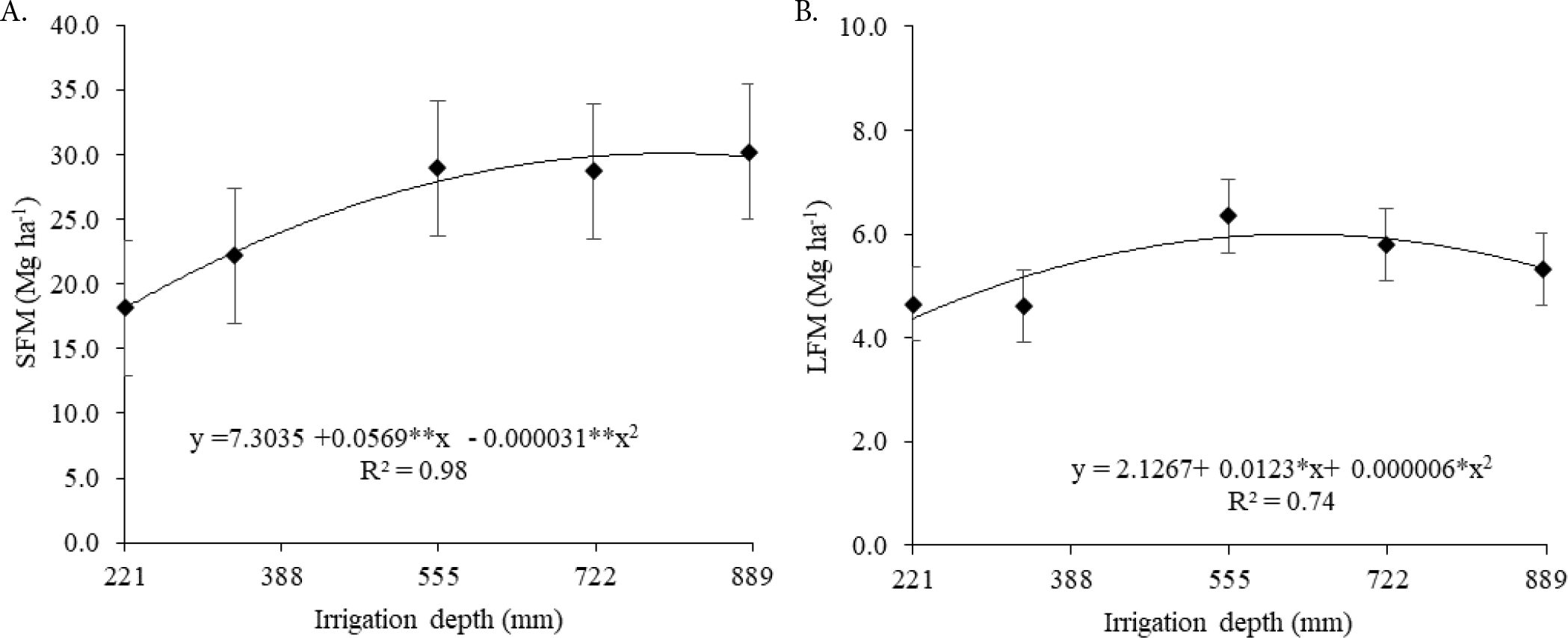
Although both factors independently influenced the SFM variable, for the KD factor, the proposed regression models did not provide an adequate fit (y = 23.5355 + 0.105109*K₂O; R2 = 0.40). The highest accumulation of SFM (29.37 Mg ha-1) was obtained with the application of irrigation depth of 886 mm (Figure 4A). The maximum accumulation of LFM was 5.91 Mg ha-1, obtained when applying an irrigation depth of 615 mm (Figure 4B). These results underscore the importance of proper irrigation management aimed at maximizing yield. Such findings are consistent with those reported by Guimarães et al. (2022), who observed that higher irrigation depths can enhance sorghum crop yield.

Stem fresh mass - SFM (A) and leaf fresh mass - LFM (B) of sweet sorghum IPA SF15 as a function of irrigation depths
The SFM values under greater water replacement are associated with the maintenance of moisture in the field, leading to greater leaching of the Na+ ion to the layers below the root zone and the balance of nutrients in the soil, such as Ca2+, as it has greater adsorption to the soil compared to Na+ (Yurtseven et al., 2014).
However, the predisposition of Orthic Chromic Luvisols (lytic or saline) or Aridisol Argid (Soil Survey Staff, 2022), associated with high evapotranspiration in semi-arid regions, intensifies the deleterious effects of salts on plants (Calone et al., 2020) and in response, sorghum plants limit their physiological functions by decreasing the accumulation of photoassimilates, as observed for irrigation depths of more than 669.22 mm, indicating low maintenance of K/Na ratios in leaf tissue.
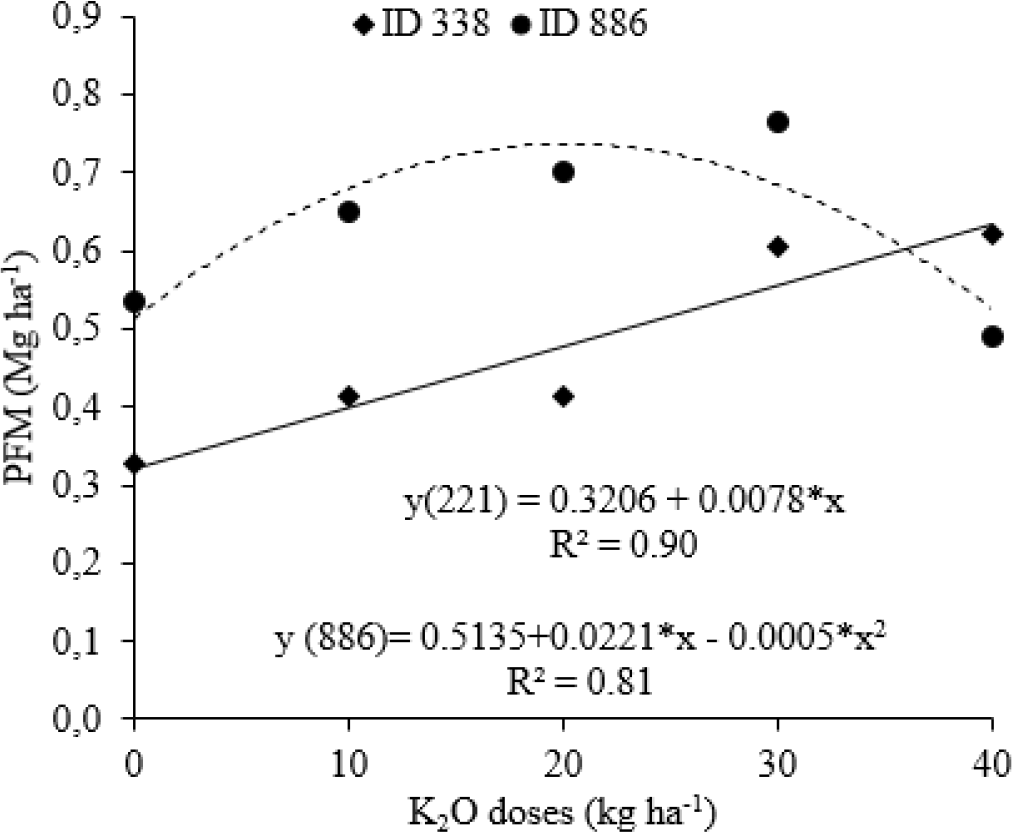
Although the interaction between irrigation depth (ID) and K₂O doses showed a significant effect (p<0.05) on the response variable PFM, suitable models for multiple regression were not obtained. Therefore, linear regression models were fitted separately for each factor within their respective levels. For the PFM variable, distinct responses were observed for the irrigation depth (ID) factor within the K2O dose treatments. Quadratic models with low coefficients of determination were fitted for the doses of 0 kg ha⁻1 K2O (ŷ = 0.000003 + 0.0035x - 0.2475; R2 = 0.43), 20 kg ha⁻1 K2O (ŷ = 0.454514 + 0.000358x; R2 = 0.39) and 30 kg ha⁻1 K₂O (ŷ = 1.108473 - 0.001319x + 0.000001x2; R2 = 0.36), indicating weak model fits. For the PFM variable in response to K₂O doses (Figure 5) within the ID treatments, a linear relationship was observed under the irrigation depth (ID) of 338 mm, with a maximum PFM value of 0.63 Mg ha⁻1 at a K₂O dose of 40 kg ha⁻1. Under ID of 886 mm, a quadratic model was fitted, with the highest PFM value (0.757 Mg ha⁻1) observed at a K₂O dose of 22.1 kg ha⁻1. No significant regression models were obtained for the K₂O doses under the other irrigation depths levels (221, 554, and 720 mm).

Panicle fresh mass (PFM) of sweet sorghum IPA SF15 as a function of K2O doses within the ID treatments
The maximum performance in PFM production is within the range recommended for the crop by IPA (2008). A deficiency in the supply of potassium can result in low plant vigor, but, on the other hand, there is usually no significant response in grain yield with the use of high K2O doses.
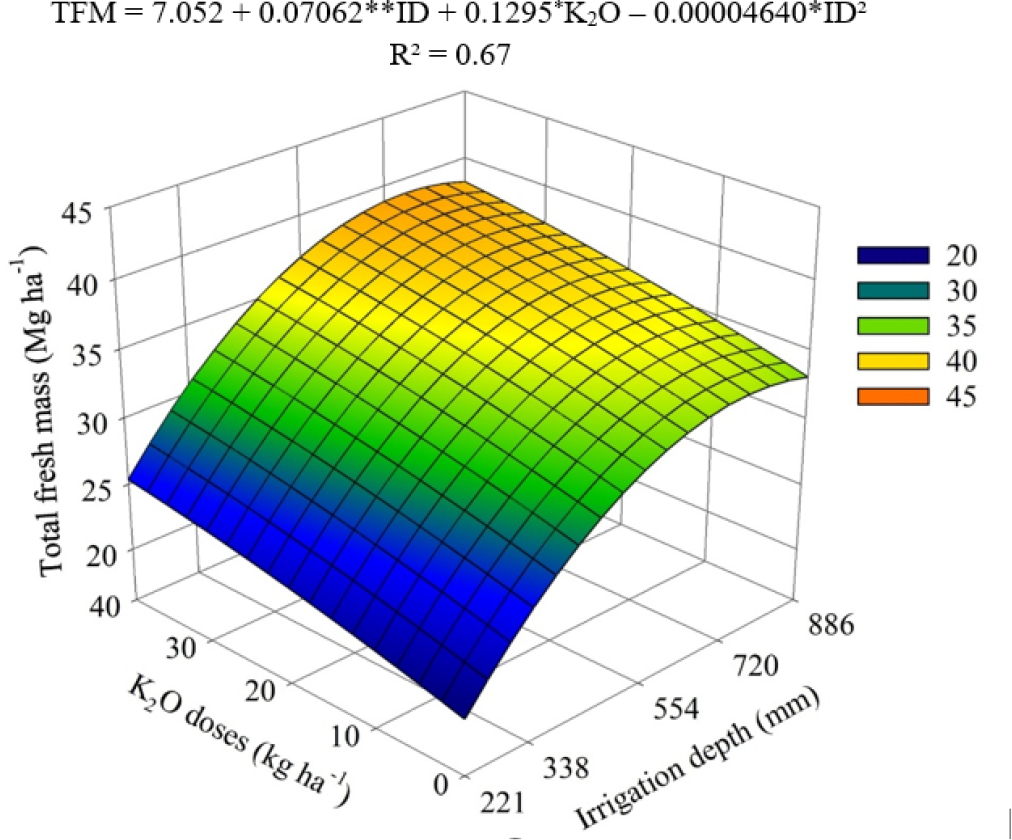
For the TFM variable, a multiple regression model was obtained (Figure 6), with the highest estimated value (39.10 Mg ha⁻1) observed under an irrigation depth of 760 mm combined with a K₂O dose of 40 kg ha⁻1. TFM production increased significantly with increasing irrigation depth. This result is partly due to the characteristics of plants with C4 mechanism, which are highly responsive in water use and adapted to the environmental conditions of the experimental area (Guimarães et al., 2022). In addition, the application of K2O doses minimized the osmotic effects caused by the salts present in the brackish water used for irrigation.
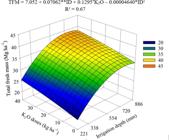
Response surface for total fresh mass of sweet sorghum IPA SF15, as a function of irrigation depths (ID) and potassium doses (K2O)
The results obtained by Nascimento et al. (2017), when evaluating the TFM in sweet sorghum cultivars with fresh water, showed that the overall mean of green mass production in the different cultivars tested was 50.5 Mg ha-1, a value that is higher than those observed in the present experiment (39.1 Mg ha-1), obtained using an irrigation depth of 760 mm. Results obtained by Guimarães et al. (2022) show that increasing the leaching fraction with brackish water promotes an increase in yield in sorghum varieties. These authors attribute this effect to a better distribution of water and salts in the soil profile, promoting a better nutritional balance associated with potassium fertilization.
Conclusions
-
1. The use of brackish water for sorghum production in the semi-arid region of Pernambuco has proven to be a viable option.
-
2. The study indicates that the use of an irrigation depth of 760 mm combined with a K₂O dose of 40 kg ha⁻1 can enhance crop yield, representing a strategy worth considering.
Data availability statement:
The authors declare that there are no data underlying the text.
-
Financing statement:
This study was financed in part by the Conselho Nacional de Desenvolvimento Científico e Tecnológico (CNPq) with research productivity grant (grant number #306747/2023-5 and #313232/2021-0) and Coordenação de Aperfeiçoamento de Pessoal de Nível Superior - Brazil (CAPES) - Finance Code 001.
Acknowledgments:
Coordenação de Aperfeiçoamento de Pessoal de Nível Superior - Brazil (CAPES), Conselho Nacional de Desenvolvimento Científico e Tecnológico (CNPq) and Graduate Program in Agricultural Engineering.
Literature Cited
-
Alencar, A. M. S.; Rocha Júnior, V. R.; Monção, F. P.; Cordeiro, M. W. S.; Santos, A. S. dos; Caldeira, L. A.; Oliveira, L. I. S.; Ananias, J. V. A.; Costa, M. D.; Souza, A. S.; Aspiazú, I.; Santos, L. C. Quality of mixed silages of sorghum, BRS capiaçu grass, and cactus pear in a semiarid region of Brazil. Journal of Applied Animal Research, v.51, p.719-728, 2023. https://doi-org.ez19.periodicos.capes.gov.br/10.1080/09712119.2023.2277256
» https://doi-org.ez19.periodicos.capes.gov.br/10.1080/09712119.2023.2277256 - Allen, R. G.; Pereira, L. S.; Raes, D.; Smith, M. Crop evapotranspiration: Guidelines for computing crop water requirements. 1.ed. Rome: FAO, 1998. 300p.
- Ayers, R. S.; Westcot, D. W. Water quality for agriculture. 3.ed. Rome: FAO, 1994. 175p.
-
Bernardes, J. V. S.; Orioli Júnior, V.; Charlo, H. C. de O.; Fernandes, G.; Bosco, L. P. V. Doses de potássio para o sorgo sacarino destinado à produção de etanol. Nativa, v.7, p.23-28, 2019. https://doi.org/10.31413/nativa.v7i1.6132
» https://doi.org/10.31413/nativa.v7i1.6132 -
Calone, R.; Sanoubar, R.; Lambertini, C.; Speranza, M.; Antisari, L. V.; Vianello, G.; Barbanti, L. Salt tolerance and Na allocation in Sorghum bicolor under variable soil and water salinity. Plants, v.9, e561, 2020. https://doi.org/10.3390/plants9050561
» https://doi.org/10.3390/plants9050561 -
Dehnavi, A. R.; Zahedi, M.; Piernik, A. Understanding salinity stress responses in sorghum: exploring genotype variability and salt tolerance mechanisms. Frontiers in Plant Science, v.14, p.1-19, 2024. https://doi.org/10.3389/fpls.2023.1296286
» https://doi.org/10.3389/fpls.2023.1296286 - EMBRAPA - Empresa Brasileira de Pesquisa Agropecuária. Sistema brasileiro de classificação de solos. 4.ed. Brasília: Embrapa Solos, 2018. 356p.
-
Guimarães, M. J. M.; Simões, W. L.; Salviano, A. M.; Oliveira, A. R. de; Silva, J. S. da; Barros, J. R. A.; Willadino, L. Management for grain sorghum cultivation under saline water irrigation. Revista Brasileira de Engenharia Agrícola e Ambiental, v.26, p.755-762, 2022. https://doi.org/10.1590/1807-1929/agriambi.v26n11p755-762
» https://doi.org/10.1590/1807-1929/agriambi.v26n11p755-762 -
Hussain, S.; Hussain, S.; Ali, B.; Ren, X.; Chen, X.; Li, Q.; Saqib, M.; Ahmad, N. Recent progress in understanding salinity tolerance in plants: Story of Na+/K+ balance and beyond. Plant Physiology and Biochemistry, v.160, p.239-256, 2021. https://doi.org/10.1016/j.plaphy.2021.01.029
» https://doi.org/10.1016/j.plaphy.2021.01.029 - IPA - Instituto Agronômico de Pernambuco. Recomendações de adubação para o Estado de Pernambuco. 3.ed. Recife: Instituto Agronômico de Pernambuco, 2008. 212p.
-
Lima, B. L. de C.; Silva, Ê. F. F. e; Santos, H. R. B.; Souza, E. R. de. Potassium fertilization and irrigation with treated waste water on gas exchange of colored cotton. Revista Brasileira de Engenharia Agrícola e Ambiental, v.22, p.741-746, 2018. https://doi.org/10.1590/1807-1929/agriambi.v22n11p741-746
» https://doi.org/10.1590/1807-1929/agriambi.v22n11p741-746 -
Lima, R. F. de; Aparecido, L. E. de O.; Lorençone, J. A.; Lorençone, P. A.; Torsoni, G. B.; Moraes, J. R. da S.; Meneses, K. C. de. Assessing life zone changes under climate change scenarios in Brazil. Theoretical and Applied Climatology, v.149, p.1687-1703, 2022. https://doi.org/10.1007/s00704-022-04133-1
» https://doi.org/10.1007/s00704-022-04133-1 -
Lira, J. B. de; Andrade, A. P. de; Magalhães, A. L. R.; Campos. F. S.; Araújo, G. G. L. de; Gois, G. C.; Regitano Neto, A.; Cunha, D. de S.; Tabosa, J. N.; Silva, T. G. F. da. Production of BRS Ponta Negra sorghum irrigated with different depths of brackish water combined with organic fertilization. Communications in Soil Science and Plant Analysis, v.53, p.396-407, 2022. https://doi.org/10.1080/00103624.2021.2017445
» https://doi.org/10.1080/00103624.2021.2017445 -
Mansour, M. M. F.; Emam, M. M.; Salama, K. H. A.; Morsy, A. A. Sorghum under saline conditions: responses, tolerance mechanisms, and management strategies. Planta, v.254, e00425, 2021. https://doi.org/10.1007/s00425-021-03671-8
» https://doi.org/10.1007/s00425-021-03671-8 -
Nascimento, M. F.; Campos, M. C. C.; Silva, D. M. P. da; Mantovanelli, B. C.; Gomes, R. P.; Weckner, F. da C.; Jordão, H. W. C. Avaliação de cultivares de sorgo sacarino (Sorghum bicolor (L.) Moench) na região amazônica, Brasil. Nativa, v.5, p.381-385, 2017. https://doi.org/10.5935/2318-7670.v05n06a01
» https://doi.org/10.5935/2318-7670.v05n06a01 -
Oliveira, A. M. de; Dias, N. da S.; Freitas, J. J. R. de; Martins, D. F. F.; Rabelo, L. N. Avaliação físico-química das águas do processo de dessalinização de poços salobros e salinos em comunidades rurais do oeste potiguar. Águas Subterrâneas, v.31, p.58-73, 2017. https://doi.org/10.14295/ras.v31i2.28663
» https://doi.org/10.14295/ras.v31i2.28663 -
Oliveira, L. R. de; Fonseca Filho, M. C.; Montes, R. M.; Benett, K. S. S.; Benett, C. G. S. Sources and doses of potassium on yield components of soybean and sorghum. Revista de Agricultura Neotropical, v.9, e7016, 2022. https://doi.org/10.32404/rean.v9i4.7016
» https://doi.org/10.32404/rean.v9i4.7016 - Pereira Filho, I. A.; Rodrigues, J. A. S. Sorgo: o produtor pergunta, a Embrapa responde. 1.ed. Brasília-DF: Embrapa, 2015. 327p.
-
SAS - Statistical Analysis System. The SAS System for Windows. New York: SAS, 2024. Available on: <https://support.sas.com/en/documentation/install-center/94/installation-guide-forwindows.html>. Accessed on: Dec. 2024.
» https://support.sas.com/en/documentation/install-center/94/installation-guide-forwindows.html -
Shukla, S.; Felderhoff, T. J.; Saballos, A.; Vermerris, W. The relationship between plant height and sugar accumulation in the stems of sweet sorghum (Sorghum bicolor (L.) Moench). Field Crops Research, v.203, p.181-191, 2017. https://doi.org/10.1016/j.fcr.2016.12.004
» https://doi.org/10.1016/j.fcr.2016.12.004 -
Silva, M. L. dos S.; Sousa, H. G. de; Silva, M. L. dos S.; Lacerda, C. F. de; Gomes Filho, E. Growth and photosynthetic parameters of saccharine sorghum plants subjected to salinity. Acta Scientiarum Agronomy, v.41, p.1-9, 2019. https://doi.org/10.4025/actasciagron.v41i1.42607
» https://doi.org/10.4025/actasciagron.v41i1.42607 -
Singh, S. K.; Reddy, V. R. Co-regulation of photosynthetic processes under potassium deficiency across CO2 levels in soybean: mechanisms of limitations and adaptations. Photosynthesis Research, v.137, p.183-200, 2018. https://doi.org/10.1007/s11120-018-0490-3
» https://doi.org/10.1007/s11120-018-0490-3 - Soil Survey Staff. Keys to soil taxonomy. 13.ed. Lincoln: USDA Natural Resources Conservation Service, 2022. 401p.
- Sousa, P. G. R. de; Viana, T. V. de A.; Carvalho, C. M. de; Sousa, A. M. de; Costa, C. P. de M.; Azevedo, B. M. de. A. Efeito de diferentes lâminas de irrigação e cobertura do solo no crescimento da cultura do sorgo. Revista Brasileira de Agricultura Irrigada, v. 11, p. 1528-1537, 2017.
- Tardin, F. D.; Almeida Filho, J. E. de; Oliveira, C. M. de; Leite, E. do P.; Menezes, C. B. de; Magalhães, P. C.; Rodrigues, J. A. S.; Schaffert, R. E. Avaliação agronômica de híbridos de sorgo granífero cultivados sob irrigação e estresse hídrico. Revista Brasileira de Milho e Sorgo, v.12, p.102-117, 2013.
-
Tittal, M.; Mir, R. A.; Jatav, K. S.; Agarwal, R. M. Supplementation of potassium alleviates water stress-induced changes in Sorghum bicolor L. Physiologia Plantarum, v.172, p.1149-1161, 2021. https://doi.org/10.1111/ppl.13306
» https://doi.org/10.1111/ppl.13306 -
Wang, H.; Wu, L.; W. X.; Zhang, S.; Cheng, M.; Feng, H.; Fan, J.; Zhang, F.; Xiang, Y. Optimization of water and fertilizer management improves yield, water, nitrogen, phosphorus and potassium uptake and use efficiency of cotton under drip fertigation. Agricultural Water Management, v.245, e10662, 2021. https://doi.org/10.1016/j.agwat.2020.106662
» https://doi.org/10.1016/j.agwat.2020.106662 - Yurtseven, E.; Öztürk, H. S.; Avci, S. Mass balance criteria in soil salinity management: different irrigation water qualities and leaching ratio. Journal of Agricultural Sciences, v.2, p.103-111, 2014.
-
Editors:
Ítalo Herbet Lucena Cavalcante & Hans Raj Gheyi

 ** Significant at p ≤ 0.01 by F test.
 **, * Significant at 0.05 and 0.01 by F test, respectively; ns - Not significant
 **, * Significant at 0.05 and 0.01 by F test, respectively
 * Significant at 0.05 by F test
 **, * Significant at 0.05 and 0.01 by F test, respectively