 Technosols after coal mining: The challenges to be overcome by soil science
ABSTRACT
Technosols are anthropogenic soils, and are mostly intentionally created and/or modified to serve a specific purpose, such as waste management and the restoration of ecosystems degraded by industrial activities. In this sense, open-cast coal mining areas can be classified as Technosols, which already use their own mining waste in their topographic restoration. The construction of Technosols for the purpose of mining waste disposing and recovering degraded areas has the potential to offset up to 60 % of the CO2 emissions caused by this activity, contributing achieving Sustainable Development Goals (SDGs) 13, 15 and 2 (in some cases, depending on the type of residue to be used in the overburden layer), relating respectively to climate action, the preservation of terrestrial life, and hunger eradication. Therefore, this study aims to provide a literature review of Technosols constructed from coal mining waste, highlighting the challenges that still need to be addressed by soil science to restore these areas ecologically. The methodology consisted of a bibliometric analysis using the terms “Mined Soils” OR “Minesoils” OR “Technosols” AND “Coal” in the Web of Science Core Collection database. The search was restricted to article-type documents published in English between 2004 and 2023, resulting in a dataset of 199 articles. The analysis was performed using VOSviewer and HistCite software, which enable bibliographic coupling between bibliometric variables such as countries, keywords, and citations. The analysis of keyword co-occurrence highlighted a trend towards increased academic relevance of topics related to the environmental contamination potential of coal mining waste, carbon sequestration by Technosols, the morphological characteristics of these soils, and recovery indicators for mined areas. The integration of the properties that characterize soil health, especially the biological ones, is the main gap in this field of study. On a global scale, Technosols are a promising strategy for the recovery of areas degraded by anthropogenic activities, aligning with greater efficiency in waste management and the mitigation of impacts associated with the climate crisis, due to their high potential for CO2 capture.
Keywords
degraded areas; bibliometric analysis; Sustainable Development Goals; environmental sustainability
INTRODUCTION
The world's main source of electricity comes from burning coal in thermoelectric plants. In 2023, demand for coal reached a new record of 8,687 Mt, driven mainly by the growth of countries that produce and consume large amounts of coal, such as China and India (IEA, 2024). However, unlike other countries in the world, Brazil has an electricity matrix of predominantly renewable origin, mainly from the Itaipu Hydroelectric Plant (EPE, 2024), and the use of coal occurs when there is a need to supply the shortage of electricity generated by hydroelectric resources (Pinto et al., 2020). Our coal use is predominantly domestic (EPE, 2024), of which 38 % of the resources come from the Candiota mine, located in the state of Rio Grande do Sul (Lopes et al., 2024).
Technosols are anthropogenic soils, characteristic of the Anthropocene (current Geological Era), and are mostly intentionally created and/or modified to serve a specific purposes, such as waste management and the restoration of ecosystems degraded by industrial activities (Leguédois et al., 2016). To be classified as a Technosol, the soil must contain approximately 20 % (of the volume) or more of technogenic materials along 1.00 m of its profile, such as solid mining waste, construction debris, industrial and agro-industrial waste (Mikheeva and Androkhanov, 2022). In this sense, open-cast coal mining areas can be classified as Technosols, because they already use their own mining waste in their topographic restoration. These anthropogenic soils can become new carbon sinks if recomposed efficiently and carefully, especially those that will not be used again for agriculture, as is the case at the Candiota Mine. The construction of Technosols for mining waste disposing and recovering degraded areas has the potential to offset up to 60 % of the CO2 emissions caused by this activity (Ruiz et al., 2023), contributing achieving Sustainable Development Goals (SDGs) 15, 13 and 2 (in some cases depending on the type of residue to be used in the overburden layer) relating to the climate action and the preservation of terrestrial life, sustainable cities and communities, and hunger eradication respectively (UN, 2015).
In the last decade, studies by Stumpf et al. (2015, 2016a, 2023), Ahirwal and Maiti (2018), Ahirwal et al. (2018), Domínguez-Haydar et al. (2019), Ezeokoli et al. (2020), Barboza et al. (2021), Miguel et al. (2023), Zocche et al. (2023) and Burgueño et al. (2024) showed the potential achievement of SDG 15 through monitoring the physical, chemical and biological properties evolution of Technosols formed in coal mining areas. Therefore, this study aims to provide a literature review of Technosols constructed from coal mining waste, highlighting the challenges that still need to be addressed by soil science to restore these areas ecologically.
MATERIALS AND METHODS
The present study used bibliometric analysis, applying statistical and mathematical models to analyze a large volume of scientific texts, as described by Donthu et al. (2021), to identify future research trends on Technosols derived from coal mining waste across different countries worldwide. The bibliometric data used in this study were extracted from the Web of Science Core Collection (WoS) database, using the following search: Topic Search= (“Mined Soils” OR “Minesoils” OR “Technosols”) AND “Coal”, which correlates the terms referring to Technosols with mineral coal. The temporal evaluation covered the period from 2004 to 2023. Although the first publication on this subject dates back to 1977, in the last two decades there have been significant technological and scientific advances, associated with a growing debate on the need to adopt sustainable practices in mining and the recovery of areas impacted by this economic activity, which has resulted in a substantial increase in the volume of publications related to the understanding of Technosols.
The search was restricted to article-type documents published in English, and the dataset obtained consisted of 199 documents. The primary information from the articles was obtained in a table in plain text format, compatible with the software used in this review. The systematic quantitative and qualitative analysis of the 199 articles was carried out using tools that integrate the software VOSviewer (version 1.6.20) and HistCite (version 9.8.24), both free of charge. VOSviewer, developed by Van Eck and Waltman (2010), operates in a Java environment and allows the creation of bibliometric co-occurrence maps. This software provides bibliographic coupling between variables, making it easier to understand their interconnection. The calculation of the Citation Growth Rate per Publication (TGCS/N) makes it possible to map the scope of research through citation analysis; this index was determined using the HistCite software (Garfield, 2009).
RESULTS AND DISCUSSION
Evolution of Technosols studies between 2004 and 2023
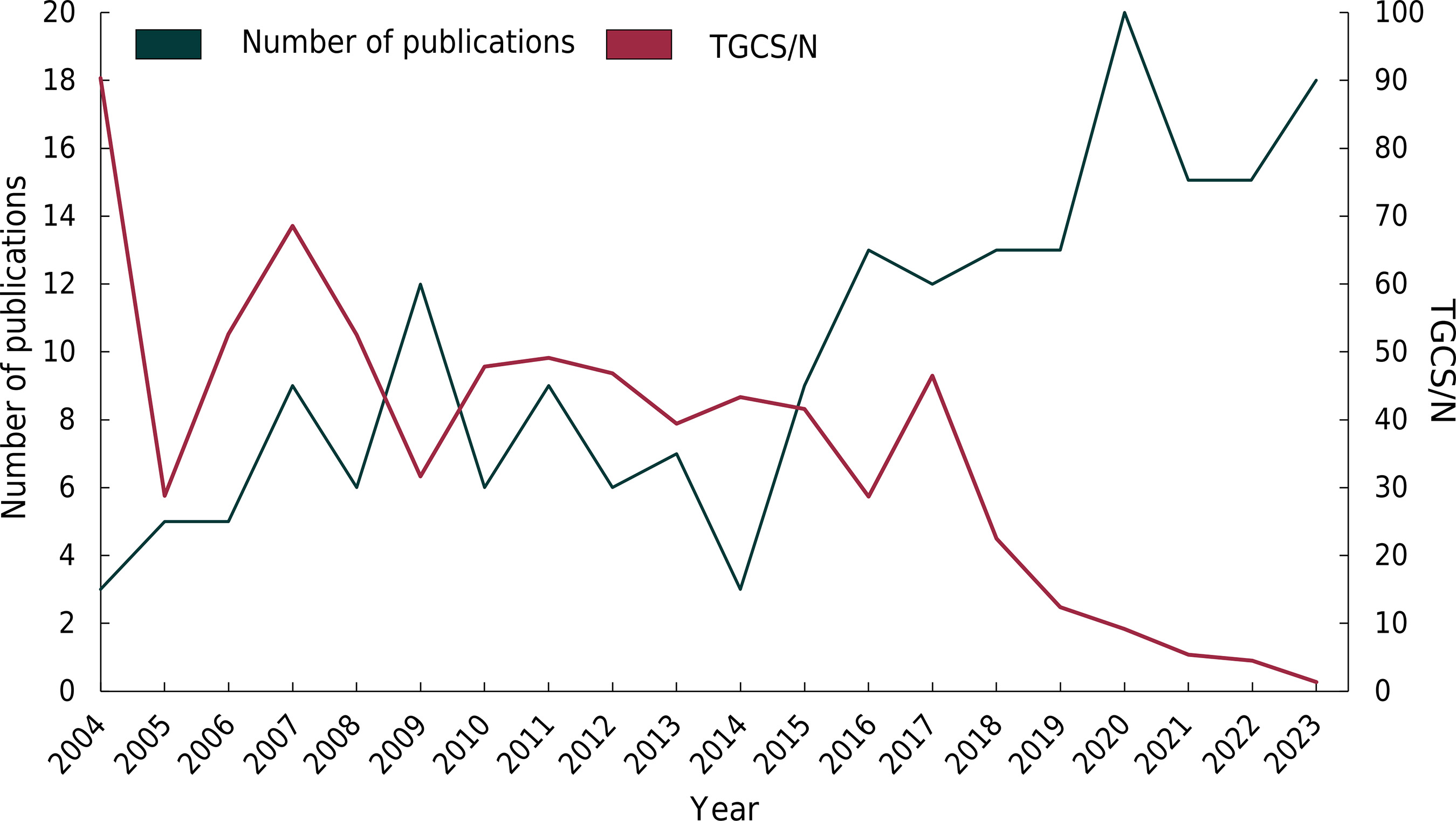
Over the last two decades, an irregular growth pattern (peaks and falls) has been observed in the number of publications related to Technosols. Figure 1 shows that publication peaks occurred in 2007 (9 publications), 2009 (12 publications), 2016 (13 publications) and 2020 (20 publications). The most consistent period of growth was observed between 2015 and 2020, with the latter being considered the most productive year since 2004. After this interval, a decline in the number of publications was observed, possibly associated with the impacts of the pandemic, followed by signs of recovery in 2023. This pattern is characteristic of an emerging field of study undergoing a process of consolidation.

Evolution of the annual number of publications and citations (TGCS/N) on Technosols from 2004 to 2023.
Overall, the number of publications has grown significantly over the last decade, reflecting the global trend towards more intense discussion of environmental issues. Especially after the COP 21 (21st Conference of the Parties), in December 2015 in Paris (France), where 195 entities (193 UN member countries, the European Union and Palestine) signed the Paris Agreement, which symbolizes a global commitment to reducing greenhouse gas emissions and promoting sustainable development. Although Technosols had already been recognized as a Reference Soil Group (RSG) in the WRB in 2006, their pedogenesis was only characterized in detail in 2016 by Leguédois et al. (2016), who described them as artificial, young soils formed from artifacts used as parent materials, developed under relatively warm and humid climatic conditions, typically on flat surfaces, and exhibiting high vertical heterogeneity.
The Total Global Citation Score by number of publications (TGCS/N) is a measure of publication impact, and after 2017, this value declines (Figure 1). This behavior is similar to that observed by Pan et al. (2021), who, in a bibliometric analysis on soil nutrients between 1992 and 2020, found that the reduction in TGCS/N indicates a rapid evolution of research topics, the large volume of publications, and the shorter time available for these publications to accumulate citations.
The ranking of countries and research centers that have contributed to advancing studies on the construction of anthropogenic soils from coal mining is shown in table 1. The United States of America (USA) leads the research on Technosols constructed to recover areas degraded by coal mining, with 57 articles published (29.53 %), followed by China (12.95 %), Poland (11.40 %) and Spain (10.36 %). Brazil, India and Russia ranked 5th, with 13 articles each. Within the period evaluated (2004-2023), the first article on this topic published in Brazil was in 2012, which represents a relatively recent period in the academic literature. In terms of total citations per country, the USA had a TCGS of 2,150, followed by Spain (1,001), China (911), India (427), and Brazil (407).
Main countries/institutions with the greatest relevance in research on Technosols in coal mining areas from 2004 to 2023
The five institutions with the greatest impact on the area of study analyzed are: Ohio State University (USA), with 21 publications; Agricultural University of Krakow (Poland), with 12 publications; China University of Geosciences (China), with nine publications; University of Vigo (Spain), with eight publications; and Ministry of Land and Resources (China), with seven publications. These figures are in line with the country rankings (Table 1).
Research focus with Technosols
The focus of the research on Technosols was mapped using the VOSviewer software, using a frequency of co-occurrence of keywords, with repetition above seven. The analysis identified 56 keywords, organized into four clusters that capture the central idea of the branch of research. Cluster 1 grouped research related to the contamination of Technosols and water bodies by coal mining waste, while cluster 2 highlighted the potential for carbon sequestration that Technosols can provide. Cluster 3 covered research on the morphological characteristics of constructed soils after topographic recomposition, and cluster 4 focused on indicators of the recovery of mined soils (Figure 2).

Co-occurrence map of keywords highlighting the focus of published research from 2003 to 2024.
Cluster 1 highlights the terms contamination, pollution, heavy-metals, minesoils, growth and water (Figure 2). This cluster refers to Technosols contamination and water bodies, mainly generated by acid mine drainage (AMD), which occurs when sulphide minerals such as pyrite, galena, arsenopyrite, chalcopyrite and sphalerite are exposed to oxidizing conditions (Guerrero et al., 2023). During coal mining, these minerals are exposed to atmospheric oxygen, water and the action of acidophilic microorganisms, triggering the sulphation process, which generates sulphuric acid and releases sulphate ions (Bitencourt et al., 2015). As a result, a highly acidic environment is formed, which favours the mobilization of heavy metals and the precipitation of secondary minerals such as iron and aluminium hydroxides and oxides, resulting in the contamination of soils and surface and underground water bodies (Silva et al., 2011; Bhagabati and Borkotohi, 2014; Feng et al., 2019). When no topsoil is added to the overburden layer (Figure 3a), Technosols may be unsuitable for plant-based restoration. Mitrakova et al. (2023), for example, observed low pH values (2.3-4.6) in Technosols derived from sediments deposited by water runoff from a mine that had not been topographically recomposed in Russia, with a direct impact on the absence of vegetation in the area. On the other hand, in Brazil, Stumpf et al. (2016b) observed that, in a Technosol receiving around 0.30 m of topsoil over the overburden (Figure 3b), vegetation was able to establish itself. However, the same authors observed that the topsoil layer below 0.30 m (in contact with the overburden) had high acidity and low nutrient availability, which will certainly act as a chemical impediment to the root system of plant species seeking to access this portion of the Technosol.
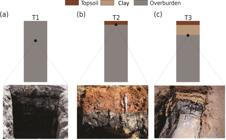
Profiles of constructed soils in the Candiota Mine: (a) Technosol with overburden layer; (b) Technosol with overburden and topsoil layers; (c) Technosol with a clay layer between an overburden and topsoil layer. Source: Adapted from Bitencourt (2014) and Stumpf (2015).
Although coal processing waste tends to have high levels of heavy metals and organic pollutants, it can also contain high levels of calcium, magnesium and phosphorus (Dong et al., 2024), which, if used as a matrix for constructed soils, could be a promising strategy that integrates the recovery of degraded areas with waste management. In China, for example, a Technosol with a mining waste dosage of more than 60 % combined with organic fertilizers favored the cultivation of corn (Zea mays L.) with a low risk of environmental pollution (Liu et al., 2024). Borůvka et al. (2012) also observed higher Ca and Mg contents in Technosols with rock fragments than in those built with a soil layer in the Czech Republic, and attributed this to rock weathering. It is important to highlight that the deposition conditions and geographic location of coal waste deposits strongly influence the concentrations of heavy metals, micronutrients, and macronutrients. These site-specific characteristics are crucial in determining the potential use of post-mined lands, especially regarding their suitability for agricultural purposes.
The second cluster focuses on carbon retention in mined soils and the dynamics of organic carbon over time, with terms such as carbon sequestration, organic matter, carbon, microbial biomass and chronosequence (Figure 2). This cluster links the Technosols construction to mitigating the impacts of the climate crisis, considering the carbon storage potential of this soil type associated with revegetation over time (Allory et al., 2022). In this sense, Ahirwal and Maiti (2018) observed that in coal mining in India, Technosols showed 70 % recovery in carbon stock and 47 % in nitrogen stock after 16 years of revegetation compared to forest soils. In Brazil, Miguel et al. (2023) observed an average increase of 331 % in organic carbon content in a Technosol between 4.8 and 10.6 years of restoration with perennial grasses. Finally, Dias (2024) observed in a chronosequence of Technosols from coal mining in Mozambique, a gradual organic carbon stock increase as the restoration with tree species progressed, highlighting that the oldest Technosol (10.6 years old) had a soil organic carbon stock very close (11.50 Mg ha-1) to that of the natural soil (14.95 Mg ha-1).
The third cluster discusses the morphological aspects of constructed soils. The inclusion of the term pedogenesis (Figure 2) suggests a focus on research into the construction processes of Technosols. In the USA, Thomas et al. (2000) compared horizon development between Technosols with 2, 7, 11, and 23 years of restoration and unmined soils and observed that A horizon thickness and aggregation increased with the restoration age, and the structure of the older Technosols was similar to that of the unmined soil. In Nigeria, Onweremadu et al. (2007) evaluated the properties of Technosols with 5, 10, 15 and 30 years in relation to natural soil and observed the presence of O and A horizons in the natural soil, while in the Technosols the O Horizon was absent. In Siberia, Mikheeva and Androkhanov (2022) analyzed changes in the physical properties of Technosols over 20 years and found a gradual improvement in the bulk density and porosity; however, there was no differentiation of horizons over this period. In Brazil, Stumpf et al. (2016a) emphasized that Technosol aggregation has structural units that are completely different from those of natural soil. That is, in the first decade of revegetation, the authors observed compressive aggregates (large, cohesive, with no visible porosity) in the Technosol from the Candiota Mine, a consequence of the persistent compaction generated during the topographic recomposition of the mined area when the topsoil used is more clayey.
The keyword fly ash (Figure 2) refers to the coal ash used in the constitution of Technosols, a strategy that shows promise as it can act to improve soil structure that is more favorable to crop development, promoting aggregation, moisture retention and improving the availability of nutrients for plants (Santini and Fey, 2015). Uzarowicz et al. (2017, 2018) characterized Technosols originating from ash disposal in Poland and observed that this material was more susceptible to weathering, as lignite ash contains highly reactive mineral phases, such as periclase and anhydrite. Finally, revegetation was also a central theme of this cluster (Figure 2). In South Africa, Mosebi et al. (2018) observed that smut finger grass was a good choice for improving compacted mine soils, because it showed very high tolerance to high bulk density and increased root growth to penetrate compacted soil layers. In the USA, Clayton et al. (2009), evaluating the evolution of natural revegetation in Technosols, observed that in the youngest constructed soils (0-2 years), annual and perennial grasses predominated; in constructed soils at 5-7 years, the leguminous species Lespedeza cuneata predominated; in constructed soils at 16-20 years, Festuca arundinaceae and tree species predominated; in soils constructed at 38-42 years, there was a mix of conifers, native trees and understory species.
In Brazil, the main studies on this topic were conducted in the Candiota Mine. For example, Stumpf et al. (2018) observed significant structural improvements in the Technosol under Urochloa brizantha revegetation after 8.6 years of restoration. The authors highlight the importance of considering Technosols as a new system, in which long-term monitoring of properties is essential, as the positive relationships between total organic carbon (TOC) and aggregation can take time to be restored due to the intense compaction in mined areas. The regression model fitted to the TOC data by Burgueño et al. (2024) indicates that using perennial grasses during recovery can increase TOC by up to 425 % and reduce soil density. In the same Technosol, Fernandez et al. (2023) observed that after 18 years of revegetation with perennial grasses, with or without mowing of the vegetative part, there was no effect on TOC levels or on the populations of fauna and microorganisms. According to the authors, this result reflects the delay in Technosols becoming suitable habitats for organisms that directly decompose organic waste deposited on their surfaces.
Finally, cluster 4 refers to the physical, chemical, and biological parameters used to assess the effectiveness of restoration techniques applied to areas degraded by coal mining. In this cluster, the gaps evident in many studies on the restoration of Technosols are clear: the failure to integrate soil properties that characterize its health (Figure 2), especially those linked to the return of soil biology. In general, the biological component, when used, is under-represented by indirect indicators such as microbial biomass carbon and basal respiration. On the other hand, physical properties such as soil density and porosity, and chemical properties such as pH and total organic carbon are traditionally used to monitor soil quality (Bünemann et al., 2018). To advance the study of the quality of mined soils, the biological components associated with soil ecosystem functions must be directly measured. In this sense, the integration of analyses of the return of edaphic fauna and soil DNA sequencing, which identify and quantify microbial groups involved in nutrient cycling and soil carbon stabilization, is considered state-of-the-art for assessing soil quality, especially in drastically altered areas such as those affected by mining.
Dias (2024) has already shown that biological properties evolved more slowly than the chemical and physical properties evaluated in Technosols in Mozambique. For example, the author observed that the pH (6.14), nutrient content (91 % base saturation), and soil density (1.41 Mg m-3) in the 10.6-year-old Technosol were very close to those of the natural soil (respectively, 6.40; 97 %; and 1.35 Mg m-3). Nevertheless, regarding the abundance of organisms, the 10.6-year-old Technosol had less than ¼ of the individuals (1,201 individuals) when compared to the natural soil (7,755 individuals). These results show the real impact of the Technosol on soil biodiversity, since of all the properties assessed, it is the one that shows the biggest difference with the natural soil. According to Feng et al. (2019) and Frouz (2021), the complete restoration of soil biodiversity in mined areas can take several decades.
Candiota Mine – Case Study in Brazil
Open-cast coal mining is the extraction method used at the Candiota Mine and offers advantages such as lower installation costs and greater worker safety compared to underground mining. However, the environmental damage is significant and includes the soil and rocks suppression that precedes the coal banks (Albert et al., 2022), the loss of biodiversity (Feng et al., 2019; Hu et al., 2020; Fabbri et al., 2021), and the high generation of waste (Weiler et al., 2020). Coal-mined area restoration begins with topographic recomposition, in which the pit opened by coal mining is once again filled with waste material from the raw coal processing operation (Firpo et al., 2021), and the rocks previously removed are also incorporated into the overburden layer. To finalize the topographical recomposition, a soil layer (topsoil) must be relocated over the overburden layer, and revegetation must be deployed (Pinto et al., 2020).
There are three reconstructed soil profiles after topographical recomposition in the Candiota Mine: Technosols consisting only of the overburden layer (Figure 3a), constructed in the 1960s and 1970s (60-50 years ago) and in the 1980s and 1990s (40-30 years ago), with no environmental recovery plan during mining. Currently this Tecnossolos are considered environmental liabilities, in the process of being recovered (CRM, 2023a); Technosols constructed with two layers- overburden and topsoil (Figure 3b)- constructed from the 1990s onwards (30 years ago) in order to comply with the environmental recovery plan; and Technosols constructed with clay layer between an overburden and topsoil layer (Figure 3c) - constructed mainly after the 2000s (approximately 20 years ago), in order to seal off the sterile layer from the topsoil contact and thus ensure proper revegetation of the mined area.
Research on Technosols and its relationship with the Sustainable Development Goals (SDGs)
In September 2015, at the 70th UN General Assembly, the 193 UN member countries and the European Union adopted the 2030 Agenda, which proposed the 17 SDGs and their 169 targets. This global initiative aims to address social, economic, and environmental challenges in an integrated way and to boost research aimed at developing viable technologies and methodologies to achieve the SDGs (UN, 2015). Of all the articles analyzed, 59.80 % contribute directly or indirectly to achieving SDG 2 on zero hunger and sustainable agriculture, 58.30 % to SDG 15 on protecting terrestrial ecosystems, and 53.77 % to SDG 13 on action against global climate change (Figure 4).
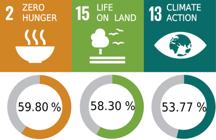
Percentage distribution of the articles analyzed in relation to the most cited Sustainable Development Goals (SDGs). Source: Modified from UN (2015).
The future use of Technosols from coal mining in agricultural activities aligns with target 4 of SDG 2. This target aims to guarantee the implementation of sustainable food production systems and resilient agricultural practices that increase productivity with low negative environmental impacts on ecosystems by 2030. At the same time, this area recovery technology corroborates the achievement of target number 3 of SDG 15, which states that: 15.3 by 2030, combat desertification, restore degraded land and soil, including land affected by desertification, drought, and floods, and strive to achieve a land degradation-neutral world (UN, 2015).
It is important to emphasize that approximately 800 hectares have already been impacted by open-pit coal mining at the Candiota Mine, of which around 760 hectares are currently undergoing revegetation recovery (CRM, 2023b). However, due to the limited number of studies, the toxicity of the waste, and the absence of technical and legal criteria, these areas remain underutilized, unlike in Germany, where such areas are returned to agricultural use (Leal et al., 2025).
Furthermore, as previously noted, deposition conditions and location directly influence the concentrations of toxic elements and micro- and macronutrients. Consider, for example, the Santa Catarina Coal Basin, an estuarine basin whose proximity to the sea allowed seawater to infiltrate the deposits, increasing their sulfur content compared with deposits in Rio Grande do Sul (Kalkreuth et al., 2010). These characteristics affect the type of coal, the composition of the waste, and the concentration of trace contaminant elements. These conditions will, in turn, influence the rehabilitation of post-mining areas and their potential future uses.
The low territorial impact of coal mining in Brazil stems from the fact that, unlike in other coal-consuming countries, coal combustion occurs mainly during periods of electricity shortages caused by limited hydropower generation (Pinto et al., 2020). In contrast, in countries where hydropower is not a dominant energy source, coal remains a widely used option for electricity generation, as is the case in Germany. In that country, lignite (brown coal) mining has affected approximately 180,000 hectares of land since it began in 1840 (Clean Energy Wire, 2023). However, unlike in Brazil, the mined land in Germany is returned to agricultural use within 6 years of mine closure (Roy et al., 2023).
The SDG 13 aims to mitigate the impacts of climate change. Technosols from coal mining are a promising approach to mitigating climate change, given their potential for CO2 capture. Weiler and Tassinari (2024) estimate that the potential for CO2 capture by Technosols could reach 65 Mg CO₂ eq ha-1. The main mechanism driving this figure is mineral carbonation, a geological process in which minerals rich in calcium and magnesium, such as olivine, serpentine, wollastonite and plagioclase, when incorporated into the soil, react with CO2, giving rise to stable compounds.
Another way to capture CO2 through Technosols is to construct them without compacting the topsoil, so that the vegetation to be established in the area does not encounter development difficulties (Da Silva Barbosa et al., 2021). When plants manage to quickly revegetate the area, in the short and medium term, it is expected that the addition of plant residues on the surface of the topsoil and the formation of biopores in the constructed profile, through easy root expansion (Burr-Hersey et al., 2017), will make the Technosol compensate for part of the carbon lost at the time of coal extraction. That is, through the formation of organic matter and its protection in biogenic aggregates, carbon will be sequestered in these areas, especially at the Candiota Mine, where the areas are not yet used for agriculture.
Brazil has 5.4 million hectares of legally active mining areas, with soil carbon stocks estimated at 2.55 Gt CO2 eq, of which 1.68 Gt CO2 eq are from soil and 0.87 Gt CO2 eq from vegetation (Ruiz et al., 2023). According to the authors, with the proper use of Technosols, carbon sequestration can reach 90 % of the carbon emitted by mining activities, depending on the climatic region where the mine is located.
CONCLUSION
Over the last two decades, the results showed an increase of 92.68 % in the number of publications between the first (2004-2013) and the second decade (2014-2023). However, the TGCS/N index showed instability, with a significant decline after 2017, a pattern characteristic of a research field in the process of consolidation. The USA stood out as the most influential country in terms of citations, with the USA and China leading the way in scientific contributions, accounting for 41.21 % of all publications.
The analysis of the co-occurrence of keywords emphasized a trend towards the rise, in terms of academic relevance, of topics related to the environmental contamination potential of coal mining waste, carbon sequestration by Technosols, the morphological characteristics of these soils and recovery indicators for mined areas. The integration of the properties that characterize soil health, especially the biological ones, is the main gap in this field of study. On a global scale, Technosols are a promising strategy for the recovery of areas degraded by anthropogenic activities, aligning with greater efficiency in waste management and the mitigation of impacts associated with the climate crisis, due to their high potential for CO2 capture.
-
How to cite:
Cardozo ES, Fernandez MBG, Dores GHS, Burgueño LET, Oliveira MS, Oliveira JR, Miguel P, Pinto LFS, Stumpf L. Technosols after coal mining: The challenges to be overcome by soil science. Rev Bras Cienc Solo. 2026;50nspe1:e0250040. https://doi.org/10.36783/18069657rbcs20250040
-
FUNDING
The authors would like to thank the Coordenação de Aperfeiçoamento de Pessoal de Nível Superior (CAPES) for providing a scholarship during the postgraduate studies.
DATA AVAILABILITY
All data were generated or analyzed in this study.
REFERENCES
-
Ahirwal J, Kumar A, Pietrzykowski M, Maiti SK. Reclamation of coal mine spoil and its effect on Technosol quality and carbon sequestration: a case study from India. Environ Sci Pollut Res. 2018;25:27992-8003. https://doi.org/10.1007/s11356-018-2789-1
» https://doi.org/10.1007/s11356-018-2789-1 -
Ahirwal J, Maiti SK. Development of Technosol properties and recovery of carbon stock after 16 years of revegetation on coal mine degraded lands, India. Catena. 2018;166:114-23. https://doi.org/10.1016/j.catena.2018.03.026
» https://doi.org/10.1016/j.catena.2018.03.026 -
Albert RP, Pinto LFS, Miguel P, Stumpf L, Leidemer JD. Acidification potential of geological materials in a coal mining area in southern Brazil. J South Am Earth Sci. 2022;120:104103. https://doi.org/10.1016/j.jsames.2022.104103
» https://doi.org/10.1016/j.jsames.2022.104103 -
Allory V, Séré G, Ouvrard S. A meta-analysis of carbon content and stocks in Technosols and identification of the main governing factors. Eur J Soil Sci. 2022;73:e13141. https://doi.org/10.1111/ejss.13141
» https://doi.org/10.1111/ejss.13141 -
Barboza FS, Stumpf L, Pauletto EA, Lima CLR, Pinto LFS, Jardim TM, Pimentel JP, Albert RP, Vivan GA. Impact of machine traffic events on the physical quality of a minesoil after topographic reconstruction. Soil Till Res. 2021;210:104981. https://doi.org/10.1016/j.still.2021.104981
» https://doi.org/10.1016/j.still.2021.104981 -
Bhagabati R, Borkotoki A. Status of Patkai lake near Tikak open cast mine, Assam: A hydro-biological approach. Biolife. 2014;2:610-21. https://doi.org/10.5281/zenodo.7214149
» https://doi.org/10.5281/zenodo.7214149 - Bitencourt D. Dinâmica de acidifcação e metais no solo e subsolo de solos construídos na área de mineração de carvão de Candiota-RS [thesis]. Pelotas: Universidade Federal de Pelotas; 2014.
-
Bitencourt DGB, Pinto LFS, Pauletto EA, Silva MT, Garcia GF. Geração de drenagem ácida e de contaminação por metais pesados em perfis de solos construídos em área de mineração de carvão. Rev Bras Cienc Solo. 2015;39:1821-34. https://doi.org/10.1590/01000683rbcs20140810
» https://doi.org/10.1590/01000683rbcs20140810 -
Borůvka L, Kozák J, Mühlhanselová M, Donátová H, Nikodem A, Němeček K, Drábek O. Effect of covering with natural topsoil as a reclamation measure on brown-coal mining dumpsites. J Geochem Explor. 2012;113:118-23. https://doi.org/10.1016/j.gexplo.2011.11.004
» https://doi.org/10.1016/j.gexplo.2011.11.004 -
Bünemann EK, Bongiorno G, Bai Z, Creamer RE, De Deyn G, Goede R, Fleskens L, Geissen V, Kuyper TW, Mäder P, Pulleman M, Sukkel W, van Groenigen JW, Brussaard L. Soil quality – A critical review. Soil Biol Biochem. 2018;120:105-25. https://doi.org/10.1016/j.soilbio.2018.01.030
» https://doi.org/10.1016/j.soilbio.2018.01.030 -
Burgueño L, Spinelli Pinto L, Stumpf L, Fátima De Brum Piana C, Silva De Oliveira M, Silveira Quadro M, Miguel P. Evolution of a Technosol cultivated with perennial grass, over 15 years: potential use as carbon sinks. In: Soni AK, editor. Technologies in Mining. London: IntechOpen; 2024. https://doi.org/10.5772/intechopen.1005687
» https://doi.org/10.5772/intechopen.1005687 -
Burr-Hersey JE, Mooney SJ, Bengough AG, Mairhofer S, Ritz K. Developmental morphology of cover crop species exhibit contrasting behaviour to changes in soil bulk density, revealed by X-ray computed tomography. PLoS ONE. 2017;12:e0181872. https://doi.org/10.1371/journal.pone.0181872
» https://doi.org/10.1371/journal.pone.0181872 -
Clayton H, Wick A, Daniels W. Microbial biomass in reclaimed soils following coal mining in Virginia. Proc Am Soc Min Reclam. 2009:227-36. https://doi.org/10.21000/JASMR09010227
» https://doi.org/10.21000/JASMR09010227 -
Clean Energy Wire. Germany’s three lignite mining regions [internet]. Berlin: CEW; 2024. Available from: https://www.cleanenergywire.org/factsheets/germanys-three-lignite-mining-regions
» https://www.cleanenergywire.org/factsheets/germanys-three-lignite-mining-regions -
Companhia Riograndense de Mineração - CRM. Relatório da diretoria e demonstrações contábeis em 31 de dezembro de 2023 e 2022. Porto Alegre: CRM; 2023a. Available from: https://admin.crm.rs.gov.br/upload/arquivos/202405/29155623-relatorio-da-diretoria-31-12-23-e-2022.pdf
» https://admin.crm.rs.gov.br/upload/arquivos/202405/29155623-relatorio-da-diretoria-31-12-23-e-2022.pdf -
Companhia Riograndense de Mineração CRM. Relatório da sustentabilidade. Porto Alegre: CRM; 2023b. Available from: https://admin.crm.rs.gov.br/upload/arquivos/202502/18142334-relatorio-de-sustentabilidade-crm-2024-assinado.pdf
» https://admin.crm.rs.gov.br/upload/arquivos/202502/18142334-relatorio-de-sustentabilidade-crm-2024-assinado.pdf - Dias SC. Estudo pioneiro da restauração de solos minerados em uma cronosequência de 10,6 anos na mina de carvão de Moatize – Moçambique [thesis]. Pelotas: Universidade Federal de Pelotas; 2024.
-
Domínguez-Haydar Y, Velásquez E, Carmona J, Lavelle P, Chavez LF, Jiménez JJ. Evaluation of reclamation success in an open-pit coal mine using integrated soil physical, chemical and biological quality indicators. Ecol Indic. 2019;103:182-93. https://doi.org/10.1016/j.ecolind.2019.04.015
» https://doi.org/10.1016/j.ecolind.2019.04.015 -
Dong J, Li J, Huang Y, Zhong J, Dun K, Wu M, Zhang L, Chen Q, Pan B. Understanding the release, migration, and risk of heavy metals in coal gangue: An approach by combining experimental and computational investigations. J Hazard Mater. 2024;461:132707. https://doi.org/10.1016/j.jhazmat.2023.132707
» https://doi.org/10.1016/j.jhazmat.2023.132707 -
Donthu N, Kumar S, Mukherjee D, Pandey N, Lim WM. How to conduct a bibliometric analysis: An overview and guidelines. J Bus Res. 2021;133:285-96. https://doi.org/10.1016/j.jbusres.2021.04.070
» https://doi.org/10.1016/j.jbusres.2021.04.070 - Empresa de Pesquisa Energética - EPE. Balanço Energético Nacional: Ano base 2023. Rio de Janeiro: EPE; 2024.
-
Ezeokoli OT, Bezuidenhout CC, Maboeta MS, Khasa DP, Adeleke RA. Structural and functional differentiation of bacterial communities in post-coal mining reclamation soils of South Africa: Bioindicators of soil ecosystem restoration. Sci Rep. 2020;10:1759. https://doi.org/10.1038/s41598-020-58576-5
» https://doi.org/10.1038/s41598-020-58576-5 -
Fabbri D, Pizzol R, Calza P, Malandrino M, Gaggero E, Padoan E, Ajmone-Marsan F. Constructed Technosols: A strategy toward a circular economy. Appl Sci. 2021;11:3432. https://doi.org/10.3390/app11083432
» https://doi.org/10.3390/app11083432 -
Feng Y, Wang J, Bai Z, Reading L. Effects of surface coal mining and land reclamation on soil properties: A review. Earth-Sci Rev. 2019;191:12-25. https://doi.org/10.1016/j.earscirev.2019.02.015
» https://doi.org/10.1016/j.earscirev.2019.02.015 -
Fernandez MBDG, Stumpf L, Miguel P, Pinto LFS, Carlos FS, Schubert RN, Pagani Junior A, Cadona EA, Bicca JM. Biological quality and organic matter dynamics in minesoil at 18 years reclamation with perennial grasses. Ecol Eng. 2023;187:106866. https://doi.org/10.1016/j.ecoleng.2022.106866
» https://doi.org/10.1016/j.ecoleng.2022.106866 -
Firpo BA, Weiler J, Schneider IAH. Technosol made from coal waste as a strategy to plant growth and environmental control. Energy Geosci. 2021;2:160-6. https://doi.org/10.1016/j.engeos.2020.09.006
» https://doi.org/10.1016/j.engeos.2020.09.006 -
Frouz J. Soil recovery and reclamation of mined lands. In: Stanturf JA, Callaham Jr MA, editors. Soils and landscape restoration. Amsterdan: Elsevier; 2021. p. 161-91. https://doi.org/10.1016/B978-0-12-813193-0.00006-0
» https://doi.org/10.1016/B978-0-12-813193-0.00006-0 -
Garfield E. From the science of science to Scientometrics visualizing the history of science with HistCite software. J Informetr. 2009;3:173-9. https://doi.org/10.1016/j.joi.2009.03.009
» https://doi.org/10.1016/j.joi.2009.03.009 -
Guerrero JL, Suárez-Vaz N, Paz-Gómez DC, Pérez-Moreno SM, Bolívar JP. Spatiotemporal evolution of U and Th isotopes in a mine effluent highly polluted by Acid Mine Drainage (AMD). J Hazard Mater. 2023;447:130782. https://doi.org/10.1016/j.jhazmat.2023.130782
» https://doi.org/10.1016/j.jhazmat.2023.130782 -
Hu Z, Zhu Q, Liu X, Li Y. Preparation of topsoil alternatives for open-pit coal mines in the Hulunbuir grassland area, China. Appl Soil Ecol. 2020;147:103431. https://doi.org/10.1016/j.apsoil.2019.103431
» https://doi.org/10.1016/j.apsoil.2019.103431 - International Energy Agency - IEA. Coal 2024-Analysis and forecast to 2027. Paris: IEA; 2024.
-
Kalkreuth W, Holz M, Mexias A, Balbinot M, Levandowski J, Willett J, Finkelman R, Burger H. Depositional setting, petrology and chemistry of Permian coals from the Paraná Basin: 2. South Santa Catarina Coalfield, Brazil. Int J Coal Geol. 2010;84:213-36. https://doi.org/10.1016/j.coal.2010.08.008
» https://doi.org/10.1016/j.coal.2010.08.008 -
Leal ODA, Reichel R, Wissel H, Brüggemann N. Legacy of severe soil degradation hinders the buildup of mineral-associated soil organic carbon. Sci Total Environ. 2025;978:179445. https://doi.org/10.1016/j.scitotenv.2025.179445
» https://doi.org/10.1016/j.scitotenv.2025.179445 -
Leguédois S, Séré G, Auclerc A, Cortet J, Huot H, Ouvrard S, Watteau F, Schwartz C, Morel JL. Modelling pedogenesis of Technosols. Geoderma. 2016;262:199-212. https://doi.org/10.1016/j.geoderma.2015.08.008
» https://doi.org/10.1016/j.geoderma.2015.08.008 -
Liu X, Zhang J, Li Q, Liang W. Preparation of Technosol based on coal gangue and its impact on plant growth in coal mining area. J Clean Prod. 2024;467:142998. https://doi.org/10.1016/j.jclepro.2024.142998
» https://doi.org/10.1016/j.jclepro.2024.142998 -
Lopes LR, Lima MVAGD, Stephenson RA. Study of the feasibility of the MASW seismic method in coal prospecting: a study based on a conceptual model for the Candiota mine, southern Brazil. REM Int Eng J. 2024;77:e230141. https://doi.org/10.1590/0370-44672023770141
» https://doi.org/10.1590/0370-44672023770141 -
Miguel P, Stumpf L, Pinto LFS, Pauletto EA, Rodrigues MF, Barboza LS, Leidemer JD, Duarte TB, Pinto MAB, Fernandez MBG, Islabão LO, Silveira LM, Rocha JVP. Physical restoration of a minesoil after 10.6 years of revegetation. Soil Till Res. 2023;227:105599. https://doi.org/10.1016/j.still.2022.105599
» https://doi.org/10.1016/j.still.2022.105599 -
Mikheeva IV, Androkhanov VA. Physical properties of technosols at brown coal mine wastes in Eastern Siberia. Soil Till Res. 2022;217:105264. https://doi.org/10.1016/j.still.2021.105264
» https://doi.org/10.1016/j.still.2021.105264 -
Mitrakova NV, Khayrulina EA, Poroshina NV, Perevoshchikova AA, Malyshkina EE. Formation of acid sulfate soils under the influence of acid mine waste in the taiga zone. Eurasian Soil Sc. 2023;56:S183-93. https://doi.org/10.1134/S106422932360152X
» https://doi.org/10.1134/S106422932360152X -
Mosebi PE, Truter WF, Madakadze IC. Smuts finger grass (Digitaria eriantha Cv Irene) root growth assessment and some physicochemical characteristics on coal mined land compacted soil. J Appl Sci Envir Manag. 2018;22:1293. https://doi.org/10.4314/jasem.v22i8.24
» https://doi.org/10.4314/jasem.v22i8.24 -
Onweremadu EU, Onyia VN, Anikwe MAN. Carbon and nitrogen distribution in water-stable aggregates under two tillage techniques in Fluvisols of Owerri area, southeastern Nigeria. Soil Till Res. 2007;97:195-206. https://doi.org/10.1016/j.still.2007.09.011
» https://doi.org/10.1016/j.still.2007.09.011 -
Pan X, Lv J, Dyck M, He H. Bibliometric analysis of soil nutrient research between 1992 and 2020. Agriculture. 2021;11:223. https://doi.org/10.3390/agriculture11030223
» https://doi.org/10.3390/agriculture11030223 -
Pinto LFS, Stumpf L, Miguel P, Junior LAD, Leidemer JD, da Silva Barbosa L, Oliveira MS. Reclamation of soils degraded by surface coal mining. Mining techniques-past, present and future. London: IntechOpen; 2020. https://doi.org/10.5772/intechopen.93432
» https://doi.org/10.5772/intechopen.93432 -
Roy J, Reichel R, Brüggemann N, Rillig MC. Functional, not taxonomic, composition of soil fungi reestablishes to pre-mining initial state after 52 years of recultivation. Microb Ecol. 2023;86:213-23. https://doi.org/10.1007/s00248-022-02058-w
» https://doi.org/10.1007/s00248-022-02058-w -
Ruiz F, Safanelli JL, Perlatti F, Cherubin MR, Demattê JAM, Cerri CEP, Otero XL, Rumpel C, Ferreira TO. Constructing soils for climate-smart mining. Commun Earth Environ. 2023;4:219. https://doi.org/10.1038/s43247-023-00862-x
» https://doi.org/10.1038/s43247-023-00862-x -
Santini TC, Fey MV. Fly ash as a permeable cap for tailings management: pedogenesis in bauxite residue tailings. J Soils Sediments. 2015;15:552-64. https://doi.org/10.1007/s11368-014-1038-6
» https://doi.org/10.1007/s11368-014-1038-6 -
Silva LFO, Wollenschlager M, Oliveira MLS. A preliminary study of coal mining drainage and environmental health in the Santa Catarina region, Brazil. Environ Geochem Health. 2011;33:55-65. https://doi.org/10.1007/s10653-010-9322-x
» https://doi.org/10.1007/s10653-010-9322-x -
Stumpf L, Fernandez MBG, Miguel P, Pinto LFS, Schubert RN, Oliveira Filho LCI, Montiel TH, Barbosa LS, Leidemer JD, Duarte TB. Impact of revegetation on ecological restoration of a constructed soil in a coal mining in southern Brazil. In: Hufnagel LA, editor. El-Esawi M, editors. Environmental Sciences. London: IntechOpen; 2023. v. 6. https://doi.org/10.5772/intechopen.105895
» https://doi.org/10.5772/intechopen.105895 -
Stumpf L, Pauletto EA, Pinto LFS, Geissler LO, Castilhos DD, Souza DL, Pimentel JP, Dutra Junior LA. Biological and physical quality of a mined soil under revegetation with perennial grasses. Agraria. 2018;13:e5498. https://doi.org/10.5039/agraria.v13i1a5498
» https://doi.org/10.5039/agraria.v13i1a5498 -
Stumpf L, Pauletto EA, Pinto LFS. Soil aggregation and root growth of perennial grasses in a constructed clay minesoil. Soil Till Res. 2016a;161:71-8. https://doi.org/10.1016/j.still.2016.03.005
» https://doi.org/10.1016/j.still.2016.03.005 - Stumpf L. Desenvolvimento radicular de gramíneas perenes e sua eficiência na recuperação de atributos físicos de um solo construído compactado em área de mineração de carvão [thesis]. Pelotas: Universidade Federal de Pelotas; 2015.
-
Stumpf L, Pauletto EA, Pinto LFS, Ambus JV, Garcia GF, Silva TS. Características químicas de um solo construído e seus efeitos no desenvolvimento radicular de gramíneas perenes. Agraria. 2016b;11:343-9. https://doi.org/10.5039/agraria.v11i4a5407
» https://doi.org/10.5039/agraria.v11i4a5407 - Thomas K, Sencindiver J, Skousen J, Gorman J. Soil horizon development on a mountaintop surface mine in southern West Virginia. Green Lands. 2000;30:41-52.
-
United Nations - UN. Transforming our world: The 2030 agenda for sustainable development [internet]. Policy Commons; 2015. Available from: https://policycommons.net/artifacts/18386159/transforming-our-world/19286553/
» https://policycommons.net/artifacts/18386159/transforming-our-world/19286553/ -
Uzarowicz Ł, Skiba M, Leue M, Zagórski Z, Gąsiński A, Trzciński J. Technogenic soils (Technosols) developed from fly ash and bottom ash from thermal power stations combusting bituminous coal and lignite. Part II. Mineral transformations and soil evolution. Catena. 2018;162:255-69. https://doi.org/10.1016/j.catena.2017.11.005
» https://doi.org/10.1016/j.catena.2017.11.005 -
Uzarowicz Ł, Zagórski Z, Mendak E, Bartmiński P, Szara E, Kondras M, Oktaba L, Turek A, Rogoziński R. Technogenic soils (Technosols) developed from fly ash and bottom ash from thermal power stations combusting bituminous coal and lignite. Part I. Properties, classification, and indicators of early pedogenesis. Catena. 2017;157:75-89. https://doi.org/10.1016/j.catena.2017.05.010
» https://doi.org/10.1016/j.catena.2017.05.010 -
Van Eck NJ, Waltman L. Software survey: VOSviewer, a computer program for bibliometric mapping. Scientometrics. 2010;84:523-38. https://doi.org/10.1007/s11192-009-0146-3
» https://doi.org/10.1007/s11192-009-0146-3 -
Weiler J, Firpo BA, Schneider IAH. Technosol as an integrated management tool for turning urban and coal mining waste into a resource. Miner Eng. 2020;147:106179. https://doi.org/10.1016/j.mineng.2019.106179
» https://doi.org/10.1016/j.mineng.2019.106179 -
Weiler J, Tassinari CCG. Evaluating CO2 sequestration through Technosol constructed from coal mining waste. Miner Eng. 2024;218:109032. https://doi.org/10.1016/j.mineng.2024.109032
» https://doi.org/10.1016/j.mineng.2024.109032 -
Zocche JJ, Sehn LM, Pillon JG, Schneider CH, Olivo EF, Raupp-Pereira F. Technosols in coal mining areas: Viability of combined use of agro-industry waste and synthetic gypsum in the restoration of areas degraded. Clean Eng Technol. 2023;13:100618. https://doi.org/10.1016/j.clet.2023.100618
» https://doi.org/10.1016/j.clet.2023.100618
Edited by
-
Editor:
Marcos Gervasio Pereira https://orcid.org/0000-0002-1402-3612