 Higher microbial activity improved rhizosphere soil aggregation of Lolium multiflorum throughout the crop cycle
ABSTRACT
Plant roots can modify the stability of soil aggregates in the rhizosphere and the surrounding bulk soil. Italian ryegrass (Lolium multiflorum) is known to improve soil aggregation through processes related to microbial activity, but these dynamics vary throughout the crop cycle. This study aims to correlate microbial activity with soil aggregate stability, determined by turbidimetry (readily-dispersible clay and mechanically-dispersible clay), in the rhizosphere and bulk soil of Italian ryegrass at 86, 113, 141, and 168 days after sowing. Results showed that the rhizosphere soil was significantly more stable, with 85–154 % lower dispersed clay than the bulk soil. Furthermore, aggregate stability increased (i.e., dispersed clay decreased) throughout the crop cycle, in tandem with a general increase in microbial parameters such as β-glucosidase, acid phosphatase, and glomalin-related soil protein. Aggregate stability was strongly correlated (R2 = 0.17–0.53; p<0.01) with these microbial parameters. In conclusion, Italian ryegrass effectively enhances soil aggregation and microbial activity, particularly in the rhizosphere, making it a valuable crop for improving soil health.
Keywords
aggregate stability; root-soil interaction; dispersed clay in water; turbidimetry method; enzyme activities
INTRODUCTION
Soil aggregation is a complex process essential for soil structure and function, shaping the soil matrix and influencing key properties like water retention and carbon storage (Lehmann et al., 2017; Lavelle et al., 2020; Rieke et al., 2022). The stability of the aggregates — defined as their resistance to breakdown from forces like tillage or raindrop impact — is a critical indicator of soil health (Kemper and Rosenau, 1986; Bronick and Lal, 2005; Abbas et al., 2025).
Plant root systems are key biological drivers of aggregate stability (Wang et al., 2020; Batista et al., 2023). Root-induced aggregate stability works not only through physical reinforcement, but also through chemical properties of root exudates and interactions between these exudates and soil biota (Hudek et al., 2022). However, root influences on soil aggregates are dependent on both plant species and soil properties (Batista et al., 2020; Zhou et al., 2020; Liu et al., 2023). Italian ryegrass (Lolium multiflorum) is particularly effective in this regard, attributed to its dense root architecture and the promotion of beneficial microbial communities that produce binding agents (Liu et al., 2005; Naveed et al., 2017; Matocha et al., 2018).
The comparison between the rhizosphere (soil adhering to roots) and the soil adjacent to it has been fundamental to understanding the role of active roots and the microbial community in soil aggregation processes (Li et al., 2020; Liu et al., 2023; Mateu et al., 2024). However, linking the rapid, short-term changes in microbial activity to the more gradual process of soil aggregation presents a methodological challenge (Paz-Ferreiro and Fu, 2016; Marcos et al., 2019). Evaluating these dynamics requires sensitive methods capable of detecting subtle shifts in soil structure throughout a single crop cycle.
The dispersed clay method using turbidimetry has proven effective for detecting fine-scale differences in aggregate stability between the rhizosphere and the adjacent bulk soil (Batista et al., 2020, 2022, 2023). The method quantifies readily dispersible clay (RDC) and mechanically-dispersible clay (MDC), which can be used to assess the resistance of aggregates to disaggregation under increasing levels of applied energy, i.e., shaking time and intensity (Dexter et al., 2011; Czyż and Dexter, 2015; Batista et al., 2020).
Despite extensive research on soil aggregation, uncertainties remain regarding the specific role of biological factors (Merino-Martín et al., 2021; Yudina and Kuzyakov, 2023). This is particularly true for Italian ryegrass, for which the specific microbial processes mediated by roots responsible for enhancing soil aggregate stability are not yet fully understood (Mateu et al., 2024). A deeper understanding of these dynamics is crucial for assessing the broader implications for soil health and functionality.
Therefore, we hypothesized that higher microbial activity in the rhizosphere of Italian ryegrass improves soil aggregate stability throughout its growing cycle. To test this hypothesis, our study had two specific objectives: (i) to evaluate the dynamics of microbial activity and aggregate stability in both the rhizosphere and the soil between plant rows (i.e., bulk soil) throughout the crop cycle; and (ii) to establish the correlation between these microbial and physical parameters to explain the observed improvements in soil structure.
MATERIALS AND METHODS
Description of the experimental area
The experimental area belongs to the Department of Biosystems Engineering, College of Agriculture “Luiz de Queiroz”, University of São Paulo (ESALQ/USP), in Piracicaba, São Paulo, Brazil (22° 42’ 15.0” S and 47° 37’ 23.3” W, 564 m altitude). The soil in the area is classified as a Nitossolo Vermelho Eutroférrico latossólico, according to the Brazilian Soil Classification System (Santos et al., 2018), which corresponds to a Kandiudalfic Eutrudox (Soil Survey Staff, 2014), with a clay texture consisting of 383 g kg-1 of sand, 161 g kg-1 of silt, and 456 g kg-1 of clay. A detailed chemical characterization of the soil is provided in the Supplementary Data (Table S1). The regional climate is classified as tropical savanna (Aw) according to the Köppen classification system (Dias et al., 2017).
This area has a history of cultivation with ‘Marandu’ palisade grass (Urochloa brizantha cv. Marandu) from November 2015 to March 2018, followed by a previous cycle of Italian ryegrass (L. multiflorum cv. BRS ‘Ponteio’) from April to December 2018. The area was then left fallow until the sowing of the Italian ryegrass evaluated in this study on April 28, 2019, with a row spacing of 0.17 m. A cut-and-carry management was adopted, consisting of five sequential growth and cutting cycles (Figure 1). Each growth cycle was concluded with a cut when the plants reached the reproductive stage, i.e., from the pre-reproductive (first floral meristem differentiation) to the early reproductive stage. This stage was identified visually by observing key developmental markers, including stem elongation driven by the apical meristem, the appearance of the flag leaf, and the beginning of sheath filling. At that point, the entire plot was cut to a stubble height of 0.07 m, initiating a new regrowth cycle. The initial growth cycle was 60 days long, while the four subsequent regrowth cycles varied from 26 to 28 days.
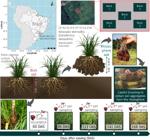
Visual summary from the site’s geographical location in Piracicaba, Brazil, to the randomized complete block design. It details the sampling strategy for the 0.00-0.10 m soil layer, distinguishing between bulk soil and rhizosphere soil, with photographs illustrating the practical procedures. The timeline at the bottom indicates the cut-and-carry management and soil sampling events.
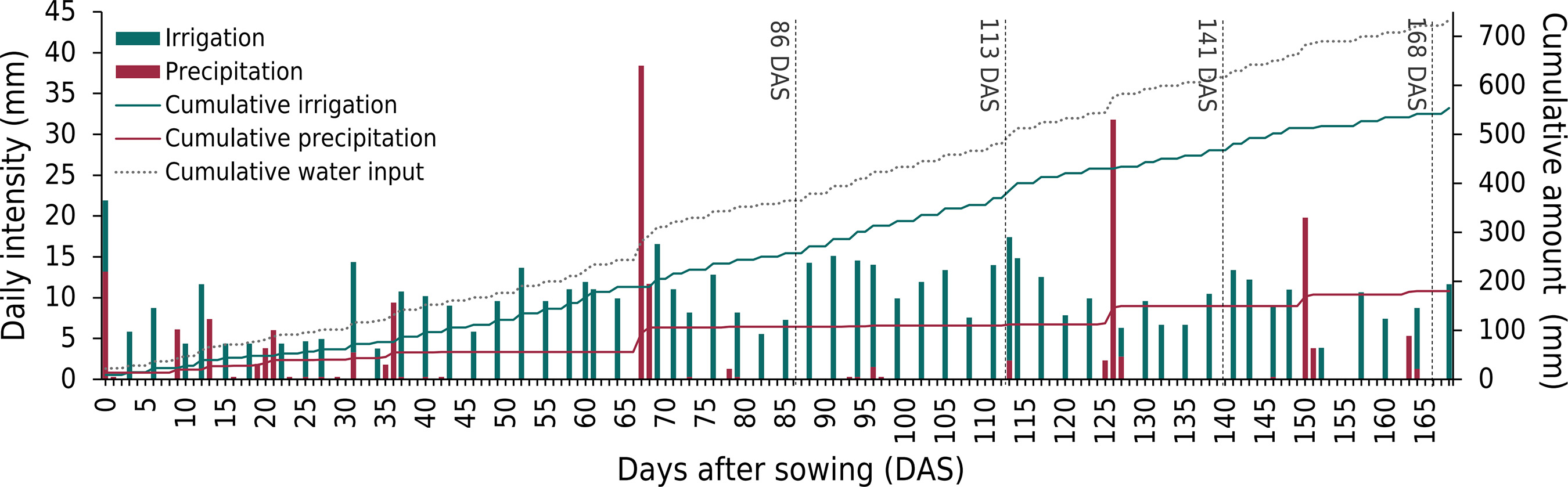
Irrigation was managed by monitoring soil water status with conventional porous ceramic tensiometers installed at depths of 0.15, 0.30 and 0.45 m. To prevent water stress and promote optimal plant development, irrigation was applied on a fixed schedule every three days. For each irrigation event, the matric potential measured by the tensiometers was used to estimate the current soil water content via a laboratory-determined soil water retention curve fitted with the van Genuchten model, considering Mualem’s restriction (Mualem, 1976; Van Genuchten, 1980). The volume of water applied was then precisely calculated to replenish the soil water deficit and restore the profile to its field capacity. The frequency and intensity of all precipitation and irrigation events in the study area are presented in figure 2.

Daily intensity (bars) and cumulative amount (lines) of precipitation and irrigation throughout the experimental period. Vertical dashed lines indicate the soil sampling days: 86, 113, 141, and 168 days after sowing (DAS).
Experimental design and soil sampling
The experiment followed a complete randomized block design within an approximately 40 m2 plot. This area was divided into five blocks (replicates), and within each, two soil zones were sampled as treatments: the rhizosphere soil and the bulk soil (Figure 1). Soil samples were collected from the 0.00-0.10 m layer, where most of the root system was concentrated (Table S2, Supplementary Data), at 86, 113, 141, and 168 days after sowing (DAS). These four soil samplings occurred during these final four regrowth cycles. For rhizosphere sampling, the plants were carefully uprooted. The soil adhering to the roots was then gently brushed off and considered the rhizosphere sample (Figure 1). For bulk soil sampling, soil was collected with a hand auger from between the plant rows (Figure 1). A similar sampling strategy has been employed in several studies (Zhang et al., 2022; Batista et al., 2023; Han et al., 2024).
Soil aggregation analyses
Soil aggregation was assessed by determining the readily-dispersible clay (RDC) and mechanically-dispersible clay (MDC) via turbidimetry (Dexter et al., 2011). For these analyses, soil samples were air-dried and passed through a 2-mm mesh sieve.
To measure RDC, 5 g of air-dried aggregates were mixed with 125 mL of deionized water in 150-mL flasks and shaken manually (four inversions per minute). The same procedure was followed to measure MDC, but the flasks were shaken mechanically on a horizontal shaker at 120 oscillations per minute for 30 min. After shaking, suspensions were allowed to settle for 16 h. Turbidity was then measured with a turbidimeter (model 2100AN, Hach Company, Loveland, CO, USA). Turbidity readings, expressed in nephelometric turbidity units (NTU), were normalized to a concentration of 1 g L-1 using the equation 1.
in which: NT is the normalized turbidity [NTU/(g L-1)]; T is the turbidity (NTU); ms is the dry mass of the soil (g); Vw is the volume of water used (125 mL); and 1000 is a correction factor to convert mL to L.
Microbial analyses
The activities of three enzymes — β-glucosidase (BG), dehydrogenase (DH), and acid phosphatase (ACP) — were determined. Additionally, the quantity of easily extractable glomalin-related soil protein (EE-GRSP) was measured as an indicator of mycorrhizal hyphae. These analyses were performed using soil samples with preserved field moisture.
The enzymatic activity of ACP and BG was determined according to Tabatabai and Bremner (1969) and Tabatabai (1994), respectively. Briefly, 1 g of soil was mixed with 4 mL of MUB buffer (pH 6.5 for ACP and pH 6.0 for BG) and 1 mL of the corresponding p-nitrophenyl substrate — i.e., p-nitrophenyl sodium phosphate (PNF) for ACP and p-nitrophenyl-β-D-glycopyranoside (PNG) for BG. The mixtures were incubated for one hour at 37 °C. After incubation, 1 mL of 0.5 mol L-1 CaCl2 and 4 mL of either 0.5 mol L-1 NaOH (for ACP) or 0.1 mol L-1 Tris(hydroxymethyl)aminomethane (THAM) at pH 12.0 (for BG) were added. After stirring again, the solution was filtered, and ACP and BG activities were determined by colorimetry at 410 nm using a spectrophotometer (model NI 2000, Nova Instruments, Piracicaba, Brazil).
Enzymatic activity of DH was measured according to Casida et al. (1964). Briefly, 5 g of soil was mixed with 5 mL of a 1 % 2,3,5-triphenyltetrazolium chloride (TTC) solution and incubated for 24 h at 37 °C. After incubation, 10 mL of methanol was added. The mixture was then centrifuged at 3400 rpm for 10 min, and DH activity was determined by colorimetry at 435 nm using a NI 2000 spectrophotometer.
The content of EE-GRSP was extracted from the soil according to Wright and Upadhyaya (1998) and quantified using the method described by Bradford (1976). Briefly, 8 mL of 20 μmol L-1 sodium citrate was added to 1 g of soil. The mixture was then vortexed for approximately four seconds, autoclaved at 121 °C for 30 min, and centrifuged at 5000 rpm for 5 min. The protein content of the supernatant was measured using colorimetry with an EZ Read 400 ELISA reader (Biochrom, Holliston, USA) at 595 nm.
Statistical analyses
All statistical analyses were performed in R (version 4.4.1), running on RStudio (version 2023.06.1+524). A linear mixed-effects model (LMM) was used to assess differences between treatments throughout the time, with block (i.e., replicates) as a random effect and treatment and DAS as fixed effects. The interaction between treatment and DAS was included to examine varying treatment effects throughout the time. Type III analysis of variance (ANOVA) was used to test the significance of the fixed effects and their interaction at a 0.05 significance level using the “Anova” function from the “car” package. All test assumptions were previously tested. Estimated marginal means (EMMs) were calculated for each treatment at each DAS using the “emmeans” package. Pairwise comparisons of EMMs were performed to identify significant differences between the rhizosphere and the bulk soil at each DAS, with Tukey adjustments applied to p-values for multiple comparisons. In addition, EMMs were used to assess differences between DAS within each treatment, with pairwise comparisons adjusted using Tukey’s method for multiple testing.
To evaluate the relationships between the response variables, simple linear regression models were used to assess the relationships between microbial (BG, DH, ACP, and EE-GRSP) and physical parameters (RDC and MDC). Significance of the relationships was assessed using the coefficient of determination (R2) and the p-value for each regression. Data from both treatments were combined in the analysis because the individual regressions for the rhizosphere and the bulk soil showed that the nature of the relationship (i.e., whether the correlation was positive or negative) was consistent across both treatments. However, when analyzing the treatments separately, the smaller sample size (n = 20) sometimes prevented the detection of significant correlations (Figure S1, Supplementary Data). By combining the data (n = 40), the increased sample size improved the statistical power, allowing for more robust detection of significant relationships. In addition, to provide a more manageable and interpretable representation of the multidimensional dataset, principal component analyses (PCA) were performed for each DAS, segregating rhizosphere and bulk soil. Confidence ellipses representing 85 % confidence intervals of the groups (rhizosphere and bulk soil) were used (Payton et al., 2000, 2003). Other authors have also used 85 % CI in relevant research (Luo et al., 2021; Li and Bengtson, 2022; Barreto et al., 2024). Before performing PCA, the dataset was standardized by scaling the data to ensure that each variable contributed equally to the analysis. The PCA was performed using the “factoextra” package.
RESULTS
Stability of soil aggregates throughout the crop cycle
The dispersed clay in water methods — readily-dispersible clay (RDC) and mechanically-dispersible clay (MDC) — were sensitive enough to detect differences between rhizosphere and bulk soil (Figure 3). The lowest values were consistently observed in the rhizosphere across all sampling dates (p<0.05). On average, the bulk soil had ~85 % higher RDC and ~154 % higher MDC compared with the rhizosphere soil. Furthermore, RDC decreased throughout the time in both soil zones (Figure 3a), while MDC decreased throughout the time only in the bulk soil (Figure 3b).
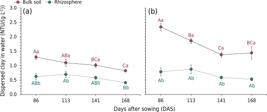
Stability of soil aggregates at 86, 113, 141, and 168 days after sowing (DAS) determined by (a) readily dispersible clay (RDC) and (b) mechanically-dispersible clay (MDC). Treatments correspond to two soil zones: the soil between plant rows (bulk soil) and the rhizosphere of Italian ryegrass. Values are mean ± standard error (n = 5). Different uppercase letters indicate differences among DAS for each treatment, and different lowercase letters indicate differences between the bulk soil and the rhizosphere within each DAS (Tukey’s adjustment; α = 0.05).
Rhizosphere aggregates demonstrated greater resistance to the increased mechanical energy applied during the analysis than the bulk soil aggregates. This resilience was evident when comparing the low-energy method (RDC) with the high-energy method (MDC) (Figure 3). Specifically, on average, the increase from RDC to MDC was ~20 % for the rhizosphere soil, while it was ~66 % for the bulk soil.
Microbial activity and its influence on aggregate stability
Overall, microbial activity generally increased in both the rhizosphere and the bulk soil throughout the time (Figure 4). The rhizosphere often exhibited higher microbial activity than the bulk soil. For example, β-glucosidase activity (BG) was consistently higher (p<0.05) in the rhizosphere than in the bulk soil (Figure 4a). Differences in other parameters depended more on the crop stage. Dehydrogenase activity (DH), for example, only differed between treatments at 86 DAS (Figure 4b). Conversely, differences in acid phosphatase activity (ACP) were observed at 86, 141, and 168 DAS (Figure 4c), as well as in easily extractable glomalin-related soil protein (EE-GRSP) at 113 and 168 DAS (Figure 4d). Despite these variations, all microbial parameters were significantly correlated with dispersed clay metrics (RDC and MDC) (Figure 5).

Soil microbial parameters determined at 86, 113, 141, and 168 days after sowing (DAS): (a) β-glucosidase (BG), (b) dehydrogenase (DH), (c) acid phosphatase (ACP), and (d) easily extractable glomalin-related soil protein (EE-GRSP). Treatments correspond to two soil zones: the soil between plant rows (bulk soil) and the rhizosphere of Italian ryegrass. Values are mean ± standard error (n = 5). Different uppercase letters indicate differences among DAS for each treatment, and different lowercase letters indicate differences between the bulk soil and the rhizosphere within each DAS (Tukey’s adjustment; α = 0.05).

Linear regression between microbial parameters and dispersed clay metrics (RDC and MDC). Microbial parameters considered are: (a) β-glucosidase (BG), (b) dehydrogenase (DH), (c) acid phosphatase (ACP), and (d) easily extractable glomalin-related soil protein (EE-GRSP). Data from both the bulk soil and the rhizosphere are included. Coefficient of determination (R2) and p-value are presented for each regression, n = 40.
Principal Component Analysis
For each PCA analysis, the first two principal components (PC1 and PC2) explained over 80 % of the total variability (Figure 6). Confidence ellipses for the rhizosphere and bulk soil were distinctly separated at most time points, with only a slight overlap observed at 113 DAS (Figure 6b). This consistent distinction indicates that the two soil environments exhibited distinct patterns of microbial and physical properties throughout the experiment. The individual contribution of each variable to the principal components varied across the sampling dates (Table S3, Supplementary Data).
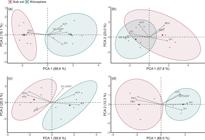
Principal component analysis (PCA) of soil properties at the four sampling dates. Biplots show the discrimination between bulk soil and rhizosphere at (a) 86, (b) 113, (c) 141, and (d) 168 days after sowing (DAS). Vectors indicate the influence of each variable (RDC, MDC, DH, BG, ACP, and EE-GRSP). Shaded ellipses represent the 85 % confidence interval for each treatment group. The percentage of variance explained by each principal component is shown in parentheses on the axes.
The PCA biplots confirmed the relationships between the measured variables observed in Figures 4, 5 and 6. Consistently across all sampling dates, the vectors for RDC and MDC were positively correlated with each other and associated with the bulk soil treatment group. In contrast, the vectors for the microbial parameters BG, ACP, and EE-GSRP were generally associated with the rhizosphere treatment group and negatively correlated with the RDC and MDC vectors.
Some of the observed relationships fluctuated throughout the time. For example, DH vector showed a positive correlation with RDC and MDC at 113 and 141 DAS, coinciding with the absence of a difference in DH activity between the rhizosphere and the bulk soil (Figure 4b). Similarly, the relationship between EE-GRSP and the other microbial parameters was weakest at 141 DAS, and its vector was less associated with the rhizosphere cluster. At this time, a lack of difference in EE-GRSP content between the rhizosphere and the bulk soil was observed (Figure 4d).
DISCUSSION
Changes in soil aggregate stability, mediated by microbial parameters, were observed throughout the Italian ryegrass growing cycle in both the rhizosphere and the bulk soil. In our study, the bulk soil corresponds to the soil between plant rows and represents the legacy effect of the soil management history. This history includes three years of ‘Marandu’ palisade grass cultivation followed by a previous cycle of Italian ryegrass. Perennial grass cultivation significantly contributed to the high structural quality and microbial activity of the experimental soil. Cover crop species enhance aggregate stability, and the value of perennial grass in improving soil structure has long been recognized (Clark, 1949; Liu et al., 2005; Hudek et al., 2022). Additionally, the experimental area exhibited high soil organic carbon content (Table S1, Supplementary Data), a factor known to positively influence soil aggregation (Grunwald et al., 2021).
In this context, the bulk soil measurements in our study serve as a reference for this legacy effect, while the study primary focus was to isolate the short-term, dynamic influence of the current Italian ryegrass root system. By comparing rhizosphere soil directly with adjacent bulk soil from the same plot and time point (Figure 1), our experimental design effectively differentiates the immediate rhizosphere effect from the pre-existing soil condition (Figures 3, 4, 5 and 6). This comparison is fundamental to understanding the role of active roots and the microbial interactions in the soil aggregation processes (Li et al., 2020; Liu et al., 2023; Mateu et al., 2024). Therefore, the differences observed between the rhizosphere and the bulk soil were directly attributable to the ongoing biological activity of living Italian ryegrass roots.
This study showed that the dispersed clay metrics (RDC and MDC), determined by turbidimetry, were effective in detecting short-term changes in soil aggregation during the Italian ryegrass cycle (Figure 3). Although previous studies have validated the method’s utility in distinguishing between the rhizosphere and the bulk soil or across seasons (Batista et al., 2020, 2022, 2023), this is the first one to detect changes at short time intervals (~27 days; Figure 1) during a single crop cycle. For comparison, Souza et al. (2010) assessed aggregate stability monthly in a crop-livestock system with Italian ryegrass and black oats but did not observe significant differences, likely due to methodological limitations in detecting temporal dynamics.
Clay dispersion caused by mechanical energy was ~46 % lower in the rhizosphere than in the bulk soil (Figure 3), underscoring the stabilizing effect of active Italian ryegrass roots. This effect has been previously reported. Materechera et al. (1992), for instance, found that ryegrass promoted aggregate formation more effectively than wheat and pea. More recently, Batista et al. (2020) demonstrated that cropping systems including ryegrass had the highest soil aggregation levels among various systems. Their findings are consistent with our observation of greater aggregate stability in the rhizosphere.
Although plant roots are essential for soil aggregation (Liu et al., 2019), they release compounds that can either stabilize or destabilize soil particles (Naveed et al., 2017; Batista et al., 2020). The observed reduction in RDC in the rhizosphere soil throughout the Italian ryegrass cycle (Figure 3a), reflecting enhanced soil stability, can be attributed to root traits of this crop — such as its architecture, high population of mycorrhizal hyphae, and exudation of organic carbon and polysaccharides, which act as binding agents (Liu et al., 2005; Naveed et al., 2017; Matocha et al., 2018; Hudek et al., 2022).
Improved nutrient availability and aggregation make the rhizosphere a favorable habitat for microorganisms, leading to increased microbial biomass and enzyme activity and enhancing carbon mineralization (Li et al., 2023). This plant–microbe synergy often results in elevated microbial activities — including the production of enzymes such as acid phosphatase and β-glucosidase, as well as the glomalin content — in the rhizosphere compared with the bulk soil (Sarabia et al., 2018; Holz et al., 2019; Molefe et al., 2023), as shown in figure 4. These activities increase throughout the growing cycle, driven by root exudation (Deng and Tabatabai, 1996; Marx et al., 2001; Burns et al., 2013). However, they can also vary due to factors such as carbon allocation and soil moisture availability (Kaiser et al., 2011; Manzoni et al., 2012; Razavi et al., 2016; Ma et al., 2018), which justifies the observed fluctuation throughout the time (Figures 4 and 6).
Since microbial communities are sensitive indicators of changes in the soil environment caused by management practices (Mateu et al., 2024), the possible effect of grazing management on microbial activity fluctuations cannot be disregarded in this study. Grazing management can influence changes in soil biota over time (Merino-Martín et al., 2021). Specifically, grass cutting directly affects the amount of above- and below-ground biomass, consequently impacting the carbon input and microbial activity (Souza et al., 2010). For example, Chen et al. (2021) demonstrated that the management of a semiarid pasture through cutting had clear impacts on the bacterial community composition in the soil.
Of the evaluated microbial parameters, β-glucosidase is associated with the carbon cycle. It specifically acts in the enzymatic degradation of cellulose, contributing to the stabilization of soil aggregates (Turner et al., 2002; Stott et al., 2010). Dehydrogenase, on the other hand, is essential for the initial steps of organic matter oxidation (Dai et al., 2017). Acid phosphatase activity is generally higher in the rhizosphere than in the bulk soil because it is important for phosphorus mobilization (Holz et al., 2019). This enzyme is released by roots and microorganisms stimulated by the rhizodeposition, linking it to soil aggregation promotion (Kuzyakov and Razavi, 2019; Witzgall et al., 2024).
Finally, glomalin, a glycoprotein primarily produced by arbuscular mycorrhizal fungi (AMF), contributes to soil aggregation (Wright et al., 1996; Wright and Upadhyaya, 1998; Santiago et al., 2022; Hu et al., 2024). It is considered a marker for the presence of mycorrhizal hyphae (Demenois et al., 2018; Silva et al., 2023). A high population of mycorrhizal hyphae in association with Italian ryegrass roots was previously documented (Tisdall and Oades, 1982). The AMF network and its influence on the soil can gradually expand or reduce (Wang et al., 2015; Santiago et al., 2022). Furthermore, the AMF can extend throughout the soil volume where they proliferate and not just at the direct root interface (Witzgall et al., 2024). This justifies the non-differentiation of the rhizosphere and the bulk soil on some of the days evaluated in our study (Figure 4). This is understandable, as the rhizosphere and the hyphosphere — the soil region influenced by fungal hyphae — are distinct soil environments (Meier et al., 2015; Wang et al., 2022), and distinguishing them is beyond the objective of our study.
This study had two main limitations that should be addressed in future studies. First, we recommend that future studies collect data points before 86 days after sowing (DAS) — e.g., at 30 and 60 DAS — to determine when roots start to play a significant role in the rhizosphere soil aggregation. Soil sampling in the early stages of Italian ryegrass was avoided in this study due to the small size of the experimental plots and the need for destructive samples. Second, future research could explicitly compare managed versus uncut systems to isolate the effects of cut-and-carry management on microbial activity.
Future studies could also focus on broaden our understanding of the rhizosphere-bulk soil interface by focusing on additional relevant factors:
-
While our study focused on the 0.00-0.10 m soil layer — the zone of maximum root concentration (Table S2, Supplementary Data) and where Italian ryegrass roots have a more significant effect on soil aggregation (Souza et al., 2010) — investigating the dynamics in deeper layers, where root influence diminishes, would provide a more complete understanding of the vertical distribution of these effects;
-
To fully address the contribution of Italian ryegrass to soil health and functionality, more soil variables should be considered. These include chemical analyses such as soil pH, total carbon, nitrogen, and phosphorus, as well as dissolved organic carbon and available nitrogen and phosphorus, all of which can also influence soil aggregation processes (Batista et al., 2022; Merino-Martín et al., 2021; Mateu et al., 2024);
-
Quantifying the degree of soil surface cover by the plant canopy throughout the time is important, as this variable can influence clay dispersion processes by modifying factors such as raindrop impact and surface evaporation (Zhu et al., 2016; Lann et al., 2024);
-
Evaluating the quantity and composition of root exudates and soil water cycles in the rhizosphere is also crucial for understanding the complete biogeochemical dynamics of the aggregation process in the Italian ryegrass rhizosphere on tropical soil (Wang et al., 2022; Molefe et al., 2023).
CONCLUSIONS
This study underscores the crucial role of microbial activity in enhancing soil aggregate stability. It also provides a clear justification for the greater stability observed in the rhizosphere compared with the bulk soil. Our central hypothesis, stating that the microbial processes in the root zone play a critical role in stabilizing soil aggregates, was confirmed. Rhizosphere consistently exhibited greater aggregate stability than bulk soil, as evidenced by the lower amounts of dispersed clay. The use of turbidimetry to measure readily-dispersible and mechanically-dispersible clay is a method that is less labor-intensive and costly than microbial enzyme assays. It provides direct inferences about soil stability and, in the present study, proved effective for detecting short-term changes in soil structure. While it cannot replace microbial analysis, turbidimetry proves a valuable tool for studying soil aggregate stability, particularly in the rhizosphere. Overall, our findings highlight the pivotal role of root-microbe interactions in shaping soil structure and affirm that Italian ryegrass is a valuable crop for promoting soil health in agricultural systems.
ACKNOWLEDGMENTS
We are grateful to CAPES (Finance Code 001), Agrisus Foundation (PA-3047/21) and the Graduate Program in Soils and Plant Nutrition of Superior School of Agriculture “Luiz de Queiroz” for financial support.
How to cite:
FUNDING
SUPPLEMENTARY DATA
Supplementary data to this article can be found online at https://www.rbcsjournal.org/wp-content/uploads/articles_xml/1806-9657-rbcs-50-e0250011/1806-9657-rbcs-50-e0250011-suppl01.pdf.
SUPPLEMENTARY DATA
DATA AVAILABILITY
The data will be provided upon request.
REFERENCES
-
Abbas F, Du J, Chen H, Azeem M, Fan R. Soil aggregate stability assessment based on ultrasonic agitation: Limitations and recommendations after sixty years (1964-2023). Pedosphere. 2025;35:67-83. https://doi.org/10.1016/j.pedsph.2024.08.008
» https://doi.org/10.1016/j.pedsph.2024.08.008 -
Barreto MSC, Wani RP, Goranov AI, Sowers TD, Fischel M, Douglas TA, Hatcher PG, Sparks DL. Carbon fate, iron dissolution, and molecular characterization of dissolved organic matter in thawed Yedoma varying redox conditions. Environ Sci Technol. 2024;58:4155-66. https://doi.org/10.1021/acs.est.3c08219
» https://doi.org/10.1021/acs.est.3c08219 -
Batista AM, Libardi PL, Alves ME, Prataviera F, Giarola NFB. Electrochemical effects on clay dispersion in rhizo- and non-rhizospheric soils. J Soil Sci Plant Nutr. 2022;22:3518-26. https://doi.org/10.1007/s42729-022-00906-9
» https://doi.org/10.1007/s42729-022-00906-9 -
Batista AM, Libardi PL, Giarola NFB. Evaluation of the soil aggregation induced by the plant roots in an Oxisol by turbidimetry and water percolation. Rhizosphere. 2020;16:100265. https://doi.org/10.1016/j.rhisph.2020.100265
» https://doi.org/10.1016/j.rhisph.2020.100265 -
Batista AM, Nunes MR, Pessoa TN, Libardi PL. Seasonal variation of the rhizosphere soil aggregation in an Oxisol. Soil Till Res. 2023;231:105741. https://doi.org/10.1016/j.still.2023.105741
» https://doi.org/10.1016/j.still.2023.105741 -
Bradford MM. A rapid and sensitive method for the quantitation of microgram quantities of protein utilizing the principle of protein-dye binding. Anal Biochem. 1976;72:248-54. https://doi.org/10.1016/0003-2697(76)90527-3
» https://doi.org/10.1016/0003-2697(76)90527-3 -
Bronick CJ, Lal R. Soil structure and management: A review. Geoderma. 2005;124:3-22. https://doi.org/10.1016/j.geoderma.2004.03.005
» https://doi.org/10.1016/j.geoderma.2004.03.005 -
Burns RG, DeForest JL, Marxsen J, Sinsabaugh RL, Stromberger ME, Wallenstein MD, Weintraub MN, Zoppini A. Soil enzymes in a changing environment: Current knowledge and future directions. Soil Biol Biochem. 2013;58:216-34. https://doi.org/10.1016/j.soilbio.2012.11.009
» https://doi.org/10.1016/j.soilbio.2012.11.009 -
Casida LE, Klein DA, Santoro T. Soil dehydrogenase activity. Soil Sci. 1964;98:371-6. https://doi.org/10.1097/00010694-196412000-00004
» https://doi.org/10.1097/00010694-196412000-00004 -
Chen L, Baoyin T, Minggagud H. Effects of mowing regimes on above-and belowground biota in semi-arid grassland of northern China. J Environ Manage. 2021;277:111441. https://doi.org/10.1016/j.jenvman.2020.111441
» https://doi.org/10.1016/j.jenvman.2020.111441 -
Clark FE. Soil microorganisms and plant roots. Adv Agron. 1949;1:241-88. https://doi.org/10.1016/S0065-2113(08)60750-6
» https://doi.org/10.1016/S0065-2113(08)60750-6 -
Czyż EA, Dexter AR. Mechanical dispersion of clay from soil into water: Readily-dispersed and spontaneously-dispersed clay. Int Agrophys. 2015;29:31-7. https://doi.org/10.1515/intag-2015-0007
» https://doi.org/10.1515/intag-2015-0007 -
Dai J, Hu J, Zhu A, Lin X. No-tillage with half-amount residue retention enhances microbial functional diversity, enzyme activity and glomalin-related soil protein content within soil aggregates. Soil Use Manag. 2017;33:153-62. https://doi.org/10.1111/sum.12329
» https://doi.org/10.1111/sum.12329 -
Demenois J, Carriconde F, Bonaventure P, Maeght JL, Stokes A, Rey F. Impact of plant root functional traits and associated mycorrhizas on the aggregate stability of a tropical Ferralsol. Geoderma. 2018;312:6-16. https://doi.org/10.1016/j.geoderma.2017.09.033
» https://doi.org/10.1016/j.geoderma.2017.09.033 -
Deng SP, Tabatabai MA. Effect of tillage and residue management on enzyme activities in soils. II. Glycosidases. Biol Fertil Soils. 1996;22:208-13. https://doi.org/10.1007/BF00382514
» https://doi.org/10.1007/BF00382514 -
Dexter AR, Richard G, Davy J, Hardy M, Duval O. Clay dispersion from soil as a function of antecedent water potential. Soil Sci Soc Am J. 2011;75:444-55. https://doi.org/10.2136/sssaj2010.0088
» https://doi.org/10.2136/sssaj2010.0088 - Dias HB, Alvares CA, Sentelhas PC. Um século de dados meteorológicos em Piracicaba, SP: Mudanças do clima pela classificação de Köppen. In: XX Congresso Brasileiro de Agrometeorologia, V Simpósio de Mudanças Climáticas e Desertificação do Semiárido Brasileiro; 2017; Juazeiro-BA/Petrolina-PE, Brazil; 2017.
-
Grunwald D, Panten K, Schittenhelm S. Soil aggregation and aggregate-associated organic carbon concentrations for the perennial energy crop cup plant in comparison to maize. J Plant Nutr Soil Sci. 2021;184:339-42. https://doi.org/10.1002/jpln.202000381
» https://doi.org/10.1002/jpln.202000381 -
Han J, Wang R, Sardans J, Liu H, He P, Deng H, Ma W, Peñuelas J, Han X, Jiang Y. Gradient variations in rhizospheric soil exchangeable cations across a forest-steppe transect. Catena. 2024;245:108330. https://doi.org/10.1016/j.catena.2024.108330
» https://doi.org/10.1016/j.catena.2024.108330 -
Holz M, Zarebanadkouki M, Carminati A, Hovind J, Kaestner A, Spohn M. Increased water retention in the rhizosphere allows for high phosphatase activity in drying soil. Plant Soil. 2019;443:259-71. https://doi.org/10.1007/s11104-019-04234-3
» https://doi.org/10.1007/s11104-019-04234-3 -
Hu X, Chen D, Yan F, Zheng X, Fang X, Bai Y, Zhao J, Ma X, Ma C, Cai X, Deng D, Sun G, Sun F, Zhou J, Liu L. Global research trends on the effects of arbuscular mycorrhizal fungi on the soil carbon cycle: A bibliometric analysis. Ecol Indic. 2024;158:111543. https://doi.org/10.1016/j.ecolind.2023.111543
» https://doi.org/10.1016/j.ecolind.2023.111543 -
Hudek C, Putinica C, Otten W, De Baets S. Functional root trait-based classification of cover crops to improve soil physical properties. Eur J Soil Sci. 2022;73:e13147. https://doi.org/10.1111/ejss.13147
» https://doi.org/10.1111/ejss.13147 -
Kaiser C, Fuchslueger L, Koranda M, Gorfer M, Stange CF, Kitzler B, Rasche F, Strauss J, Sessitsch A, Zechmeister-Boltenstern S, Richter A. Plants control the seasonal dynamics of microbial N cycling in a beech forest soil by belowground C allocation. Ecology. 2011;92:1036-51. https://doi.org/10.1890/10-1011.1
» https://doi.org/10.1890/10-1011.1 -
Kemper WD, Rosenau RC. Aggregate stability and size distribution. In: Klute A, editor. Methods of soil analysis: Part 1 Physical and mineralogical methods. Madison: Soil Science Society of America, Inc.; 1986. p. 425-42. https://doi.org/10.2136/sssabookser5.1.2ed.c17
» https://doi.org/10.2136/sssabookser5.1.2ed.c17 -
Kuzyakov Y, Razavi BS. Rhizosphere size and shape: Temporal dynamics and spatial stationarity. Soil Biol Biochem. 2019;135:343-60. https://doi.org/10.1016/j.soilbio.2019.05.011
» https://doi.org/10.1016/j.soilbio.2019.05.011 -
Lann T, Bao H, Lan H, Zheng H, Yan C, Peng J. Hydro-mechanical effects of vegetation on slope stability: A review. Sci Total Environ. 2024;926:171691. https://doi.org/10.1016/j.scitotenv.2024.171691
» https://doi.org/10.1016/j.scitotenv.2024.171691 -
Lavelle P, Spain A, Fonte S, Bedano JC, Blanchart E, Galindo V, Grimaldi M, Jimenez JJ, Velasquez E, Zangerlé A. Soil aggregation, ecosystem engineers and the C cycle. Acta Oecol. 2020;105:103561. https://doi.org/10.1016/j.actao.2020.103561
» https://doi.org/10.1016/j.actao.2020.103561 -
Lehmann A, Leifheit EF, Rillig MC. Mycorrhizas and soil aggregation. In: Johnson N, Gehring C, Jansa J, editors. Mycorrhizal mediation of soil: Fertility, structure, and carbon storage. Amsterdam: Elsevier; 2017. p. 241-62. https://doi.org/10.1016/B978-0-12-804312-7.00014-0
» https://doi.org/10.1016/B978-0-12-804312-7.00014-0 -
Li J, Bengtson P. Comparative analysis of planted and unplanted controls for assessment of rhizosphere priming effect. Pedosphere. 2022;32:884-92. https://doi.org/10.1016/j.pedsph.2022.06.018
» https://doi.org/10.1016/j.pedsph.2022.06.018 -
Li J, Yuan X, Ge L, Li Q, Li Z, Wang L, Liu Y. Rhizosphere effects promote soil aggregate stability and associated organic carbon sequestration in rocky areas of desertification. Agr Ecosyst Environ. 2020;304:107126. https://doi.org/10.1016/j.agee.2020.107126
» https://doi.org/10.1016/j.agee.2020.107126 -
Li JY, Chen P, Li ZG, Li LY, Zhang RQ, Hu W, Liu Y. Soil aggregate-associated organic carbon mineralization and its driving factors in rhizosphere soil. Soil Biol Biochem. 2023;186:109182. https://doi.org/10.1016/j.soilbio.2023.109182
» https://doi.org/10.1016/j.soilbio.2023.109182 -
Liu A, Ma BL, Bomke AA. Effects of cover crops on soil aggregate stability, total organic carbon, and polysaccharides. Soil Sci Soc Am J. 2005;69:2041. https://doi.org/10.2136/sssaj2005.0032
» https://doi.org/10.2136/sssaj2005.0032 -
Liu G, Deng D, Yang M, Sun Y. Root traits and soil bacterial composition explain the rhizosphere effects along a chronosequence of rubber plantations. Forests. 2023;14:2209. https://doi.org/10.3390/f14112209
» https://doi.org/10.3390/f14112209 -
Liu R, Zhou X, Wang J, Shao J, Fu Y, Liang C, Yan E, Chen X, Wang X, Bai SH. Differential magnitude of rhizosphere effects on soil aggregation at three stages of subtropical secondary forest successions. Plant Soil. 2019;436:365-80. https://doi.org/10.1007/s11104-019-03935-z
» https://doi.org/10.1007/s11104-019-03935-z -
Luo W, Zai X, Sun J, Li D, Li Y, Li G, Wei G, Chen W. Coupling root diameter with rooting depth to reveal the heterogeneous assembly of root-associated bacterial communities in soybean. Front Microbiol. 2021;12:783563. https://doi.org/10.3389/fmicb.2021.783563
» https://doi.org/10.3389/fmicb.2021.783563 -
Ma X, Liu Y, Zarebanadkouki M, Razavi BS, Blagodatskaya E, Kuzyakov Y. Spatiotemporal patterns of enzyme activities in the rhizosphere: effects of plant growth and root morphology. Biol Fertil Soils. 2018;54:819-28. https://doi.org/10.1007/s00374-018-1305-6
» https://doi.org/10.1007/s00374-018-1305-6 -
Manzoni S, Schimel JP, Porporato A. Responses of soil microbial communities to water stress: Results from a meta-analysis. Ecology. 2012;93:930-8. https://doi.org/10.1890/11-0026.1
» https://doi.org/10.1890/11-0026.1 -
Marcos MS, Carrera AL, Bertiller MB, Olivera NL. Grazing enhanced spatial heterogeneity of soil dehydrogenase activity in arid shrublands of Patagonia, Argentina. J Soils Sediments. 2019;20:883-8. https://doi.org/10.1007/s11368-019-02440-1
» https://doi.org/10.1007/s11368-019-02440-1 -
Marx MC, Wood M, Jarvis SC. A microplate fluorimetric assay for the study of enzyme diversity in soils. Soil Biol Biochem. 2001;33:1633-40. https://doi.org/10.1016/S0038-0717(01)00079-7
» https://doi.org/10.1016/S0038-0717(01)00079-7 -
Materechera SA, Dexter AR, Alston AM. Formation of aggregates by plant roots in homogenised soils. Plant Soil. 1992;142:69-79. https://doi.org/10.1007/BF00010176
» https://doi.org/10.1007/BF00010176 -
Mateu MG, Domnariu H, Moore AD, Trippe KM. Soil health, microbial communities, and annual ryegrass yield under contrasting management practices. Agron J. 2024;116:380-93. https://doi.org/10.1002/agj2.21484
» https://doi.org/10.1002/agj2.21484 -
Matocha CJ, Karathanasis TD, Murdock LW, Grove JH, Goodman J, Call D. Influence of ryegrass on physico-chemical properties of a fragipan soil. Geoderma. 2018;317:32-8. https://doi.org/10.1016/j.geoderma.2017.12.004
» https://doi.org/10.1016/j.geoderma.2017.12.004 -
Meier IC, Pritchard SG, Brzostek ER, Mccormack ML, Phillips RP. The rhizosphere and hyphosphere differ in their impacts on carbon and nitrogen cycling in forests exposed to elevated CO2 New Phytol. 2015;205:1164-74. https://doi.org/10.1111/nph.13122
» https://doi.org/10.1111/nph.13122 -
Merino-Martín L, Stokes A, Gweon HS, Moragues-Saitua L, Staunton S, Plassard C, Oliver A, Le Bissonnais Y, Griffiths RI. Interacting effects of land use type, microbes and plant traits on soil aggregate stability. Soil Biol Biochem. 2021;154:108072. https://doi.org/10.1016/j.soilbio.2020.108072
» https://doi.org/10.1016/j.soilbio.2020.108072 -
Molefe RR, Amoo AE, Babalola OO. Communication between plant roots and the soil microbiome; involvement in plant growth and development. Symbiosis. 2023;90:231-9. https://doi.org/10.1007/s13199-023-00941-9
» https://doi.org/10.1007/s13199-023-00941-9 -
Mualem, Y. A new model for predicting the hydraulic conductivity of unsaturated porous media. Water Resour. Res. 1976;12:513-22. https://doi.org/10.1029/WR012i003p00513
» https://doi.org/10.1029/WR012i003p00513 -
Naveed M, Brown LK, Raffan AC, George TS, Bengough AG, Roose T, Sinclair I, Koebernick N, Cooper L, Hackett CA, Hallett PD. Plant exudates may stabilize or weaken soil depending on species, origin and time. Eur J Soil Sci. 2017;68:806-16. https://doi.org/10.1111/ejss.12487
» https://doi.org/10.1111/ejss.12487 -
Payton ME, Greenstone MH, Schenker N. Overlapping confidence intervals or standard error intervals: What do they mean in terms of statistical significance? J Insect Sci. 2003;3:34. https://doi.org/10.1093/jis/3.1.34
» https://doi.org/10.1093/jis/3.1.34 -
Payton ME, Miller AE, Raun WR. Testing statistical hypotheses using standard error bars and confidence intervals. Commun Soil Sci Plant Anal. 2000;31:547-51. https://doi.org/10.1080/00103620009370458
» https://doi.org/10.1080/00103620009370458 -
Paz-Ferreiro J, Fu S. Biological indices for soil quality evaluation: Perspectives and limitations. Land Degrad Dev. 2016;27:14-25. https://doi.org/10.1002/ldr.2262
» https://doi.org/10.1002/ldr.2262 -
Razavi BS, Zarebanadkouki M, Blagodatskaya E, Kuzyakov Y. Rhizosphere shape of lentil and maize: Spatial distribution of enzyme activities. Soil Biol Biochem. 2016;96:229-37. https://doi.org/10.1016/j.soilbio.2016.02.020
» https://doi.org/10.1016/j.soilbio.2016.02.020 -
Rieke EL, Bagnall DK, Morgan CLS, Flynn KD, Howe JA, Greub KLH, Mac Bean G, Cappellazzi SB, Cope M, Liptzin D, Norris CE, Tracy PW, Aberle E, Ashworth A, Bañuelos Tavarez O, Bary AI, Baumhardt RL, Borbón AG, Brainard DC, Brennan JR, Briones DR, Bruhjell D, Carlyle CN, Crawford JJW, Creech CF, Culman SW, Deen B, Dell CJ, Derner JD, Ducey TF, Duiker SW, Dyck MF, Ellert BH, Entz MH, Espinosa AS, Fonte SJ, Fonteyne S, Fortuna AM, Foster JL, Fultz LM, Gamble A V., Geddes CM, Griffin-LaHue D, Grove JH, Hamilton SK, Hao X, Hayden ZD, Honsdorf N, Ippolito JA, Johnson GA, Kautz MA, Kitchen NR, Kumar S, Kurtz KSM, Larney FJ, Lewis KL, Liebman M, Lopez Ramirez A, Machado S, Maharjan B, Martinez Gamiño MA, May WE, McClaran MP, McDaniel MD, Millar N, Mitchell JP, Moore AD, Moore PA, Mora Gutiérrez M, Nelson KA, Omondi EC, Osborne SL, Osorio AL, Owens P, Pena-Yewtukhiw EM, Poffenbarger HJ, Ponce Lira B, Reeve JR, Reinbott TM, Reiter MS, Ritchey EL, Roozeboom KL, Rui Y, Sadeghpour A, Sainju UM, Sanford GR, Schillinger WF, Schindelbeck RR, Schipanski ME, Schlegel AJ, Scow KM, Sherrod LA, Shober AL, Sidhu SS, Solís Moya E, St. Luce M, Strock JS, Suyker AE, Sykes VR, Tao H, Trujillo Campos A, Van Eerd LL, van Es HM, Verhulst N, Vyn TJ, Wang Y, Watts DB, Wright DL, Zhang T, Honeycutt CW. Evaluation of aggregate stability methods for soil health. Geoderma. 2022;428:116156. https://doi.org/10.1016/j.geoderma.2022.116156
» https://doi.org/10.1016/j.geoderma.2022.116156 -
Santiago FLA, Silva AO, Batista ÉR, Kemmelmeier K, Gastauer M, Ramos SJ, Siqueira JO, Carneiro MAC. Rehabilitation promotes rapid recovery of arbuscular mycorrhizal fungi in iron mining areas. Pedobiologia. 2022;95:150838. https://doi.org/10.1016/j.pedobi.2022.150838
» https://doi.org/10.1016/j.pedobi.2022.150838 - Santos HG, Jacomine PKT, Anjos LHC, Oliveira VA, Lumbreras JF, Coelho MR, Almeida JA, Araújo Filho JC, Oliveira JB, Cunha TJF. Sistema brasileiro de classificação de solos. 5. ed. rev. ampl. Brasília, DF: Embrapa; 2018.
-
Sarabia M, Cazares S, González-Rodríguez A, Mora F, Carreón-Abud Y, Larsen J. Plant growth promotion traits of rhizosphere yeasts and their response to soil characteristics and crop cycle in maize agroecosystems. Rhizosphere. 2018;6:67-73. https://doi.org/10.1016/j.rhisph.2018.04.002
» https://doi.org/10.1016/j.rhisph.2018.04.002 -
Silva AMM, Feiler HP, Qi X, de Araújo VLVP, Lacerda-Júnior GV, Fernandes-Júnior PI, Cardoso EJBN. Impact of water shortage on soil and plant attributes in the presence of arbuscular mycorrhizal fungi from a harsh environment. Microorganisms. 2023;11:1144. https://doi.org/10.3390/microorganisms11051144
» https://doi.org/10.3390/microorganisms11051144 - Soil Survey Staff. Keys to soil taxonomy. 12th ed. Washington, DC: United States Department of Agriculture, Natural Resources Conservation Service; 2014.
-
Souza ED, Costa SEVGA, Anghinoni I, Carvalho PCF, Oliveira EVF, Martins AP, Cao E, Andrighetti M. Soil aggregation in a crop-livestock integration system under no-tillage. Rev Bras Cienc Solo. 2010;34:1365-74. https://doi.org/10.1590/S0100-06832010000400033
» https://doi.org/10.1590/S0100-06832010000400033 -
Stott DE, Andrews SS, Liebig MA, Wienhold BJ, Karlen DL. Evaluation of β-Glucosidase activity as a soil quality indicator for the soil management assessment framework. Soil Sci Soc Am J. 2010;74:107-19. https://doi.org/10.2136/sssaj2009.0029
» https://doi.org/10.2136/sssaj2009.0029 -
Tabatabai MA, Bremner JM. Use of p-nitrophenyl phosphate for assay of soil phosphatase activity. Soil Biol Biochem. 1969;1:301-7. https://doi.org/10.1016/0038-0717(69)90012-1
» https://doi.org/10.1016/0038-0717(69)90012-1 - Tabatabai MA. Soil enzymes. In: Weaver RW, Scott A, Bottomeley PJ, editors. Methods of soil analysis: Microbiological and biochemical properties. Madison: Soil Science Society of America; 1994. p. 775-833.
-
Tisdall JM, Oades JM. Organic matter and water-stable aggregates in soils. Eur J Soil Sci. 1982;33:141-63. https://doi.org/10.1111/j.1365-2389.1982.tb01755.x
» https://doi.org/10.1111/j.1365-2389.1982.tb01755.x -
Turner BL, Hopkins DW, Haygarth PM, Ostle N. Β-Glucosidase activity in pasture soils. Appl Soil Ecol. 2002;20:157-62. https://doi.org/10.1016/S0929-1393(02)00020-3
» https://doi.org/10.1016/S0929-1393(02)00020-3 -
Van Genuchten MT. A closed-form equation for predicting the hydraulic conductivity of unsaturated soils. Soil Sci Soc Am J. 1980;44:892-8. https://doi.org/10.2136/sssaj1980.03615995004400050002x
» https://doi.org/10.2136/sssaj1980.03615995004400050002x -
Wang H, Lu J, Dijkstra FA, Sun L, Yin L, Wang P, Cheng W. Rhizosphere priming effects and trade-offs among root traits, exudation and mycorrhizal symbioses. Soil Biol Biochem. 2025;202:109690. https://doi.org/10.1016/j.soilbio.2024.109690
» https://doi.org/10.1016/j.soilbio.2024.109690 -
Wang L, Rengel Z, Zhang K, Jin K, Lyu Y, Zhang L, Cheng L, Zhang F, Shen J. Ensuring future food security and resource sustainability: Insights into the rhizosphere. iScience. 2022;25:104168. https://doi.org/10.1016/j.isci.2022.104168
» https://doi.org/10.1016/j.isci.2022.104168 -
Wang S, Wu QS, He XH. Exogenous easily extractable glomalin-related soil protein promotes soil aggregation, relevant soil enzyme activities and plant growth in trifoliate orange. Plant Soil Environ. 2015;61:66-71. https://doi.org/10.17221/833/2014-PSE
» https://doi.org/10.17221/833/2014-PSE -
Witzgall K, Steiner FA, Hesse BD, Riveras-Muñoz N, Rodríguez V, Teixeira PPC, Li M, Oses R, Seguel O, Seitz S, Wagner D, Scholten T, Buegger F, Angst G, Mueller CW. Living and decaying roots as regulators of soil aggregation and organic matter formation—from the rhizosphere to the detritusphere. Soil Biol Biochem. 2024;197:109503. https://doi.org/10.1016/j.soilbio.2024.109503
» https://doi.org/10.1016/j.soilbio.2024.109503 -
Wright SF, Franke-Snyder M, Morton JB, Upadhyaya A. Time-course study and partial characterization of a protein on hyphae of arbuscular mycorrhizal fungi during active colonization of roots. Plant Soil. 1996;181:193-203. https://doi.org/10.1007/BF00012053
» https://doi.org/10.1007/BF00012053 -
Wright SF, Upadhyaya A. A survey of soils for aggregate stability and glomalin, a glycoprotein produced by hyphae of arbuscular mycorrhizal fungi. Plant Soil. 1998;198:97-107. https://doi.org/10.1023/A:1004347701584
» https://doi.org/10.1023/A:1004347701584 -
Yudina A, Kuzyakov Y. Dual nature of soil structure: The unity of aggregates and pores. Geoderma. 2023;434:116478. https://doi.org/10.1016/j,geoderma.2023.116478
» https://doi.org/10.1016/j,geoderma.2023.116478 -
Zhang X, Zhao W, Liu Y, He H, Kou Y, Liu Q. Dominant plant species and soil properties drive differential responses of fungal communities and functions in the soils and roots during secondary forest succession in the subalpine region. Rhizosphere. 2022;21:100483. https://doi.org/10.1016/j.rhisph.2022.100483
» https://doi.org/10.1016/j.rhisph.2022.100483 -
Zhou M, Liu C, Wang J, Meng Q, Yuan Y, Ma X, Liu X, Zhu Y, Ding G, Zhang J, Zeng X, Du W. Soil aggregates stability and storage of soil organic carbon respond to cropping systems on Black Soils of Northeast China. Sci Rep. 2020;10:265. https://doi.org/10.1038/s41598-019-57193-1
» https://doi.org/10.1038/s41598-019-57193-1 -
Zhu Y, Marchuk A, Bennett JM. Rapid method for assessment of soil structural stability by turbidimeter. Soil Sci Soc Am J. 2016;80:1629-37. https://doi.org/10.2136/sssaj2016.07.0222
» https://doi.org/10.2136/sssaj2016.07.0222