 Sponge cities: potential of urban soils of São Paulo (Brazil) in flood mitigation and ecosystem services provision
ABSTRACT
Urban soils play a crucial role in regulating the hydrological cycle, particularly in flood management. This study investigates the morphological, physical, chemical, and hydrological properties of soils in Villa-Lobos Park, São Paulo (Brazil), to assess their potential for mitigating flood risks through the "sponge city" concept. The results indicate that the soils in this urban park exhibit characteristics typical of Technosols, with significant anthropogenic materials such as plastics, ceramics, rubber, and concrete influencing their properties. Despite the challenges posed by soil compaction and anthropogenic waste, the development of granular and blocky structures over about three decades has enhanced bulk density, total porosity, infiltration, permeability, and water retention in the studied soils. The data suggest that, when managed effectively, urban soils can significantly increase water infiltration rates and reduce surface runoff, contributing to flood mitigation. This research highlights the importance of the interplay between pedogenetic processes and management practices to optimize the hydrological functions of urban soils. The findings provide valuable insights for urban planning strategies that utilize urban soils as ecosystem service providers to enhance flood resilience in cities.
Keywords
water infiltration; ecosystem services; flood management; Technosols
INTRODUCTION
Throughout history, humans have interacted with soils to meet their needs (Pérez et al., 2016). However, population growth and accelerated urban development (Carlos, 2007), particularly during the 20th century, have caused unprecedented soil transformations, significantly affecting their ecosystem functions and services (Jenerette et al., 2011; Vasenev et al., 2018; Erb et al., 2024). Urban soils reflect the complexity of urbanization processes (Morel et al., 2005; Ahn et al., 2024), evolving through interactions between human activities and natural dynamics (Adameková et al., 2025), and exhibiting characteristics strongly shaped by anthropogenic actions (Zhang and Wang, 2020; Araújo et al., 2023; Song et al., 2025).
A defining feature of urban soils is their heterogeneity, resulting from the deposition of diverse materials over time (Morel et al., 2015). Technosols, defined as soils strongly influenced by humans with a high concentration of artifacts (IUSS Working Group WRB, 2022), exemplify this variability in pH and bulk density (Rokia et al., 2014), nutrient availability (Molineux et al., 2009), biological traits (Deeb et al., 2016), internal water movement (Séré et al., 2012), and ecosystem services (Morel et al., 2015; Fazia et al., 2024). Morphological diversity includes abrupt stratifications associated with anthropogenic artifacts such as plastics, glass, paper, and rubber (Ladeira, 2012; Paradelo et al., 2024), which can obstruct or redirect water flow (Yang and Zhang, 2015). Practices such as compaction further modify soil structure and porosity, directly influencing water and gas dynamics (Fiorentino et al., 2025).
Awareness of the ecosystem services provided by soils, including those in urban environments, has grown substantially in recent decades. These services are categorized as provisioning, regulating, cultural, and supporting (MEA, 2005). Provisioning services involve supplying food, water, fibers, and fuels; regulating services include water cycle regulation, flood control, erosion prevention, pollution reduction, and gas fluxes; cultural services cover aesthetic, spiritual, educational, and recreational functions; and supporting services encompass nutrient cycling, habitat provision, and the physical foundation for infrastructure (MEA, 2005; Adhikari and Hartemink, 2016).
Urban soils often exhibit a decline in these services (Morel et al., 2015). However, pedogenetic processes can create new structures that enhance porosity and improve conditions altered by human activity (Costa and Furquim, 2025), increasing hydraulic conductivity and ecosystem functionality (Huot et al., 2015; Leguédois et al., 2016; Ghibus and Gaitanaru, 2024). Although soil evolution is often considered a slow, long-term process, recent studies indicate that significant structural changes can occur on anthropogenically relevant timescales (Sullivan et al., 2022; Costa and Furquim, 2025). Consequently, regulating services such as water storage, runoff management, and flood control can be strengthened by integrating soil functions into engineering designs and public policies (Stefanidis et al., 2024).
The sponge city concept, introduced in China, aims to mitigate urban flooding exacerbated by climate change, rapid urbanization, and failures in land-use management (NDRC, 2016; Zevenbergen et al., 2018; Ma et al., 2024). The approach seeks to restore or preserve the capacity of urban landscapes to absorb and retain rainwater, thereby reducing flood risks, runoff-related pollution, and enhancing water availability (Jiang et al., 2018; Yuan et al., 2024; Lubaina et al., 2025). Several factors influence soil sponge capacity, including soil type, initial saturation coefficient, rainfall intensity and duration, slope, and land cover (Ren et al., 2020; Tian et al., 2025; Lubaina et al., 2025). Soils with aggregates that form stable macropores, even within fine-pore-dominated matrices, enhance hydraulic conductivity and water flow (Jangorzo et al., 2013; Bagarello et al., 2025), underscoring the importance of characterizing their physical and hydrological properties to predict ecosystem services.
Parks are key elements in sponge city strategies, serving as nodes for implementing green infrastructure (Peng and Wen, 2025). Sponge city projects are generally easier to implement in newly urbanized areas, where planning allows flexible integration of green infrastructure, whereas densely built neighborhoods face spatial constraints that limit retrofitting (Yang et al., 2025; Iqbal et al., 2025). Liu et al. (2025) demonstrated that parks with sponge city infrastructures in Wuhu City significantly reduced urban runoff (100,840 m³) and associated carbon emissions (7,089.85 kg eq of CO2) compared with traditional systems. Various design solutions can be incorporated within these parks and other urban green infrastructures, including rain gardens, constructed wetlands, bioswales, porous pavements, retention lakes, green roofs, water sinks, and green walls (Soni et al., 2025). Collectively, these interventions enhance infiltration, storage, and evapotranspiration, contributing to flood mitigation and urban cooling (Yin et al., 2022; Femin and George, 2025).
In Brazil, urban flooding has increased, causing substantial loss of life and placing the country among the ten most affected by flood-related deaths worldwide (EM-DAT). These disasters result from extreme rainfall, often intensified by climate change, and from urbanization processes such as deforestation, soil sealing, and river channelization. In São Paulo, the most populous city in Latin America, the expansion of impermeable surfaces, automobile-oriented planning, and river rectification have long contributed to recurrent flooding during the rainy season (Alves Filho and Ribeiro, 2006; Haddad and Teixeira, 2015).
In this context, understanding the altered hydrological dynamics and soil properties is crucial for implementing sponge city strategies. Preserving or restoring soil functions can enhance water retention, infiltration, and stormwater management, directly supporting flood mitigation and urban resilience in densely modified cities. This study evaluated the capacity of human-modified soils in an urban park of São Paulo (Brazil) to regulate the hydrological cycle, providing a scientific basis for integrating soil properties into sponge city strategies to enhance urban resilience and quality of life.
MATERIALS AND METHODS
Study Area
This study was conducted in Villa-Lobos State Park, an urban park located on the Pinheiros River floodplain in São Paulo, a metropolis with approximately 12 million inhabitants (IBGE, 2022). São Paulo has a humid tropical climate (Novais and Galvani, 2022), with an average annual precipitation of 1,591 mm, about 55 % of which occurs during the summer months (National Institute of Meteorology of Brazil – INMET, 2025).
The Pinheiros River floodplain is a naturally low-lying landscape historically prone to seasonal inundation due to overbank flows and intense rainfall. However, extensive human interventions have profoundly altered the floodplain’s natural hydrology, including river rectification, channelization, and the expansion of impermeable surfaces associated with urban development (Luz and Rodrigues, 2013; Gouveia, 2016). Villa-Lobos Park itself was inaugurated in 1994 on a former landfill composed of diverse anthropogenic materials, including organic waste from the Companhia de Entrepostos e Armazéns Gerais de São Paulo (CEAGESP), dredged sediments from the Pinheiros River, and construction debris. The land was leveled using approximately 1.6 million cubic meters of these disturbed materials, and a layer enriched with organic matter and earthworms was added to facilitate the establishment of grasses and tree species (Laruccia, 2004).
To investigate the characteristics of these three main deposits present in the park, three soil pits were excavated in areas considered representative of the different material types. Pedon SP1 was located in the organic matter deposit (323536.10 m E, 7394943.20 m S, Zone 23K), Pedon SP2 in the construction debris deposit (324027.59 m E, 7394957.20 m S, Zone 23K), and Pedon SP3 in the dredged material deposit (324577.98 m E, 7394655.25 m S, Zone 23K). All pits were established in areas with similar land cover (grasslands) and nearly level slopes to reduce variability related to surface conditions. This study is based on the hypothesis that soils from Parque Villa-Lobos exhibit properties that enhance water infiltration and storage, thereby contributing to the hydrological dynamics underlying the “sponge city” concept, defined as urban systems capable of absorbing, retaining, and regulating surface runoff.
Morphological description
The morphology of each soil pit was described according to Schoeneberger et al. (2012), including the identification of soil horizons, soil color, texture, and structure. Structure was classified by type (blocky, granular, platy, lenticular, wedge, prismatic, or columnar), size, and grade (weak, moderate, strong). When structural units (i.e., peds) were not identified, the horizon was classified as having either single-grain or massive structureless conditions. Additionally, anthropogenic materials such as plastic, rubber, metal alloys, and glass were identified and characterized.
Urban soils are inherently heterogeneous due to anthropogenic artifacts and past disturbances, which can influence sampling and analysis. To address this variability, multiple subsamples were collected across different horizons in each pit, ensuring the study representativeness. These considerations in the sampling design provide a robust basis for assessing the capacity of human-modified soils in Villa-Lobos Park to regulate the hydrological cycle and support the implementation of sponge city strategies in tropical urban environments.
Physical and chemical analyses
Hydraulic conductivity
Saturated hydraulic conductivity (K) was measured in situ using a mini-disk infiltrometer (Decagon Devices, Pullman, WA, USA), following manufacturer guidelines. A suction of 2 cm was applied to ensure adequate contact with the soil surface. Cumulative infiltration (I) over time (t) was fitted using the model of Zhang (1997), and K was subsequently calculated using the method proposed by van Genuchten (1980) and Carsel and Parrish (1988). This approach allows the assessment of water movement under near-saturated conditions, relevant for evaluating soil capacity to absorb and transmit rainfall.
Macroporosity analysis
Intact samples collected from each horizon were analyzed for macroporosity using multistripe laser triangulation (MLT) scanning, as described by Eck et al. (2013). Vertical cross-sectional surfaces of the intact samples were prepared for scanning according to the protocol described by Hirmas (2013). Briefly, the sample was moistened with water and treated with 1.1-difluoroethane (DFE). The interaction between the DFE and the wet surface results in rapid freezing, enabling easy removal of the frozen section and revealing the internal, well-preserved portions of the sample (Hirmas, 2013). After surface preparation using the freeze-and-peel technique, the samples were oven-dried at 45 °C for 72 h to enhance the visibility of soil macropores. Scanning was performed with an MLT scanner (Ultra HD 3D Scanner, NextEngine, Santa Monica, CA, USA). Point cloud data from the MLT scanner were converted to binary TIFF images of the pore network in R (R Development Core Team, 2024) by overlaying a 180 µm grid on the data; grid cells without points were counted as pores. ImageJ (Schneider et al., 2012) was used to open the TIFF files and analyze the macropores in the image. The resulting data files, containing information from each pore identified and analyzed in ImageJ, were read into R, and descriptive statistics for the pores were summarized.
Bulk density, particle density and porosity
Bulk density (BD) was determined using the paraffin-coated clod method (Almeida et al., 2017), allowing measurement in horizons with both structured and massive conditions. Particle density (ρp) was obtained using the volumetric flask method (Blake and Hartge, 1986). These parameters were used to calculate soil porosity (ϕ) following Danielson and Sutherland (1986), which provides insight into the potential of the soil to store and transmit water.
Particle-size distribution
The Pipette Method (Gee and Or, 1986) was applied to determine the particle-size distribution, using sodium hexametaphosphate (0.038 mol L-¹) and sodium hydroxide (0.1 mol L-¹) as dispersing agents. Grain-size information supports the interpretation of infiltration, hydraulic conductivity, and porosity data.
pH(H2O) and pH(KCl)
Soil pH was measured in deionized water (2.5:1) and potassium chloride (1:1), following Thomas (1996). The difference between pH in KCl and H₂O (ΔpH) was calculated to estimate the dominance of soil colloid charges, which can affect water retention and nutrient availability.
RESULTS
Morphological descriptions
The three pedons presented contrasting characteristics (Figure 1) according to the type of deposited material (Table 1). Pedon SP1 (organic matter) exhibited dark colors, a granular structure, and abundant roots. Pedon SP2 (construction debris) showed high heterogeneity, with fragments of bricks, concrete, and glass embedded in the soil matrix. Pedon SP3 (dredged material) presented a sandy texture, weak structure, and mottled colors indicative of alternating wetness.

Soil pit reveals the heterogeneous characteristics of Villa-Lobos Park, with the numbers on the right of each profile indicating the horizons, and the green points indicate the locations of hydraulic conductivity measurements. A variety of colors is prominent, reflecting different source materials.
Pedon SP1, excavated in an area of organic material deposition, reached ~2.00 m depth and displayed nine horizons (Table 1). The lower horizons (8 and 9) consisted of organic deposits, while the upper horizons were mainly composed of pre-weathered material (alterite). The hues ranged from 2.5YR to 10YR in the profile. The upper three horizons (0.00-0.16 m) presented granular to subangular blocky structures, whereas deeper horizons were mostly massive, with one exception (Hor. 5) showing blocky aggregates. Medium-textured horizons were associated with blocky structures, while clayey horizons tended to be massive. Anthropogenic artifacts, including plastic bags, ceramic/floor fragments, fabrics, and rocks, were also identified across different horizons.
Pedon SP2, with a depth of ~1.50 m and nine horizons (Table 1), was predominantly composed of human-altered and human-transported (HAHT) construction materials. The soil matrix contained numerous anthropogenic artifacts—rubber, concrete, plastics, glass, metals, fabrics, and ceramics—associated with hues ranging from 5R to 10YR. The upper 2 horizons (0.00-0.11 m) showed granular structures with subangular blocks in clayey material, while a single-grained horizon occurred at 0.11-0.21 m. Below, horizons were mainly massive with alternating clay and loamy sand textures. The deepest layer (Hor. 9) stood out for its black color (10YR 2/1), indicating the deposition of darker material.
Pedon SP3, ~1.60 m deep with 10 horizons (Table 1), was formed by river dredging deposits and showed features of a reducing environment, including gleying. Matrix colors ranged from 2.5YR to 5GY. The upper 0.56 m (Hor. 1–5) consisted of clay with granular and subangular blocky structures among grass roots, while deeper horizons were mainly clay with massive conditions. Granular structures occurred in the surface (0.00-0.09 m) and reappeared at 0.45-0.54 m, though they were absent in intermediate horizons. Rounded pebbles of varied origins and sizes were identified in massive horizons (Hor. 6 and 8).
Physical and chemical properties
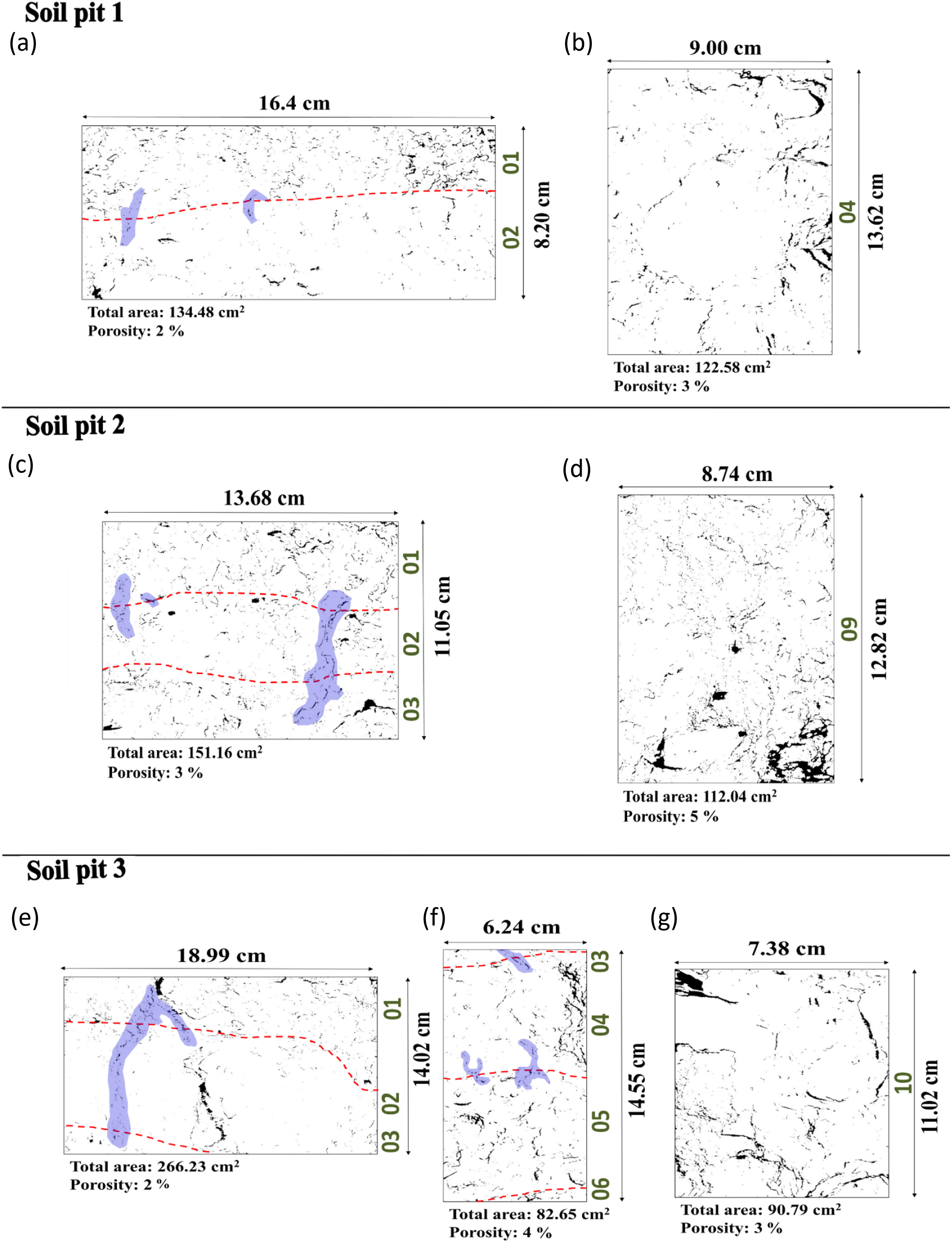
The scanning revealed information about soil macroporosity at different layers (Figure 2). In pedon SP1, the 0.00-0.11 m (Hor. 01 and 02) sample showed 2 % porosity, while the 0.17-0.35 m sample had 3 %. In pedon SP2, the 0.00-0.16 m horizon showed 3 % porosity, and the 1.10-1.24 m horizon had 5 %. In profile 3, the 0.00-0.18 m sample had 2 % porosity, the 0.35-0.53 m sample had 3 %, and the 0.94-1.08 m sample had 4 %.In all soil pits, the collected samples that span more than one horizon show a porous system connecting these layers (Figures 2a, 2c, 2e, and 2f).
The results reveal a broad diversity in soil properties that directly impact water infiltration and retention, crucial aspects for flood control in urban environments (Table 2). Table 3 shows significant variability across the evaluated properties, with different patterns of skewness and kurtosis reflecting diverse physical and chemical properties. Hydraulic conductivity, with a median of 1.3 cm h-1 and a coefficient of variation of 54.6 %, shows high variability among samples. Bulk density exhibits slightly lower variability, with a coefficient of variation of 48.2 % and values concentrated around the median of 1.60 Mg m-3.

The porous systems are shown in black, while the green numbers indicate the horizon number for each pit, and in blue, an example of pores that connect across horizons.
Descriptive statistics of the physical and chemical properties of soils from Villa-Lobos Park
Particle density values exhibit high dispersion, evidenced by a coefficient of variation of 139.7 %, with a distribution slightly skewed to the right (skewness of 0.97) and positive kurtosis (0.89). Porosity has relatively consistent values, with a median of 0.31 m3 m-3 and low variability (coefficient of variation of 9.48 %).
Median clay content across all pedons was 374.5 g kg-1, with a coefficient of variation of 10.2 %, indicating consistent values. The median silt content was 140.5 g kg-1, with a coefficient of variation of 27.4 %, indicating moderate variability and a distribution with a higher concentration of lower values, as indicated by a positive skewness (1.46) and high kurtosis (2.20). Median sand content was 417 g kg-1 with a coefficient of variation of 39.6 %.
The median pHH2O value was 6.85, with a coefficient of variation of 37.1 %, indicating moderate variation. The median pHKCl was 6.00 with a coefficient of variation of 34.3 %, reflecting moderate variation.
Different soil structure types affect hydraulic conductivity (K) (Table 3). In horizons with granular and blocky structures (gr and bk), as seen in some of the upper horizons in soil pits 1, 2, and 3, hydraulic conductivity tends to be higher. In pedons SP1 and SP2, these granular horizons exhibit relatively high K (such as 5.3 m h-¹ in SP1 and 1.26 m h-¹ in SP2), with porosity ranging from 0.34 to 0.44.
In contrast, horizons with massive structure (m) and anthropic materials (Table 1) found in the deeper depths of SP1, SP2, and SP3 exhibit lower K (e.g., 0.69 and 0.53 cm h-¹), reflecting a compact structure that is less favorable for water movement. Massive soils tend to form barriers to water infiltration due to a lack of interconnected porosity, as evidenced by low porosity values (e.g., 0.26 and 0.30 m3 m-3) and high bulk density.
In horizons with a blocky structure, which was common across all three pedons in this study, K value depended on porosity and soil texture. In horizons such as the horizon 2 of pedon SP3, hydraulic conductivity was 1.11 cm h-1, with a porosity of 0.28 m3 m-3, indicating that although these soils have moderate porosity, the presence of subangular block aggregates likely allows for more consistent water conduction than in massive soils, though still less efficient compared to granular structure. Also, coarser textures were found to be associated with granular and subangular blocky structures, which promoted coarser pores and facilitated infiltration. Conversely, in horizons dominated by clay and massive conditions, infiltration was reduced due to low porosity and high bulk density.
DISCUSSION
The morphological, physical and chemical results obtained from Villa-Lobos Park reveal characteristics typical of Technosols, particularly due to the significant presence of anthropogenic materials and the large variability of chemical and physical properties. These findings align with previous studies on urban soils (Chaurasia et al., 2024; Bartkowiak et al., 2025) and emphasize the complexity of urban environments, which results from the interaction between natural processes and human interventions (Hazelton and Murphy, 2011; Yang and Zhang, 2015).
The identification of materials such as plastic, ceramic fragments, rubber, and concrete highlights the role of urban waste in shaping these soils, reinforcing the notion that urban soils often contain anthropogenic materials (Charzyński et al., 2017) that can alter soil properties (Yang and Zhang, 2015). The heterogeneous composition of the studied soils, along with the variety of colors and textures observed, can be traced back to historical processes of waste deposition and the use of excavated materials from the surrounding areas (Laruccia, 2004).
Research has extensively documented the dramatic changes in urban soil characteristics, particularly physical properties, resulting from intensive human activities, often leading to negative environmental impacts (Yang and Zhang, 2015; Martin et al., 2023; Ahn et al., 2024). Urban infrastructure, traffic loads, and construction works usually promote compression, which consequently decreases bulk density, porosity, infiltration capacity, and hydraulic conductivity of surface and/or subsurface horizons (Hazelton and Murphy, 2011; Burghardt, 2017). However, our study illustrates that urban soils can serve as vital allies in enhancing infiltration and hydraulic conductivity, behaving like a sponge despite anthropogenic modifications (Figure 3).
Costa and Furquim (2025) showed, for the same soils of the present study, that anthropogenic actions during the construction and management of the Villa Lobos Park, such as additions of clay layers, carbonate-bearing residues (concrete, cement), organic matter, earthworms, and grass cover, triggered the development of stable macro and micro granular and blocky aggregates. Macroaggregates developed quickly through wetting-drying cycles, grass root networks, and organic matter accumulation, whereas microaggregates developed more slowly through the action of earthworms, polysaccharides, and organic-mineral interactions. According to these authors, the development of both macro and microaggregates has occurred in the last 30 years.
Thus, the rapid formation of stable aggregates decreases bulk density and increases total porosity in the horizons marked by structural units in the 3 pedons. The continuous, well-connected network of pores created by pedalization facilitates infiltration, permeability, and water retention. Conversely, horizons with massive structures (m) and anthropogenic materials, particularly in deeper layers of pedons SP1, SP2, and SP3, show lower hydraulic conductivity values (e.g., 0.69 cm h-1 and 0.53 cm h-1), reduced porosity, and higher bulk density, reflecting a massive structure that is less favorable for water movement. These massive horizons act as barriers to water infiltration, highlighting the variability of soil structure within urban environments.
According to the USDA/NRCS Ksat classification (2009), hydraulic conductivity values ranging from 1.5 to 5.1 cm h-1 are considered indicative of moderate infiltration capacity, a range that encompasses several horizons observed at Villa-Lobos Park, most of which have a granular and/or blocky structure. The same classification defines values between 5.1 and 15.2 cm h-¹ as moderately rapid, within which two horizons of the studied profiles fall, exhibiting measured conductivities of 5.3 and 13.37 cm h-¹, respectively. The former is a surface horizon with a granular structure, and the latter is a heterogeneous, massive deep horizon marked by macrofissures that trigger preferential flows.
Despite the challenges posed by anthropogenic materials and massive structures, our data support the claim that the physical properties of soils in urban centers can improve within decades through the interplay between pedogenetic processes and human actions. Thus, soils within cities, especially those in green areas, can function as sponges within a short time span if careful soil management is applied to optimize the recovery of soil functions linked to drainage control (Valencia-Félix, 2024). The soils of Villa-Lobos Park demonstrate strong potential to contribute to sponge city strategies in highly urbanized areas, as evidenced by other studies such as Ding et al. (2021) and Bai et al. (2021), which simulated and analyzed runoff reduction. Therefore, degraded areas impacted by human activities, such as the study area, can still be managed to enhance infiltration capacity.
A variety of ecosystem services, especially stormwater regulation (Jiang et al., 2018; Ren et al., 2020; Chapman et al., 2022), is supported by the facilitation of the water movement through the studied soils, especially in the upper horizons, where well-developed structure units are observed. Improvement of massive deeper horizons can be achieved through interventions such as the strategic planting of deep-rooted species, which enhance aggregate formation and promote water flow through deeper soil layers (Button et al., 2022). The enhancement of soil ecosystem services by biological management, improving infiltration and water storage, has been described by Lipiec et al. (2006) and Qiu et al. (2024).

Illustration representing the ability of urban soils to provide hydraulic conductivity and water storage. Water flow is positively influenced by soil structures, which create a porous system. Additionally, plant roots and fauna contribute to this porosity. Another factor affecting hydraulic conductivity is the presence of anthropogenic materials, which can form preferential pathways for water or act as barriers, as well as the occurrence of massive horizons.
Villa-Lobos Park exemplifies how urban green spaces, especially in a tropical metropolis such as São Paulo, can play a pivotal role in restoring and enhancing the Pinheiros River floodplain functionality. This concept aligns with international examples showing that urban soil management and green infrastructure enhance both ecosystem services and flood resilience in densely populated regions with high precipitation (Chan et al., 2018; Wang et al., 2021; Peng and Wen, 2025; Liu et al., 2025).
In summary, Villa-Lobos Park demonstrates that even heavily modified urban soils can regulate water infiltration and storage through the interplay of soil-forming processes and human interventions, contributing to the broader objectives of sponge city planning. The park serves as an initial model for the restoration of the Pinheiros River floodplain and can act as a reference for other riverine floodplain areas, highlighting the importance of urban green spaces in improving multiple ecosystem services, including hydrological functions. In this context, the strategic planning of urban parks and green infrastructure is essential, enabling the integration of existing spaces with various approaches within the sponge city concept, such as rain gardens, porous pavements, retention ponds, green roofs, water sinks, and green walls.
CONCLUSION
This study highlights the important role of urban soils as providers of ecosystem services, particularly in the context of flood management within city environments. The analysis of soil profiles in Villa-Lobos Park has demonstrated that, despite the challenges posed by anthropogenic materials and compaction, these soils possess significant potential to regulate the hydrological cycle by enhancing bulk density, total porosity, infiltration capacity, and hydraulic conductivity. The development of granular and block structures in a few decades in the studied soils supports the idea that urban soils can function effectively within the sponge city framework, mitigating flood risks in densely populated areas.
Moreover, the findings suggest that urban soil management practices, such as the establishment of appropriate vegetation cover and the addition of organic matter, can substantially improve the hydrological functions of these soils. Implementing these practices can lead to greater infiltration rates and water retention, ultimately contributing to more resilient urban ecosystems. The insights from this study in São Paulo provide a foundation for future urban planning strategies that integrate ecosystem services into flood mitigation efforts, thereby addressing the pressing challenges of urbanization and climate change.
Fostering the multifunctionality of urban soils as a vital component of urban infrastructure is essential for promoting sustainability and enhancing the quality of life in cities. Further research is needed to explore the long-term impacts of urban soil management on flood resilience and ecosystem health, ensuring that urban areas can thrive in harmony with their natural systems.
-
How to cite:
Costa JR, Hirmas DR, Furquim SAC. Sponge cities: potential of urban soils of São Paulo (Brazil) in flood mitigation and ecosystem services provision. Rev Bras Cienc Solo. 2026;50nsp1:e0250051. https://doi.org/10.36783/18069657rbcs20250051
-
FUNDING
This study was supported by the São Paulo Research Foundation (FAPESP) [2019/03576-7].
DATA AVAILABILITY
The data will be provided upon request.
REFERENCES
-
Adameková K, Prišťáková M, Doláková N, Dresler P, Nehyba S, Dlapa P, Majorošová K, Světlík I. Soil-alluvial dynamics, landscape evolution and human activity in the Thaya river floodplain (Czech Republic) from the Late Pleistocene to the Holocene. Quat Sci Adv. 2025;19:100287. https://doi.org/10.1016/j.qsa.2025.100287
» https://doi.org/10.1016/j.qsa.2025.100287 -
Adhikari K, Hartemink AE. Linking soils to ecosystem services - A global review. Geoderma. 2016;262:101-11. https://doi.org/10.1016/j.geoderma.2015.08.009
» https://doi.org/10.1016/j.geoderma.2015.08.009 -
Ahn Y-J, Koriyev M, Juraev Z. Urban soil dynamics: The relationship between soil health and urbanization. J Asian Geogr. 2024;3:62-9. https://doi.org/10.36777/jag2024.3.2.6
» https://doi.org/10.36777/jag2024.3.2.6 - Almeida BG, Viana JHM, Teixeira WG, Donagemma K. Densidade do solo. In: Teixeira PC, Donagemma GK, Fontana A, Teixeira WG, editors. Manual de métodos de análise de solo. 3. ed. rev e ampl. Brasília, DF: Embrapa; 2017. p. 65-75.
-
Alves Filho AP, Ribeiro H. A percepção do caos urbano, as enchentes e as suas repercussões nas políticas públicas da Região Metropolitana de São Paulo. Saude Soc. 2006;15:145-61. https://doi.org/10.1590/S0104-12902006000300012
» https://doi.org/10.1590/S0104-12902006000300012 -
Araújo KV, Horák-Terra I, Terra FS, Dobbss LB. Anthropic interventions change the soil properties of savanna palm swamps (veredas) from Central Brazil. Geoderma Reg. 2023;33:e00644. https://doi.org/10.1016/j.geodrs.2023.e00644
» https://doi.org/10.1016/j.geodrs.2023.e00644 -
Bagarello V, Conte P, Ferro V, Iovino M, Librici C, Nicosia A, Palmeri V, Pampalone VV, Zanna F. How rilling and biochar addition affect hydraulic properties of a clay‐loam soil. Eur J Soil Sci. 2025;76:e170034. https://doi.org/10.1111/ejss.70034
» https://doi.org/10.1111/ejss.70034 -
Bai J, Zhu Z, Liu R, Wang M, Zhang Q, Ma H. Groundwater runoff pattern and keyhole grouting method in deep mines. Bull Eng Geol Environ. 2021;80:5743-55. https://doi.org/10.1007/s10064-021-02102-y
» https://doi.org/10.1007/s10064-021-02102-y -
Bartkowiak A, Lemanowicz J, Rydlewska M, Sowiński P. The impact of proximity to road traffic on heavy metal accumulation and enzyme activity in urban soils and dandelion. Sustainability. 2024;16:812. https://doi.org/10.3390/su16020812
» https://doi.org/10.3390/su16020812 -
Blake GR, Hartge KH. Particle density. In: Klute A, editor. Methods of soil analysis: Part 1. Physical and mineralogical methods. 2nd ed. Madison, WI: Soil Science Society of America, American Society of Agronomy; 1986. p. 377-82. https://doi.org/10.2136/sssabookser5.1.2ed.c14
» https://doi.org/10.2136/sssabookser5.1.2ed.c14 -
Instituto Brasileiro de Geografia e Estatística - IBGE. Censo Demográfico; 2022. [internet]. [cited 2025 Dec 12]. Available from: https://www.ibge.gov.br/estatisticas/sociais/trabalho/22827-censo-demografico-2022.html
» https://www.ibge.gov.br/estatisticas/sociais/trabalho/22827-censo-demografico-2022.html - Burghardt W. Main characteristics of urban soils. In: Levin MJ, Kim K-HJ, Morel JL, Burghardt W, Charzyński P, Shaw RK, editors. Soils within cities: Global approaches to their sustainable management - composition, properties, and functions of soils of the urban environment. Stuttgart: Catena Soil Science; 2017. p. 19-26.
-
Button ES, Pett-Ridge J, Murphy DV, Kuzyakov Y, Chadwick DR, Jones DL. Deep-C storage: Biological, chemical and physical strategies to enhance carbon stocks in agricultural subsoils. Soil Biol Biochem. 2022;170:108697. https://doi.org/10.1016/j.soilbio.2022.108697
» https://doi.org/10.1016/j.soilbio.2022.108697 - Carlos AFA. O espaço urbano: Novos escritos sobre a cidade. São Paulo: FFLCH; 2007.
-
Carsel RF, Parrish RS. Developing joint probability distributions of soil water retention characteristics. Water Resour Res. 1988;24:755-69. https://doi.org/10.1029/WR024i005p00755
» https://doi.org/10.1029/WR024i005p00755 -
Chan FKS, Griffiths JA, Higgitt D, Xu S, Zhu F, Tang Y-T, Xu Y, Thorne CR. “Sponge City” in China—a breakthrough of planning and flood risk management in the urban context. Land Use Policy. 2018;76:772-8. https://doi.org/10.1016/j.landusepol.2018.03.005
» https://doi.org/10.1016/j.landusepol.2018.03.005 -
Chapman EJ, Gaston E, Paliza S. Investigating potential hydrological ecosystem services in urban gardens through soil amendment experiments and hydrologic models. Urban Ecosyst. 2022;25:867-78. https://doi.org/10.1007/s11252-021-01191-7
» https://doi.org/10.1007/s11252-021-01191-7 - Charzyński P, Galbraith JM, Kabala C, Kühn D, Prokofeva TV, Vasenev VI. Classification of urban soils. In: Levin MJ, Kim K-HJ, Morel JL, Burghardt W, Charzyński P, Shaw RK, editors. Soils within cities: Global approaches to their sustainable management - composition, properties, and functions of soils of the urban environment. Stuttgart: Catena Soil Science; 2017. p. 93-106.
-
Chaurasia M, Patel K, Bhadouria R, Rao KS. Spatial variability in soil physicochemical parameters across land use classes in the peri-urban landscape. Environ Dev Sustain. 2024;26:24791-815. https://doi.org/10.1007/s10668-023-03653-8
» https://doi.org/10.1007/s10668-023-03653-8 -
Costa J, Furquim S. Aggregation of tropical urban soils in the metropolis of São Paulo, southern Brazil. Catena. 2025;249:108681. https://doi.org/10.1016/j.catena.2024.108681
» https://doi.org/10.1016/j.catena.2024.108681 -
Danielson ER, Sutherland PL. Porosity. In: Klute A, editor. Methods of soil analysis: Part 1 Physical and mineralogical methods. 2nd ed. Madison, WI: Soil Science Society of America, American Society of Agronomy; 1986. p. 443-78. https://doi.org/10.2136/sssabookser5.1.2ed.c18
» https://doi.org/10.2136/sssabookser5.1.2ed.c18 -
Deeb M, Grimaldi M, Lerch TZ, Pando A, Podwojewski P, Blouin M. Influence of organic matter content on hydro-structural properties of constructed Technosols. Pedosphere. 2016;26:486-98. https://doi.org/10.1016/S1002-0160(15)60059-5
» https://doi.org/10.1016/S1002-0160(15)60059-5 -
Ding K, Zhang Y. Practical research on the application of sponge city reconstruction in pocket parks based on the analytic hierarchy process. Complexity. 2021;2021:5531935. https://doi.org/10.1155/2021/5531935
» https://doi.org/10.1155/2021/5531935 -
Eck DV, Hirmas DR, Giménez D. Quantifying soil structure from field excavation walls using multistripe laser triangulation scanning. Soil Sci Soc Am J. 2013;77:1319-28. https://doi.org/10.2136/sssaj2012.0421
» https://doi.org/10.2136/sssaj2012.0421 -
Erb KH, Matej S, Haberl H, Gingrich S. Sustainable land systems in the Anthropocene: Navigating the global land squeeze. One Earth. 2024;7:1170-86. https://doi.org/10.1016/j.oneear.2024.06.011
» https://doi.org/10.1016/j.oneear.2024.06.011 -
Fazia C, Nahiduzzaman KM, Al-Ramadan B, Aldosary A, Moraci F. Counteract soil consumption through ecosystem services and landscape restoration for an efficient urban regeneration. Land. 2024;13:323. https://doi.org/10.3390/land13030323
» https://doi.org/10.3390/land13030323 -
Femin M, George EH. Review on sponge city construction for flood management. Sustain Agri Food Environ Res. 2023;10:2537. https://doi.org/10.7770/safer-V10N1-art2537
» https://doi.org/10.7770/safer-V10N1-art2537 -
Fiorentino A, Rajput FZ, Di Serio A, Baldi V, Guarino F, Baldantoni D, Ronga D, Mazzei P, Motta O, Falanga M, Cicatelli A, Castiglione S. Role of plants and urban soils in carbon stock: Status, modulators, and sustainable management practices. Plants. 2025;14:546. https://doi.org/10.3390/plants14040546
» https://doi.org/10.3390/plants14040546 - Gee GW, Or D. Particle-size analysis. In: Klute A, editor. Methods of soil analysis: Part 1 Physical and mineralogical methods. 2nd ed. Madison, WI: Soil Science Society of America, American Society of Agronomy; 1986. p. 255-93.
-
Ghibus T, Gaitanaru D. A statistical approach for the assessment of saturated hydraulic conductivity values of unsaturated urban soils obtained by field infiltration tests. Water. 2024;16:1908. https://doi.org/10.3390/w16131908
» https://doi.org/10.3390/w16131908 -
Gouveia IC. A cidade de São Paulo e seus rios: Uma história repleta de paradoxos. Confins. 2016;27:21. https://doi.org/10.4000/confins.10884
» https://doi.org/10.4000/confins.10884 -
Haddad E, Teixeira E. Economic impacts of natural disasters in megacities: The case of floods in São Paulo, Brazil. Habitat Int. 2015;45:106-13. https://doi.org/10.1016/j.habitatint.2014.06.023
» https://doi.org/10.1016/j.habitatint.2014.06.023 -
Hazelton P, Murphy B. Understanding soils in urban environments. Clayton: CSIRO Publishing; 2011. https://doi.org/10.1071/9780643101432
» https://doi.org/10.1071/9780643101432 -
Hilmes DR, Giménez D, Subroy V, Platt BF. Fractal distribution of mass from the millimeter- to decimeter-scale in two soils under native and restored tallgrass prairie. Geoderma. 2013;207-208:121-30. https://doi.org/10.1016/j.geoderma.2013.05.009
» https://doi.org/10.1016/j.geoderma.2013.05.009 -
Huot H, Simonnot MO, Morel JL. Pedogenetic trends in soils formed in technogenic parent materials. Soil Sci. 2015;180:182-92. https://doi.org/10.1097/SS.0000000000000135
» https://doi.org/10.1097/SS.0000000000000135 -
Instituto Nacional de Meteorologia - INMET. Clima [internet]. 2025. Available from: http://clima.inmet.gov.br
» http://clima.inmet.gov.br -
Iqbal A, Soni L, Qazi AW, Nazir H. Utilizing remote sensing for sponge city development: Enhancing flood management and urban resilience in Karachi. Remote Sens. 2025;17:1818. https://doi.org/10.3390/rs17111818
» https://doi.org/10.3390/rs17111818 -
IUSS Working Group WRB. World reference base for soil resources. International soil classification system for naming soils and creating legends for soil maps. 4th. ed. Vienna, Austria: International Union of Soil Sciences (IUSS); 2022. Available from: https://www.isric.org/sites/default/files/WRB_fourth_edition_2022-12-18.pdf
» https://www.isric.org/sites/default/files/WRB_fourth_edition_2022-12-18.pdf -
Jangorzo NS, Watteau F, Schwartz C. Evolution of the pore structure of constructed Technosols during early pedogenesis quantified by image analysis. Geoderma. 2013;207-208:180-92. https://doi.org/10.1016/j.geoderma.2013.05.016
» https://doi.org/10.1016/j.geoderma.2013.05.016 -
Jenerette GD, Watteau F, Schwartz C. Ecosystem services and urban heat riskscape moderation: water, green spaces, and social inequality in Phoenix, USA. Ecol Appl. 2011;21:2637-51. https://doi.org/10.1890/10-1493.1
» https://doi.org/10.1890/10-1493.1 -
Jiang Y, Zevenbergen C, Ma Y. Urban pluvial flooding and stormwater management: A contemporary review of China’s challenges and “sponge cities” strategy. Environ Sci Policy. 2018;80:132-43. https://doi.org/10.1016/j.envsci.2017.11.016
» https://doi.org/10.1016/j.envsci.2017.11.016 - Ladeira FBC. A ação antrópica sobre os solos nos diferentes biomas brasileiros-terras indígenas e solos urbanos. Entre-Lugar. 2012;3:127-39.
- Laruccia MAF. Parques urbanos e a cidade de São Paulo: o Parque Estadual Villa-Lobos [dissertation]. São Paulo: Universidade de São Paulo; 2004.
-
Leguédois S, Séré G, Auclerc A, Cortet J, Huot H, Ouvrard S, Watteau F, Schwartz C, Morel JL. Modelling pedogenesis of Technosols. Geoderma. 2016;262:199-212. https://doi.org/10.1016/j.geoderma.2015.08.008
» https://doi.org/10.1016/j.geoderma.2015.08.008 -
Lipiec J, Kuś J, Słowińska-Jurkiewicz A, Nosalewicz A. Soil porosity and water infiltration as influenced by tillage methods. Soil Till Res. 2006;89:210-20. https://doi.org/10.1016/j.still.2005.07.012
» https://doi.org/10.1016/j.still.2005.07.012 -
Liu W, Chen J, Li H, Zhu S, Duan Z. Assessing carbon emission impacts of sponge city development: Insights from runoff reduction analysis. Water Sci Technol. 2025;91:923-45. https://doi.org/10.2166/wst.2025.046
» https://doi.org/10.2166/wst.2025.046 -
Lubaina S, Asifa I, Shah AA. The concept of sponge city as a nature-based solution for urban resilience: Insights from stakeholders in Karachi, Pakistan. Habitat Int. 2025;165:103564. https://doi.org/10.1016/j.habitatint.2025.103564
» https://doi.org/10.1016/j.habitatint.2025.103564 -
Luz RA, Rodrigues C. Reconstituição geomorfológica de planícies fluviais urbanizadas: O caso do Rio Pinheiros, São Paulo-SP. Rev Bras Geomorf. 2013;14:47-57. https://doi.org/10.20502/rbg.v14i1.354
» https://doi.org/10.20502/rbg.v14i1.354 -
Ma Y, Ning X, Jiang Y. China’s sponge city development: Global position, governance, and potential enhancement with ecosystem services. J Urban Technol. 2024;31:83-106. https://doi.org/10.1080/10630732.2024.2381181
» https://doi.org/10.1080/10630732.2024.2381181 -
Martin AP, Lim C, Kah M, Rattenbury MS, Rogers KM, Sharp EL, Turnbull RE. Soil pollution driven by duration of urbanisation and dwelling quality in urban areas: An example from Auckland, New Zealand. Appl Geochem. 2023;148:105518. https://doi.org/10.1016/j.apgeochem.2022.105518
» https://doi.org/10.1016/j.apgeochem.2022.105518 - Millennium ecosystem assessment - MEA. Ecosystems and human well-being. Washington, DC: Island Press; 2005.
-
Molineux CJ, Fentiman CH, Gange AC. Characterising alternative recycled waste materials for use as green roof growing media in the UK. Ecol Eng. 2009;35:1507-13. https://doi.org/10.1016/j.ecoleng.2009.06.010
» https://doi.org/10.1016/j.ecoleng.2009.06.010 -
Morel JL, Chenu C, Lorenz K. Ecosystem services provided by soils of urban, industrial, traffic, mining, and military areas (SUITMAs). J Soils Sediments. 2015;15:1659-66. https://doi.org/10.1007/s11368-014-0926-0
» https://doi.org/10.1007/s11368-014-0926-0 - Morel JL, Schwartz C, Florentin L, Florentin C. Urban soils. In: Hillel D, editor. Encyclopedia of soils in the environment. London: Elsevier Ltd., Academic Press; 2005. p. 202-8.
-
Novais GT, Galvani E. Uma tipologia de classificação climática aplicada ao estado de São Paulo. Rev Dep Geogr. 2022;42:e184630. https://doi.org/10.11606/eISSN.2236-2878.rdg.2022.184630
» https://doi.org/10.11606/eISSN.2236-2878.rdg.2022.184630 -
Paradelo R, Herbón C, Barral MT. Physical properties of the urban soils of Santiago de Compostela (Spain). J Soils Sediments. 2024;25:462-71. https://doi.org/10.1007/s11368-024-03833-7
» https://doi.org/10.1007/s11368-024-03833-7 -
Peng X, WEN S. The economic performance of urban sponge parks uncovered by an integrated evaluation approach. Land. 2025;14:1099. https://doi.org/10.3390/land14051099
» https://doi.org/10.3390/land14051099 -
Pérez DV, Brefin MLM, Polidoro JC. Solo, da origem da vida ao alicerce das civilizações: uso, manejo e gestão. Pesq Agropec Bras. 2016;51:1-4. https://doi.org/10.1590/S0100-204X201600090000i
» https://doi.org/10.1590/S0100-204X201600090000i -
Qiu D, Xu R, Gao P, Mu X. Effect of vegetation restoration type and topography on soil water storage and infiltration capacity in the Loess Plateau, China. Catena. 2024;241:108079. https://doi.org/10.1016/j.catena.2024.108079
» https://doi.org/10.1016/j.catena.2024.108079 -
R Development Core Team. R: A language and environment for statistical computing. Vienna, Austria: R Foundation for Statistical Computing; 2014. Available from: http://www.R-project.org/
» http://www.R-project.org/ -
Ren X, Hong N, Li L, Kang J, Li J. Effect of infiltration rate changes in urban soils on stormwater runoff process. Geoderma. 2020;363:114158. https://doi.org/10.1016/j.geoderma.2019.114158
» https://doi.org/10.1016/j.geoderma.2019.114158 -
Rokia S, Séré G, Schwartz C, Deeb M, Fournier F, Nehls T, Damas O, Vidal-Beaudet L. Modelling agronomic properties of Technosols constructed with urban wastes. Waste Manag. 2014;34:2155-62. https://doi.org/10.1016/j.wasman.2013.12.016
» https://doi.org/10.1016/j.wasman.2013.12.016 -
Schneider C, Rasband W, Eliceiri K. NIH image to ImageJ: 25 years of image analysis. Nat Methods. 2012;9:671-5. https://doi.org/10.1038/nmeth.2089
» https://doi.org/10.1038/nmeth.2089 -
Séré G, Ouvrard S, Magnenet V, Pey B, Morel JL, Schwartz C. Predictability of the evolution of the soil structure using water flow modeling for a constructed Technosol. Vadose Zone J. 2012;11:vzj2011.0069.. https://doi.org/10.2136/vzj2011.0069
» https://doi.org/10.2136/vzj2011.0069 -
Song M, Wang K, Xie Y, Wen X, Tu Y, Teng T, Luo C, Zhang D. Impacts of anthropogenic disturbances on antibiotic resistomes in biological soil crusts on the Qinghai-Tibetan Plateau. Environ Pollut. 2025;367:125582. https://doi.org/10.1016/j.envpol.2024.125582
» https://doi.org/10.1016/j.envpol.2024.125582 -
Soni L, Iqbal A, Waheed F, Shah AA, Akbar N. Challenges and considerations of applying nature-based solutions for future mega-cities: Implications for Karachi as a sponge city. Human Settl Sustain. 2025;1:50-61. https://doi.org/10.1016/j.hssust.2025.02.002
» https://doi.org/10.1016/j.hssust.2025.02.002 -
Stefanidis S, Proutsos N, Alexandridis V, Mallinis G. Ecosystem services supply from peri-urban watersheds in Greece: Soil conservation and water retention. Land. 2024;13:765. https://doi.org/10.3390/land13060765
» https://doi.org/10.3390/land13060765 -
Sullivan PL, Billings SA, Hirmas D, Li L, Zhang X, Ziegler S, Murenbeeld K, Ajami H, Guthrie A, Singha K, Giménez D, Duro A, Moreno V, Flores A, Cueva A, Koop, Aronson EL, Barnard HR, Banwart SA, Keen RM, Nemes A, Nikolaidis NP, Nippert JB, Richter D, Robinson DA, Sadayappan K, Souza LFT, Unruh M, Wen H. Embracing the dynamic nature of soil structure: A paradigm illuminating the role of life in critical zones of the Anthropocene. Earth-Sci Rev. 2022;225:103873. https://doi.org/10.1016/j.earscirev.2021.103873
» https://doi.org/10.1016/j.earscirev.2021.103873 -
The National Development and Reform Commission - NDRC. Strengthening urban drainage and water logging prevention infrastructure development to support transformative urbanization. News Brief. Beijing: The National Development and Reform Commission; 2016 [cited 2025 Dec 12]. Available from: http://www.sdpc.gov.cn/xwzx/xwfb/201609/t20160914_818443.html
» http://www.sdpc.gov.cn/xwzx/xwfb/201609/t20160914_818443.html -
Thomas GW. Historical developments in soil chemistry: Ion exchange. Soil Sci Soc Am J. 1977;41:230-8. https://doi.org/10.2136/sssaj1977.03615995004100020015x
» https://doi.org/10.2136/sssaj1977.03615995004100020015x -
Thomas GW. Soil pH and soil acidity. In: Sparks DL, Page AL, Helmke PA, Loeppert RH, Soltanpour PN, Tabatabai MA, Johnston CT, Sumner ME, editors. Methods of soil analysis: Part 3 Chemical methods. Madison, WI: Soil Science Society of America and American Society of Agronomy; 1996. p. 475-90. https://doi.org/10.2136/sssabookser5.3.c16
» https://doi.org/10.2136/sssabookser5.3.c16 -
Tian Y, Wang Y, Chen W, Chen R, Wei Z. Quantitative analysis of sponge city construction and function in the main urban area of Chengdu. Water. 2025;17:933. https://doi.org/10.3390/w17070933
» https://doi.org/10.3390/w17070933 -
USDA Natural Resources Conservation Service. Hydrologic soil groups. In: National Engineering Handbook, Part 630: Hydrology. U.S. Department of Agriculture; 2009 [cited 2025 Dec 12]. Available from: https://directives.nrcs.usda.gov/sites/default/files2/1712930597/11905.pdf
» https://directives.nrcs.usda.gov/sites/default/files2/1712930597/11905.pdf -
Valencia-Félix S, Anco-Valdivia J, Vigil AJE, Valdivia AVH, Sanchez-Carigga C. Review of green water systems for urban flood resilience: Literature and codes. Water. 2024;16:2908. https://doi.org/10.3390/w16202908
» https://doi.org/10.3390/w16202908 -
Van Genuchten MT. A closed‐form equation for predicting the hydraulic conductivity of unsaturated soils. Soil Sci Soc Am J. 1980;44:892-8. https://doi.org/10.2136/sssaj1980.03615995004400050002x
» https://doi.org/10.2136/sssaj1980.03615995004400050002x -
Vasenev V, Kuzyakov Y. Urban soils as hot spots of anthropogenic carbon accumulation: Review of stocks, mechanisms and driving factors. Land Degrad Dev. 2018;29:1607-22. https://doi.org/10.1002/ldr.2944
» https://doi.org/10.1002/ldr.2944 -
Wang J, Xue F, Jing R, Lu Q, Huang Y, Sun X, Zhu W. Regenerating sponge city to sponge watershed through an innovative framework for urban water resilience. Sustainability. 2021;13:5358. https://doi.org/10.3390/su13105358
» https://doi.org/10.3390/su13105358 -
Yang JL, Zhang GL. Formation, characteristics and eco-environmental implications of urban soils – A review. Soil Sci Plant Nutr. 2015;61:30-46. https://doi.org/10.1080/00380768.2015.1035622
» https://doi.org/10.1080/00380768.2015.1035622 -
Yang M, Hu Z, Wang R, Zhu L. Spatiotemporal responses and threshold mechanisms of urban landscape patterns to ecosystem service supply–demand dynamics in central Shenyang, China. Sustainability. 2025;17:7419. https://doi.org/10.3390/su17167419
» https://doi.org/10.3390/su17167419 -
Yin D, Xu C, Jia H, Yang Y, Sun C, Wang Q, Liu S. Sponge city practices in China: From pilot exploration to systemic demonstration. Water. 2022;14:1531. https://doi.org/10.3390/w14101531
» https://doi.org/10.3390/w14101531 -
Yuan Y, Zheng Y, Huang X, Zhai J. Climate resilience of urban water systems: A case study of sponge cities in China. J Clean Prod. 2024;451:141781. https://doi.org/10.1016/j.jclepro.2024.141781
» https://doi.org/10.1016/j.jclepro.2024.141781 -
Zevenbergen C, Fu D, Pathirana A. Transitioning to sponge cities: Challenges and opportunities to address urban water problems in China. Water. 2018;10:1230. https://doi.org/10.3390/w10091230
» https://doi.org/10.3390/w10091230 -
Zhang Q, Wang C. Natural and human factors affect the distribution of soil heavy metal pollution: a review. Water Air Soil Pollut. 2020;231:350. https://doi.org/10.1007/s11270-020-04728-2
» https://doi.org/10.1007/s11270-020-04728-2 -
Zhang R. Determination of soil sorptivity and hydraulic conductivity from the disk infiltrometer. Soil Sci Soc Am J. 1997;61:1024-30. https://doi.org/10.2136/sssaj1997.03615995006100040005x
» https://doi.org/10.2136/sssaj1997.03615995006100040005x
Edited by
-
Editor:
Marcos Gervasio Pereira https://orcid.org/0000-0002-1402-3612 and Fábio Soares de Oliveira https://orcid.org/0000-0002-1450-7609