 Potassium buffer capacity in subtropical soils with high organic matter content
ABSTRACT
Subtropical soils can have medium to high soil organic matter levels, which directly affects cation exchange capacity (CEC) and potassium (K) availability to plants. This generates the need to define K buffer capacity (KBC) values and K corrective rates to improve the fertilization recommendation system for these soils, ensuring high yields and reducing the likelihood of K losses in the environment. This study aimed to define KBC values and the K rates to be applied in corrective fertilization of acidic soils with high SOM and CECpH7.0 in a subtropical climate, and evaluate K corrective rates in vineyard soils in relation to the regional fertilization recommendation. Thirty-one native forest soils from the subtropical climate of Serra Gaúcha (RS), Southern Brazil, were collected. The samples were incubated with ten rates of K2O for 30 days, with three replicates. After the incubation period, available K (K_M1) contents were obtained by the Mehlich-1 extractor. The K_M1 contents of the 0.00-0.20 m layer of 209 vineyards in the region were evaluated in the 2021/22 and 2022/23 crop seasons. Natural K_M1 contents in 97 % of the forest soils evaluated were classified as "high" and "very high" availability. Average KBC value obtained was 3.1 kg ha-1 K2O, indicating the nutrient rate required to increase the K_M1 content by 1.0 mg dm-3. Correction rates for the low and medium K availability classes were, respectively, 170 % higher and 78 % lower than the current regional fertilization recommendation for fruit trees. The K_M1 contents in 38 % of the vineyard soils in the study region were classified as "very high" availability, indicating the possibility of reducing the use of K fertilization. We recommend adjusting the K2O rates based on KBC values, aiming to maintain K_M1 contents in the "high" availability class, reducing production costs and unnecessary K nutrient applications.
Keywords
potash fertilization; cation exchange capacity; nutrient availability; correction fertilizer
INTRODUCTION
Cultivated soils typically do not provide the amounts of potassium (K) that plants require (Hahn et al., 2024a; Pesini et al., 2024). Therefore, K fertilization in crops can increase productivity (Chen et al., 2024). However, there is a need to update the technical criteria for defining adequate rates, providing greater accuracy in fertilization recommendations and rationalization in the K fertilizers use, since Brazil is highly dependent on the importation of this nutrient. Additionally, about 90 % of K reserves are located in Canadian, Russian, and Belarusian territories, which have finite reserves (Al Rawashdeh, 2020; Soumare et al., 2023), and are subject to price variations in the international market. This dynamic directly affects the production costs, especially during diplomatic crises, as evidenced by the war between Russia and Ukraine in 2022, which resulted in a 343 % increase in K fertilizers compared with 2020 (Conab, 2024).
Chemical weathering of clay minerals allows for the K release into the soil solution. Part remains available to plants, and part can be lost to waterways (Wang et al., 2021). In Brazil, about 13 % of the K applied to soils is lost due to erosion/surface runoff (Sipert et al., 2020), reinforcing the importance of properly managing agricultural areas. In addition, the southern region of Brazil has been experiencing extreme climate changes in recent years, such as the accumulated 1,093 mm of precipitation in March and April 2024 alone in the Serra Gaúcha region (Inmet, 2024). All this requires that K fertilization management be rethought and updated in the new climate context, seeking to meet plant nutritional and physiological demands, while mitigating losses and environmental impacts.
In subtropical regions, such as southern Brazil, soils have higher cation exchange capacity (CEC) values due to the contribution of clay permanent charges and those dependent on pH, associated with the soil organic fraction and clay minerals (Bortoluzzi et al., 2006). In this case, soil organic matter (SOM) plays an important role in increasing the soil CECpH7.0, controlling the K availability in the soil solution, and reducing the chances of losses by leaching (Artuso et al., 2024). Thus, fertilization recommendations used on a large scale and for a wide diversity of distinct soils may not be efficient and accurate in predicting the real need for fertilizers. Under these conditions, regionalized studies can be an alternative to improve recommendations for K fertilization.
Corrective fertilization is used to define the total fertilizer rates to raise nutrient levels above the crop critical level (Souza Junior et al., 2022; Hahn et al., 2024b). This fertilizer rate considers the K availability in the soil and the CEC, which affects the soil nutrient availability; therefore, CECpH7.0 classes are currently considered for K fertilization recommendation. According to the soil nutrient retention capacity, the quantity/intensity (Q/I) relationship is affected, modifying the proportion of K available to plants (Wang et al., 2004; Kassa et al., 2019).
The definition of K buffer capacity (KBC) allows updating recommendations that may often be inefficient in predicting the real need for K fertilizer (Souza Junior et al., 2022; Awgchew et al., 2024; Hahn et al., 2024b). Some studies have already reported divergences from the current fertilization recommendation system, underestimating the rates of K corrective fertilization for southern Brazil (Souza Junior et al., 2022). We hypothesize that soils with high SOM contents (>5 %) and high CECpH7.0 (>15.0 cmolc dm-3) require higher rates of K fertilizers than those recommended by the current fertilization recommendation system to reach the critical levels of crops (CQFS-RS/SC, 2016).
This study aimed to define K buffer capacity values and the K rates to be applied in corrective fertilization of acidic soils with high SOM and CECpH7.0 in a subtropical climate, and evaluate K corrective fertilizer rates in vineyard soils in relation to the official regional recommendation, proposed by CQFS-RS/SC (2016).
MATERIALS AND METHODS
Soil sampling
The study area is located in the Serra Gaúcha region, in the state of Rio Grande do Sul (RS), southern Brazil (Figure 1). Soils were collected from the 0.00-0.20 m layer in six municipalities in the region, in forested and non-anthropogenic areas. According to the Köppen-Geiger classification system, the climate is Cfb, with temperate summers, and Cfa, with hot summers (Alvares et al., 2013). The geology of this region comprises a Brazilian Serra Geral formation, with a lithology composed of basalt, present at lower elevations, rhyolites and rhyodacites, present at higher elevations, formed in the Mesozoic era. The low to medium weathering degree formed poorly developed profiles, with Neossolos and Cambissolos predominating (Modena et al., 2016; Santos et al., 2018), which correspond to Entisols and Inceptisols (Soil Survey Staff, 2014), respectively. The samples were air-dried, ground, sieved through a 2 mm mesh, and stored for analysis.

Spatial distribution of the 31 forest soils from Serra Gaúcha region, Southern Brazil (a and b), collected in the 0.00-0.20 m layer (c and d), and soils air-drying (e and f).
Soil chemical and physical analysis
Soil chemical and physical characterization is presented in table 1. The K_M1 contents were extracted with Mehlich-1 solution (0.0125 mol L-1 H2SO4 and 0.050 mol L-1 HCl) and determined by flame photometry (DM-62, Digimed). Clay content was determined by the pipette method (Teixeira et al., 2017), after organic matter oxidation with hydrogen peroxide (H2O2). Total organic carbon (TOC) content was determined by the dry combustion method. For that, soil samples were ground in a continuous rolling mill and analyzed in an Elemental Analyzer (Flash EA1112, Thermo Electron Corporation). Soil organic matter (SOM) percentage was determined by multiplying the total organic C value by 1.724. The pH(H2O) was determined through the soil:water ratio (1:1) and the pH-TSM through the soil:water:solution ratio (1:1:0.5) to obtain potential acidity (H+Al) (Toledo et al., 2010). Exchangeable Ca and Mg were extracted with 1.0 mol L-1 KCl solution and determined by atomic absorption spectrophotometry (AAnalyst 200, PerkinElmer). Cation exchange capacity (CECpH7.0) was obtained by summing the exchangeable elements Ca, Mg, K, and H+Al. Analyses were based on the methodologies proposed by Tedesco et al. (1995).
Forest soil characterization from Serra Gaúcha region, Southern Brazil, in the 0.00-0.20 m layer
K buffer capacity
To determine the K buffer capacity (KBC), the K_M1 contents in the soil were interpreted and the soils classified in CECpH7.0 classes (medium: 7.5-15.0, high: 15.1-30.0, and very high: >30.0 cmolc dm-3) and K+ availability classes (low, medium, high, and very high) according to CQFS-RS/SC (2016). Then the K2O rates were calculated, since the CECpH7.0 values for all soils were >8.5 cmolc dm-3, the KBC = 2.73 recommended for Southern Brazil soils was used (Souza Junior et al., 2022), aiming to increase K_M1 levels to the "high" availability class according to CQFS-RS/SC (2016). For soils that presented natural K_M1 contents in the "high" (K2O rate = -0.6205K_M1 + 327.39) and "very high" (K2O rate = -0.6205K_M1 + 368.36) classes, different equations were used to determine K2O rates based on initial K_M1 content and CECpH7.0 classes. The K2O rates ranged from 80 to 307 kg ha-1. Each soil received 10 rates of K2O, corresponding to 0, 25, 50, 75, 100, 125, 150, 200, 250, and 300 % of the calculated rate. Each treatment was composed of three replicates, in a completely randomized design, totaling 930 soil samples. Each experimental unit consisted of 50 g of soil, previously adjusted to pH 6.0 using lime if necessary, and conditioned in a transparent plastic bag. Potassium rates were applied via liquid, made from KCl reagent dissolved in distilled water. Fertilizer rates were calculated to correct 0.00-0.20 m soil layer, assuming the soil mass of 2,000,000 kg (d = 1.0 kg dm-3). After applying the rates, the soils were homogenized, the moisture adjusted to 70 % of field capacity, and then incubated for 30 days. Weekly, the experimental units were opened and, when necessary, the moisture was corrected. At the end of this period, the samples were dried in an oven at 45 °C for 48 h, ground, and sieved through a 2 mm mesh. Posteriorly, the K considered "available" (K_M1) was extracted using the Mehlich-1 solution.
Soil fertility evaluation in a vineyard
To evaluate soil fertility, 209 vineyard soils in the study region were evaluated during the 2021/22 and 2022/23 crop seasons. Commercial vineyards presented different cultivation histories, cultivars, and production management practices adopted by the growers. Soil samples were collected from the 0.00-0.20 m layer, dried in an oven, ground, sieved (2 mm mesh), and subjected to chemical and physical characterization analyses. Potassium contents were extracted by Mehlich-1. Subsequently, the soils were classified into CECpH7.0 classes (medium: 7.5-15.0, high: 15.1-30.0, and very high: >30.0 cmolc dm-3) and K availability classes (low, medium, high, and very high) according to CQFS-RS/SC (2016). The KBC values were used to define the K2O rates to raise K_M1 levels to "high" availability levels in 209 vineyard soils. The K2O rates indicated by the soil KBC were compared with the official recommendation rates for the soils in the region (CQFS-RS/SC, 2016) for each K availability class.
Statistical analysis
Contents of K_M1, along with the respective K2O rates, were subjected to linear regressions. The KBC value was obtained for each soil through the inverse of the angular coefficient (KBC = 1/angular coefficient). The KBC values were subjected to normality analysis using the Shapiro-Wilk test. Subsequently, the values were subjected to analysis of variance (ANOVA) and compared using the Tukey test (p<0.05), within the CECpH7.0 classes and the K availability classes established by CQFS-RS/SC (2016). The correlation between KBC values and soil properties was performed using the Pearson test (p<0.05). Statistical and graphical analyses were performed using the R software version 4.2.2 (R Development Core Team, 2022).
The K2O rates based on the KBC values for the evaluated vineyards were determined and compared using the Tukey test (p<0.05) with the current fertilization recommendation system for the study region (CQFS-RS/SC, 2016).
RESULTS
KBC determination
Evaluated soils were classified according to clay content, SOM, and CECpH7.0, presenting a medium texture between 20-40 % clay, with high SOM contents (>5 %) and high CECpH7.0 values, between 15 and 40 cmolc dm-3 (Table 1). The addition of K2O rates to the soils increased K-M1 contents linearly, and it was possible to obtain linear equations for the calculation of KBC values (Table 2). The KBC values for the evaluated soils, obtained from the linear equations, showed a range between 2.3 and 4.0 kg ha-1 K2O.
Potassium extracted in function of the 10 applied K2O rates and values of K buffer capacity (KBC) in soil samples from Serra Gaúcha region, collected in the 0.00-0.20 m layer
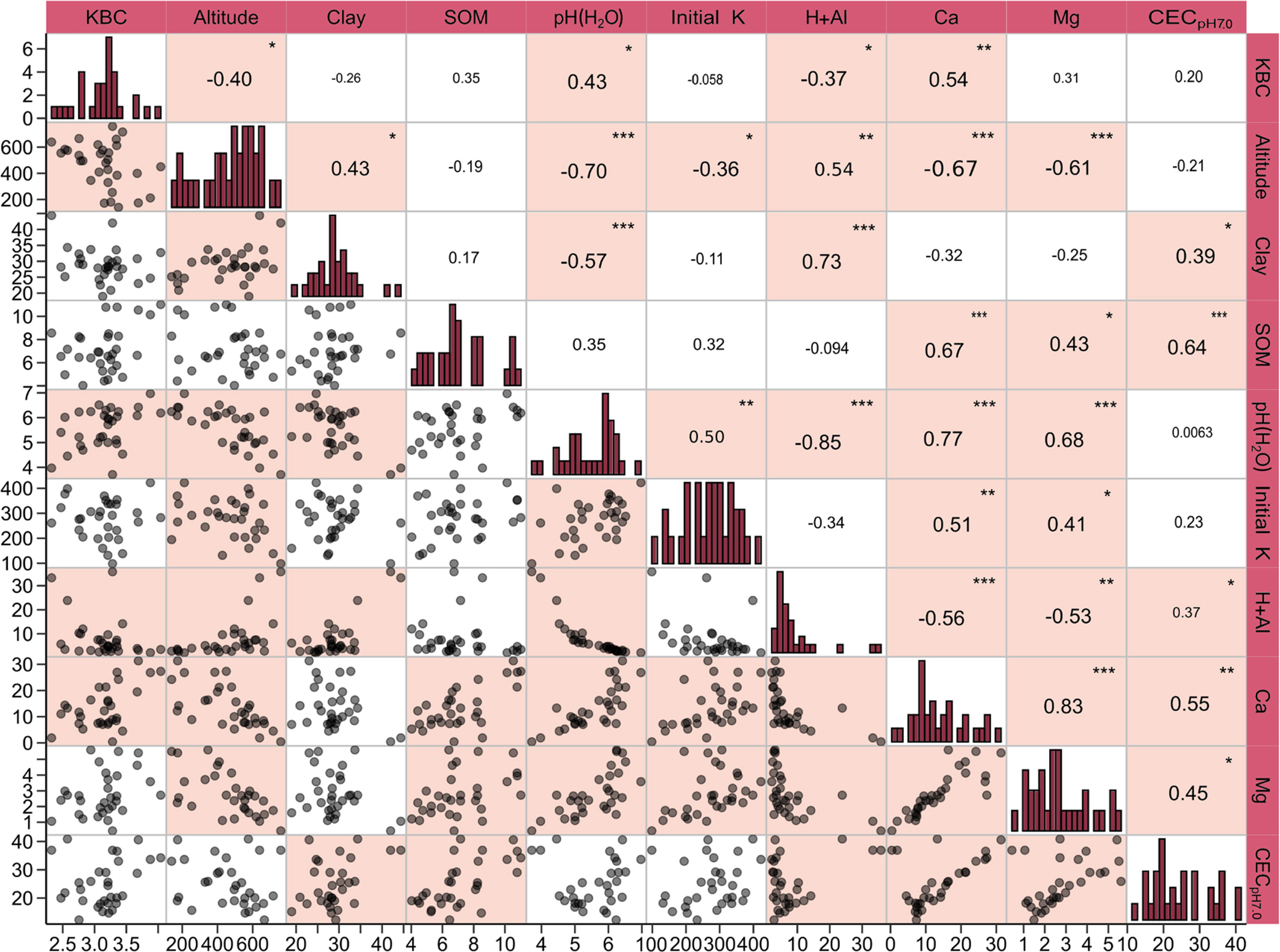
The KBC values showed a positive correlation with Ca2+ and pH(H2O), and a negative correlation with altitude and H+Al (Figure 2). On the other hand, no correlation was observed between KBC and the initial K_M1 content, CECpH7.0, clay, SOM, and Mg. Soil organic matter showed a positive correlation with Ca, CECpH7.0, and Mg.
Pearson correlation between the variables analyzed, in the 0.00-0.20 m layer, for forest soils (n = 31) from Serra Gaúcha region. Significance level: 0 '***' 0.001 '**' 0.01 '*' 0.05. The upper figure presents a correlation matrix with histograms on the main diagonal, indicating the distribution of variables, and scatter plots in the other panels, illustrating the relationship between pairs of variables. Colors and sizes of the points indicate intensity and direction of the correlation.
Soils were classified according to CECpH7.0 and K availability classes, following the official recommendation for soils in the region (CQFS-RS/SC, 2016). However, no differences in KBC were observed between the CECpH7.0 and K availability classes (Figures 3a and 3b). The average KBC value was 3.1 kg ha-1 K2O. Most of the soils (68 %) were classified in the high CECpH7.0 class, between 15 and 30 cmolc dm-3. In addition, 29 and 68 % of the soils showed natural K_M1 contents in the high and very high availability classes, respectively (Figure 3b).

Grouping of K buffer capacity (KBC) values according to CECpH7.0 classes (a) and K availability classes (b). ns: indicate no statistical significance by the Tukey test (p<0.05); dots represent the distribution points; circles represent the mean; horizontal line inside the box represents the median; red horizontal dotted line represents the general mean. (a) Medium: 7.5-15.0 cmolc dm-3; High: 15.1-30.0 cmolc dm-3; Very high: >30.0 cmolc dm-3. Availability K class (b) according to CQFS-RS/SC (2016).
Vineyards soil fertility evaluation and K rates
The KBC values were used to define the K2O rates to raise K_M1 levels to "high" availability levels in the vineyard soils (Figure 4). The rates for the "low" and "medium" availability classes were 153 and 47 kg ha-1 K2O, respectively. This represents an increase of 170 % and a reduction of 78 % for the "low" and "medium" availability classes, respectively, compared with the K rates recommended for fruit trees according to CQFS-RS/SC (2016). In addition, it can be observed that 38 % of the evaluated vineyards have K levels in the "very high" availability class.
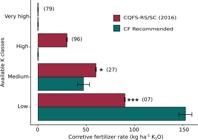
Comparison between corrective fertilization (CF) proposed for fruit trees in relation to CQFS-RS/SC (2016) and based on KBC to 209 vineyard soils from the Serra Gaúcha region of Rio Grande do Sul State. Horizontal error bars at the top of the bars represent the standard deviation of the mean; * statistically significant by the Tukey test (p<0.05); *** statistically significant by the Tukey test (p<0.001); the numbers within parentheses represent the number of observations for each class.
DISCUSSION
Serra Gaúcha (RS) presents distinct climatic and relief characteristics, such as a cold climate and sloping soils, which provide the soils with specific conditions of high natural fertility and high CECpH7.0 values. High natural K_M1 contents of the forest soils evaluated in the 0.00-0.20 m layer (average 274.3 mg dm-3) are due to its parent material, igneous rocks with minerals such as K-feldspar in its composition. The predominant soils in the Serra Gaúcha have low to medium weathering degree, and the presence of 2:1 type minerals in the clay fraction, in the d equal to 1.0 nm phase, characteristic of illite, is frequent (Bortoluzzi et al., 2012). The presence of 2:1 type minerals such as illite and also 2:1 minerals with hydroxy Al in the interlayer in these soils results in high CECpH7.0 values (Bortoluzzi et al., 2012), which showed a direct relationship with SOM (0.64***) (Figure 2). Most of these soils are cultivated with perennial species, which favors nutrient cycling and lower losses due to constant soil surface protection.
The K_M1 contents increased linearly with K rates. Similar results were observed by Souza Junior et al. (2022) in soils from the southern region of Brazil, but with characteristics of wide chemical and physical variability. This happens because part of the K can form an outer sphere complex with functional groups of reactive particles, mainly associated with the presence of 2:1 minerals with hydroxy Al in the interlayer (Li et al., 2021). Thus, part of the adsorbed K can be desorbed, increasing the K content in the soil solution, which can be absorbed by plants or transferred to other environments.
The pH(H2O) and exchangeable Ca and Mg contents were the main predictors of K availability in the soil (Figure 2). This is corroborated by Kassa et al. (2019), who, in addition to pH(H2O), Ca2+, and Mg2+, also mention exchangeable Al and soil clay content. In our study, the clay content did not show a correlation with K_M1, being a variable with low sensitivity. This can be attributed to the qualitative factor of clay, due to the presence of 2:1 type minerals. Soil pH is directly related to the occupation of negative soil charges by H+ and Al3+, and at pH values >5.5, Al3+ precipitation occurs in the soil solution to form Al-(OH)x, as well as the consumption of H+, increasing the net negative charges of the soil (Miotto et al., 2020). Thus, correcting soil acidity is a way to increase K stocks at CECpH7.0, increasing K availability for plants (Tiecher et al., 2023).
The KBC values were proposed for Serra Gaúcha soils, with high SOM contents (>5 %) and CECpH7.0 (>15 cmolc dm-3), obtaining an average KBC value of 3.1 kg ha-1 K2O (Table 2). The KBC value was higher than the value of 2.7 observed in soils evaluated by Souza Junior et al. (2022), which may be related to the lower CECpH7.0 values (<15 cmolc dm-3) and SOM (3.4 %) and great variability in clay contents (10-71 %). On the other hand, the soils of the Serra Gaúcha are younger, with lower clay content, but with more reactive clays (Bortoluzzi et al., 2012), which provides a higher KBC (3.1 kg ha-1 K2O). In addition, the K recovery rate is lower for soils with medium texture, such as those in the present study, compared with sandy soils (Yu et al., 2023), which increases the K rates required to increase available levels in solution. In soils with high clay content (>60 %) and medium SOM (3.9 %), the KBC value was 2.3, as observed by Hahn et al. (2024b).
High levels of Ca2+ (>4.0 cmolc dm-3) and Mg2+ (>1.0 cmolc dm-3) in the soils directly affect the competition for charges in the soil functional groups (Table 1). This is because the adsorption sites with charges for cation retention in the solid phase of the soil are limited. Thus, K, due to its lower electronegativity and, consequently, a greater tendency to form ionic bonds than Ca and Mg, has a lower affinity for bonding with oxygen (Tiecher, 2015). This is also justified when observing the saturation of Ca2+, Mg2+, and K+, at CECpH7.0, which were 55.5, 11.6, and 3.1 %, respectively. In this case, K+ competes with Ca2+ and Mg2+ for adsorption sites, with Ca2+ and Mg2+ being preferentially adsorbed, which increases the K availability in solution (Yu et al., 2023). This can also be observed with the positive correlation between K+, Ca2+, and Mg2+ contents (Figure 2).
Average correction rates obtained for the "low" and "medium" K availability classes were 153 and 47 kg ha-1 K2O (Figure 4). For the "low" availability class, the current nutrient recommendation for the study region (CQFS-RS/SC, 2016) underestimates the K2O rate (90 kg ha-1 K2O), on average, 1.7 times for fruit trees, as observed in vineyard soils. These rates are similar to those proposed by Souza Junior et al. (2022), who observed rates of 191 and 39 kg ha-1 K2O, respectively for the "low" and "medium" K availability classes, in the CECpH7.0 class between 15.1-30.0 cmolc dm-3. The KBC value can be used to determine the K rate for different crops of interest in the Serra Gaúcha region. This result makes the recommendation regionalized by encompassing the specific soil conditions, improving the K fertilization efficiency.
Corrective fertilization is not indicated when K levels are in the "high" availability class (CQFS-RS/SC, 2016). Therefore, maintenance fertilization would be practiced to achieve the maximum technical efficiency of the crop, seeking to replace annual exports, as well as possible system losses (Ciotta et al., 2021; Tassinari et al., 2022). When these recommendations are met, excessive nutrient accumulation in the soil can be avoided. In the evaluated vineyards, 38 % of the soils are already in the "very high" availability class (Figure 4), reinforcing the importance of monitoring fertility, as well as adjusting nutrient rates.
Annual fertilization causes a gradual K accumulation in soils, forming a natural decreasing gradient of K available in the soil profile (Roeva et al., 2023; Artuso et al., 2024). Since it is not part of the plant structure, K is highly cycled in the soil through the cover crop deposition or even crop residues themselves. As a result, excessive levels are reached, mainly in the soil surface layer (Mallarino and Borges, 2006). Potassium reserve in the soil can be used in the long-term by plants (Schneider et al., 2013), being considered a K legacy. Therefore, it is important to seek strategies that allow the use of the soil K legacy in the medium and long term (Ambrosini et al., 2022), reducing fertilization needs.
In soils cultivated with vineyards, due to the weathering of illite, a higher percentage of 2:1 type clay minerals and hydroxy Al are formed, resulting from the K loss from the interlayers (Bortoluzzi et al., 2012). This may imply a higher K adsorption capacity in forest soils than in vineyard soils. In addition, in soils with high natural K contents, such as those in the present study, the importance of the 2:1 type minerals presence as a source-sink of K in soils are responsible for the higher KBC value. At the same time, they leave this adsorbed K with low binding energy, for plants to absorb during the crop cycle. For soils with low K mineral contents, to increase the efficiency of fertilizer use and reduce production costs, it is considered that the capacity to supply K to plants depends more on the newly added K than on the intrinsic capacity of the soil to supply K to plants (Kaminski et al., 2007).
The vineyard soils in our study have SOM values that are 54 % lower than the forest soils evaluated (data not shown). This may be related to the initial preparation with soil tillage of agricultural areas, which usually favors the oxidation of SOM. In addition, the long-term fertilization affects the soil properties, microbial community, and C mineralization, mainly due to the addition of lime, N, and P to the soil (Dai et al., 2017; Guo et al., 2019). Also, soil physical properties, such as texture, associated with the crop management system, have a direct relationship with SOM accumulation (Bi et al., 2023; Hu et al., 2024). This reflects the importance of maintaining constant soil protection with cover crops, increasing nutrient cycling (Hahn et al., 2024a). Maintaining or increasing SOM levels in more stable forms is indicated to increase the accumulation and K availability for a long period (Kai-lou et al., 2022; Jindaluang and Darunsontaya, 2024). In addition, carbon deposition in the soil, combined with adequate K fertilization, can be a strategy to increase the efficiency of K utilization by plants, as well as increase C sequestration in the soil (Xia et al., 2024), which is desirable.
Surface applications of K and its accumulation in soils can potentiate losses due to surface runoff (Wang et al., 2019; Daniels et al., 2023), and these losses can be aggravated in soils with high CECpH7.0. For this reason, it is necessary to maintain soil surface protection with cover crops united with complementary soil conservation practices, to dissipate the kinetic energy of the raindrop and increase water infiltration (Barbosa et al., 2021; Clement et al., 2024). In addition, the input of C contributes to the maintenance and increase of SOM levels, which is fundamental for the sustainability of production systems.
In general, we observed a single KBC value for the region under evaluation (3.1 kg ha-1 K2O). With this, the recommendations for K corrective fertilization can be simplified, as they do not require the consideration of other soil variables, such as CECpH7.0. However, it is relevant to consider that, based on the obtained KBC value, there is a need to reconsider the current recommendations in force, as these may be underestimating the correction rates.
CONCLUSION
Soils with high soil organic matter levels and cation exchange capacity (CECpH7.0) in Southern Brazil have high K_M1. Potassium buffer capacity (KBC) value of 3.1 kg ha-1 K2O was obtained for soils with CECpH7.0 >15 cmolc dm-3, representing the nutrient rate to increase the soil K_M1 content by 1.0 mg dm-3.
Current K fertilization recommendation for fruit trees proposed by the regional Fertilization Commission (CQFS-RS/SC, 2016) underestimates the real need for fertilizer to raise K levels from the "low" to "high" class, in soils with high SOM and CECpH7.0 in southern Brazil. In addition, a high percentage of vineyards (38 %) was classified in the "very high" K_M1 availability class (0.00-0.20 m layer), indicating the possibility of reducing the use of K nutrient.
ACKNOWLEDGMENT
We would like to thank the Conselho Nacional de Desenvolvimento Científico e Tecnológico – CNPq (Academic Doctorate for Innovation – MAI/DAI, CNPq Public Call No. 12/2020) and the Cooperativa Vinícola Aurora Ltda for the financial support.
-
How to cite:
Grando DL, Martins CG, Deponti LP, Rodrigues ML, Mumbach GL, Schmitt DE, Moterle DF, Tiecher TL, Garlet LP, Dunker LS, Papalia DG, Brunetto G. Potassium buffer capacity in subtropical soils with high organic matter content. Rev Bras Cienc Solo. 2025;49:e0240201. https://doi.org/10.36783/18069657rbcs20240201
DATA AVAILABILITY
All data were generated or analyzed in this study.
REFERENCES
-
1 Al Rawashdeh R. World peak potash: An analytical study. Resour Policy. 2020;69:101834. https://doi.org/10.1016/j.resourpol.2020.101834
» https://doi.org/10.1016/j.resourpol.2020.101834 -
2 Alvares CA, Stape JL, Sentelhas PC, Gonçalves JLM, Sparovek G. Köppen’s climate classification map for Brazil. Meteorol Z. 2013;22:711-28. https://doi.org/10.1127/0941-2948/2013/0507
» https://doi.org/10.1127/0941-2948/2013/0507 -
3 Ambrosini VG, Almeida JL, Araujo EA, Alves LA, Filippi D, Flores JPM, Fostim ML, Fontoura SMV, Bortoluzzi EC, Bayer C, Tiecher T. Effect of diversified cropping systems on crop yield, legacy, and budget of potassium in a subtropical Oxisol. Field Crop Res. 2022;275:108342. https://doi.org/10.1016/j.fcr.2021.108342
» https://doi.org/10.1016/j.fcr.2021.108342 -
4 Artuso DR, Moterle DF, Santos DR, Tiecher T. Potassium distribution in soil profiles under no-tillage system. Rev Bras Cienc Solo. 2024;48:e0230125. https://doi.org/10.36783/18069657rbcs20230125
» https://doi.org/10.36783/18069657rbcs20230125 -
5 Awgchew H, Beyene S, Kifilu A. Potassium adsorption capacity and desorption kinetics in soils of Qenberenaweti sub-watershed, central highlands of Ethiopia. Heliyon. 2024;10:e31336. https://doi.org/10.1016/j.heliyon.2024.e31336
» https://doi.org/10.1016/j.heliyon.2024.e31336 -
6 Bi X, Chu H, Fu M, Xu D, Zhao W, Zhong Y, Wang M, Li K, Zhang Y. Distribution characteristics of organic carbon (nitrogen) content, cation exchange capacity, and specific surface area in different soil particle sizes. Sci Rep. 2023;13:12242. https://doi.org/10.1038/s41598-023-38646-0
» https://doi.org/10.1038/s41598-023-38646-0 -
7 Barbosa FT, Bertol I, Wolschick NH, Vázquez EV. The effects of previous crop residue, sowing direction and slope length on phosphorus losses from eroded sediments under no-tillage. Soil Till Res. 2021;206:104780. https://doi.org/10.1016/j.still.2020.104780
» https://doi.org/10.1016/j.still.2020.104780 -
8 Bortoluzzi EC, Tessier D, Santos DR, Julien JL. The cation exchange capacity of a sandy soil in southern Brazil: An estimation of permanent and pH-dependent charges. Eur J Soil Sci. 2006;57:356-64. https://doi.org/10.1111/j.1365-2389.2005.00746.x
» https://doi.org/10.1111/j.1365-2389.2005.00746.x -
9 Bortoluzzi EC, Moterle DF, Santos DR, Casali CA, Melo GW, Brunetto G. Mineralogical changes caused by grape production in a Regosol from subtropical Brazilian climate. J Soils Sediments. 2012;12:854-62. https://doi.org/10.1007/s11368-012-0509-x
» https://doi.org/10.1007/s11368-012-0509-x -
10 Ciotta MN, Ceretta CA, Krug AV, Brunetto G, Nava G. Grape (Vitis vinifera L.) production and soil potassium forms in vineyard subjected to potassium fertilization. Rev Bras Frutic. 2021;43:e-682. https://doi.org/10.1590/0100-29452021682
» https://doi.org/10.1590/0100-29452021682 -
11 Chen B, Fang J, Piao S, Ciais P, Black TA, Wang F, Niu S, Zeng Z, Luo Y. A meta-analysis highlights globally widespread potassium limitation in terrestrial ecosystems. New Phytol. 2024;241:154-65. https://doi.org/10.1111/nph.19294
» https://doi.org/10.1111/nph.19294 -
12 Clement T, Bielders CL, Degré A. How much do conservation cropping practices mitigate runoff and soil erosion under Western European conditions: A focus on conservation tillage, tied ridging and winter cover crops. Soil Use Manag. 2024;40:e13047. https://doi.org/10.1111/sum.13047
» https://doi.org/10.1111/sum.13047 -
13 Conselho Nacional de Abastecimento - Conab. Preços Agropecuários [internet]. Brasília, DF: Ministério do Desenvolvimento Agrário e Agricultura Familiar; 2024. Available from: https://consultaweb.conab.gov.br/consultas/consultaInsumo.do;jsessionid=B882875F51EDA819D8CE6F7ADAE61F0B?method=acaoListarConsulta
» https://consultaweb.conab.gov.br/consultas/consultaInsumo.do;jsessionid=B882875F51EDA819D8CE6F7ADAE61F0B?method=acaoListarConsulta - 14 Comissão de Química e Fertilidade do Solo - CQFS-RS/SC. Manual de calagem e adubação para os Estados do Rio Grande do Sul e de Santa Catarina. 11. ed. Porto Alegre: Sociedade Brasileira de Ciência do Solo - Núcleo Regional Sul; 2016.
-
15 Dai X, Wang H, Fu X. Soil microbial community composition and its role in carbon mineralization in long-term fertilization paddy soils. Sci Total Environ. 2017;580:556-63. https://doi.org/10.1016/j.scitotenv.2016.11.212
» https://doi.org/10.1016/j.scitotenv.2016.11.212 -
16 Daniels MB, Fryer MS, Fernandes SB, Slaton NA, Sharpley AN, Webb P, Riley L, Burke J, Berry LG, Roberts T, Robertson B. Potassium losses in runoff from cotton production fields. Agron J. 2023;115:1666-77. https://doi.org/10.1002/agj2.21335
» https://doi.org/10.1002/agj2.21335 -
17 Guo Z, Han J, Li J, Xu Y, Wang X. Effects of long-term fertilization on soil organic carbon mineralization and microbial community structure. PLoS ONE. 2019;14:e0211163. https://doi.org/10.1371/journal.pone.0211163
» https://doi.org/10.1371/journal.pone.0211163 -
18 Hahn L, Wamser AF, Wolschick NH, Grando DL, Siqueira GN, Brunetto G. Garlic yield after decomposition and nutrient release of cover crops under no-tillage and conventional tillage. Rev Bras Cienc Solo. 2024a;48:e0230134. https://doi.org/10.36783/18069657rbcs20230134
» https://doi.org/10.36783/18069657rbcs20230134 -
19 Hahn L, Feltrim AL, Ender MM, Grando DL, Moura-Bueno JM, Tassinari A, Lima-Rodrigues M, Brunetto G. Potassium reference values in garlic cultivars grown in a subtropical climate. J Soil Sci Plant Nutr. 2024b;24:4049-58. https://doi.org/10.1007/s42729-024-01829-3
» https://doi.org/10.1007/s42729-024-01829-3 -
20 Hu B, Xie M, Zhou Y, Chen S, Zhou Y, Ni H, Peng J, Ji W, Hong Y, Li H, Shi Z. A high-resolution map of soil organic carbon in cropland of Southern China. Catena. 2024;237:107813. https://doi.org/10.1016/j.catena.2024.107813
» https://doi.org/10.1016/j.catena.2024.107813 -
21 Instituto Nacional de Meteorologia - Inmet. Catálogo de estações automáticas: Bento Gonçalves RS A840 [internet]. Brasília, DF: Inmet; 2024. Available from: https://tempo.inmet.gov.br/TabelaEstacoes/A840
» https://tempo.inmet.gov.br/TabelaEstacoes/A840 -
22 Jindaluang W, Darunsontaya T. Role of soil organic carbon composition on potassium availability in smectite-dominated paddy soils. J Soil Sci Plant Nutr. 2024;24:1288-300. https://doi.org/10.1007/s42729-024-01631-1
» https://doi.org/10.1007/s42729-024-01631-1 -
23 Kai-lou LIU, Jing H, Tian-fu HAN, Ya-zhen LI, Dong-chu LI, Qaswar M, Abbas M, Bo-ren WANG, Jiang-xue DU, Lu Z, Shu-jun LIU, Li-sheng LIU, Hui-min Z. The relationship between soil aggregate-associated potassium and soil organic carbon with glucose addition in an Acrisol following long-term fertilization. Soil Till Res. 2022;222:105438. https://doi.org/10.1016/j.still.2022.105438
» https://doi.org/10.1016/j.still.2022.105438 -
24 Kaminski J, Brunetto G, Moterle DF, Santos DR. Depleção de formas de potássio do solo afetada por cultivos sucessivos. Rev Bras Cienc Solo. 2007;31:1003-10. https://doi.org/10.1590/S0100-06832007000500017
» https://doi.org/10.1590/S0100-06832007000500017 -
25 Kassa M, Haile W, Kebede F. Evaluation of adsorption isotherm models for potassium adsorption under different soil types in Wolaita of Southern Ethiopia. Commun Soil Sci Plant Anal. 2019;50:388-401. https://doi.org/10.1080/00103624.2018.1563097
» https://doi.org/10.1080/00103624.2018.1563097 -
26 Li W, Liu X-M, Hu Y, Teng F-Z, Hu Y. Potassium isotopic fractionation during clay adsorption. Geochim Cosmochim Acta. 2021;304:160-77. https://doi.org/10.1016/j.gca.2021.04.027
» https://doi.org/10.1016/j.gca.2021.04.027 -
27 Mallarino AP, Borges R. Phosphorus and potassium distribution in soil following long‐term deep‐band fertilization in different tillage systems. Soil Sci Soc Am J. 2006;70:702-7. https://doi.org/10.2136/sssaj2005.0129
» https://doi.org/10.2136/sssaj2005.0129 -
28 Miotto A, Tiecher T, Kaminski J, Brunetto G, De Conti L, Tiecher TL, Martins AP, Santos DR. Soil acidity and aluminum speciation affected by liming in the conversion of a natural pasture from the Brazilian Campos Biome into no-tillage system for grain production. Arch Agron Soil Sci. 2020;66:138-51. https://doi.org/10.1080/03650340.2019.1605164
» https://doi.org/10.1080/03650340.2019.1605164 -
29 Modena RCC, Hoff R, Farias AR, Viel JA, Coelho OGW. Gamma-ray spectrometry for distinguishing acid and basic rocks of the Serra Geral formation, in the Serra Gaúcha wine region, Brazil. Rev Bras Geofis. 2016;34:455-67. https://doi.org/10.22564/RBGF.V34I4.889
» https://doi.org/10.22564/RBGF.V34I4.889 -
30 Pesini G, Flores JPM, Alves LA, Filippi D, Martins AP, Carmona FC, Tiecher TL, Inda AV, Gatiboni LC, Santos DR, Tiecher T. Potassium rates and application methods: Effects on soil K availability and crop response in Planosols and Ferralsols. Commun Soil Sci Plant Anal. 2024;55:1675-89. https://doi.org/10.1080/00103624.2024.2323081
» https://doi.org/10.1080/00103624.2024.2323081 -
31 R Development Core Team. The R project for statistical computing. Vienna, Austria: R Foundation for Statistical Computing; 2022. Available from: http://www.R-project.org/
» http://www.R-project.org/ -
32 Roeva T, Leonicheva E, Leonteva L, Vetrova O, Makarkina M. The features of potassium dynamics in ‘Soil–Plant’ system of sour cherry orchard. Plants. 2023;12:3131. https://doi.org/10.3390/plants12173131
» https://doi.org/10.3390/plants12173131 - 33 Santos HG, Jacomine PKT, Anjos LHC, Oliveira VA, Lumbreras JF, Coelho MR, Almeida JA, Araújo Filho JC, Oliveira JB, Cunha TJF. Sistema brasileiro de classificação de solos. 5. ed. rev. ampl. Brasília, DF: Embrapa; 2018.
- 34 Sarmento EC, Flores CA, Webe E, Hasenack H, Oscar PR, Giasson E. Contribution of soil for tipifiyng wines in four geographical indications at Serra Gaúcha, Brazil. IX Int Terroir Congr. 2012:8-11.
-
35 Schneider A, Tesileanu R, Charles R, Sinaj S. Kinetics of soil potassium sorption-desorption and fixation. Commun Soil Sci Plant Anal. 2013;44:837-49. https://doi.org/10.1080/00103624.2013.749442
» https://doi.org/10.1080/00103624.2013.749442 -
36 Sipert S, Cohim E, Nascimento FRA. Identification and quantification of main anthropogenic stocks and flows of potassium in Brazil. Environ Sci Pollut Res. 2020;27:32579-93. https://doi.org/10.1007/s11356-020-09526-1
» https://doi.org/10.1007/s11356-020-09526-1 - 37 Soil Survey Staff. Keys to soil taxonomy. 12th ed. Washington, DC: United States Department of Agriculture, Natural Resources Conservation Service; 2014.
-
38 Soumare A, Sarr D, Diédhiou AG. Potassium sources, microorganisms and plant nutrition: Challenges and future research directions. Pedosphere. 2023;33:105-15. https://doi.org/10.1016/j.pedsph.2022.06.025
» https://doi.org/10.1016/j.pedsph.2022.06.025 -
39 Souza Junior AA, Mumbach GL, Almeida É, Grando DL, Gatiboni LC, Brunetto G, Ernani PR. Potassium buffering capacity and corrective potassium fertilizer recommendations in soils from Southern Brazil. Rev Bras Cienc Solo. 2022;46:e022001. https://doi.org/10.36783/18069657rbcs20220010
» https://doi.org/10.36783/18069657rbcs20220010 -
40 Tassinari A, Santos EMH, Stefanello LO, Vitto BB, Siqueira GN, Schwalbert RA, Ceretta CA, Schwalbert R, Tiecher TL, Ciotta MN, Hindersmann J, Oliveira FN, Baldi E, Toselli M, Brunetto G. Establishment of potassium reference values using bayesian models in grapevines. Agriculture. 2022;12:1867. https://doi.org/10.3390/agriculture12111867
» https://doi.org/10.3390/agriculture12111867 - 41 Tedesco MJ, Gianello C, Bissani CA, Bohnen H, Volkweiss SJ. Análises de solo, plantas e outros materiais. 2. ed. Porto Alegre: Universidade Federal do Rio Grande do Sul; 1995. (Boletim técnico, 5).
- 42 Teixeira PC, Donagemma GK, Fontana A, Teixeira WG. Manual de métodos de análise de solo. 3. ed. rev e ampl. Brasília, DF: Embrapa; 2017.
- 43 Tiecher T. A química antes da química do solo. Frederico Westphalen: Universidade Regional Integrada; 2015.
- 44 Tiecher T, Silva LS, Martins AP, Mallmann FJK. Química do Solo. Santa Maria: Sociedade Brasileira de Ciência do Solo - Núcleo Regional Sul; 2023.
- 45 Toledo JA, Kaminski J, Santanna MA, Santos DR, Cella C, Gonzatto R. O Tampão Santa Maria (TSM) como alternativa ao Tampão SMP na estimativa da necessidade de calcário do solo. Santa Maria: Universidade Federal de Santa Maria; 2010. (Informe técnico, 28).
-
46 Wang JJ, Harrell DL, Bell PF. Potassium buffering characteristics of three soils low in exchangeable potassium. Soil Sci Soc Am J. 2004;68:654-61. https://doi.org/10.2136/sssaj2004.6540
» https://doi.org/10.2136/sssaj2004.6540 -
47 Wang K, Peucker-Ehrenbrink B, Chen H, Lee H, Hasenmueller EA. Dissolved potassium isotopic composition of major world rivers. Geochim Cosmochim Acta. 2021;294:145-59. https://doi.org/10.1016/j.gca.2020.11.012
» https://doi.org/10.1016/j.gca.2020.11.012 -
48 Wang W, Wu X, Yin C, Xie X. Nutrition loss through surface runoff from slope lands and its implications for agricultural management. Agr Water Manage. 2019;212:226-31. https://doi.org/10.1016/j.agwat.2018.09.007
» https://doi.org/10.1016/j.agwat.2018.09.007 -
49 Xia H, Wang J, Riaz M, Babar S, Li Y, Wang X, Xia X, Liu B, Jiang C. Co-application of biochar and potassium fertilizer improves soil potassium availability and microbial utilization of organic carbon: A four-year study. J Clean Prod. 2024;469:143211. https://doi.org/10.1016/j.jclepro.2024.143211
» https://doi.org/10.1016/j.jclepro.2024.143211 -
50 Yu C, Geisseler DJ, Brown PH, Khalsa SDS. Distribution of potassium, calcium, and magnesium ions from potassium fertilizers in columns of orchard soils. Soil Sci Soc Am J. 2023;87:572-85. https://doi.org/10.1002/saj2.20535
» https://doi.org/10.1002/saj2.20535
Edited by
-
Editors:
José Miguel Reichert https://orcid.org/0000-0001-9943-2898 and Adelson Paulo de Araújo https://orcid.org/0000-0002-4106-6175