 Pedoarchaeology in the pre-Hispanic terraces of Cusco
ABSTRACT
The High Andean systems of agricultural terraces are a Pre-Hispanic cultivation technique that allowed the development of one of the most extraordinary civilizations on steep slopes and dry land by the intensive conditioning and management of constructed soils. Despite recent advances, little is known about long-term changes in these constructed soils, especially in the context of high-mountain ecosystems. This study aimed to investigate the morphological, physical, chemical, and mineralogical properties of 13 soil profiles from highland soils in the upper parts of Cuzco province and to establish a chronology based on C14 dating. Nine soil profiles with clear anthropogenic influence were compared with four profiles that showed no marked anthropogenic influence. The anthropogenic horizons varied in thickness from 0.20 to 1.40 m, and many contained buried horizons enriched in organic matter. The high values of P found in anthropogenic soils highlight the long-term soil management practices with a consistent cumulative improvement, especially in cases of extremely high values in P (Mehlich-1) and total P2O5 (total), with radiocarbon age in some cases of 4110 +/- 30 BP, and therefore from the Pre-Ceramic period (Pre-Inca). Clay mineralogy is very similar in all soils (constructed or natural) dominated by chlorite, illite, kaolinite, and quartz. Soils of the sub-humid region in the higher parts of the study area show less pedogenetic evolution. Despite the low precipitation and rejuvenation, a higher degree of pedogenesis was observed in the highland semi-arid environment, with well-crystalline forms of Fe oxides, such as hematite.
Keywords
Anthrosols; ancient agriculture; phosphorus; Andean soils
INTRODUCTION
The pre-Hispanic Andean civilizations established a very advanced terraced farming system (Andenes) to facilitate the intensive agriculture and food production on steep mountain slopes and dry lands, used to produce corn (Zea mays L.), potatoes (Solanum tuberosum L.), quinoa (Chenopodium quinoa Willd.), and many other crops. These man-made terraces reveal one of the most outstanding anthropogenic soilscapes in high mountains worldwide. The first terrace systems were apparently established at least 4,000 years ago (Pearsall, 2008), but their characteristics and development are still very poorly understood. Thus, the development of Andenes was based on the experience of many highland cultures that preceded the Incas (Lumbreras, 1999). Attempts to develop large cultivated terrace systems began after 200 AD, by the Huarpa and Wari cultures (Kendall and Rodriguez, 2009).
These old terraces represent true anthropogenic soils, with generally dark colors, as well as the presence of archaeological artifacts, ceramic and charcoal (Sandor and Eash, 1995; Kemp et al., 2006; Goodman-Elgar, 2008; Nanavati et al., 2016), with high levels of available and total phosphorus, organic carbon and nitrogen at the surface (Sandor and Eash, 1995). Most of these soils have been continuously cultivated for almost five centuries, since the conquest in ~ 1532 AD (Londoño, 2008). The arrival of the Spanish marked a period of disruption in terrace construction, but recent efforts have sought to renew terrace technology (Goodman-Elgar, 2008).
Currently, many of these terraces are abandoned and highly vulnerable to erosion and degradation, or are subject to excessive cultivation that greatly reduces organic matter and phosphorus levels (Goodman-Elgar, 2008). Traditional subsistence agriculture in the Andes has been replaced by a labor economy and market-oriented agricultural production (Inbar and Llerena, 2000). Today, the young Andean population continues to migrate from rural areas to cities, a process that has been taking place since the 1940s (IOM, 2015) in search of better job opportunities. The isolated locations and limited infrastructure in rural areas also reduce the competitiveness of agricultural and livestock products produced in traditional systems, leading to the abandonment of many traditional agricultural terraces.
Studies carried out by Onern (1988) and Sandor and Eash (1995) indicate that these terraces are associated with constructed-like soils, Entisols, Mollisols and Inceptisols. As they are man-made soils, they do not fit satisfactorily into classification systems such as the Brazilian System for Soil Classification or Soil Taxonomy, even though the presence of Anthropogenic epipedon or Plaggen surface horizons can be inferred. In the World Reference Base System (IUUS Working Group WRB, 2022), these soils are recognized as Anthrosols at the highest categorical level.
The aim of this study was to investigate the constructed soils on old agricultural terraces in the Cusco region and their physical, chemical, and mineralogical properties, compared with non-anthropogenic soils of the same region.
MATERIALS AND METHODS
Study area
The study area (Figure 1) is in the high "Altiplanic" province of Cuzco (Carlotto et al., 1996, 2011), largely dominated by agricultural activity, situated above 3000 m a.s.l. with extensive areas of agricultural terraces during the apex of two great empires: Wari (560-1000 CE) and Inca (1430-1532).

Study area in the Cusco region, Peru, illustrating the spatial distribution of the evaluated soil profiles. Green and red circles indicate sampling sites with and without cumulative anthropogenic influence, respectively, along the altitudinal gradient.
The climate varies from semi-arid to humid, with rainfall ranging from 500 to 1,000 mm and an average annual temperature of 12 to 14 °C. The months with the highest rainfall are from December to March, with a dry period from May to July (IMA, 2009). Throughout Holocene history, the rainfall regime has varied greatly over the last few centuries, as indicated by climate records from the Marcacocha basin, located 12 km from Ollantaytambo in Cuzco. Dry periods were recorded around 900 BC, 500 BC, 100 AD, and 550 AD, with a long dry period from 900 to 1800 AD (Chepstow-Lusty et al., 2003). Studies carried out by Sublette-Mosblech et al. (2012) in Huaypo lagoon, 20 km from Cuzco, indicate wetter climatic conditions around 650-750 AD. Wetter periods have also been recorded in the studies carried out by Thompson et al. (1985, 1986) on the "ice mantle" of Quelccaya, in the periods 610-650, 760-1040, 1500-1720 AD, and 1870-1984 AD.
The geology of the study area is composed of parent materials from different ages and lithologies. Profile 01 is derived from andesitic rocks of the Rumicolca Formation (NpQ-ru) from the Plio-Pleistocene (Carlotto et al., 2011). Profiles P02, P03, P04, P05, P06, P07, P08, P09 and P13 are developed from siltstones, claystones, sandstones and limestones that form the Maras Formation (Ks-m), of Cretaceous age, while P10 was developed from red shales with claystone, red sandstone-siltstone and medium to fine sandstone strata of the Quilque Formation (KsPp-qu), from the upper Cretaceous to the Paleogene (Sánchez and Zapata, 2003). The P11 profile originated from alluvial deposits formed by the erosion of upstream soils (Qh-al) during the Late Quaternary. Profile P12 was developed from fluviolacustrine sediments of the San Sebastian Formation (Qh-Sa) from the lower Pleistocene (Carlotto et al., 1996).
Sampling and classification
Thirteen (13) soil profiles were carefully selected for the study (Figure 1). The horizons were described and collected according to the procedures of the Soil Survey Staff (2017) and classified according to the WRB/FAO (IUSS Working Group WRB, 2022). Wet colors were obtained according to the Munsell booklet (Munsell Color 2012).
Physical and chemical analyses
Particle size analyses were carried out using the pipette method adapted from Ruiz (2005). The pH was determined in water and in a 1.0 mol L-1 KCl solution, in a 1:2.5 soil/solution suspension duly calibrated with standard pH 4.0 and 7.0 solutions. Exchangeable Ca, Mg and Al were quantified via extraction with 1.0 mol L-1 KCl. Calcium and Mg were quantified by atomic absorption spectrometry, and Al by titration with 0.025 mol L-1 NaOH. Available Na, K and P were extracted with Mehlich-1 (0.05 mol L-1 HCl and 0.0125 mol L-1 H2SO4 ), where Na and K were determined by flame photometry and P by colorimetry using ascorbic acid as a reducer (Teixeira, 2017). Soil organic carbon (SOC) was determined according to Walkley and Black (1934). Phosphorus adsorbed was quantified from the phosphorus remaining (P-rem) after stirring for 1 h of air-dried fine earth with a 0.01 mol L-1 CaCl2 solution, containing 60 mg L-1 of P, in a 1:10 ratio (Alvarez et al., 2000). Based on the results obtained, the following were calculated: Base Sum (SB = Ca2+ + Mg2+ + K+ + Na+); cation exchange capacity (T = S + Al + H); base saturation (V % = 100 S/T); aluminum saturation [m % = 100 × Al3+ /(S + Al3+)]. Total phosphorus content (Pt) was determined according to Bowman (1988).
Mineralogical analysis
Mineralogical analysis was carried out using X-ray diffraction (XRD) techniques (Teixeira, 2017). Organic matter was previously removed using 10 % (w/v) sodium hypochlorite at pH 9.5. Oriented slides of natural clay fraction were prepared, and the following treatments were carried out on the clay fraction: removal of Fe and Al oxides with dithionite-citrate-bicarbonate (DCB) (Mehra and Jackson, 1958); saturation with 1 mol L-1 MgCl2; solvation with glycerol; saturation with 1 mol L-1 of KCl at different temperatures (25 and 350 °C). Samples were analyzed by X-ray diffractometry (XRD) in the Panalytical X'Pert PRO apparatus (Co α radiation) with a setting of 4 to 70° 2θ, at a scanning speed of 1° 2θ min-1, with a potential generator of 40 kV and a current generator of 40 mA. The diffractograms were interpreted according to Chen (1977).
Selective dissolution analyses were carried out: (1) crystalline and non-crystalline Fe and Al compounds in the soil, extracted by dithionite-citrate-bicarbonate (DCB) (Fed and Ald) (Mehra and Jackson, 1958), (2) Fe and Al compounds associated with amorphous constituents extracted by acid ammonium oxalate (OAA) solution (Feo and Alo) at pH 3 (McKeague and Day, 1966). The Ferrihydrite content was estimated using the following equation 1.7 × % Feo (Childs et al., 1991). To evaluate the anodic properties, the Alo + 1/2Feo equation was used, according to Soil Survey Staff (2014).
Dating by C14
A sample of charcoal from the buried horizon was collected and carefully stored in a sealed container to avoid contamination, and later sent to the Beta Analytic laboratory (Miami, USA) for dating by Accelerator Mass Spectrometry. Calibration was carried out using specific databases (Hogg et al., 2013).
RESULTS
Soils with anthropogenic influence
These pedons were identified at different landscape positions on the Cusco plateau (Table 1 and Figure 1), located in terraced 0.5 mol L-1 NaOH areas, with clear anthropogenic evidence, such as ceramics, bone fragments, and charcoal. The anthropogenic A horizon ranged from 0.20 to 1.40 m thick, developed on flattened surfaces conditioned by agricultural activities. These pedons were classified as Anthrosols, with a terric A horizon, Kastanozems and Phaeozems with anthropogenic characteristics (terric A horizon), according to the IUSS Working Group WRB (2022). The following criteria for terric horizon definition are required: (i) evidence of addition of material substantially different from the environment, (ii) human artefacts, (iii) ≥0.6 % soil organic carbon, (iv) base saturation ≥50 %, (v) evidence that the land surface has been raised, and (vi) thickness ≥0.20 m.
The dominant texture varied from sandy loam to silty loam. The higher pH(H2O) values compared with the pH(KCl) imply the net negative charges (Supplementary Material), with a predominance of base saturation (V) above 50 % in all horizons, where Ca2+ > 2 cmolc kg-1 is the dominant base in the exchange complex (Figures 6, 7 and 8). In addition to the accumulation of organic carbon (OC), Ca2+ and P (extracted by Mehlich-1 (PM) and total P), with a marked irregular distribution at depth.
Pedon P01 was classified as Pantoterric Anthrosols (Pantohypereutric, Pantoloamic, Pantoescalic). Located on an elevated surface (Bench terrace) at 3,192 m a.s.l., a man-made horizontal platform still possesses part of the original stone walls (Andesite). The soil is well-drained, with signs of erosion. The anthropogenic horizon has a very dark grayish red color (2.5YR 2.5/2) with a moderate medium granular structure in the Ap horizon, and dark reddish (2.5YR 3/4) with a moderate medium subangular block structure in the 2Bb horizon. Roots are abundant in the first horizon and common at depth, with abundant biological channels. Texture varies from clay loam to loam, slightly gravelly (<10 %) (Table 2). The pH varies from slightly acidic to neutral, with high Ca2+ values, base saturation above 80 % throughout the profile, PM above 30 mg kg-1 and Pt values ranging from 281.15 to 586.11 mg kg-1 (Figure 2). The clay mineralogy is mainly composed of vermiculite, illite, kaolinite, quartz, feldspar and hematite (Figure 5).

Pedon P02 was classified as Terric Chernic Phaeozems (Pantoloamic, Transportic). It was described on elevated, gently sloping terraces at 3,577 m a.s.l., related to ancient cultivation. Despite the well-drained condition, strong laminar erosion is evident. The anthropogenic A horizon of the Phaeozems is 0.40 m thick, dark brown in color (7.5YR 3/2) with a strong structure to large subangular blocky structure. Roots vary from abundant in the Ap to common in the 2Ab, with living earthworms present down to the 3CA horizon. The texture varies from loam to loamy loam, with subrounded gravel (<10 %) (Table 2). The pH varies from neutral to slightly alkaline, Ca2+ content, base saturation is above 80 %, PM above 30 mg kg-1 and Pt values from 632.30 to 768.0 mg kg-1 (Figure 2).
Profile P03 is classified as Pantoterric Anthrosols (Pantohypereutric, Pantoloamic) and consists of a sloping terrace at 3,741 m a.s.l., built on a steep slope (8-20 %), showing ancient signs of human occupation. The soil is well-drained, with moderate erosion. The anthropogenic horizon is black (7.5YR to 2.5Y/1) in the Ap/2Ab/3Ab and 5Ab horizons, with a yellowish red (5YR 5/8) horizon (4C) between 1.00 and 1.20 m. Soil structure throughout the profile varies from moderate granular to medium subangular blocky, with the presence of ceramics, bones and charcoal in the 4C (Table 2). Very fine roots were observed throughout the profile, ranging from abundant in the surface horizons to few with depth, as well as many earthworm channels. The radiocarbon age of the large coal fragments at the base indicated that human occupation began 4,110 +/- 30 BP. The texture varied from clayey loam at 0.55 m to loamy in the deeper horizons (Table 2). The pH is neutral to slightly alkaline, with carbonates present from 0.55 m depth, which readily react with HCl (10 %), and Ca2+ is the dominant exchangeable cation. The PM values (978.30 to 1717.60 mg kg-1) and total P (2415.82 to 6724.58 mg kg-1) were very high, compared to the other pedons (Figure 2). The mineralogy of the clay fraction is composed of chlorite, vermiculite, illite, kaolinite, quartz and calcite (Figure 5).
Pedon P04 was classified as Pantoterric Endopetrocalcic Kastanozems (Pantoloamic, Endodensic) and was described on a locally built surface (sloping terrace) at 3,748 m a.s.l., with a regional steep slope (>20 %), showing signs of ancient human occupation. Soil is well- drained, with moderate laminar erosion. Anthropogenic horizon reaches a depth of 0.35 m, with a dark reddish-brow color (5YR 3/2) in the Ap/2Ap to yellowish red (5YR 5/6) in 3C, with a moderate composite structure (small to medium granular, and medium to large subangular blocky). The roots range from abundant to few, with biological earthworm channels present throughout the soil. The texture is loamy in the anthropogenic horizon to clayey in the 4Ab horizon (Table 2). The pH is slightly acidic, with high Ca2+ values and base saturation is above 50 %. The PM ranges from 2.70 to 8.70 mg kg-1 and PT values from 420.10 to 638.58 mg kg-1 (Figure 3). The anthropogenic A horizon is based on Kastanozems. The presence of carbonates was observed in the Cr horizon, corroborated by the reaction with HCl (10 %).

Profile P05 was classified as "Anthropogenic" Pantoeutric Regosol (Pantoloamic), described on a built sloping terrace at 3,781 m a.s.l., with a regional mountainous slope (45 %) and the presence of ceramic fragments between 0.20 and 1.20 m deep, indicating. The color of the Anthropogenic horizon is dark reddish brown throughout the profile (2.5YR 3/3 to 5YR 3/3), with a weak, small granular structure in the Ap changing to a medium to large subangular block in the C. Roots vary from abundant to few, with the presence of living earthworms and galleries down to the C. The texture is loamy throughout the profile (Table 2). The pH is slightly acidic, with high Ca2+ values, base saturation ranging from 73.80 to 79.50 %, PM >30 mg kg-1 and Pt ranging from 409.43 to 663.24 mg kg-1 (Figure 3).
Profile P06 was classified as Pantoterric Anthrosols (Pantohypereutric, Pantoloamic) described on a raised sloping terrace at 3,835 m a.s.l., with a regional undulated slope (8 – 20 %), abundant ceramic fragments and charcoal indicating ancient human occupation. Soil is well-drained, with moderate erosion. The anthropogenic soil reaches a depth of 2.50 m, with colors of very dark (7.5YR 2.5/3) in the Ap/2BA, dark reddish (5YR 2.5/2) in the 3Ab/4Ab, and black (7.5YR 2.5/1) in the 5Ab, structure varies from moderate medium granular, to medium to large, strong subangular blocks. Roots are abundant in the surface horizons and are common in the deeper horizons, with many earthworm galleries throughout the profile. The texture varies from loamy to clay loam, with slightly gravelly content (8–15 %) (Table 2). The pH ranges from moderately acidic to neutral, with high Ca2+ values and base saturation above 80 % between 20 and 2.50 m. The PM and Pt range from 11.80 to 30.50 mg kg-1 and 294.34 to 744.01 mg kg-1 (Figure 3), respectively. Clay mineralogy is composed of chlorite, illite, kaolinite, quartz and feldspar (Figure 5).
Profile P07 was classified as Pantoterric Anthrosols (Eutric, Pantoclayic, Pantovertic) described on a raised, gentle sloping terrace at 3,729 m a.s.l., and traces human occupation. Soil is poorly drained, with moderate erosion, located on a gently undulating relief. The anthropogenic soil reaches a depth of 1.10 m, with colors ranging from dark reddish brown (5YR 2.5/2 to 5YR 3/3) in the Ap/2Av/3Av to black (10YR 2/1) in the 5Av, with small to large moderate subangular/angular blocks, in the first 0.60 m, to moderate medium to large prismatic with depth. The roots range from abundant to common, irregularly distributed in the profile. The texture is clay (Table 2) with an acid pH in the deeper horizons to slightly acid in the first horizon, with high Ca2+ values, base saturation above 50 %. The PM and Pt range from 2.10 to 5.30 mg kg-1 and 109.26 to 445.49 mg kg-1, respectively (Figure 4).
Profile 08, classified as Pantoterric Anthrosols (Pantohypereutric, Pantoloamic, Pantoescalic), was described on a raised terrace at 3,772 m a.s.l., with traces of ancient human occupation, and a regional very steep slope (45-75 %). The soil is well-drained, with strong erosion, on a mountainous relief. The anthropogenic horizon is 0.50 m deep, dark brown in color (7.5YR 3/2) with a weak to moderate, small to medium granular structure changing to medium subangular blocks. The roots vary from abundant to few, with fragments of ceramics in the Ap horizon and abundant earthworm channels. The texture is loamy, gravelly (15 – 50 %). The pH is slightly alkaline, suggesting the presence of carbonates throughout the profile, which react with HCl (10 %). High Ca2+ and PM values, along with Pt values ranging from 4.50 to 9.30 mg kg-1 and 468.73 to 544.66 mg kg-1, respectively (Figure 4).
Pedon P09 was classified as Pantoterric Anthrosols (Pantohypereutric, Pantoloamic) on a raised terrace described at 3,414 m a.s.l., near the Maras town. The steep regional slope (20-45 %), is degraded by erosion after abandonment. Located on an undulating to strongly undulating relief, the profile is well-drained with moderate to strong erosion. Anthropogenic horizon is 1.40 m deep, with dark reddish brown in color (5YR 2.5/2 to 5YR 3/4), weak to strong small subangular/angular block structure. The roots vary from abundant to very few with deep, with the presence of ceramics in the 2ABb and many biological channels (earthworms) in the profile, as well as rhizoconcretions and carbonate nodules at the base of the anthropogenic profile. The texture varies from silty loam to silty clay loam, with gravels (8 – 15 %). In general, the pH of the Anthropogenic soil is slightly alkaline, suggesting the presence of carbonates, which react with HCl (10 %). The Ca2+, PM and Pt values of 0.92 to 2.58 cmolc kg-1 and 141.24 to 271 cmolc kg-1 were higher in the topsoil (Figure 4). The mineralogy of the clay fraction is made up of smectite, vermiculite, chlorite, kaolinite, quartz, illite, and hematite (Figure 5).


X-ray diffraction of the clay fraction of anthropogenic horizons. Unt. Clay: natural clay; K: K+ saturation (heated treatment of K to 25 °C and 350 °C); Mg: Mg2+ saturation; Glycerol: saturated by Mg2+ and solvated with glycerol (Ko: kaolinite; Ch: chlorite; II: illite; Fd: feldspate; Py: pyrophyllite; Qz: quartz; Hm: hematite; Sm: Esmectite; Vm: vermiculite).
Soils without significant anthropogenic influence
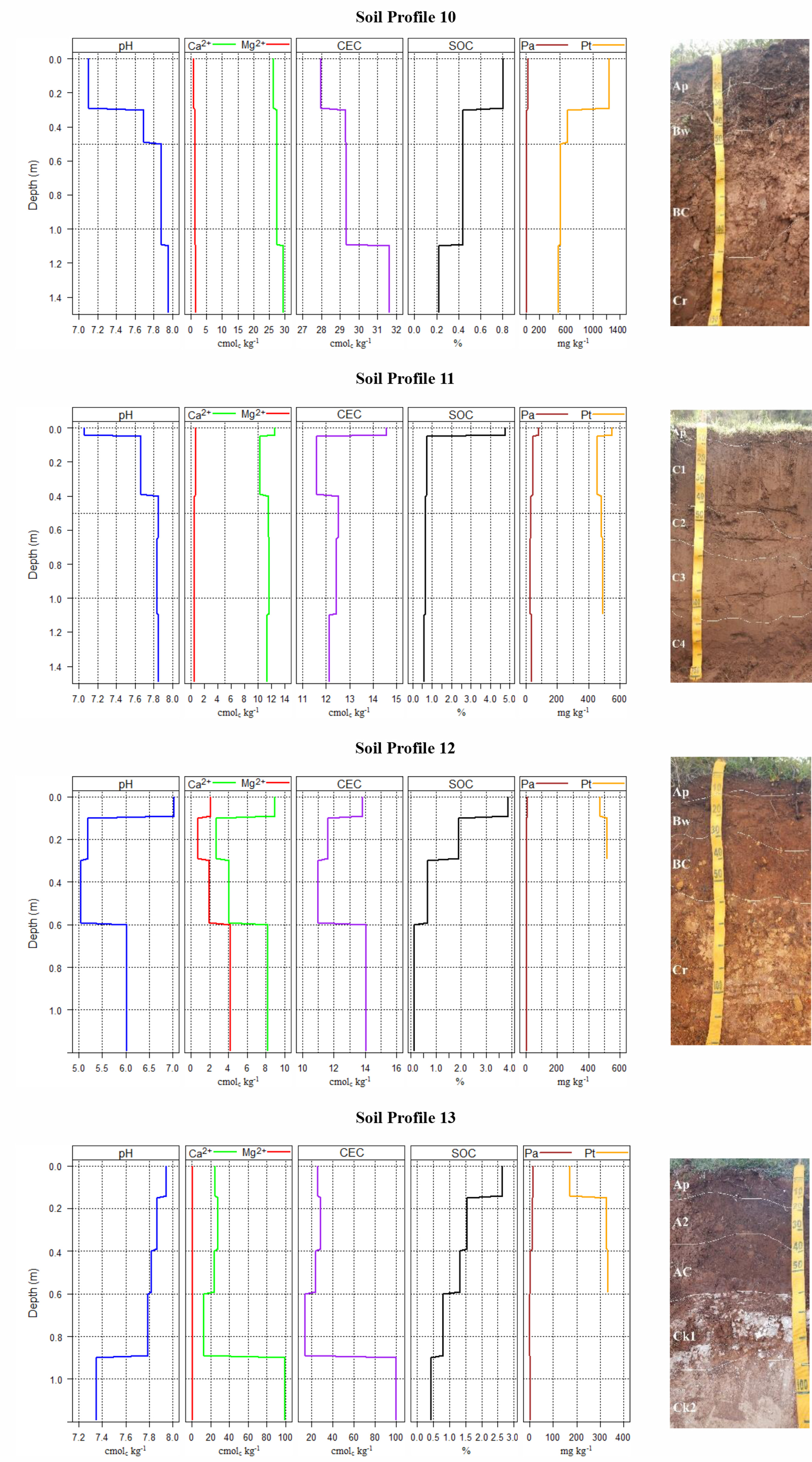
These pedons (P10, P11, P12, and P13) were selected from parts of the Cusco plateau (Table 1 and Figure 6), and although they have been cultivated, no evidence of ancient anthropogenic activity has been found. These soils are classified as Kastanozems, Cambisols and Fluvisols (IUUS Working Group WRB, 2022) (Table 1). A hard calcareous horizon was found in P10 and P12, as well as a petrocalcic horizon in P13.
All pedons have dark reddish brown surface horizons (2.5YR 2.5/3 to 5YR 3/3), with a weak to moderate granular to subangular block structure. Regarding the cambic (Bi) horizon of P10 and P12, the structure is subangular blocks (moderate to strong). Pedon P11 shows no degree of structural development (Table 2). In P10, CaCO3 precipitation was observed on the surface of the peds, as well as Vertic properties and slickensides in the Cr, with a strong prismatic structure and the presence of angular gravels (<3 %). In P12, manganese coatings were recorded on aggregates in the BC horizon. In general, the depth of the pedons varies from moderately deep to deep (0.75 to 1.00 m), with texture varying from sandy loam to clay loam (Table 2).
Regarding chemical properties, higher pH(H2O) values than pH(KCl) imply a negative net charge, as observed in pedons with anthropogenic influence (Supplementary Material). The pH varies from very strongly acidic to moderately alkaline, with the highest Ca2+ values observed in P10 and P13. Most soils are eutrophic (V >50 %), with higher organic carbon contents in the surface (Figure 6). The highest aluminum contents were observed in P12 (Bi and BC), ranging from 0.68 to 1.55 cmolc kg-1, but aluminum saturation lower than 30 %. In relation to CEC (t) and CEC (T), there was an increase with depth in all the pedons, reaching up to 100.17 cmolc kg-1, in the Ck2 horizon of P13 (Figure 6). The highest PM values were observed in P11, reaching 81.10 mg kg-1, while the highest P retention (Prem) was observed in the surface horizons of P13 (over 90 %).
Total phosphorus (Pt) content increased with depth in pedons P12 and P13, ranging from 172.33 to 520.70 mg kg-1 (Figure 6). The presence of carbonates was observed in P10, P11 and P15, confirmed by reaction with HCl (10 %). The clay mineralogy of P11 and P13 is composed of chlorite, vermiculite, illite, and kaolinite (Figure 7). Hematite was only identified in P13 (0.270 nm).

X-ray diffraction of the clay fraction of some horizons without anthropogenic influence. Unt. Clay: Natural clay; K: K+ saturation (heated treatment of K to 25 °C and 350 °C); Mg: Mg2+ saturation; Glycerol: saturated by Mg2+ and solvated with glycerol (Ko: kaolinite; Ch: chlorite; II: illite; Fd: feldespate; Qz: quartz; Hm: hematite; Sm: Esmectite; Vm: vermiculite).
Selective dissolution
In general, all soils under study showed Fed>Feo>Fp values (Table 3), indicating the preferential formation of crystalline materials. The lowest Feo/Fed ratio values (<0.04) were observed in the bottomlands of the study area (P01, P09, and P13), indicating the dominance of crystalline Fe oxides at lower altitudes (Table 3). Higher values of the Feo/Fed ratio were detected in P07, accompanied by higher values of Fep/Feo ratio (>0.2), indicating the dominance of amorphous Fe forms and organic complexes.
The Alp/Alo ratio is conventionally used to identify the presence of allophane or imogolite (Alp/Alo <0.5) or Al - humus complexes (Alp/Alo >0.5) (Nanzyo et al., 1993). Most of the studied soils showed an Alp/Alo ratio <0.5 (Table 3). The formation of allophane and imogolite predominates at pH(H2O) of 5 to 7, and low contents of organic complexes (Ugolini and Dahlgren, 1991), while Al and Fe-humus complexes predominate at lower pH (Shoji and Fujiwara, 1984). In the present case, however, the andic properties were not confirmed by the sum of Al + 1/2Feo being below 2 % in all pedons, which is below the minimum required to meet andic properties (Soil Survey Staff, 2014; IUUS Working Group WRB, 2015). Hence, these cultivated, artificial terraces are no Andosols, regardless of the anthropogenic features.
Iron and Al contents in the extracts of dithionite-citrate-bicarbonate (Fed and Ald), acid ammonium oxalate (Feo and Alo) in the horizons of the soil profiles studied
DISCUSSION
Influence of Anthropogenic terraces on the landscape and soil physical properties
The agricultural terraces, traditionally called Andenes, observed in the study area, represent a unique man-made landscape, with contrasting soil physical and chemical properties (Figure 2), levelled topography (Sandor and Eash, 1995; Borisov et al., 2016; Londoño et al., 2017), with changes in the microclimate (Denevan, 1995). All these factors are favorable to the sustainable functioning of ecosystems and society, up to the present day (Spencer and Hale, 1961).
In the Cuzco region, large areas of steep slopes have been terraced, creating a new landscape with a more stable, flat topography suitable for continuous cultivation and farming. The type of terrace built depends on the local topography, available substrate and construction techniques used (Stanchi et al., 2012), which influences the degree of soil and water conservation (Chen et al., 2017), as well as making work easier for people by creating a more comfortable environment for agricultural work (Tarolli et al., 2014).
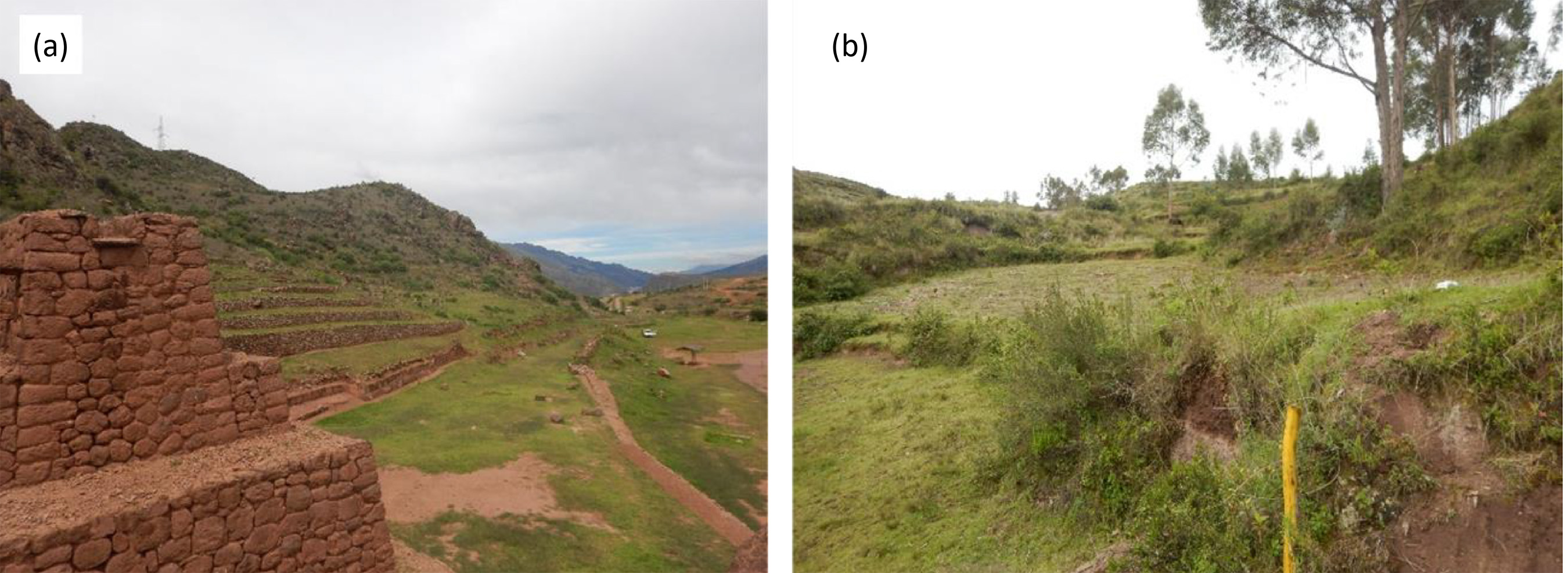
The terraces vary in size and shape. Some terraces have stone walls (Bench Terraces), whereas others have earthen walls (Sloping terraces) (Figure 8). Bench terraces are associated with the ancient Inca Empire, built during the Late period (1438-1533 AD) (Lumbreras, 1981), while the more common sloping terraces (without irrigation) are older (Pre-Inca), and served as the starting point for the construction of bench terraces, according to Kendall and Rodriguez (2009).

Types of agricultural terraces identified in the study area. (a) Bench terraces with horizontal platforms supported by dry-stone retaining walls. (b) Sloping-field terraces with cultivated surfaces following the natural slope gradient and bounded by low stone embankments.
The materials used to build the agricultural terraces depend on the local substrates, the availability of stones and suitable soil (Arnáez et al., 2015). For example, in P01 (Bench Terraces), the enclosing walls are made of local Andesitic rock blocks. Most terraces however, do not show stone walls, with gentle slopes at steep surfaces, where soil cultivation takes place. The aim of constructing agricultural terraces is to reduce the angle of slope and length (Sandor and Eash, 1995), thereby reducing the amount and speed of surface runoff, and preventing sediment transport (Chen et al., 2017), so reducing nutrient losses caused by erosion (Ni and Zhang, 2007) and enhancing water infiltration.
The pedological features revealed that many terraces in the Cuzco region have a thicker topsoil (A Horizon) than adjacent soil profiles, without anthropogenic influences. This is a major effect of terracing, as reported by Denevan (1995), Guillet (1987), Sandor and Eash (1995) and Homburg and Sandor (2011). The anthropogenic horizons range from 0.20 to 1.40 m, resulting in higher crop production by increasing the volume of fertile soil explored by toots, consistent with the results of Sandor and Homburg. A similar description was made by Sandor and Eash (1995) in the Colca Valley, where the A horizons are 0.30-1.30 m thick, and surface horizons are greatly enriched with organic matter. In the agricultural terraces of Viejo Sangayaico, Nanavati et al. (2016) studied 28 soil profiles and found that they rarely exhibit very thick A horizons, ranging from 0.25 to 0.75 m. There is therefore a wide variation in the thickness of the anthropogenic horizons between and within regions of the Andes.
Agricultural terraces of the Cuzco region, built along the slopes, are composed of locally redistributed soils, as evidenced by their mineralogical similarity (Supplementary Material), and are filled from bottom to top (Sandor and Eash, 1995; Londoño, 2008). Buried horizons enriched with organic matter are common in Andean terraces (Sandor and Eash, 1995; Kemp et al., 2006; Branch et al., 2007; Nanavati et al., 2016) and may indicate the presence of original A horizons, before landscaping (P03: 1.20-1.40 m; P06: 1.50-2.50 m; P07: 0.82-1.70 m). In our study, the A horizons buried directly above B or C represent pre-existing A horizons before terracing (P02: 0.20-0.40 m; P04: 0.35-0.70 m; P05: 0.50-0.60 m; P06: 1.50-2.50 m; P08: 0.30-0.60 m; P09: 1.40-1.80 m).
The majority of the terraces under study (without irrigation) are composed of loamy to loamy clay materials, with no evidence of clay illuviation, as recorded in the Chicha-Soras Valley terraces in Peru (Kemp et al., 2006; Branch et al., 2007). Sandor and Eash (1995) coatings on coarser-textured materials in terrace soils, originating from suspended materials added by irrigation water. In some cases, the presence of carbonates on the surface of the agricultural terrace soils (P02 and P09) results from the limestone rocks, and further concentrated by the slightly to moderately alkaline pH and dry climatic conditions, where evapotranspiration exceeds rainfall (Inrena, 1995), and CaCO3 moves up by capillarity.
At P09 the increase in the clay fraction at depth in the anthropogenic horizon may indicate the continuous translocation of these particles, caused by the precipitation of soluble Ca2+ ions (Figure 4) as calcium carbonate (Pal et al., 2003; Pereira et al., 2013), probably in wetter periods.
While we adhere to the established WRB criteria for anthropogenic horizons, we emphasize that the observed morphological features reflect a gradient of human influence intensity. This variability stems primarily from differences in land-use history, particularly in long-abandoned soils (e.g., P09) where primary anthropogenic signatures have been substantially degraded. Our data demonstrate this continuum of modification - from strongly and persistently transformed profiles (P03, P07, characterized by their deep A horizons) to those showing only minimal or recent alterations, without significant anthropogenic influence.
Terracing and soil chemical properties
One of the most evident chemical characteristics in anthropogenic soils of agricultural terraces in the Peruvian Andes is the high P content (Sandor and Eash, 1991, 1995; Dick et al., 1994; Branch et al., 2007; Sandor and Homburg, 2017), consistently recorded observed in pedons P01, P02, P03, P05 and P06 at the surface (Figures 3 and 4). According to Holliday and Gartner (2007), phosphorus is a very significant archaeological indicator of human activity in agricultural soils of pre-Hispanic societies.
The prolonged period of cultivation of the soils with agricultural practices that included additions of “abonos” (organic fertilizers) (Kendall and Rodriguez, 2015; Londoño et al., 2017) in combination with the mild temperate climate, alternating dry and wet periods, over the centuries, has favored the formation of soils with higher amounts of organic matter and P. Similar soil and climate characteristics have been reported in previous studies on agricultural terraces in the Andean region of southern Peru (Sandor and Eash, 1995; Branch et al., 2007) and on agricultural terraces in Mexico (Sandor et al., 1986, 1990), suggesting a widespread effect of soil conditioning by pre-hispanic societies in these highlands.
In P03, very high PM values were observed (Figure 3) compared to levels recorded in the other terraces under study and in other studies carried out on agricultural terraces in the Colca Valley (Sandor and Eash, 1991, 1995) and Chicha-Soras (Branch et al., 2007) in Peru. The very high levels of PM and Pt observed throughout the P06 profile (Figure 3) result from centuries of organic fertilizer additions and may be associated with the previously intensive use of llama or alpaca dung (Sandor and Eash, 1991, 1995), which has been domesticated since 4200 BC in the central Andes (Lumbreras, 1999) to maintain agricultural production. Ferro-Vázques et al. (2017) indicate that the increase in phosphorus in the buried horizons suggests that different additions, especially ashes and bones, helped maintain agricultural production.
The radiocarbon age of charcoal samples from the 4C horizon of P03, with an age of 4110 +/- 30 BP (2161 BC) supports the hypothesis of in situ burning at the beginning of agricultural occupation in the Preceramic period (5000-1800 BC) (Lumbreras, 1981). In line with this, Preceramic agriculture (around 2000 BC) has been reported by Chepstow-Lusty et al. (1998) in the Marcacocha lagoon, in the same region. It is evident that this terrace was built and refashioned at different times, as evidenced by the presence of ceramics and bones in buried horizons and in old surfaces (2Ab and 3Ab), indicating the repeated application of domestic waste over time.
Soils with less anthropogenic influence showed high levels of P at the surface (Figure 6), but low organic carbon levels (P10, P11, and P13), suggesting the use of inorganic fertilizers (Goodman-Elgar, 2008). Some terraces have low P and organic carbon levels, either because they have never been intensively fertilized, because continued cultivation led to degradation and abandonment (P09), or because of the expansion of urban areas (P07). Changes in landowners and a lack of terrace improvements during the colonial period (1533 - 1826) (Gade, 2016), in combination with diseases such as smallpox and measles, strongly affected the Andean population between 1585 and 1590 (Cook, 2000), leading to the depopulation of traditional communities and land abandonment. Another factor that may affect the low fertility of some agricultural terraces is the change from traditional long-term planting practices to a market-oriented agricultural production (Inbar and Llerena, 2000).
The slight acidity in the surface horizons of the anthropogenic soils (P03, P04, P05, P06) is very common in cultivated soils at present, and is probably related to additions of organic matter or less likely fertilizers which reduce the pH (Sandor and Eash, 1995), decreasing pH may result from nitrification which occurs after the addition of ammonium-rich fertilizers, producing H+ ions.
Selective dissolution analysis of the soils under study
The Feo/Fed ratio <0.04 suggests the predominance of crystalline Fe oxides, such as hematite, in P01, P09 and P13, corroborated by XRD (Figures 6 and 8), which are currently located in a temperate semi-arid environment (Inrena, 1995). The presence of hematite was also recorded by Cerón Loayza et al. (2011, 2014) at the archaeological site of Moray (Cuzco), under sub-humid conditions, according to Inrena (1995). It is known that hematite is more frequent in environments with higher temperatures that favor its formation, low pH, and low moisture (Chesworth et al., 2008). Chepstow-Lusty et al. (2003) reported that between 8000- and 5000-years BP, the climate in the central Andes was warmer, stable, and relatively arid, conditions that favored the formation of hematite in the past. Soils P09 and P13 showed the highest levels of phosphorus retention (Supplementary Material), which can be explained by the presence of Fe-oxides (hematite), together with the presence of carbonates, which was corroborated by the reaction with HCl (10 %).
Higher Feo/Fed ratio values were found at higher altitudes (above 3,600 a.s.l.), suggesting the dominance of non-crystalline Fe forms such as ferrihydrite (Table 3), caused by the high moisture and low temperatures at higher altitudes, preventing the crystallization of Fe-oxides under cold, humid to sub-humid climate (Table 1) (Schwertmann, 1985; Kleber et al., 2015).
The Alp/Alo ratio <0.5 (Table 3) observed in some pedons suggests the presence of amorphous materials such as allophane/imogolite. On the other hand, pH above 7 does not favor the formation and maintenance of these materials, and Ugolini and Dahlgren (1991) reported that the formation of allophane is favored at pH(H2O) between 5 and 7. However, even soils with pH ranging from 5 to 7 would not form allophane due to the presence of 2:1 minerals (Figures 6 and 8; Supplementary Material), as reported by Dahlgren et al. (1993) and Shoji and Fujiwara (1984) for volcanic soils. The Alp/Alo ratio, higher than 0.5, is present in the 3Av horizons (Table 3) and indicates the dominance of Al-Humus complexes, favored by pH <5 and high organic matter content (Figure 5).
Values above 0.8 for the Fep/Feo and Alp/Alo ratios (Table 3) extracted by ammonium oxalate are associated with Fe complexation by organic matter. Loveland and Bullock (1976) indicate that ammonium oxalate is not efficient in extracting Fe and Al associated with humic acids because at a pH close to 3, this fraction of organic matter is only slightly soluble.
On the other hand, Alo/Ald ratio values above 1 were observed in most soils (Table 3), as reported by Portes et al. (2016) in the western Peruvian Cordillera, but Wada (1978) suggests that the extraction of crystalline forms of Al by DCB does not represent the total amount of secondary Al hydroxides.
CONCLUSIONS
The long-term anthropogenic influence on man-made soils in the Andean region of Cuzco has greatly altered the physical and chemical properties of these singular soils. These changes are partially the result of the terrace construction technique, combined with soil management practices such as the application of organic materials (bones and ashes), intercropping, and long-term crop rotation.
The agricultural terraces built since Pre-Inca (and pre-hispanic) times have caused extensive modifications in the soil physical and chemical properties, including increasing the thickness of the Anthropogenic A horizon, creating a new pedological structure, greater porosity, and very high P values. In contrast, lower values of C and P found on some terraces are related to their abandonment and degradation following the migration of the population from rural to urban areas, a process that dates back to the time of the Spanish conquest.
The 14C dating of the charcoal sample from the bottom profile (P03) indicates that agricultural terraces were first built in the Late Archaic Pre-Ceramic period (2698 - 2486 BC), with very high levels of PM (Phosphorus extracted by Mehlich-1) and Pt (Total phosphorus content), suggesting centuries of cumulative fertilization effects. The presence of hematite found in the semi-arid pedons suggests an inheritance of warmer climates in the Holocene.
Since Al and Fe are closely associated with P retention, this element is key in identifying anthrosols. Hematite dominance (Feo/Fed <0.04) in P09/P13 correlates with high P retention, characteristic of ancient fertilization practices in warmer periods. Organo-Al complexes (Alp/Alo >0.5) in 3Av horizons indicate increasing P-binding capacity by anthropogenic OM management.
-
How to cite:
Lama DAI, Schaefer CEGR, Amaral EF, Lama PI, Senra EO. Pedoarchaeology in the pre-Hispanic terraces of Cusco. Rev Bras Cienc Solo. 2026;50nspe1:e0250032. https://doi.org/10.36783/18069657rbcs20250032
SUPPLEMENTARY MATERIALS
Supplementary data to this article can be found online at https://www.rbcsjournal.org/wp-content/uploads/articles_xml/1806-9657-rbcs-50-spe1-e0250032/1806-9657-rbcs-50-spe1-e0250032-suppl01.pdf
SUPPLEMENTARY MATERIALS
DATA AVAILABILITY
The data is available at https://www.rbcsjournal.org/wp-content/uploads/articles_xml/1806-9657-rbcs-50-spe1-e0250032/1806-9657-rbcs-50-spe1-e0250032-suppl01.pdf
REFERENCES
- Alvarez V VH, Novais RF, Dias LE, Oliveira JA. Determining and using the remaining phosphorus. In: Sociedade Brasileira de Ciência do Solo - SBCS. Boletim Informativo da Sociedade Brasileira de Ciência do Solo. 2000;52:27-32.
-
Arnáez J, Lana-Renault N, Lasanta T, Ruiz-Flaño P, Castroviejo J. Effects of farming terraces on hydrological and geomorphological processes. A review. Catena. 2015;128:122-34. https://doi.org/10.1016/j.catena.2015.01.021
» https://doi.org/10.1016/j.catena.2015.01.021 -
Borisov AV, Chernysheva EV, Korobov DS. Buried Paleoanthrosols of the Bronze Age agricultural terraces in the Kislovodsk basin (Northern Caucasus, Russia). Quat Int. 2016;418:28-36. https://doi.org/10.1016/j.quaint.2015.08.054
» https://doi.org/10.1016/j.quaint.2015.08.054 -
Bowman RA. A rapid method to determine total phosphorus in soils. Soil Sci Soc Am J. 1988;52:1301-4. https://doi.org/10.2136/sssaj1988.03615995005200050016x
» https://doi.org/10.2136/sssaj1988.03615995005200050016x -
Branch NP, Kemp RA, Silva B, Meddens FM, Williams A, Kendall A, Pomacanchari CV. Testing the sustainability and sensitivity to climatic change of terrace agricultural systems in the Peruvian Andes: A pilot study. J Archaeol Sci. 2007;34:1-9. https://doi.org/10.1016/j.jas.2006.03.011
» https://doi.org/10.1016/j.jas.2006.03.011 -
Carlotto VC, Gil W, Cárdenas J, Chávez R. Geología de los cuadrángulos de Urubamba y Calca. Hojas: 27-r y 27-s. Lima, Peru: Ingemmet; 1996. (Boletín, Serie A: Carta Geológica Nacional, 65). Available from: https://hdl.handle.net/20.500.12544/187
» https://hdl.handle.net/20.500.12544/187 - Carlotto VC, Cárdenas RJ, Carlier G. Geologia del cuadrángulo de Cusco. Hoja: 28s - 1:50000. Lima, Peru: Ingemmet; 2011. (Bulletin, Series A: 138).
-
Cerón Loayza ML, Aurelio BCJ, Navarro FAR, Arcondo RA. Structural characterization of iron oxides and hydroxides in the clay fraction of soil from the Inca civilization Moray terraces. J Met Mater Miner. 2014;24:7. https://doi.org/10.14456/jmmm.2014.15
» https://doi.org/10.14456/jmmm.2014.15 -
Cerón Loayza ML, Cabrejos JAB, Santillán MEM. Mineralogy of the clay fraction of soils from the moray Cusco archaeological site: A study by energy dispersive X-ray fluorescence, X-ray diffractometry and Mössbauer spectroscopy. Hyperfine Interact. 2011;203:133-41. https://doi.org/10.1007/s10751-011-0375-8
» https://doi.org/10.1007/s10751-011-0375-8 -
Chen D, Wei W, Chen L. Effects of terracing practices on water erosion control in China: A meta-analysis. Earth-Sci Rev. 2017;173:109-21. https://doi.org/10.1016/j.earscirev.2017.08.007
» https://doi.org/10.1016/j.earscirev.2017.08.007 - Chen P-Y. Table of key lines in x ray powder diffraction patterns of minerals in clays and assocated rocks. Bloomington, Indiana: Department of Natural Resources; 1977. (Geological Survey Occasional Paper 21).
-
Chepstow-Lusty A, Frogley MR, Bauer BS, Bush MB, Herrera AT. A late Holocene record of arid events from the Cuzco region, Peru. J Quat Sci. 2003;18:491-502. https://doi.org/10.1002/jqs.770
» https://doi.org/10.1002/jqs.770 -
Chepstow-Lusty AAJ, Bennett KD, Fjeldsa J, Kendall A, Galiano W. Tracing 4,000 years of environmental history in the Cuzco area, Peru, from the pollen record. Mt Res Dev. 1998;18:159-72. https://doi.org/10.2307/3673971
» https://doi.org/10.2307/3673971 - Chesworth W, Perez-Alberti A, Arnaud E, Morel-Seytoux HJ, Schwertmann U. Iron oxides. In: Chesworth W, editor. Encyclopedia of soil science. New York: Springer; 2008. p. 363-9.
-
Childs CW, Matsue N, Yoshinaga N. Ferrihydrite in volcanic ash soils of Japan. Soil Sci Plant Nutr. 1991;37:299-311, https://doi.org/10.1080/00380768.1991.10415040
» https://doi.org/10.1080/00380768.1991.10415040 -
Cook N. El impacto de las enfermedades en el mundo antiguo andino del siglo XVI. Histórica. 2000;24:341-65. https://doi.org/10.18800/historica.199902.009
» https://doi.org/10.18800/historica.199902.009 -
Dahlgren R, Shoji S, Nanzyo M. Mineralogical characteristics of volcanic ash soils. In: Shoji S, Nanzyo M, Dahlgren RA, editors. Volcanic ash soils: Genesis, properties and utilization. Amsterdam: Elsevier; 1993. (Developments in Soil Science, 21). https://doi.org/10.1016/S0166-2481(08)70266-6
» https://doi.org/10.1016/S0166-2481(08)70266-6 -
Denevan WM. Prehistoric agricultural methods as models for sustainability. Adv Plant Pathol. 1995;11:21-43. https://doi.org/10.1016/S0736-4539(06)80004-8
» https://doi.org/10.1016/S0736-4539(06)80004-8 -
Dick RP, Sandor JA, Eash NS. Soil enzyme activities after 1500 years of terrace agriculture in the Colca Valley, Peru. Agric Ecosyst Environ. 1994;50:123-31. https://doi.org/10.1016/0167-8809(94)90131-7
» https://doi.org/10.1016/0167-8809(94)90131-7 -
Ferro-Vázquez C, Lang C, Kaal J, Stump D. When is a terrace not a terrace? The importance of understanding landscape evolution in studies of terraced agriculture. J Environ Manage. 2017;202:500-13. https://doi.org/10.1016/j.jenvman.2017.01.036
» https://doi.org/10.1016/j.jenvman.2017.01.036 -
Gade DW. Spell of the Urubamba: Anthropogeographical essays on an Andean Valley in space and time. New York, London: Springer; 2016. https://doi.org/10.1111/gere.12189
» https://doi.org/10.1111/gere.12189 -
Goodman-Elgar M. Evaluating soil resilience in long-term cultivation: A study of pre-Columbian terraces from the Paca Valley, Peru. J Archaeol Sci. 2008;35:3072-86. https://doi.org/10.1016/j.jas.2008.06.003
» https://doi.org/10.1016/j.jas.2008.06.003 -
Guillet D. Terracing and irrigation in the Peruvian highlands. Curr Anthropol. 1987;28:409-30. https://doi.org/10.1086/203546
» https://doi.org/10.1086/203546 -
Hogg AG, Hua Q, Blackwell PG, Niu M, Buck CE, Guilderson TP, Zimmerman SRH. SHCal13 Southern Hemisphere Calibration, 0-50,000 Years cal BP. Radiocarbon. 2013;55:1889-903. https://doi.org/10.2458/azu_js_rc.55.16783
» https://doi.org/10.2458/azu_js_rc.55.16783 -
Holliday VT, Gartner WG. Methods of soil P analysis in archaeology. J Archaeol Sci. 2007;34:301-33. https://doi.org/10.1016/j.jas.2006.05.004
» https://doi.org/10.1016/j.jas.2006.05.004 -
Homburg JA, Sandor JA. Anthropogenic effects on soil quality of ancient agricultural systems of the American Southwest. Catena. 2011;85:144-54. https://doi.org/10.1016/j.catena.2010.08.005
» https://doi.org/10.1016/j.catena.2010.08.005 -
Inbar M, Llerena CA. Erosion processes in high mountain agricultural terraces in Peru. Mt Res Dev. 2000;20:72-9. https://doi.org/10.1659/0276-4741(2000)020[0072:EPIHMA]2.0.CO;2
» https://doi.org/10.1659/0276-4741(2000)020[0072:EPIHMA]2.0.CO;2 - Instituto de Manejo de Agua y Medio Ambiente - IMA. Economic Ecological Zoning of the Cusco Region. Cusco, Peru: PER – IMA; 2009.
- International Organization for Migration - IOM. Internal migration in Peru. Lima, Peru: IOM; 2015.
-
IUSS Working Group WRB. World reference base for soil resources. International soil classification system for naming soils and creating legends for soil maps. 4th. ed. Vienna, Austria: International Union of Soil Sciences (IUSS); 2022. Available from: https://www.isric.org/sites/default/files/WRB_fourth_edition_2022-12-18.pdf
» https://www.isric.org/sites/default/files/WRB_fourth_edition_2022-12-18.pdf -
Kemp R, Branch N, Silva B, Meddens F, Williams A, Kendall A, Vivanco C. Pedosedimentary, cultural and environmental significance of paleosols within pre-Hispanic agricultural terraces in the southern Peruvian Andes. Quat Int. 2006;158:13-22.https://doi.org/10.1016/j.quaint.2006.05.013
» https://doi.org/10.1016/j.quaint.2006.05.013 - Kendall A, Rodríguez A. Desarrollo y perspectivas de los sistemas de andeneria de los Andes centrales del Perú. Cuzco: Institud Français D'études Andines; 2009.
-
Kleber M, Eusterhues K, Keiluweit M, Mikutta C, Mikutta R, Nico PS. Mineral-organic associations: Formation, properties, and relevance in soil environments. Adv Agron. 2015;130:1-140. https://doi.org/10.1016/bs.agron.2014.10.005
» https://doi.org/10.1016/bs.agron.2014.10.005 -
Londoño AC. Pattern and rate of erosion inferred from Inca agricultural terraces in arid southern Peru. Geomorphology. 2008;99:13-25. https://doi.org/10.1016/j.geomorph.2007.09.014
» https://doi.org/10.1016/j.geomorph.2007.09.014 -
Londoño AC, Williams PR, Hart ML. A change in landscape: Lessons learned from abandonment of ancient Wari agricultural terraces in Southern Peru. J Environ Manage. 2017;202:532-42. https://doi.org/10.1016/j.jenvman.2017.01.012
» https://doi.org/10.1016/j.jenvman.2017.01.012 -
Loveland PJ, Bullock P. Chemical and mineralogical properties of brown podzolic soils in comparison with soils of other groups. J Soil Sci. 1976;27:52-6. https://doi.org/10.1111/j.1365-2389.1976.tb02022.x
» https://doi.org/10.1111/j.1365-2389.1976.tb02022.x - Lumbreras LG. Archaeology of Andean America. Lima: Editorial Milla Batres; 1981.
- Lumbreras LG. Formation of urban societies. In: Lumbreras LG, editors. History of Andean America. Vol. 1: Aboriginal Societies. San Isidro: Universidad Andina Simón Bolívar; 1999. p. 223-65.
-
Mckeague JA, Day JH. Dithionite and oxalate extractable Fe and Al as aids in differentiating various classes of soils. Can J Soil Sci. 1966;46:13-22. https://doi.org/10.4141/cjss66-003
» https://doi.org/10.4141/cjss66-003 -
Mehra OP, Jackson ML. Iron oxide removal from soils and clays by a dithionite- citrate system buffered with sodium bicarbonate. Clay Clay Miner. 1958;7:317-27. https://doi.org/10.1016/B978-0-08-009235-5.50026-7
» https://doi.org/10.1016/B978-0-08-009235-5.50026-7 - Munsell Soil color company. Baltimore: Munsell Soil Color Charts; 2012.
-
Nanavati WP, French C, Lane K, Oros OH, Beresford-Jones D. Testing soil fertility of Prehispanic terraces at Viejo Sangayaico in the upper Ica catchment of south- central highland Peru. Catena. 2016;142:139-52. https://doi.org/10.1016/j.catena.2016.03.007
» https://doi.org/10.1016/j.catena.2016.03.007 -
Nanzyo M, Dahlgren R, Shoji S. Chemical characteristics of volcanic ash soils. Dev Soil Sci. 1993;21:145-87. https://doi.org/10.1016/S0166-2481(08)70267-8
» https://doi.org/10.1016/S0166-2481(08)70267-8 - National Institute of Natural Resources - Inrena. Ecological Map of Peru - Explanatory Guide. Lima, Peru: Ministry of Agriculture; 1995.
-
Ni SJ, Zhang JH. Variation of chemical properties as affected by soil erosion on hillslopes and terraces. Eur J Soil Sci. 2007;58:1285-92. https://doi.org/10.1111/j.1365-2389.2007.00921.x
» https://doi.org/10.1111/j.1365-2389.2007.00921.x - Onern. Inventory and evaluation of the natural resources of the Peruvian Highlands (soils, current use, agrostology). Lima, Peru: Semidetallado Departamento del Cusco. Oficina Nacional de Evaluación de los Recursos Naturales; 1988.
-
Pal DK, Srivastava P, Bhattacharyya T. Clay illuviation in calcareous soils of the semiarid part of the Indo-Gangetic Plains, India. Geoderma. 2003;115:177-92. https://doi.org/10.1016/S0016-7061(02)00377-4
» https://doi.org/10.1016/S0016-7061(02)00377-4 -
Pearsall DM. Plant domestication and the shift to agriculture in the Andes. In: Silverman H, Isbell WH, editors. The handbook of South American archaeology. New York: Springer; 2008. p. 105-20. https://doi.org/10.1007/978-0-387-74907-5_7
» https://doi.org/10.1007/978-0-387-74907-5_7 -
Pereira MG, Schiavo JA, Fontana A, Dias Neto AH, Miranda LPM. Characterization and classification of soils in a toposequence on limestone in Serra da Bodoquena, MS. Rev Bras Cienc Solo. 2013;37:25-36. https://doi.org/10.1590/S0100-06832013000100003
» https://doi.org/10.1590/S0100-06832013000100003 -
Portes RC, Spinola DN, Reis JS, Ker JC, Costa LM, Fernandes Filho EI, Kühn P, Schaefer CEGR. Pedogenesis across a climatic gradient in tropical high mountains, Cordillera Blanca - Peruvian Andes. Catena. 2016;147:441-52. https://doi.org/10.1016/j.catena.2016.07.027
» https://doi.org/10.1016/j.catena.2016.07.027 -
Ruiz HA. Increasing the accuracy of soil granulometric analysis by collecting the suspension (silt + clay). Rev Bras Cienc Solo. 2005;29:297-300. https://doi.org/10.1590/S0100-06832005000200015
» https://doi.org/10.1590/S0100-06832005000200015 - Sánchez AF, Zapata AM. Memoria Descriptiva de la revisión y actualización de los cuadrángulos de río Picha (25-p), Timpia (25-q), Chuanquiri (26-p), Quillabamba (26-q) Quebrada Honda (26-r), Parobamba (26-s), Pacaypata (27-p), Machupicchu (27-q), Urubamba (27-r), Calca (27-s), Chontachaca (27-t), Quincemil (27-u), Ocongate (28-t), Corani (28-u) and Ayapata (28-v). Scale 1:100 000. Lima, Peru: Instituto Geológico Minero y Metalurgico – Ingemmet; 2003.
-
Sandor JA, Eash NS. Significance of ancient agricultural soils for long-term agronomic studies and sustainable agriculture research. Agron J. 1991;83:29-37. https://doi.org/10.2134/agronj1991.00021962008300010011x
» https://doi.org/10.2134/agronj1991.00021962008300010011x -
Sandor JA, Eash NS. Ancient agricultural soils in the Andes of southern Peru. Soil Sci Soc Am J. 1995;59:170-9. https://doi.org/10.2136/sssaj1995.03615995005900010026x
» https://doi.org/10.2136/sssaj1995.03615995005900010026x -
Sandor JA, Gersper PL, Hawley JW. Soils at prehistoric agricultural terracing sites in New Mexico: I. Site placement, soil morphology, and classification. Soil Sci Soc Am J. 1986;50:177-80. https://doi.org/10.2136/sssaj1986.03615995005000010031x
» https://doi.org/10.2136/sssaj1986.03615995005000010031x -
Sandor JA, Gersper PL, Hawley JW. Prehistoric agricultural terraces and soils in the Mimbres area, New Mexico. World Archaeol. 1990;22:70-86. https://doi.org/10.1080/00438243.1990.9980130
» https://doi.org/10.1080/00438243.1990.9980130 -
Sandor JA, Homburg JA. Anthropogenic soil change in ancient and traditional agricultural fields in arid to semiarid regions of the Americas. J Ethnobiol. 2017;37:196-217. https://doi.org/10.2993/0278-0771-37.2.196
» https://doi.org/10.2993/0278-0771-37.2.196 -
Schwertmann U. The effect of pedogenic environments on iron oxide minerals. Adv Soil Sci. 1985;1:171-200. https://doi.org/10.1007/978-1-4612-5046-3_5
» https://doi.org/10.1007/978-1-4612-5046-3_5 -
Shoji S, Fujiwara Y. Active aluminum and iron in the humus horizons of Andosols from northeastern Japan: Their forms, properties, and significance in clay weathering. Soil Sci. 1984;137:216-26. https://doi.org/10.1097/00010694-198404000-00002
» https://doi.org/10.1097/00010694-198404000-00002 - Soil Survey Staff. Keys to soil taxonomy. 12th ed. Washington, DC: United States Department of Agriculture, Natural Resources Conservation Service; 2014.
- Soil Survey Staff. Soil survey manual agriculture. Washington, DC: United States Department of Agriculture, Natural Resources Conservation Service; 2017. (Agricultural Handbook, 18).
- Soil Survey Staff. Soil taxonomy: a basic system of soil classification for making and interpreting soil surveys. 2nd ed. Washington, DC: United States Department of Agriculture, Natural Resources Conservation Service; 1999. (Agricultural Handbook, 436).
-
Spencer JE, Hale G. Origin, nature, and distribution of agricultural terracing. Pac Viewp. 1961;2:1-40. https://doi.org/10.1111/apv.21001
» https://doi.org/10.1111/apv.21001 -
Stanchi S, Freppaz M, Agnelli A, Reinsch T, Zanini E. Properties, best management practices and conservation of terraced soils in Southern Europe (from Mediterranean areas to the Alps): A review. Quat Int. 2012;265:90-100. https://doi.org/10.1016/j.quaint.2011.09.015
» https://doi.org/10.1016/j.quaint.2011.09.015 -
Sublette-Mosblech NA, Chepstow-Lusty A, Valencia BG, Bush MB. Anthropogenic control of late-Holocene landscapes in the Cuzco region, Peru. Holocene. 2012;22:1361-72. https://doi.org/10.1177/0959683612449760
» https://doi.org/10.1177/0959683612449760 -
Tarolli P, Preti F, Romano N. Terraced landscapes: From an old best practice to a potential hazard for soil degradation due to land abandonment. Anthropocene. 2014;6:10-25. https://doi.org/10.1016/j.ancene.2014.03.002
» https://doi.org/10.1016/j.ancene.2014.03.002 - Teixeira PC, Donagemma GK, Fontana A, Teixeira WG. Manual de métodos de análise de solo. 3. ed. rev e ampl. Brasília, DF: Embrapa; 2017.
-
Thompson LG, Mosley-Thompson E, Dansgaard W, Grootes PM. The Little Ice Age as recorded in the stratigraphy of the tropical Quelccaya ice cap. Science. 1986;234:361-4. https://doi.org/10.1126/science.234.4774.361
» https://doi.org/10.1126/science.234.4774.361 -
Thompson LG, Mosley-Thompson E, Bolzan JF, Koci BR. A 1500-year record of tropical precipitation in ice cores from the Quelccaya ice cap, Peru. Science. 1985;229:971-3. https://doi.org/10.1126/science.229.4717.9
» https://doi.org/10.1126/science.229.4717.9 -
Ugolini FC, Dahlgren RA. Weathering environments and occurrence of imogolite/allophane in selected Andisols and Spodosols. Soil Sci Soc Am J. 1991;55:1166-71. https://doi.org/10.2136/sssaj1991.03615995005500040045x
» https://doi.org/10.2136/sssaj1991.03615995005500040045x -
Wada K. Chapter 4 Allophane and imogolite. Dev Sedim. 1978;26:147-87. https://doi.org/10.1016/S0070-4571(08)70685-X
» https://doi.org/10.1016/S0070-4571(08)70685-X -
Walkley A, Black IA. An examination of the degtjareff method for determining soil organic matter, and a proposed modification of the chromic acid titration method. Soil Sci. 1934;37:29-38. https://doi.org/10.1097/00010694-193401000-00003
» https://doi.org/10.1097/00010694-193401000-00003
Edited by
-
Editor:
Marcos Gervasio Pereira https://orcid.org/0000-0002-1402-3612 and Wenceslau Geraldes Texeira https://orcid.org/0000-0002-2010-6078