 Is it possible to learn skills for democratic discussion? An experiment on deliberative capacities with controversial topics
Abstract:
This article explores the application of the principles of deliberative democracy for teaching and developing skills for democratic discussion, based on a field experiment with more than 500 young people in public schools between 2018 and 2022. Based on studies about citizen assemblies with a deliberative design and recent initiatives in the education sector, the analyses highlight the importance of experimental research, with the use of treatment and control groups, to examine different capacities in concrete discussion practices - competences for justification of preferences and aptitude to present personal stories to support positions and concerns; inclusion and respectful engagement. It focuses on challenges for identifying and measuring the effects of programmatic workshops on changes in participant behavior and, also, for capturing differences among groups in distinct socioeconomic contexts. The article contributes to filling a gap in the current literature and advancing a research agenda to motivate teaching and training for capacity building for democratic discussion on controversial topics - an emerging field with great potential for replication and social intervention on a broad scale.
Keywords:
deliberative democracy; experimental method; experiments in deliberation; deliberation and education; discussion-based learning
Resumo:
Este artigo tem como objetivo discutir a aplicação dos princípios da democracia deliberativa ao ensino e desenvolvimento de habilidades para a discussão democrática, a partir de um experimento de campo com mais de 500 jovens em escolas públicas entre 2018 e 2022. Fundamentadas em estudos sobre assembleias de cidadãos com desenho deliberativo e em iniciativas recentes no setor da educação, as análises destacam a importância da pesquisa experimental, com grupos de tratamento e controle, para examinar desempenho de diferentes habilidades em práticas concretas de discussão - como competências de justificação de preferências e aptidão para contar histórias pessoais pertinentes para sustentar posições e preocupações; e de inclusão e engajamento respeitoso. São focalizados desafios para observar e mensurar efeitos de oficinas programáticas na mudança de comportamento dos participantes e para detectar diferenças em grupos localizados em distintos contextos socioeconômicos. Este artigo contribui para preencher uma lacuna na literatura atual e fazer avançar uma agenda de pesquisa para motivar o ensino e treino de habilidades para discussões democráticas sobre temas polêmicos - uma área incipiente com grande potencial de replicação e intervenção social em ampla escala.
Palavras-chave:
democracia deliberativa; método experimental; experimentos em deliberação; deliberação e educação; aprendizagem baseada em discussão
Resumen:
Este artículo tiene como objetivo debatir la aplicación de los principios de la democracia deliberativa a la enseñanza y desarrollo de habilidades para la discusión democrática, a partir de un experimento de campo con más de 500 jóvenes en escuelas públicas entre 2018 y 2022. Con base en estudios recientes sobre asambleas ciudadanas e iniciativas en el sector educativo con diseños deliberativos, abordamos los desafíos en la observación y medición de los efectos de talleres programáticos en el cambio de comportamiento de los participantes. Los análisis destacan la importancia de la investigación experimental, con clases de tratamiento y control, para examinar diferentes capacidades en prácticas de discusión concretas - competencias de justificación de preferencias y aptitud de presentación de historias personales para sostener posiciones y preocupaciones; inclusión y respeto. Se centra en los desafíos para comprender y medir los efectos de talleres programáticos en el cambio de comportamiento de los participantes y, también, para capturar sistemáticamente las diferencias en grupos ubicados en contextos socioeconómicos distintos. Este artículo contribuye a llenar un vacío en la literatura actual y avanzar en una agenda de investigación para motivar la enseñanza y la formación de habilidades para las discusiones democráticas sobre temas controvertidos - un área naciente con potencial de replicación e intervención social a gran escala.
Palabras-llave:
democracia deliberativa; métodos experimentales; experimentos en deliberación; deliberación y educación; aprendizaje basado en discusiones
Since their consolidation in the 1990s, deliberative theories have fostered intense debate, marked by recurrent controversies and normative disputes (Bächtiger et al., 2010; Chambers, 2018, 2023; Habermas, 1996, 2018; Maia, 2012; Maia et al., 2025; Steiner, 2012). In practical terms, the approach has inspired the creation of spaces, methods, and resources for well-informed and high-quality discussions, across numerous initiatives involving mini-publics and citizens’ assemblies (Fishkin, 2009; Reuchamps; Vrydagh; Welp, 2023). In light of the intensification of polarization, intolerance, and the deterioration of democracy, concerns about creating conditions and cultivating democratic coexistence have moved to the forefront (Bächtiger; Dryzek, 2024; Calhoun; Gaonkar; Taylor, 2022; Maia; Hauber; Choucair, 2023b; Maia; Orlandini, 2025; Reber, 2023). Yet, is it possible to teach deliberation or deliberative capacities to counteract the harms inflicted on democracy and the public sphere? Based on a field experiment8 involving more than 500 participants across five public schools in two Brazilian cities, Belém and Belo Horizonte, we argue here that it is indeed possible to teach skills conducive to more democratic discussions.
In this article, we discuss some of the challenges that emerge when attempting to translate the principles of deliberative democracy into educational programs or practical training strategies. We also investigate the difficulties involved in observing and measuring the effects on participants’ behavior in field experiments. Drawing on Jürgen Habermas’s theoretical framework (1987, 1996, 2018), we define “deliberative capacities” as the motivation and skills to articulate viewpoints based on reflective considerations; to seek reciprocal engagement with interlocutors; and to communicate in a more inclusive and respectful manner when discussing controversial political issues. Despite the large number of forums designed with a deliberative structure that are conducted in the realms of political participation and across local, national, and transnational levels of government, studies at the intersection of deliberation and education remain scarce, particularly considering the limited scope of prior experimental studies (Andersson, 2015; Bogaards; Deutsch, 2015).
The Projeto Compartilha, grounded in deliberative democracy theory, is unprecedented in Brazil and an international pioneer for implementing a field experiment with treatment and control groups to assess learning about deliberation. Unlike other experimental initiatives in both formal and informal education, our effort sought to promote the conceptual understanding of deliberative principles among young people, foster self-reflection, and motivate them to engage in discussions on controversial political topics through various planned situations designed to teach deliberative capacities.
In Brazil, references to field experiments can be found in media studies (Carlomagno; Braga; Sampaio, 2018; Mundim et al., 2019; Porto, 2004, 2007), surveys (Avelino, 2022; Mouron; Urdinez; Onuki, 2016; Russo; Pimentel Júnior; Moisés, 2022), and list experiments (Burle; Turgeon, 2020; Turgeon; Chaves; Wives, 2014). More recently, comparisons between regions or situations with minor variations have been employed to estimate the impacts of specific treatments in natural experiments (Karruz, 2018) and quasi-experiments (Meireles, 2019; Silva, 2017). In this article, we present the design of the field experiment developed by the Projeto Compartilha team to test the effects of teaching and training deliberation on the quality of discussions in concrete, practical situations. We aim to measure effects in terms of: (a) an increase in speech acts providing justifications that allow participants to support their positions; (b) a greater volume of personal stories focused on the topic under discussion; (c) an increase in respect toward other participants and their respective opinions; and (d) heightened engagement in the practice of discussion. To our knowledge, no other experimental studies have sought to motivate and teach favorable attitudes toward democratic discussions on controversial topics.
This article is structured into three sections, in addition to this introduction and the concluding remarks. The first section explores the guiding concepts of the research within the context of previous initiatives and highlights the relevance of considering “deliberative capacities” as flexible and dynamic skills that can be created, trained, and developed. The second section explains the planning and implementation of workshops with active learning strategies based on peer instruction, games, playful activities, and authentic small-group discussions. The third section focuses on the potential of teaching deliberation within educational settings. As this study was conducted in public schools located in both middle-class neighborhoods and socially vulnerable contexts, it enables an analysis of socioeconomic inequalities that interfere with learning processes. Given the nature of the issues addressed, we present only a portion of our findings. We, therefore, chose to emphasize the implications of observing components of deliberation learning through an integrated teaching approach, as well as the challenges associated with the school context - contributing to fill a gap in the current literature on deliberative forums when compared with the experiences documented in deliberative democracy theory in North American and European countries, and advancing an innovative research agenda with significant potential for replication and large-scale social intervention.
A proposal to develop skills for democratic discussions based on deliberative democracy theory
The Theory of Deliberative Democracy originates from different philosophical traditions, spanning liberal, republican, and participatory models of democracy. In particular, the work of Jürgen Habermas (1987, 1996, 2017) provides a set of principles that define the conditions, procedures, and means for democratic communicative exchange. Among deliberative democracy theorists, Thomas Englund (2000, 2011, 2016) was one of the first scholars to highlight the potential of schools as privileged spaces for cultivating democratic communication among distinct social and cultural groups, with the purpose of “developing an ability and willingness to reason on the basis of the views of others and to change perspectives” (Englund, 2011, p. 245).
The idea that democracy should be learned in school is, of course, not new. John Dewey (2011), in one of his seminal works, Democracy and Education: An Introduction to the philosophy of education (published in 1916), particularly emphasizes that the classroom can function as a public sphere where children and adolescents encounter peers with different political positions, potentially holding divergent moral values and perspectives. In this regard, the Brazilian philosopher and educator Paulo Freire (1986, 1996, 2019) conceives dialogue - horizontal and authentic - as central to educational and transformative praxis. The Freirean legacy (Freire, 1996; 2019) has inspired and provided guidelines for various models of active learning across different regions of the world, such as the “open classroom climate” model, peer instruction models (Maurissen; Claes; Barber, 2018), and pedagogical approaches to addressing social injustices, class inequalities, racism, and other power asymmetries (Molnar-Main, 2017; Oliveira; Sousa, 2022; Pasquarelli; Chirinéa, 2017; Shaffer et al., 2017; Teixeira, 1997; Vieira et al., 2013).
The exchange of viewpoints and the mutual effort to understand others’ positions or perspectives in problematic or conflictual situations may appear to be a simple exercise, yet it lies at the core of deliberative democracy. The central argument developed in this section is that deliberative democracy theory calls attention to a broader set of attitudes and behaviors within interactive dynamics, while also placing strong emphasis on open and authentic communication. In summary, according to Habermas (1996 p. 305-306), communicative exchanges in the context of a deliberative discussion require participants to: a) provide considerations and explanations for their opinions and concerns, offering justifications to sustain their positions; b) engage reciprocally with one another’s viewpoints or justifications; c) construct a free and noncoercive dialogic interaction; d) interact respectfully with others; e) remain open to the inclusion of other participants, topics, views, or perspectives in the discussion; and f) allow for the possibility of altering preferences or reversing decisions based on critical considerations.9
A specific conceptual definition of deliberation has significant implications, first and foremost, for the design of educational programs or strategies. Several initiatives emerging in the 2000s in the United States and Europe, linked to civic education programs, focused on discussion as a means to acquire content related to specific political issues, as well as to foster political mobilization, social capital acquisition, or community cooperation (Avery; Levy; Simmons, 2013, 2014; Dassonneville et al., 2012; Feldman et al., 2007; Godfrey; Grayman, 2014; Thornberg, 2010). While deliberative capacities - justification, reciprocity, noncoercion, reflexivity, inclusion - are relevant to various forms of political and civic agency, they are not to be conflated with the civic virtues mentioned above.
In the past decade, educational initiatives have increasingly adopted deliberative principles explicitly and broadly, either as guidelines for teaching practices or as a framework for structuring classroom interactions (Ferreira, 2019; Longo; Shaffer, 2019; Shaffer et al., 2017; Nishiyama, 2019, 2021). Within this perspective, Longo, Manosevitch, and Shaffer offer a concise definition: “the work of deliberative pedagogy is about space-making: creating and holding space for authentic and productive dialogue, conversations that can ultimately be not only educational but also transformative” (2017, p. xxi). Stacie Molnar-Main (2017) identifies six core characteristics of deliberative pedagogy: (a) the focus or topic of learning concerns an issue of importance to both individuals and society; (b) learning is highly interactive and discussion-based; (c) teachers and students share responsibility for the learning process; (d) the process emphasizes the analysis of options or collective decision-making; (e) multiple perspectives, including marginalized viewpoints, are considered in a balanced manner; (f) students are treated as citizens or decision-makers, often participating in follow-up activities related to these roles (Molnar-Main, 2017, location 189 of 2045).
Other initiatives within the educational sector have sought to organize discussion events following the formats of mini-publics or citizens’ assemblies (Bogaards; Deutsch, 2015). The implementation of these events requires careful planning to engage young people in discussing the issue under scrutiny and employs strategies such as the prior distribution of informational materials presenting plural perspectives, moderation to ensure equitable participation despite differences, and, in some cases, the formulation of recommendations at the conclusion of the discussion to address the issue at stake. Typically, these events are not intended to foster reflection on the very concept of deliberation, nor to develop an understanding of what deliberation entails, its requirements, or the specific behaviors necessary for successful deliberative practice.
In contrast, our project is pioneering both internationally and nationally, as it aims to develop a conceptual understanding of deliberative principles, promote self-reflection on behaviors that foster or hinder such practices, and train adolescents to engage in discussions on controversial issues. Moreover, the literature on deliberation and education includes only a limited number of experiments conducted with the rigor required by established protocols (Druckman et al., 2011; Esterling, 2018). One example is the quasi-experimental study by Klas Andersson (2015), conducted with vocational high school students. In one class (treatment group), lessons were delivered using deliberative pedagogy, where students were encouraged to deliberate on solutions to collective problems. In the same study, another class (control group) received conventional instruction, in which the teacher lectured on the issue and students completed exercises individually. Another example is provided by Martin Samuelsson (2016), who designed discussion models to assist educators in using questioning strategies to create space for disagreement while simultaneously offering opportunities for collective decision-making. However, this study did not report the use of control groups. The design of our experiment adhered to the necessary procedures to ensure its validity for calculating the average treatment effect, fulfilling these requirements as rigorously as possible for a field experiment involving human participants (Druckman et al., 2011; Esterling, 2018). The experiment was conducted simultaneously across 15 classes, with ten assigned to treatment groups participating in workshops over four months, paired with five classes forming the control groups.
Why focus on deliberative capacities?
Before presenting our experiment, it is important to highlight that schools have institutional arrangements, norms, routines, and contextual factors that distinguish them from citizens’ assemblies or mini-public initiatives (Fishkin, 2009; Reuchamps; Vrydagh; Welp, 2023). Schools are environments where young people are socialized and construct their own political views (Dassonneville et al., 2012; Englund, 2000, 2011, 2016; Nishiyama, 2021; Vieira et al., 2013) - a process that involves historical and social conflicts, as well as diverse contingent issues that must not be overlooked when applying deliberative democracy theory to the educational sector.
In our research, we follow the definition of “capabilities” proposed by Amartya Sen (1999, 2009) and Martha Nussbaum (2011, 2013), referring to the potentialities or competencies that can be developed through resources and methods. According to Sen (1999), capabilities concern what individuals “are able to be and do.” These are “complex combinations” encompassing both cognitive and emotional dimensions (Nussbaum, 2011, p. 21). The basic premise is that individuals’ internal characteristics, dispositions, singular attributes, or psychological traits should not be regarded as fixed but rather as flexible and dynamic, constantly interacting with socioeconomic conditions, political factors, and family context. Public policies or programs based on the capabilities approach aim to create favorable conditions and incentives for individuals to develop - add, expand, or transform - their predispositions and skills through environmental reshaping, methodological interventions, and restructuring of the practices that organize social life.
The capabilities approach also allows us to distinguish between “being capable,” as a potential, and “functioning,” as practical performance - an especially useful distinction in educational programs. To deliberate, individuals must possess the willingness and self-confidence to express their viewpoints or concerns in a manner understandable to others, actively listen to fellow participants, and communicate respectfully and inclusively (Gutmann, Thompson, 2018; Habermas, 2018; Steiner et al., 2017). For example, a participant may be fully capable of articulating or justifying their ideas in a group discussion yet choose not to do so, while another may wish to contribute but lack the confidence or perceived ability to express themselves. One of the central challenges of our research was to design strategies and methods to motivate behaviors and train attitudes in the intended direction, within a context of individual choice.
How can deliberative principles be taught in practice?
In Brazil, there is a well-established body of programs rooted in the tradition of dialogical and critical education (Dayrell et al., 2013; Freire, 1996, 2019; Molnar-Main, 2017; Oliveira; Sousa, 2022; Pasquarelli; Chirinéa, 2017; Shaffer et al., 2017; Teixeira, 1997). In our project, we sought to bring together insights from the works of Habermas and Paulo Freire (1996, 2019). We also followed the guidelines set forth in key national documents, such as the National Plan for Human Rights Education (Brasil, 2018), which emphasizes the role of education in strengthening democracy and building a more just society; the National Education Plan 2014-2024 (Brasil, 2014); and the National Common Curricular Base (Brasil, 2017), which recommends treating children and adolescents as citizens in formation, holders of rights that include their education. Finally, we incorporated lessons from the literature on deliberation and on discussions involving deeply divided groups (Maia, 2014; Maia et al., 2017; Steiner et al., 2017; Ugarriza; Caluwaerts, 2014).
As in most initiatives concerning deliberation in educational settings, we began with the premise that participants learn to deliberate by engaging in concrete discussion practices (Andersson 2015; El Kadri; Molinari; Ramos, 2019; Hess, 2022; Longo; Shaffer, 2019; Nishiyama, 2019, 2021; Samuelsson, 2016; Shaffer et al., 2017). However, as we detail below, our workshops sought to combine conceptual understanding and self-awareness regarding behaviors with the training of democratic conduct for discussing controversial issues in interaction with others. We summarized the deliberative principles into “Seven Pillars of Deliberation”, namely: respect - showing consideration for others as citizens and for their opinions; justification - explaining one’s arguments, positions, and concerns in detail; equality - ensuring that all participants can contribute regardless of differences; inclusion - bringing in voices that are usually unheard and enabling their expression; non-coercion - avoiding intimidation or undue pressure; reciprocity - listening and responding to others’ contributions; and reflexivity - remaining open to changing one’s opinion and reflecting upon the perspectives of others.
In our project, we incorporated the understanding that personal stories can contribute to the quality of debate, in line with deliberative parameters, provided they are relevant to the issue under discussion (Maia et al., 2020). Narratives and lived experiences shared by participants foster inclusion and engagement by allowing individuals to reveal their identities and positions in relation to events, to situate the impact of policies in everyday life, and to reflect upon harms and injustices affecting groups or communities (Black; Lubensky, 2013; ; Polletta; Lee, 2006; Maia, 2014; Maia; Garcêz, 2014; Steiner et al., 2017).
The Projeto Compartilha
The Projeto Compartilha designed and implemented a set of workshops as part of a field experiment aimed at fostering young people’s understanding of deliberative principles and encouraging their engagement in discussions of controversial political topics. To this end, we conducted a pilot project in 2018 in two cities - Belém (PA) and Belo Horizonte (MG) - which provided valuable data and insights for revising the structure, activities, and scripts of the workshops. We developed an integrated pedagogical approach comprising: (a) methods for peer-based active learning; (b) playful and performative activities, including a game developed by our team (“Which profile is that?”), in which participants played both deliberative and non-deliberative roles; and (c) authentic discussions on contentious political issues.
This integrated approach required the provision of dedicated spaces, the creation of opportunities, and the programmatic implementation of activities. Table 1 (below) summarizes the activities conducted in each session organized by the Projeto Compartilha team.
In other works, we have discussed the implications of combining methods in our project (Maia et al., 2024a; Maia et al., 2024b). The workshops were designed to enable young participants to: articulate their perceptions and understand the normative principles of deliberation in the context of democratic discussion practices; solve problems collectively through dialogue; engage in games and playful activities, while reflecting on their own behaviors and those of others in different debate situations; and participate in authentic discussions on controversial topics. At various points, through planned exercises, students were encouraged to distinguish between different moments in the flow of communicative interactions that either approximate or deviate from deliberation, and to practice specific attitudes for democratic discussion as something that can be learned and refined, much like other skills and competences. This combination of methods also made it possible to address both cognitive and emotional dimensions in developing deliberative capacities, in ways that can be adapted to diverse formal and informal educational contexts.
Experimental Design
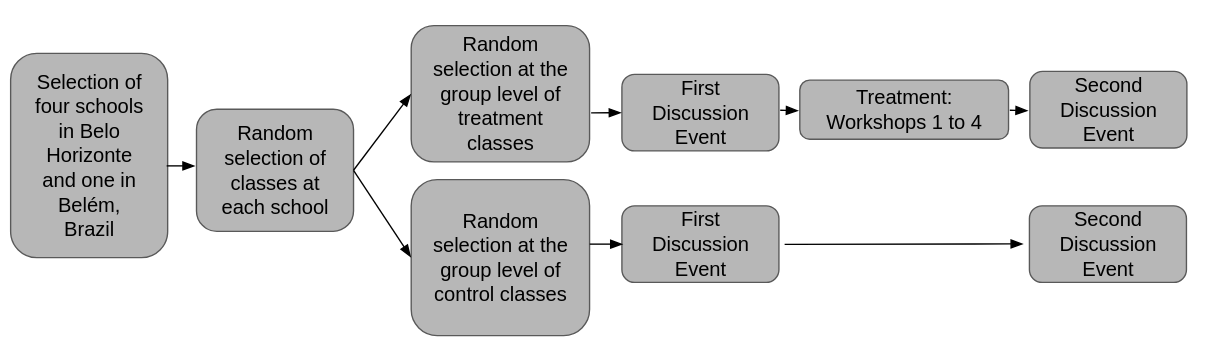
The experiment was conducted simultaneously in 15 classes from the 9th grade of lower secondary and the 1st grade of upper secondary education, involving 516 students aged 15 to 18, across five public schools - four located in Belo Horizonte and one in Belém. The experiment spanned from March to June 2019. To capture potential correlations between the development of deliberative capacities and socioeconomic or contextual factors, we selected two public schools located in middle-class neighborhoods and three in socially vulnerable areas, as socioeconomic factors often influence individuals’ willingness and interest in political participation (Brady; Verba; Schlozman, 1995; Solt, 2008). Under the Brazilian Statute of Children and Adolescents, young people are guaranteed the right to attend schools near their place of residence; consequently, families living within the same school catchment area tend to share similar socioeconomic profiles. In the five participating schools, entire classes were randomly assigned to serve as either treatment or control groups, thereby generating a randomized treatment assignment at the group level. Figure 1 below illustrates the different steps undertaken in the experiment.

Ten treatment groups participated in the workshops (n = 326 students), paired with five classes that served as control groups (n = 134 students). As shown in Figure 1, the diagram outlines the steps followed from the initial selection of classes through to the conclusion of the treatment phase, highlighting the aspects that distinguish the treatment and control groups. The experiment adhered to the requirements for experimental deliberative designs outlined by Kevin Esterling (2018), based on the framework of Angrist, Imbens, and Rubin (1996): (a) randomization of participants into treatment and control conditions; (b) the assumption of stability among individuals in the experiment (Stable Unit Treatment Value Assumption, SUTVA), meaning that the treatment effect depends solely on one’s own group assignment, not on other participants’ assignment to treatment; and (c) the exclusion restriction, whereby assignment to treatment has no effect on potential outcomes other than through the treatment itself.
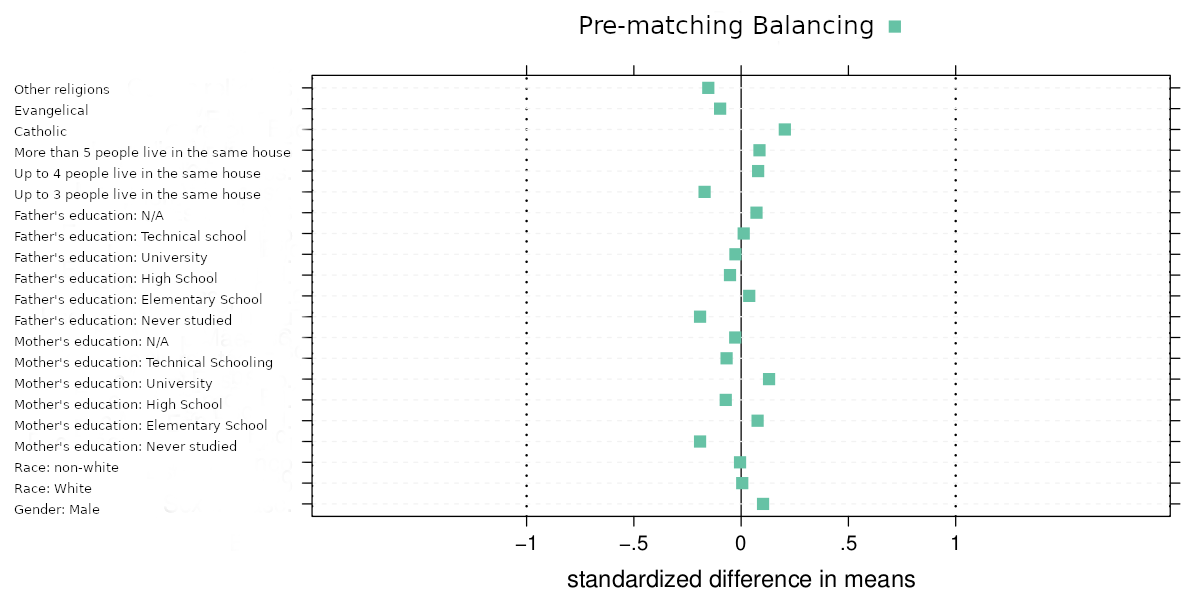
To mitigate potentially confounding factors in our field experiment, three procedures were adopted. First, all students completed questionnaires containing basic sociodemographic information to assess the distribution of gender, race, religion, and social class across classrooms. Based on these data, we confirmed that these characteristics were balanced between the treatment and control groups, as no systematic differences were identified among the participants (see Table A3 and Figure A1 in the Appendix). Second, the facilitators were members of our research teams, including researchers, undergraduate students, and graduate students of varying ages, genders, ethnicities, social backgrounds, and academic disciplines. Prior to the project’s implementation, the team underwent intensive training to familiarize all workshop facilitators with their roles and the facilitation strategies to be employed. Protocols were also established to manage instances of disrespect among students or toward researchers, and to define situations warranting the suspension of neutral moderation. Third, the workshop interventions were standardized across all treatment groups, using identical teaching materials, the same sequence of pedagogical activities, and equivalent time durations for all exercises.
To assess the effects of the workshops on deliberative capacities, two discussion events were held: one before and one after the workshops (see Figure 1). For these discussions, students in each class were randomly distributed into small subgroups to avoid self-selection bias. The topics of the first discussion event addressed freedom of expression, intolerance, and hate speech on social media. In the second debate, students revisited these topics and were invited to collaboratively draft practical recommendations to address the related issues. Control group students participated only in the first and second discussion events, without receiving any treatment between them.
Overview of the results of the experiment
The literature has emphasized that educational initiatives grounded in deliberation have a positive impact on adolescents and young people. We began our research with the expectation that teaching and training deliberation would positively affect the quality of discussions. Our null hypothesis, describing a scenario in which deliberative capacities cannot be trained, was formulated as follows: “following the deliberation workshops, young people will exhibit no difference in their deliberative capacities compared to the control group” (H0). If the treatment were successful, the treatment group would hypothetically exhibit: an increase in the use of justifications to support their positions (H1); a greater number of stories focused on the topic under discussion (H2); an increase in respect toward other participants and their opinions (H3); and an increase in overall engagement in discussion (H4).
We employed a set of materials and techniques to examine the development of deliberative capacities: questionnaires; observation and video recordings of workshops and debates; transcription of discussions; essays and written reflections produced by students; personal letters to future participants in the project; and overall evaluations of the program, among others. To analyze the deliberative quality of discussions before and after the treatment, we used an adapted version of the Discourse Quality Index (DQI) content analysis framework (Steiner et al., 2004; Steiner, 2012). This index is grounded in deliberative principles inspired by the work of Habermas - such as justification, inclusion, and respect - and therefore encompasses the key elements of deliberative capacities in our experiment. The small-group discussion events (first and second discussion sessions, see Figure 1) were transcribed and analyzed. Two independent coders were trained to apply the instructions contained in our codebook (Krippendorff, 2012; Neuendorf, 2002; for more details on the codebook, see Maia et al., 2023a). After three rounds of testing, followed by discussions between the coders to adjust inconsistencies and resolve discrepancies in understanding, the coders achieved acceptable levels of agreement according to Krippendorff’s Alpha coefficient (α > 0.66) (see Table A2 in the Appendix). After the training process, all material was coded by the same two coders.
The experimental design of our study acknowledges the possibility that the first discussion event might induce behavioral changes among the youth, including those in the control group. Scholars of deliberative theory, as well as those working in the educational field, often emphasize that participation in discussions already constitutes a form of learning (Fishkin 2003, 2009; Hess, 2009, 2022; Shaffer et al., 2017; Samuelsson, 2016). Consequently, students from both groups (treatment and control) may feel more motivated and participate more actively in the second discussion event. To test our hypotheses, we implemented a two-step procedure. First, we conducted a Z-test to verify whether the proportion of speech acts exhibiting deliberative capacities (justification, storytelling, respect, and inclusion) differed between the first and second discussion events. In cases where we identified a significant change in the proportion of a variable between the two events, the subsequent step was to determine whether the changes in the treatment group differed from those in the control group. In other words, for the categories in which the Z-test revealed significant differences in proportions, we employed a Difference-in-Differences (DiD) test to estimate the effect of our workshops on the students who received the treatment. Additional information regarding hypothesis testing is provided in the Appendix of this article.
Our results suggest that teaching deliberative capacities does, in fact, generate a positive effect; however, specific nuances warrant careful consideration, as the impact varied across different normative principles of deliberation. Here, we present only selected findings and refer the reader, when appropriate, to results discussed in other studies (Maia; Leão; Camelo, 2022; Maia et al., 2023a; Maia et al., 2024a; Maia et al., 2024b; Magalhães, 2020).
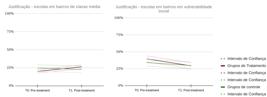
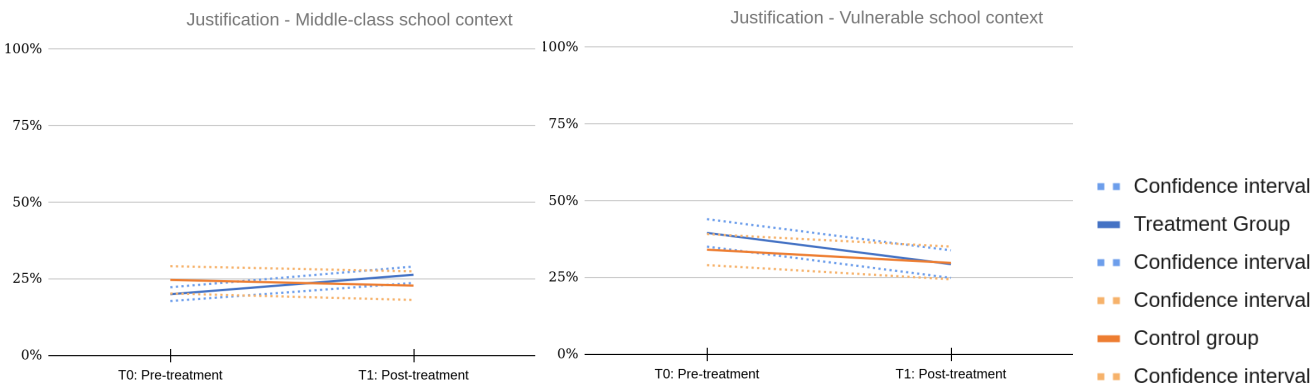
(1) When examining the overall results, combining schools from middle-class neighborhoods with those from socially vulnerable areas, we observed no significant change in the use of justifications between the first and second discussion events in either the treatment or control groups. The data would therefore suggest a rejection of H1 (i.e., the treatment group would exhibit an increase in justifications supporting their positions). However, when segmenting the data by schools in the two socioeconomic contexts, a relevant difference emerged. The treatment group in middle-class schools demonstrated a significant increase in formal justifications for their positions (from 173 speech acts, corresponding to 20% of the total, to 255 speech acts, or 25% of the total). In contrast, the treatment group in schools located in vulnerable neighborhoods exhibited a decline in the provision of arguments compared to the control group (from 184 speech acts, or 40% of the total, to 119 speech acts, or 30% of the total) (see Figures A1 and A2 in the Appendix).
It is important to highlight that, in our study, we deliberately chose not to provide supplementary information on the topic under discussion (measures to mitigate hate speech on social media). In middle-class contexts, studies indicate that students tend to possess a broader repertoire of prior knowledge (Dayrell et al., 2013; Maurissen; Claes; Barber, 2018), which, in this case, enabled them to engage in productive discussions even without receiving additional information. A plausible explanation is that students in schools located in vulnerable environments, upon learning about deliberation and becoming aware of the importance of reflective considerations, adopted a more cautious stance. Since they were not given the opportunity to access further information, they refrained from engaging in discussions for which they did not feel adequately prepared, in contrast to students in the control group. According to the literature (Gastil; Knobloch 2020; Niemeyer et al., 2024), one of the advantages of collective discussions is that not all participants need to possess specific expertise or prior knowledge, as some individuals can instruct and assist others in articulating viewpoints, expressing concerns, and reflecting on potential solutions. Thus, students in schools located in more vulnerable areas, by remaining relatively silent in the treatment group, negatively affected the overall dynamics of the discussion and the formulation of recommendations to address the issues at hand.
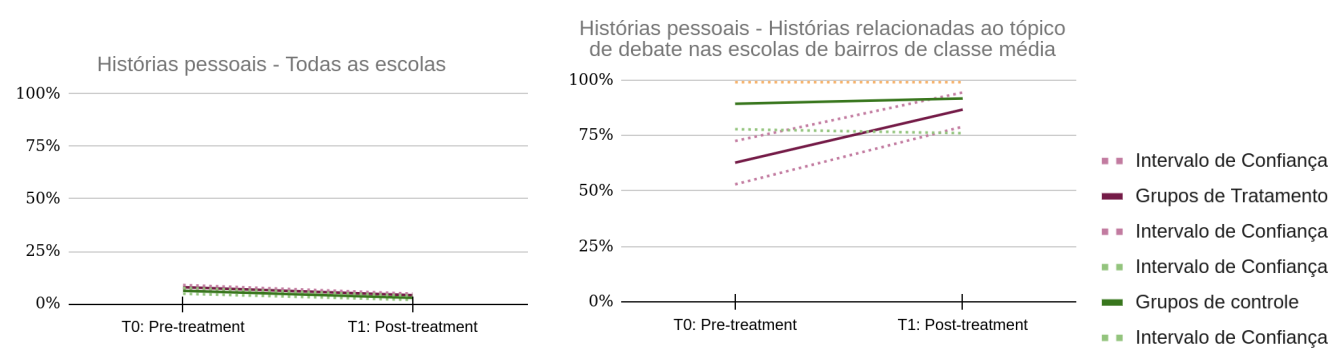
(2) In the analysis of speech acts containing narratives, we observed a significant increase in the occurrence of stories related to the discussion topic within the treatment group, thereby confirming H2 (the treatment promotes an increase in topic-focused storytelling) (see Figures A3 and A4 in the Appendix). This suggests that students who participated in the workshops sought to detail their preferences using concrete examples and articulated personal stories that contributed to the discussion. In the control group, no significant variation in the frequency of on-topic or off-topic stories was detected. The total number of stories in the control group was low, which may reflect a ceiling effect, thereby explaining the limited variation observed in this condition.
(3) We observed a similar pattern of respectful interactions in both the treatment and control groups, across middle-class and socioeconomically vulnerable environments. Since no significant changes in this variable were detected throughout the experiment, our results reject H3 (increase in respect for participants and their opinions) and support the notion that educational settings provide a face-to-face interaction environment conducive to discussing controversial issues, as widely emphasized in the literature (Avery; Levy; Simmons, 2013; Ferreira, 2019; Hess, 2022; Nishiyama, 2021). This does not imply that the school environment is harmonious or free from violence. However, authentic discussions in small groups enable participants to manage disagreement - often in a more constructive manner - when compared to unregulated informal exchanges or the dynamics of social media (Maia; Hauber; Choucair, 2023b).
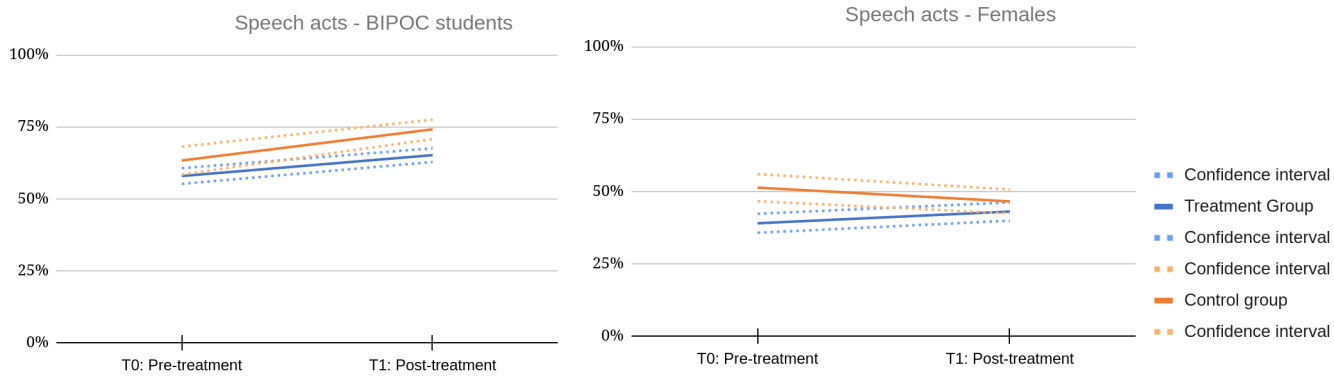
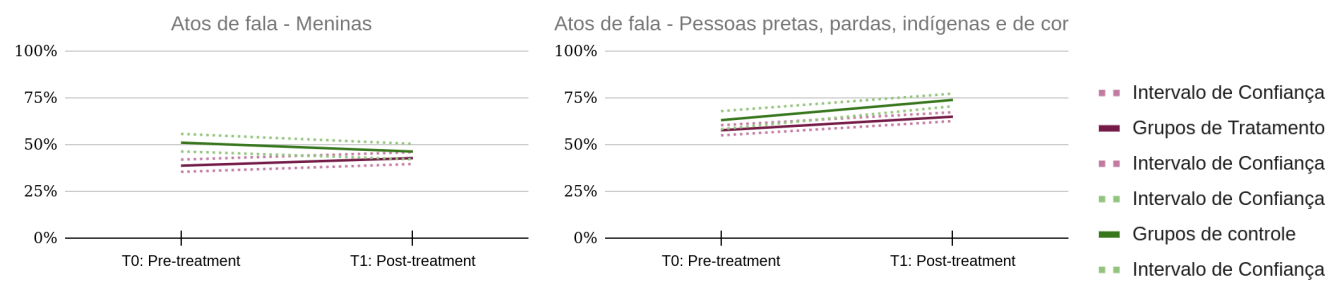
(4) More intense engagement among youth in the discussions was observed in the treatment group, confirming H4 (increase in participation). We detected a general rise in the number of speech acts during the second discussion event compared to the first (from 20.79 to 27.79 speech acts per student), as well as greater inclusion of voices. Regarding gender, there was an increase in the proportion of speech acts by girls (from 38.92% to 42.97% of total student speech acts). Notably, this increased female participation occurred both in discussion subgroups where girls were the majority and, surprisingly, also in subgroups where they were the minority. This finding reinforces the expectation that learning and practicing deliberation can strengthen self-confidence and foster recognition of the importance of expressing one’s own opinions, thereby helping to reduce gender disparities in discussions on controversial political topics. Regarding race, our study did not reveal significant changes in the participation of Black, Mixed, Indigenous and People of Colour (BIPOC), as participation increased similarly in both the treatment and control groups. To capture race-related effects more accurately, future studies should introduce systematic variations in gender and racial composition alongside socioeconomic factors, although this is challenging to achieve in field experiments with randomized designs.
Final considerations
Formal or informal educational programs explicitly based on deliberative theory carry with them the hope and commitment to create spaces and resources aimed at motivating and sustaining discussions on conflicts and disagreements over controversial issues from a democratic perspective. By quantitatively analyzing whether teaching and training deliberation alter youth behavior in concrete discussion practices, our study offers relevant conceptual, methodological, and empirical contributions. Our findings demonstrate that learning skills for democratic and deliberative discussion is not a unidimensional process; some abilities may be more easily developed than others.10 Rather than adopting a holistic perspective - as in the “open classroom climate” model or dialogic education frameworks - research focused on deliberative capacities enables the disaggregation of different components of discussion practices as a set of behaviors and skills.
Methodologically, experimental research offers a more nuanced approach compared to deliberative pedagogy and mini-public initiatives. In particular, randomized controlled experiments - though difficult to implement - allow systematic observation of variables across distinct conditions, as illustrated in this article. Much remains to be studied about the development of behaviors and attitudes that can be translated into voice, competences for justification, listening, reciprocity, and inclusion within interpersonal and group discussion dynamics. The use of diverse methods for teaching and training these capacities may be recombined, tested, and adapted across contexts to achieve more effective approaches toward the desired outcomes.
Discussion and inclusion practices are closely tied to underlying sociocultural processes and conflicts between social groups, beyond individual characteristics. Empirically, our results show that socioeconomic conditions, depending on school context, are related to the elaboration of justifications; and gender and race intersect and shape the learning dynamics of deliberative capacities. Several questions about “facilitating conditions” may be raised for future research. Identifying ways to motivate and sustain discussions democratically and effectively, in alignment with the specific types of conflicts at stake, is a challenge worth addressing.
References
-
ANDERSSON, Klas. Deliberative teaching: effects on students’ democratic virtues. Scandinavian Journal of Educational Research, London, v. 59, n. 5, p. 604-622, 2015. DOI: https://doi.org/10.1080/00313831.2014.965789. Acesso em: 15 jan. 2025.
» https://doi.org/10.1080/00313831.2014.965789 - ANGRIST, Joshua D.; IMBENS, Guido W.; RUBIN, Donald B. Identification of causal effects using instrumental variables. Journal of the American Statistical Association, v. 91, n. 434, p. 444-455, 1996. Disponível em: https://www.math.mcgill.ca/dstephens/AngristIV1996-JASA-Combined.pdf Acesso em: 15 jan. 2025.
-
AVERY, Patricia G.; LEVY, Sara A.; SIMMONS, Annette M. M. Deliberating controversial public issues as part of civic education. The Social Studies, London, v. 104, n. 3, p. 105-114, 2013. DOI: https://dx.doi.org/10.1080/00377996.2012.691571. Acesso em: 15 jan. 2025.
» https://doi.org/10.1080/00377996.2012.691571 -
AVERY, Patricia G.; LEVY, Sara A.; SIMMONS, Annette M. M. Secondary students and the deliberation of public issues. PS: Political Science & Politics, v. 47, n. 4, p. 849-854, 2014. DOI: https://doi.org/10.1017/S1049096514001164. Acesso em: 15 jan. 2025.
» https://doi.org/10.1017/S1049096514001164 -
BÄCHTIGER, André; NIEMEYER, Simon; NEBLO, Michael; STEENBERGEN, Marco; STEINER, Jürg. Disentangling diversity in deliberative democracy: competing theories, their blind spots and complementarities. Journal of Political Philosophy, v. 18, n. 1, p. 32-63, 2010. DOI: https://doi.org/10.1111/j.1467-9760.2009.00342.x. Acesso em: 15 jan. 2025.
» https://doi.org/10.1111/j.1467-9760.2009.00342.x -
BÄCHTIGER, Andre; DRYZEK, Jonh. Deliberative democracy for diabolical times: confronting populism, extremism, denial, and authoritarianism. Cambridge University Press, 2024. DOI: https://doi.org/10.1017/9781009261845. Acesso em: 15 jan. 2025.
» https://doi.org/10.1017/9781009261845 -
BLACK, Laura W.; LUBENSKY, Ron. Deliberative design and storytelling in the Australian Citizens’ Parliament. In: CARSON, Lyn; GASTIL, John; HARTZ-KARP, Janette; LUBENSKY, Ron. The Australian Citizens’ Parliament and the future of deliberative democracy. University Park: Penn State University Press, 2013. DOI: https://doi.org/10.1515/9780271062464
» https://doi.org/10.1515/9780271062464 -
BRASIL. Lei n.º 13.005, de 25 de junho de 2014. Aprova o Plano Nacional de Educação - PNE e dá outras providências. Diário Oficial da União, Brasília, DF, 26 jun. 2014. Disponível em: Disponível em: https://www.planalto.gov.br/ccivil_03/_ato2011-2014/2014/lei/l13005.htm Acesso em: 15 jan. 2025.
» https://www.planalto.gov.br/ccivil_03/_ato2011-2014/2014/lei/l13005.htm -
BRASIL. Ministério da Educação e Cultura. Conselho Nacional de Educação. Base Nacional Comum Curricular. Parecer CNE/CP nº 15/2017. Brasília, DF: MEC/CONSED, 2017. Disponível em: Disponível em: http://basenacionalcomum.mec.gov.br/images/BNCC_EI_EF_110518_versaofinal_site.pdf Acesso em: 15 jan. 2025.
» http://basenacionalcomum.mec.gov.br/images/BNCC_EI_EF_110518_versaofinal_site.pdf -
BRASIL. Ministério da Educação e Cultura. Comitê Nacional de Educação em Direitos Humanos. Plano Nacional de Educação em Direitos Humanos. 3. reimpr. simplificada. Brasília, DF: MEC, 2018. Disponível em: Disponível em: https://www.gov.br/mdh/pt-br/navegue-por-temas/educacao-em-direitos-humanos/DIAGRMAOPNEDH.pdf Acesso em: 15 jan. 2025.
» https://www.gov.br/mdh/pt-br/navegue-por-temas/educacao-em-direitos-humanos/DIAGRMAOPNEDH.pdf -
BOGAARDS, Matthijs; DEUTSCH, Franziska. Deliberation by, with, and for university students. Journal of Political Science Education, London, v. 11, n. 2, p. 221-232, 2015. DOI: https://doi.org/10.1080/15512169.2015.1016036. Acesso em: 15 jan. 2025.
» https://doi.org/10.1080/15512169.2015.1016036 -
BRADY, Henry E.; VERBA, Sidney; SCHLOZMAN, Kay Lehman. Beyond SES: a resource model of political participation. The American Political Science Review, v. 89, p. 271-294, 1995. DOI: https://doi.org/10.2307/2082425. Acesso em: 15 jan. 2025.
» https://doi.org/10.2307/2082425 -
BURLE, Fernanda R.; TURGEON, Mathieu. Ação afirmativa e desejabilidade social. Opinião Pública, Campinas, v. 26, n. 2, p. 283-322, 2020. Disponível em: Disponível em: https://www.scielo.br/j/op/a/Tw7Ty5r533W8M9NjxbbTqgS/ Acesso em: 15 jan. 2025.
» https://www.scielo.br/j/op/a/Tw7Ty5r533W8M9NjxbbTqgS/ -
CALHOUN, Craig; GAONKAR, Dilip P.; TAYLOR, Charles. Degenerations of democracy. Cambridge: Harvard University Press, 2022. https://doi.org/10.1086/726308 Acesso em: 15 jan. 2025.
» https://doi.org/10.1086/726308 -
CAMELO, Pedro. Escola em disputa: o espaço de razões e a sala de aula em tempos de Escola Sem Partido. 2021. 151 f. Dissertação (Mestrado em Comunicação Social) - Programa de Pós-Graduação em Comunicação Social, Universidade Federal de Minas Gerais, Belo Horizonte, 2021. Disponível em: Disponível em: http://hdl.handle.net/1843/79541 Acesso em: 15 jan. 2025.
» http://hdl.handle.net/1843/79541 -
CARLOMAGNO, Márcio; BRAGA, Sérgio; SAMPAIO, Rafael. Respondem os políticos a questionamentos dos eleitores? Um experimento controlando os incentivos de mensagem, período e meio. Opinião Pública, Campinas, v. 24, n. 2, p. 328-364, 2018. Disponível em: Disponível em: https://www.scielo.br/j/op/a/97fdRFRTy958X6RmKDrzwzs/ Acesso em: 15 jan. 2025.
» https://www.scielo.br/j/op/a/97fdRFRTy958X6RmKDrzwzs/ -
CHAMBERS, Simone. The philosophic origins of deliberative ideals. In: BÄCHTIGER, André; DRYZEK, John S.; MANSBRIDGE, Jane; WARREN, Mark E. (eds.). The Oxford handbook of deliberative democracy. Oxford: Oxford University Press, 2018. p. 55-69. DOI: https://doi.org/10.1093/oxfordhb/9780198747369.013.50. Acesso em: 15 jan. 2025.
» https://doi.org/10.1093/oxfordhb/9780198747369.013.50 -
CHAMBERS, Simone. Deliberative democratic theory. Annual Review of Political Science, v. 6, n. 1, p. 307-326, 2003. DOI: https://doi.org/10.1146/annurev.polisci.6.121901.085538. Acesso em: 15 jan. 2025.
» https://doi.org/10.1146/annurev.polisci.6.121901.085538 - CHAMBERS, Simone. Contemporary democratic theory. Polity Press, 2023. [Kindle edition].
-
COHEN, Joshua. Procedure and substance in deliberative democracy. In: BOHMAN, James; REHG, William (Eds.). Deliberative democracy: essays on reason and politics. Cambridge: The MIT Press, 1997. DOI: https://doi.org/10.7551/mitpress/2324.003.0017. Acesso em: 15 jan. 2025.
» https://doi.org/10.7551/mitpress/2324.003.0017 -
COOKE, Maeve. Five arguments for deliberative democracy. Political Studies, v. 48, n. 5, p. 947-969, 2000. DOI: https://doi.org/10.1111/1467-9248.00289
» https://doi.org/10.1111/1467-9248.00289 -
DASSONNEVILLE, Ruth; QUINTELIER, Ellen; HOOGHE, Marc; CLAES, Ellen. The relation between civic education and political attitudes and behavior: a two-year panel study among Belgian late adolescents. Applied Developmental Science, v. 16, n. 3, p. 140-150, 2012. DOI: https://doi.org/10.1080/10888691.2012.695265. Acesso em: 15 jan. 2025.
» https://doi.org/10.1080/10888691.2012.695265 - DEWEY, John. Democracy and education: an introduction to the philosophy of education. Simon & Brown, 2011.
- DRUCKMAN, James N.; GREENE, Donald P.; KUKLINSKI, James H.; LUPIA, Arthur. (eds.). Cambridge handbook of experimental political science. New York, NY: Cambridge University Press, 2011.
-
EL KADRI, Michele S.; MOLINARI, Andressa C.; RAMOS, Samantha M. Pedagogia deliberativa, linguagem e poder: emancipação e transformação social na educação pelo viés da teoria crítica. Revista Ibero-Americana de Estudos em Educação, Araraquara, v. 14, n. 4, p. 2088-2103, 2019. DOI: https://doi.org/10.21723/riaee.v14iesp.4.12936. Acesso em: 15 jan. 2025.
» https://doi.org/10.21723/riaee.v14iesp.4.12936 -
ENGLUND, Tomas. Rethinking democracy and education: towards an education of deliberative citizens. Journal of Curriculum Studies, v. 32, n. 2, p. 305-313, 2000. DOI: https://doi.org/10.1080/002202700182772. Acesso em: 15 jan. 2025.
» https://doi.org/10.1080/002202700182772 -
ENGLUND, Tomas. The potential of education for creating mutual trust: schools as sites for deliberation. Educational Philosophy and Theory, London, v. 43, n. 3, p. 236-248, 2011. DOI: https://doi.org/10.1111/j.1469-5812.2009.00594.x. Acesso em: 15 jan. 2025.
» https://doi.org/10.1111/j.1469-5812.2009.00594.x -
ENGLUND, Tomas. On moral education through deliberative communication. Journal of Curriculum Studies, v. 48, n. 1, p. 58-76, 2016. DOI: https://doi.org/10.1080/00220272.2015.1051119 Acesso em: 15 jan. 2025.
» https://doi.org/10.1080/00220272.2015.1051119 -
ESTERLING, Kevin. Deliberation and experimental design. In: BÄCHTIGER, André; DRYZEK, John S.; MANSBRIDGE, Jane; WARREN, Mark E. (eds.). The Oxford handbook of deliberative democracy. Oxford: Oxford University Press, 2018. p. 663-677. DOI: https://doi.org/10.1093/oxfordhb/9780198747369.001.0001 Acesso em: 15 jan. 2025.
» https://doi.org/10.1093/oxfordhb/9780198747369.001.0001 -
FELDMAN, Lauren; PASEK, Josh; ROMER, Dan; JAMIESON, Kathleen Hall. Identifying best practices in civic education: lessons from the Student Voices Program. American Journal of Education, v. 114, n. 1, p. 75-100, 2007. Disponível em: Disponível em: https://repository.upenn.edu/server/api/core/bitstreams/9f2432ec-3585-4d42-84f0-a9438dc97c89/content Acesso em: 15 jan. 2025.
» https://repository.upenn.edu/server/api/core/bitstreams/9f2432ec-3585-4d42-84f0-a9438dc97c89/content -
FERREIRA, Gil. Por que acho que sim? Sobre a importância do modelo deliberativo numa melhor prática educativa. In: GONÇALVES, Susana; COSTA, José (eds.). Diversidade no ensino superior. Coimbra: CINEP/IPC, 2019. p. 223-238. Disponível em: Disponível em: https://www.ipc.pt/wp-content/uploads/2021/05/Diversidade-ES-_Colecao-Estrategias-Ensino.pdf Acesso em: 15 jan. 2025.
» https://www.ipc.pt/wp-content/uploads/2021/05/Diversidade-ES-_Colecao-Estrategias-Ensino.pdf -
FISHKIN, James S. Consulting the public through deliberative polling. Journal of Policy Analysis and Management, v. 22, n. 1, p. 128-133, 2003. DOI: https://doi.org/10.1002/pam.10101. Acesso em: 15 jan. 2025.
» https://doi.org/10.1002/pam.10101 - FISHKIN, James S. When the people speak: deliberative democracy and public consultation. Oxford: Oxford University Press, 2009.
- FREIRE, Paulo. Educação como prática da liberdade. Rio de Janeiro: Editora Paz e Terra, 1986.
- FREIRE, Paulo. Pedagogia da autonomia. 3. ed. São Paulo: Paz e Terra, 1996.
- FREIRE, Paulo. Pedagogia do oprimido. 84. ed. São Paulo: Paz e Terra, 2019.
- GASTIL, John; KNOBLOCH, Katherine. R. Hope for democracy: How citizens can bring reason back into politics. New York: Oxford University Press, 2020.
-
GODFREY, Erin B.; GRAYMAN, Justina K. Teaching citizens: the role of open classroom climate in fostering critical consciousness among youth. Journal of Youth and Adolescence, v. 43, n. 11, p. 1801-1817, 2014. DOI: https://doi.org/10.1007/s10964-013-0084-5. Acesso em: 15 jan. 2025.
» https://doi.org/10.1007/s10964-013-0084-5 -
GUTMANN, Amy; THOMPSON, Dennis F. Reflections on deliberative democracy: when theory meets practice. In: BÄCHTIGER, André; DRYZEK, John S.; MANSBRIDGE, Jane; WARREN, Mark E. (eds.). The Oxford handbook of deliberative democracy. Oxford: Oxford University Press, 2018. p. 900-912. DOI: https://doi.org/10.1093/oxfordhb/9780198747369.013.44. Acesso em: 15 jan. 2025.
» https://doi.org/10.1093/oxfordhb/9780198747369.013.44 - HABERMAS, Jürgen. The theory of communicative action: lifeworld and system: a critique of functionalist reason. Beacon Press, 1987.
- HABERMAS, Jürgen. Between facts and norms. Massachusetts: MIT Press, 1996.
- HABERMAS, Jürgen. Postmetaphysical thinking II: essays and replies. Polity Press, 2017.
-
HABERMAS, Jürgen. Interview with Jürgen Habermas (trans. C. Cronin). In: BÄCHTIGER, André; DRYZEK, John S.; MANSBRIDGE, Jane; WARREN, Mark E. (eds.). The Oxford handbook of deliberative democracy. Oxford: Oxford University Press, 2018. p. 871-882. DOI: https://doi.org/10.1093/oxfordhb/9780198747369.013.60. Acesso em: 15 jan. 2025.
» https://doi.org/10.1093/oxfordhb/9780198747369.013.60 - HESS, Diana E. Controversy in the classroom: the democratic power of discussion. New York, NY: Routledge, 2009.
- HESS, Diana E. Making classroom discussions work: methods for quality dialogue in the social studies. New York: Teachers College, 2022.
- KARRUZ, Ana. Oferta, demanda e nota de corte: experimento natural sobre efeitos da Lei das Cotas no acesso à Universidade Federal de Minas Gerais. Dados, Rio de Janeiro, v. 61, n. 2, p. 405-462, 2018. Disponível em: https://dados.iesp.uerj.br/artigos/?id=1111 Acesso em: 15 jan. 2025.
- KRIPPENDORFF, Klaus. Content analysis: an introduction to its methodology. Los Angeles: Sage Publications, 2012.
-
LONGO, Nicholas V.; MANOSEVITCH, Idit; SHAFFER, Timothy J. Introduction. In: SHAFFER, Timothy J.; LONGO, Nicholas V.; MANOSEVITCH, Idit; THOMAS, Maxine S. (Eds.). Deliberative pedagogy: teaching and learning for democratic engagement. Michigan: Michigan State University Press, p. xix-xxxvi, 2017. Disponível em: Disponível em: http://www.jstor.org/stable/10.14321/j.ctt1qd8zh2.5 Acesso em: 15 jan. 2025.
» http://www.jstor.org/stable/10.14321/j.ctt1qd8zh2.5 - LONGO, Nicholas V.; SHAFFER, Timothy J. Creating space for democracy: a primer on dialogue and deliberation in higher education. New York: Routledge, 2019.
-
MAGALHÃES, Suzana. Lições em sala de aula: interações na prática da pedagogia deliberativa em uma escola pública. 2020. 162 f. Dissertação (Mestrado em Comunicação Social) - Programa de Pós-Graduação Comunicação, Cultura e Amazônia, Universidade Federal do Pará, Belém, 2020. Disponível em: Disponível em: https://repositorio.ufpa.br/items/cf07ce66-a10d-4a06-a62e-36029e1ccd9 e Acesso em: 15 jan. 2025.
» https://repositorio.ufpa.br/items/cf07ce66-a10d-4a06-a62e-36029e1ccd9 - MAIA, Rousiley C. M. Deliberation, the Media, and Political Talk. New York: Hampton Press, 2012.
- MAIA, Rousiley C. M. Recognition and the Media. Londres: Palgrave Macmillan, 2014.
-
MAIA, Rousiley C. M.; GARCÊZ, Regiane. Recognition, feelings of injustice and claim justification: a case study of deaf people’s storytelling on the internet. European Political Science Review. v. 6, n. 3, p. 359-382, 2014. DOI: https://doi.org/doi:10.1017/S1755773913000143
» https://doi.org/10.1017/S1755773913000143 -
MAIA, Rousiley C. M.; CAL, Danila; BARGAS, Janine K. R.; OLIVEIRA, Vanessa V.; ROSSINI, Patrícia G. C.; SAMPAIO, Rafael C. Authority and deliberative moments: assessing equality and inequality in deeply divided groups. Journal of Deliberative Democracy, v. 13, n. 2, 2017. Disponível em: Disponível em: https://delibdemjournal.org/article/id/555/ Acesso em: 15 jan. 2025.
» https://delibdemjournal.org/article/id/555/ -
MAIA, Rousiley C. M.; CAL, Danila; BARGAS, Janine; CREPALDE, Neylson. Which types of reason-giving and storytelling are good for deliberation? Assessing the discussion dynamics in legislative and citizen forums. European Political Science Review, v. 12, n.2, p. 113-132, 2020. DOI: https://doi.org/10.1017/S1755773919000328 Acesso em: 15 jan. 2025.
» https://doi.org/10.1017/S1755773919000328 -
MAIA, Rousiley C. M.; CAL, Danila; HAUBER, Gabriella; LEÃO, Augusto Veloso. Learning deliberative capacities in Brazilian schools. Journal of Deliberative Democracy, v. 19, 2023a. DOI: https://doi.org/10.16997/jdd.1156. Acesso em: 15 jan. 2025.
» https://doi.org/10.16997/jdd.1156 - MAIA, Rousiley C. M.; HAUBER, Gabriella; CHOUCAIR, Tariq. The deliberative system and inter-connected media in times of uncertainty. Cham: Palgrave Macmillan, 2023b.
-
MAIA, Rousiley C. M.; HAUBER, Gabriella; CAL, Danila; LEÃO, Augusto Veloso. Teaching and developing deliberative capacities: an integrated approach to peer-to-peer, playful, and authentic discussion-based learning. Democracy and Education, Oregon, v. 32, n. 1, 2024a. Disponível em: Disponível em: https://democracyeducationjournal.org/home/vol32/iss1/5/ Acesso em: 15 jan. 2025.
» https://democracyeducationjournal.org/home/vol32/iss1/5/ -
MAIA, Rousiley C. M.; HAUBER, Gabriella; LEÃO, Augusto Veloso; CUNHA, Leonardo Santa Inês. Desenvolvendo capacidades para a comunicação democrática: uma abordagem integrada de ensino baseada na deliberação. Comunicação & Educação, São Paulo, Brasil, v. 29, n. 1, p. 43-64, 2024b. DOI: 10.11606/issn.2316-9125.v29i1p43-64. Disponível em: Disponível em: https://www.revistas.usp.br/comueduc/article/view/223535 Acesso em: 15 jan. 2025.
» https://doi.org/10.11606/issn.2316-9125.v29i1p43-64» https://www.revistas.usp.br/comueduc/article/view/223535 -
MAIA, Rousiley C. M.; CHOUCAIR, Tariq; HAUBER, Gabriella; SANTA INÊS, Leonardo. Deliberative theory for re-focusing the concept, measurement, and analysis of substantive reasons in political discussions. Constellations, v. 32, n. 3, 2025. https://doi.org/10.1111/1467-8675.12795 Acesso em: 15 jan. 2025.
» https://doi.org/10.1111/1467-8675.12795 - MAIA, Rousiley C. M.; ORLANDINI, Maiara (orgs.). Esfera pública no Brasil: diferentes faces dos conflitos sociais, rupturas e reconstrução democrática. Salvador: EdUFBA, 2025.
- MAIA, Rousiley C. M.; LEÃO, Augusto Veloso; CAMELO, Pedro. Pesquisas com desenho experimental. In: MAIA, Rousiley C. M. (org.). Métodos de Pesquisa. 1. ed. Salvador: EDUFBA, 2022. p. 251-275.
-
MAURISSEN, Lies; CLAES, Ellen; BARBER, Carolyn. Deliberation in citizenship education: how the school context contributes to the development of an open classroom climate. Social Psychology of Education, Dordrecht, v. 21, p. 951-972, 2018. DOI: https://doi.org/10.1007/s11218-018-9449-7. Acesso em: 15 jan. 2025.
» https://doi.org/10.1007/s11218-018-9449-7 -
MEIRELES, Fernando. Carreiras políticas na Câmara dos Deputados: uma análise quase-experimental. Dados, Rio de Janeiro, v. 62, n. 4, p. e20160198, 2019. Disponível em: Disponível em: https://www.scielo.br/j/dados/a/g76FD6prXVnWLrJTCmLPxJq/ Acesso em: 15 jan. 2025.
» https://www.scielo.br/j/dados/a/g76FD6prXVnWLrJTCmLPxJq/ - MOLNAR-MAIN, Stacie. Deliberation in the classroom: fostering critical thinking, community, and citizenship in schools. Ohio: Kettering Foundation, 2017.
-
MOURON, Fernando; URDINEZ, Francisco; ONUKI, Janina. Framing effects on foreign policy: experimental evidence from emerging countries and the Argentine-Brazilian rivalry. Opinião Pública, Campinas, v. 22, n. 1, p. 195-218, 2016. Disponível em: Disponível em: https://www.scielo.br/j/op/a/Htwnw5m6d94xVSjgbh9h4QQ/ Acesso em: 15 jan. 2025.
» https://www.scielo.br/j/op/a/Htwnw5m6d94xVSjgbh9h4QQ/ -
MUNDIM, Pedro; VIDIGAL, Robert; MICHELOTTI, Fernando; PINTO, André. Bolsa Família, informação e preconceito: uma análise com o uso de experimentos. Revista do Serviço Público, Brasília, DF, v. 70, n. 4, p. 551-575, 2019. Disponível em: Disponível em: https://revista.enap.gov.br/index.php/RSP/article/view/3288 Acesso em: 15 jan. 2025.
» https://revista.enap.gov.br/index.php/RSP/article/view/3288 - NEUENDORF, Kimberly. The content analysis guidebook. Los Angeles: Sage Publications, 2002.
-
NIEMEYER, Simon; VERI, Francesco; DRYZEK, John S.; BÄCHTIGER, André. How deliberation happens: enabling deliberative reason. American Political Science Review, v. 118, n. 1, p. 345-362, 2024. Disponível em: https://doi.org/10.1017/S0003055423000023. Acesso em: 15 jan. 2025.
» https://doi.org/10.1017/S0003055423000023 -
NISHIYAMA, Kei. Enabling children’s deliberation in deliberative systems: schools as a mediating space. Journal of Youth Studies, v. 22, n. 4, p. 473-488, 2019. Disponível em: https://doi.org/10.1080/13676261.2018.1514104. Acesso em: 15 jan. 2025.
» https://doi.org/10.1080/13676261.2018.1514104 -
NISHIYAMA, Kei. Democratic education in the fourth generation of deliberative democracy. Theory and Research in Education, v. 19, n. 2, p. 109-126, 2021. DOI: https://doi.org/10.1177/14778785211017102. Acesso em: 15 jan. 2025.
» https://doi.org/10.1177/14778785211017102 - NOGUEIRA, Maria Alice; VIEIRA, Maria M.; RESENDE, José. Habitar escolas e suas margens. Portalegre, Portugal: Instituto Politécnico de Portalegre, 2013.
-
NUSSBAUM, Martha C. Capabilities, entitlements, rights: supplementation and critique. Journal of Human Development and Capabilities, v. 12, n. 1, p. 23-37, 2011. Disponível em: https://doi.org/10.1080/19452829.2011.541731. Acesso em: 15 jan. 2025.
» https://doi.org/10.1080/19452829.2011.541731 - NUSSBAUM, Martha C. Creating capabilities: the human development approach. Massachusetts: Harvard University Press, 2013.
-
OLIVEIRA, Emmanuel; MOISÉS, José. Corruption in the perception of Brazilian society: persistence and resilience. Opinião Pública, Campinas, v. 29, n. 2, p. 270-303, 2023. Disponível em: Disponível em: https://www.scielo.br/j/op/a/fPq8FJcFwrLbNhHPMmNf59f/ Acesso em: 15 jan. 2025.
» https://www.scielo.br/j/op/a/fPq8FJcFwrLbNhHPMmNf59f/ -
OLIVEIRA, Thaiane; SOUSA, Lumárya. A educação midiática, diálogos e práticas possíveis com crianças no ambiente educacional da favela. Comunicação & Educação, v. 27, n. 2, p. 63-77, 2022. DOI: https://doi.org/10.11606/issn.2316-9125.v27i2p63-77. Acesso em: 15 jan. 2025.
» https://doi.org/10.11606/issn.2316-9125.v27i2p63-77 -
PASQUARELLI, Bruno Vicente Lipe; CHIRINÉA, Andréia Melanda. Teoria democrática e políticas de educação: a importância da deliberação para a accountability. Revista Eletrônica de Educação, v. 11, n. 3, p. 846-861, 2017. DOI: https://doi.org/10.14244/198271991702. Acesso em: 15 jan. 2025.
» https://doi.org/10.14244/198271991702 -
POLLETTA, Francesca; LEE, John. Is telling stories good for democracy? Rhetoric in public deliberation after 9/11. American Sociological Review, v. 71, n. 5, p. 699-721, 2006. DOI: https://doi.org/10.1177/000312240607100501
» https://doi.org/10.1177/000312240607100501 - PORTO, Mauro. Enquadramentos da mídia e política. In: RUBIM, A. A. C. (org.). Comunicação e política: conceitos e abordagens. Salvador: Edufba, 2004. p. 73-104. Acesso em: 15 jan. 2025.
- PORTO, Mauro P. Televisão e política no Brasil: a Rede Globo e as interpretações da audiência. Rio de Janeiro: e-papers, 2007.
- REBER, Bernard. Responsible deliberation, between conversation and consideration: conditions for a great democratic debate. Londres: Wiley-Iste, 2023.
- REUCHAMPS, Min; VRYDAGH, Julien; WELP, Yanina (eds.). De Gruyter handbook of citizens’ assemblies. 1. ed. De Gruyter, 2023.
-
RUSSO, Guilherme A.; PIMENTEL JUNIOR, Jairo; AVELINO, George. O crescimento da direita e o voto em Bolsonaro: causalidade reversa? Opinião Pública, Campinas, v. 28, n. 3, p. 594-614, 2022. Disponível em: Disponível em: https://www.cesop.unicamp.br/vw/1I8TzTKswNQ_MDA_7aa08_/2.%20O%20crescimento%20da%20direita%20e%20voto%20em%20Bolsonaro.pdf Acesso em: 15 jan. 2025.
» https://www.cesop.unicamp.br/vw/1I8TzTKswNQ_MDA_7aa08_/2.%20O%20crescimento%20da%20direita%20e%20voto%20em%20Bolsonaro.pdf -
SAMUELSSON, Martin. Education for deliberative democracy: a typology of classroom discussions. Democracy & Education, v. 24, n. 1, p. 1-9, 2016. [artigo 5]. Disponível em: Disponível em: https://democracyeducationjournal.org/home/vol24/iss1/5/ Acesso em: 15 jan. 2025.
» https://democracyeducationjournal.org/home/vol24/iss1/5/ -
SEN, Amartya Kumar. Democracy as a universal value. Journal of Democracy, v. 10, n. 3, p. 3-17, 1999. DOI: https://doi.org/10.1353/jod.1999.0055. Acesso em: 15 jan. 2025.
» https://doi.org/10.1353/jod.1999.0055 - SEN, Amartya Kumar. The idea of justice. Massachusetts: Harvard University Press, 2009.
-
SHAFFER, Timothy J.; LONGO, Nicholas V.; MANOSEVITCH, Idit; THOMAS, Maxine S.; BARGERSTOCK, Burton A.; VAN EGEREN, Laurie A.; FITZGERALD, Hiram E. (orgs.). Deliberative pedagogy: teaching and learning for democratic engagement. Michigan: Michigan State University Press, 2017. Disponível em: Disponível em: https://www.jstor.org/stable/10.14321/j.ctt1qd8zh2 Acesso em: 15 jan. 2025.
» https://www.jstor.org/stable/10.14321/j.ctt1qd8zh2 -
SILVA, Glauco. Mesmas instituições, mesmos resultados? Comparando o efeito da competição eleitoral sobre os níveis de concentração de votos. Opinião Pública, v. 23, n. 3, p. 682-713, 2017. DOI:10.1590/1807-01912017233682 Acesso em: 15 jan. 2025.
» https://doi.org/10.1590/1807-01912017233682 -
SOLT, Frederick. Economic inequality and democratic political engagement. American Journal of Political Science, v. 52, n. 1, p. 48-60, 2008. DOI: https://doi.org/10.1111/j.1540-5907.2007.00298.x. Acesso em: 15 jan. 2025.
» https://doi.org/10.1111/j.1540-5907.2007.00298.x - STEINER, Jürg. The foundations of deliberative democracy: empirical research and normative implications. Cambridge: Cambridge University Press, 2012.
- STEINER, Jürg; BÄCHTIGER, André; SPÖRNDLI, Markus; STEENBERGEN, Marco R. Deliberative politics in action: cross-national study of parliamentary debates. Cambridge: Cambridge University Press, 2004.
- STEINER, Jürg; JARAMILLO, Maria Clara; MAIA, Rousiley C. M.; MAMELI, Simona. Deliberation across deeply divided societies: transformative moments. Cambridge: Cambridge University Press, 2017.
- TEIXEIRA, Anísio. Educação para a democracia: Introdução à administração educacional. 2. ed. Rio de Janeiro: Editora UFRJ, 1997.
-
THOMPSON, Dennis F. Deliberative democratic theory and empirical political science. Annual Review of Political Science, v. 11, n. 1, p. 497-520, 2008. DOI: https://doi.org/10.1146/annurev.polisci.11.081306.070555. Acesso em: 15 jan. 2025.
» https://doi.org/10.1146/annurev.polisci.11.081306.070555 -
THORNBERG, Robert. School democratic meetings: pupil control discourse in disguise. Teaching and Teacher Education, v. 26, n. 4, p. 924-932, 2010. Disponível em: Disponível em: https://www.sciencedirect.com/science/article/abs/pii/S0742051X09002315?via%3Dihub Acesso em: 15 jan. 2025.
» https://www.sciencedirect.com/science/article/abs/pii/S0742051X09002315?via%3Dihub - TURGEON, Mathieu; CHAVES, Bruno; WIVES, William. Políticas de ação afirmativa e o experimento de listas: O caso das cotas raciais na universidade brasileira. Opinião Pública, Campinas, v. 20, n. 3, p. 363-376, 2014. Acesso em: 15 jan. 2025.
-
UGARRIZA, Juan E.; CALUWAERTS, Didier (orgs.). Democratic deliberation in deeply divided societies. Palgrave Macmillan UK, 2014. DOI: https://doi.org/10.1057/9781137357816. Acesso em: 15 jan. 2025.
» https://doi.org/10.1057/9781137357816 - VIEIRA, Maria M.; RESENDE, José; NOGUEIRA, Maria Alice; DAYRELL, Juarez; MARTINS, Alexandre; CALHA, António. Habitar escolas e suas margens. Portalegre, Portugal: Instituto Politécnico de Portalegre, 2013.
-
8
This article engages with and complements the reflections and findings presented in Maia et al. (2023a) in the Journal of Deliberative Democracy, Maia et al. (2024a) in Democracy & Education, and Maia et al. (2024b) in Revista Comunicação & Educação.
-
9
Habermas, 1996; see also Cohen, 1997; Chambers, 2003, 2018; Steiner, 2012; Thompson, 2008; and Maia 2012.
-
10
The detailed results on this issue are presented in Maia et al. (2023a).
-
Data Availability
The entire dataset from this study was published in the article
Appendix Is it Possible to Learn Skills for Democratic Discussions? An Experiment about Deliberative Capacities with controversial topics
In total, we analyzed 4.556 speech acts in the first discussion event (1.397 from control subgroups; 3.159 from treatment subgroups) and 5.271 speech acts in the second discussion event (1.594 from control subgroups; 3.677 from treatment subgroups).
Hypotheses
Null hypothesis
H0: Students after participating in workshops on deliberative capacities will not show any difference in their deliberative capacities compared to the control group
Alternative hypotheses:
H1: Students after participating in workshops on deliberative capacities will have an increase in justifications to support their positions between the first and second discussion events
H2: Students after participating in workshops on deliberative capacities will display more stories focused on the topic under discussion between the first and second discussion events
H3: Students after participating in workshops on deliberative capacities will have increase in respect between the first and second discussion events
H4: Students after participating in workshops on deliberative capacities will have increase in participation between the first and second discussion events

Standardized difference in means from sociodemographic variables between treatment groups and control groups
Hypotheses testing
Z-test
A Z-test checks for a statistically valid difference in the proportions of our analytical categories in the two discussion events. When we observe a statistically valid difference in the proportion (hereby defined as p < 0,05), the difference in occurrence of the speech acts are not a result from a normal deviation in the same proportion. In that case, the difference in proportion shows a change in the distribution of a given characteristic in a population, for example, a general decrease in the proportional occurrence of speech acts with personal stories. This test checks only for the existence or not of a statistically valid difference in the proportion, and does not indicate any relation of cause and effect between treatment and the results in the second discussion event.
Difference in Differences (DiD)
The Difference in Differences (DiD) test was used to estimate the effect of treatment because it allows to compare differences in proportions. Once this test measures the proportional occurrence of the variables for the treatment and control groups before and after the treatment, this test is not affected by differences in the starting or ending point of measurements (for example, it is not affected by the number of students in each group, in the volume of speech acts, or other differences between the classes). A central assumption from DiD is that the treatment and control groups would show parallel change tendencies in the absence of treatment. In other words, changes can happen in both groups (control and treatment), therefore, we can only talk about effects caused by the treatment when the changes happen in different directions or different magnitudes between both groups. This test was chosen because it works well to mitigate the effects from selection biases and other external factors, like effects from general events than happened between the first and second discussion events.

Speech acts with justification in treatment and control groups in schools located in middle-class neighborhoods and socially vulnerable neighborhoods

Speech acts with all personal stories in treatment and control groups located in all schools and speech acts with on-topic personal stories in schools located in middle-class neighborhoods

-
Editors
Debora Rezende de AlmeidaRebecca Neaera Abers
The entire dataset from this study was published in the article

 Thumbnail
 Thumbnail
 Thumbnail
 Source: Prepared by the authors, adapted from
  Source: Prepared by the authors, adapted from
  Source: Prepared by the authors.
 Source: Prepared by the authors.
 Source: Prepared by the authors.
 Fonte: Elaboração própria.
 Fonte: Elaboração própria.
 Fonte: Elaboração própria.