 Translation and Validation of the OVAMA Questionnaire into Portuguese and Its Application in Patients with Vascular Anomalies
Abstract
Introduction The Outcome Measures for Vascular Malformations (OVAMA) questionnaire evaluates subjective outcomes of vascular malformation treatments. Originally written in Dutch, its clinical application in Brazil requires a translation into Portuguese.
Materials and Methods Bilingual teams performed direct and reverse translations, and the authors submitted a consensus version to specialists. The final version underwent testing on 8 patients of different ages, genders, and diagnoses. Their feedback led to adjustments to ensure the questionnaire's equivalence to the original.
Results The subjects had a broad understanding of the Portuguese version, although some minor difficulties were noted. Final adaptations ensured clarity and accessibility without compromising the original content.
Conclusion The translated OVAMA questionnaire will contribute to the standardized assessment of quality of life and therapeutic outcomes in vascular malformations, aiding in the optimization of clinical and surgical approaches.
Keywords
outcome assessment, health care; surgery, plastic; vascular malformations; patient reported outcome measures; disease impact profile; quality of life
Resumo
Introdução O questionário Avaliação de Resultados de Malformações Vasculares (OVAMA, do inglês Outcome Measures for Vascular Malformations) avalia resultados subjetivos dos tratamentos de malformações vasculares. Escrito originalmente em holandês, sua tradução para o português se faz necessária para aplicação clínica no Brasil.
Materiais e Métodos Realizou-se tradução direta e reversa por equipes bilíngues, com elaboração de uma versão consensual submetida a especialistas. A versão final foi aplicada em oito pacientes de diferentes idades, gêneros e diagnósticos. Foram realizados ajustes após o feedback, mantendo equivalência ao original.
Resultados A versão em português foi amplamente compreendida, embora dificuldades pontuais tenham sido observadas. As adaptações finais garantiram clareza e acessibilidade sem comprometer o conteúdo original.
Conclusão O questionário OVAMA traduzido contribuirá para a avaliação padronizada de qualidade de vida e resultados terapêuticos em malformações vasculares, auxiliando na otimização de condutas clínicas e cirúrgicas.
Palavras-chave
avaliação de resultados em cuidados de saúde; cirurgia plástica; malformações vasculares; medidas de resultados relatados pelo paciente; perfil de impacto da doença; qualidade de vida
Introduction
Peripheral vascular malformations are congenital anomalies of blood vessels, featuring vessels with dilation, tortuosity, or an abnormal quantity. According to the affected vessels, these malformations can be capillary, venous, lymphatic, arteriovenous, or have a combined origin.1–3 The pathophysiology of vascular malformations involves defects in angiogenesis and vasculogenesis. Despite being congenital, their diagnosis may occur after birth, during adolescence, or early adulthood.
The clinical picture is quite variable as signs and symptoms depend on the anatomical location, involved tissue planes, type of malformation, and lesion size.1,3,4 Symptoms may include pain, swelling, physical disability, bleeding, and thrombosis.5
It is now well established that patients with vascular malformations have a poorer quality of life4,5 because lesions present changes in color, size, and texture compared with normal skin. They can lead to abnormal physical features, particularly when occurring in the head and neck region. As such, external perception becomes a significant component in patients' self-esteem and mental health.2,5
In this context, the treatment of vascular malformations is a critical ally in optimizing patients' quality of life and self-esteem. In 2018, Horbach et al. created the Outcome Measures for Vascular Malformations (OVAMA) questionnaire, which focuses on outcomes of therapeutic interventions to measure and assist the development of a treatment algorithm for vascular malformations.1
The questionnaire was developed in Dutch and focuses on the subjective assessment of vascular malformation treatments' outcomes from the perspective of patients (> 14-years-old) or family members (< 14-years).1,3 To date, OVAMA is the only validated questionnaire specific to vascular malformations.6 Its application in the Brazilian population requires its translation and validation into Portuguese. The present article describes this process.
Objective
This study aimed to describe the translation and validation process of the OVAMA questionnaire into Portuguese and its application in patients with vascular malformations.
Materials and Methods
The Ethics Committee of Hospital das Clínicas, Faculdade de Medicina, Universidade de São Paulo (HC-FMUSP) reviewed and approved this study under the number 75108623.2.0000.0068.
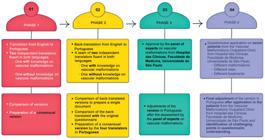
After authorization from the authors (OVAMA consensus group), we proceeded to the translation and validation of the questionnaire into Portuguese from January to April 2024. The process was divided into 4 phases:
-
Translation of the questionnaire from English to Portuguese by two translators fluent in both languages (one with medical knowledge on vascular malformations and one without). We compared the independent translations and developed a consensus.
-
Back-translation of the previous version from English to Portuguese by a second team of two translators fluent in both languages (one with medical knowledge on vascular malformations and one without). After comparing them with the original version, the four translators consensually produced a final Portuguese version.
-
Submission of the final Portuguese version for approval by a panel of experts in vascular malformations at HC-FMUSP.
-
The Portuguese version of each questionnaire was used in a heterogeneous group of 8 patients (with different malformations in distinct sites and undergoing diverse treatments) at the Vascular Anomalies Outpatient Clinic of HC-FMUSP. Half of the patients completed the questionnaires without help, as they were over 14-years-old. The other half responded with assistance, or, if very young, their guardians answered.
The questionnaire application through Google Forms (Google LLC) occurred after an outpatient consultation. The informed consent form was the introductory part of the questionnaire, and the authors committed to providing a copy to each patient.
Following the test with patients, we adapted the Portuguese version to facilitate understanding, preserving the content of the original version, with the approval of the original group (Appendix 1, Fig. 1).
Results
The translation process and the final Portuguese version of the questionnaires occurred according to the protocol proposed by the originating institution, which holds the copyright. We applied the OVAMA to patients from the Vascular Malformations Outpatient Clinic of the HC-FMUSP.
Patients and family members who completed the questionnaire were able to understand and respond for the most part. Sometimes, they required help from the assistant team. Subsequently, we made a few adjustments in language to ensure greater understanding by the general public.
We selected patients of different ages, from both genders, and several diagnoses, according to the latest classification proposed by the International Society for the Study of Vascular Anomalies (ISSVA). Table 1 shows the patients' epidemiological data.
Patients' epidemiological data (questionnaire application in phase 3 of the translation process)
Discussion
The Brazilian Ministry of Health's latest census, from 2022, identified that approximately 13 million Brazilians have rare diseases, for which 95% have no specific treatment. This spectrum includes vascular tumors and malformations, still little known to the Brazilian population and, at times, even to the medical community.
Brazil has few referral centers for the treatment of vascular tumors and malformations, both in public and private settings. The HC-FMUSP is the referral center for these patients in the state of São Paulo, as well as receiving patients from other Brazilian states, including Rondônia, Roraima, Pará, Mato Grosso, and Espírito Santo. As such, it is the largest referral center in Brazil, with broad sociocultural, economic, and, consequently, educational diversity among its population.
The questionnaire required the participation of parents or guardians for more than half of the sample, as they were under 14-years-old at the time of administration, as recommended by the institution of origin. This was the greatest challenge for the study, as it was sometimes difficult to convey to guardians the need for responses based on the children's self-perception and image, rather than solely on their perceptions of the child. This obstacle was closely related to the caregivers' educational levels, with greater difficulty in understanding the questionnaires among those with lower levels.
Conclusion
The use of the OVAMA questionnaire by plastic surgeons and other specialists in vascular malformations (including vascular surgeons, pediatricians, hematologists, radiologists, and pediatric surgeons) may provide important information about its treatment and correlation with the patients' quality of life, to provide the best aesthetic and functional outcomes.
Clinical Trials
Financial Support
Data Availability
Data will be available upon request to the corresponding author.
References
-
1 Horbach SER, van der Horst CMAM, Blei F, van der Vleuten CJM, Frieden IJ, Richter GT, et al; OVAMA Consensus Group. Development of an international core outcome set for peripheral vascular malformations: the OVAMA project. Br J Dermatol 2018;178(02): 473–481. Doi: 10.1111/bjd.16029
» https://doi.org/10.1111/bjd.16029 -
2 Lokhorst MM, Horbach SER, Waner M, O TM, van der Vleuten CJM, Spuls PI, van der Horst CMAM. Responsiveness of quality of life measures in children with peripheral vascular malformations: The OVAMA project. JPRAS Open 2020;27:70–79. Doi: 10.1016/j. jpra.2020.11.013
» https://doi.org/10.1016/j.jpra.2020.11.013 -
3 Lokhorst MM, Horbach SER, Young-Afat DA, Stor MLE, Haverman L, Spuls PI, et al; OVAMA Steering Group. Development of a condition-specific patient-reported outcome measure for measuring symptoms and appearance in vascular malformations: the OVAMA questionnaire. Br J Dermatol 2021;185(04):797–803. Doi: 10.1111/bjd.20429
» https://doi.org/10.1111/bjd.20429 -
4 Lokhorst MM, Horbach SER, van der Horst CMAM, Spuls PIOVAMA Steering Group. Finalizing the international core domain set for peripheral vascular malformations: the OVAMA project. Br J Dermatol 2019;181(05):1076–1078. Doi: 10.1111/bjd. 18043
» https://doi.org/10.1111/bjd.18043 -
5 Stor MLE, Lokhorst MM, Horbach SER, Young-Afat DA, Spuls PI, van der Horst CMAM. Appearance-related concerns and their impact on health-related quality of life in patients with peripheral vascular malformations. J Plast Reconstr Aesthet Surg 2022;75(11):4202–4211. Doi: 10.1016/j.bjps.2022.08.042
» https://doi.org/10.1016/j.bjps.2022.08.042 -
6 Horbach SER, Rongen APM, Elbers RG, van der Horst CMAM, Prinsen CAC, Spuls PICollaborators OVAMA consensus group. Outcome measurement instruments for peripheral vascular malformations and an assessment of the measurement properties: asystematic review. Qual Life Res 2020;29(01):1–17. Doi: 10.1007/ s11136-019-02301-x
» https://doi.org/10.1007/s11136-019-02301-x