
 Pendular energy transduction and body center of mass levelling at different gait speeds in middle-aged versus young adults
ABSTRACT
This study examined whether gait mechanics already differ in middle-aged adults respect to young adults. Thirty young (18–30 years) and thirty middle-aged (50–59 years) adults walked at self-selected, slow, and fast speeds. Spatiotemporal variables increased with speed in both groups, but middle-aged adults showed smaller increments in mean speed and dimensionless velocity. At the angular level, differences were most evident at the knee, where middle-aged adults exhibited greater flexion. Energetic analysis revealed lower energy recovery and higher energy congruence, indicating reduced pendular efficiency. These findings suggest that early gait adaptations emerge in midlife, especially under higher mechanical demands.
Keywords:
Gait analysis; Mechanical energy; Kinematic study; Biomechanical modelling
RESUMO
Este estudo examinou se a mecânica da marcha já difere em adultos de meia-idade. Trinta adultos jovens (18–30 anos) e trinta adultos de meia-idade (50–59 anos) caminharam em velocidades autosselecionadas, lentas e rápidas. As variáveis espaço-temporais aumentaram com a velocidade em ambos os grupos, mas os adultos de meia-idade apresentaram incrementos menores na velocidade média e na velocidade adimensional. No nível angular, as diferenças foram mais evidentes no joelho, onde os adultos de meia-idade exibiram maior flexão. A análise energética revelou menor recuperação de energia e maior congruência energética, indicando eficiência pendular reduzida. Esses achados sugerem que as adaptações precoces da marcha surgem na meia-idade, especialmente sob maiores demandas mecânicas.
Palavras-chave:
Análise da marcha; Energia mecánica; Estudo cinemático; Modelagem biomecânica
RESUMEN
Este estudio examinó si la mecánica de la marcha ya difiere en adultos de mediana edad. Treinta adultos jóvenes (18-30 años) y treinta de mediana edad (50-59 años) caminaron a velocidades autoseleccionadas, lentas y rápidas. Las variables espaciotemporales aumentaron con la velocidad en ambos grupos, los adultos de mediana edad mostraron incrementos menores en la velocidad media y la velocidad adimensional. A nivel angular, las diferencias fueron más evidentes en la rodilla, donde los adultos de mediana edad exhibieron mayor flexión. El análisis energético reveló menor recuperación de energía y mayor congruencia energética. Estos hallazgos sugieren que las adaptaciones tempranas de la marcha surgen en la mediana edad, especialmente bajo mayores demandas mecánicas.
Palabras clave:
Análisis de la marcha; Energía mecánica; Estudio cinemático; Modelado biomecánico
INTRODUCTION
The onset of alterations in neuromuscular control (Vervoort et al., 2020) and decreases in muscle mass (Muscaritoli et al., 2013) typically begins in the fifth decade of life (Kennis et al., 2014; Chuang et al., 2019). Some evidence suggests that these changes may underlie subtle variations in gait performance (McCrum et al., 2016). Furthermore, a proportion of middle-aged adults report difficulties in performing activities of daily living (Zajacova and Montez, 2018). Such functional decline can have a considerable impact on population health (Case and Deaton, 2015) and social aspects (Meyer and Mok, 2019). However, middle-aged adults also show a strong capacity to recover from functional impairments (Brown and Covinsky, 2020). Despite its potential clinical and public health relevance, this life stage remains largely underrepresented in gait research, which has traditionally focused on comparisons between young and older adults (Herssens et al., 2018). Therefore, studying gait functionality in middle-aged adults may play a crucial role in anticipating and preventing adverse effects later in life.
Regarding functionality evaluation, gait is one of the most frequently analysed aspects (Perry, 2005; Baker, 2006). Spatiotemporal parameters such as mean speed, cycle length, and joint angular values are commonly used in clinical gait evaluations and are important for the diagnosis and treatment of musculoskeletal disorders (Perry, 2005; Baker, 2006; Willems et al., 2012). A review reported that, in healthy adults, most spatiotemporal parameters significantly change across the lifespan (Herssens et al., 2018). However, these differences are mainly observed when comparing young and older adults, as studies focusing on middle-aged individuals are scarce. Alterations in spatiotemporal parameters may compromise key functional outcomes of gait, such as minimizing energy cost and maintaining stability (Perry, 2005).
Energy cost during walking is closely associated with the movement of the body center of mass (CoM) (Iida and Yamamuro, 1987; Willems et al., 2012). During gait, the CoM undergoes cyclic changes in potential (Ep) and kinetic (Ek) energy, and two main strategies have been proposed to reduce the energetic cost of walking (Willems et al., 2012). The first strategy is to level the trajectory of the CoM (Saunders et al., 1953; Della Croce et al., 2001), which involves coordinated movements of the lower limbs and pelvis that reduce vertical CoM displacement (Willems et al., 2012). The second strategy describes the legs acting like inverted pendulums in the sagittal plane during each step, enabling conservation and transfer of mechanical energy (Margaria, 1976; Cavagna et al., 1976; Saibene and Minetti, 2003; Peyré-Tartaruga et al., 2021). Neither strategy alone fully explains the complexity of walking; however, a combined kinematic analysis of both aspects can help address this complexity (Kuo, 2007; Kuo and Donelan, 2010). Specifically, the kinematic actions that contribute to levelling the CoM trajectory during gait include pelvis rotation in the transverse and frontal planes, hip abduction/adduction in the frontal plane, knee flexion during mid-stance and swing, and the rolling action of the ankle (Willems et al., 2012). Complementarily, the inverted pendulum mechanism is commonly assessed through the percentage of energy recovery (R) and the congruity percentage (%Cong) (Biewener, 2006; Peyré-Tartaruga et al., 2021). R represents the proportion of external mechanical work saved through the transfer of kinetic (Ek) and potential (Ep) energy, relative to the theoretical work assuming no energy transduction (Cavagna et al., 1977). In contrast, %Cong corresponds to the proportion of the gait cycle in which Ek and Ep fluctuate in the same direction (Biewener, 2006), reflecting the degree of synchrony between these energy components. In healthy young adults, walking is typically characterised by high R (60-60% in optimal speed), low %Cong (<20% in optimal speed) (Cavagna et al., 2002; Gomeñuka et al., 2016) and coordinated angular movements of the lower limbs that level the CoM (Willems et al., 2012; Peyré-Tartaruga et al., 2021). Both energy parameters (R and %Cong) and angular values change systematically with walking speed (Saibene and Minetti, 2003; Willems et al., 2012). Knowing these parameters across different gait speeds in healthy individuals may help interpret potential age-related alterations. Despite their relevance, possible age-related changes in these strategies, particularly considering the effect of different walking speeds, have not yet been systematically described in middle-aged adults
This study aimed to evaluate the impact of ageing on gait mechanics by comparing angular kinematics related to the vertical levelling of the CoM and energy transduction associated with the inverted pendulum mechanism between young and middle-aged adults walking at different speeds. We hypothesised that middle-aged adults would show overall similar gait patterns to young adults, but that early age-related changes could lead to subtle differences in lower-limb angular kinematics and CoM energy parameters, particularly under higher mechanical demands (fast walking).
METHODS
Design
Body movement was recorded during gait at three self-selected speeds slow (Ss), preferred (Sa), and fast (Sf). We implemented a comparative cross-sectional design with a mixed (split-plot) structure, including a between-subjects factor Group (young vs. middle-aged adults) and a within-subjects factor Speed (Ss, Sa, Sf); repeated measures within each participant. The study focused on pendular energy recovery (inverted pendulum mechanism) and lower-limb angular kinematics contributing to the vertical levelling of CoM. The protocol was approved by the CENUR Litoral Norte ethics committee, Universidad de la República (UdelaR) (Exp. Nº 311170-000561-20), and adhered to the Declaration of Helsinki.
Subjects
Sixty healthy adults participated in this study, divided into two groups: thirty young adults (18–30 years) and thirty middle-aged adults (50–59 years). Participants were recruited by convenience. Table 1 summarises their main characteristics. Informed written consent was obtained from all participants prior to data collection. Inclusion criteria for both groups were: (i) no history of neurological, musculoskeletal, or cardiovascular disorders affecting gait; (ii) no acute or chronic pain or injuries at the time of testing; (iii) ability to walk independently without assistive devices; and (iv) normal or corrected-to-normal vision. None of the participants reported taking medications known to affect balance or locomotor performance.
Main physical characteristics of the subjects that participated in the study, hCoM represents the height of CoM from the ground when the subject is standing in an anatomical stance.
Experimental protocol
To enable three-dimensional whole-body reconstruction, each participant was fitted with 45 retro-reflective markers placed at anatomical landmarks (marker set and placement as in Fábrica et al. (2019). Participants walked along a flat 10 m × 4 m walkway in a temperature-controlled laboratory (21 °C) at three self-selected speeds: Ss, Sa and Sf. Walking speeds were not externally imposed or paced, in order to capture behaviour representative of activities of daily living. For each speed condition, participants completed ten walking trials; from each trial, two strides from the central walkway section were retained for analysis to avoid acceleration or deceleration artefacts. One-minute seated rests were provided between trials and a 5-minute rest between speed conditions. Motion capture was performed with eight Bonita B10 cameras at 100 Hz, integrated with a Vicon Nexus 2.8 system (Oxford Metrics, Oxford, UK). Heel-strike and toe-off events were identified kinematically from foot markers (heel and toe): heel-strike was defined as the first local minimum of the heel marker vertical position following swing (with the antero-posterior heel velocity crossing zero), and toe-off as the first local minimum of the toe marker vertical position preceding swing. Strides were excluded if there was marker loss for more than three consecutive frames, visible artefacts, turning or acceleration phases, or if instantaneous speed deviated by more than ±10% from the mean speed over the central walkway section.
Data processing and variable calculus
Data processing and variable calculation were performed in MATLAB R2019a (MathWorks, Inc.). Raw marker trajectories were low-pass filtered using a fourth-order zero-lag Butterworth with a 6 Hz cut-off frequency. Spatiotemporal variables and variables associated with energy transduction in CoM were then computed.
Two types of spatiotemporal variables (global and angular) were considered. The global variables were: mean speed (MS), cycle length (CL) and dimensionless velocity (β) derived from the Froude number (β = √Fr = v/√(g·l)), where Fr is the Froude number v is the mean gait speed, g the gravitational acceleration (9.8 m / s2) and l is the height from floor to CoM (hCoM) when the subject is standing in an anatomical stance (Vaughan and O’Malley, 2005). The angular variables were selected based on the combined movements of the lower limb segments and pelvis that contribute to levelling the CoM trajectory (Saunders et al., 1953; Della Croce et al., 2001; Willems et al., 2012). The selected angular variables were: pelvic rotation range (Pr) movement in the transversal plane, maximum pelvic obliqueness range (Po) movement in the frontal plane, maximum hip adduction/abduction range (H), maximum knee flexion in the sagittal plane, during support (K1), and during swing (K2), ankle dorsiflexion in the sagittal plane, at initial contact (Aci), and maximum during support (Am).
Segmental mass and partial center of mass position and segmental radius of gyration were estimated from anthropometric tables (Winter, 2009), to apply a spatial model used in previous work to determine the variables associated with CoM energy reconversion (Nardello et al., 2011).
R was quantified according to the following equation (Cavagna and Kaneko, 1977):
were Wv is the vertical work, Wh is the horizontal work, and Wext is the external work (Saibene and Minetti, 2003; Peyré-Tartaruga et al., 2021). The definitions and computation procedures for Wv, Wh and Wext, are detailed in Willems et al (1995).
The %Cong was determined as the percentage of the gait cycle during which the instantaneous variations in Ep and Ek occurred in opposite directions (Cavagna and Kaneko, 1977).
DATA ANALYSIS
Variables are reported as mean (SD). For each dependent variable (MS, β, CL; Pr, Po, H, K1, K2, Am, Aci; %Cong, R), we conducted a mixed (split-plot) repeated-measures ANOVA with Group (young vs. middle-aged; between-subjects) and Speed (Ss, Sa, Sf; within-subjects) as factors, using Type III sums of squares. Analyses were performed in SPSS (GLM Repeated Measures / Mixed design) and reproduced in MATLAB for transparency. Statistical significance was set at α = 0.05 (two-tailed). Model assumptions were verified as follows. Normality of residuals within each cell was assessed using studentized residuals (extreme |z| > 3) and Q–Q plots. Homogeneity of variances across groups was tested with Levene’s test. Mauchly’s test was used to assess sphericity of the within-subjects factor (Speed) and the Group × Speed interaction; when violated, we applied Greenhouse–Geisser correction if ε < 0.75 or Huynh–Feldt correction if ε ≥ 0.75. We reported F, p, and partial η2 (ηp2) for all main effects and interactions. When a significant Group × Speed interaction was found, we examined simple effects using Bonferroni-adjusted pairwise comparisons: (i) between-group contrasts at each speed and (ii) within-group contrasts across speeds. Given the balanced design (n = 30 per group), the ANOVA was considered reasonably robust to mild normality or variance deviations. When severe violations were detected, we considered variance-stabilising transformations (e.g., log transformation for positively skewed variables); however, these were not required as conclusions remained unchanged.
RESULTS
Results of mixed-design repeated-measures ANOVA (2×3; Group × Speed) realized to analyse the effects of age group (young vs. middle-aged adults) and walking speed (self-selected, slow, fast) on the spatiotemporal, angular, and energetic variables are presented in Tables 2 to 4.
Results of the 2 × 3 mixed ANOVA (Group × Speed) for spatiotemporal variables (MS, β, CL). F, p, and effect size (ηp2) values are presented for the main effects of Group, Speed, and their interaction.
Results of the 2 × 3 mixed ANOVA (Group × Speed) for the energy variables (%Cong, R). The F, p, and effect size (ηp2) values are presented for the main effects of Group, Speed, and their interaction.
As shown in Table 2, increasing walking speed produced marked changes in all global spatiotemporal variables, whereas group-related differences were subtle. The Group × Speed interaction reached significance for mean speed (MS), dimensionless velocity (β), and step length (CL), indicating that the progression of these variables across speeds differed between groups. These results are illustrated in Figure 1. At self-selected speed (Sa), mean speed (MS) was 1.10 ± 0.09 m/s in young adults and 1.08 ± 0.07 m/s in middle-aged adults. Dimensionless velocity (β) showed similar values (0.37 ± 0.03 vs. 0.35 ± 0.02), and step length (CL) was also comparable (1.29 ± 0.08 vs. 1.27 ± 0.08 m).
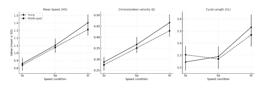
Global spatiotemporal variables by speed condition and group. Mean Speed (MS), Dimensionless velocity (β) and Cycle Length (CL) are shown as mean ± SD across the three speed conditions (Ss, Sa, Sf) for both groups without discriminating by sex. Circles and solid lines represent young adults; squares and dashed lines represent middle-aged adults.
Regarding the angular variables (Table 3), clear main effects of speed were observed from proximal to distal joints. Group effects and Group × Speed interactions were particularly evident for the knee angles (K1, K2), while more proximal segments (pelvis, hip) showed smaller or inconsistent differences between groups. The values of the angular variables for both groups at the analyzed speeds are presented in Figure 2. At Sa, pelvic rotation (Pr) was 7.93 ± 0.53° in young adults and 7.83 ± 0.53° in middle-aged adults, while pelvic obliqueness (Po) reached 5.71 ± 0.38° vs. 5.65 ± 0.35°. Knee flexion during support (K1) was 15.35 ± 1.20° in young adults compared with 19.22 ± 1.61° in middle-aged adults, and during swing (K2) it was 50.06 ± 1.62° vs. 59.76 ± 1.62°, respectively.
Results of the 2 × 3 mixed ANOVA (Group × Speed) for the angular variables (Pr, Po, H, K1, K2, Am, Aci). F, p, and effect size (ηp2) values are presented for the main effects of Group, Speed, and their interaction.

Angular kinematic variables by speed condition and group. Mean ± SD values of Pelvic rotation (Pr), Pelvic obliqueness (Po), Hip adduction/abduction (H), Knee flexion during support (K1), Knee flexion during swing (K2), Ankle dorsiflexion at initial contact (Aci), and Max ankle dorsiflexion during support (Am) across the three speed conditions. Circles/solid lines represent young adults; squares/dashed lines represent middle-aged adults.
Finally, the energetic variables (Table 4) also displayed strong effects of speed. Notably, both energy recovery (R) and pendular energy transference (%Cong) differed between groups, with %Cong additionally showing a significant Group × Speed interaction. The values of the pendular energy recovery variables for both groups at the analyzed speeds are presented in Figure 3. At Sa, energy recovery (R) was 64.11 ± 3.47% in young adults and 59.67 ± 3.30% in middle-aged adults, whereas %Cong was 20.42 ± 2.09% vs. 24.98 ± 3.18%, respectively.

Energetic variables associated with transduction of mechanical energy at center of mass (CoM) level considering the inverted pendulum model by speed condition and group. Mean ± SD values of Energy recovery (R) and Congruence percentage (%Cong) across the three speed conditions. Circles/solid lines represent young adults; squares/dashed lines represent middle-aged adults.
DISCUSSION
This study aimed to examine whether age-related changes in gait mechanics already begin to manifest in middle-aged adults. In general terms, mean values appeared broadly similar between groups at each speed condition; however, the mixed-design ANOVA revealed that the progression across speeds differed between young and middle-aged adults. In practical terms, young adults exhibited steeper increments in MS and β when transitioning from slow to fast walking, while middle-aged adults showed comparatively smaller increases in these parameters and slightly longer CL at slow speed. At the angular level, group effects and interactions were most evident at the knee, where middle-aged adults displayed higher flexion values than young adults, particularly under faster speeds, suggesting early alterations in joint strategies that contribute to the vertical levelling of the CoM. Regarding energetics, middle-aged adults also demonstrated lower R and higher %Cong compared with young adults, indicating a reduced efficiency in pendular energy transduction. Taken together, these results suggest that neuromuscular (Vervoort et al., 2020) and structural (Muscaritoli et al., 2013) changes that begin in the fifth decade of life (Kennis et al., 2014; Chuang et al., 2019) imply detectable variations in gait, which become more evident as locomotor demands increase. An important methodological aspect of this study is that walking speeds were not externally imposed but self-selected. This approach allowed us to capture gait performance within the natural range chosen by each participant, thereby reflecting conditions closer to daily living activities. For this reason, the comparisons provide a valuable reference framework. In the following sections, we discuss the results in three domains: (I) global spatiotemporal variables, (II) angular kinematic variables, and (III) energetic variables associated with CoM energy transduction.
(I) For the global spatiotemporal variables (MS, β and CL), a marked increase with speed was observed in both groups (ηp2 > 0.70), confirming that these variables consistently respond to the proposed speed manipulation. Although mean values at each condition were broadly comparable between young and middle-aged adults, the Group × Speed interaction indicated that the progression across speeds differed: young adults exhibited steeper increases in MS and β, while middle-aged adults showed comparatively smaller increments and slightly longer CL at slow speed. MSa mean values for both groups were similar to those established as optimal in most of the works (4 Km/h or 1,11 m/s) (Saibene and Minetti, 2003; Willems et al., 2012; Peyré-Tartaruga et al., 2021). The same occurred with CL, whose mean values closely matched with the corresponding graphs presented in Willems et al. (2012), which were made based on data from Schepens et al (2004). The same absolute MS does not necessarily indicate the same mechanical task, but actions can be compared if two individuals walk at the same β (Vaughan and O’Malley, 2005). This effect has been discussed when comparing adults with children (Vaughan et al., 2003), or with groups of adults with short height (Minetti et al., 1994, 2000; Saibene and Minetti, 2003). Dimensionless velocity β is the product of dimensionless step length and frequency. All three parameters increase from 18 months of age and reach values that are thought to remain relatively stable in adulthood (Vaughan et al., 2003). Our mean values support this notion; however, the way in which speed influenced these parameters differed between groups. To conclude this point, it should be noted that although we considered hCoM instead of lower limb length, as done in some previous studies (Saibene and Minetti, 2003; Vaughan et al., 2003), calculating β based on lower limb length would have resulted in only a 0.01 increase in the values. Therefore, our previous discussion remains valid. We opted to calculate dimensionless velocity relative to hCoM because we believe it aligns better with the assumptions of the inverted pendulum model on which the calculations of R and %Cong are based.
(II) Mean angular values associated with levelling the trajectory of the CoM in this study were within the range established as normal for adult subjects at self-selected speed (Sa) (Willems et al., 2012). In agreement with Willems et al. (2012), actions at the pelvis, hip, and knee (Pr, Po, H, K1 and K2) showed clear effects of speed, with amplitudes increasing from slow to fast walking. Group effects and interactions, however, were most evident at the knee. Middle-aged adults consistently exhibited higher knee flexion values both during support (K1) and swing (K2), and the progression of these variables with speed differed from that of young adults. These findings suggest that knee joint strategies contributing to the vertical levelling of the CoM may already begin to change in middle age. Such alterations are consistent with previous evidence showing that young adults display greater knee extension at heel strike and during swing when compared under speed-matched conditions (Boyer et al., 2017). The functional implications of the observed knee values in middle-aged adults are noteworthy, as knee flexion during mid-support reduces the elevation of the CoM precisely when it passes over the supporting limb (Willems et al., 2012). Consequently, angular values reflecting the knee’s contribution to vertical levelling of the CoM appear to change significantly within this age range. By contrast, more proximal segments showed smaller or inconsistent group differences: pelvic rotation and obliqueness (Pr and Po) increased with speed in both groups but with only subtle between-group variations, while hip adduction/abduction (H) followed a parallel pattern in young and middle-aged adults. Finally, ankle dorsiflexion at initial contact (Aci) and maximum dorsiflexion during support (Am) remained virtually unchanged across speeds and between groups, indicating that distal control at the ankle is preserved in middle-aged adults. Taken together, these results highlight those early age-related changes in gait mechanics manifest preferentially at the knee, whereas proximal adjustments remain broadly comparable to young adults and distal control appears unaffected.
(III) Clear effects of speed were observed for both energy recovery (R) and congruence (%Cong). Beyond this expected modulation, group differences were also evident: middle-aged adults displayed lower R values and higher %Cong than young adults, indicating a reduced efficiency in pendular energy transduction. Importantly, the interaction effects suggest that discrepancies between groups became more pronounced as walking speed increased. From a functional perspective, these findings imply that, although middle-aged adults walk at absolute speeds similar to young adults, they utilise CoM mechanical energy less effectively. This aligns with previous reports establishing that R values in young adults at self-selected pace typically range between 60–65% (Saibene and Minetti, 2003; Peyré-Tartaruga et al., 2021), whereas the values observed here for middle-aged adults (59.6) fell below this benchmark. Moreover, for efficient walking, the duration during which the potential and kinetic energies of the CoM fluctuate in the same direction should be low (Biewener, 2006). %Cong values in healthy young adults are generally below 20% at optimal speeds (Gomeñuka et al., 2016) as observed here (20.42 in MSa), whereas middle-aged adults in our sample exceeded this threshold (24.98 in MSa), suggesting a greater mismatch in the synchrony of kinetic and potential energy fluctuations. Together, these results reinforce the notion that age-related alterations in locomotor energetics emerge already in middle age, even in the absence of marked reductions in self-selected walking speed, and may precede more evident declines typically reported in older adults.
This study has some limitations that should be acknowledged. First, the cross-sectional design precludes establishing causal relationships between age and the observed gait differences. Second, walking speeds were self-selected rather than imposed, which enhances ecological validity but may limit comparability with studies using strictly controlled speeds. Third, dimensionless velocity was normalised to hCoM instead of leg length; although theoretically consistent with the inverted pendulum model, this choice complicates direct comparisons with Froude-based reports. Finally, the absence of additional neuromuscular or structural measures (e.g. muscle strength or EMG) restricts our ability to directly link the observed gait alterations with underlying mechanisms.
Future studies should address these aspects by including broader age groups, longitudinal designs, and integrated neuromuscular assessments to better characterise the onset and progression of age-related gait adaptation. In addition, the differences observed in K1 may indicate that relevant alterations occur at specific moments within the gait cycle. Because R and %Cong values are averaged over the entire cycle, complementary analyses focusing on pendular energy transduction within-cycle could provide further insight. One option is the instantaneous recovery of mechanical energy in equal time intervals (Gomeñuka et al., 2016), a method previously applied to study gait at different slopes and speeds in young adults (Dewolf et al., 2017) and in asymmetric gait (Fábrica et al., 2019). Applying this approach to middle-aged adults could help clarify the mechanisms underlying the differences reported here.
CONCLUSION
Middle-aged adults maintain a broadly similar spatiotemporal gait pattern to that of young adults; however, differential effects emerge when speed increases, with smaller increments in MS and β and a slightly longer CL at slow speed. The main age-related manifestations in angular variables occur at the knee, becoming more evident at higher speeds. Finally, middle-aged adults exhibit a gait pattern that is slightly less economical, as reflected by lower R and higher %Cong values, and this inefficiency becomes more pronounced with increasing speed.
ACKNOWLEDGEMENTS
We are grateful to the Director of the Department of Rehabilitation and Physical Medicine, Hospital de Clínicas, UdelaR, Prof. Dr. Teresa Camarot and Dr. Pedro Gallardo for facilitated the completion of pilot for this study.
-
FUNDING
This work was made possible by the financing of the ANII within the project FCE-3- 2020-1-162513, funds from the BSE. The postdoctoral researcher Daniel Jerez-Mayorga has a contract through the programme “Recualificación del Profesorado Universitario. Modalidad Margarita Salas”, University of Granada / Ministry of Universities and Next Generation Funds of the European Union.
-
DATA AVAILABILITY
The data that support the findings of this study are available from the corresponding author upon reasonable request.
REFERENCES
-
Baker R. Gait analysis methods in rehabilitation. J Neuroeng Rehabil. 2006;3:4. https://doi.org/10.1186/1743-0003-3-4 PMid:16512912.
» https://doi.org/10.1186/1743-0003-3-4 -
Biewener AA. Patterns of mechanical energy change in tetrapod gait: Pendula, springs and work. J Exp Zoolog A Comp Exp Biol. 2006;305(11):899-911. https://doi.org/10.1002/jez.a.334 PMid:17029267.
» https://doi.org/10.1002/jez.a.334 -
Boyer KA, Johnson RT, Banks JJ, Jewell C, Hafer JF. Systematic review and meta-analysis of gait mechanics in young and older adults. Exp Gerontol. 2017;95:63-70. https://doi.org/10.1016/j.exger.2017.05.005 PMid:28499954.
» https://doi.org/10.1016/j.exger.2017.05.005 -
Brown RT, Covinsky KE. Moving prevention of functional impairment upstream: is middle age an ideal time for intervention? Womens Midlife Health. 2020;6(1):4. https://doi.org/10.1186/s40695-020-00054-z PMid:32695430.
» https://doi.org/10.1186/s40695-020-00054-z -
Case A, Deaton A. Rising morbidity and mortality in midlife among white non-Hispanic Americans in the 21st century. Proc Natl Acad Sci USA. 2015;112(49):15078-83. https://doi.org/10.1073/pnas.1518393112 PMid:26575631.
» https://doi.org/10.1073/pnas.1518393112 -
Cavagna GA, Heglund NC, Taylor CR. Mechanical work in terrestrial locomotion: two basic mechanisms for minimizing energy expenditure. Am J Physiol. 1977;233(5):R243-61. https://doi.org/10.1152/ajpregu.1977.233.5.R243 PMid:411381.
» https://doi.org/10.1152/ajpregu.1977.233.5.R243 -
Cavagna GA, Kaneko M. Mechanical work and efficiency in level walking and running. J Physiol. 1977;268(2):467-81. https://doi.org/10.1113/jphysiol.1977.sp011866 PMid:874922.
» https://doi.org/10.1113/jphysiol.1977.sp011866 -
Cavagna GA, Thys H, Zamboni A. The sources of external work in level walking and running. J Physiol. 1976;262(3):639-57. https://doi.org/10.1113/jphysiol.1976.sp011613 PMid:1011078.
» https://doi.org/10.1113/jphysiol.1976.sp011613 -
Cavagna GA, Willems PA, Legramandi MA, Heglund NC. Pendular energy transduction within the step in human walking. J Exp Biol. 2002;205(Pt 21):3413-22. https://doi.org/10.1242/jeb.205.21.3413 PMid:12324550.
» https://doi.org/10.1242/jeb.205.21.3413 -
Chuang YF, Chen CC, Hsu MJ, Huang NJ, Huang YZ, Chan HL, et al. Age related changes of the motor excitabilities and central and peripheral muscle strength. J Electromyogr Kinesiol. 2019;44:132-8. https://doi.org/10.1016/j.jelekin.2018.12.007 PMid:30640164.
» https://doi.org/10.1016/j.jelekin.2018.12.007 -
Della Croce U, Riley PO, Lelas JL, Kerrigan DC. A refined view of the determinants of gait. Gait Posture. 2001;14(2):79-84. https://doi.org/10.1016/S0966-6362(01)00128-X PMid:11544057.
» https://doi.org/10.1016/S0966-6362(01)00128-X -
Dewolf AH, Ivanenko YP, Lacquaniti F, Willems PA. Pendular energy transduction within the step during human walking on slopes at different speeds. PLoS One. 2017;12(10):e0186963. https://doi.org/10.1371/journal.pone.0186963 PMid:29073208.
» https://doi.org/10.1371/journal.pone.0186963 -
Fábrica G, Jerez-Mayorga D, Silva-Pereyra V. Pendular energy transduction in the different phases of the gait cycle in post-stroke subjects. Hum Mov Sci. 2019;66:521-8. https://doi.org/10.1016/j.humov.2019.06.006 PMid:31220691.
» https://doi.org/10.1016/j.humov.2019.06.006 -
Gomeñuka NA, Bona RL, da Rosa RG, Peyre-Tartaruga LA. The pendular mechanism does not determine the optimal speed of loaded walking on gradients. Hum Mov Sci. 2016;47:175-85. https://doi.org/10.1016/j.humov.2016.03.008 PMid:27017543.
» https://doi.org/10.1016/j.humov.2016.03.008 -
Herssens N, Verbecque E, Hallemans A, Vereeck L, Van Rompaey V, Saeys W. Do spatiotemporal parameters and gait variability differ across the lifespan of healthy adults? A systematic review. Gait Posture. 2018;63:59-66. https://doi.org/10.1016/j.gaitpost.2018.06.012 PMid:29929161.
» https://doi.org/10.1016/j.gaitpost.2018.06.012 -
Iida H, Yamamuro T. Kinetic analysis of the center of gravity of the human body in normal and pathological gaits. J Biomech. 1987;20(10):987-95. https://doi.org/10.1016/0021-9290(87)90328-9 PMid:3693380.
» https://doi.org/10.1016/0021-9290(87)90328-9 -
Kennis E, Verschueren S, Van Roie E, Thomis M, Lefevre J, Delecluse C. Longitudinal impact of aging on muscle quality in middle-aged men. Age (Dordr). 2014;36(4):9689. https://doi.org/10.1007/s11357-014-9689-1 PMid:25104137.
» https://doi.org/10.1007/s11357-014-9689-1 -
Kuo A, Donelan M. Dynamic principles of gait and their clinical implications. Phys Ther. 2010;90(2):157-74. https://doi.org/10.2522/ptj.20090125 PMid:20023002.
» https://doi.org/10.2522/ptj.20090125 -
Kuo A. The six determinants of gait and the inverted pendulum analogy: A dynamic walking perspective. Hum Mov Sci. 2007;26(4):617-56. https://doi.org/10.1016/j.humov.2007.04.003 PMid:17617481.
» https://doi.org/10.1016/j.humov.2007.04.003 - Margaria R. Biomechanics and energetics of muscular exercise. Oxford: Clarendon Press; 1976.
-
McCrum C, Epro G, Meijer K, Zijlstra W, Bruggemann GP, Karamanidis K. Locomotor stability and adaptation during perturbed walking across the adult female lifespan. J Biomech. 2016;49(7):1244-7. https://doi.org/10.1016/j.jbiomech.2016.02.051 PMid:26970886.
» https://doi.org/10.1016/j.jbiomech.2016.02.051 -
Meyer BD, Mok WK. Disability, earnings, income and consumption. J Public Econ. 2019;171:516-9. https://doi.org/10.1016/j.jpubeco.2018.06.011
» https://doi.org/10.1016/j.jpubeco.2018.06.011 -
Minetti AE, Ardigo LP, Saibene F, Ferrero S, Sartorio A. Mechanical and metabolic profile of locomotion in adults with childhood-onset GH deficiency. Eur J Endocrinol. 2000;142(1):35-40. https://doi.org/10.1530/eje.0.1420035 PMid:10633219.
» https://doi.org/10.1530/eje.0.1420035 -
Minetti AE, Saibene F, Ardigo LP, Atchou G, Schena F, Ferretti G. Pygmy locomotion. Eur J Appl Physiol. 1994;68(4):285-90. https://doi.org/10.1007/BF00571444 PMid:8055884.
» https://doi.org/10.1007/BF00571444 -
Muscaritoli M, Lucia S, Molfino A, Cederholm T, Fanelli FR. Muscle atrophy in aging and chronic diseases: is it sarcopenia or cachexia? Intern Emerg Med. 2013;8(7):553-60. https://doi.org/10.1007/s11739-012-0807-8 PMid:22773188.
» https://doi.org/10.1007/s11739-012-0807-8 -
Nardello F, Ardigo LP, Minetti AE. Measured and predicted mechanical internal work in human locomotion. Hum Mov Sci. 2011;30(1):90-104. https://doi.org/10.1016/j.humov.2010.05.012 PMid:21056491.
» https://doi.org/10.1016/j.humov.2010.05.012 - Perry J. Análise de marcha. San Pablo: Prima Producción Editorial; 2005.
-
Peyré-Tartaruga LA, Dewolf AH, di Prampero PE, Fábrica CG, Malatesta D, Minetti AE, et al. Mechanical work as a (key) determinant of energy cost in human locomotion: recent findings and future directions. Exp Physiol. 2021;106(9):1897-908. https://doi.org/10.1113/EP089313 PMid:34197674.
» https://doi.org/10.1113/EP089313 -
Saibene F, Minetti AE. Biomechanical and physiological aspects of legged locomotion in humans. Eur J Appl Physiol. 2003;88(4-5):297-316. https://doi.org/10.1007/s00421-002-0654-9 PMid:12527959.
» https://doi.org/10.1007/s00421-002-0654-9 -
Saunders JB, Inman VT, Eberhart HD. The major determinants in normal and pathological gait. J Bone Joint Surg Am. 1953;35-A(3):543-58. https://doi.org/10.2106/00004623-195335030-00003 PMid:13069544.
» https://doi.org/10.2106/00004623-195335030-00003 -
Schepens B, Bastien GJ, Heglund NC, Willems PA. Mechanical work and muscular efficiency in walking children. J Exp Biol. 2004;207(Pt 4):587-96. https://doi.org/10.1242/jeb.00793 PMid:14718502.
» https://doi.org/10.1242/jeb.00793 -
Vaughan CL, Langerak N, O’Malley MJ. Neuromaturation of human locomotion revealed by non-dimensional scaling. Exp Brain Res. 2003;153(1):123-7. https://doi.org/10.1007/s00221-003-1635-x PMid:14566445.
» https://doi.org/10.1007/s00221-003-1635-x -
Vaughan CL, O’Malley MJ. Froude and the contribution of naval architecture to our understanding of bipedal locomotion. Gait Posture. 2005;21(3):350-62. https://doi.org/10.1016/j.gaitpost.2004.01.011 PMid:15760752.
» https://doi.org/10.1016/j.gaitpost.2004.01.011 -
Vervoort D, den Otter AR, Buurke TJW, Vuillerme N, Hortobágyi T, Lamoth CJC. Do gait and muscle activation patterns change at middle-age during split-belt adaptation? J Biomech. 2020;99:109510. https://doi.org/10.1016/j.jbiomech.2019.109510 PMid:31780122.
» https://doi.org/10.1016/j.jbiomech.2019.109510 -
Willems PA, Cavagna GA, Heglund NC. External, internal and total work in human locomotion. J Exp Biol. 1995;198(Pt 2):379-93. https://doi.org/10.1242/jeb.198.2.379 PMid:7699313.
» https://doi.org/10.1242/jeb.198.2.379 -
Willems PA, Schepens B, Detrembleur C. Marcha normal. EMC-Kinesiterapia-Med Física. 2012;33(2):1-29. https://doi.org/10.1016/S1293-2965(12)61944-6
» https://doi.org/10.1016/S1293-2965(12)61944-6 -
Winter DA. Biomechanics and motor control of human movement. 4th ed. Hoboken: John Wiley & Sons; 2009.. https://doi.org/10.1002/9780470549148
» https://doi.org/10.1002/9780470549148 -
Zajacova A, Montez JK. Explaining the increasing disability prevalence among mid-life US adults, 2002 to 2016. Soc Sci Med. 2018;211:1-8. https://doi.org/10.1016/j.socscimed.2018.05.041 PMid:29864712.
» https://doi.org/10.1016/j.socscimed.2018.05.041
Edited by
-
Editor Executivo: Pedro Otavio Pimpim Bezerra.Editor Chefe: Leonardo Peyré-Tartaruga.Editor Assistente: André Ivaniski-Mello.Editor Final: Ari Lazzarotti Filho
The data that support the findings of this study are available from the corresponding author upon reasonable request.


