 Lower-limb power and gait speed as early markers of functional decline in middle-aged women
Abstract
Abstract This study examined whether lower-limb power and gait speed act as early markers of functional decline in middle-aged women compared with older women. In a cross-sectional design, 31 community-dwelling women were assessed and divided into two groups: 40-59 years (n=12) and ≥60 years (n=19). Primary outcomes were lower-limb muscle power estimated from the 30- and 60-second sit-to-stand tests (STS-30/60), six-minute walk test (6MWT) distance and habitual gait speed. Secondary outcomes included handgrip strength and frailty status (FRAIL scale and Fried phenotype). Between-group comparisons used Mann-Whitney tests with Hedges’ g and effect size r, and p values for primary outcomes were adjusted using the Holm-Bonferroni method. Middle-aged women showed better performance in STS-30/60, 6MWT distance and gait speed than women ≥60 years, with statistically significant differences and moderate-to-large effect sizes, whereas handgrip strength was similar between groups. Sit-to-stand-derived power was positively associated with gait speed. Frailty-related measures indicated a burden of prefrailty/frailty across the sample, with a numerically greater vulnerability in the ≥60 group and evidence of non-robust profiles already present among some middle-aged women. These findings suggest that simple tests of lower-limb power and gait speed may serve as practical early markers of functional decline in women, supporting their use for screening and exercise prescription from midlife onwards.
Key words:
Frailty; Gait; Middle-aged women; Muscle power; Physical performance
Resumo
Resumo Este estudo investigou se a potência de membros inferiores e a velocidade de marcha atuam como marcadores precoces de declínio funcional em mulheres de meia-idade, em comparação com mulheres mais velhas. Em um delineamento transversal, 31 mulheres residentes na comunidade foram avaliadas e divididas em dois grupos: 40-59 anos (n=12) e ≥60 anos (n=19). Os desfechos primários foram a potência muscular de membros inferiores estimada a partir dos testes de sentar-levantar de 30 e 60 segundos (STS-30/60), a distância do teste de caminhada de seis minutos (6MWT) e a velocidade de marcha habitual. Os desfechos secundários incluíram força de preensão manual e estado de fragilidade (escala FRAIL e fenótipo de Fried). Empregou-se o teste de Mann-Whitney com g de Hedges e tamanho de efeito r, e os valores de p para os desfechos primários foram ajustados pelo método de Holm-Bonferroni. Mulheres de meia-idade apresentaram melhor desempenho no STS-30/60, na distância do 6MWT e na velocidade de marcha do que mulheres ≥60 anos, com diferenças estatisticamente significativas e tamanhos de efeito moderados a grandes, enquanto a força de preensão manual foi semelhante entre os grupos. A potência derivada do teste de sentar-levantar associou-se positivamente à velocidade de marcha. As medidas relacionadas à fragilidade indicaram uma carga de pré-fragilidade/fragilidade em toda a amostra, com vulnerabilidade numericamente maior no grupo ≥60 anos e evidência de perfis não robustos já presentes em algumas mulheres de meia-idade. Esses achados sugerem que testes simples de potência de membros inferiores e velocidade de marcha podem funcionar como marcadores precoces práticos de declínio funcional em mulheres, apoiando seu uso para triagem e prescrição de exercícios desde a meia-idade.
Palavras-chave:
Fragilidade; Marcha; Mulheres de meia-idade; Potência muscular; Desempenho físico
INTRODUCTION
Population ageing and longevity have strengthened the paradigm of healthy ageing, which emphasizes preserving functional ability and autonomy across the life course rather than merely extending life expectancy1,2. Within this framework, frailty is a prevalent geriatric syndrome and public health challenge, associated with increased disability, hospitalization, institutionalization and mortality3,4. Identifying markers of functional decline before 60 years of age may help delay the transition from robustness to prefrailty and frailty.
Neuromuscular deterioration plays a central role in this process. Age-related loss of muscle mass and strength is accompanied by faster decline in muscle power, defined as the ability to generate force rapidly5,6. Muscle power is consistently associated with physical performance indices such as gait speed, chair-rise ability and overall mobility, and appears to be a better predictor of functional limitations than maximal strength5. Lower-limb power has been linked to sarcopenia, frailty and adverse outcomes, and may better discriminate the risk of disability and loss of independence than isolated isometric strength5-7. Recent studies in middle-aged and older Brazilian women suggest that alterations in relative power are already detectable from the fifth decade of life8. This is especially relevant in women, who show higher rates of frailty and disability, influenced by accumulated biological, social and gender-related determinants1,3,9.
From an applied perspective, simple, low-cost tests are needed to estimate lower-limb power and physical performance in clinical and community settings. The 30-second sit-to-stand test (30-s STS) is a valid method to estimate lower-limb muscle power and correlates with power assessed by specific equipment and with gait speed7. Gait speed and six-minute walk distance are sensitive indicators of physical performance and functional capacity and are proposed as early markers of functional decline and frailty5-7. However, evidence on the combined usefulness of lower-limb power, physical performance and gait speed as potential markers of early functional decline in middle-aged women remains limited, particularly in Latin American settings.
Therefore, the aim of this study was to examine whether lower-limb muscle power, physical performance, and gait speed discriminate functional status in women aged 40-59 years compared with women aged 60 years or older, and to explore the association between sit-to-stand-derived power and gait speed.
METHODS
Study design and participants
This cross-sectional study was conducted at Universidad Católica de Temuco (Campus San Francisco, Temuco, Chile). Recruitment used posters and contacts with primary health care centers and snowball sampling. Eligible participants were community-dwelling women aged ≥40 years, able to ambulate independently and follow instructions. Exclusion criteria were diagnosed dementia or cognitive impairment, sensory deficits limiting assessment, dependence in basic activities of daily living, major neurological disease or stroke in the previous three months, decompensated cardiovascular disease, terminal illness or other conditions precluding safe testing.
Thirty-five women were screened; four were excluded due to incomplete data or not meeting inclusion criteria. The final sample comprised 31 women, divided into two groups: 40-59 years (n=12) and ≥60 years (n=19).
Procedures and instruments
All assessments were performed in a single session in a laboratory and adjacent corridor; resting vital signs were checked before testing.
Primary outcomes
Lower-limb power was assessed using the 30- and 60-second sit-to-stand tests (STS-30 and STS-60), which evaluate hip and knee extensor performance and integrate strength, power and endurance7. Participants sat on an armless chair (seat height 43-45 cm) with feet flat, knees at 90° and arms crossed over the chest. After one practice trial, they performed one trial of STS-30 and one of STS-60, separated by 2-3 minutes of rest. The number of correctly completed repetitions was recorded, and relative lower-limb power was estimated using previously published equations7.
Physical performance was assessed using the six-minute walk test (6MWT), following American Thoracic Society guidelines10. The test was conducted in a 30-m indoor corridor. Participants were instructed to walk “as far as possible” for six minutes; distance, heart rate, oxygen saturation and perceived exertion (Borg scale) were recorded before and immediately after the test.
Habitual gait speed was measured over a 4-m walkway, with 1 m for acceleration and 1 m for deceleration11. Participants walked at their usual pace; time was recorded over the central 4 m, and gait speed (m/s) was calculated as 4 m/time.
Secondary outcomes
Handgrip strength was measured using a hydraulic dynamometer (Baseline® LITE™ 200 lb, 90.7 kgf) in a seated position, following American Society of Hand Therapists recommendations. Three maximal isometric contractions of the dominant hand were performed, each ~3 seconds, with ~60 seconds rest between attempts. The highest value (kgf) was used for analysis.
Frailty status was assessed using the FRAIL scale, a five-item questionnaire (Fatigue, Resistance, Ambulation, Illnesses, Loss of weight) that classifies individuals as robust (0 points), prefrail (1-2 points) or frail (≥3 points)12, and the Fried frailty phenotype, defined by unintentional weight loss, exhaustion, weakness (low handgrip strength), slowness (reduced gait speed) and low physical activity4. Participants were classified as robust (0 criteria), prefrail (1-2) or frail (≥3).
Sociodemographic variables included age, body mass index, educational level, occupation, number of pregnancies and number of children. Physical activity was assessed with the Global Physical Activity Questionnaire (GPAQ), recommended by the World Health Organization for surveillance in low- and middle-income countries13.
Statistical analysis
Continuous variables are presented as mean ± standard error of the mean (SEM) or median [interquartile range, IQR]; categorical variables as n (%). Normality was assessed by visual inspection and Shapiro-Wilk tests. Between-group comparisons (40-59 vs ≥60 years) for continuous variables were performed using the Mann-Whitney U test (α=0.05), reporting p values, Hedges’ g and effect size r (r = Z/√N). For primary outcomes (STS-30, STS-60, gait speed and 6MWT distance), p values were adjusted using the Holm-Bonferroni method.
Categorical variables were compared using Pearson’s χ2 or Fisher’s exact test, reporting Cramer’s V or odds ratios (OR) with 95% confidence intervals (CI). Within-group pre-post changes in 6MWT heart rate, oxygen saturation and Borg scores were analyzed using paired t tests or Wilcoxon signed-rank tests; between-group differences in change scores (Δ) were analyzed with Welch’s t test or Mann-Whitney U tests. Associations between lower-limb power (STS-30/60) and gait speed were examined using Pearson or Spearman correlations, reporting correlation coefficients (r) with 95% CI. Analyses were complete-case with no imputation, using R (R Foundation for Statistical Computing, Vienna, Austria) and Python.
Ethical considerations
The study was approved by the Scientific Ethics Committee of Universidad Católica de Temuco (protocol CEIUCT0411003/23) and conducted in accordance with the Declaration of Helsinki, the 2016 CIOMS guidelines and national regulations on personal data protection. All participants provided written informed consent. Data were anonymized using alphanumeric codes, and testing was supervised by trained professionals.
RESULTS
Participant characteristics
Thirty-one women were included in the analyses (40-59 years: n=12; ≥60 years: n=19). As expected, chronological age differed between groups, whereas body mass index was broadly similar. Women in the 40-59 group had higher educational attainment and a greater proportion of paid employment, whereas women in the ≥60 group were more frequently retired or engaged in unpaid domestic work. Self-reported physical activity ranged from low to moderate in both groups, with many participants not meeting current recommendations and no clear between-group differences (Table 1).
Sociodemographic characteristics and physical activity level by age group (total n=31; 40-59 years n=12; ≥60 years n=19).
Primary outcomes: lower-limb power and physical performance
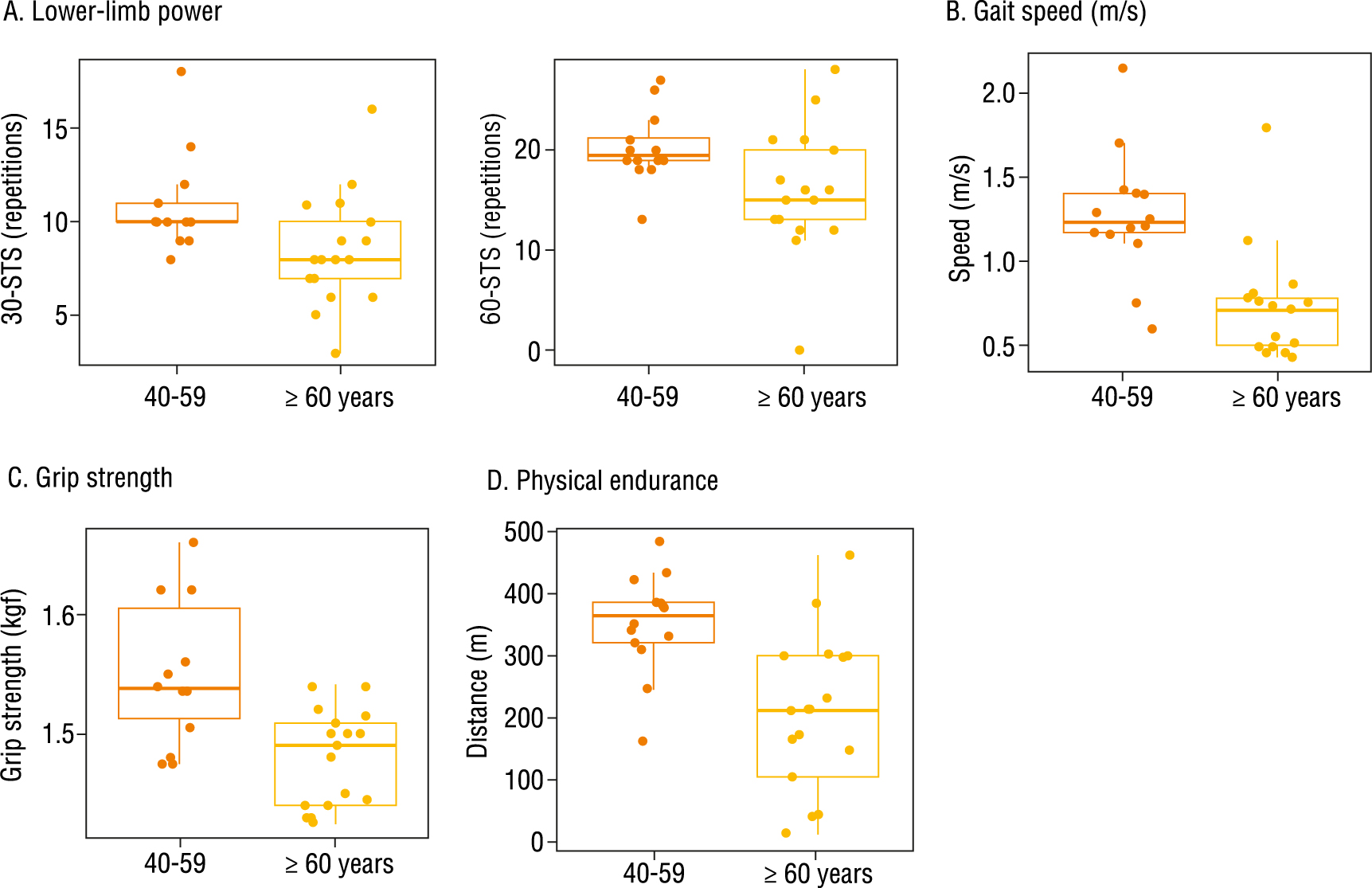
Between-group comparisons for the primary outcomes (Figure 1, Table 2) showed consistently better performance in the 40-59 group. Middle-aged women completed more repetitions in both the 30-s and 60-s sit-to-stand tests, covered a longer distance in the 6MWT and walked faster in the habitual gait speed assessment than women aged ≥60 years. These differences were statistically significant for all primary outcomes and remained so after Holm-Bonferroni correction. Effect sizes were in the moderate-to-large range, indicating clinically relevant differences in lower-limb power and mobility between groups.
Functional physical performance (40-59 vs ≥60 years). Note. The multiple boxplots summarize: (A) gait speed; (B) lower-limb power (Sit-to-Stand 30 s and 60 s); (C) grip strength; (D) physical performance (six-minute walk test, 6MWT). A lower median and greater dispersion are observed in the ≥60 years group for power, 6MWT distance and gait speed (slower performance), in line with the differences reported in the text.
Functional physical performance by age group. Means ± standard error of the mean (SEM) are presented for each group (40-59 years n=12; ≥60 years n=19).
Secondary outcomes: handgrip strength and frailty
Handgrip strength did not differ meaningfully between groups. Mean maximal grip values were comparable in middle-aged and older women, and between-group differences were small and not statistically significant (Table 2).
Regarding frailty status, both instruments indicated a burden of prefrailty/frailty in the sample. With the FRAIL scale, participants in both age groups clustered predominantly in prefrail and frail categories, with no statistically significant between-group differences. Using the Fried frailty phenotype, the ≥60 years group showed a numerically greater burden of non-robust status, although this difference was not statistically significant. Overall, frailty-related measures provided contextual information on vulnerability across the sample but did not clearly discriminate age-group differences in this small cohort.
Physiological responses during the six-minute walk test
In both age groups, perceived exertion (Borg scale) increased significantly from pre- to post-6MWT, whereas oxygen saturation remained stable within the normal range (Table 3). Heart rate also increased descriptively after the test in both groups, but these within-group changes did not reach statistical significance. No significant between-group differences were observed in change scores. These findings are consistent with the expected physiological demand of the test, and no adverse events were reported during testing.
Associations between lower-limb power and gait speed
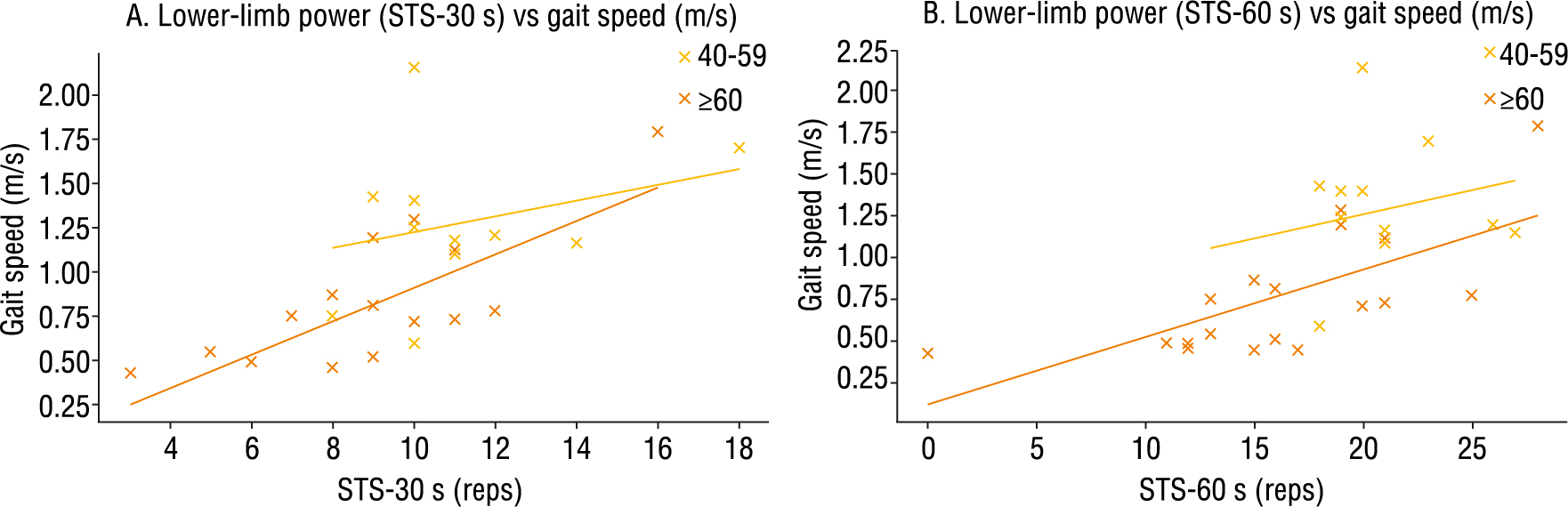
Across the whole sample, higher lower-limb muscle power (estimated from STS-30 and STS-60) was positively associated with habitual gait speed. Women who achieved more repetitions in the sit-to-stand tests tended to walk faster over 4 m, with correlation coefficients in the moderate-to-strong range (Figure 2). When analyses were stratified by age group, similar patterns were observed, although correlations were slightly attenuated in the ≥60 group. Associations between frailty measures and physical performance were weaker and less consistent.
Relationship between lower-limb power (STS 30/60 s) and gait speed (m/s). Note. Relationship between lower-limb power, measured as repetitions in (A). STS 30 s and (B) STS 60 s, and gait speed (m/s), stratified by age group (40-59 in orange; ≥60 in dark blue). Individual data points and linear regression lines for each group are shown. A higher number of repetitions is associated with higher gait speed. Ns: 40-59, n=12; ≥60, n=19.
DISCUSSION
This cross-sectional study found that lower-limb power and walking performance discriminated functional status between middle-aged (40-59 years) and older (≥60 years) women, whereas handgrip strength did not. Women 40-59 years completed more repetitions in the 30- and 60-second sit-to-stand tests, walked longer distances in the 6MWT and achieved higher gait speed, with moderate-to-large effect sizes. Maximal handgrip strength was similar in both groups. Frailty status, as a secondary outcome, indicated a numerically greater burden of prefrailty/frailty in the older group and also revealed prefrailty in some middle-aged women.
Our findings are consistent with evidence that muscle power declines earlier than maximal strength and may better predict physical performance in older adults5,14,15. Lower-limb power estimated from the 30-s sit-to-stand test has been related to leg extension power and gait speed7. Our results extend this work by showing that sit-to-stand-derived power and walking performance discriminate functional status between middle-aged and older women, suggesting that neuromuscular changes are evident before 60 years of age. The observed differences in sit-to-stand performance, 6MWT distance and gait speed align with literature supporting the clinical and prognostic value of lower-extremity function and gait speed as markers of health status, disability risk and survival11,15-18.
Handgrip strength, although widely used as a general indicator of muscle strength and associated with adverse outcomes14,18, did not differ meaningfully between age groups. Previous studies indicate that lower-extremity strength and power are more closely related to functional tasks such as rising from a chair and walking19. Our results support this view: lower-limb power and walking tests showed clear age-related differences, whereas grip strength did not, reinforcing the need to include lower-extremity performance measures when screening for early functional decline, especially in women.
Frailty was not a primary endpoint, but its secondary analysis provides useful context. Using both the FRAIL scale and the Fried phenotype, we observed a burden of prefrailty/frailty across the sample, with a numerically greater burden among older women. The presence of non-robust profiles among some 40-59-year-old women suggests that the transition from robustness to frailty may begin earlier than commonly assumed, supporting the life-course perspective promoted by the World Health Organization’s healthy ageing framework1-4. This is especially relevant in women, who generally show higher frailty prevalence and disability burden across later life9,17,20-21. Focusing on women across midlife and older age is therefore relevant for understanding how biological transitions, accumulated social exposures and caregiving roles may interact with neuromuscular decline and functional capacity9,17,21-22.
Simple field tests such as the 30- and 60-second sit-to-stand tests, short-distance gait speed and the 6MWT may serve as pragmatic tools to identify women at higher risk of functional decline from midlife onward23-26. These low-cost tests can be implemented in primary care, community programs and rehabilitation settings, including low-resource contexts, and our data support incorporating lower-limb power assessments into routine functional evaluations7,11,14,23,24. The associations observed between sit-to-stand-derived power and gait speed reinforce the concept that lower-extremity power is a relevant determinant of mobility. In this regard, Alcazar et al.7 and Reid and Fielding14 support the relevance of muscle power for functional performance in older adults, whereas Byrne et al.5 and el Hadouchi et al.27 suggest that interventions specifically targeting muscle power, particularly velocity-oriented resistance training, may produce meaningful improvements in gait performance and overall physical function.
Strengths of this study include its focus on women, the combined use of simple functional tests and validated frailty instruments, and a life-course perspective comparing midlife and older age. Limitations include the cross-sectional design, modest sample size from a single center and reliance on self-reported physical activity and comorbidities, which may limit generalizability and causal inference. The absence of men also prevents sex-based comparisons; future studies with larger, sex-balanced samples should explore interactions between sex, hormone status, muscle power and functional decline.
CONCLUSIONS
In community-dwelling women, lower-limb muscle power and walking performance discriminated functional status between middle-aged (40-59 years) and older (≥60 years) groups, whereas handgrip strength did not. Women ≥60 years showed poorer sit-to-stand performance, shorter six-minute walk distance and slower gait speed, while grip strength was similar across age groups.
Frailty status, analyzed as a secondary outcome, indicated a burden of prefrailty/frailty across the sample, with a numerically greater vulnerability among older women and evidence of non-robust profiles already present in middle-aged participants. These findings support a life-course perspective in which functional decline may begin before 60 years of age.
These findings suggest that simple, low-cost tests of lower-limb power and walking performance, such as the 30- and 60-second sit-to-stand tests, the six-minute walk test and short-distance gait speed, may serve as practical early markers of functional decline in women. Implementing these assessments in primary care, community and rehabilitation settings, together with power-oriented exercise strategies from midlife onward, may help preserve functional capacity and delay progression towards frailty.
How to cite this article
Funding
Ethical approval
Data Availability Statement
The data that support the findings of this study are available from the corresponding author, upon reasonable request.
REFERENCES
-
1 Beard JR, Officer A, de Carvalho IA, Sadana R, Pot AM, Michel JP, et al. The World report on ageing and health: a policy framework for healthy ageing. Lancet. 2016;387(10033):2145-54. https://doi.org/10.1016/S0140-6736(15)00516-4 PMid:26520231.
» https://doi.org/10.1016/S0140-6736(15)00516-4 - 2 World Health Organization. Healthy ageing and functional ability: Q&A. Geneva: WHO; 2020.
-
3 Buckinx F, Rolland Y, Reginster JY, Ricour C, Petermans J, Bruyère O. Burden of frailty in the elderly population: perspectives for a public health challenge. Arch Public Health. 2015;73(1):19. https://doi.org/10.1186/s13690-015-0068-x PMid:25866625.
» https://doi.org/10.1186/s13690-015-0068-x -
4 Fried LP, Tangen CM, Walston J, Newman AB, Hirsch C, Gottdiener J, et al. Frailty in older adults: evidence for a phenotype. J Gerontol A Biol Sci Med Sci. 2001;56(3):M146-57. https://doi.org/10.1093/gerona/56.3.M146 PMid:11253156.
» https://doi.org/10.1093/gerona/56.3.M146 -
5 Byrne C, Faure C, Keene DJ, Lamb SE. Ageing, muscle power and physical function: a systematic review and implications for pragmatic training interventions. Sports Med. 2016;46(9):1311-32. https://doi.org/10.1007/s40279-016-0489-x PMid:26893098.
» https://doi.org/10.1007/s40279-016-0489-x -
6 Volpi E, Nazemi R, Fujita S. Muscle tissue changes with aging. Curr Opin Clin Nutr Metab Care. 2004;7(4):405-10. https://doi.org/10.1097/01.mco.0000134362.76653.b2 PMid:15192443.
» https://doi.org/10.1097/01.mco.0000134362.76653.b2 -
7 Alcazar J, Kamper RS, Aagaard P, Haddock B, Prescott E, Ara I, et al. Relation between leg extension power and 30-s sit-to-stand muscle power in older adults: validation and translation to functional performance. Sci Rep. 2020;10(1):16337. https://doi.org/10.1038/s41598-020-73395-4 PMid:33004970.
» https://doi.org/10.1038/s41598-020-73395-4 -
8 Coelho-Júnior HJ, de Oliveira Gonçalves I, Landi F, Calvani R, Tosato M, Picca A, et al. Muscle power-related parameters in middle-aged and older Brazilian women: a cross-sectional study. Sci Rep. 2023;13(1):13186. https://doi.org/10.1038/s41598-023-39182-7 PMid:37580323.
» https://doi.org/10.1038/s41598-023-39182-7 -
9 Gordon EH, Peel NM, Samanta M, Theou O, Howlett SE, Hubbard RE. Sex differences in frailty: a systematic review and meta-analysis. Exp Gerontol. 2017;89:30-40. https://doi.org/10.1016/j.exger.2016.12.021 PMid:28043934.
» https://doi.org/10.1016/j.exger.2016.12.021 -
10 ATS Committee on Proficiency Standards for Clinical Pulmonary Function Laboratories. ATS statement: guidelines for the six-minute walk test. Am J Respir Crit Care Med. 2002;166(1):111-7. https://doi.org/10.1164/ajrccm.166.1.at1102 PMid:12091180.
» https://doi.org/10.1164/ajrccm.166.1.at1102 -
11 Guralnik JM, Simonsick EM, Ferrucci L, Glynn RJ, Berkman LF, Blazer DG, et al. A short physical performance battery assessing lower extremity function: association with self-reported disability and prediction of mortality and nursing home admission. J Gerontol. 1994;49(2):M85-94. https://doi.org/10.1093/geronj/49.2.M85 PMid:8126356.
» https://doi.org/10.1093/geronj/49.2.M85 -
12 Morley JE, Malmstrom TK, Miller DK. A simple frailty questionnaire (FRAIL) predicts outcomes in middle aged African Americans. J Nutr Health Aging. 2012;16(7):601-8. https://doi.org/10.1007/s12603-012-0084-2 PMid:22836700.
» https://doi.org/10.1007/s12603-012-0084-2 -
13 Bull FC, Maslin TS, Armstrong T. Global physical activity questionnaire (GPAQ): nine country reliability and validity study. J Phys Act Health. 2009;6(6):790-804. https://doi.org/10.1123/jpah.6.6.790 PMid:20101923.
» https://doi.org/10.1123/jpah.6.6.790 - 14 Reid KF, Fielding RA. Skeletal muscle power: a critical determinant of physical functioning in older adults. Curr Opin Clin Nutr Metab Care. 2012;15(1):12-7. PMid:22108098.
-
15 Studenski S, Perera S, Patel K, Rosano C, Faulkner K, Inzitari M, et al. Gait speed and survival in older adults. JAMA. 2011;305(1):50-8. https://doi.org/10.1001/jama.2010.1923 PMid:21205966.
» https://doi.org/10.1001/jama.2010.1923 - 16 Steinbrink M, Zschech P, Yilmaz M, Gorbahn S, Groneberg DA, Groß J, et al. Chair rise test shows strong association with mortality in older adults. J Funct Morphol Kinesiol. 2024;9(1):29. PMid:38390929.
-
17 Hanlon P, Nicholl BI, Jani BD, Lee D, McQueenie R, Mair FS. Frailty and pre-frailty in middle-aged and older adults and its association with multimorbidity and mortality: a prospective analysis of 497 987 UK Biobank participants. Lancet Public Health. 2018;3(7):e323-32. https://doi.org/10.1016/S2468-2667(18)30091-4 PMid:29908859.
» https://doi.org/10.1016/S2468-2667(18)30091-4 - 18 Johansson J, Nordström P, Nordström A. Handgrip strength, chair stand performance and a composite muscle function score as predictors of mortality in older adults: a prospective cohort study. BMC Med. 2023;21:405.
- 19 Harris-Love MO, Benson K, Leasure E, Adams B, McIntosh V. The influence of upper and lower extremity strength on functional performance in community-dwelling older adults. Sports (Basel). 2018;6(4):53.
-
20 Collard RM, Boter H, Schoevers RA, Oude Voshaar RC. Prevalence of frailty in community-dwelling older persons: a systematic review. J Am Geriatr Soc. 2012;60(8):1487-92. https://doi.org/10.1111/j.1532-5415.2012.04054.x PMid:22881367.
» https://doi.org/10.1111/j.1532-5415.2012.04054.x -
21 Nguyen HT, Nguyen TN, Nguyen TX, Nguyen AT, Nguyen TT, Nguyen TTH, et al. Sex differences in frailty of geriatric outpatients with type 2 diabetes and its impact on one-year mortality. Sci Rep. 2022;12(1):16122. https://doi.org/10.1038/s41598-022-20678-7 PMid:36151247.
» https://doi.org/10.1038/s41598-022-20678-7 -
22 Wright VJ, Schwartzman JD, Itinoche R, Wittstein I. The musculoskeletal syndrome of menopause. Climacteric. 2024;27(5):466-72. https://doi.org/10.1080/13697137.2024.2380363 PMid:39077777.
» https://doi.org/10.1080/13697137.2024.2380363 - 23 Casas-Herrero Á, Anton-Rodrigo I, Zambom-Ferraresi F, Sáez de Asteasu ML, Martínez-Velilla N, Etxeberria-Lekuona D, et al. Effect of a multicomponent exercise programme (Vivifrail) on functional capacity in frail older patients: a randomised multicentre trial. J Am Geriatr Soc. 2022;70(5):1429-40. PMid:35080003.
-
24 Concha-Cisternas Y, Castro-Piñero J, Vásquez-Muñoz M, Molina-Márquez I, Vásquez-Gómez J, Guzmán-Muñoz E. Effects of neuromuscular training on postural balance and physical performance in older women: a randomized controlled trial. J Funct Morphol Kinesiol. 2024;9(4):195. https://doi.org/10.3390/jfmk9040195 PMid:39449489.
» https://doi.org/10.3390/jfmk9040195 -
25 Peller A, Suarez L, Trapuzzano A, Stock MS, Dawson N. Cognitive and physical indicators of gait speed in the community-dwelling older adult. OBM Geriat. 2022;6(1):188. https://doi.org/10.21926/obm.geriatr.2201188
» https://doi.org/10.21926/obm.geriatr.2201188 -
26 Ho HH, Fang IY, Yu YC, Huang YP, Kuo IL, Wang LT, et al. Is functional fitness performance a useful predictor of risk of falls among community-dwelling older adults? Arch Public Health. 2021;79(1):108. https://doi.org/10.1186/s13690-021-00608-1 PMid:34144712.
» https://doi.org/10.1186/s13690-021-00608-1 - 27 el Hadouchi R, Delaunay F, Hajj-Boutros G, Marcangeli V, Gouspillou G, Aubertin-Leheudre M. Effectiveness of power training compared with traditional resistance training interventions for improving physical function in community-dwelling older adults: a systematic review and meta-analysis. JAMA Netw Open. 2022;5(11):e2245385.
Corresponding author
Lidia Castillo-Mariqueo. Universidad Andrés Bello, Faculty of Rehabilitation Sciences Fernández Concha 700, Las Condes, Región Metropolitana, Chile. E-mail: lidia.castillo@unab.clScientific Editor:
Conflict of interest statement