 Five-Year Mortality of Surgical and Transcatheter Aortic Valve Replacement in the Real-World Scenario: A Systematic Review and Meta-Analysis of Propensity Score Matching Studies
ABSTRACT
Introduction: Randomized controlled trials (RCTs) provide evidence of efficacy, while real-world data (RWD) demonstrate effectiveness in real-world practice. We designed a systematic review and meta-analysis of reconstructed time-to-event (RTE) data from propensity score matching studies comparing transcatheter aortic valve implantation (TAVI) and surgical aortic valve replacement (SAVR) to compare their effectiveness and evaluate the generalizability of TAVI indications.
Methods: Systematic review of literature between 2007 and 2023 including propensity score matching studies comparing TAVI or SAVR that reported at least one-year Kaplan-Meier curves of endpoints.
Results: Twenty-one studies were included (39538 participants). TAVI shows a higher all-cause mortality (hazard ratio [HR] 1.41; 95% confidence interval [CI] 1.34-1.47, P-value < 0.001), with a significant heterogeneity. The analysis of HR trend over time shows that TAVI superiority is limited to the first month with a steep reversal afterwards, when SAVR becomes clearly superior. All-cause mortality is significantly higher in TAVI in low-risk (HR 1.35; 95% CI 1.08-1.69, P-value < 0.001) as well as in intermediate (HR 1.73; 95% CI 1.35-2.22, P-value < 0.001) and high-risk (HR 1.61; 95% CI 1.38-1.88, P-value < 0.001) patients. The HR trend in the subgroups of risk confirms the data from the whole mixed population.
Conclusion: In a real-word setting, TAVI is associated with higher incidence of all-cause death and maintains a survival benefit only in the first month after implantation. These results show that TAVI effectiveness may not reflect the efficacy demonstrated by RCTs and pose a threat to their external validity.
Keywords:
Transcatheter Aortic Valve Replacement; Aortic Valve; Meta-Analysis; Systematic Review
INTRODUCTION
The development and diffusion of the transcatheter approach for the treatment of aortic valve disease have been driven by an unprecedented amount of randomized controlled trials (RCTs), most of them sponsored by companies that addressed recent guidelines and lead to a broadening of the indications for the transcatheter approach to include lower categories of risk[1-9]. Transcatheter aortic valve intervention (TAVI) is nowadays more common than surgical aortic valve replacement (SAVR), partially because current evidence has influenced patients’ wishes and the definition of risk profile has been overcome by the concepts of life expectancy, frailty, and specific transcatheter and surgical risk factors.
In evidence-based medicine, RCTs provide the highest hierarchical level of evidence based on a single experiment. However, randomization allows control for confounding on admission but does not protect from biases other than non-random allocation, which can pose a serious threat to internal validity[10]. Moreover, RCTs may lead to critical issues in the external validity, as they require strict inclusion and exclusion criteria, thus limiting the generalizability of the results to broader population[11,12]. The expansion of an intervention program that benefits a specific subgroup of patients to a broader population without evidence, named indication creep, is evident in RCTs comparing TAVI and SAVR, particularly in low-risk studies[13]. These RCTs are designed in very selected cohorts, as demonstrated by their several exclusion criteria, and do not represent the entire population from which they are extrapolated. The mean age of the low-risk trial is exemplificative, being over 74 years for all low-risk RCTs cohorts[5-7]; nonetheless, current American guidelines have generalized their recommendation to all low-risk patients over 65 years[14].
The void of information in RCTs on the most vulnerable patients and the whole population may be implemented integrating real-world data (RWD) in the decision making[12]. RCTs provide evidence of efficacy, while RWD produces evidence of effectiveness in real-word practice settings and can identify previously unrecognized aspects related to treatment, although it is unreliable for assessing causal relationship and intrinsically have a higher risk of bias[15]. Regulators are paying growing attention to the complimentary information of real-world evidence (RWE), and the United States of America’s Food and Drug Administration (FDA) developed a framework to evaluate the potential use of RWE to help support the approval of a new indication for a previously approved drug or to help support post-approval drug study requirements[16]. RWE of TAVI vs. SAVR may furnish integrative data on effectiveness to support the generalization of TAVI indication beyond the strict exclusion and inclusion criteria of RCTs. Advances in methodologies for non-randomized studies, as well as statistical tools for minimizing the effects of confounders such as balancing methods, have contributed to ameliorating RWE’s quality and reliability, although not all sources of bias can be removed[11].
Hence, we designed a systematic review and meta-analysis of reconstructed time-to-event (RTE) data from propensity score matching studies comparing TAVI and SAVR to compare their effectiveness on mid-term all-cause mortality to evaluate the generalizability of TAVI indication.
METHODS
Search Strategy and Selection Criteria
The study protocol adheres to the Preferred Reporting Items for Systematics Reviews and Meta-analyses (or PRISMA) statement[17]. The protocol has been registered in PROSPERO (CRD42023455630).
A systematic review of the literature was performed by two independent researchers to identify eligible studies published between January 1st, 2007 and May 31st, 2023, in MEDLINE, Embase, and the Cochrane Central Register of Controlled Trials (or CENTRAL). The inclusion criteria were: 1) propensity score matching studies comparing TAVI or SAVR; 2) at least one-year follow-up; 3) the full report of Kaplan-Meier (KM) curves of all-cause mortality in Text or Appendix, including the correct report of patients at risk and perioperative mortality. The meta-analysis’ endpoint was death from any cause at follow-up. The hazard ratio (HR) was considered the effect size. HRs were estimated from pooled RTE data with Cox models and fully parametric models. For studies on the same population, we selected the longest available follow-up report.
Data Extraction and Analysis
Two independent investigators (BD and MS) identified trials that fulfilled the pre-specified inclusion criteria. Eligible trials were then reviewed in duplicate, and disagreement was solved by a third investigator (FB). Extracted data from the Text and Appendix were trial characteristics, patients' baseline data and comorbidities, device type, and implantation access.
In meta-analysis of aggregated time-to-event data across trials, the appropriate effect measurement is the HR[18,19]. The HRs were derived using time-to-event data reconstructed from digitally captured KM curves. Time-to-event data was extracted at the individual level from KM graphs, employing a dedicated software (Plot Digitized 2.6.2 for Macintosh) to digitize KM curves and a KM-data reconstruction algorithm coded in R for estimating the individual patient data as previously described[18-20]. HRs were estimated from pooled RTE data with both semi-parametric and fully parametric models.
Risk of Bias and Quality Assessment
The risk of bias among included studies was estimated by two Authors (FB, AP) using the ROBINS-I tool for non-randomized studies[21].
Statistical Analysis
The cumulative incidence of outcomes at follow-up in the two treatment arms was evaluated with KM estimates. Unadjusted HRs in the pooled dataset were estimated with grouped frailty semi-parametric (Cox) model, accounting for heterogeneity among trials with a random-intercept parameter, as previously described[22]. Proportionality of hazards of the Cox models was checked with the Grambsch-Therneau test and diagnostic plots based on Shoenfeld residuals. We planned to perform landmark analysis for evidence of non-constant proportional hazards from test results or visual inspection of KM curves. The time-varying HR of endpoints for TAVI vs. SAVR was modeled with fully parametric generalized survival models (Royston-Parmar models) with baseline smoother and time-varying variables based on b-splines.
Quality assessment of RTE data was performed graphically checking the derived KM curves with the original ones. Moreover, the accuracy was evaluated by comparing the estimated and reported (when available) HRs. We assessed potential publication bias with visual interpretation of funnel plot.
Analyses were performed with R language (R 4.2.0; R Development Core Team [2022]. R: A language and environment for statistical computing. R Foundation for Statistical Computing, Vienna, Austria).
Ethic Statement
This meta-analysis study is exempt from ethics approval as we collected and synthesized aggregate data published from previous clinical trials in which informed consent has already been obtained for the individual data by the trial investigators.
RESULTS
Baseline Characteristics and Risk of Bias
After literature search, eligibility evaluation, and duplicates’ exclusion, 52 studies were checked for further assessment. We excluded 31 studies that did not fulfill inclusion criteria. Twenty-one studies fulfilled the pre-specified inclusion criteria and were included in the meta-analysis[23-43].
Table 1 reports baseline characteristics of the study groups. Overall, 39538 patients underwent TAVI (n=19661) or SAVR (n=19877). Most of the studies were performed on a cohort of mixed risk profile (34840 patients) - 1746 low-risk, 1082 intermediate risk, and 1870 high-risk patients. In the study cohort, both balloon-expanding and self-expanding TAVI devices were under study. The TAVI approaches were different; however, the most common access was transfemoral.
Six studies were at critical risk of bias, 15 were at moderate risk. Assessment of Domain 5 was not possible in most of the selected studies, as there is no information on missing and how missing were handled.
Quality Assessment of Estimated Reconstructed Time-To-Event Data
No major graphical differences were shown at visual comparison between original reported KM curves and estimated KM curves. HRs estimated from RTE data were compared to HRs in the paper, when available. HRs estimated from RTE data were not different to those reported in the trials, confirming a high accuracy of the reconstructing time-to-event data method.
Analysis of Death from Any Cause Up to Five Years
Figure 1 shows the KM estimates for all-cause mortality, based on estimated 871361.3 patient-months follow-up. The difference between TAVI and SAVR curves was significant (Log-rank P-value < 0.001). Surgery was associated with a survival advantage over TAVI, as demonstrated by the grouped frailty semi-parametric modeling (HR 1.41; 95% confidence interval [CI] 1.34 - 1.47, P-value < 0.001), with a significant heterogeneity (random parameter θ = 0.1, P-value < 0.001). However, the Cox model was invalidated by the strong departure from constancy of the HR, underscored by the Shoenfeld residuals and the Grambsch-Therneau test for time-invariant effect (P-value < 0.001), that leads to misleading effect estimation. Therefore, we proceeded with the analysis of HR trend over time.

Kaplan-Meier incidence function of all-cause mortality in transcatheter aortic valve implantation (TAVI) and surgical aortic valve replacement groups. There is a strong departure from the constancy of the hazard ratio (HR). Hence, the Cox-derived HR should be interpreted with caution.
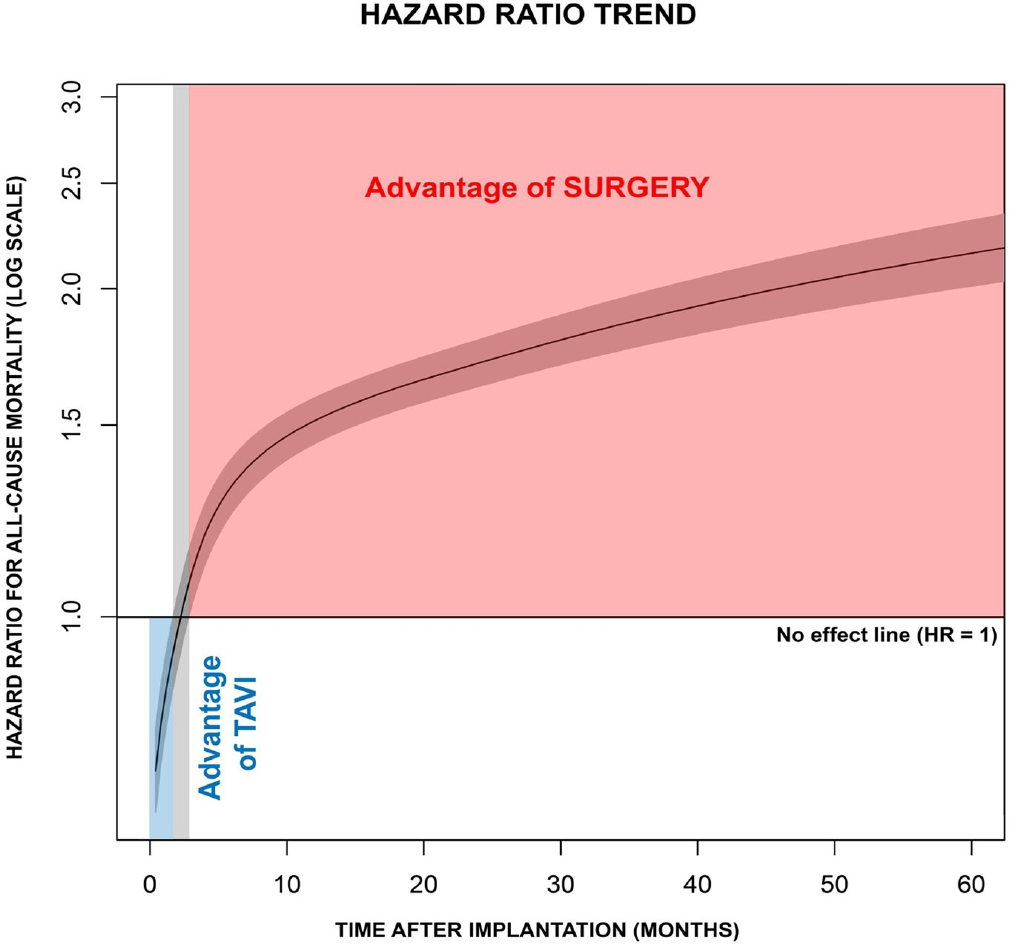
The analysis of HR trend over time of TAVI vs. SAVR estimated by fully parametric generalized survival models showed that TAVI is superior to surgery limited to the first months with a steep reversal afterwards, when SAVR became clearly superior (Figure 2). After one month, the advantage of surgery increased progressively, with a two-fold hazard of death for TAVI after 40 months.

Hazard ratio (HR) trend over time for all-cause mortality of transcatheter aortic valve implantation (TAVI) vs. surgical aortic valve replacement (SAVR) estimated by fully parametric generalized survival model. CI=confidence interval.
The analysis performed in the subgroups of risk confirmed data on the whole sample, although they represent only a small sample of the entire cohort, being most of the studies performed in mixed risk population. KM estimates for all-cause mortality in low-risk profiles showed a significant difference favoring surgery (HR 1.35; 95% CI 1.08 - 1.69, P-value < 0.001) (Figure 3), with a significant heterogeneity (random parameter θ = 0.1, P-value < 0.001). The Shoenfeld residuals and the Grambsch-Therneau test for time-invariant effect P-value was 0.02, representing a significant departure from constancy of the HR. Surgery has a five-year benefit also in intermediate risk (HR 1.73; 95% CI 1.35 - 2.22, P-value < 0.001; random parameter θ = 0.11, P-value < 0.001) (Figure 3) and high risk (HR 1.61; 95% CI 1.38 - 1.88, P-value < 0.001; random parameter θ = 0.001, P-value 0.5) (Figure 3). The HR trends in the subgroups of risk are influenced by the lower sample size. However, they corroborate the hypothesis of the benefit of surgery at five years (Figure 4).

Kaplan-Meier incidence function of all-cause mortality in transcatheter aortic valve implantation (TAVI) and surgical aortic valve replacement (SAVR) groups in low-, intermediate-, and high-risk subgroups. There is a strong departure from the constancy of the hazard ratio (HR); hence, the Cox-derived HR should be interpreted with caution. CI=confidence interval.

Hazard ratio (HR) trend over time for all-cause mortality after transcatheter aortic valve implantation vs. surgical aortic valve replacement estimated by fully parametric generalized survival model in subgroups of patients at low, intermediate, and high risk.
DISCUSSION
The current meta-analysis of RTE data from propensity score matching studies compares the effectiveness of TAVI vs. SAVR on mid-term all-cause mortality, aiming to evaluate the generalizability of TAVI indications. The main findings of this study are:
-
1. There is a significant difference in all-cause mortality at five years between TAVI and SAVR, favoring surgery.
-
2. TAVI maintains a survival advantage only in the perioperative period.
-
3. In the low-risk subgroup, TAVI is not superior to surgery, even in the first month after the procedure.
Our results on pooled RWD produced evidence of effectiveness at follow-up of TAVI and SAVR in real-world practice settings that differ from the efficacy that emerged by RCTs, raising concern about their external validity and the risk related to the indication creep[13]. All RCTs have demonstrated superiority or non-inferiority of TAVI compared to surgery, at least at one or two years, but on top of concerns related to the high risk of bias that can affect internal validity[10], they are designed on very selected subgroups of the population, as can be concluded by the several inclusion/exclusion criteria. The study selection is increasingly narrowed with the decrease of the risk profile of the trials’ cohort. A low-risk profile merges very different patients with diverse life expectancies and/or ages. Nonetheless, considering that aging is accompanied by an increase in chronic comorbidities, the elderly are likely to have an intermediate or high-risk profile, and the quote of elderly patients with no comorbidities should be limited and scarcely represented in the low-risk cohorts. Instead, only 8% of the patients were younger than 65 years in the PARTNER 3 and EVOLUT LR trials, and the mean age of all low-risk trials is higher than 73 years (79 years in the NOTION trial)[5-7,13], corroborating the hypothesis of high selection bias of the study groups.
The generalizability of the findings from the highly selective RCTs to broader populations (indication creep) without supporting data may lead to unexpected outcomes[44]. The results of the pooled RWD presented in this meta-analysis do not support the non-inferiority of TAVI shown by all RCTs and are also not concordant with meta-analyses on RCTs[1-8,45-48]. The survival advantage of TAVI in the first 24 months after implantation in RCTs in a methodologically similar meta-analysis is not corroborated by pooled RWD, as it runs out in the first month and reverses with a growing difference in mortality favoring surgery[45,46]. Other marked discrepancies are highlighted in the low-risk group, which is most likely to suffer the consequences of unsupported indication creep. A recent meta-analysis found no differences after one year in main outcomes between TAVI and SAVR in low-risk and high-risk patients, while the sub-analysis in the low-risk group of the present meta-analysis confirms that TAVI is associated with an increasingly worse all-cause mortality at five years and shows that there is also no advantage in the first months after the procedure[48]. The absence of a TAVI advantage in the perioperative period may be simply related to the lower sample size, although it might also be justified by a less pronounced effect of surgical invasiveness in low-risk patients leading to smaller perioperative differences between treatments. The outcomes of this meta-analysis on RWD pose a serious threat on the external validity of the existing first-line evidence that demonstrated the efficacy of TAVI especially in low-risk patients and drove the guidelines towards expanding the indication for TAVI to all categories of risk.
RWD has been reevaluated as a credible source of information, as it can provide evidence that informs patients, physicians, and regulators on the effects of an intervention outside the narrow confines of the research setting[11,12,15]. RCTs may exclude most patients seen in routine care; multimorbidity has a median exclusion proportion over 90% in RCTs, and large evidence gap has been noted for cardiovascular disease and psychiatric conditions, with an undisputed threat for their generalizability[49]. RWE may help regulators provide reliable information on treatment’s benefits and risks in heterogeneous clinical settings, such as vulnerable patients[12]. RWD is useful to improve the management of rare conditions, guarantee lower costs, and may also allow for longer follow-up, optimizing the detection of adverse events[11,12,15]. Companies and payers use systematic collection of RWD to monitor the effectiveness of new products and to bolster formulary positioning. Advances in methodologies applied to RWD as well as the availability of higher-quality larger datasets have bolstered their routine employment. Regulatory bodies, such as the FDA and the European Medicines Agency (or EMA), recognized the role of RWE in supporting their assessments and decision-making. RWD holds an intrinsic high risk of bias that can be reduced but not nullified and cannot substitute for the RCT design, which remains the gold standard for assessing the efficacy of a treatment. Nonetheless, observational studies can provide complementary information on treatment’s effectiveness and should be employed to supplement first-level evidence in health care decision-making[15].
The detailed explanation of the different TAVI/SAVR effectiveness at five years is far beyond the aims of the present study. Durability of the prosthesis, paravalvular leaks, and a higher incidence of pacemaker implantation have been considered potential factors affecting mid-term outcomes[39]. Newer prostheses are claimed to have better performance and a lower incidence of structural and non-structural valve deterioration, although there is limited evidence to support these arguments.
Limitations
Our pooled meta-analysis of RTE data holds intrinsic limitations. The duration of follow-up has been limited to five years as only a few patients had a longer follow-up. Most included studies have been performed in a mixed population (88%) of risk and treatments. Hence, evaluation on different devices is not feasible. A subgroup analysis should be taken with caution as the sample size is small. Moreover, the potential impact of comorbidities on both heterogeneity and outcomes in individual patients cannot be extrapolated.
CONCLUSION
In the real-word setting, TAVI is associated with a significant progressively worse incidence of all-cause of death compared to surgery and maintains a survival benefit only in the first month after implantation. However, in the subgroup of low-risk patients, the initial advantage is not evident. The results of this meta-analysis of propensity score matching studies comparing TAVI and SAVR show that TAVI effectiveness may not reflect the efficacy demonstrated by RCTs and pose a serious threat to their external validity.
-
No financial support.
-
This study was carried out at the University Department of Cardiac Surgery, Leipzig Heart Center, Leipzig, Germany.
Data Availability Statement
Data underlying the meta-analysis are retrieved from published RCTs and hence are already available in literature; no unpublished data were employed. However, the collected data underlying this article will be shared on reasonable request to the corresponding author.
REFERENCES
-
1 Mack MJ, Leon MB, Smith CR, Miller DC, Moses JW, Tuzcu EM, et al. 5-year outcomes of transcatheter aortic valve replacement or surgical aortic valve replacement for high surgical risk patients with aortic stenosis (PARTNER 1): a randomised controlled trial. Lancet. 2015;385(9986):2477-84. doi:10.1016/S0140-6736(15)60308-7.
» https://doi.org/10.1016/S0140-6736(15)60308-7. -
2 Gleason TG, Reardon MJ, Popma JJ, Deeb GM, Yakubov SJ, Lee JS, et al. 5-year outcomes of self-expanding transcatheter versus surgical aortic valve replacement in high-risk patients. J Am Coll Cardiol. 2018;72(22):2687-96. doi:10.1016/j.jacc.2018.08.2146.
» https://doi.org/10.1016/j.jacc.2018.08.2146. -
3 Makkar RR, Thourani VH, Mack MJ, Kodali SK, Kapadia S, Webb JG, et al. Five-year outcomes of transcatheter or surgical aortic-valve replacement. N Engl J Med. 2020;382(9):799-809. doi:10.1056/NEJMoa1910555.
» https://doi.org/10.1056/NEJMoa1910555. -
4 Van Mieghem NM, Deeb GM, Søndergaard L, Grube E, Windecker S, Gada H, et al. Self-expanding transcatheter vs surgical aortic valve replacement in intermediate-risk patients: 5-year outcomes of the SURTAVI randomized clinical trial. JAMA Cardiol. 2022;7(10):1000-8. doi:10.1001/jamacardio.2022.2695.
» https://doi.org/10.1001/jamacardio.2022.2695. -
5 Thyregod HGH, Ihlemann N, Jørgensen TH, Nissen H, Kjeldsen BJ, Petursson P, et al. Five-year clinical and echocardiographic outcomes from the NOTION randomized clinical trial in patients at lower surgical risk. Circulation. 2019;139(24):2714-23. doi:10.1161/CIRCULATIONAHA.118.036606.
» https://doi.org/10.1161/CIRCULATIONAHA.118.036606. -
6 Forrest JK, Deeb GM, Yakubov SJ, Gada H, Mumtaz MA, Ramlawi B, et al. 3-year outcomes after transcatheter or surgical aortic valve replacement in low-risk patients with aortic stenosis. J Am Coll Cardiol. 2023;81(17):1663-74. doi:10.1016/j.jacc.2023.02.017.
» https://doi.org/10.1016/j.jacc.2023.02.017. -
7 Leon MB, Mack MJ, Hahn RT, Thourani VH, Makkar R, Kodali SK, et al. Outcomes 2 years after transcatheter aortic valve replacement in patients at low surgical risk. J Am Coll Cardiol. 2021;77(9):1149-61. doi:10.1016/j.jacc.2020.12.052.
» https://doi.org/10.1016/j.jacc.2020.12.052. -
8 UK TAVI Trial Investigators; Toff WD, Hildick-Smith D, Kovac J, Mullen MJ, Wendler O, et al. Effect of transcatheter aortic valve implantation vs surgical aortic valve replacement on all-cause mortality in patients with aortic stenosis: a randomized clinical trial. JAMA. 2022;327(19):1875-87. doi:10.1001/jama.2022.5776.
» https://doi.org/10.1001/jama.2022.5776. -
9 Baumgartner H, Falk V, Bax JJ, De Bonis M, Hamm C, Holm PJ, et al. 2017 ESC/EACTS guidelines for the management of valvular heart disease. Eur Heart J. 2017;38(36):2739-91. doi:10.1093/eurheartj/ehx391.
» https://doi.org/10.1093/eurheartj/ehx391. -
10 Barili F, Brophy JM, Ronco D, Myers PO, Uva MS, Almeida RMS, et al. Risk of bias in randomized clinical trials comparing transcatheter and surgical aortic valve replacement: a systematic review and meta-analysis. JAMA Netw Open. 2023;6(1):e2249321. doi:10.1001/jamanetworkopen.2022.49321.
» https://doi.org/10.1001/jamanetworkopen.2022.49321. -
11 Monti S, Grosso V, Todoerti M, Caporali R. Randomized controlled trials and real-world data: differences and similarities to untangle literature data. Rheumatology (Oxford). 2018;57(57 Suppl 7):vii54-vii58. doi:10.1093/rheumatology/key109.
» https://doi.org/10.1093/rheumatology/key109. -
12 Dreyer NA. Strengthening evidence-based medicine with real-world evidence. Lancet Healthy Longev. 2022;3(10):e641-2. doi:10.1016/S2666-7568(22)00214-8.
» https://doi.org/10.1016/S2666-7568(22)00214-8. -
13 Goel SS, Reardon MJ. Indication creep in transcatheter aortic valve implantation-data or desire? JAMA Cardiol. 2023;8(6):519-20. doi:10.1001/jamacardio.2023.0674.
» https://doi.org/10.1001/jamacardio.2023.0674. -
14 Writing Committee Members; Otto CM, Nishimura RA, Bonow RO, Carabello BA, Erwin JP 3rd, et al. 2020 ACC/AHA guideline for the management of patients with valvular heart disease: a report of the American college of cardiology/American heart association joint committee on clinical practice guidelines. J Thorac Cardiovasc Surg. 2021;162(2):e183-e353. doi:10.1016/j.jtcvs.2021.04.002.
» https://doi.org/10.1016/j.jtcvs.2021.04.002. -
15 Blonde L, Khunti K, Harris SB, Meizinger C, Skolnik NS. Interpretation and impact of real-world clinical data for the practicing clinician. Adv Ther. 2018;35(11):1763-74. doi:10.1007/s12325-018-0805-y.
» https://doi.org/10.1007/s12325-018-0805-y. -
16 US Food & Drug Administration. Real-Word Evidence [Internet]. Silver Spring (MD): FDA, c2025 [cited 2025 16 Feb]. Available from: https://www.fda.gov/science-research/science-and-research-special-topics/real-world-evidence
» https://www.fda.gov/science-research/science-and-research-special-topics/real-world-evidence - 17 Moher D, Liberati A, Tetzlaff J, Altman DG; PRISMA Group. Preferred reporting items for systematic reviews and meta-analyses: the PRISMA statement. Int J Surg. 2010;8(5):336-41. Erratum in: Int J Surg. 2010;8(8):658. doi:10.1016/j.ijsu.2010.02.007.
-
18 Guyot P, Ades AE, Ouwens MJ, Welton NJ. Enhanced secondary analysis of survival data: reconstructing the data from published kaplan-meier survival curves. BMC Med Res Methodol. 2012;12:9. doi:10.1186/1471-2288-12-9.
» https://doi.org/10.1186/1471-2288-12-9. - 19 Wei Y, Royston P. Reconstructing time-to-event data from published kaplan-meier curves. Stata J. 2017;17(4):786-802.
-
20 Parolari A, Barili F, Pilozzi A, Pacini D. Ring or suture annuloplasty for tricuspid regurgitation? A meta-analysis review. Ann Thorac Surg. 2014;98(6):2255-63. doi:10.1016/j.athoracsur.2014.06.100.
» https://doi.org/10.1016/j.athoracsur.2014.06.100. -
21 Sterne JA, Hernán MA, Reeves BC, Savović J, Berkman ND, Viswanathan M, et al. ROBINS-I: a tool for assessing risk of bias in non-randomised studies of interventions. BMJ. 2016;355:i4919. doi:10.1136/bmj.i4919.
» https://doi.org/10.1136/bmj.i4919. -
22 Fiocco M, Putter H, van Houwelingen JC. Meta-analysis of pairs of survival curves under heterogeneity: a poisson correlated gamma-frailty approach. Stat Med. 2009;28(30):3782-97. doi:10.1002/sim.3752.
» https://doi.org/10.1002/sim.3752. -
23 Alperi A, Mohammadi S, Campelo-Parada F, Munoz-Garcia E, Nombela-Franco L, Faroux L, et al. Transcatheter versus surgical aortic valve replacement in patients with complex coronary artery disease. JACC Cardiovasc Interv. 2021;14(22):2490-9. doi:10.1016/j.jcin.2021.08.073.
» https://doi.org/10.1016/j.jcin.2021.08.073. -
24 Armoiry X, Obadia JF, Pascal L, Polazzi S, Duclos A. Comparison of transcatheter versus surgical aortic valve implantation in high-risk patients: a nationwide study in France. J Thorac Cardiovasc Surg. 2018;156(3):1017-25.e4. doi:10.1016/j.jtcvs.2018.02.092.
» https://doi.org/10.1016/j.jtcvs.2018.02.092. -
25 Barbanti M, Tamburino C, D'Errigo P, Biancari F, Ranucci M, Rosato S, et al. Five-year outcomes of transfemoral transcatheter aortic valve replacement or surgical aortic valve replacement in a real world population. Circ Cardiovasc Interv. 2019;12(7):e007825. doi:10.1161/CIRCINTERVENTIONS.119.007825.
» https://doi.org/10.1161/CIRCINTERVENTIONS.119.007825. -
26 Beyersdorf F, Bauer T, Freemantle N, Walther T, Frerker C, Herrmann E, et al. Five-year outcome in 18 010 patients from the German aortic valve registry. Eur J Cardiothorac Surg. 2021;60(5):1139-46. doi:10.1093/ejcts/ezab216.
» https://doi.org/10.1093/ejcts/ezab216. -
27 Brennan JM, Thomas L, Cohen DJ, Shahian D, Wang A, Mack MJ, et al. Transcatheter versus surgical aortic valve replacement: propensity-matched comparison. J Am Coll Cardiol. 2017;70(4):439-50. doi:10.1016/j.jacc.2017.05.060.
» https://doi.org/10.1016/j.jacc.2017.05.060. -
28 Brízido C, Madeira M, Brito J, Madeira S, Campante Teles R, Raposo L, et al. Surgical versus transcatheter aortic valve replacement in low-risk patients: a long-term propensity score-matched analysis. Catheter Cardiovasc Interv. 2021;98(7):E1033-43. doi:10.1002/ccd.29948.
» https://doi.org/10.1002/ccd.29948. -
29 Chung YH, Lee SH, Ko YG, Lee S, Shim CY, Ahn CM, et al. Transcatheter aortic valve replacement versus sutureless aortic valve replacement: a single center retrospective cohort study. Yonsei Med J. 2021;62(10):885-94. doi:10.3349/ymj.2021.62.10.885.
» https://doi.org/10.3349/ymj.2021.62.10.885. -
30 Deharo P, Cuisset T, Bisson A, Herbert J, Lacour T, Etienne CS, et al. Outcomes following aortic stenosis treatment (transcatheter vs surgical replacement) in women vs men (from a nationwide analysis). Am J Cardiol. 2021;154:67-77. doi:10.1016/j.amjcard.2021.05.046.
» https://doi.org/10.1016/j.amjcard.2021.05.046. -
31 Ferrara J, Deharo P, Resseguier N, Porto A, Jaussaud N, Morera P, et al. Rapid deployment versus trans-catheter aortic valve replacement in intermediate-risk patients: a propensity score analysis. J Card Surg. 2021;36(6):2004-12. doi:10.1111/jocs.15483.
» https://doi.org/10.1111/jocs.15483. -
32 Johansson M, Nozohoor S, Bjursten H, Ragnarsson S, Götberg M, Kimblad PO, et al. Late survival and heart failure after transcatheter aortic valve implantation. Asian Cardiovasc Thorac Ann. 2016;24(4):318-25. doi:10.1177/0218492316637712.
» https://doi.org/10.1177/0218492316637712. -
33 Kolar T, Bunc M, Jelenc M, Terseglav S, Kotnik A, Lakič N. Minimally invasive surgical aortic valve replacement versus transfemoral transcatheter aortic valve implantation in low-risk octogenarians : observational, retrospective and single-center study. Wien Klin Wochenschr. 2023;135(23-24):703-11. doi:10.1007/s00508-022-02094-z.
» https://doi.org/10.1007/s00508-022-02094-z. -
34 Muneretto C, Solinas M, Folliguet T, Di Bartolomeo R, Repossini A, Laborde F, et al. Sutureless versus transcatheter aortic valves in elderly patients with aortic stenosis at intermediate risk: a multi-institutional study. J Thorac Cardiovasc Surg. 2022;163(3):925-35.e5. doi:10.1016/j.jtcvs.2020.04.179.
» https://doi.org/10.1016/j.jtcvs.2020.04.179. -
35 Papadopoulos N, Schiller N, Fichtlscherer S, Lehmann R, Weber CF, Moritz A, et al. Propensity matched analysis of longterm outcomes following transcatheter based aortic valve implantation versus classic aortic valve replacement in patients with previous cardiac surgery. J Cardiothorac Surg. 2014;9:99. doi:10.1186/1749-8090-9-99.
» https://doi.org/10.1186/1749-8090-9-99. -
36 Santarpino G, Lorusso R, Moscarelli M, Mikus E, Wisniewski K, Dell'Aquila AM, et al. Sutureless versus transcatheter aortic valve replacement: a multicenter analysis of "real-world" data. J Cardiol. 2022;79(1):121-6. doi:10.1016/j.jjcc.2021.08.022.
» https://doi.org/10.1016/j.jjcc.2021.08.022. -
37 Schaefer A, Schofer N, Goßling A, Seiffert M, Schirmer J, Deuschl F, et al. Transcatheter aortic valve implantation versus surgical aortic valve replacement in low-risk patients: a propensity score-matched analysis. Eur J Cardiothorac Surg. 2019;56(6):1131-9. doi:10.1093/ejcts/ezz245.
» https://doi.org/10.1093/ejcts/ezz245. -
38 Sponga S, Isola M, Bagur R, Torracchi L, Mazzaro E, Grillo MT, et al. Transcatheter aortic valve implantation versus surgical aortic valve replacement in patients over 85 years old. Interact Cardiovasc Thorac Surg. 2017;25(4):526-32. doi:10.1093/icvts/ivx180.
» https://doi.org/10.1093/icvts/ivx180. -
39 Takeji Y, Taniguchi T, Morimoto T, Saito N, Ando K, Shirai S, et al Transcatheter aortic valve implantation vs. surgical aortic valve replacement for severe aortic stenosis in real-world clinical practice. Circ J. 2020;84(5):806-14. doi:10.1253/circj.CJ-19-0951.
» https://doi.org/10.1253/circj.CJ-19-0951. -
40 Tzamalis P, Alataki S, Bramlage P, Schmitt C, Schymik G. Comparison of valve durability and outcomes of transcatheter aortic valve implantation versus surgical aortic valve replacement in patients with severe symptomatic aortic stenosis and less-than-high-risk for surgery. Am J Cardiol. 2020;125(8):1202-8. doi:10.1016/j.amjcard.2020.01.015.
» https://doi.org/10.1016/j.amjcard.2020.01.015. -
41 Vilalta V, Alperi A, Cediel G, Mohammadi S, Fernández-Nofrerias E, Kalvrouziotis D, et al. Midterm outcomes following sutureless and transcatheter aortic valve replacement in low-risk patients with aortic stenosis. Circ Cardiovasc Interv. 2021;14(11):e011120. doi:10.1161/CIRCINTERVENTIONS.121.011120.
» https://doi.org/10.1161/CIRCINTERVENTIONS.121.011120. -
42 Virtanen MPO, Eskola M, Savontaus M, Juvonen T, Niemelä M, Laakso T, et al. Mid-term outcomes of sapien 3 versus perimount magna ease for treatment of severe aortic stenosis. J Cardiothorac Surg. 2020;15(1):157. doi:10.1186/s13019-020-01203-1.
» https://doi.org/10.1186/s13019-020-01203-1. -
43 Kowalówka AR, Kowalewski M, Wańha W, Kołodziejczak M, Mariani S, Li T, et al. Surgical and transcatheter aortic valve replacement for severe aortic stenosis in low-risk elective patients: analysis of the aortic valve replacement in elective patients from the aortic valve multicenter registry. J Thorac Cardiovasc Surg. 2024;167(5):1714-23.e4. doi:10.1016/j.jtcvs.2022.10.026.
» https://doi.org/10.1016/j.jtcvs.2022.10.026. -
44 Riggs KR, Ubel PA. The role of professional societies in limiting indication creep. J Gen Intern Med. 2015;30(2):249-52. doi:10.1007/s11606-014-2980-0.
» https://doi.org/10.1007/s11606-014-2980-0. -
45 Barili F, Freemantle N, Pilozzi Casado A, Rinaldi M, Folliguet T, Musumeci F, et al. Mortality in trials on transcatheter aortic valve implantation versus surgical aortic valve replacement: a pooled meta-analysis of kaplan-meier-derived individual patient data. Eur J Cardiothorac Surg. 2020;58(2):221-9. doi:10.1093/ejcts/ezaa087. Erratum in: Eur J Cardiothorac Surg. 2020;58(2):409. doi:10.1093/ejcts/ezaa157.
» https://doi.org/10.1093/ejcts/ezaa087. -
46 Barili F, Freemantle N, Musumeci F, Martin B, Anselmi A, Rinaldi M, et al. Five-year outcomes in trials comparing transcatheter aortic valve implantation versus surgical aortic valve replacement: a pooled meta-analysis of reconstructed time-to-event data. Eur J Cardiothorac Surg. 2022;61(5):977-87. doi:10.1093/ejcts/ezab516.
» https://doi.org/10.1093/ejcts/ezab516. -
47 Siontis GCM, Overtchouk P, Cahill TJ, Modine T, Prendergast B, Praz F, et al. Transcatheter aortic valve implantation vs. surgical aortic valve replacement for treatment of symptomatic severe aortic stenosis: an updated meta-analysis. Eur Heart J. 2019;40(38):3143-53. doi:10.1093/eurheartj/ehz275.
» https://doi.org/10.1093/eurheartj/ehz275. -
48 Ahmad Y, Howard JP, Arnold AD, Madhavan MV, Cook CM, Alu M, et al. Transcatheter versus surgical aortic valve replacement in lower-risk and higher-risk patients: a meta-analysis of randomized trials. Eur Heart J. 2023;44(10):836-52. doi:10.1093/eurheartj/ehac642.
» https://doi.org/10.1093/eurheartj/ehac642. -
49 Tan YY, Papez V, Chang WH, Mueller SH, Denaxas S, Lai AG. Comparing clinical trial population representativeness to real-world populations: an external validity analysis encompassing 43 895 trials and 5 685 738 individuals across 989 unique drugs and 286 conditions in England. Lancet Healthy Longev. 2022;3(10):e674-89. doi:10.1016/S2666-7568(22)00186-6.
» https://doi.org/10.1016/S2666-7568(22)00186-6.