
 Validation of NUTRIFICO Mnemonic as a Nutritional Approach and Breaking Dismal News in Palliative Care
ABSTRACT
Introduction: Nutritional assistance in palliative care has a preventive role and seeks to ensure the patient's nutritional needs in an attempt to help to control the symptoms, maintain satisfactory hydration, reframe food, reduce anxiety, delay the development of cachexia, preserve weight and nutritional composition.
Objective: To develop and validate the NUTRIFICO mnemonic as an approach to nutritional assistance and communication of poor news in palliative care.
Method: Research development and validation of content utilizing the Delphi technique with the application of a mixed design with qualitative and quantitative approaches for data collection and analysis. The participants, nutritionists with experience in palliative care and/or training in the area, were recruited by sampling using the snowball method. The minimum agreement percentage defined for validation was 80% on the five-point Likert scale.
Results: Forty participants were invited to participate in the study, including eight "seeds" and 16 signed the Informed Consent Form (ICF). The content analysis followed two Delphi rounds, an agreement rate greater than 80% was obtained among participants for all the components. The final version of the NUTRIFICO mnemonic presented two key principles, eight components and twelve recommendations.
Conclusion: The mnemonic NUTRIFICO was validated in terms of content and relevant for the application in the nutritional approach and communication of poor news in palliative care.
Key words:
Palliative Care; Diet, Food, and Nutrition; Delphi Technique; Communication; Validation Study
RESUMO
Introdução: A assistência nutricional em cuidados paliativos possui papel preventivo e visa assegurar as necessidades nutricionais do paciente na tentativa de auxiliar o controle dos sintomas, manter a hidratação satisfatória, ressignificar a alimentação, reduzir a ansiedade, retardar o desenvolvimento da caquexia, preservar o peso e a composição nutricional.
Objetivo: Desenvolver e validar o mnemônico NUTRIFICO como abordagem de assistência nutricional e comunicação de notícias difíceis em cuidados paliativos.
Método: Pesquisa de desenvolvimento e validação de conteúdo que utilizou a técnica Delphi com a aplicação do delineamento misto com abordagens qualitativas e quantitativas para a coleta e análise dos dados. Os participantes, nutricionistas com atuação em cuidados paliativos e/ou formação na área, foram recrutados por amostragem do tipo bola de neve. O percentual de concordância mínimo definido para validação foi de 80% pela escala Likert de cinco pontos.
Resultados: Quarenta participantes, incluindo oito "sementes", foram convidados a participar do estudo. Destes, 16 assinaram o Termo de Consentimento Livre e Esclarecido (TCLE). A análise de conteúdo seguiu duas rodadas Delphi e foi obtida uma taxa de concordância superior a 80% entre os participantes para todos os componentes. A versão final do mnemônico NUTRIFICO resultou em dois princípios-chave, oito componentes e 12 recomendações.
Conclusão: O mnemônico NUTRIFICO foi considerado válido quanto ao conteúdo e, portanto, pertinente à aplicação na abordagem nutricional e comunicação de notícias difíceis em cuidados paliativos.
Palavras-chave:
Cuidados Paliativos; Alimentos, Dieta e Nutrição; Técnica Delfos; Comunicação; Estudo de Validação
RESUMEN
Introducción: La asistencia nutricional en cuidados paliativos tiene un papel preventivo y busca asegurar las necesidades nutricionales del paciente en un intento de ayudar a controlar los síntomas, mantener una hidratación satisfactoria, replantear la alimentación, reducir la ansiedad, retrasar el desarrollo de la caquexia, conservar el peso y la composición nutricional.
Objetivo: Desarrollar y validar el nemónico NUTRIFICO como enfoque de la asistencia nutricional y comunicación de malas noticias en cuidados paliativos.
Método: Investigación de desarrollo y validación de contenido, que utilizó la técnica Delphi con la aplicación de un diseño mixto con enfoques cualitativos y cuantitativos para la recolección y análisis de datos. Los participantes, nutricionistas con experiencia en cuidados paliativos y/o estudios en el área, fueron reclutados por muestreo mediante el método de bola de nieve. El porcentaje mínimo de acuerdo definido para la validación fue del 80% en la escala de Likert de cinco puntos.
Resultados: Se invitó a cuarenta participantes incluyendo a ocho "semillas" a participar en el estudio y 16 firmaron el Término de Consentimiento Libre e Informado (TCLE). El análisis siguió dos rondas Delphi, se obtuvo una tasa de acuerdo superior al 80% entre los participantes para todos los componentes. La versión final del nemónico NUTRIFICO presentó dos principios clave, ocho componentes y doce recomendaciones.
Conclusión: El nemónico NUTRIFICO se consideró válido en cuanto a contenido y relevante para la aplicación en el enfoque nutricional y comunicación de malas noticias en cuidados paliativos.
Palabras clave:
Cuidados Paliativos; Nutrición, Alimentación y Dieta; Técnica Delfos; Comunicación; Estudio de Validación
INTRODUCTION
Palliative care (PC) is an approach which promotes the quality-of-life for patients of all ages within the context of severe or life-threatening diseases and challenges. The objective is to improve the quality-of-life through prevention, early detection and suffering relief, ensuring exceptional treatment for pain and other physical, emotional, spiritual and social issues1,2. The fundaments to ensure humanization of PC include symptoms management, full control of the pain, implementation of measures of well-being, strengthening the role of the family when the patient makes its choices and expresses its wishes, respect to living will and autonomy of the patient and promotion of reliable and transparent communication among health professionals, patient, caretakers and family as participants of the therapeutic process3.
Nutrition plays a key role in PC because it brings well-being, keeps or recovers the nutritional status, promotes emotional comfort and moments of joy4,5. Nutritional support in PC is preventive and aims to meet the patient's nutritional needs to control the symptoms, keep satisfactory hydration, reframe food, reduce anxiety, delay the development of cachexia, preserve weight and nutritional composition, if applicable. As the disease progresses, palliative approach assumes the key position, superseding the disease modifying treatment and the nutritionist should match its conduct to moral principles, respect to the dignity, empathy and honesty4,6,7.
The nutritionist has a crucial role in PC while attempting to understand and expose the relevance of this approach. Nevertheless, due to the lack of this expertise in nutrition colleges, scarce post-graduation courses or targeted training, Brazilian nutritionists have been poorly trained7,8.
The present article has the objective to develop and validate the mnemonic NUTRIFICO as nutritional approach and communication of dismal news in PC to be applied by the nutritionist as member of the multiprofessional team. In addition, the study aims to strengthen the connection among the team, patient and family, reduce the anguish and make care more effective along the course of the disease.
METHOD
Mixed, quantitative and qualitative design study of development and validation of content according to the Consolidated Criteria for Reporting Qualitative Research (COREQ) guidelines for qualitative approach9.
The study was developed in two stages. First, the mnemonic NUTRIFICO was created and based on a literature review of PC (unpublished data) and next, the Delphi technique was applied to validate the mnemonic by skilled or graduated nutritionists in PC, defined as experts.
The following descriptors were utilized for the literature review (first stage): "Palliative care", "Nutrition", "Nutritional therapy", "Communication of dismal news" at the databases PubMed, SciELO, Google Scholar and Virtual Health Library (VHS = BVS). Guidelines, randomized clinical trials, cohort and review studies, systematic literature review and manuals of reference published on any year were included. Scientific articles not within the scope were excluded. The literature review led to the creation of a work group formed by the authors of the present article who met weekly from May to November 2022 to develop the initial version of NUTRIFICO and future validation.
The mnemonic was developed and validated to guide the nutritional conduct and facilitate the communication of dismal news due to scarce literature and to improve the performance of the nutritionist in PC.
The validation with Delphi occurred between November 2022 and March 2023, consisting in collecting information and opinions of experts for decision-taking10. Snowball sampling was applied to include the experts, it begins with the first enrolled called "seeds" and these refer other participants who meet the study inclusion criteria. All the participants were nutritionists dully registered at the regional nutritionist association (CRN) and at least one year working in PC. Branco and Capelas11 confirm that this modality of sampling allows the analysis of specific populations as PC nutrition experts12,13.
The "seeds" were identified through non-systematized search of the themes PC, nutrition, hospices, hospitals, retirement homes and oncologic clinics at LinkedIn®, Plataforma Lattes, Google® and Instagram®. Additionally, nutritionists of the national palliative care nutrition council (ANCP) were also defined as "seeds".
Nutritionists received an invitation to join the study by e-mail and social media (WhatsApp® and Instagram®) with a registration link developed with Google Forms® and an explanatory video with instructions to access. After expressing their interest to participate, they were briefed about the objectives and methodology and received anonymously and individually the Confidentiality and Anonymity Form and the Informed Consent Form (ICF) to sign. Once signed, the validation questionnaire of the mnemonic elaborated with Google Forms® was sent.
According to Delphi, the responses were collected at the first round and compiled to evaluate the experts’ consensus. Had one component failed to reach the agreement level established (80% for the present study), it was redesigned and sent to the experts for revaluation. The process was repeated in subsequent rounds until the agreement level was reached for all the components evaluated10,14,15.
The 5-points Likert scale was utilized by the experts nutritionists to respond to the questions directly and quantitatively and justify their choices10,16: (1) fully disagree, (2) partially disagree, (3) neither agree nor disagree, (4) partially agree, (5) fully agree16. The sum of items 4 and 5 should reach 80% of agreement for statistical analysis.
Microsoft Excel® version 16.75.2 was utilized to analyze the quantitative data through which the variables were described statistically. Frequencies, measures of central tendency and dispersion were calculated. The Shapiro-Wilk normality test was adopted with the software Graph Pad Prism 9®17.
The Institutional Review Board of "Centro Universitário UNA de Minas Gerais" approved the study, report number 5,713,229 (CAAE (submission for ethical review): 64102122.8.0000.5098), in compliance with Directive 466/1218 of the National Health Council (CNS) in regard to anonymity and confidentiality.
RESULTS
Eight participants defined as "seeds" were invited to collaborate and validate the mnemonic NUTRIFICO according snowball sampling. Of these, only six accepted to join and signed the ICF. Upon acceptance, the seeds referred more 34 participants and only ten accepted to participate and signed the ICF, reaching the total of 16 patients enrolled as experts.
Eight females participated of the validation, mean age of 37 years (27-55 age range). 81% (n=13) lived in the Southeast region, 13% (n=2) in the Northeast and 6% (n=1) in the South region. 50% (n=8) had Masters’ degree, 13 (n=2), PhD degree and 37% (n=6) lato sensu post-graduation (specialization or residency). 94% worked in PC and 75% worked as clinical nurses for more than three years, 56% (n=9) worked in private institutions and 44% (n=7) were public employees.
Qualification, time of professional experience in PC, assistance network, sex and origin were described in absolute and relative frequency. The continuous sociodemographic data (age) was described as mean, minimum and maximum values and classified as normal distribution by the Shapiro-Wilk normality test (Table 1).
Due to loss to follow-up, 12 participants of the first round Delphi contributed anonymously within the schedule and in the second Delphi round, 15 contributed to analyze the components and their recommendations. The level of agreement ranged between 50% and 100% for eight components and 12 recommendations of the mnemonic: NU: Never forbid a food (91.7%); T: Proper texture and consistency (100% and 91.7%); R: Reframe the food (100% and 100%); I: Food intake and hydration (100% and 50%); F: Avoid forcing unwanted and non-tolerated food (100%); I: Ban unnecessary or futile procedures (100%); C: Body composition and cachexia (66.7% and 80%); O: Guideline and communication of dismal news (100% and 100%).
Of the twelve recommendations, ten were validated with mean of 98% of agreement for the questions and only two failed to reach the minimum percent defined in the first round such as: (I) Food intake and hydration: "Satisfactory hydration characterizes biological need of the patient in palliative care and should be kept in the course of the entire treatment" (50%); (C) Body composition and cachexia: "Control the body and nutritional composition and delay the development of cachexia are procedures that minimize the adverse effects of the treatment and of the disease" (66.7%).
In regard to the recommendations of the component "Food intake and hydration", the participants claimed that it is necessary to focus on the patient comfort in relation to hydration usually adjusted to the patient clinical condition and it can be contraindicated in the last days of life. The clinical condition and the phase of the treatment should be considered to maintain the body composition and treatment of cachexia according to the recommendation of the component "Body composition and cachexia". In addition, a participant has also proposed the revision of the name of the component and its recommendation from "Reframing the food" to "Reframing feeding".
The topics of disagreement of the questionnaire found in the justifications of the participants were listed (Chart 1) to facilitate the analysis of the content.
Content analysis of the justifications of the participants for the components which failed to reach the minimum level of agreement on the first round
The recommendations of the second affirmative of the component "I" were revised: "Food intake and hydration" and the affirmative of the component "C: Body composition and cachexia". Likewise, based in the suggestion of one of the participants for component "R", even after 100% of agreement, it has been decided to revise it: from "Reframe the food" to "Reframe feeding". According to the recommendations of the participants, the mnemonic was restructured (Figure 1).
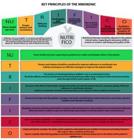
The validation of two key principles of PC was added to the mnemonic based on the comments reported: i) PC is not death. The multidisciplinary team should reach a consensus about the identification of the phase of the treatment. Nutritional assistance changes since the diagnosis through the follow up of the disease, endof-life and mourning; ii) Nutritional therapy should be adjusted to the patient's clinical condition respecting its autonomy to bring relief, well-being and improvement of the quality-of-life.
The new round of the mnemonic NUTRIFICO was reviewed after the participants comments. All the eight components of the mnemonic, including the two key principles evaluated exceeded the minimum level of agreement of 80% among the participants. Table 2 portrays the validation of the classification of the mnemonic and level of agreement.
Consensus of the participants about the content of the mnemonic NUTRIFICO, 1st and 2nd rounds of Delphi
The final conceptual structure of the NUTRIFICO presented as a diagram was validated with two key principles, eight components and 12 recommendations (Figure 1).
DISCUSSION
The present article described the development and validation of the mnemonic NUTRIFICO as an innovative approach of nutritional care and communication of dismal news in PC, utilizing the technique Delphi with quantitative and qualitative elements.
40 nutritionists graduated and/or with experience in PC selected by snowball sampling have been enrolled, 16 of which accepted to participate of the validation process.
After two Delphi rounds, the level of agreement reached at least 80% for all the components, eventually producing the final version of the mnemonic NUTRIFICO with two key principles, eight components and 12 recommendations.
According to Habibi et al.15, it was attempted to reach the most reliable consensus for the method based on the participants’ recommendations. Silva et al.19, in their study of validation of the content of instruments, concluded that the base to change the mnemonic depends on the results of the analysis of the components. The participants’ qualitative recommendations should be accepted and incorporated because they express the commitment of the professional with the theme as reinforced by Hortense et al.20.
The participants reported that it was necessary to focus on the patient's comfort in relation to the recommendations of the component "Food intake and hydration"; the indications should be adjusted to the patient's clinical conditions with possible contraindication in end-of-life.
Nakajima21 described increase of artificial hydration for patients with advanced disease, regardless of discrepancies of the current practices that can cause severe clinical problems, including unwanted symptoms related to dehydration and hyperhydration. Although hydration is not always beneficial for end-of-life patients, some studies concluded that correct hydration could help to relieve severe symptoms and contribute even more to the patient's comfort. Based on the literature and the justifications of the participants, the recommendation "Satisfactory hydration expresses the biological need of the patient in PC and should be kept throughout the entire treatment" was changed to "Satisfactory hydration depends on the patient's clinical condition and tolerance".
The participants justified that the control of the body and nutritional composition should be evaluated according to the prognosis of the patient, following the recommendation of the component "Body composition and cachexia" because the monitoring is a potentially inappropriate measure because no impact on the clinical outcome occurs. The justifications corroborate the conclusions of Ruggeri et al.22, which found that the benefits warranted by nutritional therapy on survival and performance of the patient depended on the level of cachexia when the treatment was initiated and of the patients’ nutritional condition.
The question relies on good conduct and discernment while taking decisions, well beyond the mere clinical and nutritional limits. According to these considerations, the recommendation of the component "C" was changed from "Control of body and nutritional composition and delay the development of cachexia are measures that can minimize the diseases-related adverse effects" to "Follow-up of the body composition can control the development of cachexia and minimize the adverse effects of the treatment. For end-of-life patients, it is a potentially inappropriate measure since it does change the clinical outcome".
As a result, after the second round, the participants concluded as relevant and appropriate the themes and contents proposed for nutritional approach and communication of dismal news in PC. All the items evaluated were approved and the level of agreement exceeded 80%, considered satisfactory for the construction and validation of the mnemonic NUTRIFICO.
The mnemonic was the technique of choice to develop the method NUTRIFICO as nutritional approach and communication of dismal news in PC, based on the experience of the authors in PC and scientific literature review. Toledo et al.8 adopted the same technique of mnemonic to divulge the knowledge during the campaign "Say no to MALNUTRITION" sponsored by "Sociedade Brasileira de Nutrição Parenteral e Enteral (Braspen/ SBNPE)" where each letter recalled one recommendation with guidance about the control of the depleted nutritional condition. Therefore, this technique helps to memorize and guides nutritional practices, prioritizing the health and interaction among the nutritional therapy team23–25.
It was possible to adopt the snowball methodology with "seeds" to enroll as much nutritionists as possible working and/or graduated in PC with referrals of other professionals who could potentially contribute to investigate the population in question11,12.
The enrollment of 16 participants is satisfactory since the sample was by convenience and the number of experts varies according to Delphi, where a sample smaller than ten is considered optimal12.
The technique Delphi was adopted to validate the mnemonic NUTRIFICO as nutritional approach and communication of dismal news in PC, an effective method that allows through feedback the opportunity to find a solution or reach a consensus about a theme26. Silva10 utilized the same technique in his study to analyze the agreement on tolerance and nutritional characteristic of hospital meals. The author affirms that this technique ensures the acquisition, analysis, and steer the information to achieve an agreement around a certain subject10.
Overall, the technique Delphi is defined as an interactive process designed to combine justifications of a group of participants until a consensus is reached10,19,26,27.
Predominantly, the performance of the participants was concentrated in the Southeast region (81%, 13). According to the "Atlas Global de Cuidados Paliativos 20195", PC is organized in 191 health services, increasing 8% compared with 2018. In addition, the Southeast region gathered the larger number of available PC services, similar to the present study.
The larger number of female nutritionists is consistent with the study titled "Inserção Profissional dos Nutricionistas no Brasil"28 conducted in 2016, where 1,104 nutritionists employed were investigated and 94.1% of the Brazilian nutritionists are women28. This profile is similar to this article where only women participated of the sample, a clear picture of the profession.
The limitation of the study was to find and enroll professionals graduated or working in PC who accepted to join the study, a quite challenging task. However, the snowball strategy was effective to achieve the desired sample. An additional limitation was the low adherence of professionals to scientific researches, 40 professionals were invited, but only 16 signed the Informed Consent Form.
The final model certifies the use of the mnemonic in Portuguese, however, future studies are necessary to validate NUTRIFICO in other languages and application to the targeted population.
CONCLUSION
The two-rounds Delphi technique was applied to validate the content that reached at least 80% of agreement among the experts; the content was developed and validated with two key principles, eight components and 12 recommendations.
For future studies, it is anticipated to evaluate the application of the mnemonic by nutritionists together with patients who need PC. In addition, this article can be a starting point for other researches in that area since the science supporting methods able to guide nutritional approach and communication of dismal news is quite limited.
References
-
1 World Health Organization. Palliative care [Internet]. Geneva: WHO; 2020. [acesso 2023 jan 8]. Disponível em: https://www.who.int/news-room/fact-sheets/detail/palliative-care
» https://www.who.int/news-room/fact-sheets/detail/palliative-care -
2 The International Association for Hospice and Palliative Care [Internet]. Houston: IAHPC; 2019. Consensus-based definition of palliative care. [acesso 2023 jan 8]. Disponível em: https://hospicecare.com/what-we-do/projects/consensus-based-definition-of-palliative-care/
» https://hospicecare.com/what-we-do/projects/consensus-based-definition-of-palliative-care/ -
3 Bueno JMV, La Calle GH. Humanizing intensive care: from theory to practice. Crit Care Nurs Clin North Am. 2020;32(2):135-47. doi: https://doi.org/10.1016/j.cnc.2020.02.001
» https://doi.org/10.1016/j.cnc.2020.02.001 -
4 Sociedade Brasileira de Nutrição Oncológica. I Consenso brasileiro de nutrição oncológica da SBNO [Internet]. Rio de Janeiro: Edite; 2021. [acesso 2022 dez 4]. Disponível em: https://sbno.com.br/wp-content/uploads/2021/07/consenso_2021.pdf
» https://sbno.com.br/wp-content/uploads/2021/07/consenso_2021.pdf -
5 Santos AFJ. Atlas dos cuidados paliativos no Brasil 2019 [Internet]. São Paulo: ANCP; 2020. [acesso 2023 jan 8]. Disponível em: https://api-wordpress.paliativo.org.br/wp-content/uploads/2020/05/ATLAS_2019_final_compressed.pdf
» https://api-wordpress.paliativo.org.br/wp-content/uploads/2020/05/ATLAS_2019_final_compressed.pdf -
6 Maltoni M, Caraceni A, Brunelli C, et al. Prognostic factors in advanced cancer patients: evidence-based clinical recommendations: a study by the steering Committee of the European Association for Palliative Care. J Clin Oncol. 2005;23(25):6240-8. doi: https://doi.org/10.1200/JCO.2005.06.866
» https://doi.org/10.1200/JCO.2005.06.866 -
7 Bachmann P, Marti-Massoud C, Blanc-Vincent MP, et al. Standards, options et recommandations: nutrition en situation palliative ou terminale de l'adulte porteur de cancer évolutif. Bull Cancer [Internet]. 2001 [acesso 2022 dez 4]; 88(10):985-1006. Disponível em: https://www.lissa.fr/rep/articles/11713035
» https://www.lissa.fr/rep/articles/11713035 -
8 Conselho Federal de Nutricionistas (BR). Resolução n° 689, de 04 de maio de 2021. Regulamenta o reconhecimento de especialidades em Nutrição e o registro, no âmbito do Sistema CFN/CRN, de títulos de especialista de nutricionistas [Internet]. Diário Oficial da União, Brasília, DF. 2021 maio 4. [acesso 2022 ago 17]; seção I:163-4. Disponível em: https://nutricao.ufes.br/sites/nutricao.ufes.br/files/field/anexo/resolucao_cfn_no_689_de_04_de_maio_de_2021.pdf
» https://nutricao.ufes.br/sites/nutricao.ufes.br/files/field/anexo/resolucao_cfn_no_689_de_04_de_maio_de_2021.pdf -
9 Tong A, Sainsbury P, Craig J. Consolidated criteria for reporting qualitative research (COREQ): a 32-item checklist for interviews and focus groups. Int J Qual Health Care. 2007;19(6):349-57. doi: https://doi.org/10.1093/intqhc/mzm042
» https://doi.org/10.1093/intqhc/mzm042 -
10 Silva MP. Elaboração, aprimoramento e validação do conteúdo de instrumentos para avaliar aceitação e a qualidade de dietas hospitalares[dissertação] [Internet]. Rio de janeiro: Fundação Oswaldo Cruz; 2017 [acesso 2023 jan 23]. Disponível em: https://www.arca.fiocruz.br/handle/icict/34455
» https://www.arca.fiocruz.br/handle/icict/34455 -
11 Branco DN, Capelas ML. Fatores que condicionam a acessibilidade aos cuidados paliativos dos doentes com demência na perspetiva dos neurologistas e paliativistas. Cadernos Saúde. 2020;12(1):41-6. doi: https://doi.org/10.34632/cadernosdesaude.2020.5833
» https://doi.org/10.34632/cadernosdesaude.2020.5833 -
12 Vinuto J. A amostragem em bola de neve na pesquisa qualitativa: um debate em aberto. Temáticas. 2014;22(44):203-20. doi: https://doi.org/10.20396/tematicas.v22i44.10977
» https://doi.org/10.20396/tematicas.v22i44.10977 -
13 Von der Fehr A, Sølberg J, Bruun J. Validation of networks derived from snowball sampling of municipal science education actors. Int J Res Method Educ. 2018;41(1):38-52. doi: https://doi.org/10.1080/1743727X.2016.1192117
» https://doi.org/10.1080/1743727X.2016.1192117 -
14 Wright JTC, Giovinazzo RA. DELPHI - uma ferramenta de apoio ao planejamento prospectivo. Cad Pesq Adm. [Internet]. 2000 [acesso 2023 jan 1];1(12):54-65. Disponível em: https://repositorio.usp.br/item/001173053
» https://repositorio.usp.br/item/001173053 -
15 Habibi A, Sarafrazi A, Izadyar S. Delphi technique theoretical framework in qualitative research. IJES [Internet]. 2014 [acesso 2023 jan 8];3(4):8-13. Disponível em: https://www.researchgate.net/publication/272177606_Delphi_Technique_Theoretical_Framework_in_Qualitative
» https://www.researchgate.net/publication/272177606_Delphi_Technique_Theoretical_Framework_in_Qualitative -
16 Dalmoro M, Vieira KM. Dilemas na construção de escalas tipo Likert: o número de itens e a disposição influenciam nos resultados? Rev Gest Organ [Internet]. 2013 [acesso 2022 jun 25];6(3):161-74. doi: https://doi.org/10.22277/rgo.v6i3.1386
» https://doi.org/10.22277/rgo.v6i3.1386 -
17 Graph Pad: Prism [Internet]. Versão 9.0.0. Boston: GraphPad; 2020. [acesso 2023 dez 19]. Disponível em: https://www.graphpad.com/updates/prism-900-release-notes
» https://www.graphpad.com/updates/prism-900-release-notes - 18 Conselho Nacional de Saúde (BR). Resolução n° 466, de 12 de dezembro de 2012. Aprova as diretrizes e normas regulamentadoras de pesquisas envolvendo seres humanos. Diário Oficial da União, Brasília, DF. 2013 jun 13; Seção 1:59
-
19 Silva LGD, Fenner PC, Vargas CL, et al. Validação de um questionário para puérperas sobre o conhecimento em aleitamento materno. Braz J Healt Rev. 2022;4(1):2303-15. doi: http://doi.org/10.34119/bjhrv4n1-186
» http://doi.org/10.34119/bjhrv4n1-186 -
20 Hortense FTP, Bergerot CD, Domenico EBL. Construction and validation of clinical contents for development of learning objects. Rev Bras Enferm. 2018;71(2):306-13. doi: http://dx.doi.org/10.1590/0034-7167-2016-0622
» http://dx.doi.org/10.1590/0034-7167-2016-0622 -
21 Nakajima N. Difficulties in addressing artificial hydration and nutrition therapy for terminal cancer patients: what to do if patients/families wishes differ from the medically appropriate treatment plans? Am j hosp palliat care. 2021;39(8):926-33. doi: http://dx.doi.org/10.1177/10499091211058029
» http://dx.doi.org/10.1177/10499091211058029 -
22 Ruggeri E, Giannantonio M, Agostini F, et al. Home artificial nutrition in palliative care cancer patients: Impact on survival and performance status. Clin Nutr. 2020;39(11):3346-53. doi: https://doi.org/10.1016/j.clnu.2020.02.021
» https://doi.org/10.1016/j.clnu.2020.02.021 -
23 Toledo DO, Piovacari SMF, Horie LM, et al. Campanha "Diga não à desnutrição": 11 passos importantes para combater a desnutrição hospitalar. BRASPEN J [Internet]. 2018 [acesso 2023 fev 15];33(1):86-100. Disponível em: http://arquivos.braspen.org/journal/jan-fev-mar-2018/15-Campanhadiga-nao-aadesnutricao.pdf
» http://arquivos.braspen.org/journal/jan-fev-mar-2018/15-Campanhadiga-nao-aadesnutricao.pdf -
24 Mota ER, Diniz MSK. O uso de técnicas mnemônicas como estratégia de aprendizagem para crianças do ensino fundamental I. Anais dos Cursos de Pós-Graduação Lato Sensu UniEVANGÉLICA [Internet]. 2017 [acesso 2023 jan 11];1(1):82-100. Disponível em: http://anais.unievangelica.edu.br/index.php/latosensu/article/view/1775/543
» http://anais.unievangelica.edu.br/index.php/latosensu/article/view/1775/543 -
25 Bonfim CV, Goncalves FR, Almeida AC, et al. Assistência de enfermagem ao paciente de emergência/urgência. Rev Enferm UFPE Online. 2018;12(12):3506-12. doi: https://doi.org/10.5205/1981-8963-v12i12a237472p3506-3512-2018
» https://doi.org/10.5205/1981-8963-v12i12a237472p3506-3512-2018 -
26 Oliveira CCM, Tavares JFDCJ, Leão RMCL, et al. Delphi, técnica de validação para pesquisas na pandemia. Recife: Even3; 2020. (Ebook). doi: http://doi.org/10.29327/icidsuim2020.305828
» http://doi.org/10.29327/icidsuim2020.305828 -
27 Massaroli A, Martini JG, Lino MM, et al. Método Delphi como referencial metodológico para a pesquisa em enfermagem. Texto Contexto Enferm. 2017;26(4):1-9. doi: http://doi.org/10.1590/0104-07072017001110017
» http://doi.org/10.1590/0104-07072017001110017 -
28 Conselho Federal de Nutricionistas. Inserção profissional dos nutricionistas no Brasil [Internet]. Brasília, DF: CFN; 2019 [acesso 2023 jan 20]. Disponível em: https://www.cfn.org.br/wp-content/uploads/2019/05/CARTILHA%20CFN_VERSAO_DIGITAL.pdf?fbclid=IwAR0uypYRdbnoFbs_aR4PIAKygN3PC4-BUFJfPCD2tszfAXtxG1y0KE1HvLs
» https://www.cfn.org.br/wp-content/uploads/2019/05/CARTILHA%20CFN_VERSAO_DIGITAL.pdf?fbclid=IwAR0uypYRdbnoFbs_aR4PIAKygN3PC4-BUFJfPCD2tszfAXtxG1y0KE1HvLs
Edited by
-
Associate-editor:
Livia Costa de Oliveira. Orcid iD: https://orcid.org/0000-0002-5052-1846
-
Scientific-editor:
Anke Bergmann. Orcid iD: https://orcid.org/0000-0002-1972-8777

