 Prevalence of Two Variants of BRCA2 in Women with Breast Cancer of the Hospital Día Oncológico, Encarnación, Paraguay, 2023: a Pilot Study
ABSTRACT
Introduction: Hereditary breast cancer refers to cases in which genetic predisposition plays a significant role in its development. Inherited genetic variants, particularly in the BRCA1 and BRCA2 genes, significantly increase the risk of developing breast cancer and, in some cases, ovarian cancer.
Objective: To determine the prevalence of two variants of the BRCA2 gene in women with breast cancer attending the Hospital Día Oncológico in the city of Encarnación, Paraguay.
Method: A pilot observational and descriptive study was conducted. The sample consisted of women aged 18 to 50 years diagnosed with breast cancer, selected through non-probabilistic convenience sampling. After obtaining informed consent, questionnaires were administered, and blood samples were collected. Subsequently, genomic sequencing techniques and genetic analysis were performed to identify BRCA2 variants.
Results: A total of 11 patients participated, with a mean age of 39.45 years; six of them had a first-degree family history of cancer, and all were diagnosed with invasive breast cancer. The two analyzed BRCA2 gene variants were NM_000059.4: c.5351_5352insA and NM_000059.4: c.5681_5682insA.
Conclusion: The variants investigated were not detected in the 11 women with breast cancer. A comprehensive analysis of the entire BRCA2 gene is necessary to establish a database of genetic variants circulating in the Itapúa population.
Key words:
Breast Neoplasms/genetics; Genetic Diseases, Inborn; BRCA2 Gene
RESUMEN
Introducción: El cáncer de mama hereditario hace referencia a casos en donde la predisposición genética cumple un rol importante en su desarrollo. Las variantes genéticas heredadas, especialmente en los genes BRCA1 y BRCA2 aumentan de forma significativa el riesgo de contraer cáncer de mama, y en ciertos casos, cáncer de ovario.
Objetivo: Determinar la prevalencia de dos variantes en el gen BRCA2 en mujeres con cáncer de mama que asisten al Hospital Día Oncológico de la ciudad de Encarnación.
Método: Se realizó un estudio piloto observacional y descriptivo. La muestra estuvo conformada por mujeres de entre 18 y 50 años con diagnóstico de cáncer de mama, seleccionadas mediante un muestreo no probabilístico por conveniencia. Tras la obtención del consentimiento informado, se aplicaron cuestionarios y se obtuvieron muestras de sangre. Posteriormente, se llevaron a cabo técnicas de secuenciación genómica y análisis genético para la identificación de variantes en BRCA2.
Resultados: Participaron 11 pacientes, con una media de edad de 39,45 años; 6 de ellas con antecedente familiar de primer grado de algún tipo de cáncer y la totalidad de las mismas diagnosticadas con cáncer de mama invasivo. Las dos variantes analizadas en el gen BRCA2 fueron, NM_000059.4: c.5351_5352insA y NM_000059.4: c.5681_5682insA.
Conclusión: Las variantes de estudio no fueron detectadas en las 11 mujeres con cáncer de mama. Se requiere abarcar todo el gen BRCA2 para iniciar una base de datos de las variantes genéticas que circulan en la población itapuense.
Palabras clave:
Neoplasias de la Mama/genética; Enfermedades Genéticas Congénitas; Gen BRCA2
RESUMO
Introdução: O câncer de mama hereditário refere-se a casos em que a predisposição genética desempenha um papel importante em seu desenvolvimento. As variantes genéticas herdadas, especialmente nos genes BRCA1 e BRCA2, aumentam significativamente o risco de desenvolver câncer de mama e, em certos casos, câncer de ovário.
Objetivo: Determinar a prevalência de duas variantes no gene BRCA2 em mulheres com câncer de mama atendidas no Hospital Dia Oncológico da cidade de Encarnación.
Método: Foi realizado um estudo-piloto observacional e descritivo. A amostra foi composta por mulheres entre 18 e 50 anos, diagnosticadas com câncer de mama, selecionadas por amostragem não probabilística por conveniência. Após a obtenção do consentimento informado, foram aplicados questionários e coletadas amostras de sangue. Posteriormente, foram realizadas técnicas de sequenciamento genômico e análises genéticas para identificação de variantes no BRCA2.
Resultados: Participaram do estudo 11 pacientes, com idade média de 39,45 anos; seis delas apresentavam histórico familiar de primeiro grau de algum tipo de câncer, e todas foram diagnosticadas com câncer de mama invasivo. As duas variantes analisadas no gene BRCA2 foram NM_000059.4: c.5351_5352insA e NM_000059.4: c.5681_5682insA.
Conclusão: As variantes estudadas não foram detectadas nas 11 mulheres com câncer de mama. É necessário analisar todo o gene BRCA2 para iniciar um banco de dados das variantes genéticas presentes na população de Itapúa.
Palavras-chave:
Neoplasias da Mama/genética; Doenças Genéticas Inatas; Gene BRCA2
INTRODUCTION
Cancer is a worldwide major disease burden, nearly 30 million new cases are anticipated for 2040 and low-and-middle income countries are the most vulnerable1. In 2022, approximately 4.2 million individuals were affected in the Americas, the leading cause was prostate cancer in men and breast cancer in women2.
Nearly 800 new cases of breast cancer are detected in Paraguay annually, a challenging scenario for the country3. These data reveal a rising trend with important repercussions for public health, healthcare services and quality of life.
Several genetic and environmental factors are responsible for the development and progression of breast cancer, 5-10% of which are inherited while 90% is sporadic with genetic component but not inherited4. The interaction among genetic and environmental factors and the complexity of the biological routes involved make the understanding of breast cancer an ongoing challenge5.
Unknown family history of cancer is a common characteristic of most of the women diagnosed with breast cancer, nevertheless, the World Health Organization (WHO) warns that this fact does not mean that a woman is less likely to develop breast cancer6.
Breast cancer related genetic mutations are an important topic of medical investigation and genetic counselling. In this context, one of the most investigated mutations refers to BRCA1 and BRCA2 genes involved in DNA repair and tumor suppression7. In addition to BRCA1 and BRCA2 there are others susceptibility genes recently described, for example, PALB2, TP53, CHEK2, ATM, PTEN, NBN, RAD51C and RAD51D, STK11, CDH1, BRIP18.
As these genes are involved in DNA repair and tumor suppression, their mutations account for the increase of the susceptibility of breast cancer and other types of cancer, some of them associated with triple negative phenotype, a more aggressive subtype with less options of targeted treatment9.
The prevalence and spectrum of germline BRCA1 and BRCA2 mutations are well described in the European and North American population9. This demographic group suggests that Paraguay may have unique founder population due to its historical immigration patterns.
Recurrent and founder mutations have been identified for these populations. Cerretini et al.10 identified a frequency of 6.3% of pathogenic variants of BRCA genes in Argentinean women with breast cancer, for example, the variants c.5351_5352insA and c.5681_5682insA, located on exon 11 of the BRCA2 gene that changes the sequence of amino acids of protein p.Asn1784Lysfs; the mutation c.1653T>A on exon 4 of the gene PALB2, that provokes a change of the reading frame and modifies the sequence of amino acids of the protein p.Tyr551Ter8.
The identification of mutations can help to improve management and prevention. Individuals with family history of breast cancer or other types of cancer can use genetic evidence to determine whether mutations occurred. However, poor resources for preventive screening and access to quality health services can delay significantly breast cancer detection. Further investigation is required to reach a more comprehensive picture of the etiology and risk factors11.
Breast cancer genetics in Paraguay is usually unknown, but regardless of the early age range of the onset of the disease and its aggressiveness, suggesting a strong inherited component to develop the disease, there are few national studies addressing this issue.
Actually, the investigation is ongoing and future studies shedding light on still unknown aspects are expected. The current article selected two variants reported by Cerretini et al.10 mainly in women of indigenous/Spanish, German/Paraguayan descent earlier reported in different Latin American populations whose pathogeny may predict the development of breast cancer.
The objective of the present study is to determine the prevalence of these variants of genes BRCA2, with the purpose of creating a database with genetic variants found in the study sample. The identification of these variants may help women to make decisions on their own health, adopt preventive measures and benefit from targeted and strict screening with significant impact on early detection, treatment and prevention of breast cancer in the Department of Itapúa, Paraguay.
METHOD
Observational, descriptive pilot study conducted at "Hospital Día Oncológico" of the city of Encarnación, Paraguay, in 2023. The non-probabilistic sample by convenience consisted of women who met the inclusion criteria, aged 18-50 years old, with family cancer history diagnosed with invasive breast cancer or ductal carcinoma in situ and complete medical charts.
The investigation team met periodically with the hospital's staff to disclose the objectives and collect samples and data. The women who accepted to join the study were briefed about the study and its benefits, signed the informed consent form, responded to a structured questionnaire prepared by the investigators, and had blood samples collected.
Variants of the gene BRCA2 reported by Cerretini et al.10 found in Paraguayan, indigenous or Spanish descent women have been selected and analyzed: NM_000059.4: c.5351_5352insA and NM_000059.4: c.5611_5682insA. After downloading FASTA formatted sequence, specific primers in silico were designed to amplify the mutations of interest with the tool Primer 312. Primers were synthetized by Macrogen-Korea.
A DNA sample of a random volunteer patient was utilized to validate the primers through conventional PCR. The kit Wizard® Genomic DNA Purification (PROMEGA)13 was utilized to extract the DNA according to the manufacturer's recommendations for blood samples.
The amplification of the area selected was performed with a BOECO thermal cycler at a final volume of 50uL of reaction and the following reagents: 1X of Buffer (PCR Buffer, -Mg), 1.5 mM MgCl2, 1 unit of taq (DNA Polimerasa, Invitrogen), 0.2 mM of each dNTPs (Promega), 0.5 μM of each primer and approximately 100ng of template DNA. Standard cycling conditions have been utilized, initial denaturation at 94° for 5 min, including denaturation at 94°C for 45 s, hybridization at Tm (hybridization temperature) specific for each primer for 45 s, elongation at 72°C for 1 min, final elongation at 72°C for 10 min.
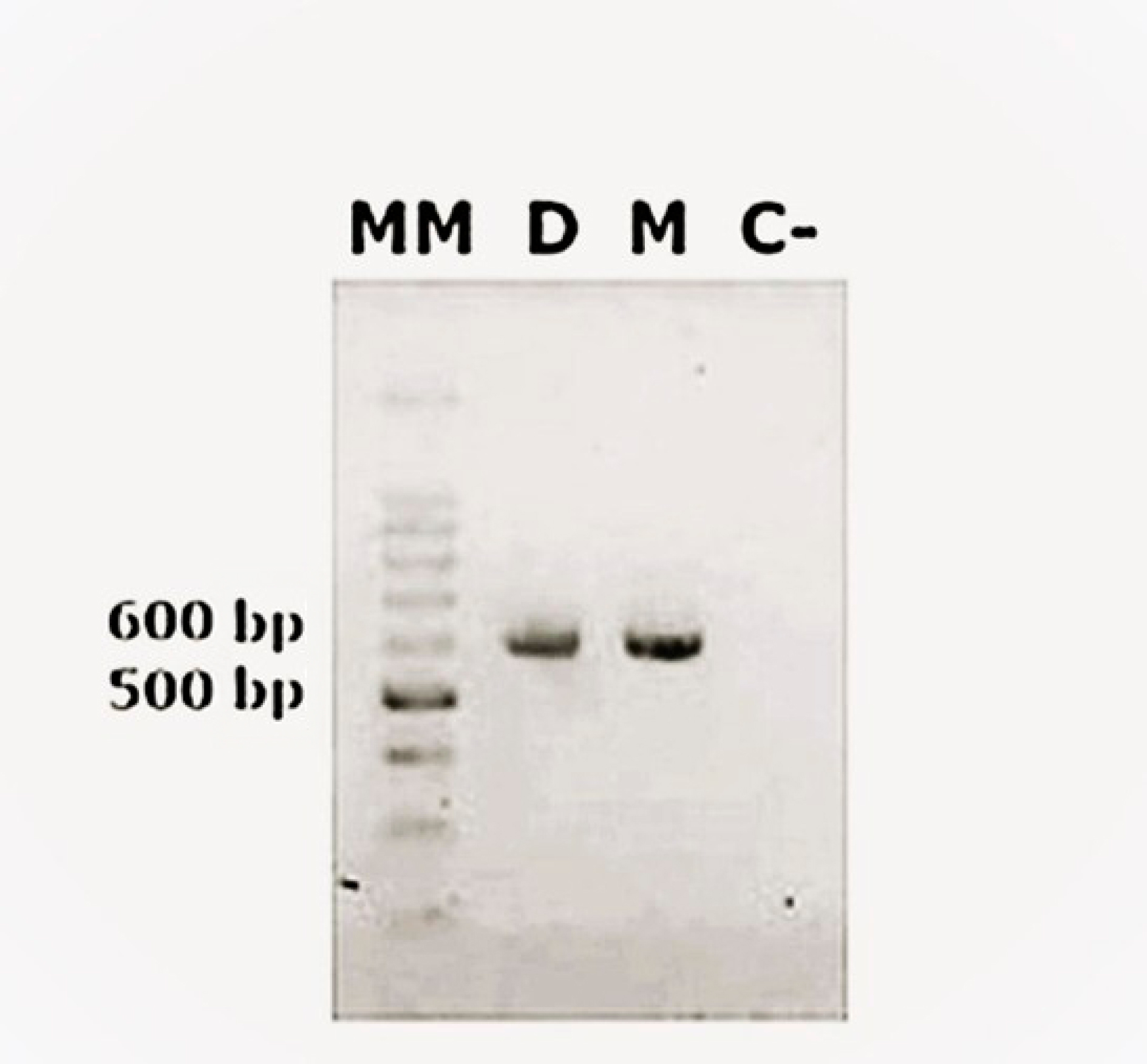
The amplifications were visualized by horizontal agarose gel electrophoresis (Figure 1). 100 bp DNA Ladder (Invitrogen) was utilized as molecular weight marker. Later, the fragments were sent for sequencing by Macrogen-Korea. The quality of the sequences received was evaluated and a consensus sequence was created through the software BioEdit14.
Electrophoresis of a partial region of BRCA2; size of amplification CG1: 599bp. Band MM: molecular weight marker of 1 kb. Band D: dilution. Band M: sample. Band C: control negative
The participants’ DNA was extracted from peripheral blood samples with EDTA utilizing the kit PureDireX GR Reagent (Genomic DNA Isolation Reagent)15, following the manufacturer's recommendations for complete blood count.
Primers initially designed and set up by the study team have been utilized (Table 1). The amplifications were performed at a BOECO thermocycler at a final volume of 25 uL of reaction, containing the following reagents: 1X of Buffer (Green GoTaq Reaction Buffer), 0.5 U of taq (GoTaq G2 DNA Polymerasa, Promega), 0.2 mM of dNTPs (Promega), 0.2 μM for each primers and approximately 50 ng of template DNA.
Cycling conditions encompassed initial denaturation at 94°C for 5 min, 35 cycles including denaturation at 94°C for 45 s, hybridization at Tm (hybridization temperature) specific of pairs of primers for 45 s, elongation at 72°C for 1 min, final elongation at 72°C for 10 min. For all the cases where PCR amplification was not observed, dilutions 1:10 and 1:20 were performed to reduce the volume of inhibitors. PCR products were sequenced by Macrogen Korea.
Before the analysis, the tool BLASTn16 was utilized to identify each sequence received. Later, the software Bioedit 14 was applied to editing and multiple alignment of the regions. The software DNAsp vs. 617 was utilized to search polymorphisms, comparing the sequences with publicly available references to identify variants of interest or any other not earlier reported.
The Ethics Committee of "Facultad de Medicina de la Universidad Nacional de Itapúa" approved the study, report number CEI 01/2025.
RESULTS
A total of six pairs of primers was obtained with the software Primer 3; two pairs which met the criteria aforementioned have been selected (Figure 1 and Table 1).
In all, 11 women, at the age range of 31-50 years were enrolled in the study, mean age of 39.45 years (Table 2), diagnosed with invasive breast cancer, seven of them premenopausal (64%). Of those with HR/HER2, four of 11 patients (80%) had HR+ breast cancer and four (36%), HER2+. Six patients (54%) had triple-negative breast cancer. The majority (54%) reported first-degree family members with breast or ovarian cancer.
After sequencing, 552 bp were aligned from locus 5335 to 5886 of the coding region (cds) of the gene BRCA2 (NM_000059.3), which included the two variants analyzed herein. In the alignment, no variants were found for the study sample or comparing with the reference sequence. Therefore, none of the variants investigated in the study were found for the totality of the sample analyzed.
DISCUSSION
Breast cancer is one of the leading causes of death by cancer of Paraguayan women. Despite the efforts to improve the access to early detection, there are still significant hurdles that impede timely and accurate diagnosis of the disease. In this context, the identification of pathogenic genetic variants associated with the development and evolution of breast cancer is a critical step to implement precision medicine strategies.
The aim of this pilot study is to investigate two specific variants of the gene BRCA2 in a cohort of women with breast cancer. The results achieved showed that the variants NM_000059.4: c.5351_5352insA and NM_000059.4: c.5681_5682insA were not detected in the sample.
Genetic studies on breast cancer have been recently published in Chile18, Brazil19, Mexico20 and Argentine10. The variants selected for the present investigation were based on inheritance characteristics of the population of Itapúa (indigenous/Spanish, German/Paraguayan, Russian/Ukrainian) and data of different Latin American populations according to Cerretini et al.10 who identified a frequency of 6.3% of pathogenic variants of the genes BRCA1 and BRCA2 in Argentinean women with breast cancer.
The present results indicate that a larger quantity of variants should be screened. The inclusion of other mutations will open the possibility to understand to what extent they can be detected in the population.
The length of the gene BRCA2 is 91193 bp, of which 10257 bp correspond to the coding region21. In addition to the investigation of the two variants already mentioned, 5.38% (552bp) of the coding region of this gene was also analyzed revealing that these two variants were not found, which reinforces the necessity of expanding the study of other segments of the gene and the potential inclusion of additional genes involved in the predisposition to breast cancer.
Breast cancer genomics is also utilized to investigate the molecular and genetic characteristics of the tumors, that can help to individualize the treatment and plan the best management. Genetic data of the sample investigated were relevant because of the type of breast cancer diagnosed (invasive). Nevertheless, the high prevalence of triple-negative cancers is an important finding that can impact the treatment options22.
Six women of the sample had first-degree family history of breast cancer, strengthening the relevance of inheritance in developing breast cancer in younger women23, since the mean age of the sample was 39 years old, most of them, premenopausal.
The results indicate that more than half of the patients had family history of breast or ovarian cancer, which could indicate a significant genetic or hereditary component of the sample, possibly associated with mutations of other genes involved in breast cancer.
The investigators acknowledge that the main study limitations are the sample size and reduced quantity of genetic variants. The sample consisted only of women with breast cancer who attended Hospital Día Oncológico with complete medical charts which limited the eligibility criteria.
Furthermore, the high costs of sequencing, in despite of a dramatic decrease in recent years, restricted the analysis to only two variants and continues to be an important obstacle. Although next-generation sequencing (NGS) allows improved coverage, the costs exceed US$ 1,000 for most of the existing panels24, which reduced its applicability in the present sample. Therefore, PCR strategy appears to be a viable option but with reduced capacity to detect variants. Consequently, PCR-based screening of variants and SANGER-based sequencing are reliable options, in despite of lower coverage of the variants to be analyzed. Since none of the variants of interest have been detected, it was not possible to associate with histologic criteria because six women had triple-negative breast cancer.
Notwithstanding these limitations, the results of this pilot study are a starting point for future investigations on cancer genetics in Paraguay. The lack of the variants investigated suggests that other mutations could be involved in cancer predisposition. Expand the analysis to a wider panel of genes and investigate larger samples appear to be critical to improve the detection of important variants. Future studies with next-generation sequencing methodologies can provide detailed information of cancer genetics of breast cancer in Paraguay, contributing to the development of screening strategies and more effective treatments.
CONCLUSIÓN
The two genetic variants of gene BRCA2 analyzed through genomic sequencing and genetic analysis were not detected in the study patients with breast cancer. It is necessary to screen more genetic variants, including other genes as BRCA 1 and PALB2, opening the possibility to find and identify mutations associated with inherited breast cancer.
The study of genetic variants which hold relation with breast cancer are an important topic for clinical investigation and genetic counselling.
ACKNOWLEDGMENTS
To Dr. Karem Sosa, mastologist and to Dr. José Bozzano, oncologist, Hospital Día Oncológico.
REFERENCES
-
1 Organización Mundial de la Salud, Panamericana de la Salud [Internet]. Washigton, DC: OPAS; OMS; [sem data]. Día mundial contra el cáncer 2023: por unos cuidados más justos, 2023 [citado 2023 marzo 15]. Disponible en: https://www.paho.org/es/campanas/dia-mundial-contra-cancer-2023-por-unos-cuidados-mas-justos
» https://www.paho.org/es/campanas/dia-mundial-contra-cancer-2023-por-unos-cuidados-mas-justos -
2 Organización Mundial de la Salud, Organización Panamericana de la Salud [Internet]. Cáncer, 2024. [citado 2024 abr 25]. Disponible en: https://www.paho.org/es/temas/cancer
» https://www.paho.org/es/temas/cancer -
3 Ministerio de Salud Pública y Bienestar Social (PY) [Internet]. Asunción: MSPBS; ©2017. Al año se tiene un promedio de 300 nuevos casos de cáncer de mamas, 2022. [citado 2023 jul 10]. Disponible en: https://portal.ips.gov.py/sistemas/ipsportal/noticia.php?cod=747
» https://portal.ips.gov.py/sistemas/ipsportal/noticia.php?cod=747 - 4 Fernández TA, Reigosa YA. Cáncer de mama hereditario. Comunidad Salud. 2016;14(1):52-60.
-
5 Organización Mundial de la Salud. Programas Nacionales de Control contra el cáncer. Políticas y pautas para la gestión [Internet]. 2 edición. Genebra: OMS; 2004. [citado 2024 abr 25]. [Disponible en: https://www3.paho.org/hq/dmdocuments/2012/OPS-Programas-Nacionales-Cancer-2004-Esp.pdf
» https://www3.paho.org/hq/dmdocuments/2012/OPS-Programas-Nacionales-Cancer-2004-Esp.pdf -
6 Organización Mundial de la Salud, Organización Panamericana de la Salud [Internet]. Cáncer de mama, 2023 [citado 2024 feb 25]. Disponible en: https://www.paho.org/es/temas/cancer-mama
» https://www.paho.org/es/temas/cancer-mama -
7 Rosado-Jiménez L, Mestre-Terkemani Y, García-Aliaga Á, et al. Variantes genéticas recurrentes y priorización de variantes de significado clínico desconocido asociadas al síndrome de cáncer de mama y ovario hereditario en familias de la Región de Murcia. Adv Lab Med. 2023;4(3):288-97. doi: https://doi.org/10.1515/almed-2023-0032
» https://doi.org/10.1515/almed-2023-0032 -
8 Nanda R. Genetic testing in an ethnically diverse cohort of high-risk women: a comparative analysis of BRCA1 and BRCA2 mutations in American Families of European and African Ancestry. JAMA. 2005;294(15):1925-33. doi: https://doi.org/10.1001/jama.294.15.1925
» https://doi.org/10.1001/jama.294.15.1925 -
9 Angeli D, Salvi S, Tedaldi G. Genetic predisposition to breast and ovarian cancers: how many and which genes to test? Int J Mol Sci. 2020;21(3):1128. doi: https://doi.org/10.3390/ijms21031128
» https://doi.org/10.3390/ijms21031128 - 10 Cerretini R, Mercado G, Morganstein J, et al. Germline pathogenic variants in BRCA1, BRCA2, PALB2 and RAD51C in breast cancer women from Argentina. Breast Cancer Res Treat. 2019;178(3):629-36.
-
11 Organización Mundial de la Salud, Organización Panamericana de la Salud. Planificación: Cómo mejorar el acceso a la atención para el cáncer de mama [Internet]. Genebra: OMS; OPAS; 2022. [citado 2024 feb 25]. Disponible en: https://www3.paho.org/hq/dmdocuments/2015/planificacion-mejorar-acceso.pdf
» https://www3.paho.org/hq/dmdocuments/2015/planificacion-mejorar-acceso.pdf -
12 Primer3 [Internet]. Versión 4.1.0. Cambridge: Whitehead Institute for Biomedical Research; ©1996-2019. [citado 2024 feb 20]. Disponible en: https://primer3.ut.ee/
» https://primer3.ut.ee/ -
13 Wizard® Genomic DNA Purification Kit Technical Manual [Internet]. São Paulo: Promega Corporation; ©2025. [citado 2024 feb 20]. Disponible en: https://worldwide.promega.com/resources/protocols/technical-manuals/0/wizard-genomic-dna-purification-kit-protocol/
» https://worldwide.promega.com/resources/protocols/technical-manuals/0/wizard-genomic-dna-purification-kit-protocol/ -
14 Bioedit [Internet]. Versión 7.7. [sem local]: Informer Technologies, Inc.; ©2025. [citado 2024 feb 20]. Disponible en: https://bioedit.software.informer.com/
» https://bioedit.software.informer.com/ -
15 PureDireX. Genomic DNA Isolation Reagent Kit [Internet]. [Sem Local]: QIAGEN; 2022. [citado 2024 feb 20]. Disponible en: https://www.bio-helix.com/uploads/product_file/file/411/PureDireX_Protocol_PDR05-0100.pdf
» https://www.bio-helix.com/uploads/product_file/file/411/PureDireX_Protocol_PDR05-0100.pdf -
16 BLASTN [Internet]. Versión 2.16. Bethesda: NCBI; 2023. [citado 2024 feb 20]. Disponible en: https://blast.ncbi.nlm.nih.gov/Blast.cgi
» https://blast.ncbi.nlm.nih.gov/Blast.cgi -
17 DnaSP v6 [Internet]. Barcelona: Universitat de Barcelona; 2018. [citado 2024 feb 20]. Disponible en: http://www.ub.edu/dnasp/downloadTv6.html
» http://www.ub.edu/dnasp/downloadTv6.html - 18 Adaniel C, Salinas F, Donaire J, et al. Non-BRCA1/2 variants detected in a high-risk chilean cohort with a history of breast and/or ovarian cancer. J Glob Oncol. 2019;5:1-14.
-
19 Costa E, Silva Carvalho S, Cury N, et al. Germline variants in DNA repair genes associated with hereditary breast and ovarian cancer syndrome: analysis of a 21 gene panel in the Brazilian population. BMC Med Genomics. 2020;13(1):21. doi: https://doi.org/10.1186/s12920-019-0652-y
» https://doi.org/10.1186/s12920-019-0652-y -
20 Zayas O, Campos L, Lugo J, et al. Analysis of the pathogenic variants of BRCA1 and BRCA2 using next-generation sequencing in women with familial breast cancer: a case–control study. BMC Cancer. 2019;19(722):1-8. doi: https://doi.org/10.1186/s12885-019-5950-4
» https://doi.org/10.1186/s12885-019-5950-4 -
21 Alvarez J. Análisis de mutaciones en BRCA1 Y BRCA2 asociadas al cáncer de mama [Internet]. 2016 [citado 2024 feb 20]. Disponible en: https://digital.csic.es/bitstream/10261/164963/1/BRCAmuta.pdf
» https://digital.csic.es/bitstream/10261/164963/1/BRCAmuta.pdf - 22 González Ortega JM, Morales Wong MM, López Cuevas Z, et al. Factores pronósticos del cáncer de mama. Rev Cubana Cir. 2024;50(1):130-38.
-
23 Depolo J. ¿Es hereditario el cáncer de mama? Breast Cancer [Internet]. 2024 [citado 2024 dic 15]. Disponible en: https://www.breastcancer.org/es/riesgo/factores-riesgo/genetica
» https://www.breastcancer.org/es/riesgo/factores-riesgo/genetica -
24 Rubio S, Pacheco R, Gómez A, et al. Secuenciación de nueva generación (NGS) de ADN: presente y futuro en la práctica clínica. 2020;61(2):1. doi: https://doi.org/10.11144/Javeriana.umed61-2.sngs
» https://doi.org/10.11144/Javeriana.umed61-2.sngs
Edited by
-
Scientific-editor:
Anke Bergmann. Orcid iD: https://orcid.org/0000-0002-1972-8777