 Comparison between GLIM Criteria, Cancer Cachexia Consensus and PG-SGA SF for the Nutritional Diagnosis of Patients with Advanced Cancer in Palliative Care
ABSTRACT
Introduction: The nutritional diagnosis in patients with cancer may vary according to the assessment method.
Objective: To evaluate the agreement of the Global Leadership Initiative on Malnutrition (GLIM) criteria and the consensus of cancer cachexia with the patient-generated subjective global assessment short form (PG-SGA SF) for nutritional diagnosis of patients with advanced cancer in palliative care.
Method: Observational study with patients with advanced cancer evaluated during their first visit to a palliative care unit. Nutritional status was defined using the GLIM criteria, the consensus of cachexia, and the PG-SGA SF. Agreement values were analyzed using the Kappa coefficient (k) and accuracy measures of the methods were calculated.
Results: A total of 254 patients was included, median age of 65 years (interquartile range: 58-71), predominantly males (55.1%). The prevalence of changes in nutritional status was 71.3%, 79.1% and 58.3%, according to GLIM, consensus of cachexia and PG-SGA SF, respectively. The agreement between the GLIM and the consensus of cachexia was moderate (k = 0.79; p < 0.001), while with the PG-SGA SF was very poor (GLIM k = 0.06; p = 0.320 and consensus of cachexia k = 0.06; p = 0.224). The accuracy between the GLIM and the consensus of cachexia was high (92.1%), however, the accuracy was low (<57.9%) in relation to the PG-SGA SF.
Conclusion: Compared to the PG-SGA SF, agreement and accuracy between GLIM and consensus of cachexia criteria was unacceptable for nutritional diagnosis, which suggests less practical applicability for nutritional assessment of this population.
Key words:
Nutritional Assessment; Malnutrition/diagnosis; Cachexia/diagnosis; Neoplasia/diet therapy; Palliative Care
RESUMO
Introdução: O diagnóstico nutricional de pacientes com câncer pode variar de acordo com o método utilizado para avaliação.
Objetivo: Avaliar a concordância dos critérios do Global Leadership Initiative on Malnutrition (GLIM) e do consenso de caquexia do câncer com avaliação subjetiva global produzida pelo paciente versão reduzida (ASG-PPP VR) para diagnóstico nutricional de pacientes com câncer avançado em cuidados paliativos.
Método: Estudo observacional com pacientes com câncer avançado, avaliados no primeiro atendimento em unidade de cuidados paliativos. O estado nutricional foi definido por meio do critério GLIM, do consenso de caquexia e da ASG-PPP VR. Foram analisados os valores de concordância pelo coeficiente de Kappa (k) e calculadas as medidas de acurácia entre os métodos.
Resultados: Foram incluídos 254 pacientes, com mediana de idade de 65 anos e predominância do sexo masculino (55,1%). A prevalência de alterações do estado nutricional foi de 71,3%, 79,1% e 58,3%, conforme o GLIM, consenso de caquexia e ASG-PPP VR, respectivamente. A concordância entre o GLIM e o consenso de caquexia foi moderada (k = 0,79; p < 0,001), enquanto com a ASG-PPP VR foi muito fraca (GLIM k = 0,06; p = 0,320 e consenso de caquexia k = 0,06; p = 0,224). A acurácia entre o GLIM e o consenso de caquexia foi alta (92,1%), contudo, demonstraram baixa acurácia (<57,9%) em relação à ASG-PPP VR.
Conclusão: Comparados com ASG-PPP VR, os critérios do GLIM e do consenso de caquexia apresentaram concordância e acurácia consideradas não aceitáveis para o diagnóstico nutricional, o que sugere menor aplicabilidade prática para a avaliação nutricional dessa população.
Palavras-chave:
Avaliação Nutricional; Desnutrição/diagnóstico; Caquexia/diagnóstico; Neoplasia/dietoterapia; Cuidados Paliativos
RESUMEN
Introducción: El diagnóstico nutricional en pacientes con cáncer puede variar según el método utilizado para la evaluación.
Objetivo: Evaluar la concordancia de los criterios de la Global Leadership Initiative on Malnutrition (GLIM) y el consenso de caquexia por cáncer con la versión reducida de la valoración subjetiva global generada por el paciente (VSG-GP VR) para el diagnóstico nutricional de pacientes con cáncer avanzado en cuidados paliativos.
Método: Estudio observacional con pacientes con cáncer avanzado, evaluados en primera atención en una unidad de cuidados paliativos. El estado nutricional se definió mediante los criterios GLIM, el consenso de caquexia y la VSG-GP VR. Los valores de concordancia se analizaron utilizando el coeficiente Kappa (k) y se calcularon medidas de precisión entre los métodos.
Resultados: Se incluyeron 254 pacientes, con una mediana de edad de 65 años y predominio masculino (55,1%). La prevalencia de cambios en el estado nutricional fue del 71,3%, 79,1% y 58,3%, según GLIM, consenso de caquexia y VSG-GP VR, respectivamente. La concordancia entre el GLIM y el consenso de caquexia fue moderada (k = 0,79; p < 0,001), mientras que con la VSG-GP VR fue muy débil (GLIM k = 0,06; p = 0,320 y consenso de caquexia k = 0,06; p = 0,224). La precisión entre la GLIM y el consenso de caquexia fue alta (92,1%), sin embargo, demostraron baja precisión (<57,9%) en relación con la VSG-GP VR.
Conclusión: En comparación con la VSG-GP VR, los criterios de GLIM y de consenso de caquexia mostraron concordancia y precisión consideradas inaceptables para el diagnóstico nutricional, lo que sugiere una menor aplicabilidad práctica para la evaluación nutricional de esta población.
Palabras clave:
Evaluación Nutricional; Desnutrición/diagnóstico; Caquexia/diagnóstico; Neoplasia/dietoterapia; Cuidados Paliativos
INTRODUCTION
Changes of nutritional status are prevalent in patients with cancer and its magnitude varies according to the method of assessment utilized for the nutritional diagnosis, tumor site, type of treatment, extent of the disease among others1-4. Regardless of the nutritional diagnosis – disease-related malnutrition (DRM), cancer cachexia (CC) or sarcopenia –, nutritional changes are associated with increased morbidity and mortality and psychosocial and economic aspects.
Nutritional assistance should address nutritional evaluation as a priority of the therapeutic plan, adjusted to the respective objectives4,5. Given the adverse impacts of malnutrition of this population, diagnosis and monitoring of the nutritional status should be recognized as a key factor and integral part of the oncologic care to minimize unfavorable outcomes and improve the quality of life6.
Since nutritional care is a human right, priority should be ensured to the impact on quality of life and functional status as these outcomes are important for the patient, especially in advanced cancer, in refractory to disease-modifying treatments where improvement of clinical outcomes as reduction of the tumor burden or mortality may not be attainable5,7. In this context, the main clinical nutritional and oncology entities recommend that the nutritional status of all the patients with cancer in any disease stage should be evaluated in addition to the implementation of a patient-centered assistance4,5,8.
Several approaches can be applied for the nutritional evaluation. The patient-generated subjective global assessment (PG-SGA) is a well-established method in that regard and recommended by the National Consensus of Oncologic Nutrition as reference method, as it addresses important domains of malnutrition, relevant prognostic aspects as changes of body weight, reduction of food intake, symptoms of nutritional impact and decline of the functional capacity9-12.
In 2022, an international expert consensus defined CC as a complex multifactorial syndrome and proposed stages of clinical relevance for its diagnosis (pre-cachexia, cachexia and refractory cachexia)13. Subsequently, it was suggested as a synonym of DRM with inflammation5,14. In 2019, the Global Leadership Initiative on Malnutrition (GLIM)15 proposed universal criteria to diagnose and grade malnutrition in clinical contexts to standardize the diagnosis of DRM through phenotypic and etiologic criteria.
Given that nutritional assistance of patients with cancer should address nutritional evaluation as priority of the therapeutic plan, it is necessary to establish evaluation methods that allow not only patient-centered treatment but the allocation of resources matched to the advance of the disease and to meet these goals7. In that sense, among the available nutritional evaluation methods, it is possible to find traditional methods utilized in clinical practice for different populations of patients with cancer and other more recent as GLIM which require further investigation. Previous studies evaluated the concurrent validity of GLIM, however, there are variations in terms of accuracy and oncologic population investigated and according to the Brazilian scenario16-18. In addition, no study has ever compared the performance of the main nutritional evaluation methods in patients with advanced cancer in palliative care.
Considering the prevalence and impact of reversible and irreversible nutritional deficits, it was attempted to evaluate the agreement among GLIM criteria and cachexia, proposed by the international consensus, and PG-SGA SF for the nutritional diagnosis of patients with advanced cancer in palliative care.
METHOD
Cross-sectional study, part of a larger longitudinal project conducted with patients with advanced cancer consecutively attended to at the palliative care unit (PCU) of the National Cancer Institute (INCA) in Rio de Janeiro/RJ. The institution's Ethics Committee approved the study, report number 4,713,495 (CAAE (submission for ethical review): 45596821.6.0000.5274) in compliance with Directive number 466/201219 of the National Health Council.
The data were collected from June 2021 to February 2024 by skilled investigators when the first assistance at the ICU occurred. The ICU is a reference of oncologic palliative care in the country and provides full assistance to patients with advanced cancer and without possibility of cure referred by other INCA assistance units.
The inclusion criteria of the study patients were: age ≥20 years, confirmed histopathological diagnosis of malignant neoplasm, advanced disease (locoregional or metastatic), regardless of the tumor site, Karnofsky Performance Status (KPS) ≥30% (100%: normal functioning - 0%: death)20, able to provide the required information correctly.
All the patients enrolled agreed to join the study and signed the informed consent form (ICF).
The following information were collected from the patients’ electronic chart: sex, age (years), self-claimed skin color (white, black, brown, indigenous), KPS, primary tumor site, site of progression of the disease, previous tumor treatment and comorbidities.
The anthropometric measures evaluated were: current body weight, body mass index (BMI), percent of weight loss (%WL) in six months, perimeter of the calf (PC), perimeter of the arm (PA), triceps skin fold (TSF) and arm muscle area corrected (AMA). The %WL in the last one and six months was calculated as: %WL = [(former weight - current weight)] x 100/former weight. The BMI was determined by the division of the measurement of the body weight (in kg) by the square of the height (in meters), resulting in a value expressed as kg/m2. The AMA was obtained through the equation proposed by Heymsfield et al.21 according to sex.
The handgrip strength (HGS) was evaluated by the measure of isomeric contraction of the hand muscles utilizing the dynamometer Jamar® (Baseline, Fabrication Enterprises, Inc, USA), in a scale from 0 to 100 kg. HGS was measured in both arms and repeated alternately three times in each arm with one-minute interval for each measurement. The bigger of six measures was considered to classify the HGS and values <1th tertile of the population investigated according to sex (women: 14 kg and men: 25 kg) were classified as low HGS.
Blood was collected according to the institutional routine the day the patient was enrolled in the study. Values of C-reactive protein (CRP) serum concentrations and albumin were obtained. Immunoturbidimetry method was utilized for quantitative determination of serum CRP and albumin bromocresol green22.
The Portuguese version of PG-SGA, (version 18-008 v.05.21.18)23 was utilized, it is a structured questionnaire divided in two parts. The short form (PG-SGA SF) utilizes only the first part answered by the patient with some questions about change of body weight, food intake history, presence of nutritional impact symptoms (NIS) and evaluation of the functional capacity. Previous studies showed that PG-SGA SF is an accurate, sensitive and specific tool when compared with the complete version of PG-SGA11,24,25. The total numeric score (0-36 range) based on the sum of each one of the items of the questionnaire (the higher the score, bigger is the risk of malnutrition) was utilized to classify the patients. Patients with PG-SGA SF ≥ 9 points26 were classified as malnourished.
The international consensus published by Fearon et al.13 in 2011 classified CC in three stages of clinical relevance: pre-cachexia, cachexia and refractory cachexia. The diagnosis of CC adopted in the present study is consistent with this publication, when one of the following criteria is met:
-
%WL >5 or;
-
BMI <20 kg/m² + % WL >2 or;
-
AMA <1th. tertile of the population investigated per sex (women: 18.4 cm2 and men : 18.9 cm2) + % WL >2.
GLIM consists in a consensus of experts with the objective of proposing universal criteria to diagnose and grade DRM in clinical setting. The diagnosis requires the presence of one etiologic criteria and one phenotypic criteria15. The following criteria were considered for the present study:
-
Etiologic: systemic inflammation characterized by the presence of locoregional and/or metastatic advanced cancer without lab confirmation as recently agreed by GLIM27.
-
Phenotypic: (1) WL >5% in the last six months or; (2) BMI <20 kg/m² (<22 kg/m² if age >70 years); or (3) low muscle mass evaluated by PC adjusted by BMI28, according to adjustment values proposed by Gonzalez et al29.
The Statistical Package for the Social Sciences30 (SPSS version 23.0)30 was utilized for the analyzes, with level of significance of 5% (p < 0.05). The distribution of the variables was evaluated with histograms and scatter plots and Shapiro-Wilk and Kolmogorov-Smirnov tests. Numerical variables with normal distribution were described as means and standard-deviation, with non-normal distribution, as medians and interquartile range (IQR; percentiles 25 and 75) and categorical variables as absolute (n) and relative (%) frequency. Comparisons of means were performed through Student's t test and of the medians, with nonparametric Mann-Whitney U test.
The chi-square test was applied to compare the prevalence of malnutrition by the three evaluation methods. Values of agreement by the Cohen's kappa coefficient (k) were analyzed and level of agreement was interpreted as very low agreement k = 0.21-0.39, low agreement k = 0.40-0.59, moderate agreement k = 0.60-0.79 and very good agreement k = ≥0.8031.
Accuracy, sensitivity, specificity, positive and negative predictive values were calculated for the methods of nutritional evaluation referenced to PG-SGA SF. Values of accuracy >80% were interpreted as acceptable and <80% as non-acceptable by GLIM consortium32.
RESULTS
Of the 348 eligible patients of the main cohort, 94 were excluded due to missing data to classify the nutritional status. In all, 254 patients have been enrolled with median age of 65 years (IQR: 58-71) and predominance of males (55.1%). The most common cancer diagnosis were head and neck (30.7%), upper gastrointestinal tract (12.6%) and colorectal (12.6%) and 85.8% of the patients metastasized (Table 1).
Demographic and clinical characteristics of patients with advanced cancer in palliative care (n = 254)
The prevalence of changes of nutritional status was 71.3%, 79.1% and 58.3% according to GLIM, consensus of CC and PG-SGA SF, respectively. Frequencies of WL >2% and >5% were higher and were significantly different for malnourished according to GLIM (p = < 0.001) and cachectic by the consensus of CC (p = < 0.001) when compared to well-nourished and non-cachectic. Means of PC and HGS in men were significantly lower for malnourished (p = 0.035 and p = 0.022, respectively) and cachectic (p = 0.032, and p = 0.018).
Malnourished patients per PG-SGA SF presented significantly higher median of NIS (p = < 0.001). Furthermore, median values of CRP were significantly worst for malnourished by PG-SGA SF (p = <0.001) and GLIM (p = 0.003), while mean values of albumin were significantly worst for malnourished by PG-SGA SF (p = 0.022) and GLIM (p = 0.004) and cachectic by the consensus of CC (p = 0.018) (Table 2).
Nutritional characteristics according to the nutritional classification of patients with advanced cancer in palliative care (n = 254)
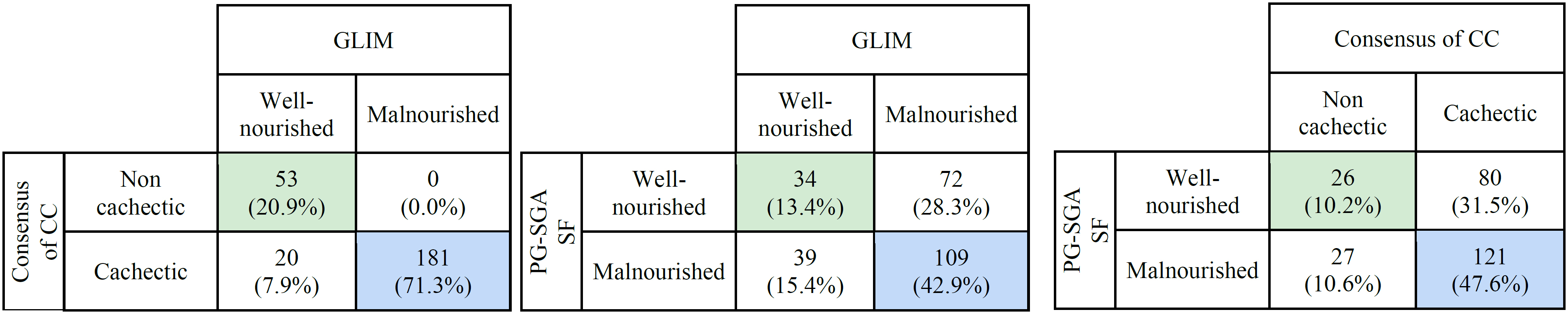
In regard to the agreement of the methods, 71.3% of the patients were classified concomitantly as malnourished and cachectic by GLIM and consensus of CC (k = 0.79; p < 0.001), 42.9% as malnourished by GLIM and PG-SGA SF (k = 0.06; p = 0.320) and 47.6% by consensus of CC and malnourished by PG-SGA SF (k = 0.06; p = 0.224) (Figure 1; Table 3).

Diagnostic among GLIM, consensus of CC and PG-SGA SF in patients with advanced cancer in palliative care (n = 254)
Measures of accuracy of the methods of nutritional evaluation of patients with advanced cancer in palliative care (n = 254)
Accuracy, sensitivity and specificity were high – 92.1%, 100% and 72.6%, respectively – by GLIM and consensus of CC, which may be related to the conceptual and diagnostic similarities of these criteria. Both GLIM and consensus of CC showed low accuracy with values considered inacceptable (<57.9%) when compared to PG-SGA SF, not being interchangeable methods for nutritional diagnosis of patients with advanced cancer in palliative care (Table 3).
DISCUSSION
The prevalence of DRM in patients with locoregional and metastatic advanced cancer without therapeutic possibilities of cure was evaluated with PG-SGA SF, international consensus of CC and GLIM in the present study. Satisfactory accuracy of diagnostic of DRM for different phenotypic combinations of GLIM and consensus of CC criteria was not found when compared with PG-SGA SF and accuracy measures failed to reach acceptable levels utilizing PG-SGA SF as reference methods.
The prevalence of changes of nutritional status was high, 71.3% by GLIM, 79.1% by consensus of CC and 58.3% by PG-SGA SF. These results are consistent with the multicenter study by Santos et al.17, with 261 patients with colorectal cancer evaluated in three Brazilian hospitals that showed prevalence of malnutrition of 45.1%-80.2% according to the combinations of the criteria GLIM and 57.2% by PG-SGA. Another study with 885 Brazilian inpatients with cancer that excluded patients in palliative care, found lower prevalence of malnutrition, ranging from 3.9% to 30% according to the combinations of criteria of GLIM and 26.1% according to SGA (categories B or C)18. Of the 637 patients enrolled in the study of Zhang et al.16 in China, 28.3% and 43.3% were malnourished according to GLIM and PG-SGA, respectively.
Differences of prevalence of malnutrition of the studies can be attributed, among other factors, to the disease stage, since 85.8% of the sample investigated was formed by patients with metastatic disease and 73% of the patients of the study of Santos et al.17 presented stages III and IV tumors. In the studies of Ozorio et al.18 and Zhang et al.16, 55.1% and 66.8% of the patients were classified in stages III and IV, respectively. The presence of advanced cancer can lead to worst nutritional status as expression of the relation of tumor burden, inflammatory condition, reduction of food intake, presence of symptoms and WL reflecting in high prevalence of malnutrition1.
The criteria GLIM, consensus of CC and PG-SGA SF were applied to all the patients of the present study without previous screening of nutritional risk, considering that these patients are at nutritional risk at the least, given the diagnosis of incurable cancer and according to results of former studies conducted with patients of the same PCU2,12,33. Despite the advances of the last decade in understanding the etiological mechanisms, allowing to improve the definition and terminology associated with nutritional diagnosis as DRM, CC and sarcopenia1,8,14, it has been observed in clinical practice that these three conditions can coexist and their clinical diagnoses address common etiologic and phenotypic criteria as WL, low BMI, low muscle mass and inflammation, posing the challenge of differentiating them in clinical contexts.
In 2021, within this scenario, the guidelines of the European Society for Medical Oncology (ESMO) recommended to evaluate CC according to the definition by GLIM5. In practice, both for terminology and diagnostic criteria, CC and DRM defined by experts consensus propose common parameters as 5%WL, low BMI (similar cutoff values for both definitions) and low muscle mass, in addition to systemic inflammation. This fact corroborates the present results that showed better agreement and excellent accuracy (92.1%) between these two definitions with sensitivity of 100%. These results suggest that GLIM could be utilized as a proposal of approach instead of the consensus of CC as suggested by ESMO in 2021. On the other hand, it is important to highlight that the proposal of GLIM has not improved the then existing diagnostic proposal of the international consensus of CC, a method utilized in clinical practice and in researches for patients with cancer since 2011.
Another important topic is that the majority of the studies published evaluating the concurrent and predictive validity of GLIM in patients with cancer utilized the disease burden as etiologic criteria, which was ratified by the recent publication of the committee GLIM27. A relevant aspect to be considered is that not all the patients with cancer, including incurable, has elevated inflammatory markers, for example CRP >10 mg/L or Glasgow prognostic score (GPS) = 2 (indicating elevated CRP and low albumin). Previous studies published for this population showed that the prevalence of modified GPS equal to 0, that is, CPR<10 mg/L, was higher than 60%34,35, consistent with the present study whose mean values of albumin and median values of CRP in malnourished and cachectic were 3.4 g/dL and between 6.7-7.5 mg/L, respectively. Although significantly higher when compared to well-nourished and non-cachectic, they do not meet the recommended cutoff values to classify the presence of systemic inflammation. These results can suggest that the incorporation of inflammatory parameters in most common utilized cutoff values or proposed by the committee GLIM25 may not help to improve the diagnostic accuracy for patients with cancer.
The results of the study showed that, when compared to consensus of GLIM and CC, the PG-SGA identified less malnourished patients. This could be explained by the simplification of diagnostic criteria of GLIM and CC, since 5% WL or BMI <20 (<22 if older than 70 years) is sufficient to diagnose DRM. It can also be related to the fact that PG-SGA does not address any criteria of evaluation of systemic inflammation for malnutrition diagnosis. However, in counterpart, this instrument addresses other important domains for nutritional evaluation of patients with cancer, as food intake and NIS. The study of Martin et al.36 evaluated 12,253 patients with advanced cancer and showed that poor food intake and systemic inflammation are factors associated with loss of body weight; hazard ratio, however, was high for low food intake even when compared to CPR >10 mg/L. Regardless of the appetite and presence of inflammation, reduced food intake is a modifiable factor that contributes significantly for loss of body weight.
It is noteworthy that nutritional status and clinical aspects related to the disease evolution undergo temporary alterations and not necessarily combined. Thus, several parameters of nutritional evaluation may be subject to different levels of alterations since the first signs and symptoms of anorexia up to pre-cachexia, cachexia and refractory cachexia, that is, signs of nutritional compromise are modifiable but not always concomitant1. In case of CC, for example, difficulties of diagnosis exist because of a complex metabolic spectrum with large range of variability of grades and characteristics and that cannot be limited to a single parameter, reason for which, efforts have been made to define diagnostic criteria with combination of factors and cutoff values2,33. Despite the complexity involved, identify the nutritional status is essential to follow an individualized care plan with measures of intervention or symptoms control matched to nutritional demands2.
PG-SGA presented low agreement and accuracy with GLIM criteria as revealed by the present study. Other previous studies with patients with cancer in different clinical contexts failed to report acceptable accuracy in GLIM considering PG-SGA as reference parameter16-18,37-39. The study of Henriksen et al.40 with 426 patients with colorectal cancer showed that the agreement between PG-SGA and GLIM was low and sensitivity of GLIM did not reach acceptable levels with or without previous nutritional screening (k = 0.24), regardless of the tool utilized. The values of accuracy were different according to the screening tool utilized prior to GLIM with improved results when PG-SGA SF was utilized as screening tool (k = 0.60, sensitivity 47% and specificity 97%).
GLIM criteria were developed to facilitate the diagnosis, global comparisons of prevalence, interventions and results of malnutrition. Therefore, its validation to evaluate its utility in clinical practice is essential. However, in the context of patients with cancer, there are not enough data supporting its validity. Due to conceptual differences among the criteria of GLIM, CC and PG-SGA, a 100% concordance is not possible because these methods evaluate different conceptual domains of malnourishment. Nevertheless, the accuracy needs to be acceptable at the least for GLIM to meet its universality objective, and it is essential to standardize their diagnostic criteria even more to reach this goal.
The systematic review by Sealy et al.41 evaluated the validity of the content of methods of evaluation of malnourishment in patients with cancer based on internationally accepted conceptual definitions for malnourishment. Of the 37 evaluation methods analyzed by the authors, the mini nutritional evaluation and PG-SGA presented the best rates of validity of content. As PG-SGA is frequently considered a well-accepted nutritional evaluation tool in the oncologic environment with several publications affirming their predictive validity11, it has been attempted to evaluate the concordance among PG-SGA, GLIM and consensus of CC for this population. These results do not support the incorporation of these methods in lieu of PG-SGA for the diagnosis of DRM, they can be used in parallel with established and validated tools as PG-SGA SF. Previous studies evaluating the concurrent and predictive validity of GLIM in the scenario of patients with incurable disease have not been found.
The study has limitations. Initially, the sample by convenience collected on a single site. Secondly, not all the possible combinations of GLIM have been tested. No method with improved accuracy was utilized to evaluate the body mass index, only anthropometric measures. However, although the anthropometric measures are double indirect methods of evaluation of muscle mass and, therefore, of low accuracy, they are simple and widely available measures in clinical practice. Finally, the predictive capacity of the three different evaluation methods was not evaluated since the objective was to verify the concurrent validity or diagnostic capacity of the most traditional methods to evaluate patients with advanced cancer. Furthermore, predictive capabilities of PG-SGA SF and different diagnostic criteria of CC have been earlier evaluated in other studies of the same research group that showed significant association of worst nutritional status evaluated by these methods with unfavorable outcomes and mortality2,12.
It is essential to evaluate patients with cancer periodically because nutritional status is a modifiable condition. As important components of support care, nutritional and metabolic care face their own limitations and there is no gold-standard yet to address DRM and cancer catabolism. New studies can contribute to verify the validity and applicability of GLIM to evaluate patients with cancer focused to better uniformization of nutritional evaluation criteria to guide the different options of nutritional care.
CONCLUSION
Agreement between GLIM criteria and consensus of CC was very weak compared to PG-SGA SF, in addition to unacceptable accuracy measures for nutritional diagnosis. These findings suggest low practical applicability of GLIM and consensus of CC for nutritional diagnosis of the population investigated.
References
-
1 Bossi P, Delrio P, Mascheroni A, et al. The spectrum of malnutrition/cachexia/sarcopenia in oncology according to different cancer types and settings: a narrative review. Nutrients. 2021;13(6):1980. doi: https://doi.org/10.3390/nu13061980
» https://doi.org/10.3390/nu13061980 -
2 Wiegert EVM, Oliveira LC, Calixto-Lima L, et al. Cancer cachexia: comparing diagnostic criteria in patients with incurable cancer. Nutrition. 2020;79-80:110945. doi: https://doi.org/10.1016/j.nut.2020.110945
» https://doi.org/10.1016/j.nut.2020.110945 -
3 Pinho NB, Martucci RB, Rodrigues VD, et al. Malnutrition associated with nutrition impact symptoms and localization of the disease: results of a multicentric research on oncological nutrition. Clin Nutr. 2019;38(3):1274-9. doi: https://doi.org/10.1016/j.clnu.2018.05.010
» https://doi.org/10.1016/j.clnu.2018.05.010 -
4 Muscaritoli M, Arends J, Bachmann P, et al. ESPEN practical guideline: clinical nutrition in cancer. Clin Nutr. 2021;40(5):2898-913. doi: https://doi.org/10.1016/j.clnu.2021.02.005
» https://doi.org/10.1016/j.clnu.2021.02.005 -
5 Arends J, Strasser F, Gonella S, et al. Cancer cachexia in adult patients: ESMO Clinical Practice Guidelines. ESMO Open. 2021;6(3):100092. doi: https://doi.org/10.1016/j.esmoop.2021.100092
» https://doi.org/10.1016/j.esmoop.2021.100092 -
6 Erickson N, Sullivan ES, Kalliostra M, et al. Nutrition care is an integral part of patient-centred medical care: a European consensus. Med Oncol. 2023;40(4):112. doi: https://doi.org/10.1007/s12032-023-01955-5
» https://doi.org/10.1007/s12032-023-01955-5 -
7 Arends J. Struggling with nutrition in patients with advanced cancer: nutrition and nourishment-focusing on metabolism and supportive care. Ann Oncol. 2018;29(supl 2):ii27-34. doi: https://doi.org/10.1093/annonc/mdy093
» https://doi.org/10.1093/annonc/mdy093 - 8 Horie LM, Barrére APN, Castro MG, et al. Diretriz BRASPEN de terapia nutricional no paciente com câncer. BRASPEN J. 2019;34(1):2-32.
-
9 Instituto Nacional de Câncer José Alencar Gomes da Silva. Consenso nacional de nutrição oncológica [Internet]. Rio de Janeiro: Instituto Nacional de Câncer; 2015. [acesso 2024 abr 5]. Disponível em: https://www.inca.gov.br/sites/ufu.sti.inca.local/files//media/document/consenso_nacional_de_nutricao_oncologica_-_2a_edicao_2015_completo_0.pdf
» https://www.inca.gov.br/sites/ufu.sti.inca.local/files//media/document/consenso_nacional_de_nutricao_oncologica_-_2a_edicao_2015_completo_0.pdf -
10 Sociedade Brasileira de Nutrição Oncológica. Consenso Brasileiro de Nutrição Oncológica da SBNO [Internet]. Rio de Janeiro: SBNO; 2021. [acesso 2024 abr 5]. Disponível em: https://sbno.com.br/wp-content/uploads/2021/07/consenso_2021.pdf
» https://sbno.com.br/wp-content/uploads/2021/07/consenso_2021.pdf -
11 Jager-Wittenaar H, Ottery FD. Assessing nutritional status in cancer: role of the patient-generated subjective global assessment. Curr Opin Clin Nutr Metab Care. 2017;20(5):322-9. doi: https://doi.org/10.1097/MCO.0000000000000389
» https://doi.org/10.1097/MCO.0000000000000389 -
12 Cunha MS, Wiegert EVM, Calixto-Lima L, et al. Validation of the scored Patient-generated subjective global assessment short form as a prognostic tool for incurable cancer patients. JPEN J Parenter Enteral Nutr. 2022;46(4):915-22. doi: https://doi.org/10.1002/jpen.2251
» https://doi.org/10.1002/jpen.2251 -
13 Fearon K, Strasser F, Anker SD, et al. Definition and classification of cancer cachexia: an international consensus. Lancet Oncol. 2011;12(5):489-95. doi: https://doi.org/10.1016/S1470-2045(10)70218-7
» https://doi.org/10.1016/S1470-2045(10)70218-7 -
14 Cederholm T, Barazzoni R, Austin P, et al. ESPEN guidelines on definitions and terminology of clinical nutrition. Clin Nutr. 2017;36(1):49-64. doi: https://doi.org/10.1016/j.clnu.2016.09.004
» https://doi.org/10.1016/j.clnu.2016.09.004 -
15 Cederholm T, Jensen GL, Correia MITD, et al. GLIM criteria for the diagnosis of malnutrition - a consensus report from the global clinical nutrition community. Clin Nutr. 2019;38(1):1-9. doi: https://doi.org/10.1016/j.clnu.2018.08.002
» https://doi.org/10.1016/j.clnu.2018.08.002 -
16 Zhang Z, Wan Z, Zhu Y, et al. Prevalence of malnutrition comparing NRS2002, MUST, and PG-SGA with the GLIM criteria in adults with cancer: a multi-center study. Nutrition. 2021;83:111072. doi: https://doi.org/10.1016/j.nut.2020.111072
» https://doi.org/10.1016/j.nut.2020.111072 -
17 Santos ALS, Santos BC, Frazão LN, et al. Validity of the GLIM criteria for the diagnosis of malnutrition in patients with colorectal cancer: a multicenter study on the diagnostic performance of different indicators of reduced muscle mass and disease severity. Nutrition. 2024;119:112324. doi: https://doi.org/10.1016/j.nut.2023.112324
» https://doi.org/10.1016/j.nut.2023.112324 -
18 Ozorio GA, Ribeiro LMK, Santos BC, et al. Exploring the use of the GLIM criteria to diagnose malnutrition in cancer inpatients. Nutrition. 2023;116:112195. doi: https://doi.org/10.1016/j.nut.2023.112195
» https://doi.org/10.1016/j.nut.2023.112195 - 19 Conselho Nacional de Saúde (BR). Resolução n° 466, de 12 de dezembro de 2012. Aprova as diretrizes e normas regulamentadoras de pesquisas envolvendo seres humanos. Diário Oficial da União, Brasília, DF. 2013 jun 13; Seção I:59.
-
20 Schag CC, Heinrich RL, Ganz PA. Karnofsky performance status revisited: reliability, validity, and guidelines. J Clin Oncol. 1984;2(3):187-93. doi: https://doi.org/10.1200/JCO.1984.2.3.187
» https://doi.org/10.1200/JCO.1984.2.3.187 -
21 Heymsfield SB, McManus C, Smith J, et al. Anthropometric measurement of muscle mass: revised equations for calculating bone-free arm muscle area. Am J Clin Nutr. 1982;36(4):680-90. doi: https://doi.org/10.1093/ajcn/36.4.680
» https://doi.org/10.1093/ajcn/36.4.680 - 22 Tietz NW, editor. Clinical guide to laboratory tests. 4 ed. Missoouri: Elsevier; 2006.
-
23 ASG-PPP [Internet]. versão 18-008 v.05.21.18. Ottery: Pt-Global Platform; ©2014. [acesso 2024 abr 5]. Disponível em: https://pt-global.org/downloads-da-pg-sga/?lang=pt
» https://pt-global.org/downloads-da-pg-sga/?lang=pt -
24 Abbott J, Teleni L, McKavanagh D, et al. Patient-Generated Subjective Global Assessment Short Form (PG-SGA SF) is a valid screening tool in chemotherapy outpatients. Support Care Cancer. 2016;24(9):3883-7. doi: https://doi.org/10.1007/s00520-016-3196-0
» https://doi.org/10.1007/s00520-016-3196-0 -
25 Carriço M, Guerreiro CS, Parreira A. The validity of the Patient-Generated Subjective Global Assessment Short-form© in cancer patients undergoing chemotherapy. Clin Nutr ESPEN. 2021;43:296-301. doi: https://doi.org/10.1016/j.clnesp.2021.03.037
» https://doi.org/10.1016/j.clnesp.2021.03.037 -
26 Azevedo MD, Pinho NB, Carvalho Padilha P, et al. Clinical usefulness of the patient-generated subjective global assessment short form for nutritional screening in patients with head and neck cancer: a multicentric study. Ecancermedicalscience. 2024;18:1662. doi: https://doi.org/10.3332/ecancer.2024.1662
» https://doi.org/10.3332/ecancer.2024.1662 -
27 Cederholm T, Jensen GL, Ballesteros-Pomar MD, et al. Guidance for assessment of the inflammation etiologic criterion for the GLIM diagnosis of malnutrition: a modified Delphi approach. Clin Nutr. 2023;43(5):1025-32. doi: https://doi.org/10.1016/j.clnu.2023.11.026
» https://doi.org/10.1016/j.clnu.2023.11.026 -
28 Barazzoni R, Jensen GL, Correia MITD, et al. Guidance for assessment of the muscle mass phenotypic criterion for the Global Leadership Initiative on Malnutrition (GLIM) diagnosis of malnutrition. Clin Nutr. 2022;41(6):1425-33. doi: https://doi.org/10.1016/j.clnu.2022.02.001
» https://doi.org/10.1016/j.clnu.2022.02.001 -
29 Gonzalez MC, Mehrnezhad A, Razaviarab N. Calf circumference: cutoff values from the NHANES 1999-2006. Am J Clin Nutr. 2021;113(6):1679-87. doi: https://doi.org/10.1093/ajcn/nqab029
» https://doi.org/10.1093/ajcn/nqab029 -
30 SPSS®: Statistical Package for Social Science (SPSS) [Internet]. Versão 23.0. [Chicago]. International Business Machines Corporation. [acesso 2023 mar 9]. Disponível em: https://www.ibm.com/br-pt/spss?utm_content=SRCWW&p1=Search&p4=43700077515785492&p5=p&gclid=CjwKCAjwgZCoBhBnEiwAz35Rwiltb7s14pOSLocnooMOQh9qAL59IHVc9WP4ixhNTVMjenRp3-aEgxoCubsQAvD_BwE&gclsrc=aw.ds
» https://www.ibm.com/br-pt/spss?utm_content=SRCWW&p1=Search&p4=43700077515785492&p5=p&gclid=CjwKCAjwgZCoBhBnEiwAz35Rwiltb7s14pOSLocnooMOQh9qAL59IHVc9WP4ixhNTVMjenRp3-aEgxoCubsQAvD_BwE&gclsrc=aw.ds - 31 McHugh ML. Interrater reliability: the kappa statistic. Biochem Med (Zagreb). 2012;22(3):276-82.
-
32 de van der Schueren MAE, Keller H, GLIM Consortium, et al. Global Leadership Initiative on Malnutrition (GLIM): guidance on validation of the operational criteria for the diagnosis of protein-energy malnutrition in adults. Clin Nutr. 2020;39(9):2872-80. doi: https://doi.org/10.1016/j.clnu.2019.12.022
» https://doi.org/10.1016/j.clnu.2019.12.022 -
33 Wiegert EVM, Oliveira LC, Calixto-Lima L, et al. New cancer cachexia staging system for use in clinical practice. Nutrition. 2021;90:111271. doi: https://10.1016/j.nut.2021.111271
» https://10.1016/j.nut.2021.111271 -
34 Souza Cunha M, Wiegert EVM, Calixto-Lima L, et al. Relationship of nutritional status and inflammation with survival in patients with advanced cancer in palliative care. Nutrition. 2018;51-52:98-103. doi: https://doi.org/10.1016/j.nut.2017.12.004
» https://doi.org/10.1016/j.nut.2017.12.004 -
35 Cunha GDC, Rosa KSDC, Wiegert EVM, et al. Clinical relevance and prognostic value of inflammatory biomarkers: a prospective study in terminal cancer patients receiving palliative care. J Pain Symptom Manage. 2021;62(5):978-86. doi: https://doi.org/10.1016/j.jpainsymman.2021.04.009
» https://doi.org/10.1016/j.jpainsymman.2021.04.009 -
36 Martin L, Muscaritoli M, Bourdel-Marchasson I, et al. Diagnostic criteria for cancer cachexia: reduced food intake and inflammation predict weight loss and survival in an international, multi-cohort analysis. J Cachexia Sarcopenia Muscle. 2021;12(5):1189-202. doi: https://doi.org/10.1002/jcsm.12756
» https://doi.org/10.1002/jcsm.12756 -
37 De Groot LM, Lee G, Ackerie A, et al. Malnutrition screening and assessment in the cancer care ambulatory setting: mortality predictability and validity of the Patient-Generated Subjective Global Assessment Short form (PG-SGA SF) and the GLIM criteria. Nutrients. 2020;12(8):2287. doi: https://doi.org/10.3390/nu12082287
» https://doi.org/10.3390/nu12082287 -
38 Yin L, Cheng N, Chen P, et al. Association of malnutrition, as defined by the PG-SGA, ESPEN 2015, and GLIM criteria, with complications in esophageal cancer patients after esophagectomy. Front Nutr. 2021;8:632546. doi: https://doi.org/10.3389/fnut.2021.632546
» https://doi.org/10.3389/fnut.2021.632546 -
39 Qin L, Tian Q, Zhu W, et al. The Validity of the GLIM criteria for malnutrition in hospitalized patients with gastric cancer. Nutr Cancer. 2021;73(11-12):2732-9. doi: https://doi.org/10.1080/01635581.2020.1856894
» https://doi.org/10.1080/01635581.2020.1856894 -
40 Henriksen C, Paur I, Pedersen A, et al. Agreement between GLIM and PG-SGA for diagnosis of malnutrition depends on the screening tool used in GLIM. Clin Nutr. 2022;41(2):329-36. doi: https://doi.org/10.1016/j.clnu.2021.12.024
» https://doi.org/10.1016/j.clnu.2021.12.024 -
41 Sealy MJ, Nijholt W, Stuiver MM, et al. Content validity across methods of malnutrition assessment in patients with cancer is limited. J Clin Epidemiol. 2016;76:125-36. doi: https://doi.org/10.1016/j.jclinepi.2016.02.020
» https://doi.org/10.1016/j.jclinepi.2016.02.020
Edited by
-
Scientific-editor:
Anke Bergmann. Orcid iD: https://orcid.org/0000-0002-1972-8777