
 Oncological Care Network: Spatial Distribution of Resources and Health Workforce in Brazil
ABSTRACT
Introduction: Health Workforce management poses a challenge in Brazilian oncological care, necessitating an understanding of the structure and delivery of health services and technologies to establish a Care Pathway for cancer patients.
Objective: To map the distribution of services and the Health Workforce for oncology care in Brazil.
Method: A descriptive cross-sectional study that analyzed 341 accredited healthcare facilities providing oncology care in the year 2021, based on the National Registry of Health Institutions (NRHI). Variables related to the characteristics of the facilities, the health workforce, the number of beds, and the physical/technological infrastructure were analyzed. Descriptive analysis was performed using classical methods and georeferencing.
Results: The majority of healthcare services were located in metropolitan areas (61.0%), operated at the secondary and tertiary levels of care (61.6%), and were characterized as non-profit entities (54.5%). Patient flow was based on both spontaneous demand and referrals (82.1%), with a predominance of mixed insurance coverage (46.3%). The distribution of oncology beds, technologies, and the health workforce was uneven across the Brazilian territory, with a higher concentration in the states of the South and Southeast regions. Noteworthy Health Workforce densities are observed in Rio Grande do Sul (55.0 professionals/100,000 inhabitants), São Paulo (43.4 professionals/100,000 inhabitants), and Paraná (33.3 professionals/100,000 inhabitants).
Conclusion: This study enables the analysis of resource and health workforce distribution, identification of areas with insufficient service demand, and the reorientation of actions and public policies to enhance the provision and quality of oncological care services in Brazil.
Key words:
Health Care Facilities Workforce and Services; Health Services Accessibility; Oncology Service, Hospital; Delivery of Health Care; Health Management
RESUMO
Introdução: A gestão da Força de Trabalho em Saúde (FTS) é um desafio vivenciado na atenção oncológica brasileira, o que torna necessário conhecer a estruturação e oferta dos serviços e tecnologias de saúde para a instituição da linha de cuidado ao paciente com câncer.
Objetivo: Mapear a distribuição dos serviços e FTS para atenção oncológica no Brasil.
Método: Estudo transversal descritivo, que analisou 341 estabelecimentos de saúde habilitados para assistência oncológica no ano de 2021, baseado no Cadastro Nacional de Estabelecimentos de Saúde (CNES). Analisaram-se variáveis relacionadas às características dos estabelecimentos, FTS, quantitativo de leitos e estrutura física/tecnológica. A análise descritiva deu-se de forma clássica e por georreferenciamento.
Resultados: Os serviços de saúde de assistência oncológica, em maioria, localizam-se em Regiões Metropolitanas (61,0%), atuam na atenção secundária e terciária (61,6%) e caracterizam--se como entidades sem fins lucrativos (54,5%). O fluxo de atendimento se dá por demandas espontânea e referenciada (82,1%), com predominância de convênio misto (46,3%). A distribuição dos leitos oncológicos, tecnologias e FTS acontece de forma desigual no território brasileiro, com maior concentração nos Estados das Regiões Sul e Sudeste. Para a densidade da FTS, destacam-se o Rio Grande do Sul (55,0 profissionais/100 mil habitantes), São Paulo (43,4 profissionais/100 mil habitantes) e Paraná (33,3 profissionais/100 mil habitantes).
Conclusão: É possível analisar a distribuição de recursos e FTS, identificar áreas com demanda insuficiente de serviços e reorientar ações e políticas públicas para melhoria da oferta e qualidade dos serviços de atenção oncológica no Brasil.
Palavras-chave:
Serviços e Recursos Humanos em Instituições de Saúde; Acessibilidade aos Serviços de Saúde; Serviço Hospitalar de Oncologia; Atenção à Saúde; Gestão em Saúde
RESUMEN
Introducción: La gestión de la Fuerza Laboral en Salud (FLS) es un desafío experimentado en la atención oncológica brasileña, lo que hace necesario comprender la estructura y oferta de los servicios y tecnologías de salud para establecer la línea de cuidado para pacientes con cáncer.
Objetivo: Mapear la distribución de los servicios y la FLS para la atención oncológica en el Brasil.
Método: Se llevó a cabo un estudio transversal descriptivo que analizó 341 establecimientos de salud autorizados para la asistencia oncológica en el año 2021, basado en el Registro Nacional de Establecimientos de Salud (Cadastro Nacional de Estabelecimentos de Saúde - CNES). Se analizaron variables relacionadas con las características de los establecimientos, la FLS, la cantidad de camas y la infraestructura física/tecnológica. El análisis descriptivo se realizó de manera convencional y mediante georreferenciación.
Resultados: La mayoría de los servicios de salud oncológicos se encuentran en regiones metropolitanas (61,0%), operan en atención secundaria y terciaria (61,6%), y se caracterizan como entidades sin fines de lucro (54,5%). El flujo de pacientes ocurre tanto por demanda espontánea como por referencias (82,1%), con una prevalencia de cobertura de seguros mixta (46,3%). La distribución de camas oncológicas, tecnologías y la FLS es desigual en todo el territorio brasileño, con una mayor concentración en los estados de las regiones Sur y Sudeste. Se observan densidades destacadas de FLS en Río Grande del Sur (55,0 profesionales/100 000 habitantes), São Paulo (43,4 profesionales/100 000 habitantes) y Paraná (33,3 profesionales/100 000 habitantes).
Conclusión: Este estudio permite analizar la distribución de recursos y FLS, identificar áreas con una demanda insuficiente de servicios y reorientar acciones y políticas públicas para mejorar la oferta y la calidad de los servicios de atención oncológica en el Brasil.
Palabras clave:
Recursos Humanos y Servicios de Instalaciones para Atención de Salud; Accesibilidad a los Servicios de Salud; Servicio de Oncología en Hospital; Atención a la Salud; Gestión en Salud
INTRODUCTION
Health Workforce (HWF) management is essential to ensure the principles of the National Health System (SUS) regarding universalization and equity of actions in public healthcare1. Knowing how to size the HWF according to health determinants helps maintain an adequate supply of professionals and services to develop health actions in compliance with the strategic objectives and institutional policies2.
In addition to the number of human resources, HWF planning also manages the availability of supplies, physical, technological, and financial resources, as well as academic centers, seen as "qualified workforce factories"3. Planning health services and actions within the SUS context culminates in formulating policies and providing care to the population through an integrated network of health services and technologies2. The organization of services in Health Care Networks (HCN) provides the population with access to a specialized, competent HWF, encouraged to fulfill the objectives of the system's policies2.
The integral care network of the person with cancer is the structural design that aims for cancer prevention and control within the HCN of people with chronic diseases in the context of SUS4. It allows for continuous provision of health actions, performed by a specialized HWF in articulation with the distinct health care spots, focused on prevention, early detection, diagnosis, treatment, and palliative care of users with cancer4,5.
Such a policy/network ensures that all users with cancer receive free and quick access to treatment, with support from the health team at every phase of the care pathway proposed by the cancer line of care5. Oncological treatment is performed by the three care levels, each with its singularity, attributions, equipment, and HWF supply, strategically distributed across the territory5,6.
Despite all advances and robustness of the HCN, the oncological care scenario in Brazil has become even more complex, exposing the difficulty of implementing this care network throughout the national territory7,8.
The distribution of HWF, resources, health equipment, and technologies directed at oncological care in Brazil is unequal. Mapping these resources enables the identification of Regions with a scarcity of professionals, technologies, and resources, which helps draft public policies to mitigate these inequalities. As the population ages and cancer incidence increases, it is crucial to foresee the demand for specialized HWF over the next years and structure training and continuous education programs. This will culminate in improving the quality of healthcare through access to well-trained multidisciplinary teams, improving clinical outcomes8.
HWF management is currently a challenge experienced in Brazilian oncological care, capable of encouraging research to help better understand the reality of health services9. It is necessary to learn how the HCN is structured across the national territory, the processes and work developed, so we can understand if it can satisfactorily cater to its users, providing access to diagnostic services and cancer treatment.
Focusing on the need to know the structure and supply of health services and technologies, the study aims at spatially mapping the distribution of services and HWF for specialized oncological care in Brazil.
METHOD
A quantitative cross-sectional study that analyzed 341 accredited healthcare facilities providing oncology care in 2021, based on the National Registry of Health Institutions (NRHI – CNES, in the Brazilian acronym)10.
The analyzed facilities were accredited for providing oncological care, registered in the NRHI10, and integrating the SUS care network. In the period studied, there were 341 care units licensed for cancer care, distributed across the 27 Brazilian States10,11. The services analyzed in the study did not exclusively provide public care, offering private, philanthropic, or health insurance assistance.
According to the National Policy of Cancer Prevention and Control (PNPCC) (Ministry Ordinance 1,399, December 17, 2019)5, SUS must offer integral, regionalized, decentralized care to individuals diagnosed with cancer. The treatment must be offered at licensed services such as High-Complexity Oncology Care Units (Unacon) or High-Complexity Oncology Center (Cacon)5.
The study included health facilities that were accredited for providing adult and/or pediatric oncological care, which had a regular and active record on NRHI, integrating the SUS care network. Licensed facilities, like Cacon, Unacon, General Hospitals with Oncological Surgery (GHOS), specialized clinics/centers, Diagnostic and Treatment Support Unit (DTSU), and isolated radiotherapy and hemotherapy services were considered.
The variables of the study enabled the characterization of the oncology patient healthcare facilities spread across the Brazilian territory. General information was collected regarding the identification, characterization, modality, activities, and services of the health facilities, number of existing beds and SUS beds, HWF, health technologies, and physical installations for oncological care.
Data collection occurred from May to July 2023, by accessing secondary data from oncology healthcare institutions’ records on the NRHI10. This Information System was implemented in 2011 and is a free-access document that gathers information from every health institution in Brazil, regardless of its legal nature or funding12.
From the data collected on NRHI, indicators for the year 2021 were calculated using data from the last Demographic Census (2010), population counts, and population estimates per Federation Unit (FU), sex, and age as the denominator13. The variable "Density of Professionals in Oncological Assistance" considered all the professional categories in the health field that act in the hospital and outpatient clinic settings, as regulated by the National Health Council (doctor, nurse, nursing technician and assistant, nutritionist, physiotherapist, psychologist, social worker, speech therapist, occupational therapist, dental surgeon, physical education professional, pharmacist, pharmacy assistant, biomedical professional, and radiology technician)14. For GHOS, there was no possibility of isolating just the professionals with a specialty in oncology care, which is a limiting factor for analyzing and inferring on this variable. The "Density of Chemotherapy Rooms" variable does not reflect the total capacity of rooms (number of beds, chairs, infusion pumps, etc.). Chart 1 details the variables and indicators analyzed in the study.
The collected information was organized, constituting a database within the Stata15 software, version 15.13, from which the statistical analysis was conducted. Initially, results are presented through descriptive statistics, using tables with absolute and relative values for the data.
The data descriptive analysis was done through georeferencing using TerraView16 software, version 4.0.0, using the Federation Unit where the health facilities are located to create themed maps.
Since the project used secondary publicly available data from health information systems that did not allow for identifying individuals, there was no need for approval by a Research Ethics Committee following Resolution 466/2012 of the National Health Council17.
RESULTS
In 2021, 341 health facilities accredited for oncological care were registered in Brazil, with emphasis on secondary and tertiary care (61.6%). These services are mainly located in Metropolitan Regions (61.0%), characterized as non-profit entities (54.5%), managed by the city (55.1%); and executing activities within the outpatient clinic and hospital scope (93.3%), including hospitalization, DTSU, urgency/emergency, health regulation and monitoring, offered to the population by multiprofessional teams (93.5%). The care flow primarily serves spontaneous demand and referrals (82.1%), with a mixed agreement/insurance type (46.3%).
A total of 77.9% of services are accredited as Unacon, 12.3% as Cacon, 4.7% as hospital complex radiotherapy service, and 3.8% as general hospital with oncological surgery. Table 1 presents the characterization of health facilities accredited for oncology care in Brazil according to the NRHI for the year 2021.
Description of the characterization of health facilities licensed for oncology care in Brazil according to the NRHI for the year 2021, n=341
The distribution of the HWF for oncological care is irregular across the Brazilian territory. Professionals are essentially allocated within the South and Southeast Regions of the country, mainly in Rio Grande do Sul (55.0 professionals for each 100 thousand inhabitants), São Paulo (43.4 professionals for each 100 thousand inhabitants), and Paraná (33.3 professionals for each 100 thousand inhabitants). Additionally, the Federal District (72.4 professionals for each 100 thousand inhabitants), Mato Grosso do Sul (46.1 professionals for each 100 thousand inhabitants), and Roraima (48.0 professionals for each 100 thousand inhabitants), located in the Middle West and North Regions, should also be highlighted (Figure 1).

Density of professionals for oncological care in Brazil (per FU), according to the NRHI (CNES) data for the year 2021
The distribution analysis of clinical and surgical beds for oncological care in Brazil reveals an irregular territorial distribution. The South and Southeast Regions present the highest density of beds for oncological care, including private care. In those Regions, São Paulo (13.9 oncological beds per a thousand inhabitants), Rio Grande do Sul (10.8 oncological beds per a thousand inhabitants), and Santa Catarina (10.5 oncological beds per a thousand inhabitants) lead with the highest density of beds for oncological care in the country (Figure 2).

Density of clinical and surgical beds for oncological care in Brazil (per FU), according to NRHI (CNES) data for the year 2021
Regarding oncological beds for SUS-exclusive care, São Paulo is the leading State in the offer of beds (11.1 oncological SUS beds per 100 thousand inhabitants), followed by Rondônia (9.8 oncological beds per 100 thousand inhabitants), and Santa Catarina (9.2 oncological beds per 100 thousand inhabitants). In contrast, the States in the North Region, Amazonas (0.7 oncological beds per a thousand inhabitants), Roraima (1.5 oncological beds per a thousand inhabitants), and Acre (1.8 oncological beds per a thousand inhabitants), presented the lowest densities of oncological beds, being all exclusive for SUS patients (Figure 2).
The physical structure of the cancer patient care network health facilities was assessed in the present study regarding the density of chemotherapy and radiotherapy rooms. Figure 3 shows a higher density of chemotherapy rooms in the States of Santa Catarina (8.4 chemotherapy rooms per 100 thousand inhabitants), Piauí (5.2 chemotherapy rooms per 100 thousand inhabitants), Rio Grande do Sul (3.0 chemotherapy rooms per 100 thousand inhabitants), and the Federal District (2.6 chemotherapy rooms per 100 thousand inhabitants).
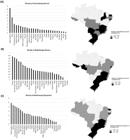
Density of chemotherapy and radiotherapy rooms and radiotherapy equipment in use for oncological care in Brazil (per FU), according to NRHI (CNES) data for the year 2021
Concerning the physical structure for radiotherapy (Figure 3), the spatial distribution of these technologies is concentrated in the South and Southeast Regions, mostly in Paraná (0.9 radiotherapy rooms per 100 thousand inhabitants), Rio Grande do Sul (0.8 radiotherapy rooms per 100 thousand inhabitants), and Santa Catarina (0.8 radiotherapy rooms per 100 thousand inhabitants).
The territorial distribution of radiotherapy equipment shows a similar pattern to the other indicators, with higher densities in the States of Santa Catarina (4.8 radiotherapy equipment per 100 thousand inhabitants), Paraná (4.4 radiotherapy equipment per 100 thousand inhabitants), and Rio Grande do Sul (4.1 radiotherapy equipment per 100 thousand inhabitants). It must be noted that Rio Grande do Norte (3.9 radiotherapy equipment per 100 thousand inhabitants) and Alagoas (2.4 radiotherapy equipment per 100 thousand inhabitants), which present high densities of this equipment, in addition to the possibility of a better distribution of technological equipment in the North and Middle West Regions.
DISCUSSION
Results reveal existing inequalities in the distribution of healthcare facilities, services, technologies, and resources within the context of the cancer patient care network in Brazil. The data suggests a greater range of services in the Metropolitan Regions and urban areas, with economic and population development potential. In contrast, other rural areas and remote communities are left with no proper access to specialized HWF and health services/technologies, affecting the quality and efficiency of oncological assistance provided to the population.
Cancer treatment in Brazil is regulated by the PNPCC, whose objective is to organize actions that contemplate cancer awareness/prevention, diagnosis, treatment, rehabilitation, and palliative care4,5. Within the HCN, high and medium complexities are pointed out as fundamental components for ensuring access to clinical or histopathological diagnosis, tumoral staging, treatment, and care according to defined guidelines and clinical routines4,17. These roles are essentially played by Unacon and Cacon, in addition to other specialized services for oncological care and diagnosis5,18.
Services like Unacon, which correspond to 77.9% in the study, refer to hospitals that provide care to the most prevalent cancer types in the country, relying on HWF, physical installations, technical conditions, and equipment to provide specialized oncology care5. Cacons are also high-complexity services that present adequate and specialized structure for definitive diagnosis and treatment of all adult cancer types, not necessarily obliged to care for children and teenagers4,5.
Since the advent of PNPCC4, GHOS have been included in the care network. These services only perform cancer surgical treatment, later referring the patient to other services within the HCN when complementary therapy is needed4,5,18. This study shows that a total of 3.8% of analyzed health facilities are GHOS, which highlights the importance of inserting such services into the care network, allowing for timely and skilled treatment and diagnosis. Shifting the focus from the accreditation type allowed for regional discussions and the elaboration of oncological care plans that considered the HCN in which it is inserted, minimizing assistance gaps19.
In the organization of the cancer patient care network, logistic and regulatory systems are key to ensuring the flows and counter-flows needed for a seamless care provision. Additionally, it is part of the HCN organizational structure, managing the coordination between services, equipment, and network professionals19. The present study reveals that medium and high complexity health services work through spontaneous demand, characterized as "open door" services, and through referral demands. Such care flows aim to design strategic care pathways, minimize difficulties in accessing health services, and ensure equitable and seamless resource distribution18,20.
The most frequently observed agreement between hospitals and oncological health facilities is mixed, aggregating users from SUS, private, and health insurance. Brazil manages the most comprehensive universal health system in the world. The majority of the Brazilian population (80%) is exclusively cared for by the public health system. However, financial investment in this sector is still low, which contributes to an uneven and incomplete coverage of the healthcare system. The Brazilian population often seeks private assistance in search of health services21. In 2023, approximately 26.1% of Brazilians had some form of private health insurance, with the majority residing in the Southeast (37.7%) and South (26.4%) regions22.
The study reveals that most hospitals (93.5%) in the cancer patient care network have a multiprofessional team specialized in oncology care. However, the presence of health multiprofessional support teams (MST) and multiprofessional homecare support teams (MHST) seems far-fetched from the services analyzed in the study.
A multiprofessional approach to cancer treatment helps optimize patient outcomes and prognoses. Its main function is to provide integral care, foster discussions within the health team, and reach a consensus regarding a fast and safe diagnosis, as well as choose the most assertive and appropriate therapeutic approach23. This assistance model ensures integral care, with support to the most diverse demands and dimensions of suffering experienced by users with cancer5,24.
MST and MHST are multiprofessional teams responsible for caring for patients outside the hospital environment, ensuring they have a coordinated and responsible discharge, with access to the HCN. These teams are not exclusive to the cancer patient care network, but are essential for the continuity of care and provision of palliative care to these patients, especially in their home environment25,26. The absence of these teams, as observed in the present study, highlights the distance between understanding the concept of integrity and enforcing actual care practices based on this principle in Brazilian healthcare services.
The exposed deficit of MST and MHST teams within oncological care can be justified by the fact that the study evaluation considered only secondary and tertiary HCN care services. These teams can be allocated within the Primary Health Care (PHC) facilities. However, studies suggest the fragility of oncological care continuity at the PHC, contributing to recurrent worsening health conditions and patients constantly returning to hospital care20,26-28.
Regarding the HWF, presented in the study by the "Density of professionals for Oncological Care" indicator, there was an uneven distribution of human resources in the health field across the national territory, concentrated in the States located in the South and Southeast Regions of the country. The following States called our attention in the study: Roraima (48.0 professionals per 100 thousand inhabitants), which has one general hospital with an active Unacon, and Sergipe (36.4 professionals per 100 thousand inhabitants), with three hospital units also licensed to work as Unacon. Another important discussion topic is the characterization of the facilities in question, which are mostly general hospitals, but with an active license to work as a Cacon or Unacon. This indicator must be carefully interpreted, considering such specificities in the performed calculation.
The Brazilian health sector is characterized by its dynamism and turnover of professionals. SUS plays an important role in this scenario, with over 60% of health facilities in the country absorbing approximately 80% of the sector's workforce. The majority of this specialized HWF is allocated in the great urban centers, which concentrate well-equipped and territorially well-distributed health services 29,30. In 2023, the indicator of inequality in the distribution of doctors between capital cities and inland municipalities (division between the ratio of capital cities and the ratio of inland municipalities – doctors per thousand inhabitants) was 3.80 for Brazil. The Northeast has the most unequal distribution of doctors (7.95), followed by the North (5.49) and Middle West (4.75) Regions. The Southeast has the lowest index (2.87) of unequal distribution of doctors in the country, with the State of São Paulo standing out (2.43)30.
The unequal distribution of the HWF in the Brazilian territory follows a worldwide trend known as the Global Workforce Crisis in Health, which shows an overall scarcity of 12.9 million workers in the health field. Such scarcity may be justified by the increase in prevalence of chronic-degenerative diseases, the health system reformation process, and global economic growth31. For 2020, a deficit of approximately 1 million health workers was estimated. Even in developed areas, such as European countries, approximately 15% of the population's health needs are not properly met. The HWF crisis seems to be even more impactful in emerging countries, like the African and Southeast Asian Regions, which have 10 to 15 times fewer health professionals than the Europe and Americas Regions31.
A concentration of physical, technological resources, and trained oncology professionals can be observed in the South and Southeast Regions, especially in large urban centers, which offer better coverage, but suffer a high demand from the population for specific healthcare32.
In the spatial distribution of physical and technological resources for oncology care, some States of the North and Northeast Region deserve mention, like Rio Grande do Norte and Rondônia. In Rio Grande do Norte, the cancer patient care network has seven healthcare services, most of which are located in the State Capital, Natal (5), and in the city of Mossoró (2). Both municipalities are located on the coast, which impairs proper access to these services for people coming from the interior of the State. In Rondônia, health technologies are located in hospital units located in Porto Velho (3), the State Capital, and Cacoal (1). These geographical disparities translate into significant difficulties for the population living in those areas, resulting in long-distance migrations to obtain specialized oncology care33,34.
Spatial distribution of services, technologies, and HWF associated with oncology in Brazil seems to follow the spatial distribution of the disease's epidemiological aspects concerning incidence and mortality. Approximately 704 thousand new cancer cases a year are expected in the country for the 2023-2025 period. The Southeast and South Regions concentrate approximately 70% of this incidence35.
Regarding cancer mortality, it is also possible to observe significant variations between the Regions of the country. The Southeast and South Regions recorded the highest mortality rates, especially for lung, colorectal, and prostate cancer in men, and breast, lung, and colorectal cancer in women. The North and Northeast Regions had a heightened mortality from cancers associated with socioeconomic factors, such as cervical cancer in women and stomach cancer in men, reflecting inequalities in access to prevention and early diagnosis11.
Studies on the spatiality of HWF, oncology care services, and technologies enable a better understanding of the health opportunities that the Brazilian population experiences. As a potential aspect of the study, the importance of outlining the cancer patient care network with information extracted from the NRHI, the most complete secondary data source available in Brazil, is highlighted, bringing together essential information for planning and managing the health system. As limitations of the study, we highlight the access to data from health equipment exclusive to secondary and tertiary care, which limits the outline of the whole network. Inserting PHC health services would allow for a better network design, with access to essential information for the continuity and integrity of oncological care in SUS. Another limiting factor of this study is its descriptive-only character. The association between the data available here with the cancer morbidity and mortality information could fill important knowledge gaps related to the effectiveness and solvability of the HCN, given the population's health demands.
CONCLUSION
The presented results reveal existing inequalities in the distribution of healthcare facilities, services, technologies, workforce, and resources within the context of the cancer patient care network. The design of this health care network suggests potential ways to mitigate the impact of social inequities on the population's health, with a focus on regions of greater vulnerability, particularly areas with gaps in the provision of such services and workforce in the Brazilian territory.
The uneven distribution of resources, services, and health professionals for cancer treatment and control reflects the economic inequality and the country's historical background. In this sense, the data presented is essential to guide public policies in line with the distinct realities of the Brazilian Regions.
DATA AVAILABILITY STATEMENT
The generated data sets analyzed during the current study are available at the DATASUS CNES (NRHI) portal: https://cnes.datasus.gov.br/pages/estabelecimentos/consulta.jsp. Data are free and easy to access. The database used for the current study is available at: https://docs.google.com/spreadsheets/d/1wFCLabNnvumnz-3zsnWkBZURUt_DBX-21V2pUFRsVQw/edit?usp=sharing
References
-
1 Santini SML, Nunes EFPA, Carvalho BG, et al. Dos ‘recursos humanos’ à gestão do trabalho: uma análise da literatura sobre o trabalho no SUS. Trab Educ Saúde. 2017;15(2):537-59. doi: https://doi.org/10.1590/1981-7746-sol00065
» https://doi.org/10.1590/1981-7746-sol00065 -
2 Carvalho DS, Nascimento EPL, Carmona SAMLD, et al. Planejamento e dimensionamento da força de trabalho em saúde no Brasil: avanços e desafios. Saúde debate. 2022;46(135):1215-37. doi: https://doi.org/10.1590/0103-1104202213519
» https://doi.org/10.1590/0103-1104202213519 - 3 Carvalho M, Santos NR, Campos GWS. A construção do SUS e o planejamento da força de trabalho em saúde no Brasil: breve trajetória histórica. Saúde debate. 2013;37(98):372-87.
-
4 Ministério da Saúde (BR), Gabinete do Ministro. Portaria nº 874, de 16 de maio de 2013. Institui a Política Nacional para a Prevenção e Controle do Câncer na Rede de Atenção à Saúde das Pessoas com Doenças Crônicas no âmbito do Sistema Único de Saúde (SUS) [Internet]. Diário Oficial da União, Brasília, DF. 2013 maio 17 [acesso 2025 jan 30]; Seção 1:129.2. Disponível em: https://bvsms.saude.gov.br/bvs/saudelegis/gm/2017/prc0002_03_10_2017.html
» https://bvsms.saude.gov.br/bvs/saudelegis/gm/2017/prc0002_03_10_2017.html -
5 Ministério da Saúde (BR), Gabinete do Ministro. Portaria nº 1.399, de 17 de dezembro de 2019. Aprova a atualização da Política Nacional para a Prevenção e Controle do Câncer [Internet]. Diário Oficial da União, Brasília, DF. 2019 dez 18 [acesso 2025 jan 30]; Seção 1. Disponível em: https://bvsms.saude.gov.br/bvs/saudelegis/gm/2019/prt1399_17_12_2019.html
» https://bvsms.saude.gov.br/bvs/saudelegis/gm/2019/prt1399_17_12_2019.html - 6 Ministério da Saúde (BR). Plano de ações estratégicas para o enfrentamento das doenças crônicas não transmissíveis (DCNT) no Brasil 2011-2022. Brasília, DF: Ministério da Saúde; 2011.
-
7 Cecilio AP, Takakura ET, Jumes JJ, et al. Breast cancer in Brazil: epidemiology and treatment challenges. Breast Cancer (Dove Med Press). 2015;7:43-9. doi: https://doi.org/10.2147/bctt.s50361
» https://doi.org/10.2147/bctt.s50361 -
8 Oliveira EXG, Melo ECP, Pinheiro RS, et al. Acesso à assistência oncológica: mapeamento dos fluxos origem-destino das internações e dos atendimentos ambulatoriais. O caso do câncer de mama. Cad Saúde Pública. 2011;27(2):317-26. doi: https://doi.org/10.1590/S0102-311X2011000200013
» https://doi.org/10.1590/S0102-311X2011000200013 -
9 Barros AF, Uemera G, Macedo JLS. Tempo para acesso ao tratamento do câncer de mama no Distrito Federal, Brasil Central. Rev Bras Ginecol Obstet. 2013;35(10):458-63. doi: https://doi.org/10.1590/S0100-72032013001000006
» https://doi.org/10.1590/S0100-72032013001000006 -
10 CNES: Cadastro Nacional de Estabelecimentos de Saúde [Internet]. Brasília (DF): DATASUS. [2000]. [Acesso 2022 jul 15]. Disponível em: http://cnes.datasus.gov.br/
» http://cnes.datasus.gov.br/ -
11 Instituto Nacional de Câncer [Internet]. Rio de Janeiro: INCA; [2000]. Onde tratar pelo SUS, 2022 maio 20. [Acesso 2022 jul 20]. Disponível em: https://www.gov.br/inca/pt-br/assuntos/cancer/tratamento/onde-tratar-pelo-sus
» https://www.gov.br/inca/pt-br/assuntos/cancer/tratamento/onde-tratar-pelo-sus -
12 CNES: Cadastro Nacional de Estabelecimentos de Saúde [Internet]. Brasília (DF): DATASUS. [2000]. Legislações, Versão 0.1.53. [Acesso 2022 jul 20]. Disponível em: http://cnes.datasus.gov.br/pages/legislacoes.jsp
» http://cnes.datasus.gov.br/pages/legislacoes.jsp -
13 Sinopse do Censo 2010 [Internet]. Rio de Janeiro: IBGE; [2011]. [acesso 2022 fev 11]. Disponível em: https://censo2010.ibge.gov.br/sinopse/index.php?dados=12
» https://censo2010.ibge.gov.br/sinopse/index.php?dados=12 - 14 Conselho Nacional de Saúde (BR). Resolução nº 507, de 16 de março de 2016. Publica as propostas, diretrizes e moções aprovadas pelas Delegadas e Delegados na 15a Conferência Nacional de Saúde, com vistas a garantir-lhes ampla publicidade até que seja consolidado o Relatório Final. Lista de profissões da área da saúde. Diário Oficial da União, Brasília, DF. 2016 maio 5; Edição 85; Seção 1:53-67.
-
15 StataR [Internet]. Versão 15.0. Lakeway: StataCorp LLC; 1996-2024c. [acesso 2023 nov 20]. Disponível em: https://www.stata.com/
» https://www.stata.com/ -
16 TerraView Version [Internet]. Versão5.0.0. Brasília, DF: Instituto Nacional de Pesquisas Espaciais; 2000. [Acesso 2022 ago 5]. Disponível em: http://www.dpi.inpe.br/terralib5/wiki/doku.php
» http://www.dpi.inpe.br/terralib5/wiki/doku.php - 17 Conselho Nacional de Saúde (BR). Resolução nº 466, de 12 de dezembro de 2012. Dispõe sobre diretrizes e normas regulamentadoras de pesquisas envolvendo seres humanos. Diário Oficial da União, Brasília, DF. 2013 jun 13; Seção I:59.
-
18 Carrol CB, Gomide M. Análise de redes na regulação do tratamento do câncer do aparelho digestivo. Cad Saúde Pública. 2020;36(1):415-8. doi: https://www.doi.org/10.1590/0102-311X00041518
» https://www.doi.org/10.1590/0102-311X00041518 -
19 Madi MR, Cerri GG. Organization of the cancer network in SUS: evolution of the care model. CLINICS. 2018;73(supl 1):430. doi: https://www.doi.org/10.6061/clinics/2018/e430s
» https://www.doi.org/10.6061/clinics/2018/e430s -
20 Goldman RE, Figueiredo EN, Fustinoni SM, et al. Rede de Atenção ao Câncer de Mama: perspectiva de gestores da saúde. Rev Bras Enferm. 2019;72(Sup 1):2286-92. doi:https://www.doi.org.br/10.1590/0034-7167-2017-0479
» https://www.doi.org.br/10.1590/0034-7167-2017-0479 - 21 Marinho A. A crise do mercado de planos de saúde: devemos apostar nos planos populares ou no sus? PPP. 2017;49:55-84.
-
22 ANS TABNET [Internet]. Brasília, DF: ANS; [2000]. Informações em Saúde Suplementar. Taxa de Cobertura de Planos de Saúde. [acesso 2024 ago 5]. Disponível em: https://www.ans.gov.br/anstabnet/#
» https://www.ans.gov.br/anstabnet/# - 23 Güler SA, Cantürk NZ. Multidisciplinary breast cancer teams and proposed standards. Ulusal Cer Derg. 2015;31:39-41.
-
24 Lombrado MS, Popim RC. Acesso do paciente à rede oncológica na vigência da "Lei dos Sessenta Dias": revisão integrativa. Rev Bras Enferm. 2020;73(5):e20190406. doi: https://www.doi.org/10.1590/0034-7167-2019-0406
» https://www.doi.org/10.1590/0034-7167-2019-0406 -
25 Ministério da Saúde (BR), Secretaria de Atenção Especializada à Saúde. Atenção domiciliar na Atenção Primária à Saúde [Internet]. Brasília, DF: Ministério da Saúde; 2020. [acesso 2024 ago 5]. Disponível em: https://bvsms.saude.gov.br/bvs/publicacoes/atencao_domiciliar_primaria_saude.pdf
» https://bvsms.saude.gov.br/bvs/publicacoes/atencao_domiciliar_primaria_saude.pdf -
26 Belga SMMF, Jorge AO, Silva KL. Continuidade do cuidado a partir do hospital: interdisciplinaridade e dispositivos para integralidade na rede de atenção à saúde. Saúde debate. 2022;46(133):551-70. doi: https://www.doi.org/10.1590/0103-1104202213321
» https://www.doi.org/10.1590/0103-1104202213321 -
27 Mauro AD, Cucolo DF, Perroca MG. Hospital – primary care articulation in care transition: both sides of the process. Rev Esc Enferm USP. 2021;55:e20210145. doi: https://www.doi.org/10.1590/1980-220X-REEUSP-2021-0145
» https://www.doi.org/10.1590/1980-220X-REEUSP-2021-0145 -
28 Mota RT, Martins EF, Vieira MA, et al. Percurso assistencial de pacientes convivendo com câncer de pulmão. Rev bioét (Impr). 2021;29(2):363-73. doi: https://www.doi.org/10.1590/1983-80422021292474
» https://www.doi.org/10.1590/1983-80422021292474 -
29 Carvalho MS, Gil CRR, Costa EMOD, et al. Necessidade e dinâmica da força de trabalho na Atenção Básica de Saúde no Brasil. Ciênc saúde coletiva. 2018;23(1):295-302. doi: https://www.doi.org/10.1590/1413-81232018231.08702015
» https://www.doi.org/10.1590/1413-81232018231.08702015 -
30 Scheffer M, coordenador. Demografia médica no Brasil 2023 [Internet]. São Paulo: FMUSP; CFM; 2023. [Acesso 2022 ago 5]. 344 p. Disponível em: https://amb.org.br/wp-content/uploads/2023/02/DemografiaMedica2023_8fev-1.pdf
» https://amb.org.br/wp-content/uploads/2023/02/DemografiaMedica2023_8fev-1.pdf -
31 Portela GZ, Fehn AC, Ungerer RLS, et al. Recursos humanos em saúde: crise global e cooperação internacional. Ciênc saúde coletiva. 2017;22(7):2237-46. doi: http://www.doi.org/10.1590/1413-81232017227.02702017
» http://www.doi.org/10.1590/1413-81232017227.02702017 -
32 Ramaswani R, Paulino E, Barrichello A, et al. Disparities in breast, lung, and cervical cancer trials worldwide. JGO. 2018;1:1-11. doi: https://www.doi.org/10.1200/JGO.17.00226
» https://www.doi.org/10.1200/JGO.17.00226 -
33 Oliveira NPD, Cancela MC, Martins LFL, et al. A multilevel assessment of the social determinants associated with the late stage diagnosis of breast cancer. Scient Reports. 2021;11:2712. doi: https://www.doi.org/10.1038/s41598-021-82047-0
» https://www.doi.org/10.1038/s41598-021-82047-0 -
34 Oliveira NPD, Cancela MC, Martins LFL, et al. Spatial distribution of advanced stage diagnosis and mortality of breast cancer: Socioeconomic and health service offer inequalities in Brazil. PLoS ONE. 2021;16(2):e0246333. doi: https://www.doi.org/10.1371/journal.pone.0246333
» https://www.doi.org/10.1371/journal.pone.0246333 -
35 Rocha-Brischiliari SC, Andrade L, Nihei OK, et al. Spatial distribution of breast cancer mortality: socioeconomic disparities and access to treatment in the state of Parana, Brazil. Plos One, 2018;31:1-15. doi: https://www.doi.org/10.1371/journal.pone.0205253
» https://www.doi.org/10.1371/journal.pone.0205253
Edited by
-
Associate editor:
Jeane Tomazelli. Orcid iD: https://orcid.org/0000-0002-2472-3444
-
Scientific-editor:
Anke Bergmann. Orcid iD: https://orcid.org/0000-0002-1972-8777

 Source: The authors, based on NRHI data
 Source: The authors, based on NRHI data
 Source: The authors, based on NRHI data