 Pharmaceutical Care to The Pediatric Oncology Patient: Construction of Educational Booklets for a Treatment of Acute Lymphoblastic Leukemia
ABSTRACT
Introduction: Pediatric patients with Acute Lymphoblastic Leukemia (ALL), the most common childhood cancer, require complex care, including multi-step therapy that may be challenging for the general population to comprehend. In this context, the lack of health literacy was identified as one of the causes of decreased health self-efficacy, with potential negative impacts on the treatment of diseases. Therefore, it is imperative to adopt strategies that can effectively assist patients and their caregivers in enhancing their knowledge about the therapeutic process of ALL.
Objective: To describe the development and context of use of an educational material aimed at caregivers and pediatric patients diagnosed with ALL, undergoing the ALL IC-BFM 2009 treatment protocol.
Method: Descriptive study on the preparation of booklets covering details about each of the medications to be administered during the mentioned protocol. The creation of the booklets was conducted by a pharmacist, reviewed by a pediatric oncologist, and further assessed by a second pharmacist. An analysis of textual readability was also conducted using the ALT© software.
Results: Seven booklets were created, each corresponding to a phase of the ALL protocol. The booklets exhibited high readability, with text deemed simple, containing an average of 21.5% of complex words.
Conclusion: It is believed that the material created can support the proper use of medications for children undergoing ALL treatment and can be enhanced or adapted to new scenarios and realities.
Key words:
Health Education; Patient Education Handout; Pediatrics/education; Precursor Cell Lymphoblastic Leukemia-Lymphoma; Professional-Patient Relations
RESUMO
Introdução: Pacientes pediátricos com leucemia linfoblástica aguda (LLA), considerado o câncer infantil mais comum, demandam cuidado complexo, que inclui uma terapêutica com múltiplas etapas e de difícil compreensão pela população em geral. Nesse contexto, o déficit de conhecimento em saúde foi identificado como uma das causas da diminuição da autoeficácia em saúde, podendo impactar adversamente o tratamento das doenças. Portanto, torna-se imperativa a adoção de estratégias que possam efetivamente auxiliar os pacientes e seus cuidadores para aprimorar seus conhecimentos sobre o processo terapêutico da LLA.
Objetivo: Descrever a elaboração e o contexto de utilização de um material educativo direcionado aos cuidadores e pacientes pediátricos diagnosticados com LLA, submetidos ao protocolo de tratamento ALL IC-BFM 2009.
Método: Estudo descritivo da elaboração de cartilhas abordando detalhes sobre cada um dos medicamentos a serem administrados durante o referido protocolo. A confecção das cartilhas foi conduzida por uma farmacêutica, revisada por uma médica oncologista pediátrica e um segundo farmacêutico. Realizou-se também a análise da legibilidade textual por meio do software ALT®.
Resultados: Foram confeccionadas sete cartilhas, cada uma relacionada a uma fase do protocolo de LLA. As cartilhas apresentaram alta legibilidade, com um texto considerado simples, contendo em média 21,5% de palavras complexas.
Conclusão: Acredita-se que o material elaborado pode apoiar o uso apropriado de medicamentos para crianças em tratamento de LLA, podendo ser aprimorado ou adaptado para novos cenários e realidades.
Palavras-chave:
Educação em Saúde; Prospecto para Educação de Pacientes; Pediatria/educação; Leucemia-Linfoma Linfoblástico de Células Precursoras; Relações Profissional-Paciente
RESUMEN
Introducción: Pacientes pediátricos con Leucemia Linfoblástica Aguda (LLA), el cáncer infantil más común, requieren cuidados complejos, que incluye una terapia de múltiples pasos difícil de entender para la población general. En este contexto, la falta de conocimiento en salud fue identificada como una de las causas de la disminución de la autoeficacia en salud, lo que podría impactar negativamente en el tratamiento de las enfermedades. Por lo tanto, es imperativo adoptar estrategias que puedan ayudar eficazmente a los pacientes y sus cuidadores a mejorar sus conocimientos sobre el proceso terapéutico de la LLA.
Objetivo: Describir la elaboración y contexto de uso de un material educativo dirigido a cuidadores y pacientes pediátricos diagnosticados con LLA, sometidos al protocolo de tratamiento ALL IC-BFM 2009.
Método: Estudio descriptivo sobre la elaboración de folletos que detallan cada uno de los medicamentos a ser administrado durante dicho protocolo. La creación de los folletos fue realizada por una farmacéutica, revisada por una oncóloga pediatra y un segundo farmacéutico. Además, se llevó a cabo un análisis de legibilidad textual mediante el software ALT©.
Resultados: Se crearon siete folletos, cada uno asociado a una fase del protocolo LLA. Los folletos mostraron alta legibilidad, con un texto considerado simple y que contenía un promedio de 21,5% de palabras complejas.
Conclusión: Se cree que el material creado puede respaldar el uso adecuado de medicamentos para niños en tratamiento contra la LLA y puede ser mejorado o adaptado a nuevos escenarios y realidades.
Palabras clave:
Educación en Salud; Folleto Informativo para Pacientes; Pediatría/educación; Leucemia-Linfoma Linfoblástico de Células Precursoras; Relaciones Profesional-Paciente
INTRODUCTION
Leukemia is the most frequent malign tumor in the age group of 0 to 19 years old, representing about 25 to 35% of childhood cancer cases. Among the main four leukemia groups, acute lymphoblastic leukemia (ALL) is the most predominant, representing about 75% of diagnoses in this age group1,2.
In this context, it is worth noting the challenges faced by pediatric cancer patients. The negative impacts can be felt in several spheres, such as physiological reserves compromised by the nature of the disease, toxicity inherent to the treatment, psychosocial aspects tied to the process of being ill and changes in the daily life that directly resonates in the family3,4. Moreover, the complexity of the current therapeutic routine adopted for treating ALL, which relies on multiple chemotherapeutic and support medication administered in different contexts, including at home, must be considered2.
The most common chemotherapeutic protocol employed for treating ALL in children is developed by the Berlin-Frankfurt-Münster (BFM) study group, called, in their 2009 version, “ALL IC-BFM 2009: A Randomized Trial of the I-BFM-SG for the Management of Childhood non-B Acute Lymphoblastic Leukemia”. The ALL IC-BFM 2009 therapeutic scheme is adapted according to the illness recurrence risk and has shown a high rate of global survival. However, it is a complex and extensive protocol that combines 13 chemotherapeutic medications in different forms and dosages, throughout five phases - knowingly, induction, early intensification, consolidation, reinduction and maintenance - that span for 104 weeks of treatment5,6,7.
Given the treatment’s profile, it becomes imperative to adopt strategies that may effectively help patients and their caregivers over time. This is because the lack of knowledge regarding health was identified as one of the causes of the decrease in health self-efficacy. When the individual lacks understanding over the necessary practices to take care of their own health, their perception of self-efficacy tends to be reduced. This adversely impacts their understanding of their own capabilities, the abilities they already have, or even their potential to acquire new competencies8-9.
It is also worth mentioning that understanding the pharmacological treatment is crucial to the patient’s adhesion and may significantly impact the clinical outcomes10,11,12,13. Factors such as patient education and use of clear language may improve understanding and, consequently, adhesion to treatment13. Thus, the present study aims to describe the elaboration of informative material in booklet form aimed at caregivers and pediatric patients diagnosed with ALL and who were submitted to chemotherapeutic treatment according to the ALL IC-BFM 2009 protocol.
METHOD
Descriptive study on the elaboration of booklets, developed in a pediatric oncology outpatient clinic located in the city of São Paulo, SP, Brazil. Different booklets referring to the ALL IC-BFM 2009 protocol phases were elaborated with the goal of providing support to children with ALL and their caregivers regarding pharmacological treatment.
To this end, a profound study on the ALL IC-BFM 2009, protocol as used in the studied institution, was initiated. This was followed by a literature review on the most relevant aspects in terms of indication, safety and administration form of each medication used in the referred protocol, using the Micromedex® and LexiComp® databases.
Following literature review, an acting pharmacist in the field of oncology pharmaceutical care wrote the text for one of the booklets, which was then revised by a pediatric oncologist and a second pharmacist with broad experience in the pharmaceutical care area. After incorporating improvement suggestions from the revisers into the text, the booklets elaboration began.
The booklets were produced using the Microsoft PowerPoint® software. For each phase of the chemotherapeutic protocol one booklet was produced. When needed, different versions of the same phase were elaborated to contemplate variations in the medication scheme according to the patient’s risk. In addition to the textual content validated by collaborators, illustrations were used in the booklets to facilitate understanding and make the content more accessible in the pediatric context. The illustrations were carefully selected, edited or, when needed, totally developed by the pharmacist responsible for elaborating the booklets. At the end of this process, the booklets were once again revised and validated by the collaborators involved in the first step.
Finally, the final text of each booklet was submitted to readability analysis through the ATL®14 software. This software provides the result of a text’s readability through an arithmetic mean of four indexes that operate on the education level scale, according to the following equation:
Where:
FK = Flesch-Kincaid Grade Level; GF = Gunning Fog Index; ARI = Automated Readability Index; CL = Coleman-Liau Index.
The readability level score is provided by a value between 5 and 20 and can be classified in three degrees: below 13 points, high readability; between 13 and 17 points, medium readability; and result equal to or higher than 17 points, low readability15. The texts that received a low readability score would be revised in order to evaluate the pertinence of switching complex terms for simpler and easier to understand alternatives, when possible.
The content of the booklets as well as their readability level were described. The context in which the booklets were introduced to patients and their caregivers was also presented.
Following ethical principles, this study was approved by the Research Ethics Committee (CEP) of Universidade Federal de São Paulo, approval report number 6129438 (CAAE (submission for ethical review): 27115319.4.0000.5505), based on Resolution number 466/201216 of the National Health Council, and by the Scientific Committee of Hospital do Grupo de Apoio à Criança e ao Adolescente com Câncer (IOP-008/2021).
RESULTS
A total of seven booklets were produced: two for the induction phase, one for the early intensification phase, two for the consolidation phase, one for the reinduction phase and one for the maintenance phase. Table 1 details the result from the readability analyses of each produced booklet. In general, the booklets exhibited “high readability”, with text deemed simple, containing an average of 21.5% of complex words. The “maintenance” phase booklet had the highest readability score, while the “reinduction” phase booklet had the lowest readability score.
The booklets’ covers were identified with the specific treatment phase and protocol in question. On the top of the initial pages, a timeline (Figure 1) was arranged to indicate precisely in what point of the protocol the phase in question was situated.

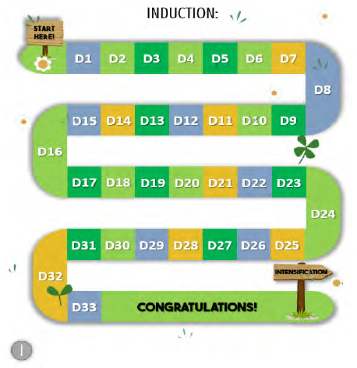
In the first page of every booklet, a diagram resembling a game board showed the course the child would follow during that phase, highlighting the chemotherapy days (Figure 2). Next to it, a table provided details on what medication would be administered on each day. In the following pages, information related to the indication, main adverse events and guidance on the administration of each of the medications were included.
At the end of each booklet, general information about the medications in the home context were included. These contained guidance on the most appropriate location for storing medicines, the importance of rigorously following administration times, considerations about medicines that must be taken on an empty stomach, among other pertinent pointers. Additionally, warning signs that demand immediate caregiver attention were detailed, with the note that, when manifested, the child must be immediately conducted to the institution’s emergency service.
During pharmaceutical appointments, the booklet played a key educational role, explaining the dynamics of the treatment phase in question. This included information on the duration of the phase, programmed days for chemotherapy and medications to be used. The objective of this process was to involve both the patient and their caregiver, stimulating children to actively explore the content of the booklets along with their caregiver.
The pharmacist would then verbally address, during appointments, relevant aspects of each medication prescribed for that specific phase. A moment was reserved for the caregiver to clear their doubts regarding the new treatment phase.
At the end of the appointment, the booklets were handled to the guardians of 12-year-olds-and-under children, ensuring their proper conservation and availability for consultation during treatment.
DISCUSSION
Oncological patients demand complex and multidisciplinary care by professionals who can act in different fronts with the aim of providing the best possible therapeutic results17. The ALL IC-BFM 2009 protocol is a good representative of this scenario, since each one of its phases demands specific care due to the different chemotherapeutic combinations in precisely delineated schemes, careful dosage adjustments and constant monitoring of clinical and laboratory parameters. Moreover, every phase has at least one medication that must be administered in the home context, in addition to chemotherapy support medications that are commonly prescribed, such as pain killers, antiemetics, and antimicrobials. The temporal extension and the complexity of the protocol highlight the need for inter-professional approach and a careful management to optimize clinical outcomes and minimize possible complications5,6,7.
Another attention point is the potential lack of adhesion to treatment that may culminate in the absence of favorable clinical results, which makes it essential to develop strategies that aim at maintenance and correct usage of medications. Some activities in the context of pharmaceutical care are able to positively contribute to treatment adhesion, such as: aid in understanding prescription and use of medications; information and management of adverse events; establishing routines considering dosage regimens; building relationships and partnerships; understanding previous and subjective experience regarding the use of medications, among others3.
In this context, printed educational materials have been used as tools for health education to facilitate knowledge, demystify mistaken approaches and conceptions of a certain social, cultural, political theme and aspects related to human health. The printed instrument acts as a guiding source, a resource to be consulted in the absence of a trained professional18,19. That way, educational resources are incorporated to every assistance level and by several professionals, including pharmacists, highlighting the importance of preparing and guiding parents, family members and caregivers on drug therapy20.
Moreover, it is worth noting that patients that are adequately informed, motivated and encouraged can observe and recognize mistakes in the medication administration, as shown by a literature review conducted by Schwappach et al.21. Thus, patients and their caregivers may be a valuable resource in strategies that aim at preventing medication errors.
In the pediatric context, text readability is an extremely relevant factor that must be considered during the production of informative material, since the technical information must be understood by children and teenagers. However, informative leaflets used in pediatric studies usually lack readability, presenting a significant difference in comparison to pediatric reference texts22,23.
A study conducted by Ménoni et al.23 evaluated the text readability of pediatric informative leaflets. A median score of 40% was identified in the Flesch index and only 14% of the evaluated leaflets had illustrations. The booklets produced in the present study showed illustrations as a strategy to fill the gap towards achieving readability in pediatric research materials, contributing for a more effective and accessible communication in the pediatric medical context. Similarly, a median score of 40.7 was obtained in the Flesch readability index.
For comparison purposes, the ALT®14 software creators conducted and made available the readability evaluation of different types of text. As an example, the analyses performed on the texts Hansel and Gretel, Pinocchio and The Ugly Duckling were used, which showed Flesch-Kincaid Grade Levels of 8.9, 8.3 and 6.7 and final results of 10, 9, and 8, respectively15,24. These results show the high readability of these children’s texts. These booklets achieved a median of 12.07 in the Flesch-Kincaid level and a mean final score of 12, indicating a high text readability, despite the technical content.
In summary, dealing with children with cancer demands the presence of professionals that not only possess technical abilities and specific knowledge, but who are also capable of being empathetic and actively engaging with the patient and their family. This interaction facilitates the identification of the real physical and psychosocial needs of patients, thus enabling the elaboration of a customized care plan that caters to their individual needs.
CONCLUSION
This study described the process of producing educational booklets with high text readability and illustrations about the ALL IC-BFM 2009 chemotherapy protocol, in addition to its usage context, with the goal of making knowledge easily understandable, stimulating adhesion, motivating and engaging patients and their caregivers during their ALL treatment. Evaluating the impact of the booklets’ utilization was not part of this research’s objective, however, future studies could approach this subject. Additionally, no usage tests were performed on the booklets, which could provide valuable insights on the educational material’s effectiveness and user experience. It is also expected that this research will encourage the creation of educational materials in various formats, aiming to meet the needs of family members regarding the appropriate use of medicines for children undergoing leukemia treatment, which can be improved or adapted to new scenarios and realities.
ACKNOWLEDGMENTS
To the Grupo de Apoio ao Adolescente e à Criança com Câncer (GRAACC) hospital for providing the means to make this study possible, as well as all the health professionals, caregivers and patients involved in this project.
References
- 1 Instituto Nacional de Câncer. Câncer no Brasil: dados dos registros de base populacional. Rio de Janeiro: Coordenação de Educação CEDEC; 2010.
- 2 Melaragno R, Carmargo B. Oncologia pediátrica - diagnóstico e tratamento. 1. ed. São Paulo: Atheneu; 2013.
- 3 Lima Santos PCJ. Cuidado farmacêutico aos pacientes com câncer, hepatite, HIV/AIDS, dengue e outras doenças. 1. ed. São Paulo: Atheneu ; 2019.
-
4 Mutti CF, Paula CCD, Souto MD. Assistência à saúde da criança com câncer na produção científica brasileira. Rev Bras Cancerol 2010;56(1):71-83. doi: https://doi.org/10.32635/2176-9745.RBC.2010v56n1.1537
» https://doi.org/10.32635/2176-9745.RBC.2010v56n1.1537 -
5 Campbell M, Kiss C, Zimmermann M, et al. Childhood acute lymphoblastic leukemia: results of the randomized acute lymphoblastic leukemia intercontinental-Berlin-Frankfurt-Münster 2009. Trial J clin oncol. 2023;41(19):3499-3511. doi: https://doi.org/10.1200/JCO.22.01760
» https://doi.org/10.1200/JCO.22.01760 - 6 Nath UK, Chattopadhyay D, Bakliwal A, et al. Encouraging results with ALL IC-BFM 2009 protocol therapy in pediatric acute lymphoblastic leukemia/lymphoma in resource-limited setting: a single-center study from India. Blood. 2019;134:5118.
- 7 Trujillo AM, Linares Ballesteros A, Sarmiento IC. Intensive chemotherapy in children with acute lymphoblastic leukemia. Interim analysis in a referral center in Colombia. Rev Fac Med. 2016;64:417.
- 8 Bandura A. Social foundations of thought and action: a social cognitive theory. Englewood Cliffs: Prentice-Hall; 1986.
- 9 Barreiro RG, Lopes MVDO, Cavalcante LDP. Middle-range theory for the nursing diagnosis of low self-efficacy in health. Rev Bras Enferm. 2020;73:e20190370.
- 10 Blaschke TF, Osterberg L, Vrijens B, et al. Adherence to medications: insights arising from studies on the unreliable link between prescribed and actual drug dosing histories. Annu Rev Pharmacol Toxicol. 2012;52:275-301.
- 11 Julius RJ, Novitsky MA, Dubin WR. Medication adherence: a review of the literature and implications for clinical practice. J psychiatr pract. 2009;15(1):34-44.
- 12 Krueger KP, Berger BA, Felkey B. Medication adherence and persistence: a comprehensive review. Adv Therapy. 2005;22:313-56.
- 13 O’Brien MK, Petrie K, Raeburn J. Adherence to medication regimens: updating a complex medical issue. Med Care Rev. 1992;49(4):435-54.
-
14 ATL Software [Internet]. Santo Domingo: ATL Software; 2006. [acesso 2023 dez 15]. Disponível em: Disponível em: https://atl-software.net/en/atl-software/
» https://atl-software.net/en/atl-software/ - 15 Moreno GCL, Souza MPM, Hein N, et al. ALT: Um software para análise de legibilidade de textos em língua portuguesa. Policromias. 2023;8(1):91-128.
- 16 Conselho Nacional de Saúde (BR). Resolução n° 466, de 12 de dezembro de 2012. Aprova as diretrizes e normas regulamentadoras de pesquisas envolvendo seres humanos. Diário Oficial da União, Brasília, DF. 2013 jun 13; Seção I:59.
- 17 Coutsouvelis J, Corallo CE, Dooley MJ, et al. Implementation of a pharmacist-initiated pharmaceutical handover for oncology and haematology patients being transferred to critical care units. Support Care Cancer. 2010;18(7):811-6.
-
18 Oliveira SC, Lopes MVO, Fernandes AFC. Development and validation of an educational booklet for healthy eating during pregnancy. Rev Latino-Am Enfermagem. 2014;22(4):611-20. doi: https://doi.org/10.1590/0104-1169.3313.2459
» https://doi.org/10.1590/0104-1169.3313.2459 -
19 Santos SLF, Torres Mormino KBN, Alves HHDS, et al. Uso seguro de medicamentos em gestantes: construção e validação de uma cartilha educativa. REAS/EJCH. 2020;(49):e3274. doi: https://doi.org/10.25248/reas.e3274.2020
» https://doi.org/10.25248/reas.e3274.2020 -
20 Costa CIA, Pacheco STDA, Soeiro G, et al. Temas para construção de material educativo sobre alimentação da criança com leucemia. Rev Bras Cancerol. 2022;68(1):e-231821. doi: https://doi.org/10.32635/2176-9745.RBC.2022v68n1.1821
» https://doi.org/10.32635/2176-9745.RBC.2022v68n1.1821 -
21 Schwappach DLB. Review: engaging patients as vigilant partners in safety: a systematic review. Med Care Res Rev. 2010;67(2):119-48. doi: https://doi.org/10.1177/1077558709342254
» https://doi.org/10.1177/1077558709342254 -
22 Grootens-Wiegers P, Vries MC, Vossen TE, et al. Readability and visuals in medical research information forms for children and adolescents. Sci commun. 2015;37(1):89-117. doi: https://doi.org/10.1177/1075547014558942
» https://doi.org/10.1177/1075547014558942 - 23 Ménoni V, Lucas N, Leforestier J-F, et al. Readability of the Written Study Information in Pediatric Research in France. PLOS ONE. 2011;6(4):e18484.
-
24 Moreno GCL, Souza MPM, Hein N, et al. ALT: um software para análise de legibilidade de textos em língua portuguesa [Preprint]. 2022. [postado 2022 mar 23, revisado 2023 ago 27]. doi: https://doi.org/10.48550/arXiv.2203.12135
» https://doi.org/10.48550/arXiv.2203.12135