 Malnutrition and Low Muscle Mass in Patients with Gastrointestinal Cancer Undergoing Surgery: is There an Association with Tumor Location?
ABSTRACT
Introduction: Depletion of nutritional status and reduction of muscle mass are common features in cancer patients.
Objective: To compare nutritional status, muscle mass, and strength in patients with upper gastrointestinal tract cancer and colorectal cancer.
Method: Subset of a prospective cohort study involving patients with gastrointestinal tract cancer undergoing surgery. Nutritional assessment included patient-generated subjective global assessment (PG-SGA) and body mass index (BMI). Body composition was assessed by computed tomography, and handgrip strength, by dynamometry. Sarcopenia was defined by reduced muscle strength and skeletal muscle index or reduced muscle strength and skeletal muscle radiodensity.
Results: The study included 52 patients, 54% males, 56% older adults, 67% had colorectal cancer, and 68% were in stages 3 and 4 of the disease. Although the majority of the individuals (42%) were classified as eutrophic/normal weight according to BMI, 56% were at nutritional risk or malnourished according to PG-SGA. Only three patients had sarcopenia. A higher incidence of patients with upper gastrointestinal tract cancer were underweight and exhibited low skeletal muscle mass compared to patients with colorectal cancer (58% and 42%, p = 0.031; 60% and 40%, p = 0.018, respectively).
Conclusion: The analysis revealed a higher prevalence of underweight and low skeletal muscle mass in patients with upper gastrointestinal tract cancer.
Key word:
Gastrointestinal Neoplasms/surgery; Colorectal Neoplasms/surgery; Sarcopenia/surgery; Nutritional Status; Body Composition
RESUMO
Introdução: A depleção do estado nutricional e a redução da massa muscular são características frequentes em pacientes com câncer.
Objetivo: Comparar o estado nutricional, a massa e a força muscular em pacientes com câncer do trato gastrointestinal alto e câncer colorretal.
Método: Subamostra de estudo de coorte prospectivo com pacientes com câncer do trato gastrointestinal submetidos à cirurgia. Para avaliação nutricional, foram utilizados a avaliação subjetiva global produzida pelo paciente (ASG-PPP) e o índice de massa corporal (IMC). A composição corporal foi avaliada por tomografia computadorizada e a aferição da força de preensão manual por dinamometria. A sarcopenia foi estabelecida pela redução da força e do índice de massa muscular esquelética ou redução da força e radiodensidade muscular esquelética.
Resultados: O estudo foi conduzido com 52 pacientes, dos quais 54% eram do sexo masculino, 56% idosos, 67% com câncer colorretal e 68% em estádios 3 e 4 da doença. Na primeira consulta, embora a maioria dos indivíduos (42%) tenha sido classificada na faixa de peso adequado/eutrofia segundo o IMC, 56% apresentavam risco ou desnutrição de acordo com a ASG-PPP. Apenas três pacientes apresentavam sarcopenia. Foram observadas maior ocorrência de pacientes com baixo peso/desnutrição e redução da massa muscular esquelética no grupo de tumores do trato gastrointestinal alto em comparação com o grupo de pacientes com tumor colorretal (58% e 42%, p = 0,031; 60% e 40%, p = 0,018, respectivamente).
Conclusão: A análise revelou uma ocorrência mais elevada de redução da massa muscular esquelética e baixo peso/desnutrição em pacientes com tumores do trato gastrointestinal alto.
Palavras-chave:
Neoplasias Gastrointestinais/cirurgia; Neoplasias Colorretais/cirurgia; Sarcopenia/cirurgia; Estado Nutricional; Composição Corporal
RESUMEN
Introducción: La depleción del estado nutricional y la reducción de la masa muscular son características frecuentes en pacientes con cáncer.
Objetivo: Comparar el estado nutricional, la masa y la fuerza muscular en pacientes con cáncer del tracto gastrointestinal superior y cáncer colorrectal.
Método: Submuestra de un estudio de cohorte prospectivo con pacientes con cáncer del tracto gastrointestinal sometidos a cirugía. Para la evaluación nutricional se utilizaron la valoración global subjetiva generada por el paciente (VGS-GP) y el índice de masa corporal (IMC). La composición corporal se evaluó mediante tomografía computarizada y la medición de la fuerza de prensión manual se realizó mediante dinamometría. La sarcopenia se estableció por la reducción de la fuerza y del índice de masa muscular esquelética o la reducción de la fuerza y la radiodensidad muscular esquelética.
Resultados: El estudio se llevó a cabo con 52 pacientes, de los cuales el 54% eran hombres, el 56% eran ancianos, el 67% tenía cáncer colorrectal y el 68% se encontraba en las etapas 3 y 4 de la enfermedad. Aunque la mayoría de los individuos (42%) fue clasificada como peso normal/eutrófico según el IMC en la primera consulta, el 56% estaba en riesgo nutricional o desnutrido según la VGS-GP. Solo tres pacientes presentaban sarcopenia. Se observó una mayor incidencia de pacientes con bajo peso/desnutrición y reducción de la masa muscular esquelética en el grupo de tumores del tracto gastrointestinal superior en comparación con el grupo de pacientes con tumor colorrectal (58% y 42%, p = 0,031; 60% y 40%, p = 0,018, respectivamente).
Conclusión: El análisis reveló una mayor incidencia de reducción de la masa muscular esquelética y bajo peso/desnutrición en pacientes con cáncer de tracto gastrointestinal superior.
Palabras clave:
Neoplasias Gastrointestinales/cirugía; Neoplasias Colorrectales/cirugía; Sarcopenia/cirugía; Estado Nutricional; Composición Corporal
INTRODUCTION
Cancer is a relevant global health problem and one of the main causes of premature death worldwide1. For each year of the triennium 2023-2025, 704 thousand new cases were estimated for Brazil, standing out 66,000 (9.4%) cases of colorectal cancer, 30,000 cases (4.4%) of gastric tumor, 10,990 (1.56%) new cases of esophageal tumors and 10,980 of pancreas cancer2.
Colorectal cancer is ranked third among the most frequent with higher rates in the Southeast region followed by gastric cancer in fifth, esophagus cancer in thirteenth and pancreas cancer in the fourteenth position, the last two the most incident types in the South region2. Cancer-related malnutrition is a condition arising from the activation of systemic inflammation that may cause anorexia and tissue breakdown that can, in turn, result in significant loss of body weight, alterations in body composition and declining physical function3. In addition, factors related to the tumor itself, staging and effect of the treatment contribute to the compromise of the nutritional status4,5, negatively impacting survival, response to the treatment, surgical outcomes and quality of life6.
Sarcopenia is a condition characterized by loss of muscle mass and function associated with ageing, called primary sarcopenia7. However, it can occur in individuals with chronic diseases as cancer, the secondary sarcopenia8,9. Actually, low skeletal muscle mass and more recently, sarcopenia have been investigated as associated with postoperative complications and lower survival of patients with cancer submitted to gastrointestinal tract surgeries10,11,12,13,14,15,16.
Studies associating muscle mass and strength with tumor site in patients submitted to surgical resection are scarce, notwithstanding the literature-based findings indicating that specifically, upper gastrointestinal cancer is one of the types with high prevalence of malnutrition. The objective of this study is to compare the nutritional status, muscle mass and strength in patients with upper gastrointestinal tract cancer (esophagus, stomach and pancreas) and colorectal cancer submitted to surgery.
METHOD
Prospective cohort study with patients diagnosed with gastrointestinal cancer assisted at a tertiary hospital in Rio de Janeiro. It is a subsample of the project “Nutritional status, body composition and functionality of patients with gastrointestinal tract cancer: a prospective study”, with the objective of monitoring weight changes, body composition and functionality in the course of the oncologic treatment. The Institutional Review Board (IRB) approved the study, report number 6758988 (CAAE (submission for ethical review): 46304721.4.0000.5274) in compliance with Directive 466/201218 of the National Health Council.
The inclusion criteria were adults (age >20 years) diagnosed with primary tumor of the gastrointestinal tract (esophagus, stomach, pancreas, colorectal) submitted to surgery who attended outpatient nutrition pre-surgery consultation. The exclusion criteria were individuals in palliative care referred to clinical treatment (chemotherapy and radiotherapy), performance status >313 and synchronous tumor.
Patients who would be submitted to elective surgery attended initial consultation at the nutrition outpatient prior to the surgery between June 2021 and July 2023 according to the routine determined by the institution’s Nutrition and Dietary Sector. Those who accepted to join the study were asked to sign the informed consent form at the consultation followed by nutritional and muscle strength evaluation. The patients were briefed about feeding according to the type of pathology and specific individual needs. Those in nutritional risk or malnourished were guided about oral or enteral nutritional support according to the outpatient routine implemented according to the standard operational procedures of the same sector.
Demographic and clinical data were collected from the electronic chart with cancer family history, comorbidities, nutritional therapy, tumor site, date of the diagnosis, performance status, clinical staging and oncologic treatment data.
The Patient-Generated Subjective Global Assessment (PG-SGA) translated and available at https://pt-global.org/. was applied The tool is divided in two parts. The first is responded by the patient or caregiver with questions about weight, food intake, symptoms and functional capacity and the second, factors associated with increase of metabolic demand were evaluated further to physical examination. The patients were classified as well nourished (A), nutritional risk or moderate malnutrition (B) and severe malnutrition (C) and all the scores were added up. In addition to identifying changes of the nutritional status, the instrument can be applied to design specific nutritional intervention measures14,19.
Body weight and height were measured to calculate the body mass index (BMI, kg/m2) according to the World Health Organization (WHO) for adults and the Pan American Health Organization (PAHO) for Older Adults20,21.
Skeletal muscle mass was evaluated by computed tomography (CT) at the level of the third lumbar vertebra (L3), utilizing the attenuation range -29HU to +150HU22 through the software Slice-O-Matic23, version 5.0, (Tomovision®, Canada). The skeletal muscle area obtained (cm2) was utilized to calculate the skeletal muscle index (SMI) defined as the ratio between the muscle area (cm2) and the height (m2). In addition, the mean of skeletal muscle radiodensity (SMD) by the mean of the attenuation of the skeletal muscle was calculated within the range -29 to +150 HU22.
Muscle strength was evaluated by the handgrip strength (HGS) with the dynamometer Jamar® (Sammons Preston®, USA) with the patients seated with the elbow flexed at 90º. Each hand was measured three times and the highest measure was utilized22.
Patients with reduced HGS and SMI or reduction of HGS and SMD were classified with sarcopenia since SMI and SMD are utilized for diagnostic confirmation according to the European Working Group on Sarcopenia in Older People8. Cutoff values below the first tertile were defined: for men, HGS < 29 kg, SMI < 44.8 cm²/m² and SMD < 35.6 HU and for women, HGS < 18kg, SMI < 36.8 cm²/m² and SMD < 31.8 HU.
The anonymized data were processed with the software SPSS24 version 21 and the results were presented in aggregate to protect the patient’s identity. The Kolgomorov-Smirnov25 test was applied to verify the normality of the distributions presented as mean and standard deviation for the continuous variables with normal distribution, median and interquartile range for non-normal distribution and absolute and percent frequency for categorical variables. The chi-square test (X2) was utilized to compare the categorical variables (PG-SGA A versus B and C, BMI low weight versus absence of low weight, SMI, SMD and HGS <1 tertile versus SMI, SMD and HGS >1 tertile) with level of significance of 5% (p < 0.05).
RESULTS
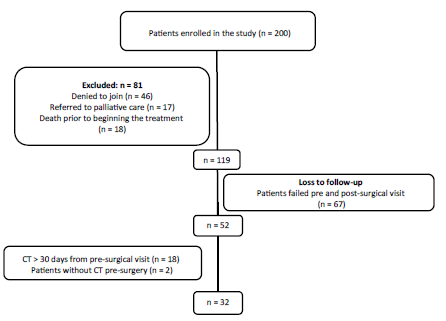
The study was conducted with 52 patients (24 women and 28 men) with median age of 61.5 years (interquartile range: 50.5; 66 years), 56% older adults and 44% adults (Table 1). The flowchart portrays the number of patients enrolled and excluded (Figure 1).

The main comorbidities were arterial hypertension (27%, n = 14) and association between diabetes mellitus and hypertension (17%, n = 9), none of the patients presented diabetes mellitus alone. More than half of the sample consisted of patients with restriction to perform extenuating physical activities (performance status 1 and 2) (73%; n = 38). This same percentage was diagnosed with colorectal tumor (67%; n = 35) and 33% (n = 17) with upper GIT tumors (esophagus, stomach and pancreas). The most prevalent staging were III and IV, responding for 68% of the sample (n = 34) (Table 1). In addition, 77% (n = 40) of the sample were in oral nutritional therapy and nearly 19% (n = 10), in enteral nutritional therapy.
According to Table 2, BMI, HGS, SMI and SMD were similar, regardless of tumor site, except for males with colorectal tumor who presented higher SMI compared to individuals with upper GIT tumors (p = 0.021).
However, 58% (n = 7) of the patients with upper GIT have low weight according to BMI, different from patients with colorectal tumor where 75% (n = 30) do not share this same weight (p = 0.031). In addition, great part of the patients with upper GIT presented SMI <1 tertile (60%; n = 6), while 82% (n = 18) of the individuals with colorectal cancer presented SMI >1 tertile (p = 0.018) (Table 3). Among the patients without low weight (classified as satisfactory/eutrophy or overweight/obesity according to BMI), four had SMI < 1 tertile, ten, HGS < 1 tertile and eight, SMD < 1 tertile.
DISCUSSION
The occurrence of low weight in upper GIT tumors was higher than in colorectal tumors. For patients with cancer, nutritional status may be associated with tumor location, staging and type of cancer treatment. Malnutrition is a frequent condition in patients with GIT cancer compared to other types of cancer22 and can affect up to 80% of patients with upper GIT cancer due to poor absorption, intestinal obstruction, surgical resection therapies and systemic treatment26,27,28.
In addition, SMI <1 tertile for the group of patients with upper GIT cancer occurred more frequently than for the group of colorectal cancer (60% versus 40%; p < 0.05), but the occurrence of SMD <1 tertile was similar for both groups (50%). McGovern et al. found similar reduction of SMD for intestine, esophagus and pancreas cancers (52%, 54% and 55%, respectively)31. However, the occurrence was higher for patients with stomach tumors (71%)29, but the reduction of SMI for upper gastrointestinal tumors was lower than in the present study (esophagus, 49%, stomach, 35% and pancreas, 32%)28. Murnane et al.30 found a reduction of 56% of SMI in patients submitted to radical resection of esophagus and stomach and Carvalho et al.31 did not find statistical differences in the reduction of colorectal and gastric tumors in patients submitted to surgery (20% and 13%, respectively)31.
Cancer related low muscle mass results from pro-inflammatory status of the disease itself, which favors the reduction of protein synthesis and high degradation of proteins in addition to high energy expenditure which may or may not be associated with the reduction of food intake32,33. Studies demonstrate that inflammatory cytokines derived from the tumor are involved in the pathogenesis of sarcopenia34,35,36,37. Despite being different clinical phenotypes37,38, fat infiltration into the muscle known as myosteatosis and depletion of muscle mass, if concomitant, can lead to worst outcomes37,39,40.
More than half of the study sample presented satisfactory/eutrophy BMI. A study with older adults submitted to surgical resection of gastrointestinal tumors have also found high occurrence of eutrophy followed by overweight5. On the other hand, 56% presented risk of malnutrition or malnutrition according to PG-SGA, which includes symptoms that can affect food intake further to other factors related to the risk of malnutrition even if no significant changes of the nutritional status according to BMI occur41.
Measurement of body weight and calculation of BMI are commonly utilized in clinical practice, but these measures do not provide information about the contributions of fat mass and muscle mass or changes in these compartments that can reflect the actual nutritional status of the individual42. In addition to the evaluation of the muscle mass, studies indicate the relevance of the diagnosis of sarcopenia in this group of patients; a cross-sectional study with 21 patients submitted to gastrectomy found low muscle mass in 100% of the sample, but only one female patient had sarcopenia43, nearly similar to the current study where only three patients had sarcopenia, revealing that the reduction of the muscle mass and strength were not concomitant for a large part of this sample.
Within the context of oncology44,45, it is widely described in the literature the close relation among muscle mass and clinical outcomes but studies evaluating all the required variables for the diagnosis of sarcopenia as suggested by the Consensus of Sarcopenia (strength, mass and muscle radiodensity) are scarce.
The evaluation of the muscle strength is the first criteria to assess sarcopenia, highlighting its importance8. A Brazilian study noticed that 22.6% of the patients with colorectal cancer presented low muscle mass, which has been shown to be an independent risk factor for postoperative complications47,48,49. A study evaluating sarcopenia in patients with gastric cancer submitted to surgery found low prevalence of HGS (32%) and sarcopenia (68%) and association among sarcopenia and postoperative complications and survival15.
The study limitations are: a) it was not possible to obtain CT of all the patients since it is a method utilized for diagnosis and cancer staging and part of the sample did not submit to this imaging test within the period of up to 30 days pre-outpatient consultation, which might have compromised the diagnosis of sarcopenia; b) the heterogeneity of the sample with individuals diagnosed with gastrointestinal tumor - pancreas, stomach, esophagus and colorectal - that have different characteristics with potential impact on the nutritional status.
In addition, the reduced sample did not favor the stratification by specific tumor sites as stomach, pancreas and esophagus cancers, it was necessary to group them as upper gastrointestinal tract tumors to allow comparisons of the nutritional status, SMI and SMD for different types of tumor. It is advised that the study findings should not be generalized to the population.
CONCLUSION
Decline of mass muscle and low weight occurred more frequently in the group of patients with upper GIT cancer than the colorectal cancer group; these findings can help to identify the types of tumor which can compromise the nutritional status more strongly and begin early nutritional intervention, but more studies are necessary to confirm the results.
In addition, longitudinal studies to evaluate the surgical impact on the body composition are required, contributing to the development of customized nutritional strategies for improved clinical outcomes.
ACKNOWLEDGMENTS
To Emanuelle Silva Russell and Leticia Cardoso Lemos for the invaluable contribution to data acquisition.
References
-
1 Bray F, Laversanne M, Sung H, et al. Global cancer statistics 2022: GLOBOCAN estimates of incidence and mortality worldwide for 36 cancers in 185 countries. CA Cancer J Clin. 2024;74(3):229-63. doi: https://doi.org/10.3322/caac.21834
» https://doi.org/10.3322/caac.21834 -
2 Santos MO, Lima FCS, Martins LFL, et al. Estimativa de incidência de câncer no Brasil, 2023-2025. Rev Bras Cancerol. 2023;69(1):e-213700. doi: https://doi.org/10.32635/2176-9745.RBC.2023v69n1.3700
» https://doi.org/10.32635/2176-9745.RBC.2023v69n1.3700 - 3 Arens J, Baracos V, Bertz H, et al. ESPEN expert group recommendations for action against cancer-related malnutrition. Clin nutr. 2017;36(5):1187-96.
- 4 Pinho NB, Martucci RB, Rodrigues VD, et al. High prevalence of malnutrition and nutrition impact symptoms in older patients with cancer: results of Brazilian multicenter study. Cancer. 2020;126(1):156-64.
- 5 Scislo L, Bodys-Cu´pak I, Walewska E, et al. Nutritional status indicators as predictors of postoperative complications in the elderly with gastrointestinal cancer. Int J Environ Res Public Health. 2022;19(20):1-14.
- 6 Sathianathen NJ, Kwaan M, Lawrentschuk N, et al. Adverse impact of malnutrition markers on major abdominopelvic cancer surgery. ANZ J Surg. 2019;89(5):509-14.
-
7 Cruz-Jentoft AJ, Gonzalez MC, Prado CM. Sarcopenia ≠ low muscle mass. Eur Geriatr Med. 2023;14(2):225-8. doi: https://doi.org/10.1007/s41999-023-00760-7
» https://doi.org/10.1007/s41999-023-00760-7 -
8 Cruz-Jentoft AJ, Bahat G, Bauer J, et al. Sarcopenia: revised european consensus on definition and diagnosis. Age Ageing. 2019;48(1):16-31. doi: https://doi.org/10.1093/ageing/afy169
» https://doi.org/10.1093/ageing/afy169 -
9 Knoedler S, Schliermann R, Knoedler L, et al. Impact of sarcopenia on outcomes in surgical patients: a systematic review and meta-analysis. Int J Surg. 2023;109(12):4238-62. doi: https://doi.org/10.1097/JS9.0000000000000688
» https://doi.org/10.1097/JS9.0000000000000688 -
10 Zhang S, Tan S, Jiang Y, et al. Sarcopenia as a predictor of poor surgical and oncologic outcomes after abdominal surgery for digestive tract cancer: a prospective cohort study. Clin Nutr. 2019;38(6):2881-8. doi: https://doi.org/10.1016/j.clnu.2018.12.025
» https://doi.org/10.1016/j.clnu.2018.12.025 - 11 Alnimri F, Sivakumar J, Sutherland T, et al. Pre-operative low muscle mass is associated with major complications and lower recurrence-free survival after gastric cancer surgery. ANZ J Surg. 2021;91(3):316-22.
- 12 Sakurai K, Kubo N, Tamura T, et al. Adverse Effects of low preoperative skeletal muscle mass in patients undergoing gastrectomy for gastric cancer. Ann Surg Oncol. 2017;24(9):2712-9.
- 13 Oken MM, Creech RH, Tormey DC, et al. Toxicity and response criteria of the Eastern Cooperative Oncology Group. Am J Clin Oncol. 1982;5(6):649-55.
- 14 Ottery FD. Definition of standardized nutritional assessment and interventional pathways in oncology. Nutrition. 1996;12(Suppl.1):15-9.
-
15 Huang DD, Cai Hy, Wang WB, et al. Measurement of muscle quantity/quality has additional predictive value for postoperative complications and long-term survival after gastrectomy for gastric cancer in patients with probable sarcopenia as defined by the nem EWGSOP2 consensus: analysis from a large scale prospective study. Nutrition. 2021;86:111156. doi: https://doi.org/10.1016/j.nut.2021.111156
» https://doi.org/10.1016/j.nut.2021.111156 - 16 Zhuang CL, Shen X, Zou HB, et al. EWGSOP2 versus EWGSOP1 for sarcopenia to predict prognosis in patients with gastric cancer after radical gastrectomy: analysis from a large-scale prospective study. Clin Nutr. 2020;39(7):2301-10.
- 17 Bossi P, Delrio P, Mascheroni A, et al. The spectrum of malnutrition/cachexia/sarcopenia in oncology according to different cancer types and settings: a narrative review. Nutrients. 2021;13(6):1-16.
- 18 Conselho Nacional de Saúde (BR). Resolução n° 466, de 12 de dezembro de 2012. Aprova as diretrizes e normas regulamentadoras de pesquisas envolvendo seres humanos. Diário Oficial da União, Brasília, DF. 2013 jun 13; Seção I:59.
- 19 Jager-Wittenaar H, Ottery FD. Assessing nutritional status in cancer: role of the Patient-Generated Subjective Global Assessment. Curr Opin Clin Nutr Metab Care. 2017;20(5):322-9.
- 20 World Health Organization. Physical status the use and interpretation of anthopometry. Geneva: WHO Library Cataloguing; 1995.
- 21 Organización Panamericana de la Salud. Encuesta Multicéntrica Salud Bienestar y Envejecimiento (SABE) en América Latina y el Caribe: informe preliminar. 36ª Reunión del Comité Asesor de Investigaciones en Salud; 9 -11 jul 2001; Kingston; Washington, D.C: OPAS: 2001.
- 22 Mourtzakis M, Prado CMM, Lieffers JR, et al. A practical and precise approach to quantification of body composition in cancer patients using computed tomography images acquired during routine care. Appl Physiol Nutr Metab. 2008;33(5):997-1006.
-
23 sliceOmatic [Internet]. Versão 5. Magog: TomoVision; 2021. [acesso 2024 jan 20]. Disponível em: Disponível em: https://www.tomovision.com/download/download_sliceo.html
» https://www.tomovision.com/download/download_sliceo.html -
24 SPSS®: Statistical Package for Social Science (SPSS) [Internet]. Versão 21. [Nova York]: International Business Machines Corporation. [acesso 2023 mar 9]. Disponível em: Disponível em: https://www.ibm.com/br-pt/spss?utm_content=SRCWW&p1=Search&p4=43700077515785492&p5=p&gclid=CjwKCAjwgZCoBhBnEiwAz35Rwiltb7s14pOSLocnooMOQh9qAL59IHVc9WP4ixhNTVMjenRp3-aEgxoCubsQAvD_BwE&gclsrc=aw.ds
» https://www.ibm.com/br-pt/spss?utm_content=SRCWW&p1=Search&p4=43700077515785492&p5=p&gclid=CjwKCAjwgZCoBhBnEiwAz35Rwiltb7s14pOSLocnooMOQh9qAL59IHVc9WP4ixhNTVMjenRp3-aEgxoCubsQAvD_BwE&gclsrc=aw.ds - 25 Leotti VB, Birck AR, Riboldi J. Comparação dos Testes de Aderência à Normalidade Kolmogorov-smirnov, Anderson-Darling, Cramer-Von Mises e Shapiro-Wilk por Simulação. In: 11º Simpósio de Estatística Aplicada à Experimentação Agronômica; 2005 jul 4-8; Londrina (PR). Florianópolis (SC): UFSC; 2005. p. 192
- 26 Silva TGB. Prevalência de Sarcopenia em Idosos não-institucionalizados de uma cidade brasileira de médio porte [dissertação]. Pelotas: Universidade Federal de Pelotas; 2014. 163 p.
-
27 Mulazzani GEG, Corti F, Valle S Della, et al. Nutritional support indications in gastroesophageal cancer patients: from perioperative to palliative systemic therapy. a comprehensive review of the last decade. Nutrients. 2021;13(8):2766. doi: https://doi.org/10.3390/nu13082766
» https://doi.org/10.3390/nu13082766 -
28 Klassen D, Strauch C, Alteheld B, et al. Assessing the effects of a perioperative nutritional support and counseling in gastrointestinal cancer patients: a retrospective comparative study with historical controls. Biomedicines. 2023;11(2):609. doi: https://doi.org/10.3390/biomedicines11020609
» https://doi.org/10.3390/biomedicines11020609 - 29 McGovern J, Dolan RD, Horgan PG, et al. Computed tomography-defined low skeletal muscle index and density in cancer patients: observations from a systematic review. J Cachexia Sarcopenia Muscle. 2021;12(6):1408-17.
-
30 Murnane LC, Forsyth AK, Koukounaras J, et al. Myosteatosis predicts higher complications and reduced overall survival following radical oesophageal and gastric cancer surgery. Eur J Surg Oncol. 2021;47(9):2295-303. doi: https://doi.org/10.1016/j.ejso.2021.02.008
» https://doi.org/10.1016/j.ejso.2021.02.008 - 31 Carvalho ALM, Gonzalez MC, Sousa IM, et al. Low skeletal muscle radiodensity is the best predictor for short-term major surgical complications in gastrointestinal surgical cancer: a cohort study. PLoS One. 2021;16(2):0247322.
-
32 Ryan AM, Prado CM, Sullivan ES, et al. Effects of weight loss and sarcopenia on response to chemotherapy, quality of life, and survival. Nutrition. 2019;67-68:110539. doi: https://doi.org/10.1016/j.nut.2019.06.020
» https://doi.org/10.1016/j.nut.2019.06.020 -
33 Daly LE, Ní Bhuachalla ÉB, Power DG, et al. Loss of skeletal muscle during systemic chemotherapy is prognostic of poor survival in patients with foregut cancer. J Cachexia Sarcopenia Muscle. 2018;9(2):315-25. doi: https://doi.org/10.1002/jcsm.12267
» https://doi.org/10.1002/jcsm.12267 - 34 Malietzis G, Johns N, Al-Hassi HO, et al. Low muscularity and myosteatosis is related to the host systemic inflammator y response in patients undergoing surger y for colorectal cancer. Ann Surg. 2016;263(2):320-5.
- 35 Okugawa Y, Kitajima T, Yamamoto A, et al. Clinical relevance of myopenia and myosteatosis in colorectal cancer. J Clin Med. 2022;11(9):2617.
- 36 Aro R, Meriläinen S, Sirniö P, et al. Sarcopenia and myosteatosis are associated with neutrophil to lymphocyte ratio but not glasgow prognostic score in colorectal cancer patients. J Clin Med. 2022;11(2656):1-16.
-
37 McGregor RA, Cameron-Smith D, Poppitt SD. It is not just muscle mass: a review of muscle quality, composition and metabolism during ageing as determinants of muscle function and mobility in later life. Longev Heal. 2014;3(1):1-8. doi: http://dx.doi.org/10.1186/2046-2395-3-9.
» https://doi.org/10.1186/2046-2395-3-9. - 38 Stretch C, Aubin JM, Mickiewicz B, et al. Sarcopenia and myosteatosis are accompanied by distinct biological profiles in patients with pancreatic and periampullary adenocarcinomas. PLoS One. 2018;13(5):1-17.
- 39 Martin L, Birdsell L, MacDonald N, et al. Cancer cachexia in the age of obesity: Skeletal muscle depletion is a powerful prognostic factor, independent of body mass index. J Clin Oncol. 2013;31(12):1539-47.
-
40 Tian J, Yuan X, Xiao J, et al. Clinical characteristics and risk factors associated with COVID-19 disease severity in patients with cancer in Wuhan, China: a multicentre, retrospective, cohort study. Lancet Oncol. 2020;21(7):893-903. doi: https://doi.org/10.3390/biomedicines11020609
» https://doi.org/10.3390/biomedicines11020609 -
41 Ishida T, Makino T, Yamasaki M, et al. Quantity and quality of skeletal muscle as an important predictor of clinical outcomes in patients with esophageal cancer undergoing esophagectomy after neoadjuvant chemotherapy. Ann Surg Oncol. 2021;28(12):7185-95. doi: https://doi.org/10.1245/s10434-021-10025-x
» https://doi.org/10.1245/s10434-021-10025-x - 42 Shibutani M, Kashiwagi S, Fukuoka T, et al. Impact of preoperative nutritional status on long-term survival in patients with stage i-iii colorectal cancer. In Vivo. 2023;37(4):1765-74.
- 43 Jager-Wittenaar H, Ottery FD. Assessing nutritional status in cancer: role of the patient-Generated Subjective Global Assessment. Curr Opin Clin Nutr Metab Care. 2017;20(5):322-9.
- 44 Holmes CJ, Racette SB. The utility of body composition assessment in nutrition and clinical practice: an overview of current methodology. Nutrients. 2021;13(8):1-16.
-
45 Gharagozlian S, Mala T, Brekke HK, et al. Nutritional status, sarcopenia, gastrointestinal symptoms and quality of life after gastrectomy for cancer - a cross-sectional pilot study. Clin Nutr ESPEN. 2020;37:195-201. doi: https://doi.org/10.1016/j.clnesp.2020.03.001
» https://doi.org/10.1016/j.clnesp.2020.03.001 - 46 Xia L, Zhao R, Wan Q, et al. Sarcopenia and adverse health-related outcomes: An umbrella review of meta-analyses of observational studies. Cancer Med. 2020;9(21):7964-78.
-
47 Shirdel M, Andersson F, Myte R, et al. Body composition measured by computed tomography is associated with colorectal cancer survival, also in early-stage disease. Acta Oncol (Madr). 2020;59(7):799-808. disponível em: https://doi.org/10.1080/0284186X.2020.1744716
» https://doi.org/10.1080/0284186X.2020.1744716 - 48 Nunes GD, Cardenas LZ, Miola TM, et al. Preoperative evaluation of sarcopenia in patients with colorectal cancer: a prospective study. Rev Assoc Med Bras. 2023;69(2):222-7.
-
49 Jiang X, Xu X, Ding L, et al. Preoperative low absolute and relative handgrip strength as predictors of postoperative short-term outcomes: a prospective study based on patients aged 60 years and older with gastric cancer. Eur Geriatr Med. 2023;14(2):251-62. doi: https://doi.org/10.1007/s41999-023-00768-z
» https://doi.org/10.1007/s41999-023-00768-z