 Survival and Prognostic Factors in Patients with Breast Cancer: Cohort Study
Introduction: Breast cancer is the most common cancer in the world and an important cause of death among women.
Objective: To analyze survival and prognostic factors in a cohort of patients with breast cancer.
Method: Retrospective cohort of 201 patients with breast cancer treated between January 2018 and December 2022 at a tertiary hospital in Caxias, Maranhão, Brazil. Data were collected between January and June 2023 and analyzed with software R, version 4.0.2. Overall survival (OS) and disease-free survival (DFS) curves were constructed using the Kaplan-Meier model. A descriptive analysis was performed by calculating absolute (n) and relative frequencies (%) and evaluating prognostic factors with Cox regression. Statistical significance was evaluated through the Wald Test, with a level of 5%.
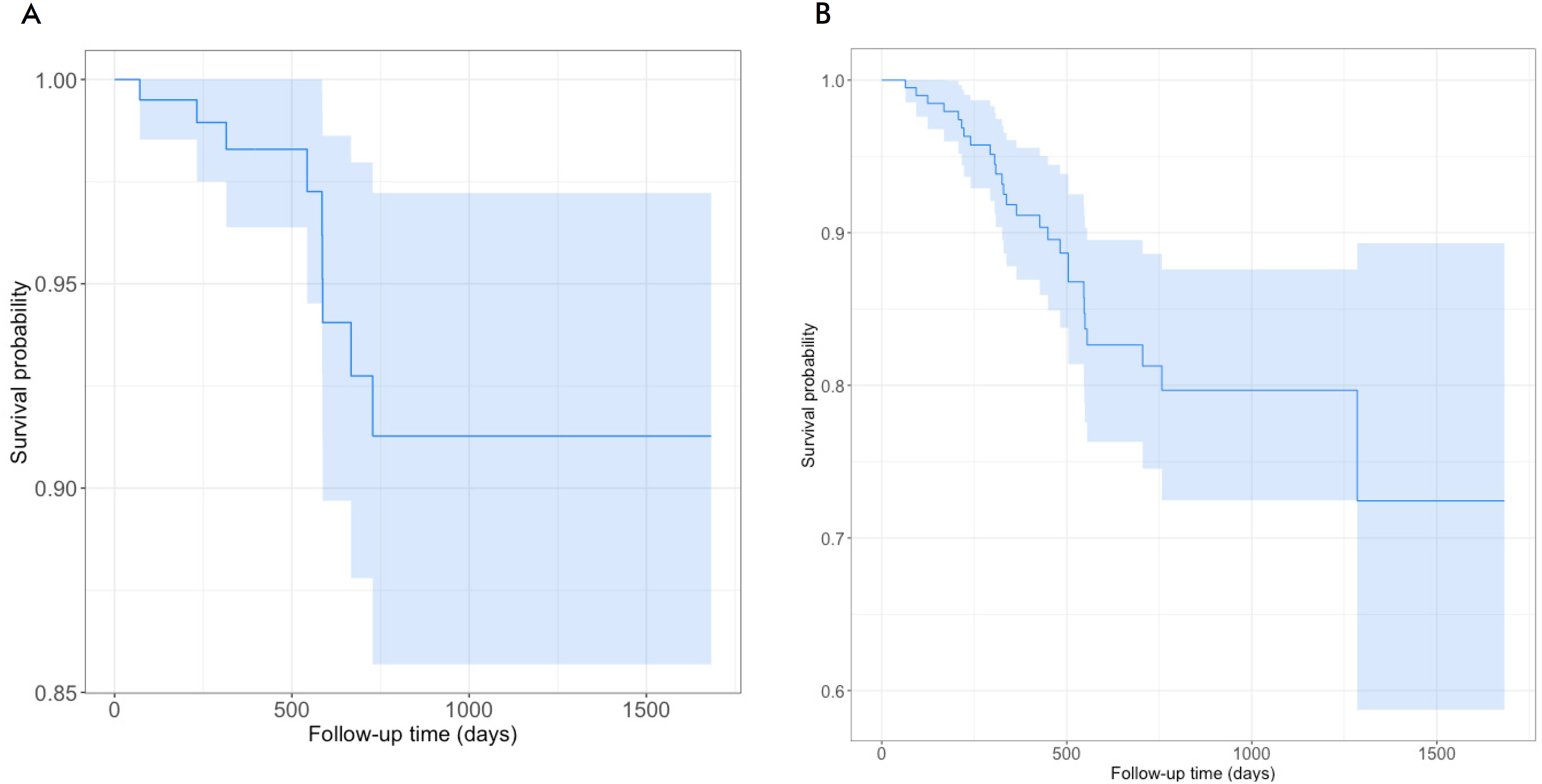
Results: The 5-year OS and DFS were 91.3% and 72.4%, respectively. Women predominated (98.5%) over 40 years of age (86.1%) and with invasive carcinoma of no-special type (94%), G1 or G2 (79.1%), smaller than 5 cm (64.6%), without angiolymphatic (52.7%) and neural (77.6%) invasion and luminal molecular subtype (65.2%). Males had higher risk of death. Patients with angiolymphatic and neural invasion and non-expression of estrogen receptors (ER) had higher risk of recurrence.
Conclusion: The 5-year OS and DFS were 91.3% and 72.4%, respectively. Male gender, angiolymphatic and neural invasion and non-expression of ER were prognostic factors associated with higher risk of death or recurrence.
Keywords:
Prognosis; Anatomical Pathological Conditions; Health Care Outcome Assessment/statistics & numerical data; Breast Neoplasms/diagnosis
 Thumbnail