 Social Participation in the Development of the National Palliative Care Policy in Brazil: the Frente PaliATIVISTAS Movement
INTRODUCTION
The mapping of the global development of palliative care placed Brazil at an intermediate level based on overall services provision, a few funding sources, availability of morphine, non-integrated specialized services to mainstream health care systems and some initiatives of capacity building1. According to an 81 countries rank about the quality of life and death, Brazil was listed in the 79th position, revealing what still needs to be done to move forward in that area2.
Organized actions by committed communities can contribute to reverse this reality in the country3-5. Efforts to educate the society and policy makers about this global health inequality are more impactful whether voices of those who offer, receive and manage these essential services are included and, therefore, are able to advocate on behalf of the urgency in providing palliative care to those in suffering.
The objective of this article is to report the trajectory of the social participation in pursue of the approval of the National Palliative Care Policy (PNCP) in Brazil through a social movement called Frente PaliATIVISTAS.
DEVELOPMENT
Creation of Frente PaliATIVISTAS
The Frente PaliATIVISTAS was created in February 2023 as a response to the high demand for palliative care. The movement endorses the Brazilian legal-historical backbone that advocates the participation of the society in the formulation of public policies6-11. Its principles are described in Chart 112,13.
The Frente PaliATIVISTAS was formed by users, health professionals, service providers and managers of the National Health System (SUS) country-wide. Social media (WhatsApp® and Instagram®) were utilized to stimulate the involvement and articulation of the community for the construction and dissemination of ideas, open, participative and democratic dialogue reuniting more than one thousand members in less than one month.
Whereas small changes of a dynamic system can cause large effects in time14-17, it is possible to state that when Frente PaliATIVISTAS was created, just like a butterfly (symbol of palliative care and of this social movement), it flapped her wings, unchaining a cascade of actions across the country and expressive involvement of the community18.
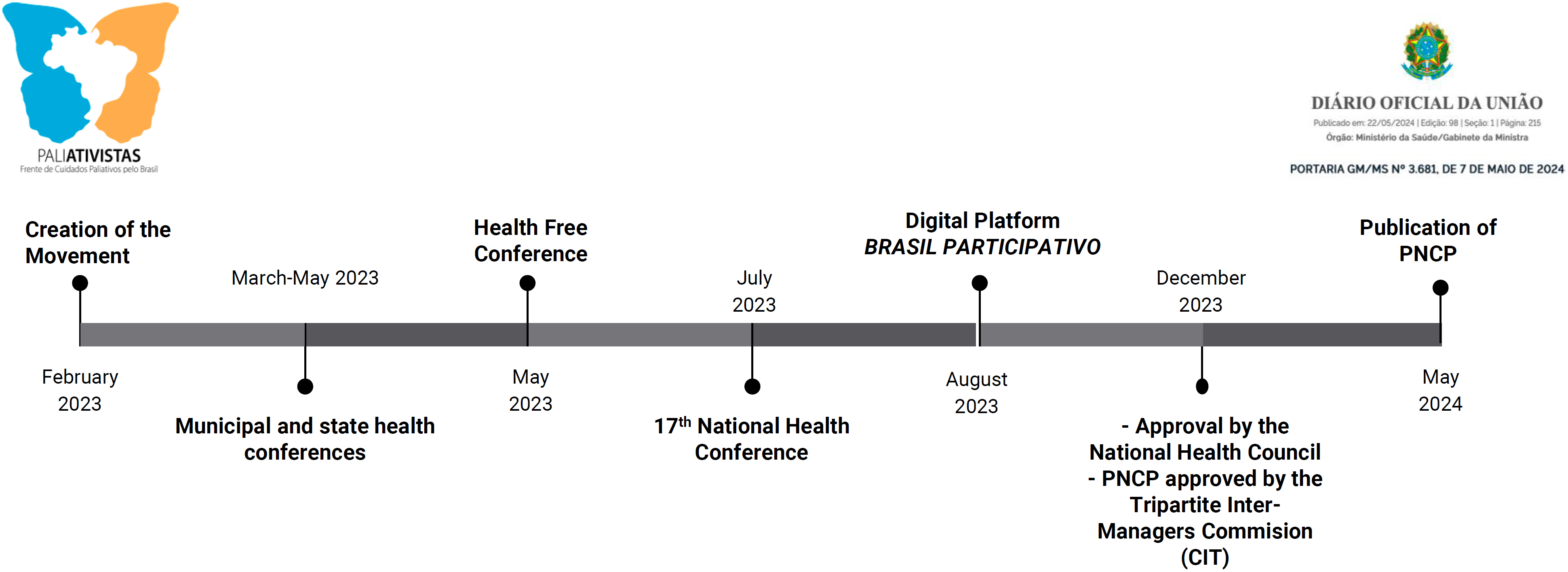
Frente PaliATIVISTAS conducted some strategic actions through the forums of popular participation and SUS guiding principles (Figure 1).

Strategic actions of Frente PaliATIVISTAS for publication of the National Palliative Care Policy
Frente PaliATIVISTAS at Health Conferences and Brasil Participativo
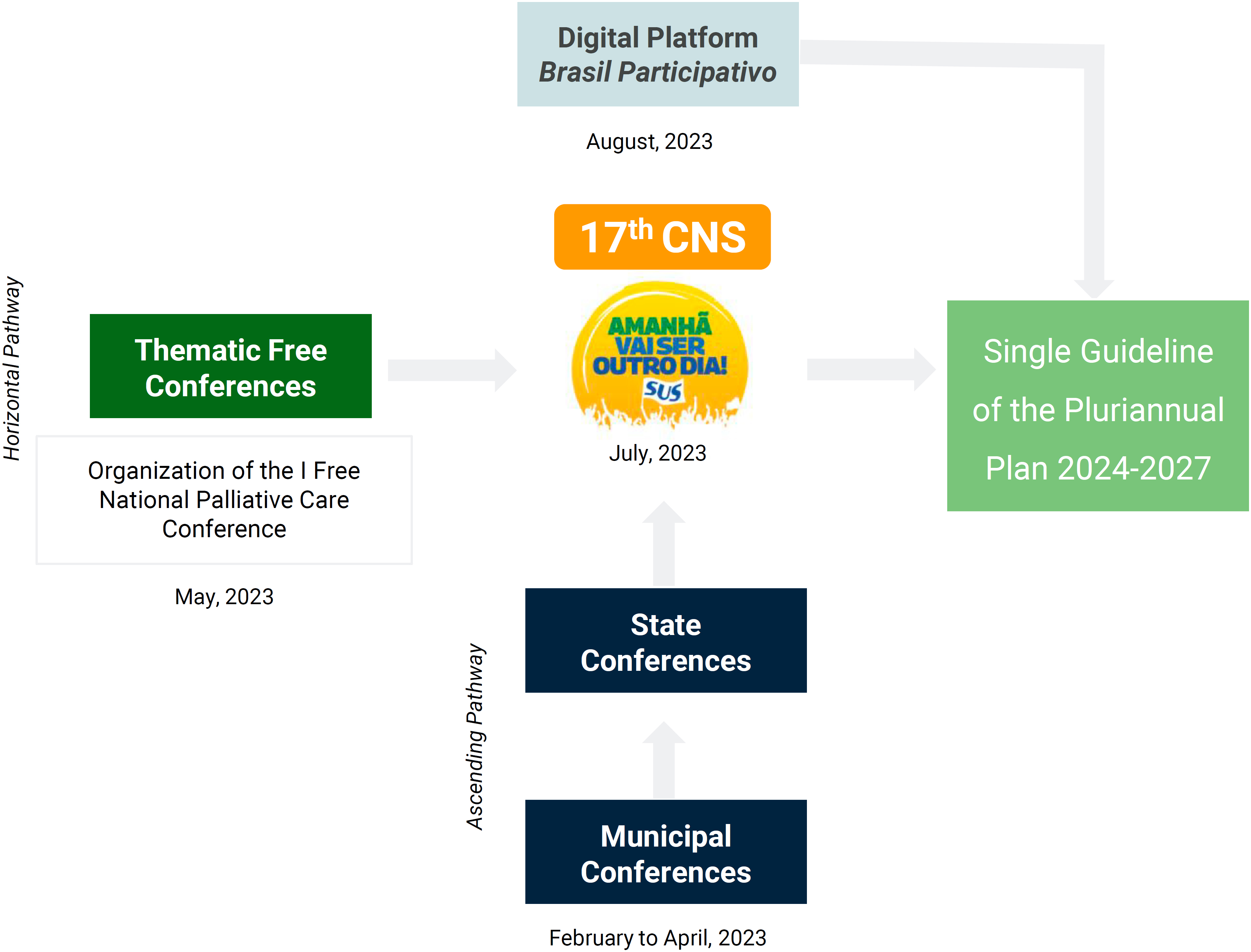
Frente PaliATIVISTAS endeavored to include palliative care in the agenda of the Health Conferences and Brasil Participativo (Figure 2).

The movement summoned users and supporters from the whole country to join synchronized and organized actions under the motto "Palliative Care, Public Policies Now!". Digital activism was encouraged through hashtags #CuidadosPaliativosPolíticasPúblicasJá, #CuidadosPaliativosparaTodos and #PalliativeCareforAll, further to the creation of a logo (the form of a butterfly containing the map of Brazil) and a visual identity (orange color tee shirts). At the same time, the defense of a single guideline of palliative care at the health conferences aimed to include it in the quadrennial plan 2024-2027 for SUS as follows: Implement PNCP, with assigned funding integrated to the Health Attention Networks and as a component of the Health Primary Attention through Family Health Strategy.
The participants of this movement, mobilized by the defense of access to palliative care, attended the conferences at 78 municipalities and 19 states, and ten states and the Federal District succeeded to elect 11 PaliATIVISTAS delegates and approval of a single guideline.
The I Free National Conference of Palliative Care, titled "Palliative Care: a human right – public policies now", was held in May 2023 in 20 poles at the five Brazilian regions in person and online on YouTube®, being considered as the most expressive (more than six thousand participants and 168 sponsoring institutions) and the second in number of synchronous participants (n=2,688). The election of more delegates and strengthening the approval of the single guideline and other proposals of palliative care was the outcome compiled in a final report sent to the 17th National Health Conference (CNS) held in July 2023 in Brasília.
3,526 delegates attended the CNS, 30 of them PaliATIVISTAS, making it one of the biggest thematic delegations ever. The theme of the 17th CNS was to Ensure rights and defend SUS, life and democracy – Tomorrow will be another day, paraphrasing the song by Chico Buarque de Hollanda. The four thematic axles were: 1. The Brazil we have, the Brazil we want; 2. The role of social control and social movements to save lives; 3. Ensure rights and defend SUS, life and democracy; and 4. Tomorrow will be another day to everyone19,20.
During the CNS, further to joining the workgroups of the four axis, the delegates of Frente PaliATIVISTAS performed self-managed activities at a thematic space, disseminating knowledge about palliative care. At the public act Ensure Rights and Defend SUS, Life and Democracy, they stood out using the visual identity of the movement and made themselves heard through posters of palliative care21,22.
More than 5,800 individuals were involved at the 17th CNS, where the Brazilian people at this moment emerged with full strength as a political subject19 after a murky antidemocratic, anti-environmentalist, radical neoliberal, antagonist of the human rights and anti-science period re-enacted in the former government21,22. The guidelines and proposals of palliative care presented by Frente PaliATIVISTAS at that conference were approved as priority for SUS and the society as a whole.
Another strategy the movement has utilized was the inclusion of the same single guideline for consideration and voting by Brasil Participativo. Countering the strategy of use of social media for mass manipulation and dissemination of fake news23, the movement utilized these resources to summon the society for free and coordinated participation to vote the proposal. As outcome, the single guideline was the fourth more voted in the area of health (11,419 votes), among other 1,297 proposals and consequently, incorporated into the Pluriannual Plan of the Federal Government for SUS. These data suggest that digital democracy platforms can potentialize the level of direct and personal participation of the individuals in the process of formation of public policies24,25.
A key aspect of the process was the interaction of several players (users, health professionals and managers) pursuing a consensual agenda to achieve compatible and interchangeable goals.
The Frente PaliATIVISTAS has also adopted many strategies2,5,24,26 of multiprofessional and intersectoral engagement based on life sciences, humanity and arts (manuals, audiovisual materials, music, etc.) that were instrumental to canvass more public engagement with eclectic profile.
National Palliative Care Policy
The Frente PaliATIVISTAS brought the theme of palliative care for community debate and democratized the access to information about quality of life, of death and of dying. Its engagement was pivotal to approve the PNCP at the CNS and further ratification by the Tripartite Inter-managers Committee.
Eventually, the guidelines and proposals of Frente PaliATIVISTAS at the 17th CNS were reflected in the publication of the PCNP by the Ministry of Health integrated to Health Attention Network and component of the Primary Health Care Attention with assigned funding on May 22, 202427.
Upon the publication of PNCP, the efforts of Frente PaliATIVISTAS are focused on its implementation and challenges to achieve a more compassionate, effective and culturally flexible health system. It is engaged in fostering care equity to meet the individuals’ needs in view of their vulnerabilities, promoting health access especially for those who are suffering now.
CONCLUSION
The Frente PaliATIVISTAS contributed to overcome the absence of a specific public policy, an important barrier for the development of palliative care in Brazil. Eventually, it is expected that this experience leads to fresh engagement to the palliative cause and inspires the creation of other social movements.
References
-
1 Clark D, Baur N, Clelland D, et al. Mapping levels of palliative care development in 198 countries: the situation in 2017. J Pain Symptom Manage. 2020;59(4):794-807. doi: https://doi.org/10.1016/j.jpainsymman.2019.11.009
» https://doi.org/10.1016/j.jpainsymman.2019.11.009 -
2 Finkelstein EA, Chatterjee S, Lize JB, et al. Cross country comparison of expert assessments of the quality of death and dying 2021. J Pain Symptom Manage. 2022;63(4):e419-e429. doi: https://doi.org/10.1016/j.jpainsymman.2021.11.007
» https://doi.org/10.1016/j.jpainsymman.2021.11.007 - 3 Worldwide Hospice Palliative Care Alliance. Global atlas of palliative care at the end of life. 2. ed. London: WHPCA; 2020.
-
4 Neto MFS, Barbosa FT, Sousa Neto AR, et al. Oncology palliative care: access barriers: bibliometric study. BMJ Support Palliat Care. 2021;31:bmjspcare-2021-003387. doi: https://doi.org/10.1136/bmjspcare-2021-003387
» https://doi.org/10.1136/bmjspcare-2021-003387 -
5 World Health Organization. Community engagement: a health promotion guide for universal health coverage in the hands of the people [Internet]. Geneva: WHO; 2020. [acesso 2024 jul 26]. Disponível em:https://iris.who.int/bitstream/handle/10665/334379/9789240010529-eng.pdf?sequence=1
» https://iris.who.int/bitstream/handle/10665/334379/9789240010529-eng.pdf?sequence=1 - 6 Presidência da República (BR). Lei nº 8.080, de 19 de setembro de 1990. Dispõe sobre as condições para a promoção, proteção e recuperação da saúde, a organização e o funcionamento dos serviços correspondentes e dá outras providências. Diário Oficial da União, Brasília, DF. 1990 set 20; Seção 1.
-
7 Presidência da República (BR). Lei No 8.142, de 28 de dezembro de 1990. Dispõe sobre a participação da comunidade na gestão do Sistema Único de Saúde (SUS) e sobre as transferências intergovernamentais de recursos financeiros na área da saúde e dá outras providências [Internet]. Diário Oficial da União, Brasília, DF. 1990 dez 31 [acesso 2024 jul 30]; Seção I. Disponível em: https://www.planalto.gov.br/ccivil_03/leis/l8142.htm
» https://www.planalto.gov.br/ccivil_03/leis/l8142.htm -
8 Conselho Nacional de Secretarias Municipais de Saúde (BR). São Paulo: Conselho de Secretários Municipais de Saúde; ©2021. Orientações básicas sobre as Conferências de Saúde. 2021. [acesso 2024 jul 25]. Disponível em: https://www.cosemssp.org.br/noticias/orientacoes-basicas-sobre-as-conferencias-de-saude/
» https://www.cosemssp.org.br/noticias/orientacoes-basicas-sobre-as-conferencias-de-saude/ - 9 Laurence C, Levesque JF, Thabane L, et al. Health policy engagement strategy for the health information technology policy project of the transdisciplinary collaborative centre for health disparities research. Ethn Dis. 2019;29(Suppl 2):377-84.
-
10 Brasil Participativo [Internet]. Brasília, DF: MPO; 2023. [acesso 2024 jul 25]. Disponível em: https://lab-decide.dataprev.gov.br/pages/help#:~:text=Brasil%20Participativo%20%C3%A9%20a%20nova,(PPA)%202024%2D2027
» https://lab-decide.dataprev.gov.br/pages/help#:~:text=Brasil%20Participativo%20%C3%A9%20a%20nova,(PPA)%202024%2D2027 -
11 World Health Organization. Seventy-seventh world health assembly [Internet]. Geneva: WHO; 2024. [acesso 2024 jul 25] Disponível em: https://apps.who.int/gb/ebwha/pdf_files/WHA77/A77_1-en.pdf
» https://apps.who.int/gb/ebwha/pdf_files/WHA77/A77_1-en.pdf -
12 Declaração de Alma-Ata. Conferência Internacional sobre cuidados primários de saúde; 6-12 de setembro 1978; Alma-Ata; USSR. In: Ministério da Saúde (BR). Declaração de Alma-Ata. Brasília, DF: MS; 2002. [acesso 2024 jul 5] p. 3 Disponível em:https://bvsms.saude.gov.br/bvs/publicacoes/declaracao_alma_ata.pdf
» https://bvsms.saude.gov.br/bvs/publicacoes/declaracao_alma_ata.pdf - 13 Cuidados Paliativos: um direito humano – políticas públicas já. 1º Conferência Livre Nacional de Cuidados Paliativos; 2023 maio 19; Câmara dos deputados, Brasília, DF. Brasília, DF: Câmara dos Deputados; 2023.
- 14 Solomon S, Greenberg J, Pyszczynski T. The worm at the core: on the role of death in life. Nova York: Random House; 2015.
-
15 Oliveira HA. Transição de fase no sistema de Hénon-Heiles. Rev Bras Ensino Fís. 2014;36(4):4313-1-7. doi: https://doi.org/10.1590/S1806-11172014000400014
» https://doi.org/10.1590/S1806-11172014000400014 - 16 Massuda A, Dall’Alba R, Chioro A, et al. After a far-right government: challenges for Brazil's Unified Health System. Lancet. 2023;401(10380):886-8.
-
17 Sallnow L, et al. Report of the Lancet commission on the value of death: bringing death back into life. Lancet. 2022;399(10327):837-84. https://doi.org/10.1016/s0140-6736(21)02314-x
» https://doi.org/10.1016/s0140-6736(21)02314-x -
18 Constituição (1988). Constituição da República Federativa do Brasil de 1988: publicação original [Internet]. Diário Oficial da União, Brasília, DF. 1988 out 5 [acesso 2024 jul 5]; Seção 1. Disponível em: https://www2.camara.leg.br/legin/fed/consti/1988/constituicao-1988-5-outubro-1988-322142-publicacaooriginal-1-pl.html
» https://www2.camara.leg.br/legin/fed/consti/1988/constituicao-1988-5-outubro-1988-322142-publicacaooriginal-1-pl.html -
19 Conselho Nacional de Saúde (BR). Conselho Nacional de Saúde. Relatório final da 17ª CNS é a resposta do povo brasileiro ao período de negacionismo na saúde e à reconstrução da democracia [Internet]. Brasília, DF: Conselho Nacional de Saúde; 2025 mar [acesso 2025 abr 15]. Disponível em: https://www.gov.br/conselho-nacional-de-saude/pt-br/assuntos/noticias/2025/marco/relatorio-final-da-17a-cns-e-a-resposta-do-povo-brasileiro-ao-periodo-de-negacionismo-na-saude-e-a-reconstrucao-da-democracia
» https://www.gov.br/conselho-nacional-de-saude/pt-br/assuntos/noticias/2025/marco/relatorio-final-da-17a-cns-e-a-resposta-do-povo-brasileiro-ao-periodo-de-negacionismo-na-saude-e-a-reconstrucao-da-democracia - 20 Arruda C, Lopes SGR, Koerich MHAL, et al. Redes de atenção à saúde sob a luz da teoria da complexidade. Escola Anna Nery. 2015;19(1):169-73
-
21 There's only one choice in Brazil's election - for the country and the world Nature [Editorial]. 2022;610(7933):606. doi: https://doi.org/10.1038/d41586-022-03388-y
» https://doi.org/10.1038/d41586-022-03388-y -
22 Conselho Nacional de Saúde (BR) [Internet]. Brasília, DF: CNS; [sem data]. 17ª CNS terá ato público em Defesa do SUS, da vida e da democracia, 2020 jun 29. [acesso 2024 ago 3]. Disponível em: https://www.gov.br/conselho-nacional-de-saude/pt-br/assuntos/noticias/2023/junho/17a-cns-tera-ato-publico-em-defesa-do-sus-da-vida-e-da-democracia
» https://www.gov.br/conselho-nacional-de-saude/pt-br/assuntos/noticias/2023/junho/17a-cns-tera-ato-publico-em-defesa-do-sus-da-vida-e-da-democracia - 23 Merchant RM, Asch DA. Protecting the value of medical science in the age of social media and "fake news". Jama. 2018;320(23):2415-6.
- 24 Palfrey J, Gasser U. Nascidos na era digital: entendendo a primeira geração de nativos digitais. Tradução: Magda França Lopes. Porto Alegre: Artmed; 2011.
-
25 Haje L, Librelon R. Especialistas apontam barreiras para participação social e transparência na política. Agência Câmara de Notícias [Internet]. 2016 dez 15. [acesso 2024 ago 5]. Disponível em: https://www.camara.leg.br/noticias/505271-especialistas-apontam-barreiras-para-participacao-social-e-transparencia-na-politica/
» https://www.camara.leg.br/noticias/505271-especialistas-apontam-barreiras-para-participacao-social-e-transparencia-na-politica/ - 26 Johnston KA, Lane AB. Building relational capital: the contribution of episodic and relational community engagement. Public Relat Rev. 2018;44:633-44.
-
27 Ministério da Saúde. Portaria GM/MS nº 3.681, de 7 de maio de 2024. Institui incentivo financeiro federal de custeio para o Componente Saúde Bucal na Atenção Primária à Saúde. Diário Oficial da União, Brasília, DF. 2024 maio 8 [acesso 2024 ago 30]; Edição 87; Seção 1:120. Disponível em:https://www.in.gov.br/en/web/dou/-/portaria-gm/ms-n-3.681-de-7-de-maio-de-2024-561223717
» https://www.in.gov.br/en/web/dou/-/portaria-gm/ms-n-3.681-de-7-de-maio-de-2024-561223717
Edited by
-
Scientific-editor:
Anke Bergmann. Orcid iD: https://orcid.org/0000-0002-1972-8777