
 Artificial Intelligence Chatbots as Sources of Information on Oral Cancer: Assessment of Readability and Discursive Content
ABSTRACT
Introduction: The growing use of artificial intelligence (AI) chatbots as sources of health information requires a critical evaluation of the readability and communicative adequacy of their responses, particularly regarding sensitive topics such as oral cancer.
Objective: To evaluate and compare the readability of responses provided by different AI chatbots to basic questions about oral cancer and to describe the discursive content generated by these platforms.
Method: This observational and descriptive study evaluated ten AI chatbots that answered seven standardized questions. Textual readability was assessed using an automated tool by calculating a global mean score. Additionally, the Discourse of the Collective Subject technique was applied to synthesize the convergent content of the responses for each question.
Results: The global mean readability score was 12.9, a borderline value classified as high readability, indicating a required educational level equivalent to completion of secondary education, with variations across platforms and question types. Convergence was observed around a technically adequate biomedical core, associated with recurrent expansion of content beyond the scope of the questions.
Conclusion: Although AI chatbots show potential to expand access to information on oral cancer, persistent limitations related to readability, content organization, and communicative adequacy remain, indicating the need for human curation to ensure complementary and equitable use in health contexts.
Key words:
Generative Artificial Intelligence; Comprehension; Health Communication; Mouth Neoplasms
RESUMO
Introdução: A utilização crescente de chatbots de inteligência artificial (IA) como fontes de informação em saúde demanda avaliação crítica da legibilidade e da adequação comunicacional das respostas, especialmente em temas sensíveis como o câncer de boca.
Objetivo: Avaliar e comparar a legibilidade das respostas fornecidas por diferentes chatbots de IA a perguntas básicas sobre o câncer de boca e descrever o conteúdo discursivo gerado pelas plataformas.
Método: Estudo observacional e descritivo com dez chatbots que responderam a sete perguntas padronizadas. A legibilidade textual foi analisada por ferramenta automatizada, com cálculo de uma média global. Complementarmente, aplicou-se a técnica do Discurso do Sujeito Coletivo para sintetizar o conteúdo convergente das respostas por pergunta.
Resultados: A média global de legibilidade foi de 12,9, valor limítrofe classificado como alta legibilidade, indicando exigência de escolaridade equivalente ao ensino médio completo, com variações entre plataformas e tipos de pergunta. Observou-se convergência de conteúdo em um núcleo biomédico tecnicamente adequado, associado à expansão recorrente do conteúdo para além do escopo das perguntas.
Conclusão: Embora os chatbots apresentem potencial para ampliar o acesso à informação sobre câncer de boca, persistem limitações relacionadas à legibilidade, à organização do conteúdo e à adequação comunicacional, indicando a necessidade de curadoria humana para uso complementar e equitativo em saúde.
Palavras-chave:
Inteligência Artificial Generativa; Compreensão; Comunicação em Saúde; Neoplasias Bucais
RESUMEN
Introducción: El uso creciente de chatbots de inteligencia artificial (IA) como fuentes de información en salud exige una evaluación crítica de la legibilidad y de la adecuación comunicacional de sus respuestas, especialmente en temas sensibles como el cáncer oral.
Objetivo: Evaluar y comparar la legibilidad de las respuestas proporcionadas por diferentes chatbots de IA a preguntas básicas sobre el cáncer oral y describir el contenido discursivo generado por las plataformas.
Método: Estudio observacional y descriptivo con diez chatbots de IA que respondieron a siete preguntas estandarizadas. La legibilidad textual se analizó mediante una herramienta automatizada, con el cálculo de una media global. De forma complementaria, se aplicó la técnica del Discurso del Sujeto Colectivo para sintetizar el contenido convergente de las respuestas por pregunta.
Resultados: La media global de legibilidad fue de 12,9, un valor límite clasificado como de alta legibilidad, que indica un nivel educativo equivalente a la finalización de la educación secundaria, con variaciones entre plataformas y tipos de pregunta. Se observó convergencia de contenido en un núcleo biomédico técnicamente adecuado, asociado a una expansión recurrente del contenido más allá del alcance de las preguntas.
Conclusión: Aunque los chatbots de IA presentan potencial para ampliar el acceso a información sobre el cáncer oral, persisten limitaciones relacionadas con la legibilidad, la organización del contenido y la adecuación comunicacional, lo que señala la necesidad de curaduría humana para un uso complementario y equitativo en salud.
Palabras clave:
Inteligencia Artificial Generativa; Comprensión; Comunicación en Salud; Neoplasias de la Boca
INTRODUCTION
Oral cancer is a malignant neoplasm that affects the structures of the oral cavity such as the lips, tongue, gums and floor of the mouth. In 2022, approximately 389,000 new cases and 188,000 deaths from this cancer occurred worldwide, with a higher incidence observed in low-and middle-income countries1. In Brazil, approximately 17,190 new cases were estimated annually for the triennium 2026-2028, placing the disease among the cancers with the highest incidence in the country2.
The main risk factors associated with oral cancer are tobacco use and alcohol consumption which act synergistically. Other factors associated with the development of the disease are infections by the human papilloma virus (HPV), chronic sun exposure and persistent inflammatory oral conditions3.
Despite its epidemiological relevance, the literature shows that the knowledge of the population about oral cancer remains limited. Although a large part of the individuals are already aware about the disease, many are unaware of its initial signs and risk factors, in addition to underestimating the severity of the condition4,5. This gap is more evident in individuals with low educational level and low income, exactly those more exposed to the main etiologic factors6. Therefore, the access to accessible and clear information on the theme, essential for the prevention and treatment, is still challenging.
It is known that the Internet is consolidated as one of the main health information sources for the overall population. When seeking health information, many individuals first use easily accessible digital tools because they offer anonymity and provide quick answers7. With the recent advance of artificial intelligence (AI), especially with the development of large scale models – LLM, a specific class of systems, the AI chatbots, have been consolidated. Because they are conversational, personalized and exhibit social presence to the users their adoption and use is increasing8.
Recent evidences indicate that these systems present high acceptability and engagement among users, acting as emerging sources of health-related information and offering continuous and accessible support further to being non-judgemental9. Therefore, it is understandable that AI chatbots are a new interface to access health information with high potential of growth in the upcoming years.
However, like other forms of health information, the usefulness depends on the veracity of the content and its readability. The actions of health communication may use textual language and structures beyond the average populational level, utilizing technical terms that are difficult to be understood by low-educated individuals. This is critical in relation to oral cancer whose occurrence is higher in least educated groups10,11. Difficulties of reading and interpreting texts can lead to misunderstanding of the recommendations, affecting the behavior in health. Simple and clear language are essential for the efficacy of health communication.
The concept of textual readability is defined as how easily the reader is able to understand a written text considering linguistic and structural characteristics such as the sentences length, number of syllables per world, the syntactic complexity and vocabulary adopted. Readability is a central element of communication in health because it determines how accessible a text is for different levels of literacy and directly influences the capacity of the reader to interpret and apply the information received12. Therefore, adequate levels of readability are essential to promote equitable access to health information.
Regardless of a rising number of studies on AI chatbots, analyzes on oral cancer are still scarce, especially in Portuguese. This study attempts to fill in the gaps by comparing different platforms and examine simultaneously the readability and the discursive content produced about a relevant theme for the public policy in Brazil.
In light of this context, the present study aims to evaluate and compare the readability of the responses provided by different AI chatbots to basic questions on oral cancer. Additionally, the responses are synthesized by questions through the technique of Discourse of the Collective Subject (DCS) in order to describe the discourse content generated by the platforms. Thus, it is attempted to contribute to the discussion about the equitable access to health information and communicative effectiveness of AI-based novel technologies.
METHOD
Observational, descriptive study of ten AI chatbots in the standard configuration: ChatGPT (GPT-5); Claude (Sonnet 3.5); Consensus; Copilot (Insight 1.0); DeepSeek (V3); Gemini (3 Flash); Grok (4.20); Manus (1.6 lite); Meta AI (Muse Spark 1.2) and Perplexity AI (4.1).
After creating a free profile exclusively for that purpose, in October 2025 the same seven basic questions in Brazilian Portuguese were asked to each chatbot only once in the standard mode without additional adjustments of configurations of the platforms or variations of context or repetition of prompts. It was attempted to reflect the common use by lay users. The first response answered by each tool was considered in order to standardize the comparison. The questions were: 1) "What is oral cancer?"; 2) "What causes oral cancer?"; 3) "How to prevent oral cancer?"; 4) "How to identify oral cancer?"; 5) "How to diagnose oral cancer?"; 6) "Is oral cancer treatable?"; 7) "If I suspect I have oral cancer, where should I seek care?". The seven questions were defined for being basic doubts about oral cancer, addressing different stages of the informational journey of the user since the onset of the disease until the treatment.
The responses were fully copied from the interface of each chatbot without modifications of the textual content and stored in a spreadsheet for further analysis. The content was analyzed entirely, except in case of emojis that were deleted. Each response was treated as an independent textual unit of analysis, representing the output of a platform to a specific question.
The readability was evaluated in the platform "ALT – Análise de Legibilidade Textual", a software developed in Brazilian Portuguese able to calculate the global mean of readability. This result was classified according to the intervals recommended13: High readability (mean value lower than 13); Average readability (mean value equal or higher than 13 and lower than 17); Low readability (mean value equal to 17 or higher). The performance of different AI tools as well as the readability per question was analyzed. The readability was analyzed as indicator of the easiness to read the responses. The informational quality, understood as accuracy and completeness of the content, was not evaluated.
Additionally, to synthesize the content of the responses, the technique of DCS was applied, based on the Theory of Social Representations. The DCS consists in the construction of a synthesis discourse drafted in the first person of the singular from textual discourses with similar meanings. Its operationalization involves the identification of Key Expressions (KEs), Central Ideas (CIs) and Anchors (ACs), when present, understood, respectively, as relevant literal texts, syntheses of the general meaning of the narratives and formulations that express beliefs, values or assumptions encountered in the discourse. In the present study, the responses were fully read segmented in KEs and grouped in CIs semantically equivalent for the elaboration of DCS14,15.
The responses to each question generated by the platforms were fully read and segmented in KEs supported by the software NVivo 1416. Next, KEs were grouped in semantically equivalent CIs drafted in the first person of the singular from the organization of the respective KEs with edition restricted to minimal adjustments of cohesiveness and removal of redundances without introduction of external content to the corpus17. For purposes of textual synthesis, the DCS associated with more recurrent CIs of each question was treated as predominant, keeping the others as non-predominant. This process was performed upon consensus between two investigators.
In compliance with Directive number 510/1618 of the National Health Council, the review by the Ethics Committee was waived because human subjects were not involved.
RESULTS
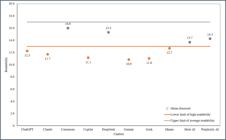
The global mean among the platforms was 12.9, classified as high readability. This level indicates a level of textual complexity compatible to readers who completed high-school (around 13 years of education). Six platforms were classified as high readability and four as average readability. Gemini (10.9) was the platform with the lower mean global value indicating easiness of textual understanding. The platform Consensus presented the highest mean global value (16.0), with texts of increased reading complexity (Figure 1).
The performance analysis per question showed that Grok and Gemini presented the better readability in two questions. The platforms Copilot, Gemini, Claude, ChatGPT and Deepseek presented the best performance in one question. In contrast, the platform DeepSeek had the worst performance in three questions and Consensus, in two (Figure 2).

Heatmap of readability per question and platform, ranging from high readability (green) to low readability (red)
The responses to the question "How to prevent oral cancer?" presented the better mean of readability (11.3). On the other hand, the responses to the question "Is oral cancer treatable?" presented the highest mean global value (14.2), indicating high linguistic complexity. Three questions presented means within the average range of readability while four questions were classified as high readability (Figure 3).

The analysis of DCS constructed for each one of the seven questions on oral cancer shows high uniformity of the informational nucleus presented by the platforms. Additionally, it was noticed that the responses are seldom limited to the strict enunciation of the questions because the chatbots expand the content with complementary explanations on the theme, incorporating definitions, risk factors, warning signs, guidelines of conduct and referrals, even when these elements extrapolate the immediate scope of the question (Chart 1).
Discourses of the Collective Subject and non-predominant ideas per question and adherence to AI chatbots
DISCUSSION
The mean readability of the responses generated by AI chatbots on oral cancer is within the limit of high readability, requiring approximately 13 years of education for comprehensive understanding, which is equivalent to completion of high-school. Furthermore, DSC analysis revealed a recurring trend where responses went beyond what was actually asked, adding explanations and complementary recommendations. This pattern appears to be associated with an implicit logic of language models based on the assumption that a larger volume of information and expanded contextualization would result in better comprehension.
Although the inclusion of additional explanations and contextualization reflects the intention to provide complete and accountable responses, this discursive expansion tends to increase the textual density and cognitive burden imposed to the lay reader, hindering the identification of what is essential for decision-making. Evidences indicate that in health contexts, the excess of information can compromise the practical understanding, create confusion and reduce the ability to act, especially for low health literacy groups11,19. Thus, the informational expansion may fail to achieve didactic function and be an obstacle to the understanding instead, especially among most vulnerable groups because more information does not necessarily imply in better communication.
Even though the readability level found is an improvement compared to previous assessments of health digital materials, it remains above the recommended level for health communication, presenting relevant linguistic barriers to effective access to information for populations with lower educational attainment. There are evidences that these limitations are not episodic or restricted to the theme of oral cancer but reflect a recurring challenge of AI chatbots applied to health11,12,19-21.
In that sense, the informational gain of these platforms22,23 not always translates into accessible information, preserving the readability as critical dimension for its use in health literacy and information. Therefore, the democratization of AI-mediated health-related information depends on better textual clarity because advances of semantic sophistication and technical correction have not ensured, on their own, an effective communication1,24-27.
In Brazil, the emphasis on communication clarity and intelligibility have recently gained legislation support through Law number 15,263 of 202528 and Law number 14,129 of 202129 that determined the use of clear and understandable language by the individual. Although both laws are applicable to the public administration and not directly to AI platforms, they are in line with the results of the present study when they reinforce the relevance of the clarity, accessibility and communicational adequacy while offering information, including those related to health.
Additionally, differences among free and paid versions of these platforms have been identified, the free versions tended to present low readability with direct implications on the equitable access to health information30. This characteristic can be critical in scenarios of low education attainment, as is often the case among groups at high risk of oral cancer10,31 because they can reinforce the already existing disparities. In this perspective, the readability and organization of the content are no longer just style or technical attributes of communication, but instead, they start to function as communicational determinants potentially expanding the symbolic barriers of healthcare, impacting the understanding, adherence and adequate use of the services25.
It has also been observed that readability varies according to the type of question, with worse performance in more clinical questions, especially related to the treatment. This difference is plausibly explained by increased terminology density inherent to the clinical field. However, from the perspective of healthcare, it is a sensitive finding because the phase of the treatment coincides with high stress, fatigue and emotional vulnerability requiring decision-driven simple and straight communication32,33. It is possible that there is a mismatch between the linguistic complexity of the responses and the ability of the user to process and understand exactly when he/she needs the clearest information as possible to adhere to the care.
The findings show still that there are differences among the platforms in regard to the use of health technical terminology which can be associated with how the models of AI have been trained. Those that rely more on scientific evidences, as, for instance, Consensus, tend to prioritize technical terms while the models exposed to daily language as Grok use to produce more fluent texts in simple language. The literature suggests that, when well calibrated and utilized in adequate situations, the different chatbots can reach understanding levels close to those of human interactions. Therefore, it is possible to improve the communicational performance if an appropriately trained tool is chosen34,35.
In light of this scenario, the results advocate that the effectiveness of the chatbots for the democratization of the access to the information depends on human curation, linguistic contextualization and attention to the educational level of the target-audience. In addition, from the ethical perspective, AI should be treated as supplement and not as a substitute of professional guideline36,37. The improvement of the readability should be pursued in order to translate scientific accuracy into understandable language for different profiles of users9,27,34.
Beyond readability, the synthesis of the responses through DCS indicated convergence around a biomedical core that, although technically adequate, tends to be ill- adjusted to the daily language utilized in the enunciation of the questions. This asymmetry between the simplicity of the questions and the specificity of the responses can limit the practical appropriation by the lay public. Furthermore, the underrepresentation of structural dimensions of illness and care reinforces discourses of individual responsibility, drawing less attention to the importance of social inequalities, access barriers and institutional determinants regarding illness and healthcare utilization. This is a particularly critical point in oral cancer where there is strong association between socioeconomic level and risk of the disease10,38, so that the omission of these dimensions can make the guideline provided insufficient exactly for the most vulnerable groups, increasing the distance between specialized knowledge and actual healthcare demands.
On the other hand, the analysis of the non-predominant ideas indicates that the expansion of the content may assume the format of practical disinformation, although the analysis of factual errors has not been done. The incorporation of more specific, rare or strongly context-dependent information as the consumption of areca and auxiliary methods as autofluorescence or toluidine blue, occurs without clear mechanisms of selection, hierarchization or distinction between what is central or exceptional. This, while hindering the identification of what is effectively relevant, compromises the practical understanding of the information, most of all among low literacy users. In that sense, the attempt of not omitting information can produce a reverse effect than the expected, since the overburden of peripheral or non-consensual contents competes with essential guidelines, damaging the ability of the user to recognize priority and usable healthcare information39.
Within SUS, the results should not be interpreted as indicative of immediate adoption of the platforms by the services, considering the lack of institutional governance about the contents created and the variability of the responses. The main contribution of the study is to reveal contemporary challenges of the communication in health and provide material for the development of educational and informational strategies accessible and responsive to meet the public demands.
The study limitations should be acknowledged. It is a cross-sectional analysis conditioned to specific versions of models subject to frequent updates. In addition, the focus was the readability, other equally relevant communicational dimensions as empathy and factual accuracy were not evaluated. Also, only one response per question in each platform was evaluated which does not allow to capture the potential variability of the outputs generated by the models. Even though, while converging the results with international findings, they reinforce that the readability should be treated as a core component for ethical, inclusive and safe use of AI in health, most of all in contexts of great vulnerability as oral cancer.
CONCLUSION
This study evaluated the readability of responses to basic questions about oral cancer produced by different AI chatbots. The generated texts require a reading level equivalent to a high-school education, which is above the level recommended for public health communications. Although these tools present potential to expand the access to information, the results indicate that textual clarity is still a relevant barrier to the comprehension among the lay public, especially those with low educational attainment.
The analysis of the DCS revealed high convergence in the biomedical core of the responses associated with a recurring trend of expansion of the content beyond the strict scope of the questions. If not followed by filtering and hierarchical mechanisms, the expansion of the content can compromise the readability and identification of prioritized guidelines, limiting the practical applicability of the information.
In that sense, the adoption of these technologies should be supported by human curation, attention to socio-cultural context and linguistic adequacy to the target-audience in order to ensure that scientific accuracy is effectively translated into accessible communication to individuals seeking information on oral cancer. AI chatbots should be understood as complementary tools to professional care. The improvement of the readability and informational organization is a required condition for these technologies to contribute ethically and responsibly to the democratization of the access to health information, particularly in more vulnerable contexts as oral cancer.
DATA AVAILABILITY STATEMENT
All content underlying the text of the article is contained in the manuscript.
References
-
1 Ferlay J, Ervik M, Lam M, et al. Global Cancer Observatory: cancer today [Internet]. Lyon: International Agency for Research on Cancer; 2024 [acesso 2025 nov 10]. Disponível em: https://gco.iarc.who.int/today
» https://gco.iarc.who.int/today -
2 Instituto Nacional de Câncer. Estimativa 2026: incidência de câncer no Brasil [Internet]. Rio de Janeiro: INCA; 2026. [acesso 2026 maio 9]. Disponível em: https://ninho.inca.gov.br/jspui/bitstream/123456789/17914/1/Estima2026_completo%20%281%29.pdf
» https://ninho.inca.gov.br/jspui/bitstream/123456789/17914/1/Estima2026_completo%20%281%29.pdf -
3 Coletta RD, Yeudall WA, Salo T. Current trends on prevalence, risk factors and prevention of oral cancer. Front Oral Health. 2024;5:1505833. doi: https://doi.org/10.3389/froh.2024.1505833
» https://doi.org/10.3389/froh.2024.1505833 -
4 Casotti E, Almeida PFD, Silva AND. Trajetórias assistenciais de usuários com câncer de boca na busca por cuidados na Rede de Atenção à Saúde. Physis. 2025;35(2):e350217. doi: https://doi.org/10.1590/S0103-73312025350217
» https://doi.org/10.1590/S0103-73312025350217 -
5 Silva CHF, Queiroz NB, Benedito FCS, et al. Conhecimento de usuários da Estratégia Saúde da Família sobre o câncer de boca. Arq Odontol. 2018;54. doi: https://doi.org/10.7308/aodontol/2018.54.e07
» https://doi.org/10.7308/aodontol/2018.54.e07 -
6 Prado NS, Bonan RF, Leonel AC, et al. Awareness on oral cancer among patients attending dental school clinics in Brazil. Med Oral Patol Oral Cir Bucal. 2020;25(1):e89-e95. doi: https://doi.org/10.4317/medoral.23207
» https://doi.org/10.4317/medoral.23207 -
7 Powell J, Inglis N, Ronnie J, et al. The characteristics and motivations of online health information seekers. J Med Internet Res. 2011;13(1):e20. doi: https://doi.org/10.2196/jmir.1600
» https://doi.org/10.2196/jmir.1600 -
8 Gkinko L, Elbanna A. AI chatbots sociotechnical research: an overview and future directions. In: Bednar P, Islind AS, Vallo Hult H, et al., editores. Proceedings of the 8th International Workshop on Socio-Technical Perspective in Information Systems Development (STPIS 2022) [Internet]; 2022 ago 19-20 [acesso 2025 nov 10]; Reykjavik, Iceland. CEUR Workshop Proceedings. 2022;3239:173-183. Disponível em: https://ceur-ws.org/Vol-3239/paper17.pdf
» https://ceur-ws.org/Vol-3239/paper17.pdf -
9 Aggarwal A, Tam CC, Wu D, et al. Artificial intelligence–based chatbots for promoting health behavioral changes: systematic review. J Med Internet Res. 2023;25:e40789. doi: https://doi.org/10.2196/40789
» https://doi.org/10.2196/40789 -
10 Conway DI, Petticrew M, Marlborough H, et al. Socioeconomic inequalities and oral cancer risk: a systematic review and meta-analysis of case-control studies. Int J Cancer. 2008;122(12):2811-9. doi: https://doi.org/10.1002/ijc.23430
» https://doi.org/10.1002/ijc.23430 -
11 Okuhara T, Furukawa E, Okada H, et al. Readability of written information for patients across 30 years. Patient Educ Couns. 2025;135:108656. doi: https://doi.org/10.1016/j.pec.2025.108656
» https://doi.org/10.1016/j.pec.2025.108656 -
12 Singh S, Jamal A, Qureshi F. Readability metrics in patient education: where do we innovate? Clin Pract. 2024;14(6):2341-9. doi: https://doi.org/10.3390/clinpract14060183
» https://doi.org/10.3390/clinpract14060183 -
13 Moreno GCDL, Souza MPM, Hein N, et al. ALT: um software para análise de legibilidade de textos em língua portuguesa. Policromias. 2023;8(1):91-128. doi: https://doi.org/10.61358/policromias.v8i1.54352
» https://doi.org/10.61358/policromias.v8i1.54352 -
14 Figueiredo MZA, Chiari BM, Goulart BNG. Discurso do Sujeito Coletivo: uma breve introdução à ferramenta de pesquisa qualiquantitativa. Distúrb comum [Internet]. 2013[acesso 2026 jan 11];25(1):129-36. Disponível em: https://revistas.pucsp.br/index.php/dic/article/view/14931/11139
» https://revistas.pucsp.br/index.php/dic/article/view/14931/11139 -
15 Genaro LE, Marconato JV, Pinotti FE, et al. Discurso do sujeito coletivo: bases conceituais, enfoques e aplicações em pesquisas qualitativas. Rev Pesq Qual. 2024;12(32):553-69. doi: https://doi.org/10.33361/RPQ.2024.v.12.n.32.739
» https://doi.org/10.33361/RPQ.2024.v.12.n.32.739 -
16 NVivo [Internet]. Versão 14.24.3 [Denver]: Lumivero; [sem data]. [acesso 2025 dez 1]. Disponível em: https://lumivero.com/products/nvivo/
» https://lumivero.com/products/nvivo/ -
17 Lefevre F, Lefevre AMC, Marques MCDC. Discurso do sujeito coletivo, complexidade e auto-organização. Ciênc. saúde coletiva. 2009;14(4):1193-204. doi: https://doi.org/10.1590/S1413-81232009000400025
» https://doi.org/10.1590/S1413-81232009000400025 -
18 Conselho Nacional de Saúde (BR). Resolução n° 510, de 7 de abril de 2016. Dispõe sobre as normas aplicáveis a pesquisas em Ciências Humanas e Sociais cujos procedimentos metodológicos envolvam a utilização de dados diretamente obtidos com os participantes ou de informações identificáveis ou que possam acarretar riscos maiores do que os existentes na vida cotidiana, na forma definida nesta Resolução [Internet]. Diário Oficial da União, Brasília, DF. 2016 maio 24 [acesso 2026 abr 7]; Edição 98; Seção 1:44. Disponível em: http://bvsms.saude.gov.br/bvs/saudelegis/cns/2016/res0510_07_04_2016.html
» http://bvsms.saude.gov.br/bvs/saudelegis/cns/2016/res0510_07_04_2016.html -
19 Walsh TM, Volsko TA. Readability assessment of internet-based consumer health information. Respir Care. 2008;53(10):1310-5. doi: https://doi.org/10.4187/respcare.08531310
» https://doi.org/10.4187/respcare.08531310 -
20 Erdat EC, Köksoy EB, Utkan G. Artificial intelligence chatbot as a companion for cancer patients about most common questions: analysis of readability and quality. Acta Oncol Turc. 2025;58(1):21-7. doi: https://doi.org/10.4274/ahot.galenos.2024.2024-8-2
» https://doi.org/10.4274/ahot.galenos.2024.2024-8-2 -
21 Friedman DB, Hoffman-Goetz L, Arocha JF. Readability of cancer information on the internet. J Cancer Educ. 2004;19(2):117-22. doi: https://doi.org/10.1207/s15430154jce1902_13
» https://doi.org/10.1207/s15430154jce1902_13 -
22 Çitir M. ChatGPT and oral cancer: a study on informational reliability. BMC Oral Health. 2025;25(1):86. doi: https://doi.org/10.1186/s12903-025-05479-4
» https://doi.org/10.1186/s12903-025-05479-4 -
23 Grassini E, Buzzi M, Leporini B, et al. A systematic review of chatbots in inclusive healthcare: insights from the last 5 years. Univ Access Inf Soc. 2025;24(1):195-203. doi: https://doi.org/10.1007/s10209-024-01118-x
» https://doi.org/10.1007/s10209-024-01118-x -
24 Diniz-Freitas M, López-Pintor RM, Santos-Silva AR, et al. Assessing the accuracy and readability of ChatGPT-4 and Gemini in answering oral cancer queries — an exploratory study. Explor Digit Health Technol. 2024:334-45. doi: https://doi.org/10.37349/edht.2024.00032
» https://doi.org/10.37349/edht.2024.00032 -
25 Davis RJ, Ayo-Ajibola O, Lin ME, et al. Evaluation of oropharyngeal cancer information from revolutionary artificial intelligence chatbot. Laryngoscope. 2024;134(5):2252-7. doi: https://doi.org/10.1002/lary.31191
» https://doi.org/10.1002/lary.31191 -
26 Boscolo-Rizzo P, Marcuzzo AV, Lazzarin C, et al. Quality of information provided by AI chatbots in head and neck cancer reconstruction. Clin Otolaryngol. 2025;50(2):330-5. doi: https://doi.org/10.1111/coa.14127
» https://doi.org/10.1111/coa.14127 -
27 Pan A, Musheyev D, Bockelman D, et al. Assessment of artificial intelligence chatbot responses to top searched queries about cancer. JAMA Oncol. 2023;9(10):1437-40. doi: https://doi.org/10.1001/jamaoncol.2023.2947
» https://doi.org/10.1001/jamaoncol.2023.2947 - 28 Presidência da República (BR). Lei nº 15.263, de 14 de novembro de 2025. Institui a Política Nacional de Linguagem Simples nos órgãos e entidades da administração pública direta e indireta de todos os Poderes da União, dos Estados, do Distrito Federal e dos Municípios. Diário Oficial da União, Brasília, DF. 2025 nov 17; Seção 1.
- 29 Presidência da República (BR). Lei nº 14.129, de 29 de março de 2021. Dispõe sobre princípios, regras e instrumentos para o Governo Digital e para o aumento da eficiência pública e altera a Lei nº 7.116, de 29 de agosto de 1983, a Lei nº 12.527, de 18 de novembro de 2011 (Lei de Acesso à Informação), a Lei nº 12.682, de 9 de julho de 2012, e a Lei nº 13.460, de 26 de junho de 2017. Diário Oficial da União, Brasília, DF. 2021 mar 30; Seção 1.
-
30 Musheyev D, Pan A, Gross P, et al. Readability and information quality in cancer information from free vs paid chatbot. JAMA Netw Open. 2024;7(7):e2422275. doi: https://doi.org/10.1001/jamanetworkopen.2024.22275
» https://doi.org/10.1001/jamanetworkopen.2024.22275 -
31 Dantas TS, Silva PGB, Sousa EF, et al. Influence of educational level, stage, and histological type on survival of oral cancer in a brazilian population: a retrospective study of 10 years observation. Medicine (Baltimore). 2016;95(3):e2314. doi: https://doi.org/10.1097/MD.0000000000002314
» https://doi.org/10.1097/MD.0000000000002314 -
32 Annunziata MA, Muzzatti B, Bidoli E. Psychological distress and needs of cancer patients: a prospective comparison between the diagnostic and the therapeutic phase. Support Care Cancer. 2010;19(2):291-5. doi: https://doi.org/10.1007/s00520-010-0818-9
» https://doi.org/10.1007/s00520-010-0818-9 -
33 Sumanu SA. The crucial role of communication in managing the long-term health impact of cancer. Qual Quant Methods Libr [Internet]. 2024[acesso 2026 abr 25]13(4):513-536 Disponível em: https://www.qqml-journal.net/index.php/qqml/article/view/891/764
» https://www.qqml-journal.net/index.php/qqml/article/view/891/764 -
34 Abreu AA, Murimwa GZ, Farah E, et al. Enhancing readability of online patient-facing content: the role of AI chatbots in improving cancer information accessibility. J Natl Compr Canc Netw. 2024;22(2D):e237334. doi: https://www.doi.org/10.6004/jnccn.2023.7334
» https://www.doi.org/10.6004/jnccn.2023.7334 -
35 Al-Hilli Z, Noss R, Dickard J, et al. A randomized trial comparing the effectiveness of pre-test genetic counseling using an artificial intelligence automated chatbot and traditional in-person genetic counseling in women newly diagnosed with breast cancer. Ann Surg Oncol. 2023;30(10):5990-6. doi: https://www.doi.org/10.1245/s10434-023-13888-4
» https://www.doi.org/10.1245/s10434-023-13888-4 -
36 Altamimi I, Altamimi A, Alhumimidi AS, et al. Artificial intelligence chatbots in medicine: a supplement, not a substitute. Cureus. 2023;15(6):e40917. doi: https://www.doi.org/10.7759/cureus.40922
» https://www.doi.org/10.7759/cureus.40922 -
37 Sohal KS, Okechi U. Evaluating the ability of artificial intelligence chatbots to respond to oral cancer questions: a descriptive study. Int Health Trends & Persp. 2025;5(1):GR13-17. doi: https://www.doi.org/10.32920/ihtp.v5i1.2308
» https://www.doi.org/10.32920/ihtp.v5i1.2308 -
38 Cunha AR, Bigoni A, Antunes JLF, et al. The impact of inequalities and health expenditure on mortality due to oral and oropharyngeal cancer in Brazil. Sci Rep. 2021;11(1):12845. doi: https://www.doi.org/10.1038/s41598-021-92207-x
» https://www.doi.org/10.1038/s41598-021-92207-x -
39 Klerings I, Weinhandl AS, Thaler KJ. Information overload in healthcare: too much of a good thing? Z Evid Fortbild Qual Gesundhwes. 2015;109(4-5):285-90. doi: https://www.doi.org/10.1016/j.zefq.2015.06.005
» https://www.doi.org/10.1016/j.zefq.2015.06.005
Edited by
-
Associate editor:
Adriana Tavares de Moraes Atty. Orcid iD: https://orcid.org/0000-0003-2271-746X
-
Scientific-editor:
Anke Bergmann. Orcid iD: https://orcid.org/0000-0002-1972-8777


