 Compassionate Community of the Slums of Rocinha and Vidigal: Strategy to Help in Cancer Control
INTRODUCTION
Cancer incidence is rising, it is one of the main causes of death in the world1. Physical, psychosocial and/or spiritual repercussions on patients, family and loved ones who begin to live an unforeseen situation and face uncertain perspectives are the unwanted repercussions of cancer diagnosis.
Access to comprehensive treatment of the disease is necessary including palliative care2, a human right recommended by the World Health Organization, consisting in a multidisciplinary and multidimensional approach to prevent and relieve suffering through early identification, thorough assessment and treatment of the pain and other physical, biopsychosocial and spiritual problems4.
However, the scarce availability of this type of care across different regions of the world is unarguable5. In the mid-2000s, the British physician and sociologist Kellehear, within a setting of overburdened health systems, came up with a model of palliative care called Compassionate Community6, based in Ottawa Charter’s five pillars for health promotion: build public health policies, create supportive environments, strengthen community action, develop personal skills and reorient health services7. Today, most of the Compassionate Communities can be found in Europe, North America and Australia8.
This innovative proposal of offer of palliative care conducted by the nurse and professor Alexandre Ernesto Silva is being developed in Brazil, Rio de Janeiro in the slums of Rocinha and Vidigal since 20199,10. The present article describes this initiative titled Favela Compassiva (Compassionate Slum).
DEVELOPMENT
Compassionate Communities can appear in different places as neighborhoods, companies, condos and wherever needed, but most of all where access to health is poor as in the Brazilian slums. Individuals living in slums are systematically subject to neglect, poverty and deprivation or when their social rights are unmet11. Whether affected by life-threatening diseases, their suffering can be even worse than the general population’s, because further to the disease itself, there are other obstacles to access health services and medications as underserved transportation where they live, in addition to local crime, making them a vulnerable population12,13 and reinforcing social exclusion.
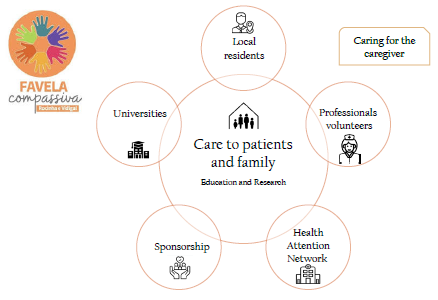
In this context, the nurse and professor Alexandre Ernesto Silva created the first Brazilian Compassionate Community in 2019 to provide care to patients with life-threatening diseases and their families living in the slums of Rocinha and Vidigal, including cancer and eligible to palliative care9,10 titled Favela Compassiva (Figure 1).

Conceptually, it is a complementary initiative not meant to replace the public health system whose main goal is to promote the human dignity through pain relief and other stressful symptoms and encourage the autonomy by means of functionality while offering a dignified life and dignified death, with physical, social and spiritual rescue.
Caring goes beyond the main caregiver, it reaches the whole network and communities, enabling the community itself to take care of its members diagnosed with life-threatening diseases. As a counterpart, the communities strengthen themselves through social empowerment, the individuals take over the responsibility to work together, detect and direct the focus to health issues and development of in-community6 care.
The community is enabled to take care of its members, mobilizing the civil society through volunteering and constructing a health support network, integrated to the local primary health attention network, attempting to minimize the disparities to access palliative care. Residents who have always cared compassionately and spontaneously for their neighbors start to be trained and receive means to perform these tasks more effectively assuming the role of compassionate agents or volunteer caregivers; they team up with health professionals volunteers and provide qualified assistance to palliative care patients and their families after death12.
Palliative care education is provided to local volunteers continuously and help to identify patients with life-threatening diseases profile and potentially eligible to palliative care, creating bonds with the health professionals working in Favela Compassiva. They follow-up the cases more closely because they live in the same community, with weekly or daily visits as needed, supporting and providing ongoing care to the patients and their families9,10. Sympathy is a key part of the social tissue and local volunteer is the driving force of this initiative.
Favela Compassiva gathers volunteer health professionals as part of multidisciplinary health teams with nurses, physicians, occupational therapists, speech therapists, dentists, social workers, psychologists, physiotherapists and nutritionists who make follow-up home visits to validate what local volunteers - the so-called compassionate agents - have already detected in addition to clinical evaluation, guidance and further contact with health professionals of the patient’s attention network to align the conducts9,10. In-person or teleconsultation home visits can be made to meet specific demands of the patients9,10.
Also, sponsors or stakeholders are players of Favela Compassiva as financial donnors or providing means to keep the inventory of essential medications, diapers, dressings, food supply, wheel-chairs, bath-chairs, as needed. For complex cases, sponsor campaigns to canvass support for financially vulnerable patients, hospital-beds, air mattresses are implemented to meet these demands and each supporter provides what is within his/her capacity in favor of a better world. The process follows transparency and financial accounting guidelines in respect to all the stakeholders involved.
Caring for the Caregiver is aimed to the family caregiver and local volunteers. Health self-care workshops and therapeutic massage sessions are offered to create positive influence on the psychological, behavioral, cognitive and physiological parameters of these professionals.
So far, this initiative has granted the assistance and follow-up of more than 100 patients living in slums through the end of their lives according to the principles of palliative care and who were unable to access health services, in addition to their families and loved ones. Due to the good results of this pioneer initiative in Brazil, the legal entity “Associação Favela Compassiva” was created in September 2022.
Favela Compassiva requires resources and ongoing assistance to the vulnerable population further to the involvement of educational and scientific research institutions to provide more equanimous care and meet the existing demands as, for instance, the National Cancer Institute (INCA).
CONCLUSION
The initiative ensures the support to patients while coping with psychosocial issues and alleviates suffering as part of a broader health approach which acknowledges the physical, psychological, social and emotional impact of severe diseases and help them and their families through and after death.
References
-
1 Bray F, Laversanne M, Sung H, et al. Global cancer statistics 2022: GLOBOCAN estimates of incidence and mortality worldwide for 36 cancers in 185 countries. CA Cancer J Clin. 2024;74(3):229-63. doi: https://doi.org/10.3322/caac.21834
» https://doi.org/10.3322/caac.21834 - 2 Duarte IV, Fernandes KF, Freitas SC. Cuidados paliativos domiciliares: considerações sobre o papel do cuidador familiar. Rev SBPH. 2013;16(2):73-88.
-
3 World Health Organization. National cancer control programmes: policies and managerial guidelines. 2. ed. Geneva: WHO; 2002. [acesso 2023 out 1]. Disponível em: Disponível em: https://www.who.int/publications/i/item/national-cancer-control-programmes
» https://www.who.int/publications/i/item/national-cancer-control-programmes -
4 Radbruch L, Lima L, Knaul F, et al. Redefining Palliative Care-A New Consensus-Based Definition. J Pain Symptom Manage. 2020;60(4):754-64. doi: https://doi.org/10.1016/j.jpainsymman.2020.04.027
» https://doi.org/10.1016/j.jpainsymman.2020.04.027 -
5 Abel J, Kellehear A, Karapliagou A. Palliative care - the new essentials. Ann Palliat Med. 2018;7(Supl 2):S3-S14. doi: https://doi.org/10.21037/apm.2018.03.04
» https://doi.org/10.21037/apm.2018.03.04 -
6 Kellehear A. Comunidades compassivas: cuidados de fim de vida como responsabilidade de todos. QJM. 2013;106(12):1071-5. doi: https://doi.org/10.1093/qjmed/hct200
» https://doi.org/10.1093/qjmed/hct200 -
7 World Health Organization. Regional Office for Europe. Ottawa Charter for Health Promotion, 1986. [Genebra]: WHO. Regional Office for Europe; 1986. [acesso 2024 fev 3]. Disponível em: Disponível em: https://iris.who.int/handle/10665/349652
» https://iris.who.int/handle/10665/349652 -
8 Roleston C, Shaw R, West K. Compassionate communities interventions: a scoping review. Ann Palliat Med. 2023;12(5):936-51. doi: https://doi.org/10.21037/apm-22-867
» https://doi.org/10.21037/apm-22-867 -
9 Silva AE, Coelho FBP, Pereira FMS, et al. Cuidados paliativos em favelas no Brasil: uma revisão integrativa. RSD. 2021;10(6):e55110616183. doi: https://doi.org/10.33448/rsd-v10i6.16183
» https://doi.org/10.33448/rsd-v10i6.16183 -
10 Mesquita MGR, Silva AE, Coelho LP, et al. Slum compassionate community: expanding access to palliative care in Brazil. Rev Esc Enferm USP. 2023;57:e20220432. doi: https://doi.org/10.1590/1980-220X-REEUSP-2022-0432en
» https://doi.org/10.1590/1980-220X-REEUSP-2022-0432en -
11 Catão MÓ. A exclusão social e as favelas na cidade do Rio de. Rev Dir da Cid. 2015;7(3):1002-45. doi: https://doi.org/10.12957/rdc.2015.18839
» https://doi.org/10.12957/rdc.2015.18839 - 12 Fialho S. Comunidade compassiva: uma estratégia empoderadora da promoção da saúde. Relatório de estágio. Lisboa: Universidade Católica Portuguesa; 2020.
-
13 Vasconcelos GB, Pereira PM. Cuidados paliativos em atenção domiciliar: uma revisão bibliográfica. Rev Adm Saúde. 2018;18(70). doi: http://dx.doi.org/10.23973/ras.70.85
» https://doi.org/10.23973/ras.70.85