 Semen Characteristics of Mexican Creole Roosters in Winter and Spring
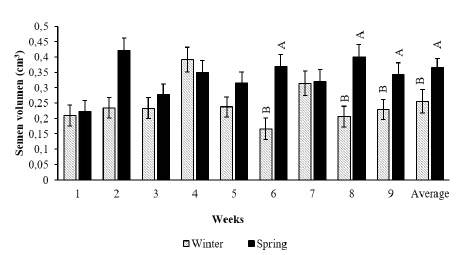
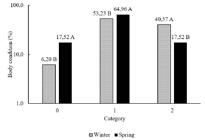
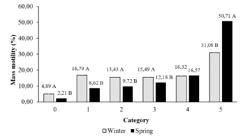
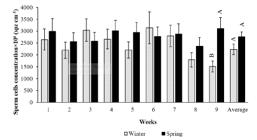
The objective of this study was to evaluate the effect of season (winter and spring) on live weight, body condition, spermatozoa percentages, mass motility, ejaculation time, semen volume, and sperm cells concentration of Mexican Creole roosters. Sixteen 59-week-old Creole roosters were used, and their semen was collected weekly for 9 weeks in winter and spring using the dorso-abdominal massage technique. The roosters were individually kept under a constant photo period (16 hours light: 8 hours dark). The average live weight was 10.6% higher (p<0.05) in spring (3.03 kg) than in winter (2.74 kg). In both winter and spring (53.23 and 64.96%, respectively), category 1 of body condition occurred (p<0.05) more frequently than the others (0, 1 and 2). Category 5 of mass motility frequency (the best of all) occurred more (p<0.05) in spring (50.71%) than in winter (31.08%). Additionally, live weight increased with age (r=0.93, p<0.05) and was positively correlated with mass motility (r=0.80, p<0.05) and percentage of abnormal spermatozoa (r=0.80, p<0.05). There was no effect of season on the percentages of live (winter 71.77%, spring 71.75%), dead (winter 28.42%, spring 28.27%), and abnormal (winter 1.00%, spring 1.00%) spermatozoa. From winter to spring, semen volume increased (p<0.05) from 0.26 to 0.37 cm3, while ejaculation time decreased (p<0.05) from 10 to 6s. Mexican Creole roosters showed higher live weight, body condition, semen volume and abnormal spermatozoa in spring (when they were older and faster to ejaculate) than in winter. Therefore, it is advisable to breed this kind of animal in spring.
Keywords:
Mexican Creole roosters; body weight; ejaculation time; semen volume; climate
 Thumbnail
 Thumbnail
 Thumbnail
 Thumbnail
 Thumbnail
 Thumbnail