 Semen Characteristics of Mexican Creole Roosters in Winter and Spring
ABSTRACT
The objective of this study was to evaluate the effect of season (winter and spring) on live weight, body condition, spermatozoa percentages, mass motility, ejaculation time, semen volume, and sperm cells concentration of Mexican Creole roosters. Sixteen 59-week-old Creole roosters were used, and their semen was collected weekly for 9 weeks in winter and spring using the dorso-abdominal massage technique. The roosters were individually kept under a constant photo period (16 hours light: 8 hours dark). The average live weight was 10.6% higher (p<0.05) in spring (3.03 kg) than in winter (2.74 kg). In both winter and spring (53.23 and 64.96%, respectively), category 1 of body condition occurred (p<0.05) more frequently than the others (0, 1 and 2). Category 5 of mass motility frequency (the best of all) occurred more (p<0.05) in spring (50.71%) than in winter (31.08%). Additionally, live weight increased with age (r=0.93, p<0.05) and was positively correlated with mass motility (r=0.80, p<0.05) and percentage of abnormal spermatozoa (r=0.80, p<0.05). There was no effect of season on the percentages of live (winter 71.77%, spring 71.75%), dead (winter 28.42%, spring 28.27%), and abnormal (winter 1.00%, spring 1.00%) spermatozoa. From winter to spring, semen volume increased (p<0.05) from 0.26 to 0.37 cm3, while ejaculation time decreased (p<0.05) from 10 to 6s. Mexican Creole roosters showed higher live weight, body condition, semen volume and abnormal spermatozoa in spring (when they were older and faster to ejaculate) than in winter. Therefore, it is advisable to breed this kind of animal in spring.
Keywords:
Mexican Creole roosters; body weight; ejaculation time; semen volume; climate
INTRODUCTION
Creole chickens (Gallus domesticus) are widely distributed in the rural areas of Mexico (Segura-Correa et al., 2007) as well as tropical and subtropical countries in general (Adamu et al., 2019). For breeding, it is important to select roosters with high semen volumes and good spermatozoa characteristics (Bah et al., 2001). Large semen volumes are associated with high sperm cells concentrations; furthermore, semen volume has been found to be one of the best variables for predicting the fertilization potential of cock ejaculates (Santiago-Moreno et al., 2009). When the sperm cell concentration of indigenous roosters is high, maximal fertility is obtained (Adamu et al., 2019). However, the environment can play a deleterious role in semen quality. Extreme environmental factors such as low and high temperatures have negative effects on bird performance (Ayo et al., 2011). For instance, there is an apparent deterioration in semen quality of roosters during the hot months of India; and in general, the effect of heat stress on semen quality depends on age, live weight, and breed (Harsha et al., 2021). Ejaculation time depends on the genotype and decreases with underfeeding; however, no information was found on the effect of season on this variable (Machebe & Ezekwe, 2002; Kabir et al., 2007). Little information was found about the effects of season on semen characteristics of local roosters in the semiarid zone of Nigeria (Adamu et al., 2019). In Mexico, no information was found about ejaculation times, and in general, information about the environmental effect on semen characteristics of Mexican Creole roosters is scarce. Therefore, the objective of the present study was to evaluate the effect of season (winter and spring) on the live weight, body condition, spermatozoa percentages, mass motility, ejaculation time, semen volume, and sperm cell concentration of Mexican Creole roosters.
MATERIALS AND METHODS
Experimental Site
Evaluations were conducted in winter 2019 and spring 2020 at the Poultry Facilities of the College of Postgraduates, Campus Montecillo, Texcoco, State of Mexico, Mexico; located at 19° 53’ NL, 98° 53’ WL, at 2247 m altitude and presenting 14.6 °C and 558.5 mm mean annual temperature and precipitation, respectively (García, 2004).
Ethical Statement
Roosters were handled following the recommendations of the College of Postgraduates Animal Welfare Committee (COLPOS, 2016), and no animals died during the experimental period.
Experimental Birds
Sixteen 59-week-old Creole roosters (2.800 ± 0.142 kg live weight) were used. Birds were kept individually in cages (0.6×0.6×0.6 m), inside a poultry house with natural ventilation regulated by side curtains, with a constant photoperiod (16h light: 8h dark) during winter and spring. All roosters were fed a diet containing 17% crude protein and 2800 kcal kg-1 metabolizable energy. During the experimental period, 120 g of feed per animal per day were offered, and water was provided ad libitum.
Temperature and Relative Humidity
Temperature and relative humidity in the poultry house were recorded daily three times a day using an automatic digital thermometer-hygrometer with sensor and LCD display (Veanic, USA). In addition, climatological data were obtained from the Montecillo Campus Meteorological Station, located at about 100 m from the experimental site.
Live Weight and Body Condition
Before starting the experimental period, the fasting live weight and body condition of each rooster were recorded, using a digital scale (L-PCR, Torrey, Mexico) with a 5 kg capacity and 5 g accuracy. Body condition was determined according to the methodology from Gregory & Robins (1998), by holding the rooster with the left hand, hugging it, and avoiding its flapping. The pectoral region was palpated with one hand, then the volume of breast muscles and the protrusion of the keel were evaluated. Roosters were classified according to the following categories: keel with prominent edge and limited breast muscle development (0); keel still prominent, but with more breast muscle development (1); keel less prominent and moderate breast muscle development (2); flat keel edge and well-developed breast muscle (3).
Semen Collection and Characterization
Before semen collection, the birds were trained using the dorso-abdominal massage technique (Burrows & Quinn, 1937). Between 9 and 11 AM, semen was collected from each bird into graduated Eppendorf tubes (5 cm3) that were pre-warmed up to 41 °C to avoid thermal shock of the spermatozoa.
The following response variables were assessed: ejaculation time (s), semen volume (cm3), mass motility (scale 0 to 5), live, dead, and abnormal spermatozoa (%), and sperm cells concentration (spermatozoa cm-3). While mass motility was observed at 10X microscope magnification, live, dead, and abnormal spermatozoa were observed at 40X, and sperm concentration at 100X. The following paragraphs describe the response variables.
Mass motility was assessed according to the following categories (Evans & Maxwell, 1987; David et al., 2015): 0 (sporadic or no motion of spermatozoa); 1 (10% of spermatozoa show movement); 2 (no wave formation, 20-40% of spermatozoa show movement), 3 (45-65% of spermatozoa are active), 4 (vigorous movement, 70-85% of spermatozoa are active) and 5 (very vigorous movement with rapid waves, 90% or more of spermatozoa are active).
Live, dead, and abnormal spermatozoa percentages were determined by the eosin-nigrosine staining technique described by Bamba (1988). A drop of semen was placed on a Neubauer chamber, and after selecting 100 cells, the spermatozoa with stained (dead) and intact (live) membranes, as well as with head or tail abnormalities, were counted (Alkan et al., 2002).
Sperm cell concentration was determined in accordance with the method described by Cortez & Gallegos (2014). Using an enhanced Neubauer chamber and a red blood cell pipette, the cells were counted in 5 of the 25 large squares (0.004 mm3 each) of the chamber, and the sperm cells per mm3 were calculated using the formula: SC=N×F×D, where SC=sperm cells mm-3; N=number of sperm cells counted in 0.02 mm3 (5×0.004 mm3); F=multiplication factor: 50 (because 0.02 mm3 is 1/50th of 1 mm3); and D=dilution rate: 200 (because semen was diluted 1/200). To express SC in sperm cells cm-3, the variable was multiplied by 1000, since 1 cm³ is equal to 1000 mm³.
Statistical Analysis
In the present study, season was the only factor studied with two levels: winter and spring. The variables live weight, semen volume, ejaculation time, spermatozoa percentages and sperm cells concentration were analyzed by time-repeated measures using the GLMIXED procedure. The variables body condition and mass motility, which are presented as frequency in %, were analyzed according to a multinomial generalized linear mixed (MGLM) model with ordinal response. Excluding the means of ordinal variables, which were separated by the t test, all other means were separated by the LSD test, α = 0.05. Additionally, Pearson correlation coefficients (p<0.05) were obtained between each pair of physical and semen variables. The statistical software used was SAS (2011) version 9.4.
RESULTS
Temperature and Relative Humidity
Environmental data recorded weekly during the experimental period (Table 1) indicated that the average temperature inside the poultry house increased (p<0.05) from winter (18.14 °C) to spring (21.38 °C); however, the relative humidity in winter (49.88%) and spring (47.87%) were similar. Additionally, there was more (p>0.05) precipitation in spring (0.47 mm) than in winter (0.19 mm). The increase in temperature and precipitation dries and humidifies the air, respectively, which is the reason why relative humidity was the same in both seasons (p>0.05).
Live Weight and Body Condition
Although the initial live weights (wk. 1) of birds in winter and spring were similar (p>0.05), from the second week onwards live weight was higher (p<0.05) in spring than in winter (Figure 1). This variable increased from 2.83 to 3.07 kg per bird, with an average value of 3.03 ± 0.14 kg in the spring that was higher (p<0.05) than that of the winter (2.80, wk. 1 to 2.80 kg wk. 9), with an average value of 2.74 ± 0.14 kg per bird.

Live weight of Mexican Creole roosters during nine weeks in winter 2019 and spring 2020 in Texcoco, State of Mexico, Mexico. Different letters above the bars of each week indicate statistical differences (p<0.05).
Out of the four body condition categories (0 to 3), only categories 0, 1 and 2 were observed (Figure 2). Category 2 (moderate breast muscle development) showed the following frequencies: 40.57% in winter and 17.52% in spring. Category 1 (keel slightly prominent, with moderate breast muscle development) showed the highest frequencies of 53.23 and 64.96%, and category 0 (keel with prominent edge and limited breast muscle development) showed the lowest frequencies of 6.20 and 17.52% in winter and spring, respectively. All these frequencies differed between seasons (p<0.05). Most of the roosters showed intermediate body condition categories, that is, they were neither too fat (category 3) nor too lean (category 0).
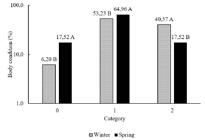
Frequency of body condition of Mexican Creole roosters during nine weeks in winter 2019 and spring 2020 in Texcoco, State of Mexico, Mexico. 0: keel with prominent edge and limited breast muscle development; 1: keel slightly prominent, but with moderate breast muscle development; 2: keel less prominent and moderate breast muscle development; 3: flat keel edge and well-developed breast muscle (Gregory & Robins,1998). The t test (p<0.05) was used for the comparison of means of each category.
Ejaculation Time and Semen Volume
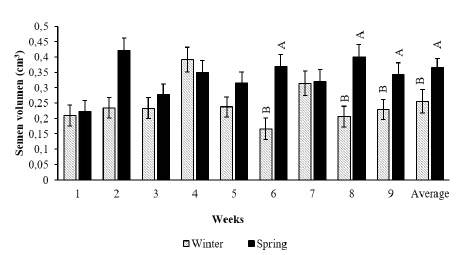
Ejaculation time (Figure 3) varied in winter from 6.16 to 12.49s (10.24 ± 0.10s), and in spring from 4.84 to 8.35 s (6.52 ± 0.52 s). On average, this variable was higher in winter than in spring (p<0.05). Semen volume varied from 0.17 to 0.39 cm3 in winter (0.26 ± 0.04 cm3) and from 0.22 to 0.42 cm3 in spring (0.37 ± 0.03 cm3) (Figure 4). On average, this variable was higher in spring than in winter (p<0.01). That is, these Mexican Creole roosters were faster to ejaculate and produce a greater semen volume in spring than in winter.

Ejaculation time of Mexican Creole roosters during nine weeks in winter 2019 and spring 2020 in Texcoco, State of Mexico, Mexico. Different letters above the bars of each week indicate statistical differences (p<0.05).

Semen volume of Mexican Creole roosters during nine weeks in winter 2019 and spring 2020 in Texcoco, State of Mexico, Mexico. Different letters above the bars indicate statistical differences (p<0.05).
Mass Motility and Sperm Cells Concentration
Category 5 of mass motility (Figure 5) showed the highest frequency (p<0.05) when compared to the others (winter 31.08% and spring 50.71%). The worst category was 0 (winter 4.89% and spring 2.21%). In general, the worst categories 0 to 3 were predominant in winter, while the best (category 5) was predominant in spring (p<0.05). However, category 4 of mass motility was similar between seasons (p>0.05).
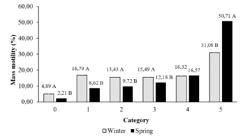
Frequency of mass motility of Mexican Creole roosters’ semen during nine weeks in winter 2019 and spring 2020 in Texcoco, State of Mexico, Mexico. Category 0: sporadic or no motion of spermatozoa; category 1: 10% of spermatozoa show movement; category 2: no formation of waves, 20-40% of spermatozoa are active; category 3: 45-65% of spermatozoa are active; category 4: vigorous movement, 70-85% of spermatozoa are active and category 5: very vigorous movement with dense waves, 90% or more of spermatozoa are active (Evans & Maxwell,1987; David et al., 2015). The t test (p<0.05) was used for the comparison of means of each category.
From week 1 to 8, sperm cell concentration (Figure 6) did not change (p>0.05) between seasons; however, at week 9 this variable was higher in spring than in winter (p<0.05). Nevertheless, on average, no difference (p>0.05) in sperm cell concentration was observed between seasons (winter 2.23×10⁹ and spring 2.76×10⁹ spermatozoa cm-3).
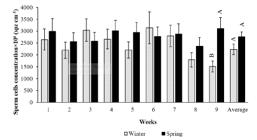
Sperm cell concentration (Cortez & Gallegos, 2014) of Mexican Creole roosters during nine weeks in winter 2019 and spring 2020 in Texcoco, State of Mexico, Mexico. Different letters above the bars indicate statistical differences (p<0.05).
Percentages of Live Dead and Abnormal Spermatozoa
The percentages of live spermatozoa in winter and spring were 71.77 and 71.75%, respectively. Those of dead spermatozoa were 28.42 and 28.27% in winter and spring, respectively. The percentages of abnormal spermatozoa were 1% in both seasons. These three variables did not change significantly from winter to spring (p>0.05).
Correlations Between Variables
Live weight was positively correlated with mass motility (r = 0.79, p<0.05), which, on average, was similar between spring and winter (p<0.05). Live weight was also positively correlated with the percentage of abnormal spermatozoa (r=0.80, p<0.05). Furthermore, the highest and best value of mass motility (category 5, very vigorous movement with rapid waves and 90% or more active spermatozoa) was more frequently observed in spring (p<0.05).
DISCUSSION
Santiago-Moreno et al. (2009), Elagib et al. (2012), and Adamu et al. (2019) studied the effects of factors such as breed, age, and season on semen characteristics of roosters in different regions of the world. However, in Mexico, little or no information on this subject is available. In this study, live weights of 59-week-old Creole roosters increased with age, as was reported for Rhode Island roosters from 6 to 18 months of age (Juárez-Caratachea et al., 2018).
Silveira et al. (2014) found an increase in the live weight of broiler breeders related to a decrease in fertility. Therefore, to delay such effect, control of intake and quality of feed are recommended (Romero-Sánchez et al., 2007). These reports are consistent with the present study, where live weight increased with age.
Category 1 of body condition (low prominent keel and close to moderate breast muscle development) occurred with a higher probability compared to the other categories (0, 1 and 2), and was more prevalent (p<0.05) in spring (64.96%) than in winter (53.23%). Category 2 (less prominent keel and moderate breast muscle development) also occurred with high probabilities. A higher category (3, for instance) with well-developed and broad breast could affect mating (McGary et al., 2003). In this study, more roosters had a good category for mating in spring than in winter. However, to know the relationship between body condition and fertility, more studies are probably required.
To obtain good quality semen and assess the ejaculation time with some accuracy, an adequate stimulus is required (Gee & Temple, 1978). No studies assessing ejaculation time in Creole roosters were found. In boars, ejaculation time was found to be positively correlated with semen volume (Oberlender et al., 2012); however, no such correlation was found in the present study, nor in the reviewed literature. Thus, further research on ejaculation time of Mexican Creole roosters is recommended.
Semen volumes in winter (0.26 cm3) and spring (0.37 cm3) were greater than those reported by Elagib et al. (2012) in one-year-old White Leghorn roosters, which recorded semen volumes of 0.21 cm3 (summer) and 0.23 cm3 (winter). Using a local rooster breed from Nigeria, Bah et al. (2001) obtained 0.28 cm3 of semen, a similar value to that found in the winter in this study (0.26 cm3). Semen volume has been reported to range from 0.24 to 0.32 cm3 (Bah et al., 2001) and to be affected by the month of year. However, Jafari et al. (2013) mention that this variable depends on genotype and latitude among Ross 308 roosters, recording values of 0.50 to 0.52 cm3. Semen volume has also been reported to be higher from October to December than in the other months of the year (Adamu et al., 2019). In the present study, semen volume obtained in spring (0.37 cm3) was within the range reported by Rashid & Khalid (2023): 0.31 to 0.50 cm3 for Iraqi domestic chickens. Saeid & Al-Soudi (1975) obtained a positive correlation between semen volume and environmental temperature (r=0.70, p<0.01). Similarly, in the present study, semen volume was higher in spring (0.37 cm3) at 21.4 °C than in winter (0.26 cm3) at 18.1 °C average environmental temperature.
The occurrence of Category 5 of mass motility in this study was higher in spring than in winter. Similarly, Santiago-Moreno et al. (2011) suggested that spring is the best season to obtain good mass motility. However, Saeid & Al-Soudi (1975) reported that neither relative humidity nor temperature affected (p>0.05) this variable. The best and most frequent mass motility (category 5) observed in the spring (50.7%, April to June) in this study was lower than that reported by Adamu et al. (2019): April to June (55.73%). These authors studied mature cocks of 14 to 18 months of age (56 to 72 weeks), while the roosters of the present study were 59 weeks old.
In the present study, there was no effect of season on the percentages of live (winter 71.77%, spring 71.75%), dead (winter 28.42%, spring 28.27%), and abnormal (winter 1.00%, spring 1.00%) spermatozoa. In contrast, Shanmugam et al. (2012) found that the percentages of live, dead, and abnormal spermatozoa increase (p<0.05) from 24 to 48 weeks of age in the semen of naked neck and dwarf roosters. On the other hand, in semen of a pure line (Indian Dahlem red), no effects of age on live, dead, and abnormal spermatozoa percentages were observed (Shanmugam et al., 2014). These authors reported that the percentages of dead spermatozoa in semen from 23, 42, and 65-weeks old roosters were less than 9%, and no differences (p>0.05) were observed among ages. The percentages of dead spermatozoa were lower than the winter and spring average obtained in the present study (28.3%). Very low percentages of abnormal spermatozoa were detected in both seasons of the current study, while Machebe & Ezekwe (2002) reported about 10% abnormalities in three genotypes of local breed roosters during the spring in a tropical region of Nigeria. In another study, Obidi et al. (2008) reported 7.8% abnormal spermatozoa in Shika brown line roosters evaluated during the spring in Nigeria. Tabatabaei et al. (2009) reported a lower percentage of abnormal spermatozoa in local breeds (7%) than in Ross 308 roosters (10%). Therefore, all these percentages were higher than those found in the present study.
Sperm cell concentration differed (p<0.05) between winter and spring (1510.1 and 3112.5×106 spermatozoa cm-3) only until the ninth week of experimentation. On average, these values were similar (p>0.05) between seasons. Similarly, Santiago-Moreno et al. (2009) reported the following (p>0.05) values - winter: 1764×106 and spring: 1664×106 spermatozoa cm-3). They studied native Spanish roosters under natural temperature and photoperiod conditions (summer: 18 to 24 °C with 14 to 16 hours of daylight; and autumn: 4 to 20 °C with 12 to 8 hours of daylight). Along the same lines, Adamu et al. (2019) did not find significant differences on sperm cell concentration of one-year-old local roosters from a semi-arid region of Nigeria between January and March [late dry (3750×106 cm-3) and early rainy (4730×106 cm-3) seasons]; these concentrations were higher than those found in the present study. Tyler et al. (2011) observed no significant differences in sperm cell concentration of Ross 708 breeding roosters from 40 to 60 weeks of age at different photoperiods (12, 14, 16, 18, 20 and 22 hours of light). The sperm cell concentration reported by these authors was lower than that obtained in our study. Therefore, the results of these studies suggest that environmental factors did not influence this variable. As in the present study, Saeid & Al-Soudi (1975) did not find significant correlations (p>0.05) between sperm cells concentration and temperature or relative humidity.
The lack of significant differences between seasons in percentage of spermatozoa and sperm cells concentration up to week 8 of experimentation is probably due to the positive effect of the spring temperature, which was close to comfort, neither high or low (Ayo et al., 2011); and the negative effect of older age, which decreases sperm DNA integrity (Shanmugam et al., 2014).
CONCLUSION
In spring (January to March), most Mexican Creole roosters had adequate live weight and reproductive age: 65% of them were in good body condition, they ejaculated faster, and had a higher semen volume than in winter (October to December). On average, semen from Mexican Creole roosters had higher mass motility in the spring than in the winter, and a positive correlation was observed between this variable and live weight. However, sperm cell concentration did not differ between seasons. Additionally, there were no significant differences between seasons in percentages of live, dead, and abnormal spermatozoa. Therefore, it is recommended to wait a little in winter and reproduce these animals early in the following spring.
ACKNOWLEDGEMENTS
Rosalía Ordaz-Contreras is grateful to the Secretaría de Ciencia, Humanidades, Tecnología e Innovación (SECIHTI) for the financial support provided to her M. Sc. studies.
REFERENCES
-
Adamu J, Dada A, Abbaya HY. Effect of genotype seasons on semen characteristics of three indigenous cock types in the semiarid zone of Nigeria. International Journal of Avian & Wildlife Biology 2019;4(3):90-4. https://doi.org/10.15406/ijawb.2019.04.00158
» https://doi.org/10.15406/ijawb.2019.04.00158 - Alkan S, Baran AO, Ozdas B, et al. Morphological defects in turkey semen. Turkish Journal of Veterinary and Animal Sciences 2002;26:1087-92.
-
Ayo JO, Obidi JA, Rekwot PI. Effects of heat stress on the well-being, fertility, and hatchability of chickens in the northern guinea savannah zone of Nigeria: a review. ISRN Veterinary Science 2011;838606. https://doi.org/10.5402/2011/838606
» https://doi.org/10.5402/2011/838606 -
Bah GS, Chaudhari SUR, Al-Amin JD. Semen characteristics of local breeder cocks in the sahel region of Nigeria. Revue D'élevage et de Médecine Vétérinaire des Pays Tropicaux 2001;54:153-8. https://doi.org/10.19182/remvt.9794
» https://doi.org/10.19182/remvt.9794 -
Bamba K. Evaluation of acrosomal integrity of boar spermatozoa by bright field microscopy using an eosin-nigrosin stain. Theriogenology 1988;29(6):1245-51. https://doi.org/10.1016/0093-691X(88)90004-0
» https://doi.org/10.1016/0093-691X(88)90004-0 -
Burrows WH, Quinn JP. The collection of spermatozoa from the domestic fowl and Turkey. Poultry Science 1937;16:19-24. https://doi.org/10.3382/ps.0160019
» https://doi.org/10.3382/ps.0160019 - COLPOS - Colegio de Postgraduados Campus Montecillo. Regulamento para el uso y cuidado de animales destinados a la investigación en el Colegio de Postgraduados. Montecillo: Editorial Colegio de Posgraduados: 2016. p.1-18.
- Cortez RC, JS Gallegos. Biotecnologías reproductivas moleculares y génicas en ovinos. Montecillo: Editorial Colegio de Posgraduados; 2014. p. 285.
-
David I, Kohnke P, Lagriffoul G, et al. Mass sperm motility is associated with fertility in sheep. Animal Reproduction Science 2015;161:75-81. https://doi.org/10.1016/j.anireprosci.2015.08.006
» https://doi.org/10.1016/j.anireprosci.2015.08.006 -
Elagib NA, Musharaf NA, Makawi SA, et al. The effects of age and season on semen characteristics of white leghorn cocks under sudan conditions. International Journal of Poultry Science 2012;11:47-9. https://doi.org/10.3923/ijps.2012.47.49
» https://doi.org/10.3923/ijps.2012.47.49 - Evans G, Maxwell WMC. Salamon's artificial insemination of sheep and goats. Sydney: Butterworths; 1987. p.97.
- García E. Modificaciones al sistema de clasificación climática de Köppen. Ciudad de México: UNAM/Instituto de Geografía; 2004. p.91.?Gee GF, Temple SA. Artificial insemination for breeding non-domestic birds. In: Watson PF, editor. Artificial breeding of non-domestic animal. London: Zoological Society of London; 1978. p.51-72.
-
Gregory NG, Robins JK. A Body condition scoring system for layer hens. New Zealand Journal of Agricultural Research 1998;41:555-9. https://doi.org/10.1080/00288233.1998.9513338
» https://doi.org/10.1080/00288233.1998.9513338 - Harsha M, Swathi B, Rajanna N, et al. Effects of heat stress on semen quality of gramapriya male line roosters. The Pharma Innovation Journal 2021;10(7):1413-17.
-
Jafari Y, Parizadian B, Zamani M. The impact of selenium supplementation on rooster semen quality in liquid condition. Poultry Science Journal 2013;1(1):23-31. https://doi.org/10.22069/psj.2013.1469
» https://doi.org/10.22069/psj.2013.1469 - Juárez-Caratachea A, Jiménez-Aguilar S, Gutiérrez-Vázquez E, et al. Efecto de la edad sobre la calidad del semen en Gallos Rhode Island Rojos. Actas Iberoamericanas en Conservación Animal 2018;11:11-8.
-
Kabir M, Oni OO, Akpa GN. Osborne selection index and semen traits interrelationships in Rhode Island Red and White Breeder Cocks. International Journal of Poultry Science 2007;6(12):999-1002. https://doi.org/10.3923/ijps.2007.999.1002
» https://doi.org/10.3923/ijps.2007.999.1002 -
McGary S, Estevez I, Bakst MR. Potential relationships between physical traits and male broiler breeder fertility. Poultry Science 2003;82:328- 37. https://doi.org/10.1093/ps/82.2.328
» https://doi.org/10.1093/ps/82.2.328 -
Machebe NS, Ezekwe AG. Ejaculate characteristics of three genotypes of local cocks in the humid tropics. Agro-Science. Journal of Agriculture Food Environment and Extension 2002;3(2):33-6. https://doi.org/10.4314/as.v3i2.1510
» https://doi.org/10.4314/as.v3i2.1510 - Oberlender G, LDS Murgas, MG Zangeronimo, et al. Influence of ejaculation time on sperm quality parameters in high performance boars. Journal of Animal Science Advances 2012;2(5):499-509.
-
Obidi JA, Onyeanusi BI, Retwot PI, et al. Seasonal variations in seminal characteristics of shikabrowns breeder cocks. International Journal of Poultry Science 2008;7(12):1219-23. https://doi.org/10.3923/ijps.2008.1219.1223
» https://doi.org/10.3923/ijps.2008.1219.1223 -
Ordaz-Contreras R, Sosa-Montes E, Pro-Martínez A, et al. Physical and Semen characteristics of mexican creole roosters in summer and autumn, at 19° North Latitude with a constant photoperiod. Brazilian Journal of Poultry Science 2023;25(1). https://doi.org/10.1590/1806-9061-2022-1663
» https://doi.org/10.1590/1806-9061-2022-1663 -
Rashid LM, Khalid A. Determining the fertility characteristics of iraqi local chickens by studying the variance in the characteristics of semen. IOP Conference Series: Earth Environmental Sciences 2023;1158:052001. https://doi.org/10.1088/1755-1315/1158/5/052001
» https://doi.org/10.1088/1755-1315/1158/5/052001 -
Romero-Sánchez H, Plumstead PW, Brake J. Feeding broiler breeder males. 3. Effect of feed allocation program from sixteen to twenty-six weeks and subsequent feed increments during the production period on body weight and fertility. Poultry Science 2007;86(4):775-81. https://doi.org/10.1093/ps/86.4.775
» https://doi.org/10.1093/ps/86.4.775 -
Saeid JM, Al-Soudi KA. Seasonal variation in semen characteristics of white leghorn new hampshire indigenous chicken in Iraq. British Poultry Science 1975;16(2):97-102. https://doi.org/10.1080/00071667508416167
» https://doi.org/10.1080/00071667508416167 -
Santiago-Moreno J, López-Sebastián A, Castaño C, et al. Sperm variables as predictors of fertility in black castellana roosters, use in the selection of sperm donors for genome resource banking purposes. Spanish Journal of Agricultural Research 2009;7(3):555-62. https://doi.org/10.5424/sjar/2009073-440
» https://doi.org/10.5424/sjar/2009073-440 -
Santiago-Moreno J, Castaño C, Toledano-Díaz A, et al. Influence of season on the freezability of free-range poultry semen. Reproduction in Domestic Animals 2011;47(4):578-83. https://doi.org/10.1111/j.1439-0531.2011.01921.x
» https://doi.org/10.1111/j.1439-0531.2011.01921.x -
Santiago-Moreno J, Castaño C, Coloma MA, et al. Use of the hypo-osmotic swelling test and aniline blue staining to improve the evaluation of seasonal sperm variation in native spanish free-range poultry. Poultry Science 2009;88:2661-9. https://doi.org/10.3382/ps.2008-00542
» https://doi.org/10.3382/ps.2008-00542 - SAS. SAS user's guide, statistics. Cary: SAS Institute; 2011. p.959.
- Segura-Correa JC, Jerez Salas MP, Sarmiento Franco L, et al. Indicadores de producción de huevo de gallinas criollas en el Trópico de México. Archivos de Zootecnia 2007;56(215):309-17.
-
Shanmugam M, Vinoth A, Rajaravindra KS, Rajkumar U. Evaluation of semen quality in roosters of different age during hot climatic condition. Animal Reproduction Science 2014;145:81-85. https://doi.org/10.1016/j.anireprosci.2013.12.015
» https://doi.org/10.1016/j.anireprosci.2013.12.015 -
Shanmugam M, Rajkumar U, Reddy MR, et al. Effect of age on semen quality in naked neck and dwarf chicken under tropical climatic conditions. Animal Production Science 2012;52: 964-8. https://doi.org/10.1071/AN12033
» https://doi.org/10.1071/AN12033 -
Silveira MM, Freitas de AG, Morales CA, et al. feeding management strategy for male broiler breeders and its effects on body weight, hatchability, fertility. Brazilian Journal of Poultry Science 2014;16:97-402. https://doi.org/10.1590/1516-635X1604397-402
» https://doi.org/10.1590/1516-635X1604397-402 - Tabatabaei S, Batavani RA, Talebi AR. Comparison of semen quality in indigenous and ross broiler breeder roosters. Journal of Animal and Veterinary Advances 2009;8(1):90-3.
-
Tyler NC, Lewis PD, Gous RM. Reproductive status in broiler breeder males is minimally affected by a mid-cycle increase in photoperiod. British Poultry Science 2011;52(1):140-5. https://doi.org/10.1080/00071668.2010.544030
» https://doi.org/10.1080/00071668.2010.544030
-
FUNDING
None.
-
DATA AVAILABILITY STATEMENT
Data is available upon request.
-
DISCLAIMER/PUBLISHER’S NOTE
The published papers’ statements, opinions, and data are those of the individual author(s) and contributor(s). The editor(s) disclaim responsibility for any injury to people or property resulting from any ideas, methods, instructions, or products referred to in the content.
Data is available upon request.