 Evaluation of the Effects of the Addition of Acacia Gum to the Diet on Productive Performance, Duodenal Viscosity, and Gut Health Indices of Broilers over 35 Days
ABSTRACT
Acacia gum is a potent prebiotic, which is fermented by the microbiota and increases beneficial bacteria and short-chain fatty acids (SCFA). This experiment aimed to determine the impact of acacia gum on broiler performance, intestinal viscosity, quantitative microbiota, and immune function in broilers. A total of 504 male broilers (43.91±0.03 g, 0 day of age) were randomly divided into six acacia gum groups (A=0, B=125, C=250, D=500, E=750, and F=1000 mg/kg basal diet), with 14 cages each (6 broilers/cage). Performance was measured for 35 days. A total of 14 broilers per group were randomly selected for slaughter to collect samples for analysis of targeted tests at 35 days of age. The results showed that acacia gum improved the performance indicators of broilers (p<0.05). The viscosity of duodenal contents was higher for acacia gum levels from 500 to 1000 mg/kg (p<0.05). Total SCFA, pro-inflammatory cytokines (IL-1β, IL-4, IL-6, and IL-12; TNF-α; INF-γ), and mucosal immune factors (MUC-2 and sIg A) increased with acacia gum supplementation (p<0.05). IL-10 was lower with 250 to 1000 mg/kg of acacia gum (p<0.05). Furthermore, acacia gum increased the beneficial microbiota (Lactobacillus spp., Bifidobacterial spp., and Bacteroides spp.), while Clostridium perfringens. was reduced. The results suggest that adding acacia gum to the diet, especially at a level of 1000 mg/kg, can positively influence growth performance, improve gut health, and enhance immune function in broilers.
Keywords:
Acacia gum; performance; gut bacterial; immunity;
Gallus gallus
INTRODUCTION
In poultry production, the gastrointestinal tract plays an essential role in maintaining optimal growth and performance, especially in broilers (El Sabry & Yalcin, 2023). Historically, antibiotics have been widely used as growth promoters to control pathogenic bacteria and enhance gut health (Lee et al., 2012; Smith, 2019). However, concerns regarding the emergence of antibiotic-resistant bacteria, alterations in the gut microbiota, and increasing consumer demand for antibiotic-free products have led to restrictions on their use in many countries (Belal et al., 2018; Xiong et al., 2018). As a result, in recent years, there has been growing interest in exploring natural feed additives as alternatives to antibiotics to improve gut health and reduce antibiotic dependence (Lockyer & Stanner, 2019). These additives, including prebiotics and natural compounds, modulate the microbiota by promoting the growth of beneficial bacteria - such as Lactobacillus spp. and Bifidobacterium spp. - and inhibiting harmful bacteria (Ramlucken et al., 2020). This modulation enhances gut health, increase nutrient digestibility, and strengthens the immune system, ultimately improving broiler performance and overall health (Amein et al., 2019; Angwech et al., 2019; Kim & Lillehoj, 2019).
Acacia gum (Acacia senegal) is considered a natural prebiotic due to its content of indigestible and soluble fiber, such as rhamnose, arabinose, galactose and glucuronic acid (Ali et al., 2009). It is also recognized by the US Food and Drug Administration as one of the safest sources of soluble fiber for humans (Al-Fadil et al., 2013; Ahmadi et al., 2017; Korcz et al., 2018). Qiu et al. (2022) showed that soluble fibers such as acacia gum can stimulate commensal bacteria to ferment and produce SCFAs, which promote growth and benefit host health. The addition of acacia gum to the diet has shown a strong immunomodulatory effect by altering the function of dendritic cells in the gut (Xuan et al., 2010). These antigen-presenting cells interact directly with intestinal cells, facilitating the production of cytokines such as Tumor necrosis factor-α (TNF-α), interleukin-6, 10 and 12, (IL-6, IL-10 and IL-12). Furthermore, acacia gum promotes the proliferation of CD4+ T-cells, which help regulate the immune response (Barkeer et al., 2024). In addition, acacia gum demonstrates antibacterial activity against Salmonella enteritidis, as reported by Hu et al. (2016). However, research on the effectiveness of adding acacia gum to the diet of broiler chickens is limited. Specifically, the effects on the innate immunity and gut microbiota in broiler chickens remain unclear.
The current experiment hypothesized that the addition of acacia gum to the diet could enhance the gut health of broiler chickens by modulating the gut microbiota, improving gut viscosity, and promoting the immune response. However, the aim of this experiment was to investigate the potential benefits of acacia gum on growth performance and three important aspects of gut health. Firstly, whether acacia gum affects the viscosity of gut contents, which could potentially affect nutrient absorption and gut motility. Secondly, evaluate the effects of acacia gum on microbiota activity and SCFA production, which are critical for digestion and immune function. Finally, investigate the effects of acacia gum addition on the expression of genes related to the immune response in the gut, potentially increasing the resistance of chickens to pathogens. By investigating these factors, this experiment could contribute to the development of effective strategies to improve broiler health and productivity.
MATERIALS AND METHODS
Ethical Statement
Based on the recommendation for the present experiment design, which minimizes the risks for the chickens, the Ethics Committee for Scientific Research of the King Saud University in Saudi Arabia accepted the experiment (No. KSU-SE-20-39).
Preparation of Acacia Gum Powder
Acacia gum (Acacia Senegal) was sourced through an authorized export company (Elobied Agro. Export.) from the state of Khartoum, Sudan. Subsequently, purified and finely ground acacia gum was included at various levels in the diets of broilers during the feeding stages.
Design, Broilers and Diets
The experiment involved 504 (0 day of age) male broiler chickens (Ross 308 breed). The broilers were randomly divided into 84 cages (80 cm x 70 cm), considered the experimental units, with 14 replicates per group and 6 broilers per replicate, with an approximately equal average weight (43.91 ± 0.03 g), using a completely randomized design. Six dietary groups were supplemented with acacia gum at levels of 0, 125, 250, 500, 750 and 1000 mg/kg (A, B, C, D, E, and F; respectively) for 35 days. Corn-soybean meal-based mash diets were formulated to meet the nutritional requirements of the Ross 308 strain (Aviagen, 2022) at each of the three feeding stages: starter (0-10 days of age), grower (10-24 days of age), and finisher (24-35 days of age), as indicated in Table 1.
All broilers had ad libitum access to feed and water throughout the experimental period. Nutrient analyses of diets were carried out in duplicate according to the method described by AOAC (2012).
Housing and Care
The broilers were kept in a temperature-controlled room with automatic cages. The growth stage (24 days of age) ended at a temperature of 22°C and a humidity of 60%, after being gradually reduced from the first day of age (initially 33°C and 50%). Lighting started with continuous light (3-foot candles) for the first week, and was then changed to 20 hours of light (1-foot candles) and 4 hours of darkness for the remainder of the experiment. Standard vaccinations such as Newcastle disease and infectious bronchitis were administered after directly hatching in commercial hatchery by spraying.
Growth Performance
According to established protocols for the evaluation of growth performance during the experimental phases (different feeding stages) from 1 to 35 days of age (Chen et al., 2023; Yesuf et al., 2023), each cage (six broilers/cage) in all dietary groups was weighed to determine daily body weight gain (final body weight - initial body weight/day). Feed intake (feed offered - feed refused/day) was recorded per cage. Finally, the feed conversion ratio (feed intake / body weight gain) was calculated.
Sample Collection
At 35 days of age, 14 broilers from each dietary group (one broiler per cage) were randomly selected for further analysis. After euthanasia, the broilers were carefully dissected to quickly remove their gastrointestinal tract. The contents of the duodenum were collected to measure their viscosity. Cecum contents were collected from each broiler in a sterile container to analyze the SCFAs and bacterial species present. These samples were stored at -80°C until analysis. For the analysis of gene expression, tissue samples were taken from the middle section of the jejunum of each broiler. These samples were placed in sterile tubes and frozen in a special solution for RNA preservation (Qiagen, Germany) and stored at -80°C until further analysis.
Duodenal Digesta Viscosity Measurements
A sample of approximately 15 g of duodenal contents from one broiler per replicate (14 broilers per dietary group) was centrifuged at 12,000 x g for 5 minutes to produce a supernatant. The viscosity of the supernatant was determined using a Brookfield digital viscometer (Model DV-II, Brookfield Engineering Laboratories Inc., Stoughton, MA 02072, USA) as described by Al-Zawqari et al. (2016).
Cecal SCFAs Measurement
A sample of cecum contents (0.2 g) from one broiler per replicate (14 broilers per dietary group) was mixed with 5 ml of double distilled water in a polypropylene tube and then homogenized by shaking for 1 min. The pH of the suspension was adjusted to about 2.5 with 5M hydrochloric acid. After the addition of 1 mL acetonitrile and gentle shaking for 10 min at room temperature, the mixture was centrifuged at 12,000 x g for 5 min at 5°C. The supernatant was filtered through a 0.2 µm PTFE syringe filter and 1 mL was transferred to a 1.5 mL glass chromatography vial. The samples were dried at 70°C for approximately 24 hours and reconstituted in 0.25 mL acetonitrile. The concentrations of SCFAs (acetic, propionic, and butyric acids) were determined by gas chromatography-mass spectrometry (Agilent Technologies, Series 1260, Alto, CA) using a SCFA mixture (1000 ppm) as an internal standard (Augsburg, Germany). The peak areas of the chromatograms were used to calculate the amounts of acetate, propionate, and butyrate expressed as a percentage of total SCFA (Zhao et al., 2022; Aljumaah et al., 2020).
Caecal Bacterial Quantification by Real-Time PCR
Total bacterial DNA was extracted from the caecal samples of one broiler per replicate (14 broilers per dietary group) using the QIAamp DNA kit (Qiagen, Hilden, Germany). The concentration and purity of DNA was determined using a Nanodrop 2000 spectrophotometer (Thermo, DE, USA). Quantitative PCR (qPCR) was performed using an Applied Biosystems 7300 Real-Time PCR System. The target primers were added to the Power SYBR® Green PCR Master Mix (Applied Biosystems, Waltham, MA, USA) for the quantification of Lactobacillus spp., Bifidobacterium spp., Bacteroidetes spp., Clostridium perfringens, and Escherichia coli in the caecal content (Table 2). A standard curve was generated using serially diluted pooled DNA (from 10² to 10¹² copies/g of caecal contents) to quantify the bacterial load (Kheravii et al., 2018; Mushtaq et al., 2019). The qPCR results were expressed as log10 copies/g of caecal content.
Jejunal Gene Expression of Immune Response
Total mRNA was extracted from tissue samples of one broiler per replicate (14 broilers per dietary group) using the Zymo Quick-RNA Miniprep Kit (Zymo, Irvine, CA, USA), according to the manufacturer’s protocol. RNA concentration and purity were determined using a Nanodrop 2000 spectrophotometer (Thermo, DE, USA). Complementary DNA was synthesized from mRNA using the Reverse Transcription Kit (Applied Biosystems, Waltham, MA, USA). Quantitative PCR (qPCR) was performed using an Applied Biosystems 7300 Real-Time PCR System. The primers used for the determination of interleukins (IL-1β, IL-4, IL-6, IL-2, and IL-10), TNF-α, INF-γ, secretory MUC-2, sIg A, and β-actin (as the housekeeper gene) for Gallus gallus are listed in Table 2. Each qPCR reaction was performed in triplicate. Relative gene expression was quantified using the comparative cycle threshold (2^-ΔΔCt) compared to the control group (group A), as previously described by Livak & Schmittgen (2001).
Statistical Analysis
Using general linear models integrated into the SAS software (SAS, 2008), the data were analyzed with a one-way ANOVA. Tukey’s test (p<0.05) was used to identify specific differences between dietary groups. Additionally, regression analysis was also performed to determine whether the effect to increasing acacia gum levels was linear or quadratic. Each result is displayed as the mean ± standard error of the mean (mean ± SEM) to indicate the average effect and its variability.
RESULTS
Growth Performance
The effects of the addition of acacia gum on the growth performance parameters of male broilers are shown in Table 3. All groups showed no significant differences in initial body weight at 0 days of age (p>0.05). At 10 days of age, group B had higher body weight than group A (p<0.05), while other groups showed no significant differences. Broilers fed acacia gum (B-F) had a higher body weights at 24 and 35 days of age than those in group A (p<0.05). In addition, broilers fed group B had higher daily weight gain at 0-10, 25-35, and 0-35 days of age than those in group A (p<0.05). In contrast, broilers fed acacia gum (B-F) had a higher daily weight gain at 11-24 days of age than those in group A (p<0.05). Daily feed intake was lower in broilers fed acacia gum (B and C) than in group A at 11-24 and 0-35 days of age (p<0.05). Daily feed intake was not affected (p>0.05) by dietary groups at 0-10 and 25-35 days of age. Feed conversion ratio improved in broilers fed acacia gum (B-F) at all stages in broilers fed groups B and C compared to group A (p<0.05), except at 25-35 days of age. Body weight, daily weight gain and feed conversion ratio showed a quadratic effect to the addition of acacia gum (p<0.05). In addition, daily feed intake showed a linear effect to the addition of acacia gum from 0-35 days of age, while the effect was quadratic between 11-24 days of age (p<0.05).
Duodenal Digesta Viscosity
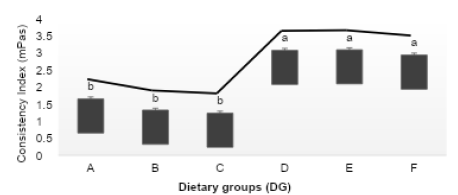
The effects of the addition of acacia gum on the viscosity values of the digesta in the duodenum of male broilers are shown in Figure 1. Duodenal viscosity significantly increased in groups supplemented with 500 to 1000 mg/kg of acacia gum (p<0.05). Remarkably, the increase in viscosity was not linear, but followed a curved pattern (quadratic effect) when the acacia gum addition to the diet was increased (p<0.05).

Effect of acacia gum addition on duodenal digesta viscosity values of male broilers (p-value: DG=0.001; L=0.001; Q=0.001).
Cecal SCFAs Analysis
The effects of the addition of acacia gum on SCFA in the caecum of male broiler chickens are shown in Table 4. The concentrations of acetate, butyrate and total SCFAs were higher in broilers fed acacia gum (groups B-F) than in group A (p<0.05). In addition, propionate concentrations were lower in broilers from groups B and C, but higher when acacia gum was added at 500 to 1000 mg/kg (groups D-F) than in group A (p<0.05). A linear effect from the increasing addition of acacia gum was observed for the concentrations of acetate, butyrate and total SCFAs, and a quadratic effect was observed for propionate concentration to increasing addition of acacia gum (p<0.05).
Caecal Bacterial Quantification
The effects of the addition of acacia gum on the quantification of the microbiota in the caecum of male broilers are shown in Table 5. The quantity of Lactobacillus spp. and Bacteroides spp. was higher in broilers receiving acacia gum than in group A (p<0.05). Broilers from groups E and F had higher quantity of Bifidobacterium spp. than those in group A (p<0.05), but this did not affect the other groups (B-D). On the other hand, the quantification of Clostridium perfringens was lower in broilers fed acacia gum (B-F) than in group A (p<0.05). Escherichia coli showed no effect in broilers fed acacia gum as compared to group A (p>0.05). In addition, there was a linear effect with increasing addition of acacia gum for Lactobacillus spp., Bifidobacteria spp. and Bacteroides spp. (p<0.05). Clostridium perfringens showed a quadratic effect from the increasing addition of acacia gum (p<0.05).
Gene Expression of Immune Response in Jejunum
The effects of the addition of acacia gum on the expression of immune genes in the intestine of male broiler chickens are shown in Table 6. The expressions of IL-1β, IL-4, IL-12, TNF-α, secretory MUC-2, and sIg A were increased in broilers fed with acacia gum as compared to group A (p<0.05). The expression of INF-γ was increased in broilers fed acacia gum (p<0.05), with the exception of group D, which was not affected compared to group A. In broilers from groups C to F (250-1000 mg/kg), the expression of IL-6 was increased and the expression of IL-10 was decreased in comparison to groups A and B (p<0.05). In addition, the expression of IL-1β, IL-6, IL-10, and IL-12 showed a linear effect with the addition of acacia gum (p<0.05). In contrast, the expression of TNF-α, INF-γ, secretory MUC-2, and sIg A showed a quadratic effect with the addition of acacia gum (p<0.05).
DISCUSSION
The gut microbiota plays a crucial role in the health and well-being of the host chicken by influencing the host’s physiology and metabolism in various ways (Elnagar et al., 2021). Several studies have reported that acacia gum can be used as a natural prebiotic in broiler diets (Ali et al., 2009; Al-Fadil et al., 2013). Acacia gum contains a high level (up to 80%) of soluble fibers such as galactose, rhamnose and arabinose, which cannot be digested by the chickens themselves (Khalid et al., 2014). Normally, acacia gum is used in traditional human medicine to treat various ailments such as intestinal infections, maintenance of kidney function, and inflammation (Fedail et al., 2016). Research by Abd Al-Fahad & Al-Mashhdani (2023) suggests that the addition of acacia gum can improve the intestinal health of poultry by promoting the fermentation process of beneficial bacteria. Our previous studies (Al-Baadani et al., 2022; 2024) investigated the mechanism of action of acacia gum when fed in high doses to broilers. It has been found that acacia gum remains undigested in the gastrointestinal tract and is then fermented by the intestinal microbiota. This fermentation process promotes the growth and activity of beneficial bacteria and the production of their beneficial by-products such as SCFAs, ultimately leading to a healthier gut environment (Zhou et al., 2024). The current experiment aimed to gain a more nuanced understanding of the effects of acacia gum on broiler performance and refine recommendations for its optimal use in broiler diets until 35 days of age.
In the present experiment, positive effects on body weight were observed in broilers fed 125 mg acacia gum/kg (10 days of age). In addition, 125 mg/kg of acacia gum resulted in higher daily weight gain between 0-10, 25-35, and 0-35 days of age. Interestingly, acacia gum supplementation led to higher body weights at 24 and 35 days of age. This indicates a broader positive effect on overall growth at different acacia gum levels. In addition, a consistent improvement in daily weight gain was observed in all acacia gum-fed groups (11-24 days of age). Overall, these results suggest that acacia gum promotes growth in broilers, with lower levels of acacia gum (125 mg/kg) often showing a more consistent positive effect across different growth stages, while higher levels contributed more to body weight at later stages. Our results are consistent with those of Siham et al. (2015), who reported similar beneficial effects of acacia gum administration on overall performance of broilers. They observed increased body weight gain and improved feed conversion ratio when acacia gum was added (250, 500, and 750 mg/kg). Contrary to the assumption that daily feed intake remained unaffected, we observed a significant decrease in feed intake at 11-24 days and 0-35 days of age in broilers fed acacia gum at lower doses (125 and 250 mg/kg). This decrease was not observed with other levels of acacia gum, suggesting a dose-dependent effect on feed intake. This selective reduction in feed intake for specific groups and time periods contrasts with the report by Tabidi & Ekram (2015), who found no effects of acacia gum on daily feed intake of broilers. These discrepancies could be due to differences in acacia gum source, acacia gum levels, broiler strain, or experimental conditions. Despite the observed reduction in feed intake in some acacia gum groups, the feed conversion ratio generally improved at almost all stages with the addition of acacia gum, especially between 11-24 and 0-35 days of age, even with reduced feed intake in broilers fed acacia gum (125 and 250 mg/kg); suggesting that acacia gum increases the efficiency of feed utilization, possibly due to improved nutrient digestibility, gut health, or metabolic efficiency.
The results now clearly state that higher levels of acacia gum (500 to 1000 mg/kg) led to a higher viscosity of duodenal contents. This result is consistent with studies by Williams & Phillips (2021), who explained that the highly branched structure and compact molecules of acacia gum lead to a viscous solution at higher concentrations. Increased viscosity can slow down the passage of digestive fluid through the intestine, which can prolong the time of nutrient absorption and improve nutrient utilization (Ayres et al., 2019). However, it appears that high viscosity has no effect on the growth performance of broilers fed high levels of acacia gum, which may be due to stimulation of the growth of beneficial bacteria in the gut. These bacteria can contribute to improved nutrient digestion and absorption, possibly offsetting the negative effects of increased viscosity.
In the present experiment, broilers fed acacia gum (125-1000 mg/kg) showed higher concentrations of acetate, butyrate, and total SCFAs. The propionate concentrations were lower in groups B (125 mg/kg) and C (250 mg/kg), but significantly higher with doses of 500 to 1000 mg/kg. The results also explicitly state that acetate, butyrate, and total SCFAs showed a linear effect, while propionate had a quadratic effect. These results indicate that acacia gum may be fermented by intestinal bacteria, leading to the production of SCFAs. This is a positive sign, as SCFAs are important energy sources for the host and play a crucial role in intestinal health. Jiménez-Moreno et al. (2009) reported that concentrations of SCFAs are influenced by factors such as age, fiber type, and the extent of fermentation in broilers. SCFAs such as acetate, propionate, and butyrate are important by-products of the fermentation of gut microbiota. They play an important role in maintaining the structural and functional integrity of the gut (Sobczak & Kozlowski, 2016). Butyrate is the preferred energy source for the intestinal mucosa; propionate contributes to gluconeogenesis in the liver, and acetate is used by the host for the biosynthesis of cholesterol and fatty acids (Louis & Flint, 2009). The result obtained is in line with Liu et al. (2019), who indicated that the highest butyric acid and total SCFA concentrations were associated with an improvement in mucosal structure and immunomodulation. Furthermore, the experiment results support the prebiotic potential of acacia gum (Alvarez-Sieiro et al., 2016).
The intestinal microbiota in the cecum of broiler chickens can change due to fermentation and the breakdown of indigestible fibers (Qiu et al., 2022). In the experiment, an increase in beneficial bacteria such as Lactobacillus spp., Bifidobacteria spp., and Bacteroides spp. was observed in chickens fed different levels of acacia gum (125-1000 mg/kg). Conversely, Clostridium perfringens decreased with acacia gum. These results are consistent with the established concept that prebiotics promote the growth of beneficial bacteria. Studies suggest a prebiotic effect of acacia gum on the growth of Bifidobacteria spp., which is consistent with observations in the human gut (Sasaki et al., 2022). For Bacteroides spp., the picture is less clear. Although some Bacteroides spp. have been shown to utilize sugars from acacia gum in the laboratory (Cartmell et al., 2018), other studies have reported an increase in Bifidobacteria spp. and Bacteroides spp. in the human gut or in simulated models following acacia gum administration (Calame et al., 2008). SCFAs are also produced by intestinal bacteria that ferment oligosaccharides, which may have antimicrobial properties. These SCFAs can disrupt the cell membranes of harmful Gram-negative bacteria such as Clostridium perfringens, and alter the pH of the intestinal environment, ultimately killing these bacteria (Faber et al., 2012). Acetic acid, butyric acid, and propionic acid all exhibit antimicrobial properties and likely play a critical role in controlling populations of pathogenic bacteria (Menconi et al., 2014). This control is likely achieved by lowering the pH of the gut through the production of these acids (Suiryanrayna & Ramana, 2015). According to Al-Alawi et al. (2018), the high concentration of non-polar components in acacia gum could be related to its antibacterial effect. In addition, Lawrence et al. (2015) investigated the antibacterial effect of acacia gum extracts against various bacteria. They attributed the observed activity to secondary metabolites such as tannins, flavonoids, and other compounds contained in these extracts. It is important to know that some bacteria, such as those of the genus Lactobacillus spp., can lower the pH in the gut by producing lactic acid. These bacteria are considered beneficial as they help control pathogens (Baldwin et al., 2018).
The current experiment also found that the expression of IL-1β, IL-4, IL-12; TNF-α; and INF-γ was increased in broilers receiving acacia gum from 125 to 1000 mg/kg in comparison to the control group. The relative expression of IL-6 was increased, and the relative expression of IL-10 was decreased in broilers receiving acacia gum (250 to 1000 mg/kg) supplementation to their basal diets (groups C to F) as compared to groups A and B. The experiment suggests that acacia gum itself may act as an antigen that is recognized by immune cell receptors and may have a positive effect on immunity. The observed cytokine expression patterns differ from the findings of Kamal et al. (2018), who reported reduced expression of IL-4 and IL-6 in acacia gum in humans. This suggests species-specific responses. In addition, acacia gum decreased the expression of TNF-α in rats (Ali et al., 2013). In a previous experiment, a dietary group with prebiotic (MOS, 200 mg/kg) increased the gene expression of IL-12 and INF-γ in broilers (Yitbarek et al., 2012). Adhikari & Kim (2017) associated lactic acid-producing bacteria with increased INF-γ production, which could explain the observed increase when acacia gum was added (as acacia gum is fermented by these bacteria). Cytokines such as IL-12 and INF-γ are important for cell-mediated responses against intracellular pathogens and the activation of macrophages (Palamidi et al., 2016). On the other hand, the effect of acacia gum on cytokine expression in this experiment could be due to its fermentation ability, alteration of the microbiota, or epithelial integrity of the small intestine. Sivaprakasam et al. (2016) reported that acacia gum regulates the expression of proinflammatory cytokines (TNF-α, INF-γ and IL-6) both directly and indirectly by modulating the host immune response via the microbiota. The expression of MUC-2 and sIg A was increased in broilers receiving acacia gum from 125 to 1000 mg/kg in comparison to the control group. The gene for sIg A is a protein secreted by plasma cells that helps prevent pathogens from attaching to the intestinal mucosa, thus enhancing the immune response, while the gene for MUC-2 is associated with mucin secretion, which acts as the first line of defense in the intestine (Liu et al., 2019). Dietary supplementation with prebiotics can strengthen the function of the intestinal barrier by increasing the number of goblet cells and sIg A -secreting cells (Shao et al., 2013). These findings are consistent with research by Rajani et al. (2016), who reported that prebiotics can increase MUC-2 gene expression, further supporting the potential of acacia gum as a prebiotic to improve intestinal barrier function.
Our results are consistent with previous studies emphasizing the prebiotic and immunomodulatory properties of acacia gum. However, discrepancies with other studies could be due to different experimental conditions, such as the type of diet, the duration of supplementation, or the specific dosages used. While higher concentrations may have been used in some studies, our results suggest that even moderate doses of acacia gum may have significant effects on gut health and immune responses in broilers.
CONCLUSION
Overall, these results indicate that the addition of acacia gum to the diet has a positive effect on growth performance, gut health, and broiler immune function. The observed improvements in growth parameters, SCFA production, beneficial microbiota (Lactobacillus spp., Bifidobacterial spp., and Bacteroides spp.) and the expression of immune genes (pro-inflammatory cytokines and mucosal immune factors) indicate that acacia gum can be a valuable feed additive as a natural prebiotic to improve the health and productivity of broilers, especially at the dosage of 1000 mg/kg of the basal diet.
ACKNOWLEDGEMENTS
The authors would like to thank Ongoing Research Funding Program, (ORFFT-2025-073-1), King Saud University, Riyadh, Saudi Arabia for financial support.
REFERENCES
-
Abd Al-Fahad ME, Al-Mashhdani HE. Evaluation of the addition of different percentages of gum Arabic powder (Acacia senegal) to diets on the productive performance of ross 308 broilers. IOP Conference Series: Earth and Environmental Science 2023;1262(7):72033. https://doi.org/10.1088/1755-1315/1262/7/072033
» https://doi.org/10.1088/1755-1315/1262/7/072033 -
Adhikari PA, Kim WK. Overview of prebiotics and probiotics: focus on performance, gut health and immunity-a review. Annals of Animal Science 2017;17(4):949-66. https://doi.org/10.1515/aoas-2016-0092
» https://doi.org/10.1515/aoas-2016-0092 -
Ahmadi S, Mainali R, Nagpal R, et al. Dietary polysaccharides in the amelioration of gut microbiome dysbiosis and metabolic diseases. Obesity and Control Therapies 2017;4:1-25. https://doi.org/10.15226/2374-8354/4/2/00140
» https://doi.org/10.15226/2374-8354/4/2/00140 -
Al-Alawi MS, Hossain MA, Abusham AA. Antimicrobial and cytotoxic comparative study of different extracts of Omani and Sudanese Gum acacia. Beni-Suef University Journal of Basic and Applied Sciences 2018;7(1):22-6. https://doi.org/10.1016/j.bjbas.2017.10.007
» https://doi.org/10.1016/j.bjbas.2017.10.007 -
Al-Baadani HH, Alhotan RA, Al-Abdullatif AA, et al. The effect of gum arabic supplementation on growth performance, blood indicators, immune response, cecal microbiota, and the duodenal morphology of broiler chickens. Animals 2022;12(20):2809. https://doi.org/10.3390/ani12202809
» https://doi.org/10.3390/ani12202809 -
Al-Baadani HH, Alhotan RA, Azzam MM, et al. Effect of gum Arabic as natural prebiotic on intestinal ecosystem of post-hatched broiler chicks. Journal of Animal Science and Technology 2024;66(6):1203. https://doi.org/10.5187/jast.2023.e57
» https://doi.org/10.5187/jast.2023.e57 - Al-Fadil S, Mukhtar MA, Tabidi MH. Response of broiler chicks to diets containing gum Arabic as a natural prebiotic. Journal of Current Research in Science 2013;1:247-3.
-
Ali BH, Beegam S, Al-Lawati I, et al. Comparative efficacy of three brands of gum acacia on adenine-induced chronic renal failure in rats. Physiological Research 2013;62:47-56. https://doi.org/10.33549/physiolres.932383
» https://doi.org/10.33549/physiolres.932383 -
Ali BH, Ziada A, Blunden G. Biological effects of gum arabic: a review of some recent research. Food and Chemical Toxicology 2009;47(1):1-8. https://doi.org/10.1016/j.fct.2008.07.001
» https://doi.org/10.1016/j.fct.2008.07.001 -
Aljumaah MR, Alkhulaifi MM, Abudabos AM, et al. Bacillus subtilis PB6 based probiotic supplementation plays a role in the recovery after the necrotic enteritis challenge. PloS One 2020;15:1-18. https://doi.org/10.1371/journal.pone.0232781
» https://doi.org/10.1371/journal.pone.0232781 -
Alvarez-Sieiro P, Montalbán-López M, Mu D, et al. Bacteriocins of lactic acid bacteria: extending the family. Applied Microbiology and Biotechnology 2016;100:2939-51. https://doi.org/10.1007/s00253-016-7343-9
» https://doi.org/10.1007/s00253-016-7343-9 -
Al-Zawqari MH, Al-Baddany AA, Al-Baadani HH, et al. Effect of feeding dried sweet orange (Citrus sinensis) peel and lemon grass (Cymbopogoncitratus) leaves on growth performance, carcass traits, serum metabolites and antioxidant status in broiler during the finisher phase. Environmental Science and Pollution Research 2016; 23:17077-82. https://doi.org/10.1007/s11356-016-6879-7
» https://doi.org/10.1007/s11356-016-6879-7 - Amein SM, Mosaad GM, Hussein MK. Effect of some medicinal plants as feed additives on growth performance, blood constituents and carcass characteristics of broilers. Journal of Advanced Veterinary Research 2019;9:170-7.
-
Angwech H, Tavaniello S, Ongwech A, et al. Efficacy of in ovo delivered prebiotics on growth performance, meat quality and gut health of kuroiler chickens in the face of a natural coccidiosis challenge. Animals 2019;9:876-89. https://doi.org/10.3390/ani9110876
» https://doi.org/10.3390/ani9110876 - AOAC - Association of Official Analytical Chemists. Official methods of analysis 17th ed. Washington; 2012.
-
Aviagen. Ross 308: broiler nutrition specification; 2022. Available from: https://tmea.aviagen.com/assets/Tech_Center/Ross_Broiler/RossBroilerNutritionSpecs2022-EN.pdf
» https://tmea.aviagen.com/assets/Tech_Center/Ross_Broiler/RossBroilerNutritionSpecs2022-EN.pdf -
Ayres VE, Broomhead JN, Li X, et al. Viscosity and growth response of broilers fed high fiber diets supplemented with a corn-produced recombinant carbohydrase. Journal of Applied Poultry Research 2019;28(4):826-36. https://doi.org/10.3382/japr/pfz039
» https://doi.org/10.3382/japr/pfz039 -
Baldwin S, Hughes RJ, Hao TT, et al. At-hatch administration of probiotic to chickens can introduce beneficial changes in gut microbiota. PLoS One 2018;13:0194825. https://doi.org/10.1371/journal.pone.0194825
» https://doi.org/10.1371/journal.pone.0194825 -
Barkeer S, Pothuraju R, Malakar P, et al. Gum acacia dietary fiber: Significance in immunomodulation, inflammatory diseases, and cancer. Phytotherapy Research 2024;38(3):1509-21. https://doi.org/10.1002/ptr.8125
» https://doi.org/10.1002/ptr.8125 -
Belal AS, Ismail A, Elnaggar MM, et al. Click chemistry inspired copper sulphide nanoparticle-based fluorescence assay of kanamycin using DNA aptamer. Molecular and Biomolecular Spectroscopy 2018;205:48-54. https://doi.org/10.1016/j.saa.2018.07.011
» https://doi.org/10.1016/j.saa.2018.07.011 -
Calame W, Weseler AR, Viebke C, et al. Gum Arabic establishes prebiotic functionality in healthy human volunteers in a dose-dependent manner. British Journal of Nutrition 2008;100:1269-75. https://doi.org/10.1017/S0007114508981447
» https://doi.org/10.1017/S0007114508981447 -
Cartmell A, Muñoz-Muñoz J, Briggs JA, et al. A surface endogalactanase in Bacteroides thetaiotaomicron confers keystone status for arabinogalactan degradation. Nature Microbiology 2018;3:1314-26. https://doi.org/10.1038/s41564-018-0258-8
» https://doi.org/10.1038/s41564-018-0258-8 -
Chen J, Wang P, Liu C, et al. Effects of compound feed additive on growth performance and intestinal microbiota of broilers. Poultry Science 2023;102(1):102302. https://doi.org/10.1016/j.psj.2022.102302
» https://doi.org/10.1016/j.psj.2022.102302 -
El Sabry MI, Yalcin S. Factors influencing the development of gastrointestinal tract and nutrient transporters' function during the embryonic life of chickens: a review. Journal of Animal Physiology and Animal Nutrition 2023;107(6):1419-28. https://doi.org/10.1111/jpn.13852
» https://doi.org/10.1111/jpn.13852 -
Elnagar R, Elkenany R, Younis G. Interleukin gene expression in broiler chickens infected by different Escherichia coli serotypes. Veterinary World 2021;14:2727. https://doi.org/10.14202/vetworld.2021.2727-2734
» https://doi.org/10.14202/vetworld.2021.2727-2734 -
Faber TA, Dilger RN, Iakiviak M, et al. Ingestion of a novel galactoglucomannan oligosaccharide-arabinoxylan (GGMO-AX) complex affected growth performance and fermentative and immuno-logical characteristics of broiler chicks challenged with Salmonella typhimurium. Poultry Science 2012;91:2241-54. https://doi.org/10.3382/ps.2012-02189
» https://doi.org/10.3382/ps.2012-02189 -
Fedail JS, Ahmed AA, Musa HH, et al. Gum Arabic improves semen quality and oxidative stress capacity in alloxan induced diabetes rats. Asian Pacific Journal of Reproduction 2016;5:434-41. https://doi.org/10.1016/j.apjr.2016.07.014
» https://doi.org/10.1016/j.apjr.2016.07.014 -
Hu Q, Gerhard H, Upadhyaya I, et al. Antimicrobial eugenol nanoemulsion prepared by gum Arabic and lecithin and evaluation of drying technologies. International Journal of Biological Macromolecules 2016;87:130-40. https://doi.org/10.1016/j.ijbiomac.2016.02.051
» https://doi.org/10.1016/j.ijbiomac.2016.02.051 -
Jiménez-Moreno E, González-Alvarado JM, de Coca-Sinova A, et al. Effects of source of fibre on the development and pH of the gastrointestinal tract of broilers. Animal Feed Science and Technology 2009;154:93-101. https://doi.org/10.1016/j.anifeedsci.2009.06.020
» https://doi.org/10.1016/j.anifeedsci.2009.06.020 -
Kamal E, Kaddam LA, Dahawi M, et al. Gum Arabic fibers decreased inflammatory markers and disease severity score among rheumatoid arthritis patients, Phase II Trial. International Journal of Rheumatology 2018;1:1-6. https://doi.org/10.1155/2018/4197537
» https://doi.org/10.1155/2018/4197537 -
Khalid SA; Musa AM, Saeed AM, et al. Manipulating dietary fibre: Gum Arabic making friends of the colon and the kidney. Bioactive Carbohydrates and Dietary Fibre 2014,3:71-76. https://doi.org/10.1016/j.bcdf.2014.01.005
» https://doi.org/10.1016/j.bcdf.2014.01.005 -
Kheravii SK, Swick RA, Choct M, et al. Effect of oat hulls as a free choice feeding on broiler performance, short chain fatty acids and microflora under a mild necrotic enteritis challenge. Animal Nutrition 2018;4:65-72. https://doi.org/10.1016/j.aninu.2017.11.003
» https://doi.org/10.1016/j.aninu.2017.11.003 -
Kim WH, Lillehoj HS. Immunity, immunomodulation, and antibiotic alternatives to maximize the genetic potential of poultry for growth and disease response. Animal Feed Science and Technology 2019;250:41-50. https://doi.org/10.1016/j.anifeedsci.2018.09.016
» https://doi.org/10.1016/j.anifeedsci.2018.09.016 -
Korcz E, Kerényi Z, Varga L. Dietary fibers, prebiotics, and exopolysaccharides produced by lactic acid bacteria: potential health benefits with special regard to cholesterol lowering effects. Food and function 2018;9(6):3057-68. https://doi.org/10.1039/C8FO00118A
» https://doi.org/10.1039/C8FO00118A - Lawrence R, Jeyakumar E, Gupta A. Antibacterial activity of acacia Arabica (Bark) extract against selected multi drug resistant pathogenic bacteria. International Journal of Current Microbiology and Applied Sciences 2015;1:213-222.
-
Lee KW, Hong YH, Lee SH, et al. Effects of anticoccidial and antibiotic growth promoter programs on broiler performance and immune status. Research in Veterinary Science 2012;93:721-8. https://doi.org/10.1016/j.rvsc.2012.01.001
» https://doi.org/10.1016/j.rvsc.2012.01.001 -
Liu SD, Song MH, Yun W, et al. Effect of carvacrol essential oils on immune response and inflammation-related genes expression in broilers challenged by lipopolysaccharide. Poultry Science 2019;98:2026-33. https://doi.org/10.3382/ps/pey575
» https://doi.org/10.3382/ps/pey575 -
Livak KJ, Schmittgen TD. Analysis of relative gene expression data using real-time quantitative PCR and the 2-??CT method. Methods 2001; 25:402-8. https://doi.org/10.1006/meth.2001.1262
» https://doi.org/10.1006/meth.2001.1262 -
Lockyer S, Stanner S. Prebiotics-an added benefit of some fiber types. Nutrition Bulletin 2019;44:74-91. https://doi.org/10.1111/nbu.12366
» https://doi.org/10.1111/nbu.12366 -
Louis P, Flint HJ. Diversity, metabolism and microbial ecology of butyrate-producing bacteria from the human large intestine. FEMS Microbiology Letters 2009;294:1-8. https://doi.org/10.1111/j.1574-6968.2009.01514.x
» https://doi.org/10.1111/j.1574-6968.2009.01514.x -
Menconi A, Kuttappan VA, Hernandez-Velasco X, et al. Evaluation of a commercially available organic acid product on body weight loss, carcass yield, and meat quality during preslaughter feed withdrawal in broiler chickens: a poultry welfare and economic perspective. Poultry Science 2014;93:448-55. https://doi.org/10.3382/ps.2013-03444
» https://doi.org/10.3382/ps.2013-03444 -
Mushtaq N, Hussain S, Zhang S, et al. Molecular characterization of alterations in the intestinal microbiota of patients with grade 3 hypertension. International Journal of Molecular Medicine 2019;44:513. https://doi.org/10.3892/ijmm.2019.4235
» https://doi.org/10.3892/ijmm.2019.4235 -
Palamidi I, Fegeros K, Mohnl M, et al. Probiotic form effects on growth performance, digestive function, and immune related biomarkers in broilers. Poultry Science 2016;95(7):1598-608. https://doi.org/10.3382/ps/pew052
» https://doi.org/10.3382/ps/pew052 -
Qiu Y, Li C, Dong H, et al. Analysis of key fungi and their effect on the edible quality of HongJun tofu, a Chinese fermented okara food. LWT 2022;172:114151. https://doi.org/10.1016/j.lwt.2022.114151
» https://doi.org/10.1016/j.lwt.2022.114151 -
Rajanie J, Dastar B, Samadi F, et al. Effect of extracted galactomannan oligosaccharides from pine wood (Pinus brutia) on Salmonella Typhimurium colonization, growth performance and intestinal morphology in broiler chicks. British Poultry Science 2016;57:682-92. https://doi.org/10.1080/00071668.2016.1200013
» https://doi.org/10.1080/00071668.2016.1200013 -
Ramlucken U, Ramchuran SO, Moonsamy G, et al. A novel Bacillus based multi-strain probiotic improves growth performance and intestinal properties of Clostridium perfringens challenged broilers. Poultry Science 2020;99:331-41. https://doi.org/10.3382/ps/pez496
» https://doi.org/10.3382/ps/pez496 - SAS Institute. SAS users guide: statistics. Cary; 2008.
-
Sasaki Y, Komeno M, Ishiwata A, et al. Mechanism of cooperative degradation of gum Arabic arabinogalactan protein by Bifidobacterium longum surface enzymes. Applied and Environmental Microbiology 2022;88:02187-21. https://doi.org/10.1128/aem.02187-21
» https://doi.org/10.1128/aem.02187-21 -
Shao Y, Guo Y, Wang Z. Beta-1,3/1,6-Glucan alleviated intestinal mucosal barrier impairment of broiler chickens challenged with Salmonella enterica serovar Typhimurium. Poultry Science 2013;92:1764-73. https://doi.org/10.3382/ps.2013-03029
» https://doi.org/10.3382/ps.2013-03029 - Siham A, Khadiga A, Huwaida E, et al. Effect of dietary inclusion of gum Arabic (Acacia senegal) on performance and blood chemistry of broiler chicks. Wayamba Journal of Animal Science 2015;3(2):305-10.
-
Sivaprakasam S, Prasad PD, Singh N. Benefits of Short-chain fatty acids and their receptors in inflammation and carcinogenesis. Pharmacology and Therapeutics 2016;164:144-51. https://doi.org/10.1016/j.pharmthera.2016.04.007
» https://doi.org/10.1016/j.pharmthera.2016.04.007 -
Smith JA. Broiler production without antibiotics: United States field perspectives. Animal Feed Science and Technology 2019;250:93-8. https://doi.org/10.1016/j.anifeedsci.2018.04.027
» https://doi.org/10.1016/j.anifeedsci.2018.04.027 -
Sobczak A, Kozlowski K. Effect of dietary supplementation with butyric acid or sodium butyrate on egg production and physiological parameters in laying hens. European Poultry Science/Archiv für Geflügelkunde 2016;80:1-14. https://doi.org/10.1399/eps.2016.XX
» https://doi.org/10.1399/eps.2016.XX -
Suiryanrayna MV, Ramana JV. A review of the effects of dietary organic acids fed to swine. Journal of Animal Science and Biotechnology 2015;6:1-11. https://doi.org/10.1186/s40104-015-0042-z
» https://doi.org/10.1186/s40104-015-0042-z - Tabidi MH, Ekram KA. Effect of feeding gum Arabic with or without commercial xylem enzyme 500 on the performance of broiler chicks. World Journal of Pharmacy and Pharmaceutical Sciences 2015;4:1863-72.
- Williams PA, Phillips GO. Gum Arabic. In: Phillips GO, Williams PA, editors. Handbook of hydrocolloids. Cambridge: Wood-head Publishing; 2021. p.627-52.
-
Xiong W, Wang Y, Sun Y, et al. Antibiotic-mediated changes in the fecal microbiome of broiler chickens define the incidence of antibiotic resistance genes. Microbiome 2018;6:1-11. https://doi.org/10.1186/s40168-018-0419-2
» https://doi.org/10.1186/s40168-018-0419-2 -
Xuan NT, Shumilina E, Nasir O, et al. Stimulation of mouse dendritic cells by gum Arabic. Cellular Physiology and Biochemistry 2010;25:641-8. https://doi.org/10.1159/000315083
» https://doi.org/10.1159/000315083 -
Yesuf YK, Zema AA, Mejab MM. Effect of fringed rue (Ruta chalepensis) leaf as feed additives on growth performance and carcass characteristics of broiler chickens. Cogent Food and Agriculture 2023;9(2):2274170. https://doi.org/10.1080/23311932.2023.2274170
» https://doi.org/10.1080/23311932.2023.2274170 -
Yitbarek A, Echeverry H, Brady J, et al. Innate immune response to yeast-derived carbo-hydrates in broiler chickens fed organic diets and challenged with Clostridium perfringens. Poultry Science 2012;91:1105-12. https://doi.org/10.3382/ps.2011-02109
» https://doi.org/10.3382/ps.2011-02109 -
Zhao H, Bai H, Deng F, et al. Chemically protected sodium butyrate improves growth performance and early development and function of small intestine in broilers as one effective substitute for antibiotics. Antibiotics 2022;11:132-51. https://doi.org/10.3390/antibiotics11020132
» https://doi.org/10.3390/antibiotics11020132 -
Zhou P, Chen C, Patil S, et al. Unveiling the therapeutic symphony of probiotics, prebiotics, and postbiotics in gut-immune harmony. Frontiers in Nutrition 2024;11:1355542. https://doi.org/10.3389/fnut.2024.1355542
» https://doi.org/10.3389/fnut.2024.1355542
-
FUNDING
This research was financially supported by the Ongoing Resrarch Funding program, (ORFFT-2025-073-1), King Saud University, Riyadh, Saudi Arabia.
-
DATA AVAILABILITY STATEMENT
The corresponding author (H.H. Al-Baadani) can provide the data supporting the conclusions of the experiment upon reasonable request.
-
DISCLAIMER/PUBLISHER’S NOTE
The published papers’ statements, opinions, and data are those of the individual author(s) and contributor(s). The editor(s) disclaim responsibility for any injury to people or property resulting from any ideas, methods, instructions, or products referred to in the content.
The corresponding author (H.H. Al-Baadani) can provide the data supporting the conclusions of the experiment upon reasonable request.