 Optimizing Local Duck Performance: Synergistic Effects of Probiotics and Dietary Protein Levels on Growth and Escherichia coli Suppression
ABSTRACT
This study evaluated the effects of probiotics added to rations with different protein levels on growth performance and ileal Escherichia coli (E. coli) populations in local ducks. A total of 240 Alabio ducks were allocated to five treatments, with six replications, in a completely randomized design. Treatments were: T1=control (basal diet/BD); T2=BD+4000 ppm probiotic; T3=BD with reduced protein (starter 16% CP, grower 14% CP)+4000 ppm probiotic; T4=BD with further-reduced protein (starter 14%) CP, grower 12% CP+4000 ppm probiotic; T5=BD+4000 ppm commercial probiotic. Parameters were feed intake, body weight, weight gain, feed conversion ratio, ileal E. coli counts, and mortality. Probiotic supplementation significantly improved performance in the starter and grower. Mortality was 1.25% across treatments. During the starter, the higher LBW was T5 (448 g/duck), and the lower was T4 (339 g/duck). Meanwhile, the lower FC was T1 (835 g/duck), and the worst was T5 (911 g/duck and the higher body weight gain was T5 (408 g/duck). T1 and T5 were similar on FCR (211 vs 2.23 g/g). The grower showed no significant differences (p>0.05) among all treatments for FC, LBW, and BWG, but significant differences for FCR. The best FCR was T4 (2.73 g/g) and the worst was T5 (3.07 g/g). The probiotic also reduced the number of E. coli in the ileum. It was concluded that the combination of giving 4000 ppm probiotics and low protein levels (12%) improved the performance of local ducks and reduced the population of ileal E. coli in local ducks at various levels of feed protein.
Keywords:
Probiotic; local duck; performance;
E. coli
INTRODUCTION
Indonesia has several local duck species with high potential for both egg and meat production. One local duck species across various regions of Indonesia is the Alabio duck (Anas platyrhynchos borneo). Alabio ducks originate from the Amuntai region of South Kalimantan and are known for their potential in both meat and egg production. Demand for duck eggs and meat in Indonesia is increasing, in line with the growing emphasis on nutritious food for good health. However, the production and quality of Alabio ducks have not yet reached optimal levels. Therefore, adding probiotics to the ration is necessary to increase the productivity and quality of local Indonesian ducks.
The use of probiotics as feed additives in poultry feed has a positive effect on the performance, enhances health status and bone development of chickens, as well as improves overall nutritional utilization (Mohammed et al., 2021; Ahmad et al., 2022; Richard et al., 2024; Naeem & Bourassa, 2025).
An equally important benefit was the reduction of pathogenic microorganisms in the intestinal tract, accompanied by improved nutrient efficiency and absorption. Previous studies have demonstrated that probiotics, including Bacillus, Lactobacillus, Bifidobacterium, and Enterococcus, can significantly inhibit pathogenic infections both in vitro and in vivo (Zhou et al., 2015; Safari et al., 2016). Beyond supporting bird health, probiotics also enhance the quality and overall characteristics of poultry products (Katarzyna et al., 2021). Probiotics act as bioregulators in the poultry intestinal tract, helping maintain microbial balance and strengthening host immune defenses (Naeem et al., 2025). In addition to regulating the gut ecosystem, beneficial gut microbes can produce natural antimicrobial compounds that positively affect host health and performance. The addition of probiotics may be more effective in low-nutrient feed. Ali et al. (2025) noted that a low-protein diet causes less environmental pollution than a high-protein diet, which can also exceed permissible limits. In addition, previous reports have shown that reducing crude protein (CP) in the diet from 17% to 16% with the addition of amino acids has no negative effect on production performance and egg quality in laying hens. A balanced low-protein diet supplemented with amino acids also drastically reduces ammonia excretion from feces. In summary, our results show that gas emissions can be reduced without affecting productivity and egg quality in Hy-Line Brown laying hens by using a low-CP diet supplemented with amino acids, indicating that this strategy is an effective measure for reducing greenhouse gas emissions (Ali et al., 2025). High-protein feed ingredients cause excessive nitrogen output and environmental damage; therefore, reducing protein levels in diets is highly desirable in poultry nutrition (Lambert et al., 2023).
In another study, the addition of probiotics to poultry feed significantly improved the growth performance of broiler chickens, nutrient utilization, and the composition of beneficial gut microbiota (Mountzouris et al., 2010). Probiotics also play an important role in maintaining the balance of microbial populations in the digestive tract of poultry. This balance is vital for poultry welfare and nutrient utilization efficiency, as it can reduce ammonia production from nitrogen waste.
The application of probiotics in poultry nutrition has been widely implemented in chickens; however, its use in duck production remains limited (Zurmiati et al., 2014). Previous studies also indicate that further research and development into probiotic supplementation strategies are necessary to achieve efficient, practical production methods that provide economic benefits to the livestock industry. Supplementation of duck diets with probiotics aims to enhance microbial balance in the gastrointestinal tract and suppress pathogenic bacteria such as E. coli, Salmonella spp., and Clostridium spp. (Naeem et al., 2025). Administration of 0.1% probiotics in rations containing 16% crude protein significantly improved the performance of ducks aged 2-10 weeks by reducing feed consumption and feed conversion ratio. Zurmiati et al. (2014) reported that supplementation of Bacillus amyloliquefaciens at 2000-3000 ppm in drinking water improved growth performance and decreased FCR in Pitalah ducks during a 6-week rearing period. Various probiotic strains, including Bifidobacterium, Lactobacillus, and yeast, have been widely evaluated in laying and broiler chickens (Alavi et al., 2012; Mohammed et al., 2018; Park et al., 2021), whereas research and application in local laying and broiler ducks remain limited. Duck production plays an important role in providing high-quality eggs and meat, contributing significantly to the human food supply.
Protein is one of the most critical nutrients determining growth rate and productivity in ducks. However, the optimal crude protein requirement for ducks, notably local breeds raised under smallholder conditions, remains unclear and varies widely. Even for well-studied commercial breeds such as Pekin ducks, protein requirements have not been fully established (Chao et al., 2020). Maintaining a balanced nutritional ratio at all stages of growth is essential for achieving optimal performance. The recommended crude protein content for starter ducks is 16-18%, and the metabolizable energy is around 3,100 kcal/kg (Directorate General of Livestock and Animal Health, Ministry of Agriculture, 2017). Because growth is rapid during the starter period (0 to 8 weeks), a relatively high protein content is required, while protein deficiency will inhibit growth. On the other hand, excessive dietary protein intake leads to increased nitrogen excretion, including ammonia, which can increase environmental stress and susceptibility to infection in ducks. Precision nutrition methods are increasingly emphasized to provide the required amounts of nutrients more accurately, promote animal growth and product quality, minimize feed waste, and reduce environmental burden (Zhang et al., 2020). Inadequate nutrient supply limits an individual’s growth potential, while excess, poorly digested nutrients impose unproductive metabolic burdens on animals (Geng et al., 2023). Therefore, accurately determining nutrient requirements is crucial for improving production efficiency.
Feed costs for dairy cattle rations are largely determined by nutritional content, as higher protein content has been shown to. Therefore, in this study, the effect of probiotic supplementation on rations with different protein levels, starting from the basic protein requirement, was investigated. The probiotic used was B. amyloliquefaciens, which is a technology developed by the Indonesian Agency for Agricultural Research and Development (Balitbang Kementan). Based on these results, local ducks may have a “protein-saving probiotic effect.” This method has strong methodological and practical implications by linking microbiological responses to appropriate feed formulations and evaluating productive traits in a unique integrated experimental design.
This study was conducted to investigate the effect of probiotic supplementation in feed containing different protein levels on growth performance and Escherichia coli population in the ileum of local ducks.
MATERIALS AND METHODS
The research was conducted with the approval of the animal ethics clearances Balitbangtan/Balitnak/A/07/2021).
Multiplication of B. amyloliquefaciens as a Probiotic
The media used for the propagation of B. amyloliquefaciens consisted of nutrient agar and Paul Marjonoff (PM) liquid medium. The propagation procedure followed the method described by Kompiang (personal communication, 2015).
Starter Period (at 4 and 8 Weeks Old)
A total of 240 unsexed Alabio ducks were used in this study. Pre-treatment, ducks were weighed to determine initial body weight and then randomly allocated to wire brooder cages measuring 1 m × 80 cm each. Each cage was equipped with a 250-watt TL lamp to maintain optimal brooding temperature and minimize temperature-related stress. To further reduce stress and enhance immunity, all ducks received Vita-Chick diluted in drinking water at a dosage of 5 g per 7 L of clean water.
From days 1 to 14, ducks were fed a commercial starter diet to allow adaptation before introducing the treatment diets. The feed ingredients used in the experimental diets included pollard, corn, soybean meal, meat and bone meal (MBM), lysine, methionine, crude palm oil (CPO), premix, dicalcium phosphate (DCP), limestone, and salt. Probiotic Bacillus sp. served as the functional feed additive. Diets were formulated for two feeding phases according to duck age: starter (3-8 weeks) and grower (9-20 weeks). Starter diet treatments were as follows:
-
T1: Basal diet (BD), 18% CP + 0 ppm probiotic (control)
-
T2: Basal diet (BD), 18% CP + 4000 ppm probiotic
-
T3: Basal diet (BD), 16% CP + 4000 ppm probiotic
-
T4: Basal diet (BD), 14% CP + 4000 ppm probiotic
-
T5: Basal diet (BD), 18% CP + 4000 ppm commercial probiotic
The ingredient composition of starter diets (3-8 weeks old) and grower diets (9-20 weeks old) is presented in Table 1. Probiotics (1.5 x 10⁸ CFU/g) were administered from 3 to 20 weeks of age. Nutrient formulation followed Purba and Sinurat (2015), with diets formulated to be iso-nitrogenous and iso-caloric, and balanced for lysine and methionine according to age requirements. Feed and water were provided ad libitum.
The experiment used a Completely Randomized Design (CRD) with five dietary treatments and six replications, each replicate containing eight ducks. Performance variables measured during the starter phase included feed consumption (FC), live body weight (LBW), body weight gain (BWG), feed conversion ratio (FCR), and mortality. Parameters were recorded weekly at 4 and 8 weeks.
When ducks reached four weeks of age, they were transferred from brooder cages and randomly placed into litter pens lined with acrylic, each equipped with feeders, drinkers, and standard housing equipment. The nutrient composition of the grower ration was formulated based on the recommendations of Purba & Sinurat (2015). Probiotic supplementation in the grower diet was applied from 9 to 20 weeks of age at the same dosage used during the starter phase, namely 4000 ppm/kg feed. The dietary treatments for the grower phase were as follows:
-
T1: Basal diet (BD), 16% CP + 0 ppm probiotic (control)
-
T2: Basal diet (BD), 16% CP + 4000 ppm probiotic
-
T3: Basal diet (BD), 14% CP + 4000 ppm probiotic
-
T4: Basal diet (BD), 12% CP + 4000 ppm probiotic
-
T5: Basal diet (BD), 16% CP + 4000 ppm commercial probiotic.
Performance variables measured during the grower period (9, 12, 16, and 20 weeks of age) included FC, LBW, BWG, FCR, total E. coli populations in the ileum, and mortality. Enumeration of E. coli in the ileum was conducted according to the procedure described by Ghaly & Alhattab (2013).
Ileal Microbial Count
The gut microbial population was determined according to the procedure of Ghaly & Alhattab (2013) with slight modifications. Briefly, 1 g of gut contents was transferred into a test tube containing 9 mL of sterile distilled water and shaken until homogeneous, yielding the first dilution (10-1). Next, 1 mL of the 10-1 dilution was transferred to a second tube containing 9 mL of sterile distilled water, mixed until homogeneous, and used to obtain the 10-2 dilution. Dilution procedure was continued until a dilution of 10-10 was reached. After that, 0.1 mL of the 10-10 dilution was evenly spread onto Eosin Methylene Blue Agar plates with a sterile glass rod, and the plates were incubated at 36°C for 24 hours. Each sample was analyzed three times following the same procedure. After overnight incubation, the samples were counted to determine the microbial population. To ensure accuracy, dilutions were chosen to produce Petri dishes containing between 30 and 300 colonies. Colony-forming units (CFU) per gram of sample were expressed as log10 values, and bacterial colonies were counted on each petri dish using a colony counter. The microbial population was calculated using the following equation:
Statistical Analysis
Performance data were analyzed using the General Linear Model (GLM) procedure in the Statistical Analysis System (SAS, version 6.12; SAS Institute, 1997). When significant treatment effects were detected, mean differences were further evaluated using Duncan’s multiple range test.
RESULTS AND DISCUSSION
Performance of Ducks at 4 and 8 Weeks Old (Starter Period)
FC, LBW, BWG, FCR, and mortality of Alabio ducks at 4 and 8 weeks of age are presented in Table 2. At 4 weeks of age, FC T1 (835±1.60 g/duck) was lower and significantly different compared to T2, T3, T4, and T5 (p<0.001), while at 8 weeks of age, T1 still produced the lowest FC with a very significant difference to T3-T5 (p<0.001). This efficiency is thought to be related to the quality of the commercial ration in T1. Overall, Table 2 shows that probiotics affect feed consumption patterns, but the T1 ration remains the most effective in suppressing FC in both growth phases.
The LBW of ducks at 4 weeks of age (starter period) was significantly influenced (p<0.05) by probiotic supplementation at different dietary protein levels. As shown in Table 2, the LBW of ducks fed the T1 ration did not differ significantly (p>0.05) from those fed T2 and T5, but was significantly higher (p<0.05) than that of ducks fed T3 and T4. In the starter phase, T1, T2, and T5 were similar (p>0.05) but higher than T3 and T4. The lowest LBW was recorded in ducks given the T4 ration (14% CP + 4000 ppm probiotic). These findings indicate that a lower protein level (14% CP) was insufficient to support optimal growth during the starter period, even when probiotics were included as feed additives.
The mean BWG at 4 weeks of age is shown in Table 2. Statistical analysis indicated that adding probiotics at different dietary levels significantly affected BWG at 4 weeks of age (p<0.05). Ducks receiving the T1, T2, and T5 treatments had significantly higher BWG values (p<0.05) compared with those fed the T3 diet. In addition, BWG values for the T4 treatment group were significantly lower (p<0.01) than all other treatments, making T4 the group with the lowest BWG.
Probiotics significantly affected BWG (p<0.01). Ducks receiving the T1, T2, and T5 rations had significantly higher BWG (p<0.05) than those fed the T3 ration, and very significantly higher BWG (p<0.001) than those receiving the T4 ration. The highest BWG was recorded in the T5 treatment, followed by T1 and T2. The BWG values of these three treatments differed significantly (p<0.001) from those of the T3 and T4 groups. These results indicate that, during the starter phase, the combination of an appropriate dietary protein level and probiotic supplementation can markedly enhance BWG in ducks. Conversely, probiotic supplementation in rations with protein levels lower than the control did not result in optimal BWG during the starter phase.
The BWG of Alabio ducks at 4 weeks of age, as presented in Table 2, was significantly influenced by probiotic supplementation across various feed protein levels (p<0.001). Treatments T1, T2, and T5 produced significantly higher BWG than treatments T3 and T4 (p<0.001), while treatment T4 showed the lowest BWG. These findings confirm that the interaction between feed protein levels and probiotic supplementation significantly increases BWG during the early growth phase.
FCR of ducks fed rations supplemented with probiotics is presented in Table 2. Probiotic inclusion significantly affected FCR (p<0.05). At four weeks of age, the best FCR was observed in the T1 treatment and was similar to those in T2 and T5, whereas the poorest FCR was observed in the T4 treatment.
The average FCR values for T2 and T3 were relatively similar, with no significant difference between them (p>0.05). The FCR values for T1 and T2 were superior to those of T3, T4, and T5 at four weeks. The average FCR values for T1 and T2 were 2.11 ± 0.10 and 2.25 ± 0.03, respectively. In duck production, a lower FCR indicates greater feed efficiency, reducing feed costs and improving growth performance, whereas a higher FCR reflects less efficient feed utilization and increased production expenses.
The FCR performance of Alabio ducks in weeks 4 and 8 showed a significant effect (p<0.001) of probiotic supplementation, as shown in Figure 1. In week 4, the FCR values for treatments T1, T2, and T5 were better than those for treatments T3 and T4. In week 8, adding probiotics to diets with 16-18% protein resulted in the most efficient FCR, whereas the negative control treatment (T4: 14% protein) remained suboptimal. During the early growth period, diets with higher feed protein content (T1, T2, and T5) produced better FCR than diets with low protein content, suggesting that duck growth at this stage may be primarily limited by protein availability; whereas probiotic efficiency is still limited by an immature digestive system and gut microbial community (Mountzouris et al., 2010; Liu et al., 2017). Conversely, during the late growth stage, probiotic supplementation at moderate dietary protein levels (16-18%) was more productive in terms of FCR, suggesting that the primary effect of probiotics is to support nitrogen utilization rather than compensate for protein deficiency. This response is believed to be related to increased gut microbiota activity, easier digestion by digestive enzymes, and improved gut integrity (Zhang et al., 2020). The low-protein-level treatment (T4) showed that adding probiotics to the diet did not improve FCR.

The number of E. coli bacteria in the ileum of ducks was increased with the addition of probiotics in the diet.
Feed intake (FC) of ducks over eight weeks and the effect of feeding treatments are shown in Table 2. The probiotic ratio at various protein levels had a significant impact on FC (p<0.05). Treatment T1 showed a significantly lower FC than the other treatments (p<0.05) and a highly significant difference (p<0.001) when compared to T3, T4, and T5. FC after 8 weeks was significantly lower in T1 and statistically higher in T4. As seen at four weeks, the T1 ratio was also significantly more effective at eight weeks in reducing FC, possibly due to the higher quality of the commercial feed provided in this treatment. In contrast, the increase in FC for T3 may be related to the lower feed protein content (16%), despite probiotic supplementation. Ducks tend to overconsume feed when the feed’s protein content does not fully meet their metabolic needs. Therefore, FC values generally decreased with probiotic intervention (T2 and T3 compared with T1).
FCR of eight-week-old ducks fed rations supplemented with probiotics at varying protein levels is also summarized in Table 2. Probiotic inclusion significantly influenced FCR (p<0.05). The T3 ration resulted in a significantly different FCR (p<0.05) compared with the other treatments. Although the T3 ration contained 16% protein and was supplemented with 4,000 ppm/kg probiotics, this level was insufficient to achieve an optimal FCR at eight weeks. However, combining 4,000 ppm/kg probiotics with 16% and 18% protein diets resulted in the greatest improvement in FCR among all treatments.
Performance of Ducks Aged 12, 16, and 20 Weeks (Grower Period)
Observations and measurements of duck performance during the grower phase (12, 16, and 20 weeks of age) were recorded. The nutrient composition of the treatment rations used in this phase is presented in Table 3. Table 3 also summarizes the performance of ducks fed rations supplemented with probiotics at different protein levels.
The addition of probiotics to the treatment rations significantly influenced the FC of grower ducks (p<0.001). As presented in Table 3, ducks in the T2 group exhibited a significantly higher FC (p<0.05) than those in T1, T3, and T5, and an even greater difference (p<0.001) compared with T4. The highest feed intake efficiency (FC) was observed in the T4 treatment, possibly due to its relatively low protein content (12%). The 12% protein level is insufficient for efficient feeding in grower ducks, as observed even with the use of probiotics at 4000 ppm/kg, especially at week 12. The most efficient FC was observed in the T2 treatment, averaging 1267 g/duck/unit per week, compared with all other treatments. These results indicate that a 16% protein diet, together with probiotics, improves feed utilization in ducks at 12 weeks of age. Although the T4 equation was associated with the highest FC, its nutritional composition was suboptimal for the best efficiency. Therefore, the T2 ratio with 16% protein and probiotic supplementation at 4000 ppm/kg was considered the optimal treatment, resulting in DM intake from 4028 to 4109 g/duck/week.
The LBW of ducks fed probiotic supplements at various protein levels is shown in Table 3. The results showed that the treatment did not significantly affect LBW (p>0.05). Live weight gain (BWG) was also not significantly different between ducks fed probiotic supplements and ducks not fed probiotic supplements (p>0.05). At 12 weeks of age, LBW and BWG varied from 1231 to 1301 g/duck/week and from 1190 to 1261 g/duck/week, respectively.
The interaction between probiotic supplementation and protein levels on FCR was also considered. This is shown in Table 3. Probiotics significantly affected FCR in 12-week-old ducks (p<0.05). T3 was significantly different from the other treatments (p<0.05). The highest FCR was observed in T1 (4000 ppm probiotics added per kg of feed) with 16% protein, at 3.32. However, FCR increased in the T4 treatment. These results indicate that a diet containing only 12% protein, even when supplemented with probiotics, is insufficient to ensure optimal performance, particularly FCR, in ducks over 12 weeks.
The effect of probiotic supplementation on FC at various dietary protein levels in 16-week-old ducks is shown in Table 3. Probiotic supplementation significantly affected FC (p<0.001). In all treatments, the best values were observed in T2 with an average FC of 4741 ± 0.01 g/duck/week and a performance range of 4741 to 4788 g/duck/week. The maximum FC (4928 g/duck) was found in the quadruple treatment T4. These results indicate that the 12% protein-based diet supplemented with the tested probiotics did not achieve optimal feed utilization. Therefore, T2 is recognized as the best way to increase FC in 16-week-old ducks.
The LBW and BWG of 16-week-old ducks fed with probiotic ratios at various protein levels are shown in Table 3. The results showed that probiotic supplementation at various protein levels significantly affected LBW and BWG (p<0.05). Ducks in the T4 treatment showed significantly higher BWG than other groups (p<0.05), suggesting that the T4 ratio is more suitable for achieving optimal growth performance at 16 weeks of age. The average BWG of ducks at 16 weeks of age was 1409 g/duck/week, where the T4 treatment varied (1303 and 1504 g/duck/week). The BWG results followed the same trend, with the T4 group achieving a BWG of 1368 g/duck, while the lowest BWG was observed in the T3 group (1253 g/duck). In general, LBW and BWG were quite consistent among the treatments, with the T4 treatment performing best. These results suggest that providing a probiotic supplement with a lower protein diet compared to the control diet would have beneficial effects on LBW and BWG when ducks reached 16 weeks of age. It indicates that a low-protein diet (12%) combined with probiotics may improve feed quality, which may be due to significant microbial activity in the gut. The effects of probiotic supplementation on LBW and BWG are presented in Table 3. Significant differences were observed among probiotics at various protein contents (p<0.05). At 16 weeks of age, ducks receiving T4 treatment had higher BWG than those in other treatments (p<0.05), suggesting that T4 treatment was more beneficial for growth performance. Mean of duck BWG at 16 wk was 1,409 g/week per bird. The BWG were in the T4 group, ranging from 1,303 to 1,504 g/duck/week. The lowest LBW was also observed in ducks fed the T3 diet, at 1,294 g/duck (Table 3). The BWG of ducks at 16 weeks showed a similar trend to the average BWG. The addition of probiotics to the ration had a significant effect on BWG (p<0.05). Ducks receiving the T4 ration exhibited significantly higher BWG (p<0.05) than other treatments, at 1,368 g/duck. In contrast, the lowest BWG was observed in the T3 treatment group, at 1,253 g/duck. The results for both LBW and BWG demonstrated a consistent pattern across treatments. The study demonstrates that supplementing rations with probiotics at a lower protein level than the control diet can yield positive results, notably improving LBW and BWG in 16-week-old ducks. These findings indicate that low-protein rations (12%) supplemented with probiotics can enhance overall feed quality. The improvement in ration quality is associated with the activity of beneficial microbes in the intestinal tract, which supports better nutrient utilization.
The performance of ducks at 20 weeks of age (end of the grower period) with the addition of probiotics at various dietary protein levels is presented in Table 3. The observed variables showed a significant effect (p<0.05). The addition of probiotics at different protein levels significantly influenced FC in ducks (p< 0.05). Table 4 shows that the T2, T3, and T4 treatments were significantly different ( p<0.05) from the T5 treatment, whereas the T1 treatment did not differ significantly (p>0.05) compared with the other treatments. Ducks receiving the T5 ration exhibited the highest FC at 20 weeks of age.
The study also demonstrated that the T3 and T4 treatments produced significantly higher BWG (p<0.05) than the other rations, while the lowest BWG was recorded in ducks receiving the T2 treatment, averaging 1,395 g/duck. The LBW of ducks fed the T3 and T4 rations were 1,533 g/duck and 1,475 g/duck, respectively.
The average BWG of ducks in response to probiotic supplementation at various protein levels is shown in Table 3. At 20 weeks of age, BWG of ducks was affected (p<0.05) by probiotic supplementation. After statistical analysis in Table 3, ducks at T3 and T4 showed significantly higher BWG than ducks at T1, T2, and T5 (p<0.05). This finding demonstrates, for the first time, that BWG at 20 weeks of age is positively affected by probiotic supplementation and protein-free feed in the control group, compared to the reference value of 4,000 ppm. These results also suggest that probiotics can improve the nutritional value of low-protein diets, particularly protein utilization. Duskaev et al. (2020) showed that BAC containing probiotics (Bacillus licheniformis) can significantly increase protein and total amino acid content. These findings align with other studies showing that probiotics are more effective when the nutrient content of the feed is low (Wang et al., 2021). Furthermore, Jeong & Kim (2014) found that Bacillus supplementation in feed significantly increased the feed conversion ratio in the grower-finisher phase and throughout the entire experimental period.
The best performance observed in the T4 treatment indicates that improved livestock/duck performance is not solely dependent on crude protein content but is also related to nitrogen utilization efficiency. However, gastrointestinal microbiota also play a role. High-protein feeds for animals will induce the removal of excess amino groups (-NH2) by gut microbes, thereby reducing nutrient utilization efficiency (Wu et al., 2021; Chen et al., 2022). Meanwhile, low-protein feed combined with the probiotic B. amyloliquefaciens in the T4 treatment can facilitate the proteolytic enzymes of B. amyloliquefaciens, which can break down proteins into amino acids for easier absorption by the intestine (Cai et al., 2023).
The FCR of 20-week-old ducks fed rations with various protein levels supplemented with probiotics is presented in Table 3. Treatments T3 and T4 differed significantly (p<0.05) with T1, T2, and T5 treatments.The lowest FCR was observed in the T4 and T3 treatments, at 2.73 and 2.85, respectively. The highest FCR was recorded in the T5 treatment, followed by T2 and T1. The highest FCR was recorded in treatment T5, followed by T2 and T1. In terms of efficiency, this study concluded that treatment T4 was more efficient than treatment T3.
The Population of E. coli Bacteria
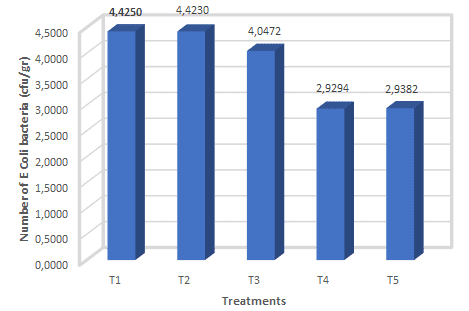
The E. coli bacterial count in the ileum of 20-week-old Alabio ducks is presented in Figure 1. The lowest E. coli bacterial count was found in treatment T4 (2,9294 CFU/g), followed by T5 (2,9382 CFU/g). Meanwhile, the E. coli counts in treatments T1, T2, and T3 were higher than in treatments T4 and T5 (Figure 1). This indicates that adding B. amyloliquefaciens to a low-protein diet can reduce the E. coli population.
This study is in line with Jeong & Kim (2014) and Richard et al. (2024). Administering B. amyloliquefaciens CECT 5940 through drinking water at 1-7, 13-17, and 23-27 days of age resulted in lower coliform and E. coli populations in fecal samples compared to the control group (Richard et al., 2024). Jeong & Kim (2014) reported that administering probiotics to broiler feed could reduce the abundance of pathogenic bacteria. Among them, the administration of B. subtilis C-1302 in broiler chicken feed has been shown to provide probiotic benefits, improving growth performance and feed efficiency by modulating the intestinal microflora, with minimal side effects. The duck mortality rate during the study, from the starter to grower period, was only 1.25%. This is strongly suspected to be closely related to the use of probiotics in the feed.
During the starter and grower phases, Alabio ducks show distinct physiological responses to probiotic supplementation and dietary protein levels, reflecting their changing nutritional needs as they grow. In the starter phase (0-8 weeks), the birds prioritize rapid development, and although adding probiotics significantly improves overall growth per-formance, it cannot fully make up for severe protein deficiencies; as a result, ducks on lower protein diets (e.g., 14% CP) have significantly lower body weight and weight gain compared to those on a standard 18% protein diet. In contrast, during the grower phase (9-20 weeks), the interaction between probiotics and dietary protein becomes more noticeable, enabling ducks to maintain good growth and feed efficiency even at further reduced protein levels (down to 12% CP), while also achieving the greatest reduction of pathogenic ileal E. coli populations.
CONCLUSION
It was concluded that the combination of giving 4000 ppm probiotics and low protein levels (12%) improved the performance of local ducks and reduced the population of ileal E. coli in local ducks at various levels of feed protein. Reducing the protein content of rations for duck maintenance, followed by the addition of probiotics such as Bacillus amyloliquefaciens, was also a positive strategy to increase feed efficiency and health, and reduce mortality in Alabio ducks.
ACKNOWLEDGEMENTS
The authors gratefully acknowledge the Ministry of Agriculture of the Republic of Indonesia for financial support of this study. Sincere appreciation is also extended to Sumardi and Hamdan, technicians of the Duck Program at the Indonesian Research Institute of Animal Science (IRIAP), Ciawi, Bogor, for their valuable technical assistance throughout the research.
REFERENCES
-
Ahmad R, Yu Y, Hsiao H, et al. Probiotics as a friendly antibiotic alternative: Assessment of their effects on the health and productive performance of poultry. Fermentation 2022;(8):672. https://doi.org/10.3390/fermentation8120672
» https://doi.org/10.3390/fermentation8120672 - Alavi S, Zakeri A, Kamrani B, et al. Effect of prebiotics, probiotics, acidfire, growth promoter antibiotics, and synbiotics on humoralimmunity of broiler chickens. Global Veterinaria 2012;8:612-7.
-
Ali U, Lee K, Cai D, et al. A low-protein diet with amino acid supplementation maintains laying performance and egg quality while reducing ammonia emissions in Hy-line brown hens. Tropical Animal Health and Production 2025;25(354):1-9. https://doi.org/10.1007/s11250-025-04611-4
» https://doi.org/10.1007/s11250-025-04611-4 -
Cai Z, Zhang S, Wang L, et al. Effects of dietary protein reduction combined with probiotics on nitrogen utilization, gut microbiota, and growth performance in broiler chickens. Poultry Science 2023;102(6):102553. https://doi.org/10.1016/j.psj.2023.102553
» https://doi.org/10.1016/j.psj.2023.102553 -
Chao L, Liu C, Suthawongwadee S, et al. Effects of probiotics on depressive or anxiety variables in healthy participants under stress conditions or with a depressive or anxiety diagnosis: a meta-analysis of randomized controlled trials. Frontiers in Neurology 2020;421(11):1-10. https://doi.org/10.3389/fneur.2020.00421
» https://doi.org/10.3389/fneur.2020.00421 -
Chen Y, Li J, Zhang H, et al. Low-protein diets supplemented with probiotics improve nitrogen retention and reduce nitrogen excretion in broilers. Animal Feed Science and Technology 2022;289:115333. https://doi.org/10.1016/j.anifeedsci.2022.115333
» https://doi.org/10.1016/j.anifeedsci.2022.115333 -
Duskaev G, Rakhmatullin S, Kvan O. Effects of Bacillus cereus and coumarin on growth performance, blood biochemical parameters, and meat quality in broilers. Veterinary World 2020;13:2484. https://doi.org/10.14202/vetworld.2020.2484-2492
» https://doi.org/10.14202/vetworld.2020.2484-2492 -
Endo T, Nakano M, Shimizu, et al. Effect of a probiotic on the lipid metabolism of cocks fed on a cholesterol-enriched diet. Bioscience, Biotechnology, and Biochemistry 1999;63(9):1569-75. https://doi.org/10.1271/bbb.63.1569
» https://doi.org/10.1271/bbb.63.1569 - Fuller R. Probiotics in man and animals. Journal Applied Bacteriology 1989;66(5):365-78.
-
Ghaly AE, Alhattab M. Drying poultry manure for pollution potential reduction and production of organic fertilizer. American Journal of Environmental Sciences 2013;9(2):88-102. https://doi.org/ doi:10.3844/ajessp.2013.88.102
» https://doi.org/ -
General of Livestock and Animal Health. Ministry of Agriculture; 2017 [cited 2026 Dec 19]. Available from: https://ditjenpkh.pertanian.go.id/storage/master/file/f2lHiA9p_Buku_Statistik_2017_(ebook).pdf
» https://ditjenpkh.pertanian.go.id/storage/master/file/f2lHiA9p_Buku_Statistik_2017_(ebook).pdf -
Geng T, Zhu K, Lu Q, et al. Healthy lifestyle behaviors, mediating biomarkers, and risk of microvascular complications among individuals with type 2 diabetes: a cohort study. Plos Medicine 2023;1(1). https://doi.org/10.1371/journal.pmed.1004135
» https://doi.org/10.1371/journal.pmed.1004135 -
Jeong J, Kim H. Effect of Bacillus subtilis C-3102 spores as a probiotic feed supplement on growth performance, noxious gas emission, and intestinal microflora in broilers. Poultry Science 2014;93(12). https://doi.org/10.3382/ps.2014-04086
» https://doi.org/10.3382/ps.2014-04086 -
Katarzyna K, Damian K, Mariusz K. Overview of the use of probiotics in poultry production. Animals 2021;11(1620). https://doi.org/10.3390/ani11061620
» https://doi.org/10.3390/ani11061620 -
Lambert, W., Berrocoso, J. D., Swart, B., Van Tol, M., Bruininx, E., & Willems, E. Reducing dietary crude protein in broiler diets positively affects litter quality without compromising growth performance whereas a reduction in dietary electrolyte balance further improves litter quality but worsens feed efficiency. Animal Feed Science and Technology 297:115571. https://doi.org/10.1016/j.anifeedsci.2023.115571
» https://doi.org/10.1016/j.anifeedsci.2023.115571 -
Liu X, Yan H, Lv L, et al. Growth performance and meat quality of broiler chickens supplemented with probiotics. Journal of Animal Physiology and Animal Nutrition 2017;101(6):127-35. https://doi.org/10.1111/jpn.12669
» https://doi.org/10.1111/jpn.12669 -
Liu, W C, Ye M, Liao XD, et al. Modulation of gut microbiota and nitrogen metabolism by Bacillus amyloliquefaciens supplementation in poultry fed reduced-protein diets. Frontiers in Microbiology 2024;15:1298441. https://doi.org/10.3389/fmicb.2024.1298441
» https://doi.org/10.3389/fmicb.2024.1298441 -
Mohammed A, Jacobs J, Murugesan G, et al. Effect of dietary synbiotic supplement on behavioral patterns and growth performance of broiler chickens reared under heat stress. Poultty Science 2018;97. https://doi.org/10.3382/ps/pex421
» https://doi.org/10.3382/ps/pex421 -
Mohammed A, Zaki R, Negm E, et al. Effects of dietary supplementation of a probiotic (Bacillus subtilis) on bone mass and meat quality of broiler chickens. Poultry Science 2021;100(100906). https://doi.org/10.1016/j.psj.2020. 11.073
» https://doi.org/10.1016/j.psj.2020. 11.073 -
Mountzouris K, Palamidi I, Arvaniti A. et al. Effects of probiotic inclusion levels in broiler nutrition on growth performance, nutrient digestibility, plasma immunoglobulins, and cecal microflora composition. Poultry Science 2010; 89. https://doi.org/10.3382/ps.2009-00308
» https://doi.org/10.3382/ps.2009-00308 -
Naeem M, Bourassa D. Probiotics in poultry: unlocking productivity through microbiome modulation and gut health. Microorganisms 2025;13(257). https://doi.org/10.3390/microorganisms13020257
» https://doi.org/10.3390/microorganisms13020257 -
Park H, Lee M, Jeong D, et al. Safety evaluation and in vivo strain-specific functionality of Bacillus strains isolated from Korean traditional fermented foods. Probiotics and Antimicrobial Proteins 2021;13. https//doi.org/10.1007/S12602-020-09672-5
» https//doi.org/10.1007/S12602-020-09672-5 -
Pelicia K, Mendes A, Saldanha E, et al. Probiotic and prebiotic utilization in diets for free-range broiler chickens. Brazilian Journal of Poultry Science 2004;6(21). https://doi.org/10.1590/S1516-635X2004000200005
» https://doi.org/10.1590/S1516-635X2004000200005 -
Pirgozliev V, Murphy T, Owens B, et al. Fumaric and sorbic acid as additives in broiler feed. Research in Veterinary Science 2008;84. https://doi.org/10.1016/j.rvsc.2007.06.010
» https://doi.org/10.1016/j.rvsc.2007.06.010 - Purba M, Sinurat A. Kinerja itik petelur pmp diberi ransum berbeda kadar energi dan lisin. Proceedings of Seminar Unggas Lokal; 2015 Nov 18-19. Semarang. IDN: Fakultas Peternakan Universitas Diponegoro; 2015.
-
Richard R, Tri W, Pangestiningsih, et al. The effects of Bacillus amyloliquefaciens CECT 5940 supplementation on the health performance and gut morphology of broiler chickens. German Journal of Veterinary Research 2024;4(3). https://doi.org/10.51585/gjvr.2024.3.0099
» https://doi.org/10.51585/gjvr.2024.3.0099 -
Safari R, Adel M, Lazado C, et al. Host-derived probiotics Enterococcus casseliflavus improve resistance against Streptococcusiniae infection in rainbow trout (Oncorhynchus mykiss) via immunomodulation. Fish & Selfish Immunology 2016;52. https://doi.org/10.1016/j.fsi.2016.03.020
» https://doi.org/10.1016/j.fsi.2016.03.020 -
Senok A, Ismael A, Botta G. Probiotics: facts and myths. Clinical Microbiology and Infection 2005:11(12). https://doi.org/10.1111/j.1469-0691.2005.01228.x
» https://doi.org/10.1111/j.1469-0691.2005.01228.x -
Saleh AA, Gálik B, Arpášová H, et al. Probiotics as a strategy to enhance protein utilization and reduce ammonia emission in poultry production: a review. Animals 2022;12(21):2947. https://doi.org/10.3390/ani12212947
» https://doi.org/10.3390/ani12212947 - Simon O. Micro-organisms as feed additives probiotics. Advances in Pork Production 2005;16:161.
-
Torres-Rodriguez A, Sartor C, Higgins S, et al. Effects of aspergillus meal prebiotic (fermacto) on performance of broiler chickens in the starter phase and fed low protein diets. Journal of Applied Poultry Research 2005;14(4). https://doi.org/10.1093/japr/14.4.665
» https://doi.org/10.1093/japr/14.4.665 -
Wang H, Ha BD, Kim IH. Effects of probiotics complex supplementation in low nutrient density diet on growth performance, nutrient digestibility, faecal microbial, and faecal noxious gas emission in growing pigs. Italian Journal of Animal Science 2021;20(1):163-70. https://doi.org/10.1080/1828051X.2020.1801358
» https://doi.org/10.1080/1828051X.2020.1801358 -
Wu SB, Swick RA, Rodgers N, Choct M, Courtin C M. Optimizing dietary protein levels and gut microbiota to improve nitrogen efficiency in broiler chickens. Journal of Animal Science and Biotechnology 2021;12(1):88. https://doi.org/10.1186/s40104-021-00594-2
» https://doi.org/10.1186/s40104-021-00594-2 -
Zhang Y, Gu Y, Ren H, et al. Gut microbiome-related effects of berberine and probiotics on type 2 diabetes (the prospective study). Nature Communications 2020;11. https://doi.org/10.1038/s41467-020-18414-8
» https://doi.org/10.1038/s41467-020-18414-8 -
Zhou D, Zhu Y, Zhang W, et al. Oral administration of a select mixture of Bacillus probiotics generates Tr1 cells in weaned F4ab/acR- pigs challenged with an F4+ ETEC/VTEC/EPEC strain. Veterinary Research 2015;46(95). https://doi.org/10.1186/s13567-015-0223-y
» https://doi.org/10.1186/s13567-015-0223-y -
Zurmiati, Mahata, Abbas M, et al. The application of probiotic on duck. Jurnal Peternakan Indonesia 2014;16(2):6 https://doi.org/10.25077/jpi.16.2.134-144.2014
» https://doi.org/10.25077/jpi.16.2.134-144.2014
-
FUNDING
The authors would like to thank the Ministry of Agriculture of the Republic of Indonesia for supervising and funding this research.
-
DATA AVAILABILITY STATEMENT
Research data is available in the body of the article.
-
DISCLAIMER/PUBLISHER’S NOTE
The published papers’ statements, opinions, and data are those of the individual author(s) and contributor(s). The editor(s) disclaim responsibility for any injury to people or property resulting from any ideas, methods, instructions, or products referred to in the content.
Research data is available in the body of the article.