 A Systematic Review of Single Nucleotide Polymorphisms and its Association with Eggshell Thickness in Chickens
ABSTRACT
Eggshell prevents microbial contamination of the egg’s internal content, and its quality determines the commercial acceptance or rejection of eggs. Broken eggs amount to about 6 to 8% of total egg production, resulting in economic loss to the egg industry. The task of animal genomics is the development of accurate genetic methods to identify genes that play a role in the manifestation of commercial traits. The current report aimed to systematically review literature on single nucleotide polymorphism and its association with chicken eggshell thickness. Literature used for the current study was obtained from the Google Scholar, PubMed, ScienceDirect, and Web of Science databases using single nucleotide polymorphisms, eggshell thickness, and chickens as key words combined in various ways. From the primary search, 76 articles were obtained, and 15 qualified to be used in the study after further screening for eligibility. These 15 studies were published from 2008 to 2023, and most of them originated from China (6), Japan (2) and Nigeria (2). Ovocleidin-116 (20%), Ovocalyxin-32 (13%) and ChEST985k21(13%) were mostly investigated in different chicken breeds. In conclusion, they are considered to be the best candidate genes playing a role in the development of eggshell thickness, as there was association between genotypes and eggshell thickness.
Keywords:
Eggshell thickness genes; Ovocleidin-116; Ovocalyxin-32; marker-trait association;
Insulin-like Growth Factor-1
INTRODUCTION
The egg industry around the world has a significant impact on the economy (Liu et al., 2011). The quality of chicken egg shells is one of its economically important traits, being affected by many factors such as environment, nutrition, diseases and genetic makeup of the animal (Jiang et al., 2010). Liu et al. (2011) further reports that eggshell quality determines whether eggs are accepted or rejected during marketing. In addition, Jiang et al. (2010) reported that the quality of the eggshell is important in chicken breeding, as it prevents microbial contamination, loss of water and plays an important role in embryonic development through the provision of calcium. However, broken eggs amount to about 6 to 8% of total egg production, resulting in economic loss to the egg industry (Dunn et al., 2008). Barkova et al. (2010) suggests that the task of animal genomics is to develop accurate genetic methods of identifying genes playing a role in the manifestation of commercial traits.
Common genes used to improve chicken eggshell thickness include Low-density Lipoprotein Receptor (LRP2) in the Pureline dwarf layers breed, Ovocalyxin-32 (OCX-32) in the White Leghorn (WL) and Rhode Island Red (RIR) breeds, Low-Density Lipoprotein Receptor-Related Protein 8 (LRP8) in dwarf chickens breeds, Ovocleidin-116 (OC-116) in the Nigerian Heavy Local Chicken Ecotype, Rhode Island Red hens and Pureline Rhode Island White layers breeds, Osteopontin (SPP1), Ovocalyxin-32, Ovotransferrin (LTF), Ovalbumin and Ovocalyxin-36, Estrogen Receptor (ESR1) and Carbonic Anhydrase II (CAII) in the Rhode Island Red hens breed, ChEST985k21 in Rhode Island layers, Polish breed Green and Rhode Island Red breed, Non-SMC Condensin I Complex, Subunit G (NCAPG) in Island chicken breed, Insulin-like Growth Factor-1 (IGF-1) in the Normal feather, Naked neck, Frizzle, Kuroiler and Sasso breeds, Subunit Beta 2 (PSMB2) in the LingKun Chickens breed, Parathyroid hormone gene in the Houdan hens breed, calmodulin1 (CALM1) in the Pureline Rhode Island White layers breed, GRB14 and GALNT1 in White Leghorn and Brown-Egg Dwarf Layers, Ovoinhibitor (OIH) in White Leghorn breed and Phospholipase C zeta (PLCZ1) in the Rhode Island Red breed.
To the authors’ knowledge, there is no literature on single nucleotide polymorphism and its association with chicken eggshell thickness. Hence the objective of this study was to systematically review literature on single nucleotide polymorphism and its association with chicken eggshell thickness. This could assist to address the identified gaps and provide guidance to chicken breeders on selecting genes to improve eggshell thickness.
MATERIALS AND METHODS
Eligibility criteria
In the current systematic review, the identification of Population, Exposure, and Outcomes (PEO) components of the research question was performed. Chickens were defined as a population of the review, eggshell thickness was defined as the exposure, and single nucleotide polymorphism of candidate genes associated with chicken eggshell thickness were the outcomes. Before the start of the study, a search of PEO elements on Google Scholar, ScienceDirect, PubMed, and Web of Science was conducted.
Search Strategy
Systematic review of the articles was performed by Kagisho Madikadike Molabe and Thobela Louis Tyasi on Google Scholar, PubMed, ScienceDirect and Web of Science databases using key combination (combined in various ways) of single nucleotide polymorphisms, eggshell thickness, and chickens.
Inclusion criteria
Systematic review included articles that were published in English investigating candidate genes associated with eggshell thickness of chickens. Articles on either genome-wide or single nucleotide polymorphism were included.
Exclusion criteria
Studies using other species than the species of interest, duplicate records, and studies not meeting the requirement (e.g. not including the key combination and using another genetic polymorphism) were excluded.
Data extraction
Kagisho Madikadike Molabe and Thobela Louis Tyasi independently selected and extracted studies (articles with authors, year of publication and type of model) of the systematic review based on the above-mentioned exclusion and inclusion criteria and agreed regarding all the materials.
Ethical considerations
To ensure the quality of the report, data manipulation, misconduct, plagiarism, and informed concern were considered ethically by all authors when conducting the systematic review.
RESULTS
Searched articles
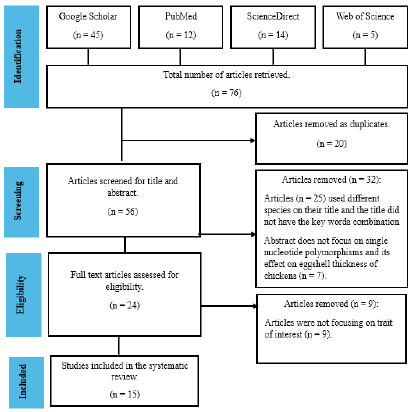
A flowchart of the identification and selection of articles for the systematic review with reasons for exclusion of articles are shown in Figure 1. A total number of 76 studies were selected from the primary search on Google Scholar, PubMed, ScienceDirect and Web of Science using the key combination (Single nucleotide polymorphisms, eggshell thickness, and chickens). A total of 56 studies remained after the extraction of duplicates, and 32 studies were excluded after screening of the title and abstract. Further screening for eligibility resulted in 15 studies being included in the current systematic review.
Characteristics of the included studies
The current systematic review used 15 articles that investigate the potential association between single nucleotide polymorphisms and chicken eggshell thickness, as shown in Table 1. Amongst the articles, Barkova published 3 articles in different years (Barkova et al., 2011; 2021; 2015). White Leghorn was used by 5 articles as the experimental animal, while other articles (n = 4) used Rhodes Island Red. About 20% (3/15) of the included articles investigated the ovocalyxin-32 gene. The results also showed that Dunn et al. (2008), Wang et al. (2016), and Ikeh et al. (2020) investigated the association of the same gene (Ovocleidin-116) with chicken eggshell thickness. About 60% (9/15) of the included articles focused on one gene of interest, whereas the others (40%) focused on more than one gene (6/15).
Publication by year
Figure 2 shows the number of articles published per year. The years 2008 (Dunn et al., 2008), 2009 (Uemoto et al., 2009), 2013 (Barkova et al., 2013), 2020 (Ikeh et al., 2020) and 2023 (Whetto et al., 2013) had the lowest number of publications, each with one article (n=1). On the other hand, 2010 (Yao et al., 2010) had the highest number of publications (20%, 3/15), while 2011 (Liu et al., 2011) and 2016 (Wang et al., 2016) had an equal number of publications (n=2) (13%, 2/15).

Publication by country
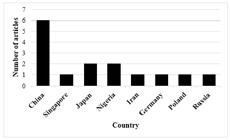
The number of articles published per country are represented in Figure 3. The results indicated that the included articles had the following countries of origin: Russia (Barkova & Smaragdov, 2015), Singapore (Whetto et al., 2023), Iran (Barkova et al., 2010), Poland (Barkova et al., 2010). Furthermore, Russia (Barkova & Smaragdov, 2015) had the lowest number of articles (n = 1), while China had the highest number of publications 40% (6/15).
Publication by population size
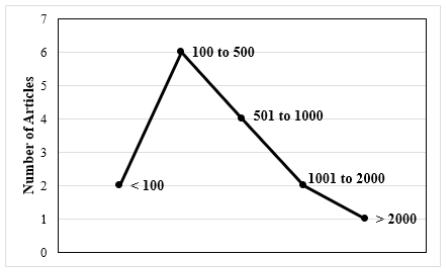
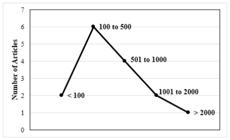
Figure 4 shows the population size of the chickens used in the studies. The results indicated that all the included articles informed the population size used. About 40% (6/15) of the included articles used population sizes between 100 and 500 chickens, and the largest population size was noted in the articles by Dunn et al. (2008) and Yao et al. (2010).
Distribution of the included articles by genes
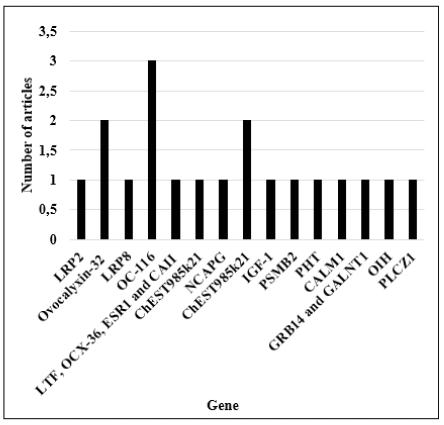
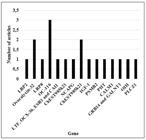
Results on Figure 5 show the number of genes per article. About 20% (3/15) of the articles investigated the same gene [Ovocleidin-116 (OC-116)] (Dunn et al., 2008; Wang et al., 2016; Ikeh et al., 2020). Ovocalyxin-32 was investigated by 2 articles (Dunn et al., 2008; Uemoto et al., 2009), and ChEST985k21 was also investigated by the same author in different years (Barkova et al., 2010 and 2013).
Identified SNPs and their regions
The identified SNPs and their positions from the included articles are presented in Table 2. The results indicated that about 73% (11/15) of the included articles identified 1 SNP. Twenty seven percent (4/15) of included articles identified 2 (rs13968878, rs13978498; Liu et al., 2011), 3 (T267G, A494C, G381C; Uemoto et al., 2009), 4 (rs15841856, rs14986134, s16544657,ss538155652; Duan et al., 2015) or 6 (S2_1 (GATCAGYAGTAAA), S3_1 (CATTTTRCTCTCA), S3_2 (GTTCAGYGTGGTC), S3_3 (TGTAAAYGCAGCA), S3_4 (CAGAATYGCACAG), S6_1 (AGTTTTYGGGTGC; Barkova et al., 2013) SNPs. The results of the current study also revealed that 47% (7/15) of the included articles showed the SNPs positions, while 53% (8/15) articles did not show the SNP positions. It was recognised that amongst the 47% (7/15) of the articles that identified SNP positions, 86% (6/7) of the SNPs were noted on exons, whereases 4% (1/7) identified SNP on intron (Retnosari & Daryon 2022). The results further indicated that about 67% (4/6) of articles identified 4 SNPs on exon 4. Amongst the investigated breeds, 27% (4/15) of included articles used the Rhode Island Red chicken breed.
Allelic and genotypic frequencies
Allelic and genotypic frequencies are shown in Table 3. Our findings showed that about 53% (8/15) of the included articles did not highlight the gene frequencies, 67% (10/15) did not indicate genotypic frequencies, and 73% (11/15) did not indicate if the populations were under Hardy Weinberg equilibrium or not. In addition,about 33% (5/15) of the included articles indicated both the gene and genotypic frequencies. Out of the 5 included articles that indicated frequencies, 50% (2/5) revealed that the population was under Hardy Weinberg equilibrium (Jiang et al., 2010; Ikeh et al., 2020), while those by Yao et al. (2010), and Zhang et al. (2011) were not under Hardy Weinberg equilibrium. The gene frequency of the investigated reports ranged between 0.09 and 0.91, with genotypic frequency ranging from 0.01 to 51.8.
Association of genotypes of the identified SNPs with eggshell thickness and their effect on the protein-coding region
The association of genotypes of the identified SNPs with eggshell thickness and the effect of SNPs on protein-coding region are represented in Table 4. About 67% (10/15) of included articles showed the association between genotypes of identified SNPs and traits of interest. Analysis of marker-trait association showed that 20% (3/15) of the selected articles did not highlight whether there was a marker-trait association or not (Wang et al., 2016; Gao et al., 2022; Wheto et al., 2023). SNP effect on the protein-coding region was highlighted by 13% (2/15), showing synonymous SNPs (Jiang et al., 2010; Zhang et al., 2011), while 7% (1/15) showed non-synonymous SNP (Barkova et al., 2015), and 80% (12/15) articles did not indicate the type of SNP.
Association of genotypes of the identified SNPs with eggshell thickness and the genetic variation contribution.
DISCUSSION
The current report systematically reviews single nucleotide polymorphism and its effects on chicken eggshell thickness, which supports marker-trait selection to enhance eggshell thickness. The review comprised 15 articles, with China (40%, 6/15 articles) being the leading country, with different sample sizes (100 and 500). From the investigated articles, Ovocleidin-116 (20%), Ovocalyxin-32 (13%) and ChEST985k21(13%) were the most studied candidate genes across different chicken breeds for their potential influence on eggshell thickness, an influence that was effectively observed.
Reports by Ikeh et al. (2010) on Nigerian Heavy Local chicken ecotype, Dunn et al. (2008) on Rhode Island Red hens, and Wang et al. (2016) on Pureline Rhode Island White layers agree that Ovocleiding-116 is the best candidate gene for marker trait association to improve eggshell thickness. A study conducted by Dunn et al. (2008) on Rhode Island Red hens reveals that Ovocalyxin-32 is the best gene for improving eggshell thickness. Barkova et al. (2010) studied the Polish breed Green and Rhode Island Red breed, and also conducted another study on Rhode Island layers, and indicated the CHEST985K21 as the gene playing a role in eggshell thickness. rs16030727 in the Ovodeidin-116, rs14491030 in CHEST985K21 on Exon 8, S2_1 (GATCAGYAGTAAA), S3_1 (CATTTTRCTCTCA), S3_2 (GTTCAGYGTGGTC), S3_3 (TGTAAAYGCAGCA), S3_4 (CAGAATYGCACAG), S6_1 (AGTTTTYG GGTGC) in CHEST985K21 and C00895G in Ovocalyxin-32, C1110G and C00895G in Ovocleidin-116 could be used as a genetic markers during animal breeding to improve eggshell thickness.
To our knowledge, the current review is the first to report on the use of single nucleotide polymorphism and its association with eggshell thickness in different chicken breeds, with no other studies it could be compared with. Current reports reveal that marker-traits association is a successful molecular approach to improve traits of economic importance such as eggshell thickness to enhance egg production.
CONCLUSION
The review suggests that Ovocleiding-116, CHEST985K21 and Ovocalyxin-32 are candidate genes playing a role in chicken eggshell thickness. The current systematic review is supported by the fact that there are no similar studies on single nucleotide polymorphism and its association with chicken eggshell thickness. This review also suggests that rs16030727, C1110G and C00895G in the Ovocleidin-116, rs14491030 in CHEST985K21 on Exon 8, S2_1 (GATCAGYAGTAAA), S3_1 (CATTTTRCTCTCA), S3_2 (GTTCAGYGTGGTC), S3_3 (TGTAAAYGCAGCA), S3_4 (CAGAATYGCACAG), S6_1 (AGTTTTYG GGTGC) in CHEST985K21 and C00895G in Ovocalyxin-32 could be used as genetic markers during animal breeding to improve eggshell thickness. However, more studies need to be conducted to increase information of the current review. In conclusion, the marker-trait association may be used to improve eggshell thickness.
ACKNOWLEDGEMENTS
Special thanks to Tyasi research team for their support and encouragement during the study.
REFERENCES
-
Barkova OU, Sazanova AL, Blagoveshenskiy IU, et al. Design of a system for genotyping of Gallus gallus based on the rSNP (Regulatory single nucleotide polymorphism) alleles affecting the eggshell thickness. Russian Journal of Genetics 2010;47:216-20. https://doi.org/10.1134/S1022795411020049
» https://doi.org/10.1134/S1022795411020049 -
Barkova OY, Smaragdov MG. Association of a nonsynonymous substitution in the condensin NCAPG gene with traits of eggs in laying hens. Russian Journal of Genetics: Applied Research 2015;6:804-8. https://doi.org/10.1134/S2079059716080037
» https://doi.org/10.1134/S2079059716080037 - Barkova OY, Sazanova AL, Fomichev KA, et al. Associations of new rSNPs with eggshell thickness in Rhode Island layers. Animal Science Papers and Reports 2013;31(2):165-72.
-
Duan Z, Sun C, Shen M, et al. Genetic architecture dissection by genome-wide association analysis reveals avian eggshell ultrastructure traits. Scientific Reports 2016;6(1):28836. https://doi.org/10.1038/srep28836
» https://doi.org/10.1038/srep28836 -
Duan Zhong Yi DZ, Chen Si Rui CS, Sun Cong Jiao SC, et al. Polymorphisms in ion transport genes are associated with eggshell mechanical property. PLoS One 2015;10(6):0130160. https://doi.org/10.1371/journal.pone.0130160
» https://doi.org/10.1371/journal.pone.0130160 -
Dunn IC, Joseph NT, Bain M et al. Polymorphisms in eggshell organic matrix genes are associated with eggshell quality measurements in pedigree Rhode Island Red hens. Animal Genetics 2008;40(1):110-4. https://doi.org/10.1111/j.1365-2052.2008.01794.x
» https://doi.org/10.1111/j.1365-2052.2008.01794.x -
Gao J, Xu W, Zeng T, et al. Genome-wide association study of egg-laying traits and egg quality in LingKun chickens. Frontiers in Veterinary Science 2022;9:877739. https://doi.org/10.3389/fvets.2022.877739
» https://doi.org/10.3389/fvets.2022.877739 - Ikeh NE, Ndofor-Foleng HM, Nnajiofor NW, et al. Association of ovocleidin-116 polymorphisms with egg quality traits of Nigerian heavy local chicken ecotype reared in derived savannah. Nigerian Journal of Animal Science 2020;22(1):74-82.
-
Jiang, RS, Xie, Z, Chen XY, et al. A single nucleotide polymorphism in the parathyroid hormone gene and effects on eggshell quality in chickens. Poultry Science 2010;89(10):2101-5. https://doi.org/10.3382/ps.2010-00888
» https://doi.org/10.3382/ps.2010-00888 -
Liu W, Li D, Liu J, et al. A genome-wide SNP scan reveals novel loci for egg production and quality traits in white leghorn and brown-egg dwarf layers. PloS One 2011;6(12):28600. https://doi.org/10.3382/ps.2010-00888
» https://doi.org/10.3382/ps.2010-00888 - Retnosari D, Daryono BS. Association between ovoinhibitor (OIH) gene polymorphism and egg quality traits in golden kamper hybrid chickens (Gallus gallus domesticus). Iranian Journal of Applied Animal Science 2022;12(3):597-603.
-
Uemoto Y, Suzuki C, Sato S, et al. Polymorphism of the ovocalyxin-32 gene and its association with egg produczhongyition traits in the chicken. Poultry Science 2009;88(12):2512-7. https://doi.org/10.3382/ps.2009-00331
» https://doi.org/10.3382/ps.2009-00331 -
Wang D, Liao B, Zhang Q, et al. Gene polymorphisms are associated with eggshell ultrastructure organization in hens. Brazilian Journal of Poultry Science 2016;19:129-34. https://doi.org/10.1590/1806-9061-2016-0255
» https://doi.org/10.1590/1806-9061-2016-0255 -
Whetto M, Chima NG, AJA J, et al. Insulin-like growth factor-1 (Igfi) gene polymorphism and its effect on egg quality traits of three chicken genotypes reared in hot humid tropics. Nigerian Journal of Animal Production 2023;49(6):107-20. https://doi.org/10.51791/njap.v49i6.3860
» https://doi.org/10.51791/njap.v49i6.3860 -
Yao JF, Chen ZX, Xu GY, et al. Low-density lipoprotein receptor-related protein 8 gene association with egg traits in dwarf chickens. Poultry Science 2010;89(5):883-6. https://doi.org/10.3382/ps.2009-00613
» https://doi.org/10.3382/ps.2009-00613 -
Zhang Y, Hou ZC, Chen ZX, et al. Low-density lipoprotein receptor-related protein 2 gene is associated with egg-quality traits in dwarf layers. Poultry Science 2011;90(12):2718-22. https://doi.org/10.3382/ps.2011-01751
» https://doi.org/10.3382/ps.2011-01751
-
FUNDING
We thank the South African National Research Foundation (NRF) for funding the study (PMDS22051410688).
-
DATA AVAILABILITY STATEMENT
Data is available upon request to the corresponding author.
-
DISCLAIMER/PUBLISHER’S NOTE
The published papers’ statements, opinions, and data are those of the individual author(s) and contributor(s). The editor(s) disclaim responsibility for any injury to people or property resulting from any ideas, methods, instructions, or products referred to in the content.
Data is available upon request to the corresponding author.