
 Comparative evaluation of Real-Time and Insulated Isothermal PCR for detection of Mycoplasma gallisepticum
Mycoplasma gallisepticum is a common cause of chronic respiratory disease in commercial poultry, affecting both egg and meat production. The infection is often complicated by secondary bacterial and viral pathogens, adding complexity to the diagnosis. Administration of antibiotics to mitigate clinical disease outcomes and reduce production losses poses threats of increased antimicrobial resistance. PCR-based diagnostic techniques are of paramount significance for early and sensitive detection of M. gallisepticum, in-time management for disease therapeutics. So far, a number of molecular techniques have been devised for quick, efficient and cost-effective detection, including insulated isothermal PCR (iiPCR). The current study was performed to validate iiPCR in comparison with real-time PCR (qPCR) and conventional PCR (con-PCR). Analytical sensitivity was evaluated by preparing 10-fold diluted concentrations of M. gallisepticum F (live vaccine), and three field isolates in M. gallisepticum broth (100-107 CFU/ml). Diagnostic performance of iiPCR was assessed using 95 field samples. The analytical and diagnostic performance of the assays was evaluated and compared with the gold standard that is qPCR. In the present study, the detection limit of iiPCR was found to be comparable with that of qPCR. Statistical analysis and comparison of reliability of different PCR-based techniques for detection of M. gallisepticum provided almost perfect agreement between all techniques. It was found that iiPCR can be a good, efficient and relatively cost-effective alternative to qPCR. It can be employed for initial detection of infectious organisms, leading to effective management strategies.
Keywords:
Mycoplasma gallisepticum; insulated isothermal PCR; real time PCR; analytical performance; diagnostic performance
 Thumbnail
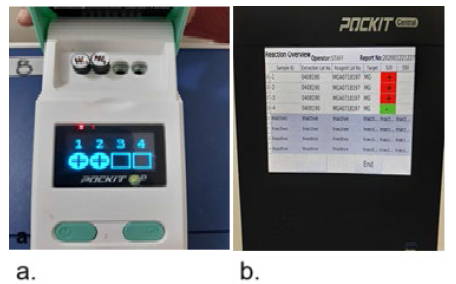 b) POCKIT Central Nucleic acid Analyzer