Distribution and available positions for Physical Education professionals in Multiprofessional Residency Programs
ABSTRACT
Objective: To characterize the availability of vacancies for physical education professionals in Multiprofessional Residency in Health (Residência Multiprofissional em Saúde - RMS) programs and describe the supply in programs developed in Primary Health Care regarding distribution among Brazilian states.
Methods: This is an exploratory study based on data obtained in 2023 through the Access to Information Law provided by the Ministry of Education.
Results: 9,621 positions were identified in different professional categories, of which 244 were allocated to physical education professionals, representing 2.5% of the total. Analyzing the distribution by Brazilian regions, the Northeast had the highest number of positions (45.9%), while the North had the lowest (3.7%). The analysis revealed that most positions for physical education professionals are concentrated in ‘Family Health’, ‘Public Health’, and ‘Basic Care’ programs, accounting for 67.2% of the total. Nationally, most of these positions are offered in capital cities (76.0%). At the state level, Mato Grosso do Sul, Ceará, and Pernambuco stand out, accounting for nearly 46.4% of the total positions.
Conclusion: The results indicate a low availability of positions for physical education professionals and limitations in distribution across states and regions. It is suggested that the National RMS Policy be strengthened, focusing on underrepresented areas, attention to the regional and state-level distribution of positions, and better coordination for integrating RMS graduates into qualified work within the Unified Health System (Sistema Único de Saúde - SUS).
Keywords:
Internship and residency; Public Health; Primary Health Care.
RESUMO
Objetivo: Caracterizar a disponibilidade de vagas para profissionais de Educação Física em programas de Residência Multiprofissional em Saúde (RMS) e descrever a oferta em programas desenvolvidos na Atenção Primária à Saúde quanto à distribuição entre os estados brasileiros.
Métodos: Trata-se de um estudo exploratório realizado a partir de dados obtidos em 2023 por meio da Lei de Acesso à Informação, fornecidos pelo Ministério da Educação.
Resultados: Foram identificadas 9.621 vagas em diferentes categorias profissionais, das quais 244 foram destinadas a profissionais de Educação Física, representando 2,5% do total. Ao analisar a distribuição por região brasileira, o Nordeste foi o local com maior número de vagas (45,9%), enquanto o Norte apresentou menor prevalência (3,7%). A análise revelou que a maioria das vagas para a Educação Física estão concentradas nos programas de ‘Saúde da Família’, ‘Saúde Coletiva’ e ‘Atenção Básica’, totalizando 67,2% das ofertas. Nacionalmente, o predomínio do oferecimento destas vagas está nas capitais (76%). Ao analisar por estados, verificou-se que Mato Grosso do Sul, Ceará e Pernambuco se destacam, com quase 46,4% do total de vagas.
Conclusão: Os resultados indicam que a oferta de vagas é baixa para a Educação Física e há limitações na distribuição, segundo os estados e regiões. Com isso, sugere-se o fortalecimento da Política Nacional de RMS, com foco em áreas pouco representadas, atenção à distribuição regional e entre os estados das vagas e a melhor articulação para absorção dos egressos da RMS para o trabalho qualificado no Sistema Único de Saúde.
Palavras-chave:
Internato e residência; Saúde pública; Atenção Primária à; Saúde.
Introduction
Ordinance No. 4279, dated December 30, 2010, established the guidelines for the organization of Health Care Networks, with Primary Health Care (PHC) designated as the coordinator of care and the guiding axis of the network1. In the National Primary Care Policy, the Family Health Strategy is highlighted as the main approach for expanding and consolidating the Health Care Networks and emphasizing its multiprofessional nature2.
There are several challenges in the context of multiprofessional work in health care, and often, professionals entering this field lack the training necessaryto perform effectively in this type of practice3. In this regard, the Multiprofessional Residency in Health (Residência Multiprofissional em Saúde - RMS) becomes a space for training and experiences that enhance the performance of health professionals based on the realities of the Brazilian Unified Health System (Sistema Único de Saúde - SUS), especially in multiprofessional work3.
The RMS was established in Brazil in 2005 by Law No. 11,129, and its operation is governed by the Ministry of Education and the Ministry of Health4, being characterized as a lato sensu graduate program. The training is focused on in-service education and is directed toward health-related professional categories, except for Medicine. Physical Education is one of the areas of knowledge included in RMS programs5. This training can be of great relevance to Physical Education professionals (PEP), as it allows them to deepen their knowledge in public health, a field in which other areas of expertise already have a more established and consolidated presence6-8.
From 2009, there was a significant increase in the participation of PEP and residents within SUS9. Based on manual data collection, researchers identified over 70 residency programs that included PEP in Brazil in 20228. The authors analyzed the websites of all state health departments, federal and state universities, and other electronic sources8. Considering the possibility that these findings may not fully reflect official data and using information obtained through the Access to Information Law, this study aims to complement the discussion presented by Paiva Neto and colleagues8. The results will be important for advancing the discussion on including PEP in RMS programs and serving as a relevant resource for professionals interested in pursuing this training. Therefore, this study aims to characterize the availability of RMS program positions for PEP and describe the offerings of programs developed within PHC in terms of their distribution across Brazilian states.
Method
This exploratory study analyzed and described the distribution of available positions for PEP in active RMS programs in 2023 based on a database provided by the Ministry of Education. The data were obtained through a document sent by the Ministry of Education by the Access to Information Law, No. 12,527, which regulates access to information as established in the Federal Constitution. The Access to Information Law stipulates that any citizen may request access to information from agencies and entities, including public bodies that are part of the direct administration of the Executive, Legislative (including Courts of Accounts), and Judicial branches, as well as the Public Prosecutor’s Office10. The request was submitted under protocol number 23546046261202317 on the website https://falabr.cgu.gov.br/web/home, in June 2023. The request sought a list of all RMS programs and the number of positions available, updated for 2023, by professional category, including area of concentration/knowledge, professional categories, federative unit, city, training institution, and executing institution.
The data provided were organized and analyzed using Google Sheets software. The distribution of available positions was examined through absolute and relative frequencies. Additionally, the allocation of positions was analyzed according to RMS programs, regions, and states of Brazil. The distribution of positions in the developed RMS programs was presented based on the characteristics of the municipality (capital/interior) and mapped using QGIS software, version 3.32.3.
Results
The search identified 9,621 positions in RMS programs across various professional categories throughout the national territory. Among the 14 professional categories identified, Nursing had the highest number of openings in 2023. Regarding positions allocated to PEP, 244 were offered (2.5% of the total). When compared to all categories, Physical Education ranked fifth in terms of the lowest number of openings. Figure 1 shows the distribution of available positions by professional category.
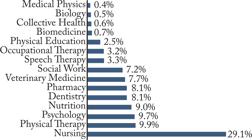
Vacancies offered for 2023 in multiprofessional health residency programs according to professional category.
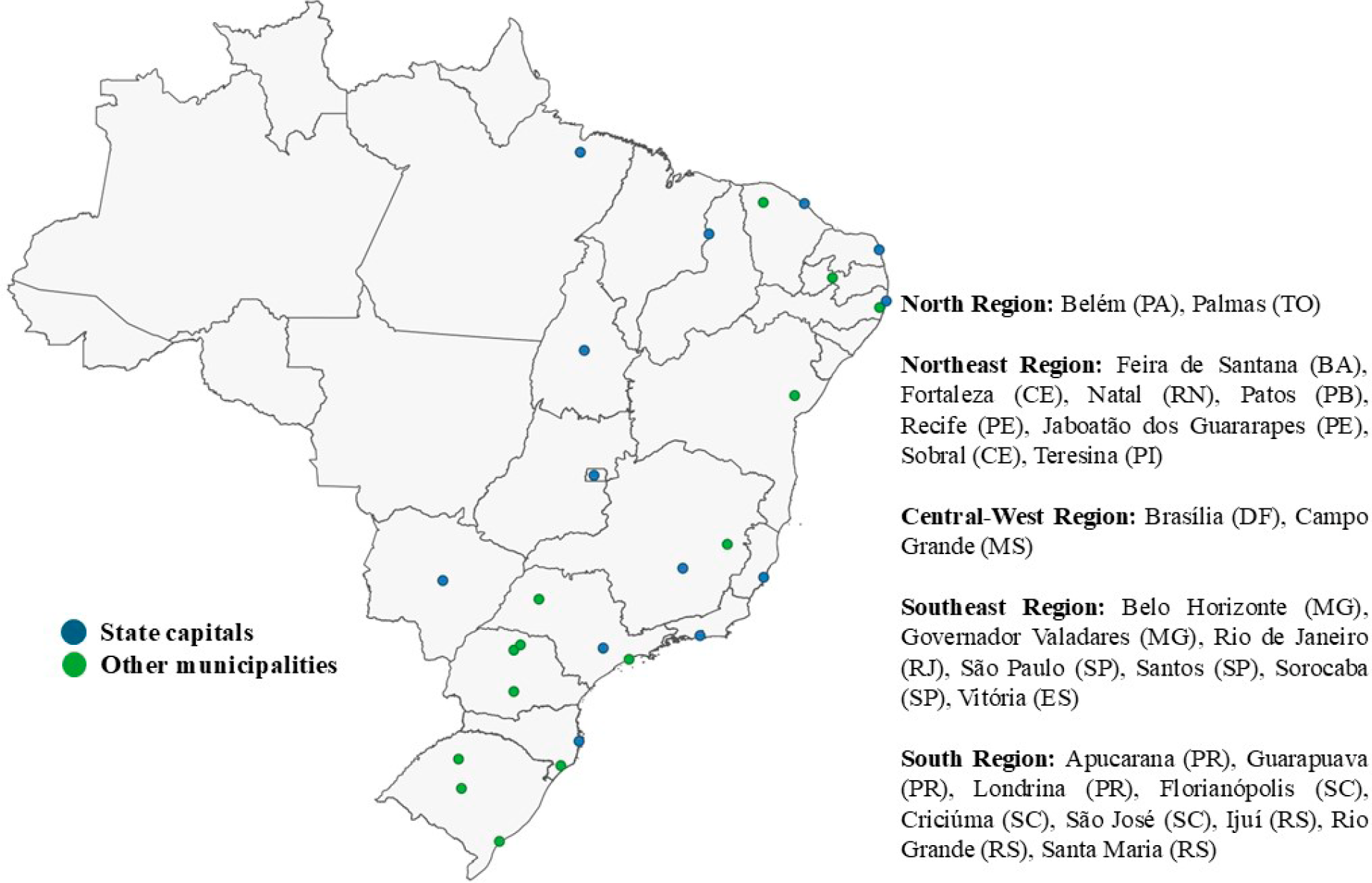
The Northeast region has the highest number of positions, with 112, representing nearly half of the total positions (45.9%), while the North region offers only nine positions (3.7%). The Central-West, Southeast, and South regions provide intermediate numbers, with 32 (13.1%), 40 (16.4%), and 51 (20.9%) opportunities, respectively, as shown in Figure 2.
Offer of vacancies (absolute number) in multiprofessional residency programs for Physical Education professionals in 2023 by region.
Table 1 shows the absolute and relative distribution of positions for PEP according to the area of concentration in the RMS program. The positions in Family Health, Public Health, and Primary Care residency programs account for approximately two-thirds (n = 164; 67.2%) of all positions available for PEP.
Number of vacancies for Physical Education professionals according to the name and concentration area of the residency program in 2023.
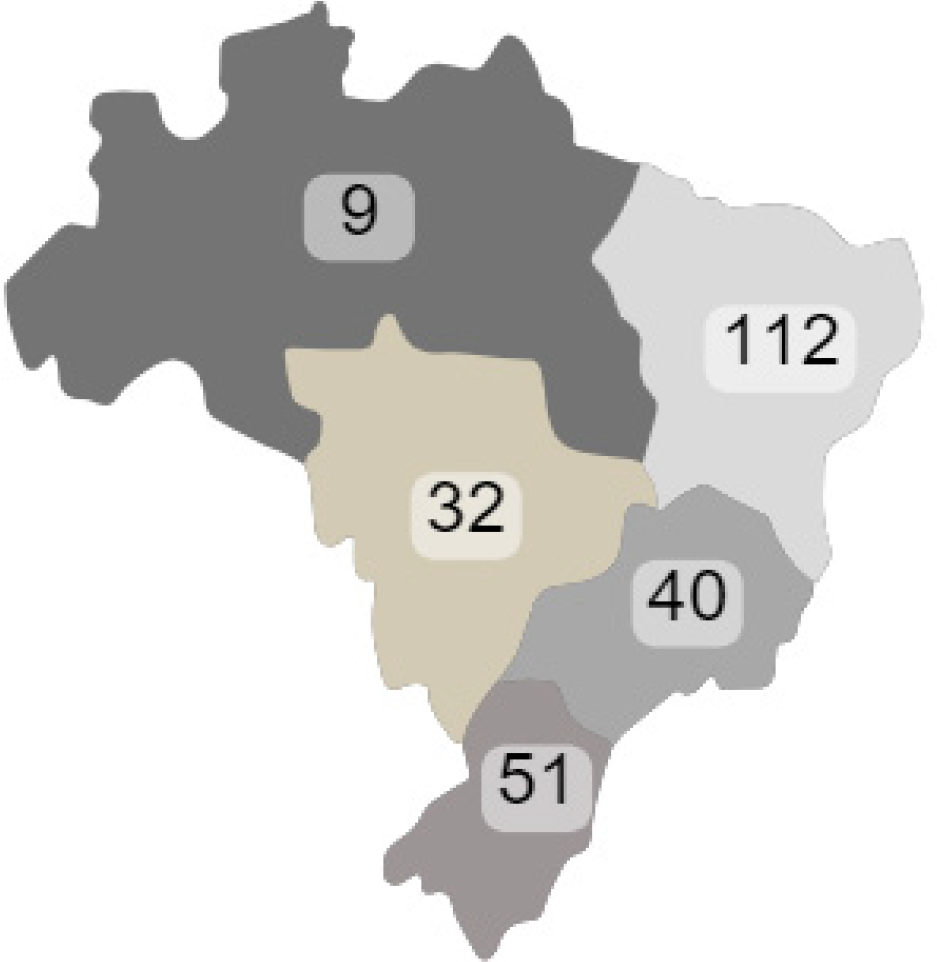
When analyzing the positions available in programs conducted in PHC, a predominance in the Northeast region is evident. Among the states, Mato Grosso do Sul, Ceará, and Pernambuco stand out, offering 46.4% of all positions nationwide. The positions available in the other states are detailed in Table 2. Of these, 76.0% are provided in Brazilian capitals, while 24.0% are in different municipalities, as illustrated in Figure 3. Additionally, the capitals also offer more programs, such as Belo Horizonte (Minas Gerais), Brasília (Federal District), Campo Grande (Mato Grosso do Sul), Florianópolis (Santa Catarina), Recife (Pernambuco), Rio de Janeiro (Rio de Janeiro), and São Paulo (São Paulo), each having more than one RMS program.
Available vacancies for Physical Education professionals in multiprofessional residency programs in Family Health and Primary Health Care in 2023.

Distribution of vacancies for Physical Education professionals in multiprofessional residency programs in Family Health or Primary Health Care 2023 according to the municipality’s location.
Discussion
This study aimed to characterize the availability of positions for PEP in RMS programs and describe the supply in programs developed in PHC, focusing on the distribution across Brazilian states. According to information from the Ministry of Education, for every 100 positions in health residency programs, fewer than three are allocated to PEP. The predominance of availability (approximately two out of every three positions) is in areas of concentration related to Family Health, Public Health, and PHC, with the states of Mato Grosso do Sul, Ceará, and Pernambuco accounting for the largest share (nearly half ). The distribution predominantly occurs in capitals (approximately three out of every four positions).
Despite the low number of positions available for Physical Education in RMS programs, the National Health Establishment Registry records indicate a significant increase from 2009 to 20219. As presented, PHC is the primary field of activity for Physical Education residents, serving as a potential training place for professional practice, with their main characteristic being work-based education in health. Over time, this context allowed for greater inclusion of PEP in the SUS, particularly in PHC in the last decade9.
It is important to highlight that this increase is related to the trajectory of government policies and the promotion of body practices and physical activities in PHC, which began with the National Health Promotion Policy, which presented “body practices/physical activities” as one of its central axes1. Next, the initiation of the Health Academy Program in 201111, and more recently, the launch of the Financial Incentive for Funding Physical Activity Actions in Primary Care12, as well as the return of funding for multiprofessional teams in Primary Care (eMulti)13. It is importantto emphasize that these programs and actions, which work with multiprofessional teams, including PEP, are based on health promotion, aligned with the principles and guidelines of SUS, based on the understanding that physical activity is not a choice for everyone. It is necessary to provide access and understand the barriers to engaging in physical activities1, 8, 14.
It is also worth noting that the techno-assistance logic of PHC values the inclusion of PEP, recognizing them as one of the important categories to work with and promote body practices and physical activities at this level of care14. Thus, expanding the number of positions for Physical Education residents in PHC is a way to qualify professional practices in health services and prepare workers who are more sensitive to humanization and aligned with the principles and guidelines of SUS9.
Although the availability of positions for PEP is still low compared to other categories, there is recognition of growth over the years9. However, reflecting on the training process offered to these professionals is necessary. It is essential to consider whether the residency is acting as a way to temporarily include professionals exclusively or as a training site for professionals who will be inserted into future opportunities as part of the workforce for SUS. Besides increasing the number of positions for Physical Education in RMS programs, a significant challenge is making better use of this qualified worker within SUS, as graduates from these programs tend to face difficulties in effectively and stably integrating as SUS professionals15. Among the regions, the Northeast has the most significant number of openings for PEP in residency programs. In the country, almost half of the positions for this professional category are offered in this region. States such as Ceará and Pernambuco enhance this distinction with nearly one-third of the country’s positions. This higher concentration in the Northeast may be related to the greater inclusion of these professionals in SUS. The study by Dutra et al.16 found that the Northeast region has the highest number of professionals registered with SUS, and the consolidated physical activity programs in the region may explain that. It is also worth noting that the region has a history of investment in body practices and physical activity programs, and there is greater involvement with SUS-related topics in undergraduate and graduate courses9.
In contrast, the North region has the lowest number of available positions, highlighting the inequity of access to both health and Physical Education professionals by region. A similar study, which aimed to analyze the distribution of RMS program offerings induced by the Ministry of Health’s public notices, also identified that the North and Midwest regions had the lowest number of approved programs from 2009 to 201517. Although this study focused on the distribution of programs involving PEP, it is clear that further progress is needed in the policies for distributing these programs, promoting a more equitable distribution across the country. Especially considering the prevalence of positions distributed in Brazilian capitals, it is also important to consider including RMS programs in areas far from major urban centers. Thus, equity should be promoted according to SUS principles, not only in health care but also in the availability of opportunities.
It is important to highlight that although the results reflect data from the bodies that manage residency programs, there may be discrepancies regarding the implementation of the positions offered in each program. However, this study, based on the data obtained through the Access to Information Law, complements the findings of Paiva Neto et al.8, who conducted a manual search for information on the availability of positions for Physical Education in RMS programs on the websites of all state secretariats, federal and state universities, and other sites. The importance of a national system for controlling and offering positions for all RMS programs, with free and easy access for all individuals, is emphasized. In addition to facilitating access to information for the academic community, such a system could contribute to the management of education and health work, serving as a strategic planning tool for professional training and action in SUS according to the needs of each state and region.
Conclusion
In conclusion, the low proportion of positions offered for the category concerning the total number of available positions in RMS programs in 2023 (2.5%) is highlighted. Family Health is the main field of insertion for Physical Education residents. In the context of PHC, the states that offer the most significant number of positions are Mato Grosso do Sul, Ceará, and Pernambuco. In addition to geographic inequality, this study also presented a discrepancy in the characteristics of the municipalities where the programs are located. Considering that most programs are developed in Brazilian capitals, it is important to reflect on actions that expand opportunities beyond these locations. Therefore, it is suggested that new studies analyze the characteristics of these areas regarding their location and funding methods.
Finally, based on the findings, it is suggested to strengthen the movement in favor of the National Policy of Multiprofessional Residency in Health, focusing on attention to knowledge areas with low representation in RMS programs, considering the equitable distribution of positions among the states and regions of the country. The challenge is also emphasized for the advancement of RMS programs to be aligned with the strengthening of SUS for the absorption of qualified workers. Thus, future research should further analyze the characteristics of the graduates.
-
Funding
Some authors have/had a scholarship. Alves LG from the Research and Innovation Support Foundation of the State of Santa Catarina (Fundação de Apoio à Pesquisa e Inovação do Estado de Santa Catarina - FAPESC); JLA from the Coordination for the Improvement of Higher Education Personnel - Brazil (Coordenação de Aperfeiçoamento de Pessoal de Nível Superior - CAPES).
Declaration Regarding the Use of Artificial Intelligence Tools in the Article Writing Process
The translation tools ChatGPT and Grammarly were used for the English version.
Acknowledgments
The authors would like to thank the other members of the Working Group on Physical Activity and Body Practices in Primary Health Care of the Brazilian Society of Physical Activity and Health.
Availability of Research Data and Other Materials
Research data is available in the body of the document.
References
-
1 Brasil. Ministério da Saúde. Secretaria de Vigilância em Saúde. Departamento de Análise de Situação e Saúde. Política Nacional de Promoção Da Saúde: 3ed. Brasília: Ministério da Saúde; 2010. Disponível em: <https://bvsms.saude.gov.br/bvs/publicacoes/politica_nacional_promocao_saude_3ed.pdf> [2025 Abril].
» https://bvsms.saude.gov.br/bvs/publicacoes/politica_nacional_promocao_saude_3ed.pdf -
2 Brasil. Portaria nº 2436 de 21 de setembro de 2017. Aprova a Política Nacional de Atenção Básica, estabelecendo a revisão de diretrizes para a organização da Atenção Básica, no âmbito do Sistema Único de Saúde (SUS). Diário Oficial da União; 2017. Disponível em: <https://bvsms.saude.gov.br/bvs/saudelegis/gm/2017/prt2436_22_09_2017.html> [2025 Abril].
» https://bvsms.saude.gov.br/bvs/saudelegis/gm/2017/prt2436_22_09_2017.html -
3 Salvador ADS, Medeiros CDS, Cavalcanti PB, Carvalho RD. Construindo a Multiprofissionalidade: um Olhar sobre a Residência Multiprofissional em Saúde da Família e Comunidade. Rev bras cienc saúde. 2011;15(3):329-38. doi: https://doi.org/10.4034/RBCS.2011.15.03.08
» https://doi.org/10.4034/RBCS.2011.15.03.08 -
4 Silva LB. Residência Multiprofissional em Saúde no Brasil: alguns aspectos da trajetória histórica. Rev Katálysis. 2018;21(1):200-9. doi: https://doi.org/10.1590/1982-02592018v21n1p200
» https://doi.org/10.1590/1982-02592018v21n1p200 -
5 Brasil. Lei no 11.129, de 30 de junho de 2005. Institui o Programa Nacional de Inclusão de Jovens - ProJovem; cria o Conselho Nacional da Juventude - CNJ e a Secretaria Nacional de Juventude; altera as Leis nº s 10.683, de 28 de maio de 2003, e 10.429, de 24 de abril de 2002; e dá outras providências. Casa Civil; 2005. Disponível em: < https://www.planalto.gov.br/ccivil_03/_Ato2004-2006/2005/Lei/L11129.htm> [2025 Abril].
» https://www.planalto.gov.br/ccivil_03/_Ato2004-2006/2005/Lei/L11129.htm -
6 Barboni VGAV, Carvalho YM, Souza VH. A formação em saúde coletiva nos currículos de Educação Física: um retrato atual. Movimento. 2021;27:e27065. doi: https://doi.org/10.22456/1982-8918.113041
» https://doi.org/10.22456/1982-8918.113041 -
7 Carvalho PHM, Alexandria DB, Rocha MB, Palma A, Malacarne JAD. A Saúde Coletiva nos cursos de Educação Física das Universidades Públicas do Rio de Janeiro. Rev Bras Ciênc Esporte. 2021;43:e007921. doi: https://doi.org/10.1590/rbce.43.e007921
» https://doi.org/10.1590/rbce.43.e007921 -
8 Paiva Neto FT, Streb, AR, Siqueira Junior JA, Del Duca, GF, Rech CR. Characterization of the Professional Area of Physical Education in Multiprofessional Health Residency Programs in Brazil. J Phys Educ. 2022;33:e3352 doi: https://doi.org/10.4025/jphyseduc.v33i1.3352
» https://doi.org/10.4025/jphyseduc.v33i1.3352 -
9 Vieira LA, Caldas LC, Lemos EC, Malhão TA, Carvalho FFB. Análise temporal da inserção de Profissionais e Residentes de Educação Física no Sistema Único de Saúde de 2009 a 2021. Cien Saude Colet. 2023;28(3):837-50. doi: https://doi.org/10.1590/1413-81232023283.14092022
» https://doi.org/10.1590/1413-81232023283.14092022 -
10 Brasil. Lei no 12.527, de 18 de novembro de 2011 Regulao acesso a informações previsto no inciso XXXIII do art.5º , no inciso II do § 3º do art. 37 e no § 2º do art. 216 da Constituição Federal; altera a Lei nº 8.112, de 11 de dezembro de 1990; revoga a Lei nº 11.111, de 5 de maiode 2005, e dispositivos da Lei nº 8.159, de 8 de janeiro de 1991; e dá outras providências. Casa Civil; 2011. Disponível em: <https://www.planalto.gov.br/ccivil_03/_ato2011-2014/2011/lei/l12527.htm> [2025 Abril].
» https://www.planalto.gov.br/ccivil_03/_ato2011-2014/2011/lei/l12527.htm -
11 Brasil. Portaria nº 2681, de 7 de novembro de 2013. Redefine o Programa Academia da Saúde no âmbito do Sistema Único de Saúde (SUS). Diário Oficial da União; 2013. Disponível em:<https://bvsms.saude.gov.br/bvs/saudelegis/gm/2013/prt2681_07_11_2013.html> [2025 Abril].
» https://bvsms.saude.gov.br/bvs/saudelegis/gm/2013/prt2681_07_11_2013.html -
12 Brasil. Portaria GM/MS nº 1.105, de 15 de maio de 2022. Altera a Portaria de Consolidação GM/MS nº 6, de 28 de setembro de 2017, para instituir o incentivo financeiro federal de custeio, destinado à implementação de ações de atividade física na Atenção Primária à Saúde (APS). Diário Oficial da União; 2022. Disponível em: <https://bvsms.saude.gov.br/bvs/saudelegis/gm/2022/prt1105_17_05_2022.html.Brasil> [2025 Abril].
» https://bvsms.saude.gov.br/bvs/saudelegis/gm/2022/prt1105_17_05_2022.html.Brasil -
13 Portaria GM/MS nº 635, de 22 de maio de 2023. Institui, define e cria incentivo financeiro federal de implantação, custeio e desempenho para as modalidades de equipes Multiprofissionais na Atenção Primária à Saúde. Diário Oficial da União; 2023. Disponível em: <https://bvsms.saude.gov.br/bvs/saudelegis/gm/2023/prt0635_22_05_2023.html> [2025 Abril].
» https://bvsms.saude.gov.br/bvs/saudelegis/gm/2023/prt0635_22_05_2023.html -
14 Vieira LA, Caldas LC, Gama MRJ, Almeida UR, Lemos EC, Carvalho FFB. A Educação Física como força de trabalho do SUS: análise dos tipos de vínculos profissionais. Trab Educ Saúde. 2023;21:1-18. doi: https://doi.org/10.1590/1981-7746-ojs01991
» https://doi.org/10.1590/1981-7746-ojs01991 -
15 Flor TBM, Miranda NM, Marinho CSR, Pinheiro JMF, Sette-de-Souza PH, Noro LRA. Admission of alumni from Multiprofessional Residency Programs into the SUS. Rev Saude Publica. 2021;55:88. doi: https://doi.org/10.11606/s1518-8787.2021055003347
» https://doi.org/10.11606/s1518-8787.2021055003347 -
16 Dutra RP, Viero VSF, Knuth AG. Inserção de profissionais de Educação Física no Sistema Único de Saúde: análise temporal (2007-2021). Rev. Bras. Ativ Fís Saúde. 2023;28:1- 9. doi: https://doi.org/10.12820/rbafs.28e0296
» https://doi.org/10.12820/rbafs.28e0296 -
17 Sarmento LF, França T, Medeiros KRD, Santos MRD, Ney MS. A distribuição regional da oferta de formação na modalidade Residência Multiprofissional em Saúde. Saúde debate. 2017;41(113):415-24. doi: https://doi.org/10.1590/0103-1104201711306
» https://doi.org/10.1590/0103-1104201711306
Edited by
-
Editor in Chief
Raphael Ritti-Dias https://orcid.org/0000-0001-7883-6746Universidade Nove de Julho. São Paulo, São Paulo, Brasil.
-
Section Editor
Marcelo Romanzini https://orcid.org/0000-0003-1355-331XUniversidade Estadual de Londrina, Londrina, Paraná, Brasil.
Reviewers’ assessment
The reviews of this article were originally conducted in Portuguese. This version has been translated using ChatGPT and subsequently reviewed by the Chief Editors.AuthorshipReviewer A
Anonymous
To the author
Dear author, congratulations on the proposal and the work developed, which presents academic and scientific merit. Some aspects have been identified that deserve the authors’ attention. The suggestions were described in detail to facilitate identification of the necessary adjustments.
-
Abstract :Standardize the objective presented in this section with the one in the Introduction and Discussion.
-
Introduction: On page 3 (lines 17 to 22), revise the paragraph wording, which is lengthy and lacks objectivity. I suggest rewriting and dividing it into two sentences. In the justification, the authors state that what differentiates the present study from another that identified 70 residency programs with the inclusion of physical education professionals is the data collection method. I invite reflection: is the methodological difference alone relevant enough to justify this study? If so, it needs to be clearly presented. Additionally, the problematization regarding the importance of this study for the community, for health professionals, and for the advancement of knowledge should be clearly presented.
-
Method: Does the database provided by the Ministry of Education (MEC) have limitations? What are they? And what are the advantages?
-
Results: In Table 2, I suggest indicating only the states that had physical education vacancies in 2023, excluding those that did not. In the description of Figure 3, I recommend indicating the municipalities and how many multiprofessional residency programs each has-e.g., a municipality might have more than one program. It would also be interesting to present the names of the municipalities in Figure 3. Also, why were only Family Health or Primary Care programs included in the analysis in Table 2 and Figure 3? Public Health was the second most frequent area of concentration.
-
Discussion: Although the discussion about the relevance of physical education professionals (PEPs) in primary care (APS) is valid, there is a lack of discussion relating the findings to the main areas of concentration that these professionals pursue. Furthermore, it is worth discussing the importance of equitable distribution beyond regional and state differences, considering that programs are still concentrated in large urban centers. What about health education in medium and small municipalities? On page 6 (lines 15 to 21), revise the wording of the paragraph, which is lengthy and not very objective. I suggest rewriting it and dividing it into two sentences. The study limitations were not presented and must be included.
-
Conclusion: It is important to include in this section that equitable distribution should encompass medium and small municipalities, considering the respective regional differences in the country. Any recommendations for future studies?
- peer review recommendation: no
Reviewers’ assessment
The reviews of this article were originally conducted in Portuguese. This version has been translated using ChatGPT and subsequently reviewed by the Chief Editors.AuthorshipReviewer B
Anonymous
Congratulations on the work.
I suggest a few minor corrections:
-
Review the use of acronyms.
-
Standardize the objective as presented in the Abstract, Introduction, Methods, and Discussion.
-
Regarding the objective “to describe the provision of programs developed in Primary Care by location”, it seems to me that this objective was not achieved with the analyses. The programs are described by prevalence, but there is no information about the location of the programs.
-
Suggestions within the manuscript:
Title
-
Suggestion: Provision and Distribution
Introduction
-
Paragraph 4, line 8: Check if this objective was really achieved.
-
Paragraph 7, line 4: I did not find in the results any geoprocessing of the program locations. Please verify.
Results
-
Paragraph 5, line 2: Again, the results do not show the provision of programs in terms of location.
Conclusion
-
Paragraph 1, line 1: I suggest removing this information from the conclusion section or referencing it (although referencing is not usual in the conclusion section).
- peer review recommendation: no