Como idosas com comprometimento cognitivo lidam com o estressor físico?
ABSTRACT
The aging process can promote hypothalamus-pituitary-adrenal axis changes causing dysregulation in cortisol levels, and consequently inappropriate response and recovery after an acute stressor stimulus. However, there is an interindividual and gender difference mainly due to pathologies related to aging as dementia or mild cognitive impairment (MCI). To MCI individuals, higher cortisol levels can be associated to chronic stress, despite it is not elucidate the acute responses to the physical stressor. The objective of this study was to compare the effect of acute physical stressor on salivary cortisol levels between healthy controls and MCI women. Elderly women patients clinically diagnosed with MCI (n = 8) and healthy older individuals (n = 10) were selected. Both groups performed a cognitive and physical test. The physical stressor test was a moderate-intensity walk on a treadmill for 30 min. Salivary cortisol was collected 3 times: before, shortly after, and 15 minutes after the walk. It was observed cortisol reduction immediately after physical stressor for both groups with large effect size, however there was no significant difference in cortisol levels (F = 3.979; p = 0.063). A third cortisol collection after 15 minutes showed a significant effect for moment (F = 4.075; p = 0.031) with a cortisol reduction. The effect size was considered large for both groups. Regardless of the diagnosis, older women present low cortisol responsiveness to a physical stimulus. Besides that, those outcomes should be interpreted with caution as a possible physiological deficit and biological differences between individuals in coping with a stressor agent.
Keywords:
Cortisol; Saliva; Reactivity; Aging; Exercise.
RESUMO
O processo de envelhecimento pode promover alterações no eixo hipotálamo-pituitária-adrenal (HPA), causando desregulação nos níveis de cortisol (resposta e recuperação inadequadas) após um estímulo estressor agudo. Para os indivíduos com comprometimento cognitivo leve (CCL), os níveis elevados de cortisol podem estar associados ao estresse crônico apesar de não conhecermos as respostas agudas ao estressor agudo. No entanto, existe uma diferença entre os gêneros e os indivíduos principalmente devido a patologias relacionadas ao envelhecimento como demência ou CCL. O objetivo do trabalho foi comparar o efeito do estressor físico agudo nos níveis de cortisol salivar entre mulheres com CCL e mulheres saudáveis. Foram selecionados idosas com diagnóstico clínico de CCL (n = 8) e idosas saudáveis (n = 10). Ambos os grupos realizaram uma triagem com teste cognitivo e físico. O estressor físico consistiu em uma caminhada de intensidade moderada em esteira por 30 min. O cortisol salivar foi coletado 3 vezes: antes, logo após e 15 minutos após a caminhada. Observou-se redução do cortisol imediatamente após o estressor físico para ambos os grupos com tamanhode efeito grande, porém esses resultados não alcançaram diferença significativa (F = 3,979; p = 0,063). A terceira coleta de cortisol pós 15 minutos mostrou um efeito significativo para o momento (F = 4,075; p = 0,031) com tamanho do efeito grande e redução dos níveis de cortisol. Independente do diagnóstico, as idosas apresentam baixa responsividade do cortisol a um estímulo físico. Apesar disso, os desfechos devem ser interpretados com cautela devidos as limitações.
Palavras-chave
Cortisol; Saliva; Reatividade; Envelhecimento; Exercício.
Introduction
Mild cognitive impairment (MCI) is a clinical condition characterized as memory complaints without impairment in activities of daily living1, which may or may not progress to dementia, such as Alzheimer’s Disease (AD). One possible risk factor for MCI and AD is chronic stress that is associated with hippocampus reduced volume causing hypothalamic-pituitary-adrenal (HPA) axis impairment and, consequently, inadequate cortisol levels at basal condition and in response to a stressor stimulus2. Thus, high levels of cortisol may be associated with chronic stress intensity in MCI subjects3.
Other important factor to be considered is the cumulative exposure to stressors agents through the life. The high levels of cumulative cortisol released would bring irreversible and toxic damage to neurons causing a neurotoxicity process5 in some brain regions as amygdala and hippocampus4. This has been used to explain the difficulty elderly people have in dealing with stressors. However, it is not elucidated if changes in cortisol levels face an acute stressor occurs by the natural aging process itself6 or by the chronic stress suffered during life7. Regardless of that, aging is associated with HPA changes causing inadequate response and recovery to different stressor stimuli. Specifically, to MCI patients it is important to investigated the cortisol response to stress, since that elevated cortisol levels may exert detrimental effects on cognition and contribute to AD pathology.
One of the stressor stimuli more widely studied is physical exercise. One session of exercise is considered a stressor agent for promoting acute physiological and neural effects in response to the in homeostasis unbalance8. During exercise, body undergoes an allostatic process, with sensory-motor and hormonal changes9,10. So, in a healthy young individual, it is expected HPA activation and consequent cortisol increase during and immediately after exercise. Then, some minutes and hours after exercise occur a cortisol reduction through the negative feedback mechanism of HPA11. Despite that, a recent study published by our laboratory showed a significant cortisol levels reduction after physical exercise in healthy older persons, with AD and depression27. One possible explanation is that the changes in the HPA which occur both as a result of depression and Alzheimer’s disease, as well as aging itself, can affect the response to a physical stressor, causing a reduction in cortisol levels after this stressful stimulus. However, it is not known whether these effects are more pronounced as a consequence of aging or of disease processes.
Regarding MCI individuals, previous studies observed higher basal cortisol levels and that HPA-axis dysregulation may accelerate disease progression and cognitive decline. However, no studies with acute effect of exercise in MCI individuals are found. Furthermore, few studies have been conducted in older population and the results are inconsistent. These studies have observed an increase12,13, decrease14,15, or no significant cortisol effect16 after a single session of strength training.
Accordingly, to our knowledge, the present study is the first to show the effect of stressor physical in MCI patients. Our hypothesis suggested a greater cortisol levels reduction in MCI patients compared to healthy older adults, due to greater wear on the HPA axis during life, in addition to possible changes in cortisol receptors in the hippocampus. Then, this study aimed to examine differences in cortisol responsiveness after an acute stressor between MCI patients and healthy women older adults.
Methods
This research is part of a larger study entitled “Efficacy of physical exercise in the treatment of Major Depression, Alzheimer’s Disease and Parkinson’s Disease”, approved by the Ethics Committee for Studies in Human Beings CAAE: 24904814.0.0000.5263) and also in the Brazilian Registry of Clinical Trials (REBEC) under RBR-4M3K2C.
A sample calculation was carried out using the software G*Power 3.1.9 for power values defined a priori, with alpha (α) = 0.05, beta power (β) = 0.95 and effect size = 0.50 indicated the need for a sample size of 14 participants to be allocated to the HC and MCI groups.
Due to the different of hormones between genders, we recruited only women. Possible candidates were initially contacted via telephone, 18 older individuals were included, MCI (n = 8) and Healthy Controls (HC) (n = 10), informing the research proposal with subsequent appointments for visits on three different days for evaluations. Inclusion criteria: older aged ≥ 60 years, female, previously diagnosed with MCI according to the Petersen et al1.
To compose the HC group, it was done an internal advertisement mostly neighbors, friends, relatives, or close to the participants. Besides that, all healthy individuals proved their status, without any diagnosis of mental disorder, after medical evaluation with a physician specialized in geriatric psychiatry.
Exclusion criteria were: insomnia the night before collection, diagnosis of dementia or any other psychiatric disorder, the existence of any musculoskeletal and audiovisual limitations, use of corticosteroids in the last few weeks, and dental procedure at least seven days before saliva collection.
Participants went to the laboratory on three different days (Figure 1) within a month. At the first visit was performed anamnesis and neuropsychological test that include: the Mini-Mental State Examination (MMSE)28, verbal fluency (VF)29, clock drawing test (CDT)30 and Geriatric Depression Scale (GDS)31. And to evaluate the physical condition: the time to up and go (TUG) and Sitting-rising test (SRT)32.

On the second visit, all participants underwent a cardiac examination to verify their health status with a cardiologist. Also, the individuals had their body mass index (BMI) checked. The cardiopulmonary exercise test was performed on a treadmill (InbraMed Pro®) with a ramp protocol (adjusting by tilt) through an indirect test without a mask to calculate expiratory volume. Speed/slope increase was defined based on the difference between start and end speed and slope and performed every 30 seconds. For this study, it was used a ErgoPC software of Micromed® which control speed and inclination of the treadmill, and estimate the VO2. Moreover, it suggests individualized values for the effort fulfillment. The test was configured to be completed in 10 min and the maximum oxygen consumption (VO2max) was estimated based on its results, through American College of Sports Medicine33 formula [VO2max = (0,2 x speed [mph]) + (0,9 x speed x slope [%]) + 3,5]. The intensity of 70% was calculated by heart rate (HR) parameters and external load used. The 12-lead MICROMED® Digital electrocardiogram was used to monitor and record blood pressure and electrocardiogram traceability.
On the third day, participants underwent exercise intervention to assess the effect of stressor physical. Participants performed 30 min of exercise, including 5 min of warm-up with low-intensity walking, 20 min with moderate-intensity (70% of the VO2max), and 5 min of calming down with low-intensity walking. Saliva samples were collected before, immediately after and 15 min after session. Exercise was guided by physical education teachers, besides that, all remained monitored during the walk and every five minutes the HR and the rate of perceived exertion (RPE)34 were checked. Individuals blood pressure (BP) was measured before and after a single session of exercise.
Participants were reminded the day before about the test, as well as the requested fasting period. Exercise intervention with stimulated saliva collections were performed between 11 am and 1 pm, with at least 1 hour of complete fasting. Before collection, a brief questionnaire was carried out with all participants which included questions that could influence in outcomes. Because of that they were inquired about: 1) usual medication; 2) if they used corticosteroids, or similar; 3) hours of sleep the night before; 4) recent dental treatment; 5) the time of the last meal and 6) last day of physical exercise.
After that, they were asked to make mouth movements to stimulate saliva and deposit it in a 15 ml falcon tube. The collection of salivary cortisol was performed before the exercise session shortly after the acute exercise session, and 15 min after physical exercise. Tubes were stored in the freezer at -20°C immediately. ELISA technique (Enzyme Linked Immuno Sorbent Assay) by IBL® was adopted. On the day of analysis, the tubes were defrosted at the ideal temperature and centrifuged at 3000 rpm for 10 min.
For normality and homoscedasticity, Shapiro-Wilk and Levene were used, respectively. Student’s T-test, Mann-Whitney U, and chi-squared were used to evaluate the difference between groups such as MMSE, GDS, BMI, age, and others variables. In addition, a repeated-measurement ANOVA was used to analyze cortisol levels between groups (HC x MCI) and at time points (pre, post-exercise, and post 15 min of exercise). Pearson correlation was chosen to analyze cortisol delta (post-pre cortisol) with variables.
Furthermore, an effect size analysis was used to examine the magnitude of the difference in cortisol levels between preand post-exercise in the HC and MCI groups. The results of effect size were interpreted according to Cohen35 (trivial; d ≤ 0.20; small: d = 0.20 to 0.49; moderate d = 0.50 to 0.79; and large: d ≥ 0, 80). All analyzes were performed and p value <0.05 was the threshold for statistical significance.
Results
Some older adults in HC group did not use any class of medication (n = 2), while others have used antihypertensive and antidiabetic (n = 2) or only antihypertensive (n = 4) and other medications for thyroid (n = 2). For the MCI group, we have a similar profile with some using no medication (n = 2), those who used only antihypertensive (n = 2), and others who used antihypertensive and antidiabetic (n = 1). Regular use of medication for gastrointestinal disorders (n = 1), medication for thyroid (n = 1) and venous insufficiency (n = 1) were also reported.
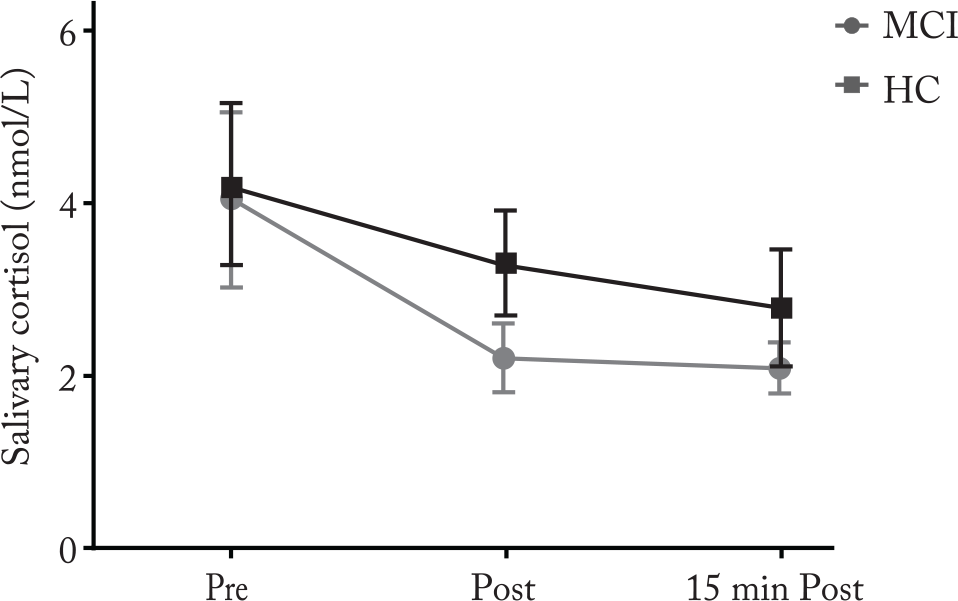
Non-significant difference was observed for sample characteristics between groups: age (t = -0.257; p = 0.800), BMI (t = -2.089; p = 0.053), education (t = 0.958; p = 0.352) and VO2max (t = -0.643; p = 0.529) (Table 1). Also, no differences were found for the neuropsychological tests: MMSE (U = 0.477; p = 0.500), GDS (U = 2.234; p = 0.154), CDT (t = 1.178; p = 0.257) VF (t = 1.720; p = 0.107) and for the physical tests: SRT (t = -1.093; p = 0.292) and TUG (t = -0.141; p = 0.890), sleep hours (t = 0.635; p = 0.537) (Table 1). Non-significant effect was observed for group (F = 2.182; p = 0.159) and for moment (F = 3.979; p = 0.063), notwithstanding trend for significant findings, revealing cortisol reduction after exercise for both groups (Figure 2).
Sample characteristics in baseline (Data in mean ± standard deviation or median (interquartile range*)

Salivary cortisol reactivity in female older adults in Mild Cognitive impairment (MCI) and healthy control (HC). Data in mean and standard error.
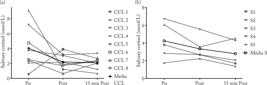
Salivary cortisol reactivity in female older adults in Mild Cognitive impairment (MCI)(a) and healthy control (HC)(b). Each line is presented by one participant. The bold line showed the mean of the group.
For the second analysis, considering the 15 min after exercise, there was a different sample size with a reduction for 13 individuals (HC: 5; MCI: 8 due to logistical problems.For comparison within three moments (pre x post x post 15 min) it was performed again the comparison for sample characteristics, which expected non-significant difference in age (t = -1.089; p = 0.299), BMI (t = -1.204; p = 0.254), education (t = 0.206; p = 0.841) and VO2max (t = 1.182; p = 0.262) (Table 2). Also, no differences were found for the neuropsychological tests: MMSE (U = 0.137; p = 0.894), GDS (U = 0.332; p = 0.406), CDT (U = 0.492; p = 0.632) VF (U = 1.935; p = 0.082) and for the physical tests: SRT (U = -0.632; p = 0.541) and TUG (U = 0.390; p = 0.704), sleep hours (t = 0.535; p = 0.608).
Sample characteristics in baseline (Data in mean ± standard deviation or median (interquartile range*)
Interestingly, we found a significant effect for cortisol (moment effect (F = 4.075; p = 0.031), revealing significant reduction between moments without interaction (moment x group) (F = 0.272; p = 0.764). The visual analysis of the means allows us to observea gradual and more accentuated slope after 15 min of exercise for the healthy controls, while a more accentuated decrease after exercise and less accentuated after 15 min was observed for the MCI group (Figure 2). The variables during exercise as speed, slope, heart rate and rate of perceived exertion have no statistically significant difference (table 03).
The mean and standard deviation of salivary cortisol levels presented for this analysis were: MCI (pre: 4.05 ± 2.86 nmol/L; post: 2.21 ± 1.09 nmol/L; post 15min 2.09 ± 0.84 nmol/L) and healthy (pre: 4.24 ± 2.12 nmol/L; post: 3.34 ± 1.33 nmol/L; post 15min: 2.79 ± 1.50 nmol/L). Sleep hours were based on the last week, considering the night before the acute test. The healthy controls had in mean 7 hours of sleep, while individuals in the MCI group had in mean 6.6 hours, which means that these older women possibly do not have sleep disorders such as insomnia or hypersomnia.
The effect size was considered large for both groups (MCI: d = 1.37; HC: d = 0.80). A positive and significant correlation was observed between cortisol delta (post 15 - pre) and symptoms of depression (r = -0.472; p = 0.048) and MMSE (r = 0.509; p = 0.031). However, non-significant correlation was observed between cortisol delta and the other variables, such as age (ρ = 0.079; p = 0.757), SRT (ρ = 0.282; p = 0.273), and TUG (ρ = 0.181; p = 0.487).
Discussion
The present study aimed to examine differences in cortisol responsiveness immediately after a physical exercise session between MCI patients and healthy older adults. The results showed non-significant effect with a trend for significant reduction immediately after exercise for total sample, but a signific ant reduction when also investigated 15 min after the end of exercise for reduced sample. The effect size was considered large for both groups.
The results indicated that MCI patients and healthy older women seem to have the same characteristic of cortisol response to a physical stressor, which may probably be associated with issues of senescence itself. A previous study explored the influence of some variables on the HPA axis and pointed out that age is largely related to changes in the HPA axis25. However, few studies have been conducted exploring cortisol responses to stress tasks in this population25. A possible explanation would be related to mineralocorticoid receptors changes, stopping effectiveness in the negative feedback activity of the HPA axis in the older36.
Meantime, these receptors are responsible for the circadian rhythm and not for the response to a stressful stimulus36. Furthermore, a reduction of negative feedback would result in cortisol increase after exercise rather than a reduction, as it has been observed. In this line, the same authors published a meta-analysis that investigated the cortisol response to a challenge in older adults and concluded that these individuals have higher cortisol levels after a stressful stimulus compared to young persons. These responses were more evident in women and pharmacological and psychological stressors were observed37.
Specifically, concerning physical exercise and the healthy population, studies have shown divergent results, with both reduction and cortisol increase after acute stressor. Taha & Mounir14 observed plasma cortisol reduction after 15 min of lowand moderate-intensity strength exercise in healthy older adults of both genders. Paunknis et al15 researched only older persons and a similar result was found 2h after strength exercise. On the other hand, studies with high intensity of aerobic exercise have observed cortisol increase17,18. However, another study also observed an increase after 30 min of cycling with intensity similar to our study (60% of VO2max)17. It is important to point out that the elderly individuals included in our research did not present symptoms of depression, which is widely investigated in terms of its relationship between cortisol levels and physical exercise26,39. In addition, they had a fitness considered weak to regular with approximately 23% of VO2max mL/kg-1/min-1.
Three months of exercise intervention successfully increased fitness and resulted in a greater fall in cortisol concentration from peak to midday, compared with the control group39. Nonetheless, the effects of chronic exercise are different from acute exercise. In the chronic adaptation, it is expected a cortisol reduction due to more efficacy of HPA negative feedback mechanism and upregulation of glucocorticoid receptor.
The type of sample collection may also have influenced the results found. The main analysis of this hormone in research is plasma, saliva, and urine. According to a study carried out over 20 years ago, the advantage of saliva analysis is the type less invasive and presents a detectable level from 15 min after the cessation of the stressor stimulus, reaching a peak at 20to 30 min. Although, to our knowledge, there are no studies on the acute effect of exercise on cortisol levels in older individuals with MCI, a greater reduction in levels of this hormone after exercise was expected due to possible physiological changes in glucocorticoid receptors11 and hippocampus atrophy, not allowing a good functioning of the HPA axis. In addition, older individuals with cognitive deficits are more unable to deal with stressful stimuli due to a reduction in their coping strategies3.
Another point to be considered is the chronic inflammation generated by the senility process, called inflammaging. Thus, the aging process is not the same for all individuals, and inflammation may arise before chronic diseases that may de-characterize the sample considered healthy. In principle, our sample of healthy older individuals consisted of older persons without mental and cognitive diseases, but some comorbidities may have influenced these responses, such as diabetes, thyroid disorders, and the medication of these pathologies. It is known, that older individuals can face more diseases developed in senility as hypertension, diabetes and thyroid conditions which would by itself impactin the HPA axis and cortisol reactivity40 even as the medication used to control these pathologies.
Some limitations were inherent to this study, such as the small sample size, because when the third cortisol test (15 min after exercise) was investigated, the sample size did not reach that estimated by the sample calculation. Moreover, heterogeneity of each individual (adapted to the treadmill x sedentary) should be considered. Another weakness was the use of medications and comorbidities that can impact the response to an acute stressor.As a strength of the study, we highlight being the first to assess cortisol reactivity to a physical stressor in MCI individuals. It is known that studies with the older population are scarce in the literature due to several factors and those with some impairment impact adherence getting even more challenge. We recognize that more studies with a greater sample size are necessary to obtain more confirmation through the preliminary data found.
For aerobic exercise, it was also revealed an increase after continuous load17,18 and after a submaximal aerobic test19, while a decrease in the hormone levels20 was also observed after continuous load.Some peculiarities must also be considered. Besides intensity, fitness ability, daytime, gender and individual differences can also influence hormonal responses23,24, as well as collection time, and psychological subjectivity of each participant as resilience25,26. Furthermore comorbidities that are very common in older as hypertension and diabetes can contribute ad influence in the cortisol reactivity40. Regardless of the diagnosis, women aging is associated with low cortisol responsiveness to a physical stimulus. These results can be interpreted as a possible physiological deficit in coping with a stressor agent in older individuals.
-
Funding
National Council for Scientific and Technological Development (Conselho Nacional de Desenvolvimento Científico e Tecnológico - CNPq) (CNPq-301483/2016-7 and CNPq-154566/2018-7) and Carlos Chagas Filho Foundation for Research Support in the State of Rio de Janeiro (Fundação Carlos Chagas Filho de Amparo à Pesquisa do Estado do Rio de Janeiro-FAPERJ) (FAPERJ-E26/203.193/2016).
-
Declaration regarding the use of artificial intelligence tools in the article writing process
The manuscript did not use artificial intelligence tools for its preparation.
Acknowledgments
We are grateful to National Council for Scientific and Technological Development (Conselho Nacional de Desenvolvimento Científico e Tecnológico - CNPq) (CNPq-301483/2016-7 and CNPq- 154566/2018-7) and Carlos Chagas Filho Foundation for Research Support in the State of Rio de Janeiro (Fundação Carlos Chagas Filho de Amparo à Pesquisa do Estado do Rio de Janeiro-FAPERJ) (FAPERJ-E26/203.193/2016). which funded the study. Also, we are grateful to “Laboratório de Imunofisiologia do Exercício” (LIFE)/FCM/UERJ which provided the laboratory to conduct the ELISA analysis, and Shayane Martins Rodrigues Gomes who helped to perform the analysis.
Availability of research data and other materials
The contents are already available.
References
-
1 Petersen RC, Smith GE, Waring SC, Ivnik RJ, Tangalos, EG, Kokmen, E. Mild cognitive impairment: clinical characterization and outcome. Arch Neurol. 1999;56(3):303-08. doi: https://doi.org/10.1001/archneur.56.3.303
» https://doi.org/10.1001/archneur.56.3.303 -
2 McEwen BS, Nasca C, Gray JD. Stress Effects on Neuronal Structure: Hippocampus, Amygdala, and Prefrontal Cortex. Neuropsychopharmacol. 2016;41(1):3-23. doi: https://doi.org/10.1038/npp.2015.171
» https://doi.org/10.1038/npp.2015.171 -
3 Souza-Talarico JN, Chaves EC, Nitrini R, Caramelli P. Chronic stress is associated with high cortisol levels and emotional coping mechanisms in amnestic mild cognitive impairment. Dement Geriatr Cogn Disord. 2009;28(5):465-70. doi: https://doi.org/10.1159/000259696
» https://doi.org/10.1159/000259696 -
4 Sapolsky RM, Krey LC, McEwen BS. The neuroendocrinology of stress and aging: the glucocorticoid cascade hypothesis. Endocr Rev. 1986;7(3):284-301. doi: https://doi.org/10.1210/edrv-7-3-284
» https://doi.org/10.1210/edrv-7-3-284 -
5 Gilbertson MW, Gilbertson MW, Shenton ME, Ciszewski A, Kasai K, Lasko NB, et al. Smaller hippocampal volume predicts pathologic vulnerability to psychological trauma. Nature Neurosci. 2002;5(11):1242-7. doi: https://doi.org/10.1038/nn958
» https://doi.org/10.1038/nn958 -
6 Kudielka BM, Kirschbaum C. Sex differences in HPA axis responses to stress: a review. Biol Psychol. 2005;69(1):113-32. doi: https://doi.org/10.1016/j.biopsycho.2004.11.009
» https://doi.org/10.1016/j.biopsycho.2004.11.009 -
7 Gaffey AE, Bergeman CS, Clark LA, Wirth MM. Aging and the HPA axis: Stress and resilience in older adults. Neurosci Biobehav Rev. 2016;68:928-45. doi: https://doi.org/10.1016/j.neubiorev.2016.05.036
» https://doi.org/10.1016/j.neubiorev.2016.05.036 -
8 Stranahan AM, Lee K, Mattson MP. Central mechanisms of HPA axis regulation by voluntary exercise. Neuromolecular Med. 2008;10(2):118-27. doi: https://doi.org/10.1007/s12017-008-8027-0
» https://doi.org/10.1007/s12017-008-8027-0 -
9 McEwen BS. Stress, adaptation, and disease. Allostasis and allostatic load. Ann N Y Acad Sci. 1998;840:33-44. doi: https://doi.org/10.1111/j.1749-6632.1998.tb09546.x
» https://doi.org/10.1111/j.1749-6632.1998.tb09546.x -
10 McEwen BS. Mood disorders and allostatic load. Biol Psychiatry. 2003;54(3):200-7. doi: https://doi.org/10.1016/s0006-3223(03)00177-x
» https://doi.org/10.1016/s0006-3223(03)00177-x - 11 Steckler T, Kalin N, Reul J. Handbook of stress and the brain. Part 1: The neurobiology of stress. Amsterdam: Elsevier science, 2005.
-
12 Kraemer WJ, Häkkinen K, Newton RU, McCormick M, Nindl BC, Volek JS, et al. Acute hormonal responses to heavy resistance exercise in younger and older men. Eur J Appl Physiol Occup Physiol. 1999;77(3):206-11. doi: https://doi.org/10.1007/s004210050323
» https://doi.org/10.1007/s004210050323 -
13 Dalbo VJ, Roberts MD, Hassell SE, Brown RD, Kerksick CM. Effects of age on serum hormone concentrations and intramuscular proteolytic signaling before and after a single bout of resistance training.J Strength Cond Res.2011;25(1):1-9. doi: https://doi.org/10.1519/JSC.0b013e3181fc5a68
» https://doi.org/10.1519/JSC.0b013e3181fc5a68 -
14 Taha MM, Mounir KM. Acute response of sérum cortisol to different intensities of resisted exercise in the elderly. Bull Fac Phys Ther. 2019;24:20-5. doi: https://doi.org/10.4103/bfpt.bfpt_13_18
» https://doi.org/10.4103/bfpt.bfpt_13_18 -
15 Paunksnis MR, Evangelista AL, Teixeira CVLS, Alegretti JG, Pitta RM, Alonso AC et al. Metabolic and hormonal responses to different resistance training systems in elderly men. Aging Male. 2018;21(2):106-10. doi: https://doi.org/10.1080/13685538.2017.1379489
» https://doi.org/10.1080/13685538.2017.1379489 -
16 Izquierdo M, Laosa O, Cadore EL, Abizanda P, Garcia- Garcia FJ, Hornillos M, et al. Two-Year Follow-up of a Multimodal Intervention on Functional Capacity and Muscle Power in Frail Patients With Type 2 Diabetes. J Am Med Dir Assoc. 2021;22(9):1906-11. doi: https://doi.org/10.1016/j.jamda.2021.06.022
» https://doi.org/10.1016/j.jamda.2021.06.022 -
17 Strüder HK, Hollmann W, Platen P, Rost R, Weicker H, Weber K. Hypothalamic-pituitary-adrenal and gonadal axis function after exercise in sedentary and endurance trained elderly males. Eur J Appl Physiol Occup Physiol. 1998;77(3):285-8. doi: https://doi.org/10.1007/s004210050334
» https://doi.org/10.1007/s004210050334 -
18 Traustadóttir T, Bosch PR, Matt KS. The HPA axis response to stress in women: effects of aging and fitness. Psychoneuroendocrinology. 2005;30(4):392-402. doi: https://doi.org/10.1016/j.psyneuen.2004.11.002
» https://doi.org/10.1016/j.psyneuen.2004.11.002 -
19 Silverman HG, Mazzeo RS. Hormonal responses to maximal and submaximal exercise in trained and untrained men of various ages. J Gerontol A Biol Sci Med Sci. 1996;51(1):B30-7. doi: https://doi.org/10.1093/gerona/51a.1.b30
» https://doi.org/10.1093/gerona/51a.1.b30 -
20 Copeland J, Consitt L, Tremblay M. Hormonal responses to endurance and resistance exercise in females aged 19-69 years. J Gerontol Biol Sci. 2002;57(4):B158-65. doi: https://doi.org/10.1093/gerona/57.4.b158
» https://doi.org/10.1093/gerona/57.4.b158 -
21 Hötting K, Schickert N, Kaiser J, Röder B, Schmidt- Kassow M. The Effects of Acute Physical Exercise on Memory, Peripheral BDNF, and Cortisol in Young Adults. Neural Plast. 2016;2016:6860573. doi: https://doi.org/10.1155/2016/6860573
» https://doi.org/10.1155/2016/6860573 -
22 Hill EE, Zack E, Battaglini C, Viru M, Viru A, Hackney AC. Exercise and circulating cortisol levels: the intensity threshold effect. J Endocrinol Invest. 2008;31(7):587-91. doi: https://doi.org/10.1007/BF03345606
» https://doi.org/10.1007/BF03345606 -
23 Kudielka BM, Kirschbaum C. Sex differences in HPA axis responses to stress: a review. Biol Psychol. 2005;69(1):113-32.doi: https://doi.org/10.1016/j.biopsycho.2004.11.009
» https://doi.org/10.1016/j.biopsycho.2004.11.009 -
24 Zänkert S, Bellingrath S, Wüst S, Kudielka BM. HPA axis responses to psychological challenge linking stress and disease: What do we know on sources of intraand interindividual variability?. Psychoneuroendocrinology. 2019;105:86-97. doi: https://doi.org/10.1016/j.psyneuen.2018.10.027
» https://doi.org/10.1016/j.psyneuen.2018.10.027 -
25 Kudielka BM, Buske-Kirschbaum A, Hellhammer DH, Kirschbaum C. HPA axis responses to laboratory psychosocial stress in healthy elderly adults, younger adults, and children: impact of age and gender. Psychoneuroendocrinology. 2004;29(1):83-98. doi: https://doi.org/10.1016/s0306-4530(02)00146-4
» https://doi.org/10.1016/s0306-4530(02)00146-4 -
26 Krogh J, Nordentoft M, Mohammad-Nezhad M, Westrin A. Growth hormone, prolactin and cortisol response to exercise in patients with depression. J Affect Disord. 2010;125(1-3):189-97. doi: https://doi.org/10.1016/j.jad.2010.01.009
» https://doi.org/10.1016/j.jad.2010.01.009 -
27 Beserra A, Oliveira B, Portugal E, Dutra P, Laks J, Deslandes A, et al. Cortisol reactivity in depression and Alzheimer. Dement Neuropsychol. 2022;16(1):61-8. doi: https://doi.org/10.1590/1980-5764-DN-2021-0066
» https://doi.org/10.1590/1980-5764-DN-2021-0066 -
28 Folstein MF, Folstein SE, McHugh PR. “Mini-mental state”: a practical method for grading the cognitive state of patients for the clinician. J Psychiatr Res. 1975;12(3):189-98. doi: https://doi.org/10.1016/0022-3956(75)90026-6
» https://doi.org/10.1016/0022-3956(75)90026-6 -
29 Brucki SM, Malheiros SM, Okamoto IH, Bertolucci PH. Normative data on the verbal fluency test in the animal category in our milieu. Arq Neuro-Psiquiatr. 1997;55(1):56-61. doi: https://doi.org/10.1590/s0004-282x1997000100009
» https://doi.org/10.1590/s0004-282x1997000100009 - 30 Ploenes C, Sharp S, Martin, M. Der Uhrentest: Das Zeichnen einer Uhr zur Erfassung kognitiver Störungen bei geriatrischen Patienten [The Clock Test: drawing a clock for detection of cognitive disorders in geriatric patients]. Z Gerontol. 1994;27(4), 246-52.
-
31 Yesavage JA, Brink TL, Rose TL, Lum O, Huang V, Adey M et al. Development and validation of a geriatric depression screening scale: a preliminary report. J Psychiatr Res. 1983;17(1):37-42. doi: https://doi.org/10.1016/0022-3956(82)90033-4
» https://doi.org/10.1016/0022-3956(82)90033-4 - 32 Rikli RE, Jones CJ. Senior Fitness Test Manual; Human Kinetics; California State University: Fullerton, CA, USA, 2013.
- 33 American College of Sports Medicine. Cálculos metabólicos. In: Manual para o Teste de Esforço e Prescrição do Exercício. 5a ed. Rio de Janeiro: Revinter, 2000.
- 34 Borg G. Borg’s perceived exertion and pain scales. Human Kinetics, 1998.
- 35 Cohen J. Statistical Power Analysis for the Behavioral Sciences, New York, NY: Routledge Academic, 1988.
-
36 Otte C, Yassouridis A, Jahn H, Maass P, Stober N, Wiedemann K et al. Mineralocorticoid receptor-mediated inhibition of the hypothalamic-pituitary-adrenal axis in aged humans. J Gerontol A Biol Sci Med Sci. 2003;58(10):B900-5. doi: https://doi.org/10.1093/gerona/58.10.b900
» https://doi.org/10.1093/gerona/58.10.b900 -
37 Otte C, Hart S, Neylan TC, Marmar CR, Yaffe K, Mohr DC. A meta-analysis of cortisol response to challenge in human aging: importance of gender. Psychoneuroendocrinology. 2005;30(1):80-91. doi: https://doi.org/10.1016/j.psyneuen.2004.06.002
» https://doi.org/10.1016/j.psyneuen.2004.06.002 -
38 Kiive E, Maaroos J, Shlik J, Tõru I, Harro J. Growth hormone, cortisol and prolactin responses to physical exercise: higher prolactin response in depressed patients. Prog Neuropsychopharmacol Biol Psychiatry. 2004;28(6):1007-13. doi: https://doi.org/10.1016/j.pnpbp.2004.05.035
» https://doi.org/10.1016/j.pnpbp.2004.05.035 -
39 Tortosa-Martínez J, Clow A, Caus-Pertegaz N, González- Caballero G, Abellán-Miralles I, Saenz MJ. Exercise Increases the Dynamics of Diurnal Cortisol Secretion and Executive Function in People With Amnestic Mild Cognitive Impairment. J Aging Phys Act. 2015;23(4):550-8. doi: https://doi.org/10.1123/japa.2014-0006
» https://doi.org/10.1123/japa.2014-0006 -
40 Hamer M, Steptoe A. Cortisol responses to mental stress and incident hypertension in healthy men and women. J Clin Endocrinol Metab. 2012;97(1):E29-34. doi: https://doi.org/10.1210/jc.2011-2132
» https://doi.org/10.1210/jc.2011-2132
Reviewers’ assessment
The reviews of this article were originally conducted in Portuguese. This version has been translated using ChatGPT and subsequently reviewed by the Chief Editors.About the reviewerSCIMAGO INSTITUTIONS RANKINGSReviewer A
For author and editor
The presented study has a clear objective and an adequate presentation of the problem to be studied. Considering the current body of evidence, understanding the cortisol response to physical stressors is highly relevant, as it may guide future treatments and rehabilitation therapies.
However, certain concerns need to be addressed, and the authors should clarify and strengthen their arguments. Below, I provide observations and comments with the goal of improving the manuscript.
Coments
Abstract
-
Lines 18-20: This sentence needs clarification-did cortisol levels increase or decrease?
-
The relevance of comparing healthy, fit women to those with mild cognitive impairment is not entirely clear. The argument is based on the premise that aging deregulates cortisol levels, but why would differences be expected between the groups? This needs to be explicitly explained.
Introduction
-
Page 3, lines 10-17: Although the study’s hypothesis is explained later, the necessity of investigating differences in cortisol levels between the groups is not entirely clear in this paragraph. While the authors have made an effort to address this, I suggest being more explicit on this point.
-
Page 3, lines 22-24: This sentence needs rewriting. It is confusing to state that cortisol increases after exercise and then say it also decreases “immediately.”
Methods
-
Page 4, lines 7-10: Rephrase this sentence. It is written in a confusing manner, making it difficult to understand the argument.
-
Page 5, line 3: On what basis did the authors estimate a large effect size? Please provide justification.
-
Page 6, lines 19-20: Were any other measures or indications considered before the acute exercise test? For example, performing exercise 24 hours prior to the experimental period could induce variability in cortisol levels measured during the test. Other factors, such as sleep and emotional stress, should also have been accounted for before the experimental test. Please clarify.
-
Page 6, lines 21-24: This seems to describe a measure implemented to control variability in cholesterol measurements. However, the authors are encouraged to restructure this paragraph to clearly explain these experimental variability control measures.
Results
-
Page 7,line 20: Use a lowercase “n”here and throughout when referring to the sample. A capital “N” is typically used to describe a population.
-
Page 8, lines 10-14: This section is confusing. It appears that the sample for measurement was reduced after 15 minutes, but the procedure is not immediately clear. Improve the clarity of this paragraph.
-
Page 8, lines 17-18: Does this correspond to what is described in Table 2? If so, make it explicit.
-
Page 8, lines 18-19: The authors are urged to describe the lack of significance in this comparison, despite the observed trend.
Discussion
-
The authors are encouraged to moderate some of their statements, particularly those regarding trends. It is essential for readers to understand that no significant differences were found. Focusing solely on trends could lead to confusion or misinterpretation.
-
Some limitations associated with the study design and sample size calculation should also be highlighted. For example, for the pre vs. post vs. 15-minute measurement, the sample size was 13 participants, while the sample size calculation was 14 (this calculation should also be clearly explained). This discrepancy may affect statistical power.
Recommendation
-
Mandatory revisions.
- peer review recommendation: revision
Reviewer B
Did not authorize publication.
- peer review recommendation: no
Reviewer C
Format
-
Does the article comply with the manuscript preparation rules for submission to the Revista Brasileira de Atividade Física & Saúde?
Yes
-
Regarding formal aspects, is the manuscript well-structured, containing the sections: introduction, methods, results, and discussion (conclusion as part of the discussion)?
Yes
-
Is the title concise, sufficiently specific, and descriptive of the study (up to 100 characters)?
Partially
-
Is the language appropriate, and is the text clear, precise, and objective?
Yes
-
Were any indications of plagiarism observed in the manuscript?
No
-
Suggestions/Comments:
-
I would like to express my gratitude for the opportunity to contribute to the review of the manuscript titled “How Older Women with Cognitive Impairment Cope with Physical Stressors? How Do Older Women Cope with Physical Stressors?”. After a careful analysis of the manuscript, I present some comments and suggestions below, which I hope will help improve the quality of the article for publication.
-
In “Methodological Procedures,” page 4, lines 23 and 24, include the CAAE number and the Brazilian Clinical Trials Registry (REBEC) number.
-
On page 6, lines 1 and 2, revise the sentence, “On the second visit, all participants underwent a cardiac examination to check their health status and body mass index (BMI).” It is ambiguous.
-
On page 6, lines 4 and 5, clarify whether any reference was followed. Additionally, the method used for the test is not clear.
-
On page 6, line 12, was VO2max calculated? How? How was 70% of VO2max determined?
-
On page 7, line 24, “...and others who used antihypertensive and more antidiabetic (N =01),” I suggest removing the word “more.”
-
In Table 1, page 19, replace “Clock drawing test (score)” with CDT (score) and “Sitting and rising test (score)” with SRT (score).
-
Once all suggested revisions have been carefully implemented, ensuring the content is clear, precise, and aligned with the journal’s guidelines, the article will be ready to make a significant contribution to the scientific field and can be submitted for publication.
Abstract
-
Are the abstract and summary appropriate (containing: objective, participant information, study variables, main results, and a conclusion) and representative of the manuscript’s content?
Yes
-
Suggestions/Comments:
No suggestions.
Introduction
-
Was the research problem clearly stated and defined?
Yes
-
Is the research problem adequately contextualized in relation to existing knowledge, progressing from general to specific?
Yes
-
Are the reasons justifying the study (including the authors’ assumptions about the problem) well established in the writing?
Yes
-
Are the references used to support the research problem presentation current and relevant to the topic?
Yes
-
Was the objective clearly presented?
Yes
-
Suggestions/Comments:
No suggestions.
Methods
-
Are the methodological procedures generally appropriate for the study of the research problem?
Yes
-
Are the methodological procedures sufficiently detailed?
Yes
-
Was the participant selection or recruitment process appropriate for the research problem and described in a sufficient, clear, and objective manner?
Yes
-
Were details provided on the instruments used for data collection, their psychometric properties (e.g., reproducibility, internal consistency, validity), and, where appropriate, on the operational definition of variables?
Partially
-
Is the data analysis plan appropriate and adequately described?
Yes
-
Are the inclusion and/or exclusion criteria for the sample participants described and appropriate for the study?
Yes
-
Did the authors provide clarifications regarding the ethical procedures adopted for the research?
Partially
-
Suggestions/Comments:
-
In “Methodological Procedures,” page 4, lines 23 and 24, include the CAAE number and the Brazilian Clinical Trials Registry (REBEC) number.
-
On page 6, lines 1 and 2, revise the sentence, “On the second visit, all participants underwent a cardiac examination to check their health status and body mass index (BMI).” It is ambiguous.
-
On page 6, lines 4 and 5, clarify whether any reference was followed. Additionally, the method used for the test is not clear.
-
On page 6, line 12, was VO2max calculated? How? How was 70% of VO2max determined?
Results
-
Is the use of tables and figures appropriate, facilitating the proper presentation of study results?
Yes
-
Is the number of illustrations in the article consistent with the journal’s submission guidelines?
Yes
-
Is the number of participants at each stage of the study, as well as the number and reasons for losses and refusals, presented in the manuscript?
Yes
-
Are participant characteristics adequately presented?
Yes
-
Are the results appropriately presented, highlighting key findings while avoiding unnecessary repetition?
Yes
-
Suggestions/Comments:
-
On page 7, line 24, “...and others who used antihypertensive and more antidiabetic (N =01),” I suggest removing the word “more.”
Discussion
-
Are the study’s main findings presented?
Yes
-
Are the study’s limitations and strengths presented and discussed?
Yes
-
Are the results discussed considering the study’s limitations and existing knowledge on the subject?
Yes
-
Do the authors discuss the potential contributions of the study’s main findings to scientific development, innovation, or real-world application?
Yes
-
Suggestions/Comments:
No suggestions.
Conclusion
-
Was the study’s conclusion adequately presented and consistent with the study objective?
Yes
-
Is the study’s conclusion original?
Yes
-
Suggestions/Comments:
No suggestions.
References
-
Are the references current and sufficient?
Yes
-
Are most references composed of original research articles?
Yes
-
Do the references comply with the journal’s guidelines (quantity and format)?
Yes
-
Is citation in the text appropriate, with statements supported by relevant references?
Yes
-
Suggestions/Comments:
No suggestions.
Comments to the author
-
on page 7, line 24, “...and others who used antihypertensive and more antidiabetic (N =01),” I suggest removing the word “more.”
-
In Table 1, page 19, replace “Clock drawing test (score)” with CDT (score) and “Sitting and rising test (score)” with SRT (score).
-
Once all suggested revisions have been carefully implemented, ensuring the content is clear, precise, and aligned with the journal’s guidelines, the article will be ready to make a significant contribution to the scientific field and can be submitted for publication.
Recommendation
-
Mandatory corrections.
- peer review recommendation: revision

 (D1: day 1; D2: day 2; D3: day 3); t: time; min: minutes; GDS: geriatric depression scale; HR: heart rate; max: maximum; MMSE: mini-mental state exam