
 Barriers to sports and physical activities among schoolchildren with Intellectual Disabilities and Autism Spectrum Disorder: a cross-sectional study in a municipality of Southern Brazil
ABSTRACT
Objective: To describe the perception of caregivers of schoolchildren with Intellectual Disability (ID) and/or Autism Spectrum Disorder (ASD) regarding their involvement in sports and physical activities, as well as to identify the barriers that influence this participation, in a municipality in Southern Brazil.
Methods: This is a descriptive cross-sectional study. Inclusion criteria considered schoolchildren diagnosed with an ID and/or ASD, aged between seven and 18 years, enrolled in regular or special schools in the municipality, totaling a sample of 53 students. Data collection was carried out through a structured questionnaire administered by researchers and answered by the caregivers, either in person at the schools or online via telephone.
Results: 86.7% of the schoolchildren presented low levels of physical activity and little engagement in sports and physical activities during leisure time. Among the barriers identified, environmental factors predominated, such as the region’s climate (86.8%), lack of adequate spaces for practice (81.7%), absence of free opportunities with professional guidance (77.4%), lack of safety near their residence (71.7%), and difficulties with transportation (64.2%). Regarding social barriers, financial difficulties (77.4%) and lack of friends to accompany them (64.2%) were highlighted. In terms of personal barriers, fear of injury (58.8%) and negative past experiences (69.8%) stood out.
Conclusion: According to the perception of the careggivers, the low engagement of schoolchildren with an ID and/or ASD in sports and physical activities is directly related to the environmental, social, and personal barriers identified in this study.
Keywords:
Schoolchildren; Physical and sports activity; Barriers and facilitators; Intellectual Disability; Autism Spectrum Disorder.
RESUMO
Objetivo: Descrever a percepção dos responsáveis de escolares com Deficiência Intelectual (DI) e/ ou Transtorno do Espectro Autista (TEA) sobre o envolvimento em práticas de atividades físicase esportivas, bem como identificar as barreiras que influenciam essa participação em um município do Sul do Brasil.
Métodos: Trata-se de um estudo transversal descritivo. Como critérios de inclusão foram considerados escolares com diagnóstico de DI e/ou TEA, idades entre sete e 18 anos, matriculados em escolas regulares e especial do município, totalizando uma amostra de 53 escolares. Na coleta de dados ocorreu aplicação de questionário estruturado aplicado pelos pesquisadores e respondido pelos responsáveis dos escolares, tanto presencialmente nas escolas quanto online por telefone.
Resultados: 86,7% dos escolares apresentaram baixo nível de atividade física e pouco engajamento em atividades físicas e esportivas no lazer. Entre as barreiras identificadas, predominaram as ambientais, como o clima da região (86,8%), dificuldade de locais para prática (81,7%), ausência de oportunidades gratuitas com orientação profissional (77,4%), insegurança próxima à residência (71,7%) e dificuldade de transporte (64,2%). Quanto às barreiras sociais, destacaram-se a dificuldade financeira (77,4%) e a falta de companhia de amigos (64,2%). Já entre as barreiras pessoais, evidenciou-se o medo de se machucar (58,8%) e experiências negativas anteriores (69,8%).
Conclusão: Segundo a percepção dos responsáveis, o baixo envolvimento dos escolares com DI e/ou TEA em atividades físicas e esportivas está diretamente relacionado às barreiras ambientais, sociais e pessoais identificadas neste estudo.
Palavras-chave:
Escolares; Atividade física e esportiva; Barreiras e facilitadores; Deficiência Intelectual; Transtorno do Espectro Autista.
Introduction
The United Nations estimates that more than one billion people in the world live with some type of disability, 80% of whom live in developing countries1. In Brazil, 18.6 million people aged two or over reported having some kind of disability2. In Rio Grande do Sul, around 7.2% of the population report this condition3, with emphasis on cases of Intellectual Disability (ID) and Autism Spectrum Disorder (ASD), both classified as neurodevelopmental disorders4.
ID is characterized by significant limitations in intellectual and adaptive functioning in the conceptual, social, and practical domains, manifesting before the age of 18. ASD comprises a spectrum of conditions marked by impairments in social skills, communication, and language use, and the presence of repetitive and stereotyped behaviors5,6.
Recent systematic, integrative reviews and meta-analyses have highlighted the benefits of participating in sports and physical activities7 for children and adolescents with ID and/or ASD. For students with ID, regular physical activity is associated with improvements in motor skills, physical fitness, quality of life, and social interaction8,9. Regarding ASD, evidence points to positive aspects of physical activity on motor development10,11 and social interaction and a reduction in stereotypical behaviors12,13. Modalities such as team sports, outdoor games, and structured programs have shown potential to increase adherence to sports and physical activities11. Furthermore, structured motor interventions have demonstrated benefits to motor skills,14 social and behavioral aspects,15 and cognitive functions16 of schoolchildren with neurodevelopmental disorders.
Although there are several studies on the importance of sports and physical activities, results reveal that children and adolescents with ID and ASD have low levels of participation in these activities, both inside and outside the school environment17-20. Low participation is associated with several barriers that hinder the engagement of these individuals in sports and recreational activities. The main limiting factors include a lack of family and social support, a shortage of suitable spaces for sports, a lack of inclusive programs and projects, adverse weather conditions, and a shortage of trained professionals21-25.
Although there is some evidence in the international literature, there are still few studies that explore, from the perspective of those responsible, the barriers that impact the participation of these students, especially in small municipalities in Brazil. Furthermore, few national studies simultaneously analyze environmental, social, and personal barriers, making it difficult to build multidimensional strategies to deal with these barriers.
Given this scenario, the current study aims to describe the perception of those responsible for schoolchildren with ID and/or ASD regarding their involvement in sports and physical activities, as well as to identify the barriers that influence this participation, in a municipality in southern Brazil. As its main contribution, the research offers an unprecedented overview of the municipal context, generating local evidence to support the formulation of intersectoral policies that are more sensitive and specific to the specific needs of this population. This information can initially contribute as a reference for future analyses in other municipalities in the South or even other regions of Brazil, mapping data on students with ID and/or ASD.
Methods
This is a cross-sectional, descriptive study. The research was conducted in the municipality of Encruzilhada do Sul, located in the interior of the Rio Pardo Valley, in the state of Rio Grande do Sul, Brazil. The municipality has approximately 26,000 inhabitants and, in its educational context, has a total of 22 schools, distributed across special education, regular municipal, and regular state education networks.
The research project was approved by the Ethics and Research Committee with Human Beings of the Higher School of Physical Education of the Federal University of Pelotas, obtaining approval with CAAE: 68276223.0.0000.5313 under opinion number 6127766. All participants agreed to voluntarily contribute to the research through the Free and Informed Consent Form.
In order to estimate the study sample, initially, a census survey was carried out across the entire school base in the municipality, covering all educational institutions (daycare centers, municipal and state schools, and special schools). This survey aimed to identify students diagnosed with ID and/or ASD, aged between four and 18 years, enrolled in regular and special education schools, based on medical reports available in the school database. In total, 133 students were identified. In the second stage, the inclusion criteria defined for the study were applied: students aged between seven and 18 years, diagnosed with ID and/or ASD, enrolled in regular or special schools in the municipality. Schoolchildren aged between seven and 18 were chosen because these ages cover the formal schooling cycle in Brazil, from the beginning of elementary school to the end of high school26, and because they are aligned with the World Health Organization classifications for children and adolescents in the context of sports and physical activities27. Based on the initial survey and the established criteria, it was identified that 100 students were eligible to participate in the study.
The exclusion criterion was established as students who did not participate in Physical Education classes due to a medical certificate. Furthermore, reports from guardians of students with ID and/or ASD associated with cerebral palsy and/or multiple disabilities, who had severe motor limitations that prevented them from moving independently or from participating in sports and physical activities in the school environment or outside of it, were considered. This criterion was adopted to avoid the inappropriate application of questions from the standardized questionnaire that could cause discomfort to those responsible for answering the questions.
The initial contact with the students’ guardians to extend an invitation for participation in the research was through messages on the WhatsApp application or telephone calls made by the researchers. Invitation messages were standardized, and a maximum limit of three contact/invitation attempts was established. Once contact with the responsible party was established, two collection methods were offered: in-person or by telephone.
The questionnaire was administered in person or by telephone based on the geographic characteristics of the municipality’s schools, which span both urban and rural areas. Parents living in rural areas requested to be interviewed by telephone due to the difficulty of traveling to the schools. Data collection was conducted between June and September 2023, a period of harsh winter, heavy rainfall, and school recess, which led to flexibility for remote interviews. Therefore, when requested, the interview took place by telephone, as in previous studies28-30.
To identify the perception of those responsible for the involvement of students in sports and physical activities and the barriers faced, a questionnaire was applied, adapted from previous studies that evaluated specific populations, people with ID and ASD18,28,29.
The questionnaire comprises five sections: identification and sociodemographic data of the student and family; socioeconomic information; information on the diagnosis and educational context; practice of sports and physical activities; and barriers to participation in sports and physical activities. It was administered through the platform Research Electronic Data Capture (REDCap).
The assessment of families’ sociodemographic data included questions addressing aspects such as age, sex, education, and area of residence. To analyze the families’ socioeconomic situation, four targeted questions were applied, including: whether the family was registered with the Single Registry for Social Programs (Cadastro Único para Programas Sociais - CADÚnico), the education level of the family’s main income earner, the number of residents in the household, and the family’s gross monthly income. To calculate the per capita family income, the total gross income of individuals was added together and divided by the number of residents.
Regarding involvement in sports and physical activities, 15 activities were pre-listed and if the student carried out activities not listed, these were added to the questionnaire. When the student was reported to practice physical or sports activities, information was requested regarding the weekly frequency and duration of practice. In addition, questions were asked about participation in Physical Education classes at school, paid and free programs/projects undertaken during leisure time, and transportation methods.
Regarding physical activity levels, participants were categorized according to whether or not they met the current physical activity recommendations of at least 60 minutes daily27. For the current study, two categories were defined to classify physical activity: one category only for sports and physical activities during leisure time and another that included sports and physical activities during leisure time or commuting.
To assess the barriers to practice, the questionnaire was divided into three sections, containing 16 questions in total: personal (n = 6), social (n = 5), and environmental (n = 5). Each question contained five response options: “I completely agree,” “I agree,” “I don’t know/I’m not sure,” “I disagree,” and “I completely disagree”.
Additionally, the research involved conducting a pilot study, using the municipality’s special education school as the study setting. At this stage, data collection was conducted with two students enrolled at the institution, one diagnosed with ASD and the other with ID, both older than the maximum age stipulated in the study, and represented by their guardians. This ensured that no participants were lost from the overall survey. After the pilot study was completed, the questionnaire questions were adapted to optimize their application. Furthermore, the application models were approved, both in-person and over the telephone.
Data analysis involved descriptive analysis with frequency distribution and calculation of measures of central tendency and dispersion. The IBM Statistical Package for the Social Sciences (SPSS) Base 22.0 statistical package was used.
Results
Of the 100 students eligible to participate in the study, five parents/guardians declined to participate, and 42 did not respond to the invitation and/or could not be located. Thus, a total of 53 students with ID and/or ASD comprised the study sample, represented by their parents/guardians. The majority of mothers participated (n = 46; 86.8%), with most being 41 years of ageor older. The preference for administering the questionnaire was by telephone call (n = 42; 79.2%) and the majority lived in the urban area of the municipality (n = 42; 79.2%). Regarding socioeconomic data, it was identified that the majority of participants (n = 36; 67.9%) were registered with CADÚnico, and that the per capita income of family members predominantly fell within the range corresponding to less than one minimum wage per person (n = 41; 77.4%). Table 1 presents the characteristics of the interviews, as well as the sociodemographic information provided by those responsible.
Sociodemographic data of the families of students with Intellectual Disabilities and/or Autism Spectrum Disorder enrolled in regular and special education schools in the municipality of Encruzilhada do Sul, Rio Grande do Sul, Brazil (n = 53).
Regarding the description of the students (Table 2), there was a greater participation of male students (n = 38; 71.7%), with a predominance of white skin color (n = 33; 62.3%), and in the age range of sevento 12 years (n = 29; 54.7%). Concerning diagnosis, a greater number of students with ID were identified(n = 28; 58.8%). With respect to diagnostic levels, the “Mild” degree predominated for both ID and ASD, as reported by those responsible for them. However, it is important to note that a significant portion of those responsible for students with ID (n = 12; 42.8%) were unable to report the degree of diagnosis. Regarding the type of school attended by the students, the majority were enrolled in regular municipal schools, and there was a balance in years/grades attended by the students.
Sociodemographic description of students with Intellectual Disability and/or Autism Spectrum Disorder enrolled in regular and special education networks in the municipality of Encruzilhada do Sul, Rio Grande do Sul, Brazil (n = 53).
In the analysis of the sports and physical activities carried out by students with ID and/or ASD, both inside and outside the school environment, it was identified that 87.7% (n = 47) of the students participate in School Physical Education classes. Of the six students who did not participate, only two had a medical certificate exempting them from Physical Education classes due to their limitations and health conditions. Regarding activities outside of school, most students do not participate in professionally supervised physical and sports activity programs/projects during their leisure time, in either free or private settings. In the same section of the questionnaire, it was identified that students are interested in participating in physical and sports activity projects and programs if given the opportunity and offered free of charge with professional guidance (n = 51; 96.2%) (Figure 1).

Prevalence of sports and physical activities performed by schoolchildren diagnosed with Intellectual Disability and/or Autism Spectrum Disorder according to participation in Physical Education classes and leisure programs/projects (public and private) in the municipality of Encruzilhada do Sul, Rio Grande do Sul, Brazil.
Regarding sports and physical activities performed outside the school environment, whether at home or in programs and projects, Figure 2 shows the prevalence of practices in specific activities. The most frequently reported activities were tag (n = 27; 50.9%), running (n = 25; 47.8%), and soccer (n = 22; 41.5%).

Practice of sports and physical activities carried out during leisure time by students with Intellectual Disabilities and/or Autism Spectrum Disorder enrolled in regular and special education networks in the municipality of Encruzilhada do Sul, Rio Grande do Sul, Brazil.
A low percentage of the included students meet the minimum physical activity recommendations set by the World Health Organization. Only 11.3% (n = 6) of students meet the recommendations during leisure time. When we combined leisure-time physical activity with commuting physical activity, the results did not differ significantly from the previous category, with only one additional student meeting the recommendations.
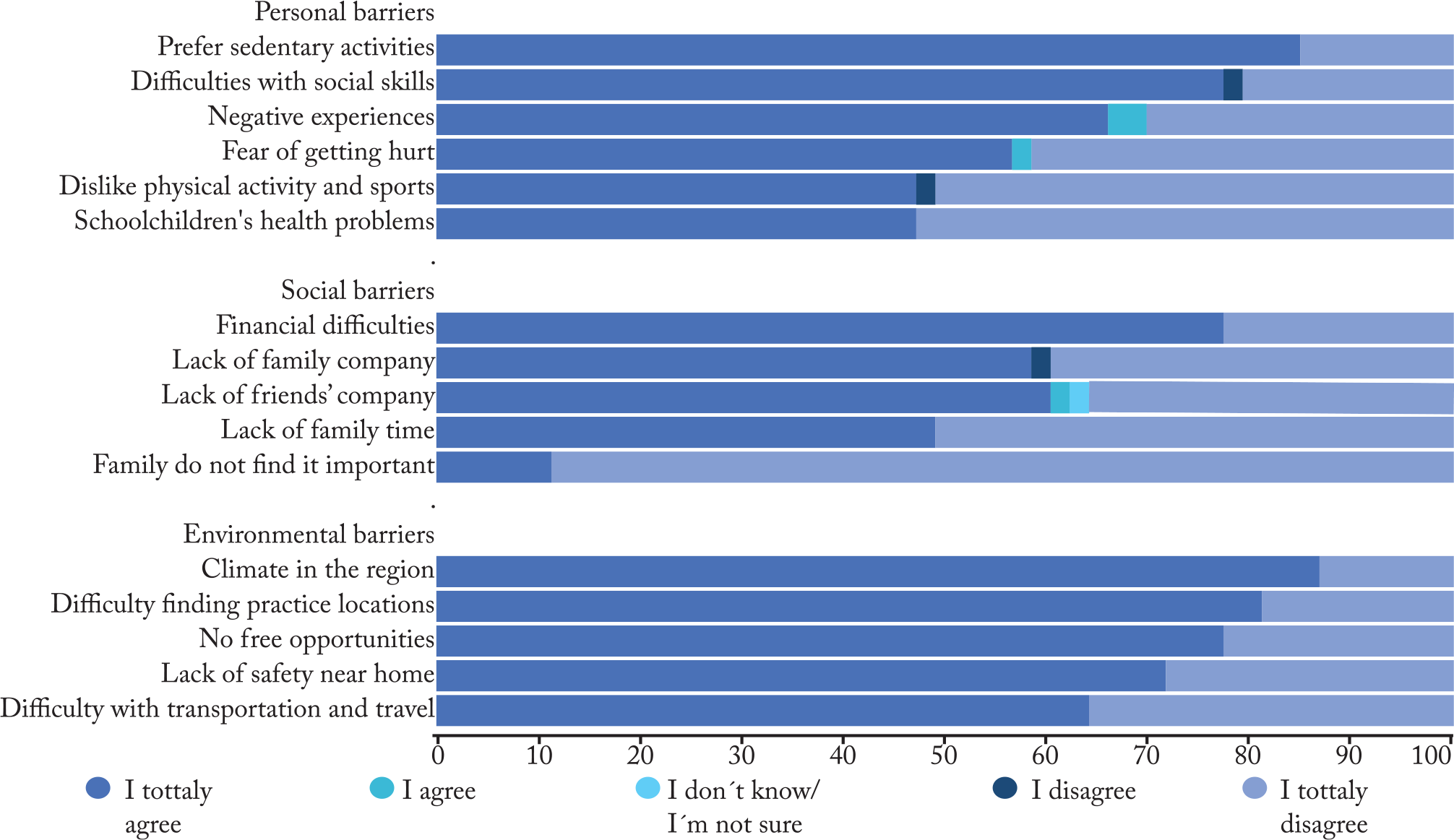
Barriers to engagement in sports and physical activities were assessed (Figure 3). It is important to note that the responses of those responsible predominated at the extremes of the response options, that is, completely agreeing or completely disagreeing with the statements. Among the categories, it was identified that environmental barriers are predominant indicators for limitations to the practice of sports and physical activities, with all barriers reported by at least 64.2% of respondents. Regarding personal barriers, students preferred to use their free time for screen time activities or sedentary behavior (n = 45; 84.9%). Other barriers included fear of injury (n = 31; 58.8%) and previous negative experiences with sports and physical activities (n = 37; 69.8%). Among the social barriers, only three were identified, with emphasis on the predominance of financial difficulties (n = 41; 77.4%). Another barrier found was the lack of company from friends for practicing sports and physical activities (n = 34; 64.2%), which may be related to the difficulties in social skills (n = 41; 77.4%) that students face in relationships, identified in personal barriers.

Barriers perceived by guardians of students with Intellectual Disabilities and/or Autism Spectrum Disorder enrolled in regular education and special education networks in the municipality of Encruzilhada do Sul, Rio Grande do Sul, Brazil.
Descriptive analyses were performed to stratify students with ID and ASD and no important differences were identified in the prevalence of practice according to the types of sports and physical activities, between the levels of PA in leisure time or commuting, and in the indicators of barriers to the practice of sports and physical activities (data not shown in illustrations).
Discussion
The current study sought to describe the perception of those responsible for students with ID and/or ASD regarding involvement in sports and physical activities, as well as to identify the barriers that influence this participation, in a municipality in southern Brazil. The findings show that most students participate in Physical Education classes in the school environment, however, they have low engagement in sports and physical activities during leisure time. Regarding the identified barriers, environmental barriers predominate, with emphasis on the region’s climate, difficulties in finding places to practice, and not having opportunities to practice sports and physical activities for free, followed by personal and social barriers.
Considering Physical Education classes, the participation of students was positive, in line with evidence that documents a gradual increase in the participation of students with ID and ASD17,31. Physical Education at School currently has as its central focus the development of body culture through movement, with an emphasis on activities such as dance, games, sports, fighting, play, among others32. From this perspective, the school environment often becomes the main means of promoting sports and physical activities for people with ID and/or ASD, as shown in the current study, where most students attend Physical Education classes and have little involvement in projects or leisure programs outside of school.
Although a high percentage of student participation in Physical Education classes was identified, it is important to highlight that the study focused on student attendance in classes, without investigating the depth of participation and inclusion of these students. Regarding students’ involvement in sports and physical activities outside of school, the most common activities included running, tag, and soccer. This preference may be related to the culture of play, ease of access, and convenience of practicing in small spaces, such as at home, without the need for professional guidance.
Despite the lack of involvement of students in these leisure activities, a positive aspect highlighted in the survey was that 96.2% of students would like to participate in sports and physical activities with professional guidance and free of charge. This suggests that although there is currently little engagement, there isa notable willingness to participate in these activities when barriers are reduced, guidance is provided, and access is facilitated.
Regarding physical activity levels, the results of the current study reveal low involvement of people with ID and ASD in sports and physical activities (86.7% of students are considered inactive according to the recommendations of the World Health Organization). These data are more alarming when compared to the findings of children and adolescents with ASD in Rio Grande do Sul, which identified 68.5% of inactive children18 and 55.9% of inactive teenagers33. In the same sense, Texeira, Graup and Copetti17 also identified that the majority of students with ID (62.5%) did not meet the established recommendations. It is noteworthy that these studies, although they use similar subjective measures of sports and physical activities, present intentional sample selection, involving people who are closer to a project or service that involves sports and physical activities and potentially explaining the differences in terms of magnitude of physical inactivity compared to the present study.
International meta-analyses and systematic reviews reinforce the importance of sports and physical activities for children and adolescents with neurodevelopmental disorders, demonstrating significant benefits in multiple dimensions of development. Li et al.34, for example, analyzed 37 studies with approximately 1,200 participants with ASD and reported significant improvements in social and communication skills after interventions in physical activities and sports. Similarly, Rivera, Robertson, and McCleery15 in a review of approximately 40 studies, identified significant reductions in stereotypical behaviors, as well as advances in social interaction and motor function.
Such evidence, although mostly international, reinforces the need for integrated public policies and intersectoral actions to expand access to structured physical and sports activity programs. Furthermore, these actions have the potential to stimulate broader diagnostics, at national, regional, and local levels, with the aim of identifying and minimizing the impacts of barriers that hinder the participation of this population in physical and sporting activities28,29.
Regarding barriers to physical activity and sports,it was observed that approximately two-thirds of personal, social, and environmental barriers affect the participation of students with ID and ASD. A similar study conducted in Uruguaiana, Rio Grande do Sul, by Gonçalves et al.35 identified similar barriers to the participation of children and adolescents with ASD in sports and physical activities. The most common barriers include the lack of specific programs for ASD, lack of spaces for sports and physical activities, professional guidance, financial constraints, time constraints, and insufficient transportation. In addition, Texeira, Graup and Copetti14 explored the perceptions of parents/guardians about the barriers to the practice of sports and physical activities both inside and outside the school environment, of students with ID in public schools in Rio Grande do Sul. The data showed that most parents did not identify barriers related to personal aspects. However, they highlighted environmental barriers, particularly the lack of social projects for sports and physical activities and the lack of places near their homes.
Among the main barriers discovered in the current study, in the social sphere, financial difficulties were clearly identified as a significant barrier to students’ participation in sports and physical activities, reinforcing aspects already mentioned related to the lack of social projects and the lack of suitable places close to home. These obstacles may be linked to the socioeconomic condition of the students’ families, expressed by the high percentage of families registered with CADÚnico, living with a per capita income of less than one minimum wage. These characteristics raise reflection on the possible relationship between economic inequality and reduced levels of physical activity in children and adolescents with ID and ASD. Previous studies, although not directly focused on students with ID and ASD and not presenting the same methodological and analytical characteristics, identify marked inequalities in the practice of physical activity36 and demarcate access to physical and sporting activities as another privilege for a small portion of the population37.
Regarding environmental barriers, all of the above influence students’ participation in sports and physical activities. The classification of the region’s climate as a limiting factor, most frequently cited by parents, may be related to the municipality’s geographic location. Furthermore, data collection took place during a period characterized by a harsh winter and adverse conditions in the state of Rio Grande do Sul. Therefore, weather conditions can lead to unfavorable situations, influencing participants’ decisions to travel to the practice location38.
Another frequently identified environmental barrier refers to the lack of social projects/programs and sports and physical activities near the residence. This lack of specific activities and professionals, which results from the absence of projects and public policies aimed at this population in the municipality under study, may explain the lack of options for the practice of sports and physical activities. To overcome these barriers, it is essential to invest in training professionals and pressure government authorities to ensure the state’s role is exercised. These reflections emphasize the need for effective public policies to promote inclusion in sports and physical activities39.
Among the limitations of the study, it is worth noting that although this research sought a census approach, including all students with ID and/or ASD, there was a significant non-response rate, requiring caution when extrapolating the data from the present study. Another aspect was the need to conduct telephone data collection. Although this approach may introduce some information bias, it is important to note that measures such as training and standardization of interviews were implemented to mitigate this possible limitation. The diagnosis was based on the report of those responsible, which may lead to inaccuracies, especially regarding the degree of disability. Furthermore, the study only assessed students’ attendance in Physical Education classes, as self-reported by their guardians, limiting verification of whether or not the students actually participated in these classes. This approach may limit understanding of the students’ actual participation in the proposed activities.
Finally, it is important to emphasize that the current study marks a significant step in research in the area of adapted physical activity, being a pioneer in the use of a broad school base in a small municipality, starting with the process of identifying this population group and addressing both the levels of practice and their multiple barriers. The results provide important support for future research and, most importantly, have the potential to inform the development of external public policies to promote sports and physical activities for children and adolescents with ID and ASD.
In conclusion, the current study identified low levels of physical activity and involvement in sports and physical activities outside the school environment among students with ID and ASD in a municipality in southern Brazil. By describing the perceptions of those responsible and mapping the barriers faced by these students, the study met its central objective of understanding the factors that influence the participation of this group in sports and physical activities. The challenges identified go beyond individual choice, reflecting a set of personal, social, and environmental factors that hinder engagement in regular sports and physical activities.
Given this scenario, it is recommended that intersectoral public policies are implemented to expand access to adapted physical activity and sports programs, especially in small municipalities. As practical actions, we highlight the creation of free social projects with trained professionals, structural investment to reduce environmental barriers, encouragement of continued training of Physical Education teachers to work with people with ID and/or ASD, and development of local awareness campaigns, aiming to reduce stigmas and expand access for students with ID and ASD to regular opportunities for sports and physical activities.
-
Funding
This work was carried out with the support of the Coordination for the Improvement of Higher Education Personnel - Brazil (Coordenação de Aperfeiçoamento de Pessoal de Nível Superior - CAPES) - Financing Code 001.
-
Declaration regarding the use of artificial intelligence tools in the article writing processThe authors did not use artificial intelligence tools to prepare the manuscript.
Acknowledgements
The authors would like to thank the Federal University of Pelotas and the Municipal Department of Education, Culture, and Sports of Encruzilhada do Sul, Rio Grande do Sul, for making this study possible. We would like to thank Prof. Dr. Alexandre Carriconde Marques (Sapinho), in memoriam, for his initial guidance and for the conception of this work.
Availability of research data and other materials
The contents underlying the research text are contained in the manuscript.
References
-
1 United Nations. Disability and development report 2024: accelerating the realization of the Sustainable Development Goals [Internet]. 2024. Available from: <https://indico.un.org/event/1010238/attachments/20948/59724/DDR%202024%20Full%20report%20-%20Unedited.pdf> [2025, set].
» https://indico.un.org/event/1010238/attachments/20948/59724/DDR%202024%20Full%20report%20-%20Unedited.pdf -
2 Instituto Brasileiro de Geografia e Estatística (IBGE). Censo Demográfico 2022: pessoas com deficiência e pessoas diagnosticadas com transtorno do espectro autista: resultados preliminares da amostra / IBGE [Internet]. Rio de Janeiro: IBGE; 2025. Available from: <https://biblioteca.ibge.gov.br/visualizacao/livros/liv102178.pdf>. [2025, September].
» https://biblioteca.ibge.gov.br/visualizacao/livros/liv102178.pdf -
3 Instituto Brasileiro de Geografia e Estatística (IBGE). Censo Demográfico 2022: resultados preliminares sobre deficiência no Rio Grande do Sul [Internet]. Rio de Janeiro: IBGE; 2023. Available from: https://www.ibge.gov.br [2025, september].
» https://www.ibge.gov.br - 4 American Psychiatric Association. Diagnostic and statistical manual of mental disorders: DSM-5. 5th ed. Arlington: American Psychiatric Publishing; 2013.
-
5 Brasil. Lei nº 13.146, de 6 de julho de 2015. Institui a Lei Brasileira de Inclusão da Pessoa com Deficiência (Estatuto da Pessoa com Deficiência) [Internet]. Brasília, DF; 2015. Available from: <https://www.planalto.gov.br/ccivil_03/_ato2015-2018/2015/lei/l13146.htm> [2025, September].
» https://www.planalto.gov.br/ccivil_03/_ato2015-2018/2015/lei/l13146.htm -
6 Frederico JCC, Laplane ALF. Sobre a Participação Social da Pessoa com Deficiência Intelectual. Rev. bras. educ. espec. 2020;26(3):465-80. doi: https://doi.org/10.1590/1980-54702020v26e0156
» https://doi.org/10.1590/1980-54702020v26e0156 -
7 Programa das Nações Unidas para o Desenvolvimento (PNUD). Relatório de desenvolvimento humano nacional - Movimento é vida: atividades físicas e esportivas para todas as pessoas [Internet]. Brasília: PNUD; 2017. Available from: <https://www.undp.org/pt/brazil/publications/movimentoe-vida-atividades-fisicas-e-esportivas-para-todas-pessoasrelatorio-nacional-de-desenvolvimento-humano-dobrasil-2017>. [2025, May].
» https://www.undp.org/pt/brazil/publications/movimentoe-vida-atividades-fisicas-e-esportivas-para-todas-pessoasrelatorio-nacional-de-desenvolvimento-humano-dobrasil-2017 -
8 McGarty AM, Downs SJ, Melville CA, Harris L. A systematic review and meta-analysis of interventions to increase physical activity in children and adolescents with intellectual disabilities. J Intellect Disabil Res. 2018;62(4):312-29. doi: https://doi.org/10.1111/jir.12467
» https://doi.org/10.1111/jir.12467 -
9 Yang W, Liang X, Sit CHP. Physical activity and mental health in children and adolescents with intellectual disabilities: a meta-analysis using the RE-AIM framework. Int J Behav Nutr Phys Act. 2022;19(1):80. doi: https://doi.org/10.1186/s12966-022-01312-1
» https://doi.org/10.1186/s12966-022-01312-1 -
10 Machado CF, Gomes TVB, Ortigas PR, Benda RN. Desempenho motor em crianças e adolescentes com Transtornodo Espectro Autista(TEA):umarevisãointegrativa da literatura. Res. Soc. Dev. 2022;11(4):e1011426692. doi: https://doi.org/10.33448/rsd-v11i4.26692
» https://doi.org/10.33448/rsd-v11i4.26692 -
11 Machado CF, Flôres F, Gomes TVB, Ortigas PR, Cordovil R, Benda RN. Motor Affordances of Children with Autism Spectrum Disorder in Southern Brazil. Phys Occup Ther Pediatr. 2025;1-15. doi: https://doi.org/10.1080/01942638.2025.2522749
» https://doi.org/10.1080/01942638.2025.2522749 -
12 Jia M, Zhang J, Pan J, Hu F, Zhu Z. Benefits of exercise for children and adolescents with autism spectrum disorder: a systematic review and meta-analysis. Front Psychiatry. 2024;15:1462601. doi: https://doi.org/10.3389/fpsyt.2024.1462601
» https://doi.org/10.3389/fpsyt.2024.1462601 -
13 Kou R, Li Z, Li M, Zhou R, Zhu F, Ruan W, et al. Comparative effectiveness of physical exercise interventions on sociability and communication in children and adolescents with autism: a systematic review and network meta-analysis. BMC psychology. 2024;12(1):712. doi: https://doi.org/10.1186/s40359-024-02210-w
» https://doi.org/10.1186/s40359-024-02210-w -
14 Xing Y, Wu X. Effects of Motor Skills and Physical Activity Interventions on Motor Development in Children with Autism Spectrum Disorder: A Systematic Review. Healthcare (Basel). 2025;13(5):489. doi: https://doi.org/10.3390/healthcare13050489
» https://doi.org/10.3390/healthcare13050489 -
15 Rivera RA, Robertson MC, McCleery JP. Exercise Interventions for Autistic People: An Integrative Review of Evidence from Clinical Trials. Curr Psychiatry Rep. 2025;27(5):286-306. doi: https://doi.org/10.1007/s11920-025-01597-6
» https://doi.org/10.1007/s11920-025-01597-6 -
16 Tao R, Yang Y, Wilson M, Chang JR, Liu C, Sit CHP. Comparative effectiveness of physical activity interventions on cognitive functions in children and adolescents with Neurodevelopmental Disorders: a systematic review and network meta-analysis of randomized controlled trials. Int J Behav Nutr Phys Act. 2025;22(1):6. doi: https://doi.org/10.1186/s12966-024-01702-7
» https://doi.org/10.1186/s12966-024-01702-7 -
17 Teixeira AM, Susane Graup, Copetti J. Barreiras para a atividade física de escolares com deficiência intelectual na percepção dos pais/responsáveis. Rev. Sapiência. 2022;11(1):136-50. doi: https://doi.org/10.31668/revsap.v11i1.11585
» https://doi.org/10.31668/revsap.v11i1.11585 - 18 krüger, GR. Atividade física: níveis e barreiras para prática em crianças com autismo de Pelotas [Dissertação de Mestrado]. Pelotas: Universidade Federal de Pelotas, Rio Grande do Sul; 2015.
-
19 Yuan Y, Wang M, Zhang Q, Zhang Y, Wang X, Hou X, et al. Physical activity levels of children and adolescents with intellectual disabilities in Northern China. J Appl Res Intellect Disabil. 2022;35(3):752-60. doi: https://doi.org/10.1111/jar.12976
» https://doi.org/10.1111/jar.12976 -
20 Pan CY, Tsai CL, Chu CH, Sung MC, Ma WY, Huang CY. Objectively Measured Physical Activity and Health- Related Physical Fitness in Secondary School-Aged Male Students With Autism Spectrum Disorders. Phys Ther. 2016;96(4):511-20 doi: https://doi.org/10.2522/ptj.20140353
» https://doi.org/10.2522/ptj.20140353 -
21 Jacinto M, Vitorino AS, Palmeira D, Antunes R, Matos R, Ferreira JP, et al. Perceived Barriers of Physical Activity Participation in Individuals with Intellectual Disability-A Systematic Review. Healthcare (Basel). 2021;9(11):1521. doi: https://doi.org/10.3390/healthcare9111521
» https://doi.org/10.3390/healthcare9111521 -
22 Yu S, Wang T, Zhong T, Qian Y, Qi J. Barriers and Facilitators of Physical Activity Participation among Children and Adolescents with Intellectual Disabilities: A Scoping Review. Healthcare (Basel). 2022;10(2):233. doi: https://doi.org/10.3390/healthcare10020233
» https://doi.org/10.3390/healthcare10020233 -
23 Bossink LWM, van der Putten AA, Vlaskamp C. Understanding low levels of physical activity in people with intellectual disabilities: A systematic review to identify barriers and facilitators. Res Dev Disabil. 2017;68:95-110. doi: https://doi.org/10.1016/j.ridd.2017.06.008
» https://doi.org/10.1016/j.ridd.2017.06.008 -
24 McGarty AM, Melville CA. Parental perceptions of facilitators and barriers to physical activity for children with intellectual disabilities: A mixed methods systematic review. Res Dev Disabil. 2018;73:40-57. doi: https://doi.org/10.1016/j.ridd.2017.12.007
» https://doi.org/10.1016/j.ridd.2017.12.007 -
25 Obrusnikova I, Miccinello DL. Parent Perceptions of Factors Influencing After-School Physical Activity of Children with Autism Spectrum Disorders. Adapt Phys Activ Q. 2012;29(1):63-80. doi: https://doi.org/10.1123/apaq.29.1.63
» https://doi.org/10.1123/apaq.29.1.63 -
26 Ministério da Educação (Brasil). Base Nacional Comum Curricular: educação é a base [Internet]. Brasília, DF: MEC; 2017. Available from: <http://basenacionalcomum.mec.gov.br>. [2025, July].
» http://basenacionalcomum.mec.gov.br -
27 World Health Organization. Guidelines on physical activity and sedentary behaviour [Internet]. Geneva: WHO; 2020. Available from: <https://www.who.int/publications/i/item/9789240015128>. [2025, July].
» https://www.who.int/publications/i/item/9789240015128 -
28 Esentürk OK. Parents’ perceptions on physical activity for their children with autism spectrum disorders during the novel Coronavirus outbreak. Int J Dev Disabil. 2020;67(6):446-57. doi: https://doi.org/10.1080/20473869.2020.1769333
» https://doi.org/10.1080/20473869.2020.1769333 -
29 Papadopoulos NV, Whelan M, Skouteris H, Williams K, McGinley J, Shih STF, et al. An Examination of Parent- Reported Facilitators and Barriers to Organized Physical Activity Engagement for Youth With Neurodevelopmental Disorders, Physical, and Medical Conditions. Front Psychol. 2020;11:568723. doi: https://doi.org/10.3389/fpsyg.2020.568723
» https://doi.org/10.3389/fpsyg.2020.568723 -
30 Gregor S, Bruni N, Grkinic P, Schwartz L, McDonald A, Thille P, et al. Parents’ perspectives of physical activity participation among Canadian adolescents with Autism Spectrum Disorder. Res Autism Spectr Disord. 2018;48:53- 62. doi: https://doi.org/10.1016/j.rasd.2018.01.007
» https://doi.org/10.1016/j.rasd.2018.01.007 - 31 Leivas, PSL. Percepção dos professores de Educação Física sobre a inclusão de crianças e jovens com transtorno do espectro autista (TEA) no ambiente escolar [Dissertação de Mestrado]. Pelotas: Universidade Federal de Pelotas, Rio Grande do Sul; 2022.
-
32 Base Nacional Comum Curricular - Educação é a Base [Internet]. Mec.gov.br. 2025. Available from: <https://basenacionalcomum.mec.gov.br/abase/>. [2025, June].
» https://basenacionalcomum.mec.gov.br/abase/ - 33 HAX, GP. Estilo de Vida de Adolescentes com Transtorno Autista [Dissertação de mestrado]. Pelotas: Universidade Federal de Pelotas, Pelotas, Rio Grande do Sul; 2012.
-
34 Li Y, Feng Y, Zhong J, Zou Z, Lan W, Shen Y, et al. The Effects of Physical Activity Interventions in Children with Autism Spectrum Disorder: a Systematic Review and Network Meta-analysis. Rev J Autism Dev Disord. 2023. doi: https://doi.org/10.1007/s40489-023-00418-x
» https://doi.org/10.1007/s40489-023-00418-x -
35 Gonçalves WRD, Graup S, Balk RDS, Da Cunha ÁLA, Ilha PV. Barreiras e facilitadores para a prática de atividades físicas em crianças e adolescentes com Transtorno do Espectro Autista de Uruguaiana - RS. Rev. Assoc. Bras. Ativ. Mot. Adapt. 2019;20(1). doi: https://doi.org/10.36311/2674-8681.2019.v20n1.02.p17
» https://doi.org/10.36311/2674-8681.2019.v20n1.02.p17 -
36 Ferreira RW, Varela AR, Monteiro LZ, Häfele CA, Santos SJ, Wendt A, et al. Desigualdades sociodemográficas na prática de atividade física de lazer e deslocamento ativo para a escola em adolescentes: Pesquisa Nacional de Saúde do Escolar (PeNSE 2009, 2012 e 2015). Cad Saúde Pública. 2018;34(4). doi: https://doi.org/10.1590/0102-311X00037917
» https://doi.org/10.1590/0102-311X00037917 -
37 Knuth AG, Antunes PC. Práticas corporais/atividades físicas demarcadas como privilégio e não escolha: análise à luz das desigualdades brasileiras. Saude soc [Internet]. 2021;30(2):e200363. doi: https://doi.org/10.1590/S0104-12902021200363
» https://doi.org/10.1590/S0104-12902021200363 -
38 Seron BB, Arruda GA, Greguol M. Facilitadores e barreiras percebidas para a prática de atividade física por pessoas com deficiência motora.Rev.Bras.Ciênc.Esporte.2015;37(3):214- 21.doi: https://doi.org/10.1016/j.rbce.2013.09.003
» https://doi.org/10.1016/j.rbce.2013.09.003 - 39 Silva RM. Diagmóstico de opções práticas para pessoas com autismo. Revista Ciência da Sabedoria (RCS-FaCiência). 2021;1(3).
Edited by
-
Editor in Chief
Raphael Ritti-DiasUniversidade Nove de Julho, São Paulo, São Paulo, Brazil.
-
Section editor
André Pereira dos Santos https://orcid.org/0000-0002-0055-4682University of Washington, Seattle, United States.
Reviewers’ assessment
The reviews of this article were originally conducted in Portuguese. This version has been translated using ChatGPT and subsequently reviewed by the Chief Editors.AuthorshipSCIMAGO INSTITUTIONS RANKINGSReviewer A
Comments to the author:
-
The study, entitled “Barriers to the practice of physical and sports activities among schoolchildren with Intellectual Disability and Autism Spectrum Disorder in a municipality in Southern Brazil,” aims to describe the perceptions of caregivers of schoolchildren with Intellectual Disability (ID) and Autism Spectrum Disorder (ASD) regarding engagement in physical and sports activities (PSAs), as well as to identify barriers that influence their participation in a municipality in Southern Brazil. The article is well written and organized, addressing a highly relevant topic. Below are some suggestions to improve the manuscript.
-
Title
Comment: The title is clear and informative; however, I suggest including the study design to make the methodological framework more transparent.
Suggested improvement:
“Barriers to the practice of physical and sports activities among schoolchildren with Intellectual Disability and Autism Spectrum Disorder: a cross-sectional study in a municipality in Southern Brazil.”
-
Abstract
Strengths:
Clear objective
Methodology briefly described.
Relevant results and outcomes presented.
-
Suggestions for improvement:
Begin the text by stating that the objective of the study was...
Include which questionnaire was used; was it validated? • Specify the inclusion criteria.
Present the characteristics of the data collection setting.
Mention the analytical technique (descriptive statistics).
The conclusion should directly address the objective, avoiding generalizations.
-
Introduction
Strengths
Solid legal and conceptual framework.
Well-developed contextualization of ID and ASD.
-
Suggestions for improvement:
The introduction could be more concise, avoiding overly long paragraphs.
It is recommended to include global data or comparisons with other Brazilian regions.
Insert recent systematic reviews or meta-analyses on PA in children/adolescents with ID and ASD to enrich the state of the art.
Strengthen the rationale and hypothesis of the study, as well as clarify the contributions and innovations brought by the research.
-
Objective
The wording is adequate, but the comma after “as well as” is incorrect.
The objective must be identical in the abstract and the body of the article.
Does the study truly achieve the proposed objective? Ensure the results and conclusion answer it.
-
Materials and Methods
Strengths:
Well-detailed methods.
Clearly defined inclusion and exclusion criteria.
The inclusion of a pilot study is a strong point.
-
Suggestions
Age range justification (7–18 years): Specify whether it follows WHO, Ministry of Education, or another criterion.
Instrument validation: The questionnaire was adapted from previous instruments, but it is unclear whether it was validated for this population. Include this information and the reference.
Sampling: The absence of a sample size calculation may compromise external validity. If not performed, justify clearly.
Telephone application: Explain the rationale for choosing between in-person and telephone interviews.
REDCap platform: Provide more details on its use.
How many evaluators were involved? Was there training?
-
Results
Strengths:
Clear description aligned with the objectives.
Tables and figures well distributed.
-
Suggestions for improvement:
Figures’ source: Include the source and indicate whether they are data from the study itself.
Acronyms: Explain all acronyms and abbreviations throughout the text and in figure legends.
Prevalent diagnosis: Briefly discuss why there was a higher number of schoolchildren with ID rather than ASD. Does the municipality have a specialized center?
Non-illustrated data: Variables such as interest in programs should be included in a figure or table (even as supplementary material).
Differences between schools: It could be interesting to stratify results by school type.
-
Discussion
Strengths:
Contextualization of findings within the literature.
Recognition of barriers across multiple dimensions.
Relevant reflections on inequalities and public policy.
-
Suggestions for improvement:
Limitations: Robust considerations are missing regarding:
Non-probabilistic, convenience sampling.
Remote data collection (telephone) and potential response bias.
Lack of depth in analyzing inclusion in Physical Education classes.
Self-reported diagnosis may lead to bias.
Strengths: Include a final section highlighting the main strengths of the study (e.g., wide school-based sample, pioneering in the municipality, analysis across multiple barriers).
Meta-analyses: Add quantitative data from international literature to strengthen the argument.
-
Conclusion
Ensure it responds to the study’s objective.
-
References
Many references are relevant and up to date.
However, only 7 out of 34 were published from 2020 onward — include more recent studies (last 5 years), preferably systematic reviews and meta- analyses.
Standardize formatting according to the journal’s guidelines (e.g., full journal names, DOI without “https” prefix, etc.).
-
Final decision
Mandatory revisions
Final decision
-
Mandatory revisions
- peer review recommendation: major-revision
Reviewers’ assessment
The reviews of this article were originally conducted in Portuguese. This version has been translated using ChatGPT and subsequently reviewed by the Chief Editors.AuthorshipReviewer B
Dear Author and Editor, please find my suggestions below:
-
Title: I suggest a change: “Difficulties in the practice of physical and sports activities among students with Intellectual Disability and Autism Spectrum Disorder in a municipality in Southern Brazil.”
Abstract: In line 1, I suggest abbreviating Physical Activity as PA
Abstract: It is important to mention how the statistical analysis was carried out.
Introduction: Lines 2 to 4, update the UN reference – 2018 UN data were cited.
Materials and Methods: Line 11, explain how the REDCap application was conducted.
Materials and Methods: Line 24, regarding the absence of signature on the informed consent form (ICF), was it sent to participants after data collection?
Results: They are appropriate.
Discussion: Include more recent references, published within the last three years.
Conclusion :Add in a separate paragraph something practical that can be done to improve the lives of schoolchildren.
Final decision
-
Mandatory revisions
- peer review recommendation: major-revision


 Source: data from the study itself