
 Gender differences in children’s physical literacy and physical activity: a network analysis
ABSTRACT
Introduction: Physical literacy is a multidimensional construct that encompasses physical, cognitive, and psychological competencies essential for adopting an active lifestyle. However, significant knowledge gaps remain in understanding gender disparities across these domains, particularly when examined through complex analytical approaches.
Objective: To investigate differences between boys and girls in physical activity and the cognitive (knowledge and understanding), psychological (motivation and confidence) and physical (physical fitness and motor coordination) domains of physical literacy in children, as well as to identify which variables have greater centrality using network analysis.
Methods: A total of 439 schoolchildren aged 8 to 12 years from twelve public schools in Lagoa do Carro, Pernambuco, Brasil, participated in the study. The cognitive and psychological domains of physical literacy were assessed using transculturally adapted questionnaires from the Canadian Assessment of Physical Literacy - Second Edition, while the physical domain was measured through physical fitness tests and gross motor coordination. Physical activity was evaluated using the Physical Activity Questionnaire for Children questionnaire. Demographic variables such as gender, chronological age, biological maturity and body mass index were also assessed and included in the statistical analysis.
Results: Network analysis revealed gross motor coordination as the most central variable for both sexes. Among girls, the network was denser, with gross motor coordination showing high betweenness (2.689) and closeness (1.408); among boys, the network was sparser, with elevated strength (1.835) and expected influence (1.800). Notably, only among boys did the psychological domain exhibit high betweenness (1.161).
Conclusion: Gross motor coordination plays a structurally central role in the physical literacy and physical activity networks for both genders, though it assumes distinct centrality functions. Gender-sensitive and system-based approaches are essential to promote active and equitable lifestyles from early childhood.
Keywords:
Gender studies; Exercise; Child; Nonlinear dynamics
RESUMO
Introdução: O letramento corporal é um constructo multidimensional que integra competências físicas, cognitivas e psicológicas essenciais à adoção de um estilo de vida ativo. Entretanto, persistem lacunas de conhecimento na compreensão das desigualdades de gênero nesses domínios, especialmente quando analisadas sob abordagens complexas.
Objetivo: Investigar as diferenças entre meninos e meninas nos níveis de atividade física e os domínios cognitivo (conhecimento e compreensão), psicológico (motivação e confiança) e físico (aptidão física e coordenação motora) do letramento corporal em crianças, bem como identificar que variáveis possuem maior centralidade a partir da análise de redes.
Métodos: Participaram 439 escolares de 8 a 12 anos de 12 escolas de Lagoa do Carro, Pernambuco, Brasil. Os domínios cognitivo e psicológico do letramento corporal foram avaliados com questionários adaptados transculturalmente do Canadian Assessment of Physical Literacy - Second Edition, enquanto o domínio físico foi mensurado por testes de aptidão física e coordenação motora grossa. A atividade física foi avaliada pelo questionário Physical Activity Questionnaire for Children. Variáveis demográficas como gênero, idade cronológica, maturação biológica e índice de massa corporal também foram avaliados e considerados na análise estatística.
Resultados: A análise de redes revelou que a coordenação motora grossa foi a variável mais central em ambos os gêneros. Nas meninas, a rede foi mais densa com coordenação motora grossa apresentando alta intermediação (2,689) e proximidade (1,408); nos meninos, a rede foi mais esparsa, com elevada força (1,835) e influência esperada (1,800). Apenas nos meninos, o domínio psicológico obteve elevada intermediação (1,161).
Conclusão: A coordenação motora grossa desempenha um papel central nas redes de ambos os gêneros, porém assumindo papéis distintos de centralidade. Abordagens sistêmicas e sensíveis ao gênero são necessárias para promoção de um estilo de vida ativo e equitativo na infância.
Palavras-chave:
Estudos de gênero; Exercício físico; Criança; Dinâmica não linear
Introduction
Adopting an active lifestyle during childhood is essential for physical, cognitive, and social development1, with impacts that tend to continue into adulthood2. For children and adolescents aged 6 to 17, the recommendation is at least 60 minutes of moderate to vigorous physical activity (PA) per day, on at least three days a week3. This includes activities that strengthen the musculoskeletal system, such as jumping, pulling, or pushing3. However, in Brazil4 and worldwide5, over 80% of children and adolescents do not meet the minimum PA recommendations. The situation becomes even more complex when analyzed from a gender perspective, as a higher percentage of boys (26.7%) meet the PA recommendations compared to girls (9.3%)4.
Understanding gender disparities related to various aspects of active lifestyles is a complex and multifactorial challenge. Understanding gender disparities related to various aspects of active lifestyles is a complex, multifactorial challenge. These differences are influenced by various factors, including individual characteristics such as age and biological maturation6, physical traits such as physical fitness and motor performance7, behavioral attributes such as adherence to PA and sports8, environmental conditions such as the availability of practice spaces9, and political influences such as public policies supporting gender equity in PA promotion10. Since these factors interact dynamically and interdependently, approaches that integrate physical, cognitive, and psychological skills are essential.
In the face of the challenge of understanding how children and adolescents become engaged in PA throughout their lives, the concept of physical literacy (PL) has gained prominence in global literature11. The PL is a conceptual structure consisting of three interrelated domains: the cognitive domain, which involves knowledge and understanding of the elements necessary for adopting an active and healthy lifestyle; the psychological domain, which is linked to the motivation and confidence required for engaging in PA and sports; and the physical domain, which concerns the motor competence and physical fitness necessary for effectively participating in PA throughout life12.While the International Physical Literacy Association12 recognizes these three domains as central, various instruments are used to assess PL around the world. These instruments meet the specific needs of each region, culture, and philosophical basis13,14, but hinder the implementation of tools that are used uniformly globally. In Canada, one of the countries that has proposed measures of PL, the behavioral domain is considered15. However, countries such as Australia and Wales consider the social domain but not the behavioral domain in their assessments.
Studies conducted in the Northern hemisphere have reinforced the relevance of PL. In Canada, for instance, Bélanger et al.16 found that children who did not meet PA recommendations had significantly lower PL psychological domain scores, averaging 12.4 points out of 18, compared to 13.3 points for those who met the recommendations. In Spain, adolescents with higher levels of PL demonstrated greater handgrip strength and lower-limb power17. Additionally, boys tend to have higher PL scores than girls, particularly in the physical domain18. These findings suggest that the domains of PL interact dynamically and are influenced by various individual, social, and environmental factors. Properly understanding these interrelationships requires analytical approaches that consider the complexity and nonlinear nature of these phenomena.
In this sense, nonlinear approaches have been proposed to understand these components and their interactions19, which form a complex, dynamic system. Network analysis emerges as a complementary alternative to traditional statistical models, enabling the investigation of multidimensional, nonlinear relationships between variables20. While linear models, such as correlations and regressions, are limited in their ability to capture such dynamics, network analysis enables the identification of connectivity and relevance patterns between variables based on centrality indicators such as betweenness, closeness, strength, and expected influence.
Despite the growing body of evidence on the importance of PL, research exploring the complex interrelationships between PA and PL domains, as well as other health indicators in boys and girls, which has not yet been examined using network analysis. This approach is essential for understanding the central elements (relevant nodes and pathways) that can promote gender equity in the adoption of active and healthy lifestyles. Given the above, the present study aims to investigate the differences between boys and girls in PA levels and the cognitive (knowledge and understanding), psychological (motivation and confidence), and physical (physical fitness and motor coordination) domains of PL in children, as well as to identify which variables have greater centrality based on network analysis.
Methods
Sample
This research is part of the “Healthy Life in Lagoa do Carro” study, which analyzed the relationship between physical and motor development and the health aspects of children and adolescents in Lagoa do Carro, Pernambuco, Brazil. It is a population-based, observational study with a cross-sectional design21. In this study, 1,359 children between the ages of five and fifteen who were enrolled in all twelve public elementary schools (six rural and six urban) were evaluated between April and November 2018, in accordance with the school calendar. A detailed description of the schools’ characteristics can be found in the study by Maia et al.22
Since the PL assessment is only valid for children between eight and twelve years of age23,24, only participants in this age group who did not have disabilities, disorders, or other physical or cognitive restrictions that prevented them from taking the measurements and/or questionnaires were considered. Furthermore, only participants who completed all the measurements in this study were considered. Thus, the final sample consisted of 439 children (216 girls, 49.2%; and 223 boys, 50.8%), aged between eight and twelve years (10.2 ± 1.2 years).
The children were assessed individually over two days. On the first day, anthropometric measurements were taken, and questionnaires and gross motor coordination (GMC) tests were administered. The following day, physical fitness tests were conducted. Missing data was collected during an additional visit when necessary. All children from each school were invited to participate, resulting in a response rate of over 95%. Parents or guardians provided informed consent for their child’s participation in the study. The study adhered to the principles of the Declaration of Helsinki and received approval from the Research Ethics Committee of the University of Pernambuco (CAAE: 83143718.3.0000.5192; CEP/UPE: 2520417) as well as formal consent from the principals of all participating schools.
Instruments and procedures
• Anthropometry
Anthropometric measurements (height and body mass) were obtained in accordance with the Lohman, Roche, and Martorell25 standard, employing a digital scale (Filizola, São Paulo, Brazil), with a precision of 0.1 kilograms, and a portable stadiometer (Sanny, São Paulo, Brazil), with a precision of 0.1 centimeters. Based on these measurements, body mass index (kg/m2) was calculated.
• Biological maturation
Biological maturation was assessed using the maturity offset26 calculation. This calculation uses gender-specific equations based on age, height, sitting height, and lower limb length. This method estimates the number of years it will take to reach peak growth velocity. A positive maturity offset value indicates how many years the participant is beyond peak height velocity, while a negative value indicates how many years the participant is before peak height velocity.
• Physical activity
The Physical Activity Questionnaire for Children, adapted cross-culturally for Brazilian children27, was used to measure PA. The instrument includes nine questions about PA practices over the past seven days. These questions cover the frequency of PA and sports during free time, as well as moderate to vigorous PA during physical education classes, recess, and specific daily periods (morning, afternoon, evening, and weekend). Additionally, the questionnaire asks about the intensity of PA during the last seven days and the frequency of intense PA each day of the week. Answer options are scored on a Likert scale from one to five points.
• Physical literacy
The PL, which includes cognitive, psychological, and physical domains, was evaluated using different instruments. The physical domain included measures of physical fitness and GMC, while the cognitive and psychological domains of the PL were assessed using cross-culturally adapted and validated versions for Brazilian children13,24 of questionnaires from the Canadian Assessment of Physical Literacy - Second Edition15. Since only the questionnaires were adapted and not the entire Canadian Assessment of Physical Literacy - Second Edition instrument, the raw scores for these domains were treated separately with the same weighting.
• Cognitive domain
The cognitive domain questionnaire covers four areas of knowledge and understanding: (1) knowledge of daily PA recommendations and sedentary behavior, (2) knowledge of definitions related to cardiorespiratory and musculoskeletal fitness, (3) understanding of ways to improve physical competence, and (4) understanding of what it means to be healthy. For the first three areas, participants were asked to select one of four possible answers, only one of which was correct. For the fourth area, participants circled what “being healthy” meant to them. They received one point for a correct answer and zero for an incorrect one. The total number of points could range from zero to nine and was used for analysis purposes.
• Psychological domain
The psychological domain questionnaire contains eight items and comprises three areas: (1) perceived competence in PA and sports, (2) pre-dilection, or liking PA, and (3) adequacy, or feeling good enough, in PA. For the perceived competence items, children were asked to rate themselves on a scale from 1 to 10, with higher values indicating greater competence. For the predilection and adequacy items, participants first circled the statement that best described their situation (e.g., “Some children don’t have much fun playing sports,” or “Other children have fun playing sports”), and then chose whether that statement was “Really true for me” or “Almost true for me.” The perceived competence item scores (1-10) were divided by four, and the pre-dilection and adequacy responses were scored from 0.6 to 2.5. The sum of these scores was used to analyze the data, which could range from 4.1 to 20 points.
• Physical domain
The physical domain was measured using GMC and physical fitness, as detailed below.
• Gross motor coordination
GMC was assessed using the Korperkoordinationstest fur Kinder28 battery, which includes the following tests:
-
Walking backwards: the child walks backward on a balance beam 3 m in length, with a progressive reduction of widths (6.0 cm, 4.5 cm, and 3.0 cm). A maximum of 24 steps (eight per trial) were counted for each balance beam, which comprises a maximum of 72 steps (24 steps × 3 beams) for this test.
-
Jumping sideways: the child makes consecutive jumps from side to side over a small beam (60 cm × 4 cm × 2 cm) as fast as possible for 15 seconds. The number ofjumps over two trials was summed.
-
Hopping for height on one foot: the child is instructed to hop on one foot at a time over a stack of foam squares; after a successful hop with each foot, the height is increased by adding a square (50 cm × 20 cm × 5 cm)
-
Moving sideways: the child begins by standing with both feet on one platform (25 cm × 25 cm × 2 cm supported on four legs 3.7 cm high), places the second platform alongside the first and steps on to it, the first platform is then placed alongside the second and the child steps on to it, the sequence continues for 20 seconds. The number of relocations was counted. It was summed over two trials.
The raw scores from all the tests were summed up to obtain a total GMC score.
• Physical fitness
Physical fitness was assessed using the Fitnessgram29, American Alliance for Health, Physical Education, Recreation and Dance32 and Projeto Esporte Brasil31 tests. The following measures were used: (1) meters covered in the Progressive Aerobic Cardiovascular Endurance Run (PACER; cardiorespiratory fitness); (2) distance reached in the sit-and-reach test (flexibility); (3) maximum handgrip strength of the dominant limb (upper-limb strength); (4) maximum distance in the horizontal jump (lower-limb strength and power); (5) speed in meters per second (m/s) in the 20-meter linear run (speed); and (6) speed in m/s in the 4x10-meter shuttle run (agility). For analysis purposes, the results of each test were treated individually.
Quality control
Data quality control was assessed in four phases. First, the project coordinators conducted systematic training with the team of evaluators on the methodological procedures. A pilot study was then conducted in a school in Lagoa do Carro to determine the approximate time required for data collection. Third, reliability procedures were conducted in the field. Three to five students from each school were randomly selected on alternate assessment days and retested one week apart for a total of 42 students. The technical measurement error was 0.2 cm for height, 0.1 kg for body mass, and 0.1 cm for sitting height, respectively. Test-retest reliability for motor tests ranged from 0.81 (WB) to 0.96 (HH) for GMC and from 0.81 (4x10-meter shuttle run) to 0.95 (sit-and-reach) for physical fitness. The final stage involved double entering the information and checking all the data for tabulation errors or inconsistencies.
Statistical analysis
Descriptive statistics (means and standard deviations) were calculated for each variable, stratified by gender. The Kolmogorov-Smirnov test was used to assess normality, and the Levene test was used to assess homogeneity of variance. Differences between genders were assessed using a t-test for independent samples. To obtain greater reliability of the results and correct for deviations from sample normality and differences between group sizes, bootstrapping procedures were carried out (1000 resamples). The effect size was estimated using Cohen’s d, considering the following cutoff points: <0.20 (trivial), 0.20-0.59 (small), 0.60-1.19 (moderate), 1.20-1.99 (large), 2.00-3.99 (very large), and ≥4.0 (extremely large).
Network analysis was used to examine the relationships between chronological age, biological maturation, PA, PL, physical fitness, GMC, and body mass index, separately by gender. The network is represented by a topology graph in which the nodes correspond to the variables and their relationships (lines)32. Blue lines indicate direct associations, and red lines indicate inverse associations32. Additionally, the thickness and intensity of the lines show the magnitude of the associations. Each node’s importance within the network is determined by its centrality, representing its structural relevance; higher values indicate greater relevance33. Four indices were considered to analyze the centrality of the nodes: betweenness, which indicates a node’s position on the average path between another pair of nodes; closeness, defined as the inverse of the average shortest distance between a node and the other nodes in the network; strength, which is the sum of all the weights of the paths connecting a node to the others; and expected influence, which estimates the magnitude of the relationships based on the negative and positive edges connecting a node to the others.
The Fruchterman and Reingold34 algorithm was applied to calculate and visualize the network. The data shows the relative space between the variables, separating the weaker associations while keeping the strong ones together. To increase the network’s accuracy, the “Markov pair random fields” algorithm was used. The regulation was determined by an absolute minimum selection and contraction operator designed to manage the network’s sparse nature33. The extended Bayesian information criterion was used to mitigate spurious associations. The hyperparameter (y) establishes the amount of the extended Bayesian information criterion that selects sparse models. For this analysis, y was set to 0.50. Network analysis uses absolute minimum shrinkage to obtain the precision matrix. After standardization, the matrix portrays the associations between the variables in the network. These analyses were conducted using JASP 19.2 software.
Results
Table 1 shows the gender differences in all variables. Boys were slightly older and less mature, with a lower body mass index. The boys were also more active, had a higher GMC and performed better in the physical fitness tests, except for flexibility, which showed no difference between the genders (Table 1). There were no significant gender differences in the cognitive and psychological domain scores of the PL (p > 0.05).
Figures 1a and 1b illustrate the relationships between PL variables in the cognitive, psychological, and physical domains (including physical fitness tests and GMC), as well as in the PA and demographic indicators (e.g., age, biological maturation, and body mass index), separately by gender.
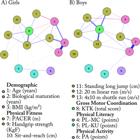
a and b. Network for associations between body literacy variables for the cognitive (PL-KU, knowledge and comprehension), psychological (PL-MC, motivation and confidence), physical (physical fitness and gross motor coordination tests), physical activity and demographic indicators (age, biological maturation and body mass index) domains, separately by gender (boys and girls). Red lines, negative associations; blue lines, positive associations. Note. PA, Physical activity; BMI, Body mass index; PL-KU, Physical literacy - knowledge and comprehension; PL-MC, Physical literacy - motivation and confidence; KTK, Korperkoordinationstest fur Kinder; PACER, Progressive Aerobic Cardiovascular Endurance Run.
Table 2 summarizes the network analysis and presents the centrality indicators. Among the girls, 39 of the 78 possible nodes were observed, resulting in a sparsity value of 0.500. Among the boys, only 27 of the possible 78 nodes were connected, leading to higher sparsity (0.654). These results suggest that boys’ and girls’ networks differ in density and connectivity.
Measures of centrality for the variables age, biological maturation, physical activity, body mass index, physical fitness, gross motor coordination and physical literacy, according to gender
In betweenness, the variable with the highest centrality for girls was GMC (2.689). For boys, higher values were found for age (2.364), GMC (1.161), and the PL motivation and confidence score (1.161). In the closeness indicator, the highest value among girls was GMC (1.408), while among boys the highest value was observed for the PL knowledge and understanding score (0.927). Regarding strength, girls showed high values for biological maturity (1.462) and GMC (1.396), while boys showed high values for GMC (1.835) and chronological age (1.272). Finally, the highest values in expected influence were observed for biological maturity (1.895) and GMC (1.241) among girls and for GMC (1.800) and age (1.420) among boys. These results demonstrate the strong capacity of these variables to influence other nodes in the network.
Discussion
This study is the first to use network analysis to explore the interrelationship between the cognitive, psychological, and physical domains of PL and PA, focusing on the gender gap. Our findings, based on a complex systems approach, contribute to the understanding of central variables that may be fundamental for the formulation of strategies and public policies to address gender inequality in Brazilian children aged eight to twelve. This ensures that GMC can boost children’s integral development and consequently equitable access to movement opportunities and the adoption of active and healthy lifestyles in boys and girls.
The gender differences observed in physical fitness, GMC, and PA measures corroborate previous studies indicating that boys engage in PA and sports more frequently from childhood onwards7,35. These inequalities are not solely due to biological predisposition but rather are the result of the social construction of gender roles36. In this construction, boys tend to be encouraged to play sports and engage in vigorous PA, while girls face cultural, institutional, and environmental barriers10.
Network analysis provides a deeper understanding of these inequalities, showing that GMC acts as a central node for both genders but with different structural properties. For girls, the GMC stood out due to its high degree of betweenness, closeness, and strength. This suggests that the GMC plays a prominent role in connecting the different components of the network. For boys, the GMC showed high strength and expected influence. These findings establish GMC as a primary hub linking variables associated with children’s lifestyles, reinforcing its pivotal role in fostering complete and healthy motor development during childhood19.
Network analysis shows that the girls’ network had fewer sparse connections, resulting in a more interconnected and cohesive structure than the boys. This high density suggests that the assessed variables, such as GMC, physical fitness, motivation, and confidence, are closely related and mutually dependent. According to graph theory, highly dense networks can paradoxically be more structurally fragile20. This is because in strongly connected systems, weakening a single component can more easily spread to others and negatively affect the network’s overall functioning. Thus, in the girls’ network, a loss of motivation or confidence, or low physical fitness, for example, could negatively affect other aspects of PL and PA practice. Conversely, sparse networks, as observed in the boys’ network, tend to be less susceptible to this type of systemic propagation. However, they depend more on central nodes with greater strength and influence, such as GMC33.
These findings suggest that, for girls, intervention strategies should be designed to develop and protect the integrity of greater centrality.
These findings suggest that intervention strategies for girls should focus on developing and protecting the integrity of greater centrality, particularly in contexts of social vulnerability where adverse external factors can hinder motor development and exacerbate inequalities in GMC acquisition41. Recent studies have indicated that interventions to promote GMC should encourage movement variability, autonomy, cognitive engagement, and creativity38. By requiring exploration of creative solutions and resolution of motor problems imposed by task constraints and the environment, these interventions holistically boost PA, cognition, and socio-emotional skills38. For these benefits to be realized fully and equitably, interventions must be sensitive to gender-specific challenges posed by social vulnerability.
Among demographic variables, age was a central node in boys’ networks, particularly in measures of expected influence and betweenness. Thus, advancing age represents a progressive accumulation of movement opportunities and skills that develop the physical component of PL, particularly GMC and physical fitness39. In girls, however, biological maturation showed greater strength and expected influence. This difference underscores the importance of considering the maturation period in girls’ PL, an area that has not yet been explored in the literature, particularly given the hormonal changes that promote greater fat accumulation in girls40, unlike boys, who tend to gain lean mass during puberty.
The psychological dimension of PL, including motivation and confidence, only played a relevant role in the boys’ network and was directly associated with PA and age. Studies show that boys tend to report greater perceived competence and motivation for PA as a result of greater exposure to organized sports, practice, and positive reinforcement in school and family contexts10. Despite the important role of the psychological aspect of PL for boys, future research should address other elements that influence movement opportunities during childhood. These elements include parental and friend support, socioeconomic status, and access to public policies that ensure equitable access to PA programs.
Lagoa do Carro has one of the lowest human development indexes (0.609) in the state of Pernambuco, ranking 3,927th out of 5,565 municipalities nationwide. Additionally, the Social Vulnerability Index indicates high vulnerability in Lagoa do Carro (0.471), particularly in the domains of urban infrastructure (0.465) and income and work (0.436), as well as in the human capital domain (0.512). More than 90% of school-age children in the municipality receive government assistance (Bolsa Família), which is only available to families with a per capita income of less than 178 reais. The municipality also has accentuated insecurity, disorderly traffic, and a lack of public spaces for recreation and leisure. This reduces opportunities to practice PA and restricts access to diverse motor experiences.
Despite the findings, there are some limitations that need to be considered. First, the cross-sectional design prevents attributing causality to the observed relationships. Additionally, PA was assessed using subjective measures, which may be susceptible to social desirability and recall bias. For logistical and financial reasons, PA was not assessed using accelerometers, although subjective measures of PA have been used internationally in PL studies. The questionnaires used to assess PA were previously adapted and validated for the Brazilian context. However, it should be noted that psychological and cognitive domains are subjective, which may imply additional psychometric limitations, especially in different cultural contexts. Finally, the exclusive sample from Lagoa do Carro may limit generalization to other age groups, geographic regions, or more favorable socioeconomic strata. However, it should be noted that the sample included over 90% of schoolchildren between the ages of eight and twelve enrolled in the Lagoa do Carro municipal school system.
Among its strengths, we highlight network analysis as a promising tool for understanding the complexity of these systems and their implications for gender equality. Network analysis is relevant to society because it can identify interrelationships and central nodes in the set of variables that influence children’s health, such as PL, PA, physical fitness, and GMC. This indepth understanding of gender-specific vulnerabilities and points of influence is crucial for designing more effective, targeted interventions. Nevertheless, longitudinal studies using network analysis are necessary to follow the evolution of these structures over time. This will continuously strengthen the foundation for educational programs and public policies that promote an active and healthy lifestyle from childhood. These programs must be sensitive to gender and social context.
The results of this study show that GMC, from the physical domain, emerged as a central variable in the PL and PA networks for both genders but with different degrees of centrality. Motivation and confidence, from the psychological domain of PL, play a significant role exclusively among boys. Meanwhile, biological maturation is more influential among girls. Network analysis proved to be a powerful tool for revealing the interdependence between variables and highlighting specific paths for promoting active lifestyles with gender equity. These findings reinforce the importance of interventions that promote GMC development, motivation, and confidence to practice PA, especially in contexts of high social vulnerability. Public policies and programs promoting an active lifestyle in childhood should incorporate integrated, systemic, and gender-sensitive approaches to promote full, healthy, and equitable development from childhood onward.
-
Funding
This work was carried out with the support from the National Council for Scientific and Technological Development (Conselho Nacional de Desenvolvimento Científico e Tecnológico - CNPq; Process 303621/2023-0) and the Pernambuco State Science and Technology Support Foundation (Fundação de Amparo à Ciência e Tecnologia do Estado de Pernambuco - FACEPE); (FACEPE; Processes: APQ-1762-4.09/22, APQ-0742-4.09/22 and APQ-1248-4.09/21).
-
Statement regarding the use of artificial intelligence tools in the process of writing the article
The authors did not use artificial intelligence tools to prepare the manuscript.
Availability of research data and other materials
After publication, the data will be available on demand to the authors.
Acknowledgments
The authors would like to thank the children, their parents, and the schools that participated in the study. Additionally, we would like to thank the members of the Healthy Life in Lagoa do Carro study’s data collection team.
References
-
1 Lee IM, Shiroma EJ, Lobelo F, Puska P, Blair SN, Katzmarzyk PT, et al. Effect of physical inactivity on major non-communicable diseases worldwide: An analysis of burden of disease and life expectancy. The Lancet. 2012;380(9838):219-29. doi: https://doi.org/10.1016/S0140-6736(12)61031-9
» https://doi.org/10.1016/S0140-6736(12)61031-9 -
2 Reis RS, Salvo D, Ogilvie D, Lambert EV, Goenka S, Brownson RC. Lancet Physical Activity Series 2 Executive Committee. Scaling up physical activity interventions worldwide: stepping up to larger and smarter approaches to get people moving. Lancet. 2016;388(10051):1337-48. doi: https://doi.org/10.1016/S0140-6736(16)30728-0
» https://doi.org/10.1016/S0140-6736(16)30728-0 - 3 Brasil. Ministério da Saúde. Secretaria de Atenção Primária à Saúde. Departamento de Promoção da Saúde. Guia de atividade física para a população brasileira. Brasília: Ministério da Saúde; 2021.
-
4 Soares CAM, de Andrade Leão OA, Freitas MP, Hallal PC, Wagner MB. Temporal trend of physical activity in Brazilian adolescents: analysis of the Brazilian National Survey of School Health from 2009 to 2019. Cad Saúde Pública. 2023;39(10):e00063423. doi: https://doi.org/10.1590/0102-311XPT063423
» https://doi.org/10.1590/0102-311XPT063423 -
5 Guthold R, Stevens GA, Riley LM, Bull FC. Global trends in insufficient physical activity among adolescents: a pooled analysis of 298 population-based surveys with 1.6 million participants. Lancet Child Adolescent Health. 2020;4(1):23-35. doi: https://doi.org/10.1016/S2352-4642(19)30323-2
» https://doi.org/10.1016/S2352-4642(19)30323-2 -
6 Luz LG, da Silva DR, Henrique RD, Seabra AF, Coelho-e-Silva MJ. Correlates of Moderate-to-Vigorous Physical Activity Among Prepubertal Girls: A Bioecological Approach. Am J Hum Biol. 2025;37(3). doi: https://doi.org/10.1002/ajhb.70024
» https://doi.org/10.1002/ajhb.70024 -
7 Pereira S, Reyes AC, Chaves R, Santos C, Vasconcelos O, Tani GO, et al. Correlates of the Physical Activity Decline during Childhood. Med Sci Sports Exerc. 2022;54(12):2129-37. doi: https://doi.org/10.1249/MSS.0000000000003013
» https://doi.org/10.1249/MSS.0000000000003013 -
8 Porto BA, Nascimento JYVN, Giudicelli BB, Pinheiro I KAS, Assis VO, Bandeira PFR, et al. Atividade física e comportamento sedentário de adolescentes da rede pública: uma análise de redes. Rev. Bras. Ativ. Fís. Saúde. 2024;29:1-13. doi: https://doi.org/10.12820/rbafs.29e0350
» https://doi.org/10.12820/rbafs.29e0350 -
9 Correia Júnior MGA, Prazeres TMP, Henrique RS, Alarcon J, Nobre IG, Pinto BCP, et al. Ambiente construído e atividade física de adolescentes: uma abordagem com redes neurais artificiais. Rev. Bras. Ativ. Fís. Saúde. 2024;29:1-12. doi: https://doi.org/10.12820/rbafs.29e0346
» https://doi.org/10.12820/rbafs.29e0346 -
10 Bauman AE, Reis RS, Sallis JF, Wells JC, Loos RJ, Martin BW; Lancet Physical Activity Series Working Group. Correlates of physical activity: why are some people physically active and others not? Lancet. 2012;380(9838):258-71. doi: https://doi.org/10.1016/S0140-6736(12)60735-1
» https://doi.org/10.1016/S0140-6736(12)60735-1 -
11 Carl J, Bryant A, Edwards LC, Bartle G, Birch J, Christodoulides E. Physical literacy in Europe: The current state of implementation in research, practice, and policy. J Exerc Sci Amp Fit. 2023;21(1):165-76. doi: https://doi.org/10.1016/j.jesf.2022.12.003
» https://doi.org/10.1016/j.jesf.2022.12.003 -
12 International Physical Literacy Association. Defining physical literacy. 2017. Disponível em: <https://www.physical-literacy.org.uk/blog/defining-physical-literacy/>. [2025 fevereiro].
» https://www.physical-literacy.org.uk/blog/defining-physical-literacy/ - 13 Gonçalves JG. Propriedades psicométricas da versão brasileira dos questionários do Canadian Assessment of Physical Literacy-2 [dissertação]. Recife: Universidade Federal de Pernambuco; 2022.
-
14 Shearer C, Goss HR, Edwards LC, Keegan RJ, Knowles ZR, Boddy LM, et al. How is physical literacy defined? A contemporary update. J Teach Phys Educ. 2018;37(3):237-45. doi: https://doi.org/10.1123/jtpe.2018-0136
» https://doi.org/10.1123/jtpe.2018-0136 -
15 Longmuir PE, Gunnell KE, Barnes JD, Belanger K, Leduc G, Woodruff SJ, et al. Canadian Assessment of Physical Literacy Second Edition: a streamlined assessment of the capacity for physical activity among children 8 to 12 years of age. BMC Public Health. 2018;18:1047. https://doi.org/10.1186/s12889-018-5902-y
» https://doi.org/10.1186/s12889-018-5902-y -
16 Belanger K, Barnes JD, Longmuir PE, Anderson KD, Bruner B, Copeland JL, et al. The relationship between physical literacy scores and adherence to Canadian physical activity and sedentary behaviour guidelines. BMC Public Health. 2018;18(Suppl 2):1042. doi: https://doi.org/10.1186/s12889-018-5897-4
» https://doi.org/10.1186/s12889-018-5897-4 -
17 Villa-González E, Faigenbaum AD, López-Gil JF. Unveiling the relationship of physical literacy with muscular fitness and muscle-strengthening activities in adolescents: the EHDLA study. BMJ Open Sport Exerc Med. 20241;10(1):e001919. doi: https://doi.org/10.1136/bmjsem-2024-001919
» https://doi.org/10.1136/bmjsem-2024-001919 -
18 Li MH, Kaioglou V, Ma RS, Choi SM, Venetsanou F, Sum RKW. Exploring physical literacy in children aged 8 to 12 years old: a cross-cultural comparison between China and Greece. BMC Public Health. 2022;22(1):2102. doi: https://doi.org/10.1186/s12889-022-14507-9
» https://doi.org/10.1186/s12889-022-14507-9 -
19 Bandeira PFR, Estevan I, Duncan M, Lenoir M, Lemos L, Romo-Perez V, et al. A Multilayer Network Model for Motor Competence from the View of the Science of Complexity. Sports Med. 2025;55(2):245-54. doi: https://doi.org/10.1007/s40279-024-02164-4
» https://doi.org/10.1007/s40279-024-02164-4 -
20 Hevey D. Network analysis: A brief overview and tutorial. Health Psychol Behav Med. 2018 Sep 25;6(1):301-28. doi: https://doi.org/10.1080/21642850.2018.1521283
» https://doi.org/10.1080/21642850.2018.1521283 - 21 Thomas JR, Martin PE, Etnier JL, Silverman SJ. Research Methods in Physical Activity. Human Kinetics; 2022.
-
22 Maia DEF, Lira Filho RS, Rego Barros TA, Sobral IRS, Lourenço ABF, Oliveira NS, et al. What school environment characteristics influence the physical fitness of low-income schoolchildren? Retos. 2025;66:679-89. doi: https://doi.org/10.47197/retos.v66.103293
» https://doi.org/10.47197/retos.v66.103293 -
23 Longmuir PE, Woodruff SJ, Boyer C, Lloyd M, Tremblay MS. Physical Literacy Knowledge Questionnaire: Feasibility, validity, and reliability for Canadian children aged 8 to 12 years. BMC Public Health. 2018;18(Suppl 2):1035. doi: https://doi.org/10.1186/s12889-018-5890-y
» https://doi.org/10.1186/s12889-018-5890-y -
24 Gonçalves JG, Luz L, Bandeira PF, Dos Prazeres T, Lima V, Maia D, Dos Santos T, Gaya A, Dos Santos MA, Henrique R. Psychometric properties of the knowledge and understanding questionnaire of the canadian assessment of physical literacy-2 in low-income brazilian children. Retos. 2024;58:291-8. doi: https://doi.org/10.47197/retos.v58.106747
» https://doi.org/10.47197/retos.v58.106747 - 25 Lohman TG, Roche AF, Martorell R. Anthropometric Standardization Reference Manual. Champaign (IL): Human Kinetics Books; 1988.
-
26 Mirwald RL, G Baxter-jones AD, Bailey DA, Beunen GP, Baxter-jones DG, Bailey DA, et al. Physical Fitness and Performance. Med Sci Sports Exerc. 2002;34(4):689-94. doi: https://doi.org/10.1097/00005768-200204000-00020
» https://doi.org/10.1097/00005768-200204000-00020 -
27 Guedes DP, Guedes JERP. Medida da atividade física em jovens brasileiros: Reprodutibilida-de e validade do PAQ-C e do PAQ-A. Rev Bras Med Esporte. 2015;21(6):425-32. doi: https://doi.org/10.1590/1517-869220152106147594
» https://doi.org/10.1590/1517-869220152106147594 - 28 Kiphard EJ, Schilling F. Korperkoordinationstest für Kinder: Manual. Germany: Beltz Test GmbH; 1974.
- 29 Welk GJ, Meredith MD. Fitnessgram/Activitygram reference guide. Dallas (TX): The Cooper Institute; 2008.
- 30 American Alliance for Health, Physical Education, Recreation and Dance. Health related physical fitness manual. Washington (DC): AAHPERD; 1980.
- 31 Gaya A, Silva G, Moreira RB, et al. Projeto Esporte Brasil - PROESP-Br: manual de testes e avaliação. Porto Alegre: UFRGS; 2012. p. 1-20.
-
32 Epskamp S, Cramer AOJ, Waldorp LJ, Schmittmann VD, Borsboom D. qgraph: Network Visualizations of Relationships in Psychometric Data. J. Statist Softw. 2012.48(4):1-18. doi: https://doi.org/10.18637/jss.v048.i04
» https://doi.org/10.18637/jss.v048.i04 -
33 Epskamp S, Borsboom D, Fried EI. Estimating psychological networks and their accuracy: A tutorial paper. Behav Res Methods. 2018;50(1):195-212. doi: https://doi.org/10.3758/s13428-017-0862-1
» https://doi.org/10.3758/s13428-017-0862-1 -
34 Fruchterman TMJ, Reingold EM. Graph drawing by force-directed placement. Softw. Pract Exp. 1991;21(11):1129-64. doi: https://doi.org/10.1002/spe.4380211102
» https://doi.org/10.1002/spe.4380211102 -
35 Tozo TA, Pereira BO, Menezes Júnior FJ, Montenegro CM, Moreira CM, Leite N. Comparison between girls and boys lifestyle profile and physical activity. Rev. Bras. Ativ. Fis Saude. 2021; 26:1-7. doi: https://doi.org/10.12820/rbafs.26e0188
» https://doi.org/10.12820/rbafs.26e0188 -
36 Oliveira NS, Lira Filho RS, Barros TAR, Sobral IR, Prazeres TMP, Celestino ML, et al. Gender gap in gross motor coordination among low-income Brazilian children. Vulnerable Child Youth Stud. 2025:1-15. doi: https://doi.org/10.1080/17450128.2025.2575325
» https://doi.org/10.1080/17450128.2025.2575325 -
37 Draper CE, Barnett LM, Cook CJ, Cuartas JA, Howard SJ, McCoy DC, et al. Publishing child development research from around the world: An unfair playing field resulting in most of the world’s child population under-represented in research. Infant Child Dev. 2023;32(6):e2375. doi: https://doi.org/10.1002/icd.2375
» https://doi.org/10.1002/icd.2375 -
38 Pesce C, Mazzoli E, Martins C, Stodden D. Physical activity meets creativity: A “CreActive” motor development and learning perspective. J Mot Learn Dev. 2025;1(aop):1-11. doi: https://doi.org/10.1123/jmld.2024-0050
» https://doi.org/10.1123/jmld.2024-0050 -
39 Barnett LM, Lai SK, Veldman SLC, Hardy LL, Cliff DP, Morgan PJ, et al. Correlates of gross motor competence in children and adolescents: a systematic review and metaanalysis. Sports Med. 2016;46(11):1663-88. doi: https://doi.org/10.1007/s40279-016-0495-z
» https://doi.org/10.1007/s40279-016-0495-z -
40 Luz LG, da Silva DR, Henrique RD, Giudicelli BB, Coelho e Silva MJ. Biological maturation, fat mass and cardiorespiratory fitness in prepubescent girls: A mediation analysis. Am J Hum Biol. 20 jun 2024. doi: https://doi.org/10.1002/ajhb.24120a
» https://doi.org/10.1002/ajhb.24120a
Edited by
-
Editor in Chief
Raphael Ritti-Dias © Universidade Nove de Julho, São Paulo, São Paulo, Brazil.
-
Section editor
Antonio Stabelini Neto Q Universidade Estadual do Norte do Paraná, Jacarezinho, Paraná, Brazil.?
Reviewers’ assessment
The reviews of this article were originally conducted in Portuguese. This version has been translated using ChatGPT and subsequently reviewed by the Chief Editors.About the reviewerReviewer A
Anonymous
Format
-
Does the article comply with the manuscript preparation rules for submission to the Revista Brasileira de Atividade Física e Saúde?
Yes
-
Regarding formal aspects, is the manuscript well structured, containing the sections: introduction, methods, results, and discussion (with the conclusion as part of the discussion)?
Yes
-
Is the language appropriate, and is the text clear, precise, and objective?
Yes
-
Was any evidence of plagiarism observed in the manuscript?
No
Suggestions/comments:
-
Nothing to comment
Abstract
-
Are the abstract (in Portuguese) and the abstract (in English) appropriate (containing: objective, information about study participants, variables studied, main results, and a conclusion) and do they reflect the content of the manuscript?
Yes
Suggestions/comments:
-
Minor corrections: include the abbreviation PA (physical activity). Replace the keyword exercise with physical activity.
Introduction
-
Was the research problem clearly explained and delimited?
Yes
-
Is the research problem adequately contextualized in relation to the knowledge already available, moving from general to specific?
Yes
-
Are the reasons that justify (including the authors’ assumptions about the problem) the need for the study well established in the writing?
Partially
-
Are the references used to support the presentation of the research problem current and relevant to the topic?
Yes
-
Was the objective clearly presented?
Yes
Suggestions/comments:
-
Include more information on how this score (LC) is calculated and what the “weight” of each domain in this score is.
-
Page 4, lines 4-5: In Canada, for example, Belanger et al.15 observed that children who did not meet PA recommendations had significantly lower scores in the psychological domain of LC. What was this value? Provide more contextualization of the result interpretations.
-
Include more information about the need for this study at the end of the introduction, contextualizing the research problem.
Methods
-
Are the methodological procedures generally appropriate for the study of the research problem?
Yes
-
Are the methodological procedures adopted for the study sufficiently detailed?
Yes
-
Was the procedure adopted for participant selection or recruitment appropriate for the research problem and described in a sufficient, clear, and objective manner?
Yes
-
Were details provided on the instruments used for data collection, their psychometric properties (e.g., reproducibility, internal consistency, and validity), and, where relevant, the operational definition of variables?
Yes
-
Is the data analysis plan appropriate and adequately described?
Yes
-
Were the inclusion and/or exclusion criteria for study participants described and appropriate?
Yes
-
Did the authors provide information on the ethical procedures adopted for the study?
Yes
Suggestions/comments:
-
Include more information on how this score (LC) is calculated and what the “weight” of each domain in this score is.
Results
-
Is the use of tables and figures appropriate and does it facilitate the adequate presentation of the study results?
Yes
-
Is the number of illustrations in the article consistent with the journal’s submission guidelines?
Yes
-
Are the number of participants at each stage of the study, as well as the number and reasons for losses and refusals, presented in the manuscript?
Yes
-
Are participant characteristics presented and sufficient?
Yes
-
Are the results presented appropriately, highlighting the main findings and avoiding unnecessary repetition?
Yes
Suggestions/comments:
-
Review the line colors in Figures 1a and 1b: Red lines = negative associations; Blue lines = positive associations. In the file, the lines appear lilac or purple.
-
Did the authors collect any socioeconomic data to characterize the sample? If so, I suggest including them in Table 1.
Discussion
-
Are the main findings of the study presented?
Yes
-
Are the study’s limitations and strengths presented and discussed?
Yes
-
Are the results discussed in light of the study’s limitations and existing knowledge on the subject?
Yes
-
Are the potential contributions of the main findings to scientific development, innovation, or real-world interventions discussed by the authors?
Partially
Suggestions/comments:
-
Page 12, lines 3-7: Include more information on the practical implications of this important study. For example, how can this analysis help physical education teachers, school administrators, and policymakers? What is the contribution of the knowledge generated by this article to the work of these professionals and to decision-making in the field?
-
Page 13, lines 9-13: “These findings suggest that, for girls, intervention strategies should be designed to develop and protect the integrity of the most central components (CMG), especially in contexts of social vulnerability, where adverse external factors may destabilize the network more easily.” I suggest including examples of intervention strategies here.
-
Page 14, lines 20-23: “Among the strengths, we highlight network analysis as a promising tool for understanding the complexity of these systems and their implications for gender equity. However, longitudinal studies using network analysis are suggested to follow the evolution of these structures over time. The findings of this study reinforce the importance of educational programs and public policies that promote LC and CMG from childhood, with approaches sensitive to gender and social context.” I suggest emphasizing once again, in practical terms, the importance of using this type of analysis for society.
Conclusion
-
Was the study conclusion presented appropriately and consistent with the study objective?
Yes
-
Is the study conclusion original?
Yes
Suggestions/comments:
-
Nothing to comment
References
-
Are the references up-to-date and sufficient?
Yes
-
Is the majority composed of original research articles?
Yes
-
Do the references meet the journal’s standards [quantity and format]?
Yes
-
Are the in-text citations appropriate, i.e., do the statements in the text cite references that truly support such statements?
Yes
Suggestions/comments:
-
Nothing to comment
Comments to the author
-
The article addresses a relevant and timely topic. It is well written and complies with the journal’s standards. As a suggestion, I recommend explaining the calculation of the LC score more clearly and highlighting the importance of interpreting the results in practical contexts, including some examples to illustrate these points.
-
Minor wording adjustments are also needed to improve clarity. Detailed comments are described in the review and highlighted in the attached file.
Final decision
-
Minor revisions required
- peer review recommendation: major-revision
Reviewers’ assessment
The reviews of this article were originally conducted in Portuguese. This version has been translated using ChatGPT and subsequently reviewed by the Chief Editors.About the reviewerReviewer B
Anonymous
Format
-
Does the article comply with the manuscript preparation guidelines for submission to the Revista Brasileira de Atividade Física e Saúde?
Yes
-
Regarding formal aspects, is the manuscript well structured, containing the following sections: introduction, methods, results, and discussion (with the conclusion as part of the discussion)?
Yes
-
Is the language appropriate, with the text being clear, precise, and objective?
Yes
-
Was any evidence of plagiarism observed in the manuscript?
No
Suggestions/comments:
-
The article format complies with the journal’s standards.
Abstract
-
Are the abstract (in Portuguese) and the abstract (in English) appropriate (including: objective, information on study participants, variables studied, main results, and a conclusion) and do they reflect the manuscript’s content?
Yes
Suggestions/comments:
-
The abstract is adequate.
Introduction
-
Was the research problem clearly explained and delimited?
Yes
-
Is the research problem adequately contextualized in relation to the existing knowledge, moving from general to specific?
Yes
-
Are the justifications (including the authors’ assumptions about the problem) for the need for the study well established?
Yes
-
Are the references used to support the presentation of the research problem current and relevant to the topic?
Yes
-
Was the objective clearly stated?
Yes
Suggestions/comments:
-
The research problem and study objective are clear and consistent with the research proposal.
Methods
-
Are the methodological procedures generally adequate for the study of the research problem?
Yes
-
Are the methodological procedures adopted for the study sufficiently detailed?
Yes
-
Was the procedure adopted for the selection or recruitment of participants adequate for the research problem and clearly and objectively described?
Partially
-
Were details provided about the instruments used for data collection, their psychometric properties (e.g., reproducibility, internal consistency, validity), and, when applicable, the operational definition of variables?
Yes
-
Is the data analysis plan adequate and sufficiently described?
Yes
-
Were the inclusion and/or exclusion criteria for participants described and appropriate for the study?
Yes
-
Did the authors provide clarification about the ethical procedures adopted in conducting the study?
Yes
Suggestions/comments:
-
In the “Methods” section, regarding the study sample, it would be helpful to explain how the schools were selected and to provide their characterization, such as location (peripheral or central), since these factors may influence the results.
Results
-
Is the use of tables and figures appropriate and does it facilitate the proper presentation of study results?
Yes
-
Is the number of illustrations in the article consistent with the journal’s submission guidelines?
Yes
-
Are the number of participants at each stage of the study, as well as the number and reasons for dropouts and refusals, presented in the manuscript?
Yes
-
Are the participants’ characteristics presented and sufficient?
Partially
-
Are the results presented adequately, highlighting the main findings and avoiding unnecessary repetition?
Yes
Suggestions/comments:
-
The results are appropriately presented in the study.
Discussion
-
Are the main findings of the study presented?
Yes
-
Are the limitations and strengths of the study presented and discussed?
Yes
-
Are the results discussed in light of the study’s limitations and the existing knowledge on the subject?
Yes
-
Do the authors discuss the potential contributions of the main findings to scientific development, innovation, or practical application?
Yes
Suggestions/comments:
-
The discussion is consistent with the study’s findings and engages with the authors cited throughout the text.
Conclusion
-
Was the study conclusion presented appropriately and coherently with the study objective?
Partially
-
Is the study conclusion original?
Yes
Suggestions/comments:
-
The conclusion could further explore the study’s findings; it is too succinct. I suggest highlighting the main results.
References
-
Are the references up to date and sufficient?
Yes
-
Are most of them composed of original research articles?
Yes
-
Do the references comply with the journal’s formatting guidelines [quantity and style]?
Yes
-
Are in-text citations appropriate, i.e., do the statements in the text cite references that indeed substantiate them?
Yes
Suggestions/comments:
-
The references are appropriate.
Comments to the author
-
The study presents a relevant proposal on the theme of Physical Literacy, a contemporary topic widely discussed nowadays. The research covers a context of different schools and numerous children, presents good methodological organization by using various investigative instruments, and demonstrates great potential for advancing the study of the topic.
Final decision
-
Minor revisions required
- peer review recommendation: major-revision

