Social support network of older people in physical activity programs
ABSTRACT
Objective: To analyze the relationship between participation in physical activity groups and the social support network of older people.
Methods: This was an observational, cross-sectional, quantitative and qualitative study, carried out in 2024, with older people participating in physical activity groups. The study included 25 older people (71.0 ± 5.1), 80% of whom were women, who answered a socio-demographic questionnaire, took part in a semi-structured interview about how the physical activity program worked and the benefits and reasons for taking part, and were assessed using the Escort Di-agram to evaluate the structure and function of their social support network.
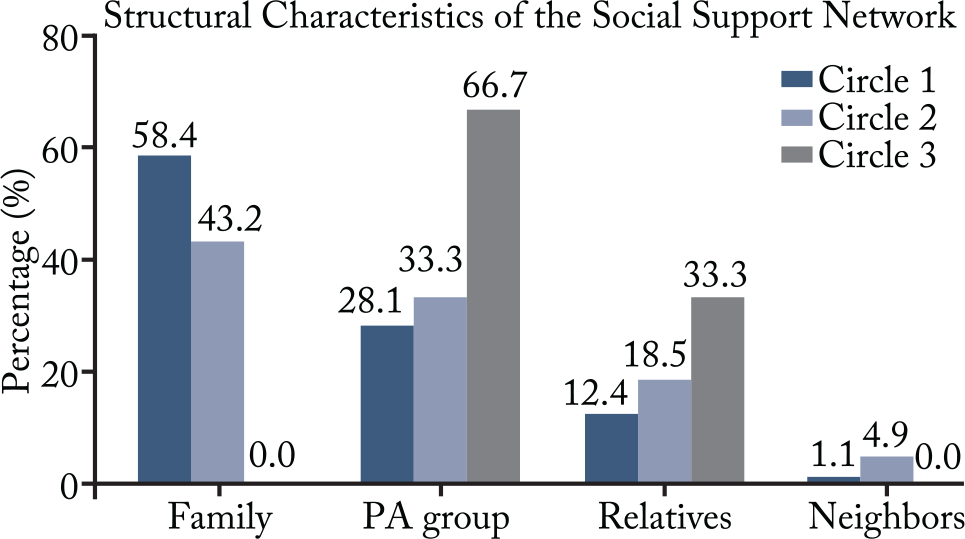
Results: Approximately 38% of the participants’ social support networks were members of the physical activity group, with an average of three members for each participant. Around 90% of the bonds in the group members’ network were classified as friendships. The category “building and strengthening bonds” was cited as the main motivation for the participation in and benefits of the program (60%). Activity Physical Program participants were mentioned at all three levels of the social support network established by the Escort Diagram, with values of 28.1%, 33.3%, and 66.7% at the first, second and third levels, respectively. Around 10% cited the group participants as their emergency contact and 5% cited the program teacher.
Conclusion: The structure and function of the social support network of physical activity participants relies significantly on group members in terms of the quantity and quality of relationships and support.
Keywords:
Social support; Elderly; Physical activity; Program; Interpersonal relationship.
RESUMO
Objetivo: Analisar a relação entre a participação em grupos de atividade física e a rede de suporte social de pessoas idosas.
Métodos: Trata-se de um estudo observacional, transversal e quanti-qua-litativo, realizado no ano de 2024, com pessoas idosas participantes de grupos de atividade física. Participaram do estudo 25 pessoas idosas (71,0 ± 5,1 anos de idade), sendo 80% mulheres, as quais responderam um questionário sociodemográfico, participaram de uma entrevista semiestruturada sobre o funcionamento do programa de atividade física, sobre os benefícios e motivos de participação, foram avaliados pelo Diagrama de Escolta, para avaliação da estrutura e função da rede de suporte social.
Resultados: Em torno de 38% da rede de suporte social dos participantes eram membros do grupo de atividade física, sendo em média três membros para cada participante. Em torno de 90% dos vínculos da rede dos membros do grupo são de amizade. A categoria “construção e fortalecimen-to de vínculos” foi citada como principal motivação de participação e benefícios do programa (60%). Os participantes do programa de atividade física foram citados nos três níveis da rede de suporte social estabelecidos pelo Diagrama de Escolta, sendo 28,1%, 33,3% e 66,7% no primeiro, segundo e terceiro nível, respectivamente. Em torno de 10% citaram como contato de emergência os participan-tes do grupo e 5% o professor do programa.
Conclusão: A estrutura e função de rede de suporte social de participantes de atividade física contam significativamente com membros do grupo em relação à quantidade e qualidade das relações e de apoio.
Palavras-chave:
Suporte social; Pessoas idosas; Atividade física; Programas; Relações interpessoais.
Introduction
The family is traditionally the primary source of social support for older people. Even considering the signif-icant reduction in the number of family members in recent years, this core group continues to play a role of responsibility, followed by the State. In this context, the World Health Organization1 proposes “participa-tion” as a pillar for active aging, suggesting that social or group activities can mitigate feelings of exclusion, loneliness, and reduced family ties, as well as enabling the construction of new social relationships through different emotional mechanisms2. Social support is not limited to individual interactions, but also encompass-es factors such as family, community, and social con-text, which can broadly influence health and longevity3.
The perspective of community as an extended family, with the complexity of social bonds and interactions, forms a broader support network, called the Convoy model4. This concept emphasizes the Lifespan model from Baltes5, who developed the life cycle perspective, emphasizing that development occurs throughout life, taking into account the specific and individual experi-ences of older people. This network plays a fundamen-tal role in maintaining ongoing care, independence, and autonomy. Therefore, expanding these social re-lationships is essential, as it contributes to increased self-esteem, autonomy, recognition, and a sense of belonging, promoting a more genuine social support network6, 7.
The scientific literature indicates that group activities for older adults increase social interaction and companionship7. However, the quality, meaning, and intensity of these created bonds, as well as the extent to which this pair interaction is actually able to positively affect the structure and function of the social support network of the older adults who participate in these groups, are still poorly studied. This information could improve existing programs or contribute to the imple-mentation of new strategies for expanding social sup-port networks, which could even generate cost savings on care in the medium and long term.
Previous research highlights that social support can encourage the practice of PA (PA)8; however, few studies have reported on the inverse relationship be-tween these variables. Although one study investigated how members of a senior walking group interacted and motivated each other during physical exercise, the au-thors did not analyze whether this social interaction was sufficient to create bonds and social support be-yond the PA itself9. A Brazilian study proposed a group PA intervention with hypertensive older individuals, and through a semi-structured interview, identified that participants develop a sense of belonging to the group10; however, it was not indicated whether these connections are incorporated into the older person’s social support network.
In addition to the scarcity of studies exploring the strengthening of social relationships within PA pro-grams using specific social support instruments, little is known about the intensity and complexity of this social support. A study conducted in Malaysia used the Duke Social Support Index to analyze subjective and instru-mental support, social interactions, and social networks in an investigation of PA levels among older women residing in a rural community; however, the sample did not participate in a PA group11. Considering the afore-mentioned, it is important to conduct mixed-methods studies that utilize specific instruments to assess social support networks among participants in PA groups aimed at older adults.
Given this, the current study aimed to analyze the relationship between participation in PA groups, and the structure and function of relationships in the so-cial support network of older adults. In addition to filling scientific gaps regarding the depth, complexity, and long-term effects of these social interactions, the results may have practical implications for the devel-opment of effective intervention policies tailored to age-related changes.
Methods
This is an observational, cross-sectional study with a quantitative-qualitative approach, conducted in the municipality of São Carlos, São Paulo, Brazil, in the year 2024. The project was approved by the Research Ethics Committee with Human Beings of the Federal Uni-versity of São Carlos (CAAE: 74281623.10000.5504). This research was initially presented to the managers of the Municipal Health, Education, Citizenship and Social Assistance, and Sports Secretariats, who are re-sponsible for the facilities that offer PA and adapted sports groups, in order to request authorization for data collection at those locations.
The target population for this study was individuals aged 60 or older who participated in PA and adapted sports groups offered in health, education, social assis-tance, and sports facilities in the aforementioned mu-nicipality. Regarding the inclusion criteria for the fa-cilities, group PA was required to have been offered for at least two years and serve independent and semi-de-pendent older individuals. Regarding the inclusion criteria for older people, they were required to have been participating in the group for two years or more and have a monthly attendance rate above 75%, evi-denced by the attendance list presented by the teacher responsible for the activities. Older individuals with hearing difficulties that could compromise data collec-tion were excluded. Regarding the inclusion criteria for the teacher responsible for the group PA, professionals with at least 2 years of experience leading the group were included, and substitute teachers were excluded.
The teachers responsible for the physical activities were initially contacted to present the research and verbally invite the participants. Those who expressed interest scheduled a day and time for data collection, which was carried out individually in a reserved room at the activity location. Prior to formal data collection, a pilot test was conducted with five older individuals at a primary healthcare unit. This procedure enabled testing of the comprehension of the questions and ad-justment of the data collection instruments. The data collection meeting began with the presentation of the Informed Consent Form, which was read and signed by the participant.
The following instruments were then applied:
-
A sociodemographic data questionnaire, consisting of questions about age, education, marital status, who the person lives with, individual income, fami-ly, occupation, and retirement;
-
A questionnaire about participation in PA groups, to investigate aspects such as participation time, weekly frequency, participation in social events, group trips and sightseeing outings, and partici-pation in activities during the pandemic. The tool also evaluated aspects related to the functioning of the classes, including the weekly frequency offered, class duration, use of playful strategies in classes, characteristics of the teacher/group leader (pro-fessional background), and socialization activities during and outside of classes;
-
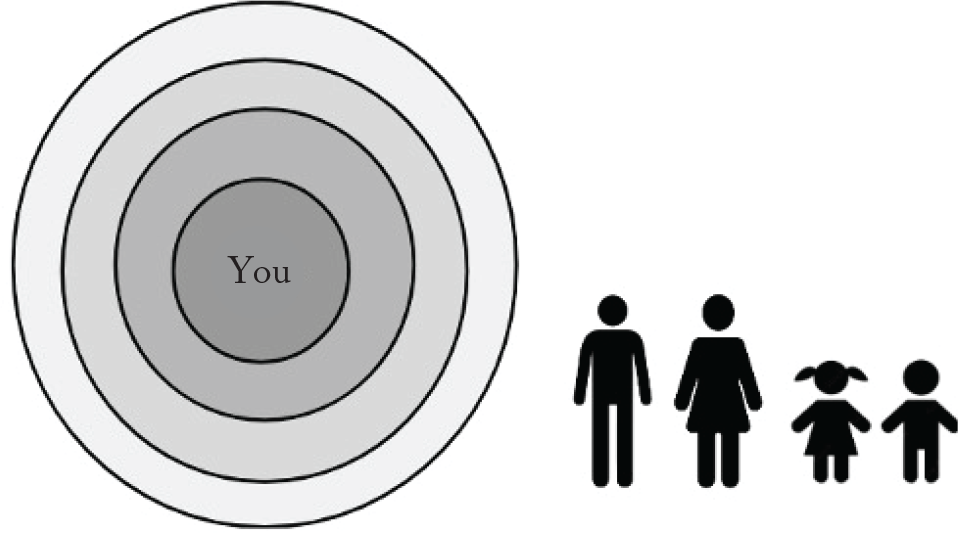
The Escort Diagram, created by Antonucci and Akiyama12, and adapted by Paula-Couto13, consid-ers variables such as proximity, type of relationship, frequency of contact, and emotional or instrumen-tal support offered.
-
Semi-structured interviews were conducted to understand participants’ perspectives on building re-lationships with other students in the same group. Questions included reasons for remaining in the group, benefits of participation, perceived changes in social relationships after joining, trust in other group members, and emergency contact informa-tion. All interviews were audio-recorded for later transcription and analysis.
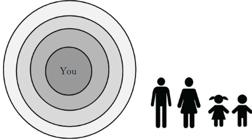
The quantitative data, relating to sociodemographic characteristics, were stored and tabulated in Microsoft Excel spreadsheets, and analyzed in terms of absolute and relative frequency. The qualitative data, obtained from the semi-structured interviews, were transcribed using the Transkriptor application and manually re-viewed by the researcher. They were also saved in the cloud, where participants were coded with the acronym of the facility they attend, for example, USF, CCI, UATI, supplemented by a number and the year of the research, such as USF 01/24, CCI 01/24, UATI 01/24, and so on. For the presentation of the qualitative results, the facility acronym, number, sex, and age will be presented.
The qualitative analysis followed Bardin’s con-tent analysis method14, organized in three stages: (i) Pre-analysis: Careful selection of relevant documents to ensure the consistency of information; (ii) Explora-tion of the Material: Initial identification of subcate-gories, subsequently grouped into broad categories, al-lowing a structured view of the data; (iii) Treatment of Results: Categorization and interpretation of the data to answer the research questions, using the saturation criterion to ensure representativeness.
The responses were grouped into two main catego-ries: Reasons for and Benefits of Participation in the Program. Each category was subdivided into subcat-egories identified during the analysis. To complement the qualitative approach, the categories were described in terms of absolute and relative frequency. Discrepan-cies in interpretations were resolved through collabo-rative review among the researchers. When necessary, multiple categories were assigned to the same response in order to capture nuances without compromising the complexity of the accounts.
Results
Characterization of the population
The majority of participants in the current study are female (80%), more than half of participants were be-tween 70 and 79 years of age (56%), and 40% had completed higher education. Furthermore, it was observed that 56% of participants lived with their spouse. Re-garding individual income and occupational activities, 44% reported earning more than two minimum wages, 28% were still working as self-employed professionals, while the vast majority (76%) were already retired.
The length of time participants had been involved in the PA and adapted sports groups varied, with 60% of participants having been part of the groups for be-tween 2 and 9 years. Furthermore, 55% of participants reported attending regularly, twice a week. Activities extended beyond regular classes, with 60% participat-ing in social gatherings and 65% involved in events and celebrations offered by the groups.
In emergencies, most indicated family members as the primary contact (80%), followed by friends from the PA group (10%). Additionally, 5% mentioned teachers from the PA and adapted sports group as emergency contacts.
Characterization of the classes and teachers
The data showed that the majority of teachers who lead PA and adapted sports groups are Physical Education professionals (60%), followed by Physiotherapists (40%). Most teachers had between 10 and 20 years of experience in the field (80%). Classes mainly included stretching exercises (86%) and strength training (57%), held twice a week, with an average duration of one hour. Interaction strategies offered by teachers includ-ed debates (71.4%), social and cultural events (42.8%), and activities aimed at strengthening bonds (14.3%).
Reasons for and benefits of participation
Three main categories stood out, both in the investi-gation of the motivation for participating in PA and adapted sports groups and in the identification of per-ceived benefits, namely: building and strengthening bonds, improving physical capacity, and improving quality of life and mental health. The categories are discussed below, highlighting where necessary their nuances in the two contexts:
Building and strengthening relationships
The search for social interaction and acceptance was an important factor in joining the PA groups. Many participants reported a desire to reduce loneliness and create friendships:
“[...] friendships, we celebrate a lot, we go for walks” (UATI 07, M, 76 years of age).
“[...] for the affection, for the friendship” (SEME 07, M, 70 years of age).
Beyond the initial motivation, participants recog-nized that the groups helped strengthen friendships and foster meaningful interactions. Being part of the groups helped create a supportive and companionable environment:
“[...] we exchange ideas, we talk, we don’t feel so alone, right?” (CRI VLP 04, F, 70 years of age). “[...] to have a relationship with human beings, friendship” (UATI 08, M, 73 years of age).
Improved physical capacity
Participants cited the pursuit of preventing age-re-lated health problems and improving overall health as the main reasons for joining PA groups. Accounts highlighted the fear of falling, the desire to maintain functionality, and the perception that regular exercise is essential:
“[...] “it was the fear of falling again, of getting hurt, of becoming bedridden, you know?” (USF SF 03, F, 70 years of age).
“[...] “the body asks for it, you know? Activity, and you feel better when you’re active” (USF ST 04, F, 64 years of age).
PA was perceived as essential for maintaining or improving physical functionality and preventing dis-ease. Participants emphasized activities such as stretch-ing and muscle strengthening as fundamental:
“[...] “the stretching was very important to get the fluid circulating” (CRI VLP 05, F, 75 years of age). “[...] I pay attention to the issue of maintaining the best possible PA” (SEME 07, M, 70 years of age).
Improved quality of life and mental health
The search for emotional balance and improved psy-chological well-being was highlighted as one of the reasons for joining PA groups. Some participants re-ported that the activity served as an outlet for dealing with personal problems:
“[...] “it’s good for your mental health” (USF RT 03, F, 70 years of age).
“[...] “then I came back again, because I saw that something wasn’t right” (CRI VLP 03, F, 73 years of age).
Participants observed a significant improvement in quality of life and mental well-being after joining the groups, reporting a reduction in stress and feelings of isolation:
“[...] I have depression, it was great” (UATI 01, F, 70 years of age).
“[...] “it ends up serving as a kind of...therapy for me” (SEME 07, M, 70 years of age).
Structure and function of relationships
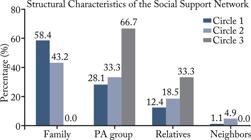
Approximately 38% of the participants’ social support network consists of members of the PA group, with an average of three PA group members cited for each par-ticipant. The results of the Escort Diagram were orga-nized into three circles of proximity. In Circle 1 (clos-est), participants indicated family members (58.4%) and participants from the PA group (28.1%). In Circle 2 (intermediate), family members (43.2%) and mem-bers of the PA group (33.3%) were indicated. In Circle 3 (most distant), a higher concentration of members of the PA group was evident (66.7%).
Regarding the characteristics of the people belong-ing to the participants’ social support network, the re-sults show that the majority are between 60 and 80 years of age (55.1%), with a predominance of women (87%). Considering the nature of the relationships, 66.7% re-ported between 1 and 9 years of cohabitation, marked by geographical proximity, with 62.3% living less than one hour away. In terms of frequency of contact, 50.7% maintained daily interactions. The majority of relation-ships are defined as friendships (89.9%), family ties (2.9%), or teacher-student relationships (7.2%).
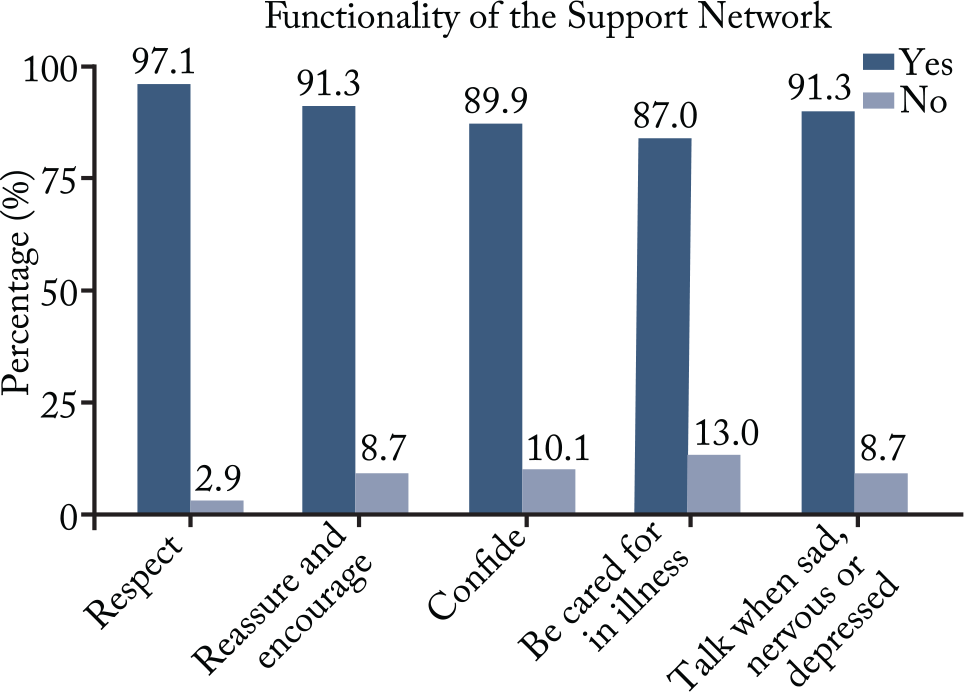
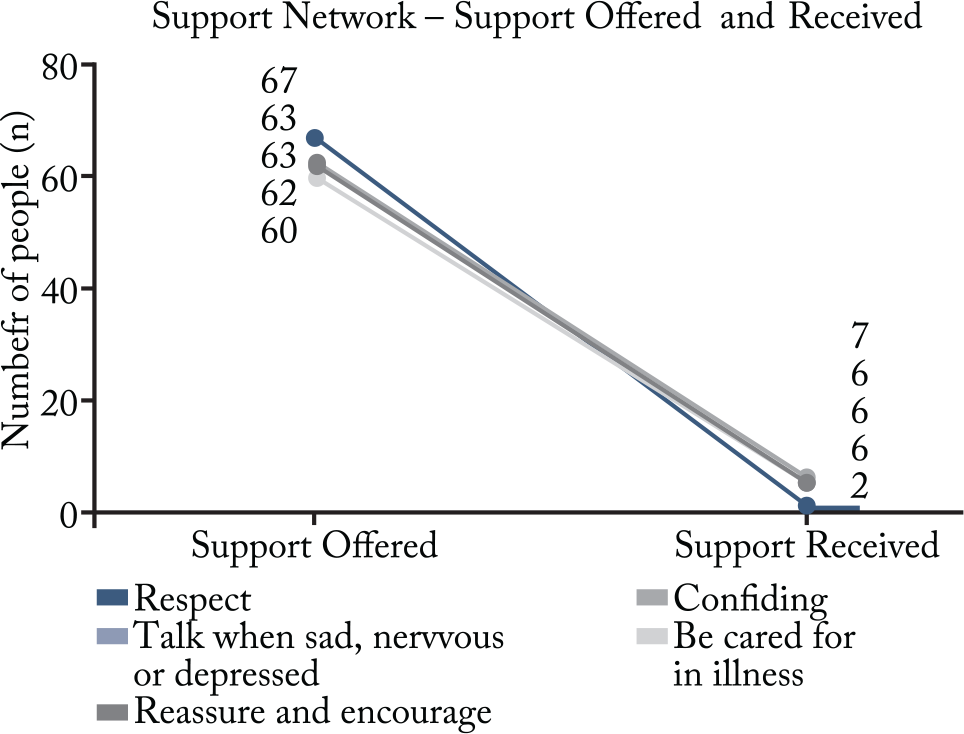
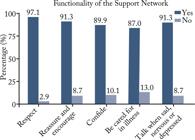
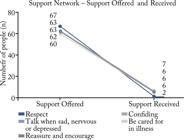
Regarding the functionality of the social support network, 97.1% of participants reported feeling re-spected, 91.3% indicated that they are reassured and encouraged, 89.9% feel safe to confide in others, 87.0% feel they can be cared for in times of illness, and 91.3% can talk to someone when they are sad, nervous, or de-pressed. The importance of reciprocity is reflected in the emotional well-being of older people, as the social support network is an important protective factor, es-pecially during the aging process.
Discussion
The findings of the current study demonstrate how participation in PA groups is positively related to the function and structure of the social support network of older adults, directly reflecting the objectives of this study to investigate the benefits of social interactions. The results highlight the centrality of friendship ties and the frequency of interactions as fundamental elements for physical, emotional, and psychological well-being10. Thus, the confidence expressed by partic-ipants in requesting help, observed in this study, sug-gests that PA groups act as an environment of emo-tional and instrumental support, protecting against the negative effects associated with a lack of social support.
This contribution is relevant to the field of healthy aging, as it corroborates that PA and adapted sports groups act as important spaces for social interaction and strengthening bonds, offering an intersectoral model that is able to integrate health, social assistance, and leisure15. In this way, the results add new perspectives to scientific knowledge, reinforcing the importance of public policies that promote healthy and active aging through social support strategies with community peer groups.
Furthermore, the results of the current study align with the Socioemotional Selectivity Theory, according to which older people tend to prioritize more mean-ingful and affective relationships as they perceive time as a finite resource16,17. The findings also showed that although family members still play a significant role in the immediate circle, friends and participants in PA groups emerge as central elements in the intermediate and more distant circles16,17.
This redistribution of social ties reflects not only a natural and quantitative reduction in networks with aging, but also a qualitative redefinition of relation-ships, in which the interaction provided by PA groups becomes a space of acceptance, motivation, and emo-tional and social support, while also providing comfort and security during difficult times18. In a context of an aging population, these results highlight the impor-tance of investing in programs that foster positive and meaningful social connections19.
Proximity and frequency of contact emerge as essential elements for strengthening social bonds, offer-ing emotional and practical support that directly im-pacts the mental health and physical functionality of older adults. This regular contact, observed in the cur-rent study, not only reduces social isolation, a critical factor in the risk of depression and cognitive decline20, but also provides a favorable environment for build-ing meaningful interactions that stimulate engagement and self-esteem. Furthermore, the constant interaction and mutual support among participants in PA groups can act as a protective network, promoting emotional resilience and improving the ability to cope with ev-eryday challenges, such as family losses or functional limitations21.
From a physical standpoint, frequent participation in group activities tends to increase adherence to regu-lar physical exercise, with positive impacts on the func-tionality, mobility, and independence of older adults22. These findings highlight the need for future interven-tions that encourage intersectoral programs for social interaction and PA, ensuring spaces that stimulate reg-ular interactions and consolidate strong support net-works, especially in vulnerable contexts23.
The categories identified through qualitative analysis were found in the investigations of both the mo-tivations and benefits. This convergence suggests that participants’ expectations upon joining the groups were largely met, which may explain the high level of en-gagement and regular attendance. These quantitative data reinforce the importance of understanding partic-ipants’ objectives, in order to ensure the success, adher-ence, and continuity of the programs.
The members of these groups occupy a significant position in the participants’ social support network, with a predominance of friendships and daily inter-actions. Furthermore, participants indicated that in many cases group members are their contacts in case of emergencies, reinforcing a relationship that goes beyond friendship and is based on trust. The expan-sion of social connections, evidenced by the escort di-agram, was corroborated by qualitative reports, which highlight the role of friendships and acceptance as key factors in reducing isolation and loneliness. Studies in-dicate that social support is associated with better ad-aptation to old age, positively impacting physical and mental health24-26.
Furthermore, the perceived benefits in terms of quality of life and mental health highlight the impor-tance of PA groups as spaces for holistic care. Accord-ing to the reports, the practice of PA was seen as a form of therapy, contributing to psychological well-being, especially relevant for participants who live alone and who may be more susceptible to social isolation27-29. In the context of the current study, the social interactions promoted by PA and adapted sports groups can be seen as analogous to these activities, functioning as a space for active engagement and strengthening of interper-sonal bonds.
The current study highlighted that physical activities are offered in health, social assistance, education, and sports facilities, covering all regions of the mu-nicipality, a scenario that aligns with the guidelines of Aging In Place30, which advocates for the importance of aging locally and benefiting from the community’s potential, promoting this through multi-sectoral and interdisciplinary collaborations.
This strategy promotes interaction among older adults, ensuring social inclusion, autonomy, and the sustainability of their support network-factors that contribute to healthy aging, especially for those in vul-nerable situations. In this sense, the development of supportive environments close to homes is crucial, as it allows older adults to maintain their functional abil-ities in their living environments, facilitating access to resources that are fundamental to their quality of life.
The strengths of the current study lie in the combination of qualitative and quantitative methods, which allows holistic understanding of the perceived bene-fits, motivations, and contextual factors that influence engagement within the groups. The use of the Escort Diagram is a methodological advancement, as it high-lights the structure and functionality of the participants’ social support network, emphasizing how interactions within PA and adapted sports groups play a central role in strengthening affective bonds and combating social isolation. Furthermore, data based on self-reports may reflect subjective perceptions and require further inves-tigation in future studies, using complementary meth-odologies.
The current study presents some limitations. The sociodemographic profile of the sample is relatively homogeneous, composed mostly of women with high levels of education and income above two minimum wages, which limits the generalization of the results due to the homogeneous characteristics and the sam-ple size. Another significant limitation concerns the focus on groups located in specific public facilities and urban institutions. While valid, these contexts exclude the experiences of older adults residing in rural ar-eas, peripheral regions, or areas with deficient public infrastructure, where access to PA programs is often limited. Finally, self-reports can reflect biases, since participants tend to emphasize positive aspects of the experience, influenced by social dynamics or the search for personal validation.
Future research should broaden the diversity of the sample, including older adults of different sexes, socio-economic levels, and geographic backgrounds, allow-ing for a more comprehensive understanding of the impacts of PA groups in varied realities. New research should consider the implementation of adapted interventions, such as itinerant programs, partnerships with local organizations, or hybrid formats that combine in-person and virtual meetings. Furthermore, studies analyzing the social support network before and after participation in long-term PA programs could contrib-ute to the field.
The results of the current study show that partic-ipation in PA groups goes beyond physical benefits, contributing to the strengthening and structuring and function of the social support networks of older adults, promoting the strengthening of meaningful bonds. Furthermore, the findings indicate elements of a group PA program model that meets the biopsycho-social needs of older people, such as in-person, group activities led by a teacher, and which, in addition to physical activities, offers opportunities for discussions, outings, social and cultural events, and activities aimed at strengthening bonds, as reported by the participants.
These elements can inspire practical implications for the development of policies to promote group PA, to be implemented in other locations, in public and pri-vate services, as well as components to be incorporated into intervention studies with older adults in the com-munity, focusing on the multidimensionality of aging. They can also assist in the formulation and reformula-tion of programs aimed at promoting PA, establishing multi-sectoral and interdisciplinary interventions, and strengthening the debate on the importance of spaces, projects, and programs that foster the creation of bonds and the consolidation of new connections in the social support network.
-
Funding
This research was supported by the Extension Project partnership between the Department of Gerontology of the Federal Univer-sity of São Carlos and the Ministry of Health.
Statement regarding the use of artificial intelligence tools in the article writing process
The authors did not use artificial intelligence tools to prepare the manuscript.
Acknowledgements
The extension project in partnership between the Department of Gerontology of the Federal University of São Carlos and the Ministry of Health.
Availability of research data and other materials
The underlying content of the research text is contained within the manuscript.
References
-
1 Organização Mundial Da Saúde. Envelhecimento Ativo: uma política de saúde. Brasília: Organização Pan-Americana de Saúde, 2005. Available from: <https://bvsms.saude.gov.br/bvs/publicacoes/envelhecimento_ativo.pdf>. [2025 February]
» https://bvsms.saude.gov.br/bvs/publicacoes/envelhecimento_ativo.pdf -
2 Gonçalves RF, Leite MLH, Da Silveira MLM, De Assis LM. Benefícios da atividade física na terceira idade. Available from: https://www.editorarealize.com.br/editora/anais/cieh/2022/TRABALHO_COMPLETO_EV179_MD1_ID1789_TB744_16082022011949.pdf [2025 January]
» https://www.editorarealize.com.br/editora/anais/cieh/2022/TRABALHO_COMPLETO_EV179_MD1_ID1789_TB744_16082022011949.pdf - 3 Julik AD. Fatores relacionados à qualidade de vida de idosos no contexto do desenvolvimento comunitário [tese de doutorado]. Irati, Paraná: Universidade Estadual do Centro-Oeste; 2024.
- 4 Kahn RL, Antonucci TC. Convoys over the life course: Attachment, roles, and social support. In: P. B. Baltes & O. G. Brim (Eds.), Life-span development and behavior. New York: Academic Press, 1980. p.253-286.
- 5 Baltes PB, Lindenberger U, Staudinger UM. Life-span theory in developmental psychology. In: Damon W, Lerner RM, editors. Handbook of child psychology. Vol. 5. New York, NY: Wiley; 1998. pp. 10291143
- 6 Glidden RF, Borges CD, Pianezer AA, Martins J. A participação de idosos em grupos de terceira idade e sua relação com satisfação com suporte social e otimismo. Bol. - Acad. Paul. Psicol. 2019:39(97):261-75.
-
7 Silva FS, Menegaldo FR, Bortoleto MAC. Ginástica para todos: um olhar sobre o desenvolvimento das relações sociais em grupos de idosos. Rev. Bras. Ciênc. Mov. 2022;30(1). doi: https://doi.org/10.31501/rbcs.v30i1.12098
» https://doi.org/10.31501/rbcs.v30i1.12098 -
8 Collado-Mateo D, Lavín-Pérez AM, Peñacoba C, Del Coso J, Leyton-Román M, Luque-Casado A, et al. Factors associated with adherence to physical exercise in patients with chronic diseases and older adults: An umbrella review. Int J Environ Res Public Health. 2021;18(4):2023. doi: https://doi.org/10.3390/ijerph18042023
» https://doi.org/10.3390/ijerph18042023 -
9 Huang WY, Huang H, Wu CE. Physical activity and social support to promote a health-promoting lifestyle in older adults: An intervention study. Int J Environ Res Public Health. 2022;19(21):14382. doi: https://doi.org/10.3390/ijerph192114382
» https://doi.org/10.3390/ijerph192114382 -
10 Freitas, R.T. Promoção da saúde através da prática de atividades físicas. Mostra de Trabalhos Científicos em Enfermagem. 2012. Available from: <https://www.coenf.ufv.br/wp-content/uploads/2018/12/ANAIS-Semana-da-Enfermagem-2012.pdf> [2025 January]
» https://www.coenf.ufv.br/wp-content/uploads/2018/12/ANAIS-Semana-da-Enfermagem-2012.pdf -
11 Marthammuthu T, Hairi FM, Choo WY, Salleh NAM, Naqiah Hairi N. The Prevalence and Association Between Social Support and Physical Activity Among the Rural Community-Dwelling Older Women in a Southeast Asian Country. J Aging Phys Act. 2023;31(4):611-20. doi: https://doi.org/10.1123/japa.2022-0201
» https://doi.org/10.1123/japa.2022-0201 -
12 Antonucci TC, Akiyama H. H. Social networks in adult life and a preliminary examination of the convoy model. J Gerontol. 1987,42(5):519-27. doi: https://doi.org/10.1093/geronj/42.5.519
» https://doi.org/10.1093/geronj/42.5.519 - 13 Paula-Couto MCP, Koller SH, Novo R, Sanchez-Soares P. Adaptação e utilização de uma medida de avaliação da rede de apoio social - diagrama da escolta - para idosos brasileiros. Universitas Psychologica. 2008;7(2):181-93.
- 14 Bardin L. Análise de conteúdo. São Paulo: Edições 70, 2011.
-
15 Kim I, An H, Yun S, Park HY. Effectiveness of community-based interventions for older adults living alone: a systematic review and meta-analysis. Epidemiol Health. 2024;46:e2024013. doi: https://doi.org/10.4178/epih.e2024013
» https://doi.org/10.4178/epih.e2024013 -
16 Carstensen LL. Socioemotional Selectivity Theory: The Role of Perceived Endings in Human Motivation. Gerontologist. 2021;61(8):1188-96. doi: https://doi.org/10.1093/geront/gnab116
» https://doi.org/10.1093/geront/gnab116 -
17 Doll J, Bernardo LD. Aprender a usar novas tecnologias. Rev. Bras. Ciênc. Envelhec. Hum. 2022;19(Supl.2). doi: https://doi.org/10.5335/rbceh.v19iSupl.2.14061
» https://doi.org/10.5335/rbceh.v19iSupl.2.14061 -
18 Chiarelli TM. Relações sociais na velhice via Facebook: um exame de extensão da teoria de seletividade socioemocional [dissertação]. São Paulo: Universidade de São Paulo, Escola de Artes, Ciências e Humanidades; 2017. doi: https://doi.org/10.11606/D.100.2017.tde-25072017-103441
» https://doi.org/10.11606/D.100.2017.tde-25072017-103441 -
19 Zimmer C, McDonough MH, Hewson J, Toohey AM, Din C, Crocker PRE, et al. Social support among older adults in group physical activity programs. J. Appl. Sport Psychol. 2022;35(4):658-79. doi: https://doi.org/10.1080/10413200.2022.2055223
» https://doi.org/10.1080/10413200.2022.2055223 - 20 Pernambuco CS, Moreira CHR, Dantas KBA. Exercício Físico e Qualidade de Vida Para Pessoa Idosa. In: Envelhecer Com Resiliência: Cuidando do Corpo e da Mente. Ponta Grossa: Editora Atena, 2024. p. 72-86.
-
21 Abadia HR, Rocha CS, Curado PF, Ferreira MG, Souza GB, Lamounier JMS, et al. A importância da Prática da Atividade Física na Saúde Mental de idosos durante o isolamento social: Uma Revisão Integrativa. Rev. Contemp. Rev. Contemp. 2024;4(9):e5635. doi: https://doi.org/10.56083/RCV4N9-024
» https://doi.org/10.56083/RCV4N9-024 -
22 Tóth EE, Ihász F, Ruiz-Barquín R, Szabó A. Physical Activity and Psychological Resilience in Older Adults: A Systematic Review of the Literature. J Aging Phys Act. 2023;32(2):276-86. doi: https://doi.org/10.1123/japa.2022-0427
» https://doi.org/10.1123/japa.2022-0427 -
23 Gust A. Effect of health conditions and community program participation on physical activity and exercise motivation in older adults. J Health Psychol. 2025;30(6):1364-76. doi: https://doi.org/10.1177/13591053241275308
» https://doi.org/10.1177/13591053241275308 -
24 Helsper N, Dippon L, Kohler S, Birkholz L, Weber P, Pfeifer K, et al. O.5.3-5 Existing structures for physical activity promotion: the role of resources, political support, intersectoral collaboration, and participation in six pilot communities - a comparative case study-. Eur J Public Health. 2023;33(Suppl 1):ckad133.256. doi: https://doi.org/10.1093/eurpub/ckad133.256
» https://doi.org/10.1093/eurpub/ckad133.256 -
25 Levasseur M, Filiatrault J, Larivière N, Trépanier J, Lévesque MH, Beaudry M, et al. Influence of Lifestyle Redesign® on Health, Social Participation, Leisure, and Mobility of Older French-Canadians. Am J Occup Ther. 2019;73(5):7305205030p1-7305205030p18. doi: https://doi.org/10.5014/ajot.2019.031732
» https://doi.org/10.5014/ajot.2019.031732 -
26 Sowa A, Tobiasz-Adamczyk B, Topór-Mądry R, Poscia A, la Milia DI. Predictors of healthy ageing: public health policy targets. BMC Health Serv Res. 2016;16(Suppl 5):289. doi: https://doi.org/10.1186/s12913-016-1520-5
» https://doi.org/10.1186/s12913-016-1520-5 -
27 Zhuori N, Cai Y, Yan Y, Cui Y, Zhao M. Does Social Support Affect the Health of the Elderly in Rural China? A Meta-Analysis Approach. Int J Environ Res Public Health. 2019;16(18):3471. doi: https://doi.org/10.3390/ijerph16183471
» https://doi.org/10.3390/ijerph16183471 -
28 Silva MVS, Rodrigues JDA, Ribas MDS, Sousa JCS, Castro TRO, Santos BA, et al. O impacto do isolamento social na qualidade de vida dos idosos durante a pandemia por COVID-19. Enferm Bras. 2020;19(4):34. doi: https://doi.org/10.33233/eb.v19i4.4337
» https://doi.org/10.33233/eb.v19i4.4337 -
29 Costa DES, Rodrigues S. de A, Alves R de CL, Silva MRF da, Bezerra ADC, Santos DC, et al. A influência das tecnologias na saúde mental dos idosos em tempos de pandemia: uma revisão integrativa. Res. Soc Dev. 2021;10(2):e8210212198. doi: https://doi.org/10.33448/rsd-v10i2.12198
» https://doi.org/10.33448/rsd-v10i2.12198 -
30 Fonseca AMG. “Aging in Place” -Envelhecer em casa e na comunidade. PerCursos, 2023;24:e0104. doi: https://doi.org/10.5965/19847246242023e0104
» https://doi.org/10.5965/19847246242023e0104
Edited by
-
Editor in Chief
Átila Alexandre Trapé University of São Paulo, Ribeirão Preto, São Paulo, Brazil.
-
Section editor
Emerson Sebastião University of Illinois Urbana-Champaign, Urbana, United States.
Reviewers’ assessment
The reviews of this article were originally conducted in Portuguese. This version has been translated using ChatGPT and subsequently reviewed by the Chief Editors.About the reviewerReviewer A
Format
-
Does the article comply with the manuscript prepa-ration rules for submission to the Revista Brasileira de Atividade Física e Saúde?
Partially
-
Regarding formal aspects, is the manuscript well-structured, containing the following sections: introduction, methods, results, and discussion (with the conclusion as part of the discussion)?
No
-
Is the language appropriate, and is the text clear, precise, and objective?
Partially
-
Was any indication of plagiarism observed in the manuscript?
No
Suggestions/comments:
-
The title suggests that the study is qualitative; how-ever, both qualitative and quantitative methodolo-gies are addressed.
-
I suggest a review of the Portuguese language, as there are some incoherent paragraphs, lack of agreement, plural issues, etc.
-
The conclusion should appear as part of the discus-sion, not under a separate “Conclusion” subtitle.
Abstract
-
Are the abstract and the resumen adequate (includ-ing objective, study participants, variables studied, main results, and a conclusion) and do they reflect the content of the manuscript?
Partially
Suggestions/comments:
-
There are several issues in the abstract; I will note them all in the review file that will be sent.
Introduction
-
Was the research problem clearly stated and delim-ited?
Partially
-
Is the research problem adequately contextualized in relation to the existing knowledge,
-
moving from general to specific?
Yes
-
Are the reasons justifying (including the authors’ assumptions about the problem) the need for the study well established?
Yes
-
Are the references used to support the presentation of the research problem current and relevant to the topic?
Yes
-
Was the objective clearly presented?
Yes
Suggestions/comments:
-
In the first paragraph of the introduction, there is a subjective passage: “given the significant reduction in recent years”… reduction of what? It is not clear.
-
Also in the first paragraph, in the passage “…sug-gesting that social or group activities can mitigate feelings of exclusion…”, the connection to the pre-vious text is missing.
-
The word lifespan should be italicized.
-
The abbreviation “AF” is cited without explaining its meaning. From its first mention, the same ab-breviation should be used consistently throughout the text.
Methods
-
Are the methodological procedures generally ap-propriate for studying the research problem?
Partially
-
Are the methodological procedures adopted for the study sufficiently detailed?
Partially
-
Was the procedure for selecting or recruiting par-ticipants appropriate for the research problem and described clearly and objectively?
Yes
-
Were details provided about the instruments used for data collection, their psychometric qualities (e.g., reproducibility, internal consistency, and va-lidity), and, when appropriate, the operational defi-nition of the variables?
Yes
-
Is the data analysis plan adequate and properly de-scribed?
Partially
-
Were inclusion and/or exclusion criteria for sam-ple participants described and appropriate for the study?
Partially
-
Did the authors provide information about the eth-ical procedures adopted for the research?
Yes
Suggestions/comments:
-
The authors describe it as a quantitative study, but it is actually a mixed-methods (qualitative-quanti-tative) study.
-
There is redundancy in the description of the target population.
-
The exclusion criteria are not clearly stated.
-
The citation “Paula-Couto (2008)” was not found in the reference list.
Results
-
Is the use of tables and figures appropriate and helpful in presenting the study results?
Partially
-
Is the number of illustrations in accordance with the journal’s submission guidelines?
Yes
-
Are the number of participants in each study stage, as well as losses and refusals, presented in the man-uscript?
Partially
-
Are the participants’ characteristics presented and sufficient?
Partially
-
Are the results adequately presented, highlighting the main findings and avoiding unnecessary repe-tition?
Partially
Suggestions/comments:
-
The percentages described in Figure 2 do not match the figure data.
-
The results described in Figure 3 also need revision, as some do not correspond to the figure.
Discussion
-
Are the main findings of the study presented?
Yes
-
Are the study’s limitations and strengths presented and discussed?
Yes
-
Are the results discussed in light of the study’s lim-itations and existing knowledge on the subject?
Partially
-
Are the potential contributions of the main find-ings for scientific development, innovation, or re-al-world interventions discussed by the authors?
Yes
Suggestions/comments:
-
The discussion meets the journal’s requirements.
Conclusion
-
Was the study conclusion adequately presented and consistent with the study objective?
Partially
-
Is the study conclusion original?
Yes
Suggestions/comments:
-
The study objective states: “...In addition to filling scientific gaps regarding the depth, complexity, and long-term effects of these social interactions, the results may have practical implications for de-veloping effective intervention policies adapted to age-related changes.” Where is the conclusion ad-dressing this proposed objective?
References
-
Are the references current and sufficient?
Yes
-
Are most of them composed of original articles?
Yes
-
Do the references comply with the journal’s stan-dards [quantity and format]?
Yes
-
Are the in-text citations appropriate, meaning that the claims made are indeed supported by the cited references?
Yes
Suggestions/comments:
-
The references meet the journal’s requirements.
Comments to the author
-
When evaluating the study “Social support network of older adults in physical activity programs: a qual-itative study”, I found it to address an extremely important topic, with interesting data and a valu-able proposal by the authors for the future use of the data to inform public policy development. To improve the article, I included several comments in the attached file and on the platform, to be revised and adjusted according to RBAFS guidelines.
Final decision
-
Substantial revisions required
- peer review recommendation: revision
Reviewer B
About the reviewerSCIMAGO INSTITUTIONS RANKINGSReviewer B
Format
-
Does the article comply with the manuscript prepa-ration guidelines for submission to the Revista Bra-sileira de Atividade Física e Saúde?
Yes
-
Regarding formal aspects, is the manuscript well-structured, containing the sections: introduc-tion, methods, results, and discussion (with the con-clusion included as part of the discussion)?
Yes
-
Is the language appropriate, and is the text clear, precise, and objective?
Yes
-
Was any indication of plagiarism observed in the manuscript?
No
Suggestions/comments:
-
The text is clear and objective.
Abstract
-
Are the abstract (in Portuguese) and the English abstract adequate (containing: objective, information about study participants, variables studied, main results, and a conclusion) and representative of the manuscript content?
Yes
Suggestions/comments:
-
Suggest including what determined the study group - older adults (60 years or older).
-
Use of acronyms: some acronyms, such as “PA” (physical activity), are introduced abruptly. Repeat-ing the full term on first use could help less familiar readers.
-
Check the descriptors of the keywords.
-
Keywords differ between Portuguese and English versions.
Introduction
-
Is the research problem clearly stated and delimited?
Yes
-
Is the research problem adequately contextualized in relation to existing knowledge, moving from general to specific?
Yes
-
Are the reasons justifying the study (including the authors’ assumptions about the problem) well es-tablished in the text?
Yes
-
Are the references used to support the presentation of the research problem current and relevant to the topic?
Yes
-
Is the objective clearly presented?
Yes
Suggestions/comments:
-
Well-written and clear introduction.
-
The term “PA” (physical activity) should be written out in full on its first appearance.
Methods
-
Are the methodological procedures generally ade-quate to study the research problem?
Yes
-
Are the methodological procedures adopted for the study sufficiently detailed?
Yes
-
Was the participant selection or recruitment pro-cedure appropriate for the research problem and clearly and objectively described?
Yes
-
Were details provided about the instruments used for data collection, their psychometric qualities (e.g., reproducibility, internal consistency, and va-lidity), and, when relevant, the operational defini-tion of the variables?
Yes
-
Is the data analysis plan appropriate and adequately described?
Yes
-
Were the inclusion and/or exclusion criteria for participants described and appropriate?
Yes
-
Did the authors provide information regarding the ethical procedures adopted for conducting the re-search?
Yes
Suggestions/comments:
-
Well-described methodology, allowing replication by readers.
Results
-
Is the use of tables and figures appropriate and do they facilitate proper presentation of the study’s results?
Yes
-
Is the number of illustrations consistent with the journal’s submission guidelines?
Yes
-
Are the number of participants at each stage of the study, as well as reasons for losses and refusals, presented in the manuscript?
Yes
-
Are participant characteristics adequately present-ed?
Yes
-
Are the results properly presented, highlighting the main findings and avoiding unnecessary repetition?
Yes
Suggestions/comments:
-
Text is well-written and objective.
Discussion
-
Are the main findings of the study presented?
Yes
-
Are the study’s limitations and strengths presented and discussed?
Yes
-
Are the results discussed considering the study’s limitations and the existing knowledge on the topic?
Yes
-
Do the authors discuss the potential contributions of the study’s main findings to scientific development, innovation, or practical applications?
Yes
Suggestions/comments:
-
Results and discussion are presented clearly.
Conclusion
-
Is the study’s conclusion appropriately presented and consistent with the study’s objective?
Yes
-
Is the study’s conclusion original?
Yes
Suggestions/comments:
-
The study’s conclusion is clear and objective, aligned with the study proposal.
-
Practical applicability: could be enhanced by in-cluding more concrete suggestions for public health managers and professionals based on the findings (e.g., ideal formats for meetings, intersectoral ac-tions, etc.).
References
-
Are the references up to date and sufficient?
Yes
-
Are most of them composed of original articles?
Yes
-
Do the references comply with the journal’s stan-dards [quantity and format]?
Yes
-
Are in-text citations appropriate, i.e., do they actu-ally substantiate the statements made?
Yes
Suggestions/comments:
-
The manuscript complies with the journal’s guide-lines.
Comments to the author
Dear Author(s),
Congratulations on your work entitled “Social support network of older adults in physical activi-ty programs: A qualitative study.” The text is clear, well-written, and flows smoothly, without structural or coherence problems. The topic addressed is highly relevant to science, particularly in the fields of public health and aging, as it sheds light on important so-cial aspects that influence older adults’ engagement in physical activity programs.
Final decision
-
Substantial revisions required
- peer review recommendation: revision
Reviewer C
About the reviewerSCIMAGO INSTITUTIONS RANKINGSReviewer C
Format
-
Does the article comply with the manuscript prepa-ration rules for submission to the Revista Brasileira de Atividade Física e Saúde?
Yes
-
Regarding formal aspects, is the manuscript well-structured, containing the sections: introduc-tion, methods, results, and discussion (with the con-clusion as part of the discussion)?
Yes
-
Is the language appropriate, and is the text clear, precise, and objective?
Partially
-
Was any indication of plagiarism observed in the manuscript?
-
Not applicable
Suggestions/comments:
-
Part of the text was detected as AI-generated. If ac-cepted, the manuscript must undergo spelling and grammar corrections.
Abstract
-
Are the abstract and resumen adequate (including the objective, study participants, variables studied, main results, and a conclusion) and do they reflect the content of the manuscript?
Partially
Suggestions/comments:
-
It needs to be rewritten; some sentences are con-fusing and awkwardly phrased, such as: “being 80% women, members of physical activity groups, who answered the questionnaire with sociodemographic information, aspects of the physical activity program, benefits, reasons for participation, and the structure and function of the social support network.”
Introduction
-
Was the research problem clearly stated and delim-ited?
-
Not applicable
-
Is the research problem adequately contextualized in relation to existing knowledge, moving from general to specific?
Yes
-
Are the reasons justifying (including the authors’ assumptions about the problem) the need for the study well established?
Yes
-
Are the references used to support the presentation of the research problem current and relevant to the topic?
Yes
-
Was the objective clearly presented?
Yes
Suggestions/comments:
-
Improve spelling as indicated and revise the study objective: “Therefore, this study aims to analyze the relationship between participation in physical activity groups for older adults and the structure and function of relationships within the social support network.” There is a repetition of “and,” which could be replaced by a comma.
Methods
-
Are the methodological procedures generally ap-propriate for studying the research problem?
Yes
-
Are the methodological procedures adopted for the study sufficiently detailed?
Yes
-
Was the procedure for selecting or recruiting par-ticipants appropriate for the research problem and described clearly and objectively?
Yes
-
Were details provided about the instruments used for data collection, their psychometric qualities (e.g., reproducibility, internal consistency, and va-lidity), and, when appropriate, the operational defi-nition of the variables?
Yes
-
Is the data analysis plan adequate and properly de-scribed?
Yes
-
Were inclusion and/or exclusion criteria for sam-ple participants described and appropriate for the study?
Yes
-
Did the authors provide information about the eth-ical procedures adopted for the research?
Yes
Suggestions/comments:
-
This section is well written and detailed.
Results
-
Is the use of tables and figures appropriate and helpful in presenting the study results?
Yes
-
Is the number of illustrations in accordance with the journal’s submission guidelines?
Yes
-
Are the number of participants in each study stage, as well as losses and refusals, presented in the man-uscript?
-
Not applicable
-
Are the participants’ characteristics presented and sufficient?
Yes
-
Are the results adequately presented, highlighting the main findings and avoiding unnecessary repe-tition?
Yes
Suggestions/comments:
-
No comments or suggestions.
Discussion
-
Are the main findings of the study presented?
Yes
-
Are the study’s limitations and strengths presented and discussed?
Yes
-
Are the results discussed in light of the study’s lim-itations and existing knowledge on the subject?
Yes
-
Are the potential contributions of the main find-ings for scientific development, innovation, or re-al-world interventions discussed by the authors?
Partially
Suggestions/comments:
-
Only public policy suggestions were presented; this could be explored further.
Conclusion
-
Was the study conclusion adequately presented and consistent with the study objective?
Yes
-
Is the study conclusion original?
Yes
Suggestions/comments:
-
The formulation of public policies aimed at strengthening and expanding social support net-works beyond family ties, with the redefinition of support structures, is essential for those who work with older adults and should be more highly valued by the State.
References
-
Are the references current and sufficient?
Yes
-
Are most of them composed of original articles?
Yes
-
Do the references comply with the journal’s stan-dards [quantity and format]?
Yes
-
Are the in-text citations appropriate, meaning that the claims made are indeed supported by the cited references?
Yes
Suggestions/comments:
-
No comments or suggestions.
Comments to the author
-
This study addresses a relevant topic by examining the relationship between participation in physi-cal activity groups and the structure and function of the social support network among older adults. The articulation between health, aging, and social relationships is an important and current field, with significant practical implications for promoting health and well-being in this population.
-
The study’s objective is clearly stated but could be reformulated more precisely, for example: “To ana-lyze the relationship between participation in phys-ical activity groups and the structure and function of relationships in the social support network of older adults.”
-
Regarding the methodology, the sample, composed of 25 participants, is relatively small and predomi-nantly female. This limits the generalizability of the findings and should be discussed in greater depth, especially concerning gender bias and representa-tiveness.
-
The results are interesting, particularly regarding the significant presence of members of physical activity groups at different levels of the participants’ social support networks. The identification of friendship bonds and the recognition of the group as a source of emotional support, even in emergencies, high-light the transformative potential of these programs in the social lives of older adults. However, the dis-cussion could be expanded to include theoretical re-flections and connections with previous studies on active aging, social support, and public health.
-
The study offers practical contributions for policymakers and professionals working with physical activity programs for older adults. It would be valu-able to emphasize these implications in the final considerations, highlighting the social value of the analyzed programs.
-
Finally, the text presents some grammatical inaccu-racies and passages that are difficult to understand, affecting readability. Expressions such as “bene-fits reasons for participation” or “network of group members” require revision. A careful linguistic re-view is recommended to ensure greater clarity and cohesion throughout the manuscript.
Final decision
-
Minor revisions required
- peer review recommendation: minor-revision
Avaliação dos pareceristas
About the reviewerAvaliador A
Formato
-
O artigo atende às regras de preparação de manus-critos para submissão à Revista Brasileira de Ativi-dade Física e Saúde?
Em parte
-
Em relação aos aspectos formais, o manuscrito está bem estruturado, contendo as seções: introdução, métodos, resultados e discussão (conclusão como parte da discussão)?
Não
-
A linguagem é adequada, o texto é claro, preciso e objetivo?
Em parte
-
Foi observado algum indício de Plágio no manus-crito?
Não
Sugestões/comentários:
-
O título sugere que o estudo é qualitativo, porém, são abordadas metodologias qualitativas e quanti-tativas no estudo.
-
Sugiro uma revisão de língua portuguesa, pois exis-tem algumas partes com parágrafos incoerentes, sem concordâncias, problemas de plural, etc.
-
A conclusão deve vir como parte da discussão e não com subtítulo “conclusão”.
Resumo/abstract
-
O resumo e o abstract são adequados (contendo: ob-jetivo, informações sobre os participantes do estu-do, variáveis estudadas, principais resultados e uma conclusão) e retratam o conteúdo do manuscrito?
Em parte
Sugestões/comentários:
-
Existem várias pendências no resumo, deixarei to-das anotadas no arquivo de revisão que irei enviar.
Introdução
-
O problema de pesquisa foi claramente explicitado e delimitado?
Em parte
-
O problema de pesquisa está adequadamente con-textualizado em relação ao conhecimento já dispo-nível, partindo do geral para o específico?
Sim
-
As razões que justificam (incluindo as pressuposi-ções dos autores sobre o problema) a necessidade do estudo está bem estabelecida na redação?
Sim
-
As referências utilizadas para apoiar a apresentação do problema de pesquisa são atuais e pertinentes à temática?
Sim
-
O objetivo foi claramente apresentado?
Sim
Sugestões/comentários:
-
No primeiro parágrafo da introdução, tem um tre-cho que está subjetivo: “diante da significativa redu-ção nos últimos anos”...redução de quê? Não ficou claro.
-
Ainda no primeiro parágrafo, no trecho “...sugerin-do que atividades sociais ou grupais podem atenuar sentimentos de exclusão...” falta link com o texto anterior.
-
Colocar a palavra lifespan em itálico.
-
Na introdução, é citada a sigla AF sem mencio-nar seu significado. A partir da primeira menção, é aconselhado utilizar a mesma sigla em todas as vezes que for utilizar a palavra.
Métodos
-
Os procedimentos metodológicos são, de modo ge-ral, adequados ao estudo do problema de pesquisa?
Em parte
-
Os procedimentos metodológicos adotados para a realização do estudo estão suficientemente detalha-dos?
Em parte
-
O procedimento adotado para seleção ou recruta-mento dos participantes foi adequado para o pro-blema estudado e está descrito de forma suficiente, clara e objetiva?
Sim
-
Foram apresentadas informações sobre os instru-mentos utilizados na coleta de dados, suas qualida-des psicométricas (por exemplo, reprodutibilidade, consistência interna e validade) e, quando pertinen-te, sobre a definição operacional das variáveis?
Sim
-
O plano de análise de dados é adequado e está adequadamente descrito?
Em parte
-
Os critérios de inclusão e/ou exclusão de partici-pantes da amostra foram descritos e estão adequa-dos para o estudo?
Em parte
-
Os autores forneceram esclarecimentos sobre os procedimentos éticos adotados para a realização da pesquisa?
Sim
Sugestões/comentários:
-
Os autores destacaram como um trabalho quanti-tativo, porém, ele é um trabalho quali-quantitativo.
-
Existe uma redundância de informações na descri-ção da população-alvo.
-
Não estão claros os critérios de exclusão do estudo.
-
A citação “Paula-Couto (2008)”, não foi encontrada na lista de referências.
Resultados
-
O uso de tabelas e figuras é apropriado e facilita a adequada veiculação dos resultados do estudo?
Em parte
-
A quantidade de ilustrações no artigo está de acor-do com o que é estabelecido pelas normas para sub-missão de manuscritos à revista?
Sim
-
O número de participantes em cada etapa do estu-do, assim como o número e as razões para as perdas e recusas estão apresentadas no manuscrito?
Em parte
-
As características dos participantes estão apresenta-das e são suficientes?
Em parte
-
Os resultados estão apresentados de forma adequa-da, destacando-se os principais achados e evitandose repetições desnecessárias?
Em parte
Sugestões/comentários:
-
Os percentuais descritos da figura 2 nos resultados não batem com os dados da figura.
-
Os resultados descritos na figura 3 também preci-sam de revisão, pois alguns não estão batendo com a figura.
Discussão
-
Os principais achados do estudo são apresentados?
Sim
-
As limitações e os pontos fortes do estudo são apresentados e discutidos?
Sim
-
Os resultados são discutidos à luz das limitações do estudo e do conhecimento já disponível sobre o as-sunto?
Em parte
-
As contribuições potenciais dos principais achados do estudo para o desenvolvimento científico, inova-ção ou intervenção na realidade são discutidas pelos autores?
Sim
Sugestões/comentários:
-
Discussão está cumprindo tudo que se pede na re-vista.
Conclusão
-
A conclusão do estudo foi apresentada de forma adequada e é coerente com o objetivo do estudo?
Em parte
-
A conclusão do estudo é original?
Sim
Sugestões/comentários:
-
No objetivo do estudo está: “. Além de preencher lacunas científicas sobre a profundidade, complexi-dade e os efeitos de longo prazo dessas interações sociais, os resultados podem ter implicações práticas para o desenvolvimento de políticas de intervenção eficazes, ajustadas às mudanças relacionadas ao en-velhecimento.” Onde está a conclusão para este ob-jetivo proposto?
Referências
-
As referências são atualizadas e suficientes?
Sim
-
A maior parte é composta de referências de artigos originais?
Sim
-
As referências atendem as normas da revista [quan-tidade e formato]?
Sim
-
A citação no texto é adequada, ou seja, as afirmações no texto citam referências que de fato substanciam tais afirmações?
Sim
Sugestões/comentários:
-
Referências atendem as solicitações da revista.
Comentários ao autor
-
Ao avaliar o estudo “Rede de suporte social de pessoas idosas em programas de atividade física: um estudo qualitativo”, verifiquei que se trata de uma temática extremamente importante, com dados in-teressantes e com uma proposta realizada pelos au-tores de futura utilização dos dados para formação de políticas públicas. Para aprimorar o artigo, deixei algumas considerações no arquivo anexo e na plata-forma, para serem revisadas e adequadas ao que se pede na RBAFS.
Parecer final (decisão)
-
Revisões substanciais necessárias
- peer review recommendation: revision
Avaliador B
About the reviewerSCIMAGO INSTITUTIONS RANKINGSAvaliador B
Formato
-
O artigo atende às regras de preparação de manus-critos para submissão à Revista Brasileira de Ativi-dade Física e Saúde?
Sim
-
Em relação aos aspectos formais, o manuscrito está bem estruturado, contendo as seções: introdução, métodos, resultados e discussão (conclusão como parte da discussão)?
Sim
-
A linguagem é adequada, o texto é claro, preciso e objetivo?
Sim
-
Foi observado algum indício de Plágio no manus-crito?
Não
Sugestões/comentários:
-
O texto apresenta escrita clara e objetiva
Resumo/abstract
-
O resumo e o abstract são adequados (contendo: objetivo, informações sobre os participantes do estudo, variáveis estudadas, principais resultados e uma conclusão) e retratam o conteúdo do manus-crito?
Sim
Sugestões/comentários:
-
Sugestão de incluir o que determinou o grupo de investigação - idosos (60 anos ou mais).
-
Uso de siglas: Algumas siglas como “AF” são intro-duzidas de forma abrupta. Reforçar o primeiro uso com o nome por extenso pode ajudar leitores menos familiarizados.
-
Conferir os descritores das palavras chaves.
-
Palavras chaves diferente (Português x Inglês)
Introdução
-
O problema de pesquisa foi claramente explicitado e delimitado?
Sim
-
O problema de pesquisa está adequadamente con-textualizado em relação ao conhecimento já dispo-nível, partindo do geral para o específico?
Sim
-
As razões que justificam (incluindo as pressuposi-ções dos autores sobre o problema) a necessidade do estudo está bem estabelecida na redação?
Sim
-
As referências utilizadas para apoiar a apresentação do problema de pesquisa são atuais e pertinentes à temática?
Sim
-
O objetivo foi claramente apresentado?
Sim
Sugestões/comentários:
-
Introdução bem escrita e clara.
-
Necessário incluir a AF por extenso na primeira aparição.
Métodos
-
Os procedimentos metodológicos são, de modo ge-ral, adequados ao estudo do problema de pesquisa?
Sim
-
Os procedimentos metodológicos adotados para a realização do estudo estão suficientemente detalha-dos?
Sim
-
O procedimento adotado para seleção ou recruta-mento dos participantes foi adequado para o pro-blema estudado e está descrito de forma suficiente, clara e objetiva?
Sim
-
Foram apresentadas informações sobre os instru-mentos utilizados na coleta de dados, suas qualida-des psicométricas (por exemplo, reprodutibilidade, consistência interna e validade) e, quando pertinen-te, sobre a definição operacional das variáveis?
Sim
-
O plano de análise de dados é adequado e está ade-quadamente descrito?
Sim
-
Os critérios de inclusão e/ou exclusão de partici-pantes da amostra foram descritos e estão adequa-dos para o estudo?
Sim
-
Os autores forneceram esclarecimentos sobre os procedimentos éticos adotados para a realização da pesquisa?
Sim
Sugestões/comentários:
-
Metodologia bem descrita e com possibilidade de replicação aos leitores
Resultados
-
O uso de tabelas e figuras é apropriado e facilita a adequada veiculação dos resultados do estudo?
Sim
-
A quantidade de ilustrações no artigo está de acor-do com o que é estabelecido pelas normas para sub-missão de manuscritos à revista?
Sim
-
O número de participantes em cada etapa do estu-do, assim como o número e as razões para as perdas e recusas estão apresentadas no manuscrito?
Sim
-
As características dos participantes estão apresenta-das e são suficientes?
Sim
-
Os resultados estão apresentados de forma adequa-da, destacando-se os principais achados e evitandose repetições desnecessárias?
Sim
Sugestões/comentários:
-
Texto bem escrito e objetivo
Discussão
-
Os principais achados do estudo são apresentados?
Sim
-
As limitações e os pontos fortes do estudo são apre-sentados e discutidos?
Sim
-
Os resultados são discutidos à luz das limitações do estudo e do conhecimento já disponível sobre o as-sunto?
Sim
-
As contribuições potenciais dos principais achados do estudo para o desenvolvimento científico, inova-ção ou intervenção na realidade são discutidas pelos autores?
Sim
Sugestões/comentários:
-
Resultados e discussão são apresentados claramente.
Conclusão
-
A conclusão do estudo foi apresentada de forma adequada e é coerente com o objetivo do estudo?
Sim
-
A conclusão do estudo é original?
Sim
Sugestões/comentários:
-
A conclusão do estudo é clara e objetiva. Atenden-do a proposta do estudo.
-
Aplicabilidade prática: Poderia ser enriquecido com sugestões mais concretas para gestores públicos e profissionais de saúde, com base nos achados (por exemplo, formatos ideais de encontros, ações inter-setoriais, etc.).
Referências
-
As referências são atualizadas e suficientes?
Sim
-
A maior parte é composta de referências de artigos originais?
Sim
-
As referências atendem as normas da revista [quan-tidade e formato]?
Sim
-
A citação no texto é adequada, ou seja, as afirmações no texto citam referências que de fato substanciam tais afirmações?
Sim
Sugestões/comentários:
-
O presente manuscrito atende as normas da revista
Comentários ao autor
Prezado(a) autor(a),
Parabenizo pelo trabalho intitulado “Rede de su-porte social de pessoas idosas em programas de ativi-dade física: Um estudo qualitativo”. O texto está claro, bem escrito e com boa fluidez, sem apresentar proble-mas de estruturação ou coerência. A temática abordada é de grande relevância para a ciência, especialmente no campo da saúde coletiva e do envelhecimento, ao lançar luz sobre aspectos sociais importantes no engajamento de pessoas idosas em programas de atividade física.
Parecer final (decisão)
-
Pequenas revisões necessárias
- peer review recommendation: revision
Avaliadora C
About the reviewerSCIMAGO INSTITUTIONS RANKINGSAvaliadora C
Formato
-
O artigo atende às regras de preparação de manus-critos para submissão à Revista Brasileira de Ativi-dade Física e Saúde?
Sim
-
Em relação aos aspectos formais, o manuscrito está bem estruturado, contendo as seções: introdução, métodos, resultados e discussão (conclusão como parte da discussão)?
Sim
-
A linguagem é adequada, o texto é claro, preciso e objetivo?
Em parte
-
Foi observado algum indício de Plágio no manus-crito?
-
Não se aplica
Sugestões/comentários:
-
Parte do texto foi detectado uso de IA. O texto se aprovado precisa passar por correções ortográficas
Resumo/abstract
-
O resumo e o abstract são adequados (contendo: objetivo, informações sobre os participantes do estudo, variáveis estudadas, principais resultados e uma conclusão) e retratam o conteúdo do manus-crito?
Em parte
Sugestões/comentários:
-
Precisa ser reescrito, um pouco confuso e truncada algumas frases, como esta por exemplo, sendo 80% mulheres, membros de grupos de atividade física, os quais responderam ao questionário com infor-mações sociodemográficas, de funcionamento do programa de atividade física, benefícios motivos de participação, estrutura e função da rede de suporte social.
Introdução
-
O problema de pesquisa foi claramente explicitado e delimitado?
-
Não se aplica
-
O problema de pesquisa está adequadamente con-textualizado em relação ao conhecimento já dispo-nível, partindo do geral para o específico?
Sim
-
As razões que justificam (incluindo as pressuposi-ções dos autores sobre o problema) a necessidade do estudo está bem estabelecida na redação?
Sim
-
As referências utilizadas para apoiar a apresentação do problema de pesquisa são atuais e pertinentes à temática?
Sim
-
O objetivo foi claramente apresentado?
Sim
Sugestões/comentários:
-
Melhorar ortografia como foi apontado e o objeti-vo do estudo: Diante disso, este estudo tem como objetivo analisar a relação entre a participação em grupos de atividade física para pessoas idosas e a estrutura e a função dos relacionamentos na rede de suporte social. Repetição e a, que pode ser substi-tuído por virgula
Métodos
-
Os procedimentos metodológicos são, de modo ge-ral, adequados ao estudo do problema de pesquisa?
Sim
-
Os procedimentos metodológicos adotados para a realização do estudo estão suficientemente detalha-dos?
Sim
-
O procedimento adotado para seleção ou recruta-mento dos participantes foi adequado para o pro-blema estudado e está descrito de forma suficiente, clara e objetiva?
Sim
-
Foram apresentadas informações sobre os instru-mentos utilizados na coleta de dados, suas qualida-des psicométricas (por exemplo, reprodutibilidade, consistência interna e validade) e, quando pertinen-te, sobre a definição operacional das variáveis?
Sim
-
O plano de análise de dados é adequado e está ade-quadamente descrito?
Sim
-
Os critérios de inclusão e/ou exclusão de partici-pantes da amostra foram descritos e estão adequa-dos para o estudo?
Sim
-
Os autores forneceram esclarecimentos sobre os procedimentos éticos adotados para a realização da pesquisa?
Sim
Sugestões/comentários:
-
Esta seção está bem escrita e detalhada
Resultados
-
O uso de tabelas e figuras é apropriado e facilita a adequada veiculação dos resultados do estudo?
Sim
-
A quantidade de ilustrações no artigo está de acor-do com o que é estabelecido pelas normas para sub-missão de manuscritos à revista?
Sim
-
O número de participantes em cada etapa do estu-do, assim como o número e as razões para as perdas e recusas estão apresentadas no manuscrito?
-
Não se aplica
-
As características dos participantes estão apresenta-das e são suficientes?
Sim
-
Os resultados estão apresentados de forma adequa-da, destacando-se os principais achados e evitandose repetições desnecessárias?
Sim
Sugestões/comentários:
-
Sem sugestões ou comentários
Discussão
-
Os principais achados do estudo são apresentados?
Sim
-
As limitações e os pontos fortes do estudo são apre-sentados e discutidos?
Sim
-
Os resultados são discutidos à luz das limitações do estudo e do conhecimento já disponível sobre o as-sunto?
Sim
-
As contribuições potenciais dos principais achados do estudo para o desenvolvimento científico, inova-ção ou intervenção na realidade são discutidas pelos autores?
Em parte
Sugestões/comentários:
-
Apenas sugestões de políticas públicas, poderia ser mais explorado
Conclusão
-
A conclusão do estudo foi apresentada de forma adequada e é coerente com o objetivo do estudo?
Sim
-
A conclusão do estudo é original?
Sim
Sugestões/comentários:
-
A formulação de políticas públicas voltadas à ga-rantia de modelos de fortalecimento e expansão da rede de suporte social para além de familiares, com ressignificação das redes de apoio é essencial para quem trabalha com idosos e precisa ser mais valori-zada pelo Estado.
Referências
-
As referências são atualizadas e suficientes?
Sim
-
A maior parte é composta de referências de artigos originais?
Sim
-
As referências atendem as normas da revista [quan-tidade e formato]?
Sim
-
A citação no texto é adequada, ou seja, as afirmações no texto citam referências que de fato substanciam tais afirmações?
Sim
Sugestões/comentários:
-
Sem comentários ou sugestões
Comentários ao autor
-
O presente estudo aborda uma temática relevan-te ao investigar a relação entre a participação em grupos de atividade física e a estrutura e função da rede de suporte social de pessoas idosas. A articu-lação entre saúde, envelhecimento e relações sociais é um campo importante e atual, com implicações práticas significativas para a promoção da saúde e o bem-estar dessa população. O objetivo do estudo está claramente enunciado, porém poderia ser re-formulado de forma mais precisa, sugerindo-se algo como: “Analisar a relação entre a participação em grupos de atividade física e a estrutura e função dos relacionamentos na rede de suporte social de pes-soas idosas”.
-
Em relação à metodologia a amostra, composta por 25 participantes, é relativamente pequena e apre-senta predominância do sexo feminino. Isso limita a generalização dos resultados e merece ser discutido com mais profundidade, especialmente em relação ao viés de gênero e à representatividade dos achados.
-
Os resultados apresentados são interessantes, par-ticularmente no que se refere à presença significa-tiva de membros do grupo de atividade física em diferentes níveis da rede de suporte social dos par-ticipantes. A identificação de vínculos de amizade e o reconhecimento do grupo como fonte de apoio emocional, inclusive em situações de emergência, apontam para o potencial transformador desses programas na vida social dos idosos. Contudo, a discussão poderia ser mais aprofundada, trazendo reflexões teóricas e articulando os dados com es-tudos prévios sobre envelhecimento ativo, suporte social e saúde coletiva.
-
O estudo oferece contribuições práticas relevantes para gestores de políticas públicas e profis-sionais que atuam com grupos de atividade física para pessoas idosas. Seria oportuno reforçar essas implicações nas considerações finais, destacando o valor social dos programas analisados. Por fim, o texto apresenta algumas imprecisões gramaticais e trechos de difícil compreensão, o que comprome-te a fluidez da leitura. Expressões como “benefícios motivos de participação” ou “rede dos membros do grupo” exigem revisão. Recomenda-se uma revisão linguística cuidadosa para garantir maior clareza e coesão ao manuscrito.
Parecer final (decisão)
-
Pequenas revisões necessárias
- peer review recommendation: minor-revision