Physical activity levels of women with breast cancer during treatment: a case-control study
ABSTRACT
Introduction: Maintaining or increasing physical activity levels after a breast cancer diagnosis may contribute to reducing the risk of disease recurrence and improving survival among affected women.
Objective: To compare the physical activity levels of women with breast cancer to those of healthy women of the same age group.
Methods: A case-control study was conducted between October 2021 and August 2022, including postmenopausal women aged 45 to 65 years. Women with breast cancer were recruited from the Goiânia Clinical Hospital, Goiás, Brazil. Approximately one age-matched control was selected from the general population for every 2.2 cases. Physical activity levels were assessed using the short version of the International Physical Activity Questionnaire. The final sam-ple comprised 95 women, including 65 cases and 30 controls.
Results: Among the cases, 40% (n = 26) were undergoing chemotherapy and 60% (n = 39) were receiving hormone therapy.
Results: In the overall analysis, women with breast cancer presented significantly lower physical activity levels compared to the control group (median: 198 MET-min/week; IQR: 0.00 - 547 vs. 606; IQR: 57.75 - 1062; p = 0.008). In the subgroup analysis, a statistically significant difference in physical activity levels was observed among the groups undergoing chemotherapy, hormone therapy, and the control group (p = 0.009).
Conclusion: Women with breast cancer exhibit lower levels of physical activity compared to healthy women of the same age group. Randomized clinical trials and epidemiological studies are needed to establish causality.
Keywords:
Breast carcinoma; Physical activity; Chemotherapy; Hormone therapy.
RESUMO
Introdução: Manter ou aumentar os níveis de atividade física após o diagnóstico de câncer de mama pode contribuir para a redução do risco de recorrência da doença e para o aumento da sobrevida dessas mulheres.
Objetivo: Comparar os níveis de atividade física de mulheres com câncer de mama com os de mulheres saudáveis da mesma faixa etária.
Métodos: Trata-se de um estudo caso-controle realizado entre outubro de 2021 e agosto de 2022, com participantes entre 45 e 65 anos, todas em menopausa. As mulheres com câncer de mama foram recrutadas no Hospital das Clínicas de Goiânia, Goiás, Brasil. Aproximadamente um controle pareado por idade foi selecionado da população geral para cada 2,2 casos. Os níveis de atividade física foram avaliados por meio do Questionário Internacional de Atividade Física - versão curta. A amostra foi composta por 95 mulheres, sendo 65 casos e 30 controles.
Resultados: Entre os casos, 40% (n = 26) estavam em tratamento com quimioterapia e 60% (n = 39) com terapia hormonal. Na análise geral, mulheres com câncer de mama apresentaram níveis significativamente mais baixos de atividade física em comparação ao grupo controle (mediana: 198 MET-min/sem; IQR: 0,00 - 547 vs. 606; IQR: 57,75 - 1062; p = 0,008). Na análise de subgrupos, observou-se uma diferença estatisticamente significativa nos níveis de atividade física entre os grupos submetidos à quimioterapia, à terapia hormonal e o grupo controle (p = 0,009).
Conclusão: Mulheres com câncer de mama apresentam níveis mais baixos de atividade física em comparação com mulheres saudáveis da mesma faixa etária. Ensaios clínicos randomizados e estudos epidemiológicos são necessários para estabelecer a causalidade.
Palavras-chave
Carcinoma de mama; Atividade física; Quimioterapia; Terapia hormonal.
Introduction
Physical activity has been widely recognized as a protective factor against various chronic diseases, including breast cancer. Evidence suggests that physically active women have a lower risk of developing breast cancer, regardless of activity intensity, tumor subtype, or menopausal status1,3. Moreover, higher levels of physical activity after diagnosis are associated with improved quality of life, reduced fatigue, maintained functional capacity, and possibly greater survival among affected women4,6.
Given these benefits, several international guidelines recommend regular physical activity at all stages of cancer treatment. However, studies indicate that many women significantly reduce their levels of physical activity following a breast cancer diagnosis, especially those undergoing chemotherapy7,8. Adverse effects such as severe fatigue, pain, nausea, depressive symptoms, and loss of functionality are frequently reported as major barriers to engaging in exercise9,10. This reduction may compromise the course of treatment and hinder physical and psychosocial recovery.
Despite the growing body of evidence on the benefits of physical activity in the context of breast cancer, few studies have directly compared physical activity levels between women undergoing treatment and those with no history of the disease11,12. Identifying possible differences in these behaviors may contribute to the development of specific intervention strategies and support for physical activity adherence, considering the type of oncological therapy in progress.
Therefore, the objective of the present study wasto compare the physical activity levels of women with breast cancer to those of age-matched healthy women. Specifically, we aimed to verify whether physical activity levels differ among women undergoing chemotherapy, hormonal therapy, and those without a cancer diagnosis. Our hypothesis is that lower levels of physical activity would be found in women with breast cancer, especially those undergoing chemotherapy.
Methods
A case-control study was conducted and reported in accordance with the Strengthening the Reporting of Observational Studies in Epidemiology (STROBE) guidelines. Cases consisted of women with a confirmed diagnosis of breast cancer, registered and receiving care at the Goiânia Clinical Hospital, Goiás, Brazil. The inclusion of women with breast cancer occurred consecutively, considering all those who sought treatment between October 2021 and August 2022 and met the eligibility criteria.
Approximately one age-matched control was selected from the general population of Goiânia for every 2.2 cases. This ratio reflects the exploratory nature of the study and the use of consecutive sampling, which aimed to include all eligible women with breast cancer during the data collection period. The inclusion of cases was prioritized to ensure greater clinical representativeness of the target population. The selection of the control group, in turn, was limited by the availability of compatible individuals without a history of cancer during the same time frame.
The matching process aimed to ensure similar age distributions between the case and control groups, as evidenced by the medians and interquartile ranges presented in Table 1. Controls were also enrolled consecutively, including all volunteers who responded to the recruitment call and met the eligibility criteria, until the required number of participants for matching was reached based on the established ratio.
The study was approved by the Research Ethics Committee of the Federal University of Goiás (CAAE: 50717115.4.0000.5083) and by the Research Ethics Committee of the Clinical Hospital (CAAE: 50717115.4.3001.5078), in accordance with Resolution No. 466/2012 of the Brazilian National Health Council for research involving human subjects. Data collection began only after full ethical approval was obtained.
Participants
Women were considered eligible for the study if they had a confirmed diagnosis of primary breast cancerat clinical stage I to III, with histological confirmation, and were undergoing oncological treatment with neoadjuvant or adjuvant chemotherapy and/or hormone therapy, including the use of tamoxifen or aromatase inhibitors. Confirmation of clinical staging and treatment type was based on direct consultation of medical records.
Healthy women with no self-reported history of breast cancer or any other type of cancer were allocated to the control group and underwent the same assessment protocol. These participants were originally recruited through public announcements about the study and informational sessions regarding the research. In addition, all participants in both groups were required to be postmenopausal, between 45 and 65 years of age, and not to have participated in any regular physical exercise program in the six months prior to data collection. For the purposes of this study, a regular physical exercise program was defined as participation in structured training sessions at least twice per week.
Only data from women who signed the Informed Consent Form were included in the analysis. The document was completed by the participants during interviews with trained researchers, during which all information about the study was clearly explained and any questions were addressed. The form was signed in duplicate, with one copy retained by the participant and the other archived by the research team.
Women with severe psychiatric or cognitive impairments that could hinder comprehension of the assessment instruments, or the consent form were excluded. Individuals identified as being at potential risk of psychological distress from participation were also deemed ineligible for the study.
Variables
We measured the level of physical activity13. In addition, specific questions were asked regarding general health status, including conditions such as lymphedema, as well as the type of surgery performed, and the type of chemotherapy received. Information on sociodemographic variables, such as educational level, was also collected. Furthermore, anthropometric data, including height (in meters) and weight (in kilograms), were recorded and used to calculate body mass index, defined as weight divided by height squared (weight/ height*height).
Data collection procedures
All participants, both women with cancer and healthy controls, received a detailed explanation of the study from the researchers and, upon agreeing to participate, signed an informed consent form. The participants completed the questionnaires related to the study variables during a single session with the researchers. During this session, an interview was conducted to assist with questionnaire completion, and support was provided to clarify any questions regarding the interpretation of the items.
Assessment of volunteers
The level of physical activity was assessed using the short version of the International Physical Activity Questionnaire13. This instrument is validated and widely used to evaluate physical activity levels across diverse populations. Developed to provide a standardized and internationally comparable measure, the short version of the International Physical Activity Questionnaire consists of seven questions that assess the frequency and duration of physical activities performed over the previous seven days, across three main categories: vigorous activity, moderate activity, and walking, in addition to time spent in sedentary behavior13.
To calculate MET-minutes per week, we adopted the MET values proposed in previous studies, assigning 3.3 METs for walking, 4.0 METs for moderate activity, and 8.0 METs for vigorous activity. The analysis of physical activity levels was based on continuous MET-minutes/week values. Adherence to physical activity recommendations for health, as established by the World Health Organization, was determined by identifying participants who reported engaging in at least 150 minutes of moderate-intensity physical activity per week. For vigorous-intensity activity, adherence was defined as participating in a minimum of three sessions of 20 minutes per week13.
The International Physical Activity Questionnaire short version was translated and cross-culturally adapted to Brazilian Portuguese and has demonstrated adequate psychometric properties. Validation studies report Cronbach’s alpha coefficients range from 0.69 to 0.80, indicating good internal consistency13.
Sample size
A formal sample size calculation was not conducted for this exploratory study. Given its preliminary nature, the sample size was determined based on the number of eligible participants who agreed to take part during the data collection period. The use of consecutive sampling enabled an initial comparison of physical activity levels between women with breast cancer and healthy controls. Although we recognize that this sampling approach limits the generalizability of the findings to the broader population of women with breast cancer, the data generated may serve as a basis for estimating sample sizes in future studies.
Statistical methods
Descriptive statistics were used to summarize the characteristics of the sample. The normality of data distribution was assessed using the Shapiro-Wilk test, visual inspection of histograms, and Q-Q plot analysis. Homogeneity of variances was evaluated using Levene’s test. The variable “weight” exhibited a normal distribution and is presented as mean and standard deviation. In contrast, the variables age, height, body mass index, and total metabolic equivalent of task (total MET) did not follow a normal distribution and are reported as medians with interquartile ranges (25th and 75th percentiles). Between-group comparisons for normally distributed variables were performed using the independent samples Student’s t-test. The nonparametric Mann-Whitney U test was used to compare two independent groups (cases and controls). For comparisons involving three independent groups (chemotherapy, hormone therapy, and control), the Kruskal-Wallis test was applied. The association between physical activity level (METs) and treatment type (chemotherapy and hormonal therapy) was examined using Spearman’s rank correlation coefficient. All statistical analyses were conducted using SPSS software (version 20), and statistical significance was set at p < 0.05.
Results
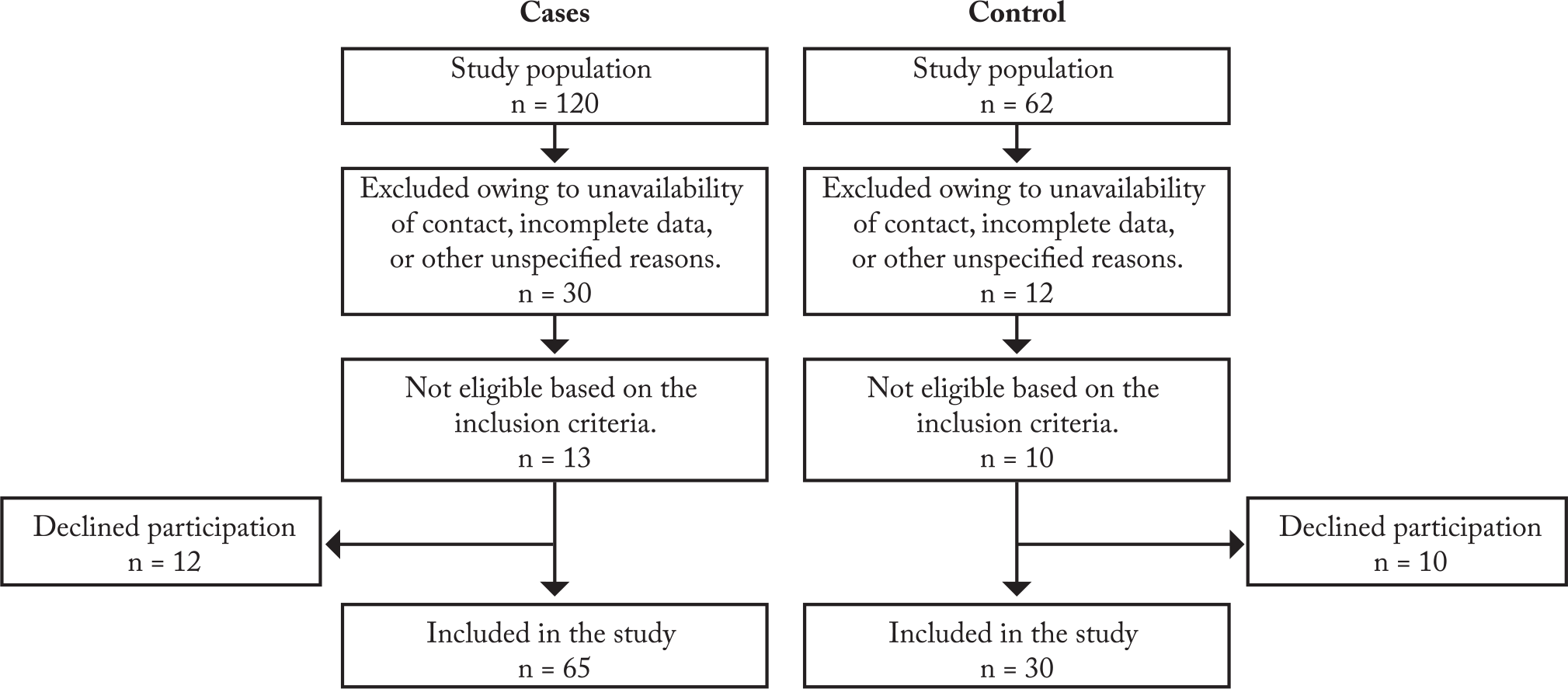
Participants were recruited between October 2021 and August 2022, yielding a total sample of 95 individuals (Figure 1). At the time of data collection, 65 eligible women with breast cancer (68.4%) and 30 healthy controls (31.5%) were included. Overall, cases and controls were comparable in terms of sociodemographic characteristics (Table 1). Most participants were classified as overweight, had completed more than eight yearsof formal education, and had a mean age of 52 years. Among women with breast cancer, approximately 40% were undergoing chemotherapy and 60% were receiving hormone therapy. The majority were diagnosed with stage II breast cancer (36.8%), and 21.4% presented with lymphedema. Regarding surgical treatment, 28.4% of participants underwent mastectomy, while 40% underwent breast-conserving surgery (quadrantectomy). The prevalence of adjuvant chemotherapy was 40%, whereas neoadjuvant chemotherapy accounted for 28.4% of the cases.

Physical activity, measured in MET-minutes per week, was significantly lower among women w ith breast cancer compared to controls. The median physical activity level was 198 MET-min/week (interquartile range [IQR]: 0.00-547) in the breast cancer group and 606 MET-min/week (IQR: 57.75-1062) in the control group (p = 0.008) (Table 2).
A subgroup analysis was conducted to compare physical activity levels among women with breast cancer undergoing chemotherapy, hormone therapy, and the control group. As shown in Table 3, the median physical activity level was 0.00 MET-min/week (IQR: 0.00-480) for participants undergoing chemotherapy, 198 MET-min/week (IQR: 0.00-699) for those receiving hormone therapy, and 606 MET-min/week (IQR: 86.6-1015) for the control group. A statistically significant difference in physical activity levels was observed among the three groups.
Subgroup Analysis: comparison of physical activity levels among women with breast cancer undergoing chemotherapy, hormone therapy, and the control group.
Discussion
Women with breast cancer included in this case-control study exhibited significantly lower levels of total physical activity compared to healthy women of the same age (p = 0.008). In the subgroup analysis, a statistically significant d ifference in physical ac tivity le vels wa s observed among the groups undergoing chemotherapy, hormone therapy, and the control group.
These fi ndings are consistent with previous re - search, such as the Health, Eating, Activity and Lifestyle Study, which reported a reduction in physical activity among women diagnosed with breast cancer, especially during chemotherapy14. Although the cross-sectional design precludes causal inferences, the data suggest that different therapeutic modalities may be related to distinct patterns of physical activity.
The interpretation of these findings should take into account the multiple factors that influence physical activity during cancer treatment8. Fatigue, pain, body image concerns, sleep disturbances, and difficulties balancing family and work responsibilities are among the barriers widely described in the literature that may hinder adherence to physical activity7,8. Although these variables were not directly assessed in the present study, their relevance as determinants of physical activity levels is well established.
According to the World Health Organization and the American College of Sports Medicine, physical activity includes any bodily movement that results in energy expenditure, such as active transportation, household chores, occupational activities, and leisure-time pursuits14,15. Maintaining adequate levels of physical activity has been associated with several benefits for women with breast cancer, including improved functional capacity, reduced fatigue, better sleep quality, and enhanced treatment tolerance14-16. Furthermore, recent meta-analyses have confirmed that regular physical activity contributes to improved quality of life and reduced symptoms of anxiety and depression in this population17.
Beyond symptom management, prospective studies suggest that regular physical activity after a cancer diagnosis may positively impact clinical outcomes. One cohort study found that women accumulating at least 540 MET-minutes per week had a 50% lower risk of overall mortality compared to physically inactive women18. These findings reinforce the importance of strategies that promote the incorporation of physical activity into the daily lives of women undergoing treatment, taking into account individual limitations, clinical conditions, and treatment stage.
Within the context of this study, the findings reinforce the importance of encouraging physical activity during cancer treatment. Strategies should prioritize lowto moderate-intensity activities that can be incorporated into daily routines, such as active commuting household chores, and leisure-time activities, always considering individual limitations, clinical conditions, and treatment stage.
Some limitations of this study must be acknowledged. The cross-sectional design limits the ability to assess changes in physical activity over time and to understand how treatment influences behavior throughout its progression. The lack of age-stratified analyses and the absence of pre-diagnosis physical activity data constrain the analysis of behavioral changes in response to treatment. Furthermore, the use of self-reported questionnaires such as the International Physical Activity Questionnaire represents another limitation, as these instruments are susceptible to recall bias and overestimation of physical activity levels. The eligibility criteria, while essential for ensuring sample homogeneity, may have limited the representativeness of the findings by excluding women with distinct clinical or functional characteristics, thus restricting the generalization of the results.
Despite these limitations, this study presents important strengths. The methodological protocol was simple, low-cost, and feasible for implementation across different populations and regional settings. Data collection and analysis were performed by trained assessors working in pairs, which contributed to the reliability of the procedures. The inclusion of an agematched control group also strengthened the interpretation of the findings and enabled valid comparisons between groups.
In summary, the results of this study indicate that women with breast cancer presented lower levels of physical activity compared to healthy women of similar age, particularly those undergoing chemotherapy. Although a statistically significant relationship between treatment type and physical activity levels was not confirmed, the findings suggest a trend toward reduced physical activity during cancer treatment. These results underscore the importance of integrating physical activity into the continuum of care for women with breast cancer and highlight the need for further research to explore this relationship across diverse clinical and sociodemographic contexts.
Acknowledgments
The authors thank the Goiânia Clinical Hospital and the Federal University of Goiás for facilitating contact with the volunteers.
Declaration regarding the use of artificial intelligence tools in the article writing process
The authors did not use artificial intelligence tools for preparation of the manuscript.
Availability of research data and other materials
The contents will be available at the time of publication of the article.
References
-
1 Friedreich CM, Neilson HK, Lynch BM. State of the epidemiological evidence on physical activity and cancer prevention. Eur J Cancer. 2010;46(14):2593-604. doi: https://doi.org/10.1016/j.ejca.2010.07.028
» https://doi.org/10.1016/j.ejca.2010.07.028 -
2 McTiernan A. Mechanisms linking physical activity with cancer. Nat Rev Cancer. 2008;8(3):205-11. doi: https://doi.org/10.1038/nrc2325
» https://doi.org/10.1038/nrc2325 -
3 Monninkhof EM, Elias SG, Vlems FA, van der Tweel I, Schuit AJ, Voskuil DW, et al. Physical activity and breast cancer: a systematic review. Epidemiology. 2007;18(1):137-57. doi: https://doi.org/10.1097/01.ede.0000251167.75581.98
» https://doi.org/10.1097/01.ede.0000251167.75581.98 -
4 Speck RM, Courneya KS, Mâsse LC, Duval S, Schmitz KH. An update of controlled physical activity trials in cancer survivors: a systematic review and meta-analysis. J Cancer Surviv. 2010;4(2):87-100. doi: https://doi.org/10.1007/s11764-009-0110-5
» https://doi.org/10.1007/s11764-009-0110-5 -
5 Mishra SI, Scherer RW, Snyder C, Geigle P, Gotay C. The effectiveness of exercise interventions for improving healthrelated quality of life from diagnosis through active cancer treatment. Oncol Nurs Forum. 2015;42(1):E33-53. doi: https://doi.org/10.1188/15.ONF.E33-E53
» https://doi.org/10.1188/15.ONF.E33-E53 -
6 Mustian KM, Alfano CM, Heckler C, Kleckner AS, Kleckner IR, Leach CR, et al. Comparison of pharmaceutical, psychological, and exercise treatments for cancer-related fatigue: a meta-analysis. JAMA Oncol. 2017;3(7):961-8. doi: https://doi.org/0.1001/jamaoncol.2016.6914
» https://doi.org/0.1001/jamaoncol.2016.6914 -
7 Courneya KS, Friedenreich CM. Physical activity and cancer control. Semin Oncol Nurs. 2007 Nov;23(4):242-52. doi: https://doi.org/10.1016/j.soncn.2007.08.002
» https://doi.org/10.1016/j.soncn.2007.08.002 -
8 Blaney JM, Lowe-Strong A, Rankin-Watt J, Campbell A, Gracey JH. The cancer rehabilitation journey: barriers to and facilitators of exercise among patients with cancer-related fatigue. Phys Ther. 2010;90(8):1135-47. doi: https://doi.org/10.2522/ptj.20090278
» https://doi.org/10.2522/ptj.20090278 -
9 Segal R, Zwaal C, Green E, Tomasone JR, Loblaw A, Petrella T. Exercise for people with cancer: a clinical practice guideline. Curr Oncol. 2017;24(1):40-6. doi: https://doi.org/10.3747/co.24.3376
» https://doi.org/10.3747/co.24.3376 -
10 Knols R, Aaronson NK, Uebelhart D, Fransen J, Aufdemkampe G. Physical exercise in cancer patients during and after medical treatment: a systematic review of randomized and controlled clinical trials. J Clin Oncol. 2005;23(16):3830-42. doi: https://doi.org/10.1200/JCO.2005.02.148
» https://doi.org/10.1200/JCO.2005.02.148 -
11 Schmidt ME, Wiskemann J, Steindorf K. Quality of life, problems, and needs of disease-free breast cancer survivors 5 years after diagnosis. Qual Life Res. 2018;27(8):2077-86. doi: https://doi.org/10.1007/s11136-018-1866-8
» https://doi.org/10.1007/s11136-018-1866-8 -
12 Pinto BM, Trunzo JJ. Health behaviors during and after a cancer diagnosis. Cancer. 2005;104(S11):2614-23. doi: https://doi.org/10.1002/cncr.21248
» https://doi.org/10.1002/cncr.21248 - 13 Matsudo S, Araújo T, Matsudo V, Andrade D, Andrade E, Oliveira L, Braggion G. International Physical Activity Questionnaire (IPAQ): validity and reproducibility study in Brazil. Rev. Bras. Ativ. Fís. Saúde. 2001;6(2):5-18.
-
14 Irwin ML, Crumley D, McTiernan A, Bernstein L, Baumgartner R, Gilliland FD, et al. Physical activity levels before and after a diagnosis of breast carcinoma: the Health, Eating, Activity, and Lifestyle (HEAL) study. Cancer. 2003;97(7):1746-57. doi: https://doi.org/10.1002/cncr.11227
» https://doi.org/10.1002/cncr.11227 -
15 Campbell KL, Winters-StoneKM,WiskemannJ, May AM, Schwartz AL, Courneya KS, et al. Exercise guidelines for cancer survivors: consensus statement from international multidisciplinary roundtable. Med Sci Sports Exerc. 2019;51(11):2375-90. doi: https://doi.org/10.1249/MSS.0000000000002116
» https://doi.org/10.1249/MSS.0000000000002116 -
16 World Health Organization. WHO guidelines on physical activity and sedentary behaviour. Geneva: W H O ; 2020. Available from: <https://www.who.int/publications/i/item/9789240015128> [2024 December].
» https://www.who.int/publications/i/item/9789240015128 -
17 Fong DYT, Ho JWC, Hui BPH, Lee AM, Macfarlane DJ, Leung SS, et al. Physical activity for cancer survivors: metaanalysis of randomised controlled trials. BMJ. 2012;344:e70. doi: https://doi.org/10.1136/bmj.e70
» https://doi.org/10.1136/bmj.e70 -
18 Demark-Wahnefried W, Hars V, Conaway M, Havlin K, Rimer BK, McElveen G, et al. Reduced rates of metabolism and decreased physical activity in breast cancer patients receiving adjuvant chemotherapy. Am J Clin Nutr. 1997;65(5):1495-501. doi: https://doi.org/10.1093/ajcn/65.5.1495
» https://doi.org/10.1093/ajcn/65.5.1495
Edited by
-
Editor in Chief
Raphael Ritti-Dias https://orcid.org/0000-0001-7883-6746Universidade Nove de Julho, São Paulo, São Paulo, Brazil.
-
Section editor
Eduardo Caldas Costa https://orcid.org/0000-0003-2807-7109Universidade Federal do Rio Grande do Norte, Natal, Rio Grande do Norte, Brazil.
Reviewers’ assessment
The reviews of this article were originally conducted in Portuguese. This version has been translated using ChatGPT and subsequently reviewed by the Chief Editors.About the reviewerReviewer A
Anonymous
Thank you for the opportunity to review the study “Physical activity levels of women with breast cancer during treatment: A case-control study”. The authors address a relevant and often overlooked topic in the cancer care continuum, which aligns well with the scope of RBAFS. While the study is of interest, some concerns must be addressed or justified before it is suitable for publication.
Major issues
Abstract
-
I noticed that there is available space in the abstract, and including more detailed information would be valuable, particularly regarding the case-control pairing strategy. The most common ratio in case-control studies is 1:1 (one case per control), yet the authors used a 2.2:1 ratio. Please clarify the rationale for this choice, both in the abstract and in the methods section of the manuscript.
-
Is “MD” an abbreviation for median? If that is the case, please avoid using this abbreviation, as it can be easily misinterpreted as a mean difference. If not, if the authors are referring to “median differences,” this is not an appropriate statistical approach, as no standard test directly provides a “median difference” with confidence intervals or IQR. A simple subtraction of medians does not constitute a valid comparison. Please clarify and revise accordingly.
-
The conclusions are not fully supported by the presented data. Since the study appears to rely solely on median comparisons, the authors cannot infer that chemotherapy caused reductions in physical activity levels. The relationship is likely not causal, but chemotherapy may represent a contributing or mediating factor associated with lower physical activity. The conclusion should be revised to avoid overstatement. Based on the current findings, the authors can only state that women with breast cancer undergoing chemotherapy presented with lower physical activity levels. Also, please avoid using terms such as “reduced” or “increased,” as they imply temporal changes, which are not appropriate in the context of cross-sectional data.
-
Keywords: Physical exercise and physical activity are not synonymous and should not be used interchangeably. If the manuscript refers specifically to structured or planned movement (e.g., training programs), then “physical exercise” is appropriate; otherwise (particularly in the context of IPAQ), “physical activity” is the broader and more accurate term. Please consider revising for precision.
-
The term “therapy” is quite broad in the context of breast cancer, which involves various treatment modalities (e.g., chemotherapy, radiotherapy, hormone therapy). Specifying the type of therapy being investigated would improve clarity and may enhance the discoverability of the article through more targeted keywords.
-
Abstract corrections need to be made in both language versions.
Introduction
-
L9: By “local treatment,” do the authors refer specifically to breast-region-focused treatment (e.g., surgery or radiotherapy to the breast area)? Please clarify this term to avoid ambiguity.
-
What are the authors’ main hypotheses? Please state it clearly in the introduction to guide the reader and align with the study objectives
-
I’m afraid the authors’ stated objective is not adequately addressed by the presented data. The current analyses do not assess which treatment has the greatest impact on physical activity levels; instead, they only compare median physical activity values between women with breast cancer and matched controls. To align the objective with the analyses conducted, the authors should either perform additional analyses to assess the specific impact of different treatments or revise the objective accordingly. Based on the current data, a more appropriate objective would be: “To compare the physical activity levels of women with breast cancer to those of healthy matched women”.
-
I’ll provide extra possibilities subsequently in the methods section.
Methods
-
Please clarify whether participants were enrolled consecutively, rather than using the term “convenience sampling.” If women were included consecutively, this approach should be explicitly stated, to be clear that authors avoided selection bias.
-
How was the control pairing?
-
Did the authors use STROBE to write their report? Please describe in methods.
-
The phrase “basic fluency in Brazilian Portuguese” may come across as vague or condescending. Please clarify what level of language proficiency was required for participation (e.g., ability to understand instructions, complete questionnaires, or participate in interviews). Consider rephrasing this to ensure clarity and avoid an exclusionary aspect.
-
L21: revise the verb tense: “measured” rather than measure.
-
Did the authors consider classifying patients’ BMI? As it may provide extra insights on physical activity levels.
-
Please avoid using the term “cancer patients” and instead adopt people-first language, which is the preferred and more respectful terminology in scientific writing. Use “patients with cancer” to maintain consistency with current standards in healthcare communication. Revise the entire manuscript accordingly.
-
In the IPAQ section, please consider specifying what the authors define as an “adequate” or “ideal” physical activity level. For instance, is the threshold based on WHO recommendations (i.e., at least 150 minutes of moderate-intensity activity per week), or another standard?
-
Please also clarify how the final physical activity level was calculated from the IPAQ responses: did it include only moderate and vigorous activity? Were walking minutes considered? This information is essential for the reproducibility and interpretation of the results.
-
Sample size: It appears the authors have misunderstood some aspects regarding sample size justification. Not all sample size calculations are intended to ensure representativeness of the general population. Instead, representativeness can refer to a well-defined target group, for example, women undergoing outpatient breast cancer treatment at the authors’ institution. This is both methodologically sound and commonly practiced, while also allowing for adequate statistical power. Additionally, using consecutive sampling (as opposed to convenience sampling) is an accepted approach, but it does not exempt the need for a formal sample size calculation.
-
Please consider removing the statements referring to “difficulties” in estimating sample size, as this does not justify its omission. A more appropriate approach would be to state that a sample size calculation was not performed due to the exploratory nature of the study, and that future studies by the group could use the current data to inform proper sample size estimations.
Statistics
-
The authors mention that BMI did not follow a normal distribution, yet it is presented in the table as mean ± SD. This is inconsistent. Moreover, it would be surprising if height and weight followed a normal distribution but BMI did not, as BMI is derived directly from those variables. Please verify the normality assessments and ensure that the reported measures are appropriate.
-
Please limit the statistical methods section to the analyses performed. Describing analyses that would have been conducted under different circumstances (e.g., with larger samples or normal distribution) is unnecessary and may confuse.
-
Rather than conducting post hoc analyses in a small sample, the authors might consider a more structured approach: (1) compare TQ cases vs. controls, and (2) compare TH cases vs. controls, using Mann-Whitney U tests for median differences.
-
Furthermore, a comparison between TQ and TH cases themselves would provide useful insights into differences across treatment modalities and help strengthen the discussion.
-
Although not ideal, but statistically acceptable in the context of an exploratory study, the authors could consider including a correlation analysis (Spearman’s rho) to explore the relationship between physical activity levels and treatment type (TH or TQ). Please note that this analysis would apply only to the subsample of participants with breast cancer (i.e., cases). This could provide additional insight into potential associations/correlations between treatment modality and activity level but still without implying causality.
Results
-
Please provide p-values for the comparisons of sociodemographic characteristics between groups to ensure transparency
-
Please consider including the additional analyses I suggested.
-
Describe all tests conducted in the table’s footnotes.
-
Figure 1: Please double-check English spelling. There are some boxes with the word “baseado”.
Discussion
-
L10:12: The authors mentioned statistical differences and wrote a P value> 0.05. Please revise accordingly.
-
To improve readability and structure, consider following standard discussion section conventions. The first paragraph should restate the study’s main objective(s), briefly summarize the key findings, and conclude with a general statement on the relevance or contribution of the study.
-
The current discussion focuses primarily on comparisons with other studies, rather than offering a deeper interpretation of the findings. Before addressing limitations, the authors should reflect on the implications of their results. What are the authors’ interpretations of the observed lower physical activity levels among women with breast cancer?
-
What is the clinical relevance of this finding in terms of health outcomes, recovery, treatment tolerance, or even survival? Please consider reinforcing the importance of this often-overlooked topic and discussing its broader impact on patient care and quality of life. A more interpretative and reflective approach would enrich the discussion and highlight the contribution of the study.
Minor issues
-
The manuscript would benefit from professional English language editing to improve clarity and readability throughout.
Final Decision
-
Major revision.
- peer review recommendation: major-revision
Reviewers’ assessment
The reviews of this article were originally conducted in Portuguese. This version has been translated using ChatGPT and subsequently reviewed by the Chief Editors.About the reviewerSCIMAGO INSTITUTIONS RANKINGSReviewer B
-
I would like to congratulate the authors for the choice of topic and for the conduction of the study. Moving on to the evaluation of the article itself, I have some suggestions that I believe will enrich the manuscript and the discussions regarding the work.
-
Review the entire writing in English, as there are some points that, in my view, could be written ina more formal manner. For example, on page 03, the phrase With around 685,000 deaths annually...; on pages 04 and 05, the phrase More or less one ageand sex-matched control. On page 05, line 22, a “d” is missing at the end of measure, and on page 09, line 04, at the end of use. In the flowchart figure, some words need to be rewritten, as they are in Portuguese. I believe that a general reading and revision of the entire manuscript may lead to other changes that, in my understanding, would benefit its writing and readability.
-
I am not sure whether it was intentional, but the information about the approval numbers from the Ethics Committee is missing (page 05).
-
Patients were eligible for the study if they had histologically confirmed stage I to III primary breast cancer and were undergoing neoadjuvant or adjuvant chemotherapy and hormonal therapy, including the use of tamoxifen and aromatase inhibitors (page 05). How was this confirmation/verification carried out? Medical record analysis? Self-report? I believe this part requires more detail.
-
and should not have participated in any regular exercise program in the last six months (page 05). What would be considered regular physical exercise? Did you consider once a week? Twice a week? A specific number of minutes per week or caloric expenditure? I think this section could be more detailed.
-
Only data from women who signed the informed consent form were considered in the study. Women with severe psychiatric or cognitive limitations that prevented them from understanding the study’s assessment instruments or who did not have basic fluency in Brazilian Portuguese were not selected, and controls were originally recruited through study announcements and information sessions about the research. Individuals at risk of suffering psychological distress from study participation were not eligible as controls (page 05). I believe this part about consent could be further detailed. Did participants have time to read the consent form alone? Was the form made available so that other researchers could replicate it, for example? Was the language of the form accessible? Was it signed in duplicate?
-
On page 06, line 11, I believe it would be better to include the IPAQ reference.
-
I suggest reviewing the formatting of Table 02.
Other considerations/suggestions
-
Were age-related issues considered in relation to physical activity levels? I believe that, if possible, stratifying physical activity levels, or at least highlighting some cutoff regarding older vs. younger women, would be extremely valuable. If such an analysis is not possible, I would mention thisin the manuscript as a limitation and/or relevant consideration about the findings. Furthermore, it is important to understand that many women still receive vague and inadequate recommendations regarding the return to their usual activities and about physical exercise. Was this aspect investigated? If so, I believe it would be interesting to report it in the manuscript as well.
-
Was prior physical activity before the diagnosis considered? If you have these data, it might be interesting to analyze whether there was a reduction or whether participants were already less active before diagnosis and chemotherapy treatment.
-
What were the main reasons for ineligibility? I believe this would be an important point to discuss, as it may directly influence the study findings.
-
I think you could also highlight as other strengths of the study its low cost and easy applicability. It could be replicated in different Brazilian cities with different social and economic realities, and the results might differ from the findings here-or not.
-
Finally, do you have any thoughts on data availability? This is not a question to be answered to me or to the Journal, unless required, but it is something to be considered in the conduction and dissemination of scientific studies.
-
Once again, congratulations on the work.
Final Decision
-
Mandatory corrections
- peer review recommendation: major-revision