 EFFECT OF AQUEOUS SMOKE EXTRACT ON THE GERMINATION OF Solanum lycocarpum ST. HIL. AND Solanum granulosoleprosum DUNAL (SOLANACEAE) SEEDS
ABSTRACT
Aqueous smoke extract (ASE) is a low-cost alternative which shows high effectiveness in optimizing seed germination. The objective of this study was to evaluate the effect of different aqueous smoke extract doses on the germination of Solanum lycocarpum St. Hil. and Solanum granulosoleprosum Dunal seeds. Two seed lots of S. granulosoleprosum were used, collected in 2016 and in June 2019, both in the region of Lavras, Minas Gerais. S. lycocarpum seeds were also collected in the Lavras region, in June 2019. The concentrations used for germination were distilled water (control) and ASE diluted in water at the following ratios: 1:5, 1:10, 1:20, 1:40, and 1:80 (v/v). The plates containing the seeds were incubated in a BOD chamber under alternating temperatures of 20 and 30 °C and a 12-hour photoperiod. The experiments were conducted in a completely randomized design, with the data subjected to analysis of variance and the means compared using Tukey’s test (p < 0.05). The experiment with S. granulosoleprosum was conducted in a two-factor factorial design (2 storage times x 6 concentrations). S. lycocarpum did not respond to the ASE treatments. S. granulosoleprosum seeds collected in 2016 and stored showed higher germination and germination speed index (GSI) compared to seeds collected in 2019 (not stored). The 1:5 and 1:20 dilutions significantly increased germination and GSI of S. granulosoleprosum seeds (2019 lot). It is concluded that all treatments improved germination and GSI compared to the control for S. granulosoleprosum seeds collected in 2019, whereas the treatments were not effective for S. lycocarpum seeds.
Keywords:
Smoked water; Seed vigor; Seed technology
RESUMO
O extrato aquoso de fumaça (EAF) é uma alternativa de baixo custo que apresenta elevada eficácia na otimização da germinação de sementes. O objetivo deste estudo foi avaliar o efeito de diferentes doses de extrato aquoso de fumaça sobre a germinação de sementes de Solanum lycocarpum St. Hil. e Solanum granulosoleprosum Dunal. Foram utilizados dois lotes de sementes de S. granulosoleprosum, coletado em 2016 e em junho de 2019, ambos na região de Lavras, Minas Gerais. As sementes de S. lycocarpum foram coletadas também na região de Lavras, em junho de 2019. Os tratamentos utilizados para a germinação foram água destilada (controle) e EAF diluído em água nas seguintes proporções: 1:5, 1:10, 1:20, 1:40 e 1:80 (v/v). As placas contendo as sementes foram incubadas em BOD, sob temperaturas alternadas de 20 e 30 °C e fotoperíodo de 12 horas. Os experimentos foram conduzidos em delineamento inteiramente casualizado, com os dados submetidos à análise de variância e as médias comparadas pelo teste de Tukey (p < 0,05). O experimento com S. granulosoleprosum foi conduzido em esquema fatorial duplo (2 tempos de armazenamento χ 6 concentrações). S. lycocarpum não apresentou resposta aos tratamentos com EAF. As sementes de S. granulosoleprosum coletadas em 2016 e armazenadas apresentaram maior germinação e índice de velocidade de germinação (IVG) em comparação às sementes coletadas em 2019 (não armazenadas). As diluições 1:5 e 1:20 aumentaram significativamente a germinação e o IVG das sementes de S. granulosoleprosum (lote de 2019). Conclui-se que todos os tratamentos melhoraram a germinação e o IVG em comparação ao controle para as sementes de S. granulosoleprosum coletadas em 2019, enquanto para as sementes de S. lycocarpum os tratamentos não foram eficientes.
Palavras-Chave:
Fumaça líquida; Vigor de sementes; Tecnologia de sementes
1. INTRODUCTION
The Solanaceae family is recognized worldwide for its importance in vegetable cultivation and its wide range of agronomic uses (Mueller et al., 2005). The genus Solanum L. stands out as the largest and most diverse within this family, with approximately 1,500 species and 5,000 epipeta distributed throughout tropical and subtropical regions of the world, with South America as the center of its diversity and distribution (Silva, 2003).
Among the species in this genus, Solanum lycocarpum St. Hil., popularly known as "lobeira", is a tree or shrub widely distributed in Brazil, predominantly in the Cerrado (Mamede et al., 2019). Another important species is Solanum granulosoleprosum Dunal, known as "gravitinga", which occurs in the Southeast and South regions of Brazil, as well as Paraguay, Uruguay, and Argentina, and has great potential for use in degraded area restoration programs (Dai et al., 2022).
Both S. lycocarpum and S. granulosoleprosum have been widely used in ecological restoration initiatives, as they are pioneer species and produce fruits that are attractive to wildlife, which promotes natural regeneration. However, the slow and uneven germination of their seeds under field conditions poses a barrier to large-scale seedling production (Silveira et al., 2019).
In this context, various alternatives are being investigated to overcome these limitations. Among them, the use of aqueous smoke extract stands out, which has shown positive results in several species (Sreekissoon et al., 2021; Pandey et al., 2024) , promoting significant improvements in germination quality and seedling vigor. This treatment helps increase the germination rate, speed, and uniformity of seeds previously considered difficult to propagate. Furthermore, it is an economically viable and operationally applicable technique, as it is derived from widely available natural products (Igbal et al., 2017).
Aqueous smoke extract can be defined as “a product resulting from the passage of smoke expelled during the burning of plant material at relatively high temperatures through a container containing water, which, after the smoke is dissolved, contains more than 200 chemical components” (Moyo et al., 2022). “Karrikins” are considered the most promising among these compounds for promoting seed germination, as they affect gibberellin pathways and have similar or greater effects than those of gibberellic acid (GA3) (Merritt et al., 2006; Daws et al., 2007). However, it is important to emphasize that responses may vary depending on the concentration applied and the species evaluated.
Therefore, this study aimed to evaluate the effect of different aqueous smoke extract concentrations on the germination of S. lycocarpum and S. granulosoleprosum seeds.
2. MATERIAL AND METHODS
The experiments were conducted in 2019 at the Laboratory of Forest Seeds of the Federal University of Lavras. Plots of two shrub species of the Solanaceae family were used: S. lycocarpum and S. granulosoleprosum.
First, one seed lot for the experiment with S. granulosoleprosum was collected in 2016, and another was collected in June 2019 in the region of Lavras, Minas Gerais. The seeds were collected from ripe fruits, where fruits that started to drop spontaneously and were soft to the touch were considered ripe. S. lycocarpum seeds were collected in the region of Lavras in June 2019. Fruits which were already dispersed in the soil were collected as recommended by Pinto et al. (2007).
After collection, the fruits were immediately taken to the laboratory, opened with a knife to remove the pulp containing the seeds and placed on a sieve. Maceration was performed under running water until pulp removal. The processed seeds were placed on blotting paper in an acclimatized room (20°C/65% RH) for drying. The S. granulosoleprosum seeds collected in 2016 were stored in a cold chamber (7.0°C; 35% RH) in hermetic packaging until use, while the S. granulosoleprosum seeds collected in 2019 and the S. lycocarpum seeds collected in 2019 were not stored, being used immediately in the tests.
Smoke extract was obtained through gas condensation from carbonizing Eucalyptus grandis W. Hill leaves and branches. A total of 200g of plant was used, which was placed in a metal container with hoses attached to a bottle containing 1 liter of distilled water. After combustion began, the smoke was forcedly pumped through a manual pump to propel the combustion gases to the bottom of the flask with distilled water until all the contents were consumed by fire. The vials containing the aqueous smoke extracts were closed and stored at 10°C in the dark until use.
The working solutions were prepared from the crude extract obtained and diluted in distilled water at the following proportions (volume/volume): 1:5, 1:10, 1:20, 1:40 and 1:80. Distilled water was used as a control. After the appropriate dilutions of the crude extract, pH measurements were performed using a pH meter, and the pH at all obtained concentrations ranged from 6.6 to 7.1.
The seeds were immersed in 1% sodium hypochlorite solution for five minutes before the tests were mounted. After this treatment, the seeds were immediately washed in running water.
Next, 5 replicates of 25 seeds were used per treatment in the germination tests. Germination was performed in Petri dishes with a diameter of 9 cm on two sheets of germination paper soaked in aqueous smoke extract solutions at different dilutions. The total solution initially added to each plate was 2 mL, which was replaced whenever necessary to keep the paper moist.
The plates with seeds were incubated in a BOD germination chamber under alternating temperatures of 20 and 30°C, with each temperature maintained for 12 hours. The 30°C period was associated with light, while the 20°C period was maintained in the dark, resulting in a 12-hour photoperiod (Pinto et al., 2007). Germination was evaluated daily using root protrusion (2 mm) as a criterion. Counts were performed up to 40 days after imbibition. At the end of this period, the normal seedlings, abnormal seedlings, dead seeds and hard seeds were counted. The final germination percentage was determined from these data and the germination speed index (GSI), according to the formula described by Maguire (1962).
In turn, 10 seedlings were randomly selected from each replicate at the end of the germination test to evaluate the root lengths. The seedlings were photographed, and measurements were performed using ImageJ software.
The experiments were conducted in accordance with a completely randomized design (DIC). The data were initially subjected to assumption analysis, with the normality of the residuals being verified by the Shapiro-Wilk test (p > 0.05) and the homogeneity of variances by the Levene test (p > 0.05). Once the assumptions were met, analysis of variance (ANOVA) was performed, and the means were compared in case of significance (p ≤ 0.05) by the Tukey test at 5% probability. The experiment with S. granulosoleprosum was conducted in a double factorial manner (2 lots × 6 concentrations). The analyses were performed using R software for Windows (Pinheiro et al., 2018).
3. RESULTS
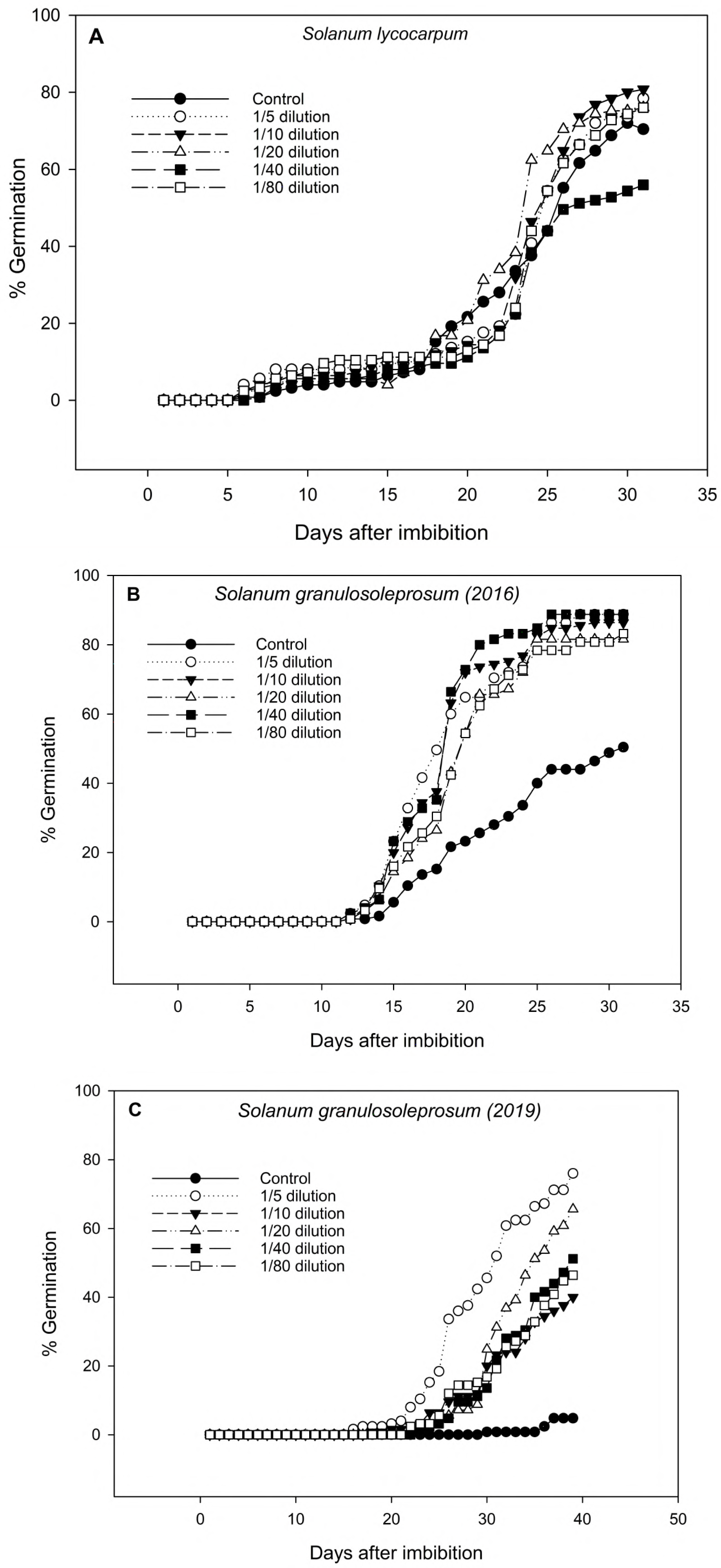
The influence of the aqueous smoke extract concentration on the germination profiles of the studied species was observed (Figure 1). All the treatments with aqueous smoke extract presented similar results for S. lycocarpum, which indicated the low influence of these treatments on the seeds of this species. However, better results were observed in S. granulosoleprosum seeds after treatment with aqueous smoke extract. Seeds germinated in water (control) had markedly lower germination rates compared with those germinated in aqueous smoke extract solutions.
Accumulated germination in (A) S. lycocarpum and S. granulosoleprosum seeds collected in 2016 (B) (stored in cold storage) and 2019 (C) not stored
Figura 1
Germinação acumulada de sementes de S. lycocarpum (A) e S. granulosoleprosum coletadas em 2016 (B) (armazenadas em câmara fria) e em 2019 (C) (não armazenadas)
There was no difference in seed germination between the seeds that underwent storage (collected in 2016) at different aqueous smoke extract concentrations; however, the treatments had a positive effect on germination compared with the control (water). On the other hand, all the smoke extract treatments positively influenced the germination of S. granulosoleprosum seeds collected in 2019 (not stored) (Figure 1C).
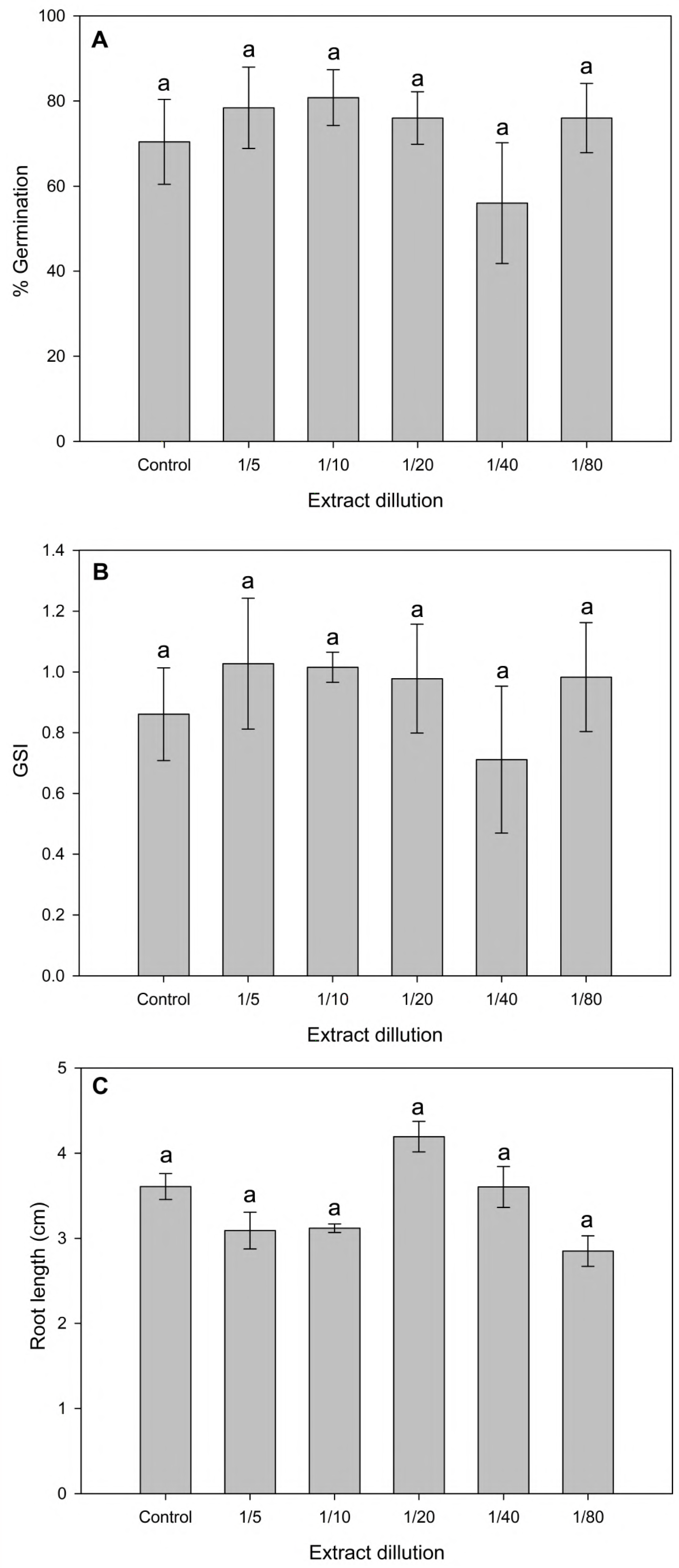
In turn, there was no significant difference between treatments for S. lycocarpum seeds. Germination percentage, germination speed index (GSI), and root length were analyzed separately. The mean final germination for this species was 72.9 ± 8.9%, GSI was 0.92 ± 0.12, and root length was 3.41 ± 0.48 cm (Figure 2).

(A) Germination percentage, (B) germination speed index (GSI) and (C) length of S. lycocarpum roots, 40 days after imbibition. The same letters indicate no significant differences according to Tukey’s test (p<0.05). The bars represent the standard error of the mean
Figura 2
Porcentagem de germinação (A), índice de velocidade de germinação (IVG) (B) e comprimento de raízes de S. lycocarpum (C), 40 dias após a embebição. Letras iguais indicam ausência de diferença significativa de acordo com o teste de Tukey (p<0,05). As barras representam o erro padrão da média
A significant interaction between the factors was observed in the 2016 lot and the 2019 lot with the tested concentrations for S. granulosoleprosum, highlighting the positive effect of smoke extract application during germination (Figure 3). Smoke extract was effective in increasing germination potential compared to seeds germinated in water alone for both the stored and freshly harvested lots.

(A) Germination percentage, (B) germination speed index (GSI) and (C) root length, 40 days after imbibition of S. granulosoleprosum seeds collected in 2016 and stored in cold room and unstored seeds collected in 2019. Different lowercase letters indicate a significant difference according to Tukey’s test (p<0.05) within each extract dilution. Different capital letters indicate a significant difference according to Tukey’s test (p<0.05) between concentrations at each collection period. The bars represent the standard error of the mean
Figura 3
Porcentagem de germinação (A), índice de velocidade de germinação (IVG) (B) e comprimento de raízes (C), 40 dias após a embebição de sementes de S. granulosoleprosum coletadas em 2016 e armazenadas em câmara fria, e sementes não armazenadas coletadas em 2019. Letras minúsculas diferentes indicam diferença significativa de acordo com o teste de Tukey (p<0,05) dentro de cada diluição do extrato. Letras maiúsculas diferentes indicam diferença significativa de acordo com o teste de Tukey (p<0,05) entre concentrações em cada período de coleta. As barras representam o erro padrão da média
Approximately zero germination was detected among the untreated S. granulosoleprosum seeds collected in 2019 (control), while germination values close to 80% were obtained in the treatment in which the extract was diluted 1/5. It was possible to observe that the treatments at concentrations of 1/5 and 1/20 had significantly better results in the lot collected in 2019 (p <0.05) for both germination and GSI. The 1/40 and 1/80 treatments did not differ from each other, and all the treatments were superior to the germination of seeds in water.
The stored S. granulosoleprosum seed lot (2016) showed higher germination than the lot collected in 2019 (not stored) at concentrations of 1/5, 1/10, 1/20, 1/40, 1/80 and water (control).
Finally, S. granulosoleprosum seeds collected in 2016 showed greater root length, with a mean of 4.44 cm, differing significantly from the 2019 seed lot which presented a mean of 1.30 cm (p < 0.05). When comparing the years within each concentration, the 2016 seed lot showed superior performance across all tested dilutions. However, no significant differences were observed among the evaluated concentrations within each collection year, indicating that the extract dilutions did not influence root length.
4. DISCUSSION
Seed germination is one of the most important stages of the plant life cycle. This process determines the establishment and development success of a plant. In this context, pre-germination treatments capable of promoting faster and more uniform germination in forest species have become increasingly relevant, given their application in landscaping, commercial cultivation, and especially in programs for the recovery of degraded areas. This is because although natural regeneration plays a fundamental role in maintaining ecosystems, this process may not be sufficient to restore biodiversity in severely impacted areas (Ribeiro et al., 2025), making the use of complementary techniques indispensable to support the restoration and conservation of native vegetation.
In the present study, the physiological responses of S. lycocarpum and S. granulosoleprosum seeds to different aqueous smoke extract concentrations were investigated via germination, GSI and root length measurements. Aqueous smoke extract diluted in water can be considered a natural stimulant for seed germination in many species that occur in ecosystems with naturally occurring fires (Light et al., 2009). This response can be attributed to the occurrence of butenolide, a low molecular weight organic compound, identified in the extract (Van Staden et al., 2004).
Both species in this study were found to occur in places with regular or low occurrence of fire. The occurrence of fires leads to significant differences in the natural regeneration, composition, structure, and functional diversity patterns of vegetation (Araújo et al., 2025). However, the species differed regarding germination performance in their response to the application of aqueous smoke extract. The compost content in S. lycocarpum did not differ among the treatments, while the germination potential in S. granulosoleprosum increased at certain concentrations.
Different responses to treatment with aqueous smoke extract are common in the literature, even for species of the same family (Brown, 1993). Differences within the species could be observed, depending on the difference in dormancy between the seed lots. Among the 18 woody species analyzed in Chile, only three (Acacia caven, Baccharis vernalis and Trevoa quinquenervia) exhibited improved germination after applying the extract (Gómez-González et al., 2008).
Positive responses to the aqueous smoke extract were shown in the germination patterns of five Amazonian tree species which do not suffer fires regularly in their natural habitats. The species that had seed lots with low vigor or long germination periods showed a better response to the treatment (Ferraz et al., 2013). Aqueous smoke extract and ash treatments were effective for five of the 12 tree species that occur in areas with frequent fires in Mexico (Zuloaga-Aguilar et al., 2011). King & Menges (2018) reported that seed treatment with this extract significantly increased germination success in three studied species (Chrysopsis highlandsensis, Eryngium cuneifolium and Lechea cernua).
The treatment did not efficiently increase the germination percentage, germination speed or seedling growth of S. lycocarpum seeds in the present study, which differed from the responses observed for S. granulosoleprosum seeds. The occurrence of physiological dormancy in these species may be the possible cause of the variations in the results. Stored S. granulosoleprosum seeds may have gone through a process of abscisic acid degradation, reducing their dormancy related to the newly collected lot.
The S. granulosoleprosum lots exhibited different behaviors during germination. The stored lot generally presented a greater germination percentage than the freshly collected lot (p<0.05), which may indicate a reduction in dormancy due to storage. Storage is directly related to seed lot viability (Vicente et al., 2016; Jesus et al., 2018). Orthodox seeds with physiological dormancy often exhibit an increase in germination after a certain storage period (Grzybowski et al., 2019). Breaking dormancy due to cold stratification is one of the most commonly used methods for removing nutrients from seeds of temperate climate species, and the same process can occur during storage under conditions of low temperature and humidity (Oba et al., 2017). It was observed that the stored S. granulosoleprosum seeds showed superior germination at a concentration of 1/10, 1/20, 1/40, 1/80 and water. However, it should be considered that the lots were collected in different years, so factors associated with the environmental conditions of seed production and the intrinsic physiological differences between the lots may have contributed to the observed responses, and it is not possible to attribute the effects exclusively to storage (Pirredda et al., 2024).
In turn, the highest concentration (1/5) of the extract was generally more effective in S. granulosoleprosum seeds than the other concentrations at promoting seed germination. Daws et al. (2007) observed a positive effect on the germination percentage compared to the control for at least 18 species of African herb; however, they also found a negative effect for two species.
This increase in germination was possibly due to the interaction between the butenoloid and gibberellin pathways. It is known that this compound has a similar effect on germination as GA3 in Australian Asteraceae (Van Staden et al., 2000; Sreekissoon et al., 2021). Butenoloids may be more effective at promoting seed germination than GA3 application, as they do not cause elongation or etiolation; these effects are typically associated with GA3 (Daws et al., 2008).
The application of the aqueous smoke extract did not produce phytotoxic effects on the seeds of the studied species. A similar finding was found by Guerreiro et al. (2012), who found no toxicity of this compound when applied to tomato seedlings. Therefore, it is possible to conclude that application of the aqueous smoke extract at the tested concentrations did not have negative effects on S. lycocarpum or S. granulosoleprosum seeds, and also had positive effects on S. granulosoleprosum seeds.
The results reinforce the need for further research to understand the mechanisms involved in the action of aqueous smoke extract on the species studied at the physiological and biochemical levels. Future studies should seek to identify which metabolic pathways and enzyme systems are modulated by this treatment during the germination process, expanding our understanding of its role and enabling more targeted application of this technique in seedling production and ecological restoration programs.
5. CONCLUSION
It is possible to conclude that S. lycocarpum seeds treated with aqueous smoke extract had no response to germination or early seedling growth compared to those treated with water alone. S. granulosoleprosum seeds showed an increase in germination and GSI when treated with aqueous smoke extract.
6. ACKNOWLEDGEMENTS
To the Postgraduate Program in Forestry Engineering at the Federal University of Lavras (UFLA), the National Council for Scientific and Technological Development (CNPq) Grant 301637/2025-3 (ACj) and Grant 305104/2025-0 (JMRF), the Coordination for the Improvement of Higher Education Personnel (CAPES) and the Minas Gerais State Research Support Foundation (FAPEMIG).
DATA AVAILABILITY
The entire dataset supporting the findings of this study has been published within the article.
7. REFERENCES
-
Araújo, F. de C., Garcia, P. O., da Páscoa, K. J. V., de Moura, A. S., Lobo-Faria, P. C., Santos, R. M. dos, & Fontes, M. A. L. (2025). Post-fire trajectories in Atlantic Forest regeneration: A case study in fragmented landscapes. Cerne, 31, e-103464. https://doi.org/10.1590/01047760202531013464
» https://doi.org/10.1590/01047760202531013464 -
Brown, N. A. C. (1993). Promotion of germination of fynbos seeds by plant-derived smoke. New Phytologist, 123(3), 575-583. https://doi.org/10.1111/j.1469-8137.1993.tb03770.x
» https://doi.org/10.1111/j.1469-8137.1993.tb03770.x -
Dai, H., Wei, S., Twardowska, I., Hou, N., & Zhang, Q. (2022). Cosmopolitan cadmium hyperaccumulator Solanum nigrum: Exploring cadmium uptake, transport and physiological mechanisms of accumulation in different ecotypes as a way of enhancing its hyperaccumulative capacity. Journal of Environmental Management, 320(1), 115878. https://doi.org/10.1016/j.jenvman.2022.115878
» https://doi.org/10.1016/j.jenvman.2022.115878 -
Daws, M. I., Davies, J., Pritchard, H. W., Brown, N. A. C., & van Staden, J. (2007). Butenolide from plant-derived smoke enhances germination and seedling growth of arable weed species. Plant Growth Regulation, 51(1), 73-82. https://doi.org/10.1007/s10725-006-9149-8
» https://doi.org/10.1007/s10725-006-9149-8 -
Daws, M. I., Pritchard, H. W., & van Staden, J. (2008). Butenolide from plant-derived smoke functions as a strigolactone analogue: Evidence from parasitic weed seed germination. South African Journal of Botany, 74(1), 116-120. https://doi.org/10.1016/j.sajb.2007.09.005
» https://doi.org/10.1016/j.sajb.2007.09.005 -
Ferraz, I. D. K., Arruda, Y M. B. C., & van Staden, J. (2013). Smoke-water effect on the germination of Amazonian tree species. South African Journal of Botany, 87(1), 122128. https://doi.org/10.1016/j.sajb.2013.04.004
» https://doi.org/10.1016/j.sajb.2013.04.004 -
Gómez-González, S., Sierra-Almeida, A., & Cavieres, L. A. (2008). Does plant-derived smoke affect seed germination in dominant woody species of the Mediterranean matorral of central Chile? Forest Ecology and Management, 255(5), 1510-1515. https://doi.org/10.1016/j.foreco.2007.11.006
» https://doi.org/10.1016/j.foreco.2007.11.006 -
Grzybowski, C. R. S., da Silva, R. C., Belniaki, A. C., & Panobianco, M. (2019). Investigação de dormência e potencial de armazenamento de sementes de maracujazeiro amarelo nativo. Journal of Seed Science, 41(3), 367-374. https://doi.org/10.1590/2317-1545v41n3214892
» https://doi.org/10.1590/2317-1545v41n3214892 -
Guerreiro, J. C. G., Bento, F. S. B., & Silvestre, C. S. (2012). Efeito da incorporação de extrato pirolenhoso em substrato no desenvolvimento inicial de mudas de tomate. Periódico Eletrônico Fórum Ambiental da Alta Paulista, 8(1), 1-9. https://doi.org/10.17271/19800827812012235
» https://doi.org/10.17271/19800827812012235 -
Iqbal, M., Ahmad, R., Hussain, Q., Mahmood, S., Akram, M. S., Aslam, Z., & Anwar, F. (2017). Smoke produced from plant waste material elicits growth of wheat (Triticum aestivum L.) by improving morphological, physiological and biochemical activity. Biotechnology Reports, 13(17), 35-44. https://doi.org/10.1016/j.btre.2017.12.001
» https://doi.org/10.1016/j.btre.2017.12.001 -
King, R. A., & Menges, E. S. (2018). Effects of heat and smoke on the germination of six Florida scrub species. South African Journal of Botany, 115(1), 223-230. https://doi.org/10.1016/j.sajb.2017.03.009
» https://doi.org/10.1016/j.sajb.2017.03.009 -
Light, M. E., Daws, M. I., & van Staden, J. (2009). Smoke-derived butenolide: Towards understanding its biological effects. South African Journal of Botany, 75(1), 1-7. https://doi.org/10.1016/j.sajb.2008.10.004
» https://doi.org/10.1016/j.sajb.2008.10.004 - Maguire, J. D. (1962). Speed of germination-aid selection and evaluation for seedling emergence and vigor. Crop Science, 2(2), 176-177.
-
Mamede, J. S. dos S., & Pasa, M. C. (2019). Diversidade e uso de plantas do Cerrado na comunidade São Miguel, Várzea Grande, MT, Brasil. Interações, 20(4), 10871098. http://dx.doi.org/10.20435/inter.v20i4.2064
» http://dx.doi.org/10.20435/inter.v20i4.2064 -
Merritt, D. J., Kristiansen, M., Flematti, G. R., Turner, S. R., Ghisalberti, E. L., Trengove, R. D., & Dixon, K. W. (2006). Effects of a butenolide present in smoke on light-mediated germination of Australian Asteraceae. Seed Science Research, 16(1), 29-35. https://doi.org/10.1079/SSR2005232
» https://doi.org/10.1079/SSR2005232 -
Moyo, M., Amoo, S. O., & van Staden, J. (2022). Aqueous smoke and karrikin influence seed germination of Amaranthus dubius in varying light, temperature and osmotic stress conditions. South African Journal of Botany, 148(1), 704-709. https://doi.org/10.1016/j.sajb.2022.05.024
» https://doi.org/10.1016/j.sajb.2022.05.024 -
Mueller, L. A., Tanksley, S. D., Giovannoni, J. J., van Eck, J., Stack, S., Choi, D., Kim, B. D., Chen, M., Cheng, Z., Li, C., Ling, H., Xue, Y., Seymour, G., Bishop, G., Bryan, G., Sharma, R., Khurana, J., Tyagi, A., Hattopadhyay, ..., & Zamir, D. (2005). The tomato sequencing project, the first cornerstone of the International Solanaceae Project (SOL). Comparative and Functional Genomics, 6(1-2), 153-158. https://doi.org/10.1002/cfg.468
» https://doi.org/10.1002/cfg.468 -
Oba, G. C., Goneli, A. L. D., Masetto, T. E., Filho, C. P. H., Patricio, V. S., & Sarath, K. L. L. (2017). Dormancy of safflower seeds: Effect of storage and cold stratification. Journal of Seed Science, 39(4), 433-439. https://doi.org/10.1590/2317-1545v39n4181244
» https://doi.org/10.1590/2317-1545v39n4181244 -
Pandey, N., Nalla, S., Dayal, A., Rai, P., & Sahi, V. P. (2024). Smoke-water treatment of seeds, an ancient technique for increasing seed vigor. Protoplasma, 262(1), 3-13. https://doi.org/10.1007/s00709-024-01975-6
» https://doi.org/10.1007/s00709-024-01975-6 -
Pinheiro, J., Bates, D., DebRoy, S., Sarkar, D., & R Core Team. (2018). nlme: Linear and nonlinear mixed effects models (R package version 3, 1-137). https://CRAN.R-project.org/package=nlme
» https://CRAN.R-project.org/package=nlme -
Pinto, L. V. A., Silva, E. A. A., Davide, A. C., Jesus, V. A. M., Toorop, P. E., & Hilhorst, H. W. M. (2007). Mechanism and control of Solanum lycocarpum seed germination. Annals of Botany, 100(6), 1175-1187. https://doi.org/10.1093/aob/mcm211
» https://doi.org/10.1093/aob/mcm211 -
Pirredda, M., Fananás-Pueyo, I., Onate-Sánchez, L., Mira, S. (2024). Seed Longevity and Ageing: A Review on Physiological and Genetic Factors with an Emphasis on Hormonal Regulation. Plants, 13(41). https://doi.org/10.3390/plants13010041
» https://doi.org/10.3390/plants13010041 -
Ribeiro, C. V. G., Silva, A. C. G., Souza, A. F., Lafetá, B. O., Botelho, S. A., & Melo, L. A. (2025). Seed bank analysis as an indicator of environmental recovery following the Fundão dam disaster in Mariana, Minas Gerais. Cerne, 31, e-103468. https://doi.org/10.1590/01047760202531013468
» https://doi.org/10.1590/01047760202531013468 -
Silva, T. M. S., Carvalho, M. G., Braz-Filho, R., & Agra, M. F. (2003). Ocorrência de flavonas, flavonóis e seus glicosídeos em espécies do gênero Solanum (Solanaceae). Química Nova, 26(4), 517-522. https://doi.org/10.1590/S0100-40422003000400014
» https://doi.org/10.1590/S0100-40422003000400014 -
Silveira, L. E. D., Oliveira, J. P. R., Luccas, D. A., Bravo, J. P., & da Silva, E. A. A. (2019). A molecular framework for the embryo growth in germinating seeds of Solanum lycocarpum A. St.-Hil., a nurse plant species. Annals of Applied Biology, 175(2), 136-145. https://doi.org/10.1111/aab.12523
» https://doi.org/10.1111/aab.12523 -
Sreekissoon, A., Finnie, J. F., & van Staden, J. (2021). Effects of smoke water on germination, seedling vigour and growth of Sceletium tortuosum. South African Journal of Botany, 139(1), 427-431. https://doi.org/10.1016/j.sajb.2021.01.025
» https://doi.org/10.1016/j.sajb.2021.01.025 -
Van Staden, J., Jāger, A. K., Light, M. E., Burger, B. V., Brown, N. A. C., & Thomas, T. H. (2004). Isolation of the major germination cue from plant-derived smoke. South African Journal of Botany, 70(1), 654659. https://doi.org/10.1016/S0254-6299(15)30206-4
» https://doi.org/10.1016/S0254-6299(15)30206-4 -
Van Staden, J., Brown, N. A. C., Jāger, A. K., & Johnson, T. A. (2000). Smoke as a germination cue. Plant Species Biology, 15(3), 167-178. https://doi.org/10.1046/j.1442-1984.2000.00037.x
» https://doi.org/10.1046/j.1442-1984.2000.00037.x -
Vicente, D., Oliveira, L. M. de, Tonetti, O. A. O., Silva, A. A., Liesch, P. P., & Engel, M. L. (2016). Viabilidade de sementes de Ocotea puberula (Rich.) Ness ao longo do armazenamento. Floresta e Ambiente, 23(3), 418-426. https://doi.org/10.1590/2179-8087.107414
» https://doi.org/10.1590/2179-8087.107414 -
Zuloaga-Aguilar, S., Briones, O., & Orozco-Segovia, A. (2011). Seed germination of montane forest species in response to ash, smoke and heat shock in Mexico. Acta Oecologica, 37(3), 256-262. https://doi.org/10.1016Zj.actao.2011.02.009
» https://doi.org/10.1016Zj.actao.2011.02.009
Edited by
-
Editors:
Rodolfo Soares de Almeida.