 Accountability, equitable public services, and open government in Brazil and Colombia
Abstract
This article analyzes the relationship between accountability and equity in public services in the context of open government plans in unequal countries and cities. It presents a conceptual discussion interweaving collaborative and inclusive governance, accountability, equity, and open government, supporting the analysis of the 5th Brazilian Open Government National Plan, the 4th Colombian Open State National Plan, and the current Municipal Open Government Action Plans of São Paulo and Bogotá. The research question addressed is: How do open government plans recognize power asymmetries and inequities among population groups when accessing public services? The study also identifies trends in connecting accountability and equity in public services, showing examples from Bogotá and São Paulo, highlighting the inclusion of equity goals in Colombian and Brazilian development plans. This qualitative and exploratory research introduces a conceptual discussion bridging academic and technical literature, conducting a documentary analysis of the empirical realities in two countries and two cities. The results show that equity in public services is usually approached broadly and is more visible in municipal than national open government plans. The operationalization and measurement of equity in public services are challenging. Improvements in this direction could make equity efforts more accountable, accountability processes more equitable, governance more inclusive, and power less concentrated.
Keywords:
accountability; equitable public services; open government; collaborative and inclusive governance
Resumo
O trabalho analisa a relação entre accountability e equidade nos serviços públicos, no contexto de planos de governo aberto em países e cidades com elevadas desigualdades socioeconômicas. A partir de uma discussão conceitual que articula governança colaborativa e inclusiva, accountability, equidade e governo aberto, analisamos o 5º Plano Nacional de Governo Aberto do Brasil e o 4º Plano Nacional de Estado Aberto da Colômbia, bem como os atuais Planos de Ação de Governo Aberto de São Paulo e Bogotá. A pergunta que orienta a investigação é como os planos de governo aberto reconhecem as assimetrias de poder e as iniquidades entre grupos populacionais no acesso aos serviços públicos? Ainda, identificamos tendências de conexão entre accountability e equidade nos serviços públicos, mostrando exemplos de Bogotá e São Paulo, além da presença de metas de equidade em planos de desenvolvimento de Brasil e Colômbia. Trata-se de uma pesquisa de caráter qualitativo e exploratório, que propõe uma articulação e discussão teórico-conceitual, articulando literatura acadêmica e técnica e análise documental sobre a realidade empírica em dois países e duas cidades. Os resultados mostram que a equidade é abordada de forma geral e é mais visível nos planos municipais do que nos planos nacionais de governo aberto. A operacionalização e mensuração da equidade em serviços públicos são desafiadoras. Melhorias nesses aspectos podem ajudar a tornar os esforços de equidade mais accountable, os processos de accountability mais equitativos, a governança mais inclusiva e o poder menos concentrado.
Palavras-chave:
accountability; equidade em serviços públicos; governo aberto; governança colaborativa e inclusiva
Resumen
El artículo busca analizar la relación entre accountability y equidad en los servicios públicos, en el contexto de planes de gobierno abierto en países y ciudades con altas desigualdades socioeconómicas. Presenta una discusión conceptual que articula gobernanza colaborativa e inclusiva, accountability, equidad y gobierno abierto, para el análisis del V Plan Nacional de Gobierno Abierto de Brasil, el IV Plan Nacional de Estado Abierto de Colombia y los actuales planes de acción municipales de gobierno abierto de São Paulo y Bogotá. La pregunta de investigación es ¿Cómo los planes de gobierno abierto reconocen las asimetrías de poder y las iniquidades entre grupos poblacionales en el acceso a los servicios públicos? El estudio también identifica tendencias en la conexión entre accountability y equidad en los servicios públicos y muestra ejemplos de Bogotá y São Paulo, además de la presencia de metas de equidad en los planes de desarrollo de Brasil y Colombia. Se trata de una investigación cualitativa y exploratoria, que propone una discusión teórico-conceptual, articulando literatura académica y técnica y análisis documental sobre la realidad empírica en dos países y dos ciudades. Los resultados muestran que la equidad en los servicios públicos es abordada de manera general y es más visible en los planes municipales que en los planes nacionales de gobierno abierto. La operacionalización y medición de la equidad en los servicios públicos es todavía un desafío. Las mejoras en estos aspectos podrían hacer que los esfuerzos en materia de equidad sean más accountable, los procesos de accountability más equitativos, la gobernanza más inclusiva y el poder menos concentrado.
Palabras clave:
accountability; equidad en los servicios públicos; gobierno abierto; gobernanza colaborativa e inclusiva
1. INTRODUCTION
Political power tends to be concentrated in contexts with high levels of socioeconomic inequality. This concentration challenges public administration in democratic regimes to consider the living conditions of different population groups and their possibilities to demand accountability and access public services equitably.
Studying transparency and accountability initiatives in Latin America, Hernandez and Cuadros (2014) observed that poverty reduces individuals’ capacity to demand accountability, creating a cycle that reinforces the conditions of poverty. In a study with Brazilian subnational oversight institutions, Fernandes et al. (2023, p. 1) identify that, even though institutions from different states operate under the same formal accountability framework, “more extractive informal institutions, measured by the level of income inequality, are associated with decreasing transparency levels.” Studying citizen-led accountability initiatives in Bogotá, Agüero and Montero (2023) found that these endeavors may help improve public service delivery. However, they favor technical and legal knowledge and privilege values and expectations of educated and upper and middle classes.
Thus, improvements in accountability mechanisms in highly unequal countries or cities may help promote better overall conditions while maintaining the concentration of power. To counterbalance this possibility, it is worth considering how structural injustice in each context affects accountability (Moncrieffe, 2011) and connects accountability and equity efforts in the field of public administration.
Among the challenges for managing and measuring equity in public services is defining it in each context in operational terms (Young et al., 2023). The Sustainable Development Goals, SDGs, are an effort in this direction. Governments use the SDGs to define goals and measure results related to justice and equity in accessing rights and services. The Open Government Partnership (OGP), and its members in several countries mention equity issues and the inclusion of vulnerable groups in Open Government Action Plans (Open Government Partnership [OGP], 2022b, 2023b).
This article aims to analyze the relationship between accountability and equity in public services in the context of open government plans in unequal countries and cities. From a conceptual discussion interweaving accountability, equity, collaborative and inclusive governance, and open government, we analyze the 5th Brazilian Open Government National Plan, the 4th Colombian Open State National Plan, two Latin American countries that are highly unequal, and the current Open Government Action Plans of São Paulo and Bogotá, the biggest cities of these countries. This qualitative and exploratory research addresses the question: How do open government plans recognize power asymmetries and inequities among population groups when accessing public services?
We focus on the relationship between accountability and equity in public services within open government plans, investigating whether the adopted approach is universal/general or considers power asymmetries among population groups. The analysis searches for equity criteria in i) the processes of co-creation, co-implementation, and co-monitoring of the Plans; ii) the content of the Plans, including goals and objectives and the means to achieve them. We assess whether these elements are addressed through general approaches, objectives, and measures or through specific goals and indicators for equity in practices related to transparency, citizen participation, accountability, innovation, and integrity.
Additionally, we identify trends in connecting accountability and equity in public services, showing examples of programs designed to promote equity in Bogotá and São Paulo and the presence of equity in the recent National Development Plans of Colombia and Brazil.
The analysis allows us to discuss the conceptual relationship between accountability and equity in public services and its implication for research and practice through collaborative and inclusive governance and open government strategies.
2. GOVERNANCE, EQUITY IN PUBLIC SERVICES, ACCOUNTABILITY, AND OPEN GOVERNMENT
2.1 Definitions and approaches
According to the World Development Report, governance is “the process through which state and non-state actors interact to design and implement policies within a given set of formal and informal rules that shape and are shaped by power” (World Bank, 2017, p. 3). Bevir (2009) sees governance as the result of patterns of rules, which emerge as contingent products of a diversity of actions and political demands related to various beliefs of situated agents.
Governance processes and results are affected by structural power asymmetries, perceived as asymmetries of information, knowledge, and resources (including relationships or social capital). Characteristics such as gender, race, and place of residence may also influence people’s possibilities to participate in decisions that affect their lives. Countervailing power asymmetries through inclusive and collaborative governance may help address problems and promote democratization, accountability, and development (Organisation for Economic Cooperation and Development [OECD], 2020):
[…] the extent to which governance is more or less inclusive has to do with the extent to and ways in which people and groups that have been traditionally left out or marginalised (including women; young people; racial, ethnic and religious groups; disabled people, transient and migrant populations, etc.) are able not only to participate but also to exert greater influence in political processes and to hold government authorities to account (OECD, 2020, p. 15, our emphasis).
[…] collaborative governance is a process through which multiple stakeholders mutually engage and negotiate values, meaning, and resources to address problems or carry out a public purpose that could not be achieved by individual actors alone. It is a collective action process that enables commitment, coordination, and cooperation among elites and non-traditional political actors, such as citizens and marginalized groups. It is grounded on different opinions, consensus building, and social learning in contexts where power is often asymmetrical. It does not entail harmonization of interests, homogeneity of values, or the elimination of disagreements among diverse participants, and it is opposed to collusion, capture, and cooptation (Schommer & Guerzovich, 2023, p. 1, our emphasis).
Inclusive and collaborative governance requires an accountability approach that is open to collaboration and any actor’s contribution, focused on problem solutions, and aware of how inequalities and inequities influence governance processes, public expectations, and responsiveness.
The concept of (social) equity is used interchangeably with equality, fairness, and justice (Azevedo, 2013; Cepiku & Mastrodacio, 2021; Miller, 2023). Theories of justice may emphasize (re)distribution (socioeconomic), recognition (cultural and political identity), and/or representation (in debates and decisions) (Fraser, 2010; Pineda, 2023). In addition to the literature on justice in ethics, legal and political philosophy (Miller, 2023), geography and ecology (Lange et al., 2013), and inequality in economics (Ferreira, 2023), equity has been addressed in governance and public administration (Cepiku & Mastrodacio, 2021), in areas such as health and education (Ainscow, 2016; Lucchese, 2003; Pineda, 2023; World Health Organization [WHO], 2021).
The term has become frequent in the repertoire of political leaders, governments, and civil society organizations (CSOs), aiming to promote access to public services and human rights and reduce poverty and socioeconomic inequalities (OECD, 2021; Open Society Foundations [OSF], 2023; United Nations Development Programme [UNDP], 2023; WHO, 2021; World Bank, 2023). The SDGs are explicit: “4. Ensure inclusive and equitable quality education and promote lifelong learning opportunities for all” (UNDP, 2023). There is also criticism and skepticism on the emergence of equity as a public value and viable criterion for designing and delivering public services (OECD, 2021).
Unfair public administration procedures and social prejudice, misrecognition, and biases may lead people to be mistreated due to characteristics such as gender, race, ethnicity, religion, class, sexual orientation, region, disability, and age (Phenomenology and Mind [P&M], 2023). Where people live, whether in rural, urban, or peri-urban areas, affects their access to public infrastructure and services (Interamerican Development Bank [IDB], 2023).
Public administration is challenged to improve social equity as the “characterization, measurement, and achievement of fairness in the provision of governmental policies and services” (Cepiku & Mastrodacio, 2021, p. 1). An operational definition for social equity (Svara & Brunet, 2005) entails that public service demonstrates and fulfills commitments to procedural fairness, i.e., operational and legal procedures for fair treatment and behavior free of favoritism or discrimination; distribution and access; quality in service provision; meeting goals, reaching the same level of results for all users, considering social and economic conditions; and responsibilities such as openness to participation.
As a conceptual umbrella, accountability is related to transparency, participation, equity, efficiency, integrity, controllability, imputability, responsibility, and responsiveness (Bovens, 2007; Koppel, 2005). According to Moncrieffe (2011), accountability is shaped by power relations and, therefore, it is essentially political.
The institutional approach to accountability emphasizes the rule of law, constitutionalism, the separation of powers, checks and balances to control government power, codes of conduct, subjective responsibility (Mulgan, 2000), elections, and other sanction mechanisms through which citizens reward or punish their agents according to their responsibility and responsiveness, actions or omissions.
The relational accountability approach emphasizes power structures and the relationships between agents in each context (Moncrieffe, 2011). Diversifying governance mechanisms and acknowledging that citizen participation is relevant for accountability and service effectiveness have expanded the concept. Terms such as transversal, systemic, social, and collaborative accountability have spread in the field (Hernandez et al., 2021).
Collaborative social accountability focuses on the mutual engagement and relationships among different actors, including users of public services and citizens affected by decisions regarding these services. Empirical results show that dialogue and collaboration may be more effective for improving access and quality of services and results in the long term than enforcement via sanctions (Astom & Santos, 2022). Citizens may work with public agents and/or service providers to achieve joint goals, coproducing information and control in decision-making, implementation, and monitoring activities, improving public services, policies, and public administration performance (Hernandez et al., 2021). They learn during action how to deal with complex problems and respond to needs and expectations in each reality, adapting strategies and instruments (Guerzovich et al., 2022).
Collaborative social accountability and collaborative governance require inclusive citizen participation and open governments.
Open government is an ambiguous and fuzzy concept (Edwards & McGee, 2016), premised on citizens and governments working together to pursue common interests through transparency, participation, and collaboration (Oliveira & Ckagnazaroff, 2023). The OECD (2022, Foreword) defines open government as “a culture of governance that promotes the principles of transparency, integrity, accountability and stakeholder participation in support of democracy and inclusive growth.” According to the OGP, it is a government approach that embraces access to information, civic participation, and public accountability as values to improve governance and solve public challenges (OGP, 2022a).
The OECD highlights the participation of underrepresented citizens:
Open government can increase the legitimacy of public decision making and improve its outcomes, by informing and involving citizens - including those usually underrepresented - and by answering to people’s real needs (OECD, 2022, our emphasis).
The OGP was founded in 2011. In 2023, it involved 75 countries and 104 local governments (OGP, 2023a). The main strategy is the co-creation and co-implementation of Open Government Action Plans by governments and CSOs (OGP, 2022b), defining a set of commitments to be fulfilled within a certain period (2-4 years).
In its recommendations for the co-creation and monitoring of the Plans, the OGP says the Multi-Stakeholder Forum/Platform should seek Balance - ensuring that no constituency, government, or civil society is over or underrepresented; Inclusion, proactively “including representatives of groups such as women, youth, seniors, people with disabilities, LGBTQIA+ and Indigenous communities, or other historically underrepresented groups who may have different needs or insights critical to shaping proposed government reforms”; and, Diversity, representing a diverse set of stakeholders and interests, and assessing which groups or interests have or do not have access or influence over the Forum/Platform (OGP, 2022b, p. 6).
2.2 Conceptual boundaries and problematization
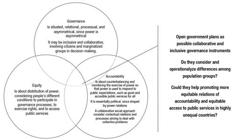
Based on the approaches presented, we may consider that governance is a relational, situated, and asymmetrical process of exercising power; collaborative and inclusive governance approaches emphasize the necessity to recognize different characteristics and power asymmetries among people; efforts toward equity in public services may help distributing power since people’s different conditions to participate in governance processes and access rights and public services are considered; accountability, in turn, is a way to counterbalancing and monitoring the exercise of power so that power is used to respond to public expectations and problems.
Nonetheless, structural power inequalities may undermine equity efforts in public services and the accountability system itself. For those better positioned in society in terms of education, social relations, and wealth, it is easier to access information, demand accountability, influence, or collaborate with state agencies. Given power inequalities, accountability tends to favor some actors over others. Administrative structures and procedures are often unable to serve citizens equitably and institutional arrangements are usually not designed to neutralize and redirect the incursions into democratic rights, corruption, and other inappropriate practices (Moncrieffe, 2011).
According to Moncrieffe (2011), social and democratic justice is necessary for building more equitable relations of accountability, which should be objectives of functioning representative systems. Defining general laws, rules, and mechanisms for accountability is not enough. Accountability and equity efforts must consider structural asymmetries and people’s values, characteristics, conditions, and relations in specific contexts.
However, operationalizing and measuring equity to manage and evaluate whether equity programs create value or make tangible improvements to systems and people is challenging. Even when equity is valued, public agents may be unaware of specific conditions and needs of different citizens or may be unable to operationalize equity procedures and measures. The possibility of assessing social equity analytically is a step toward prescribing reforms (Young et al., 2023). Designing and implementing strategies based on specific data, criteria, and other inputs in each context may help governments and society turn social equity from a policy goal into a reality.
The definition of a set of commitments in an open government plan and monitoring its implementation and results are part of a governance and accountability system since the actors involved express their expectations, agree on commitments, and develop strategies to respond to them. Depending on how equity criteria are considered in the process, open government plans could help make the power more transparent and accountable and more equitable distributed. On the other hand, if the design and delivery of public policies and services do not consider equity criteria, the tendency is that public resources continue to be directed in greater volume to those who already have more power.
Considering these arguments, what could we expect from open government strategies in different contexts to promote equity in public services and equitable relations of accountability? Figure 1 summarizes the discussion and questions.
Beyond the open government plans, other strategies could help understand the relationship between governance, equity, and accountability in specific contexts. This motivates exploratory research in unequal contexts, as detailed in the next section.
3. METHODS
This qualitative and exploratory research aims to analyze the relationship between accountability and equity in public services in the context of open government plans in unequal countries and cities. The question guiding the investigation is how do open government plans recognize power asymmetries and inequities among population groups when accessing public services?
Based on academic and technical literature and documental analysis, we investigate if the approach for transparency, participation, accountability, innovation, and integrity adopted in the construction of the Plans are universal/general or consider power asymmetries among population groups, prioritizing more vulnerable and excluded groups. Additionally, we identify trends to connect accountability and equity in public services in specific contexts.
The study introduces a conceptual discussion and explores the empirical realities in two countries and two cities. It offers a comparative analysis of these realities using primarily documentary data. Box 1summarizes our approach to the main concepts and the research steps.

The main concepts used in this work - accountability, equity in public services, collaborative and inclusive governance, and open government - are approached analytically and/or prescriptively. At the interface between theoretical propositions and empirical evidence from two countries and two cities, we explore the possibilities and limits to make equity efforts more accountable, accountability processes more equitable, governance more inclusive, and power less concentrated.
Box 2details the topics for the analysis of the Plan’s content:

Based on the presented conceptualization, problematization, and methods, in the next section we show the results of the research. The section includes analysis and secondary data from Brazil, Colombia, São Paulo, and Bogotá, data from open government plans and national development plans of both countries, open government plans of São Paulo and Bogotá, as well as examples of initiatives to make public services in both cities more equitable. Based on the analysis, the study resumes the conceptual discussion, seeking to support future stages of this ongoing research and other studies and practices in the field.
4. RESULTS
4.1 Brazil and Colombia
Brazil and Colombia show high levels of inequality (Box 3). Both countries have made efforts in the last decades to reduce poverty and violence and improve public policies and services (OECD, 2020, 2022). The 1988 Brazilian Federal Constitution and the 1991 Colombian Political Constitution express the desire to strengthen citizen participation, decentralization, and accountability. Something that has been developed by public agents and an active civil society, including advances and setbacks.

Brazil and Colombia have been members of the OGP since 2011 (OGP, 2023b). Amid changes in the political orientation of national governments, both have continued to implement open government strategies, such as citizen participation, access to information, and integrity and anticorruption, despite facing threats and setbacks.
In a recent Open Government Review, the OECD (2022, key findings) mentions the effects of inequalities and violence in Brazil:
Brazil has made efforts to reduce discriminatory practices. However, structural inequality and violence are pervasive and continue to affect the ability of certain groups to engage in public life on an equal basis. Afro-Brazilians, indigenous peoples, women, LGBTI persons, land defenders and human rights defenders are particularly at risk of violence and exclusion.
The OECD (2022) recommends that Brazil should “publish more granular data on vulnerable and marginalised groups” and “take strong, concrete actions to reduce exclusion and violence against specific groups, affecting their ability to engage in public life on an equal basis.”
In Colombia, according to the OECD (2019, p. 5):
While absolute poverty is being reduced in Colombia, the decline in spatial inequality and in relative poverty has been more modest. […] Territorial disparities are particular high, notably between urban and rural areas […] [and] within urban areas […] Persistent disparities in administrative and fiscal capacity across regions further affect the state’s ability to sustain effectively its administrative functions over the entire national territory, and thus deliver basic executive and judicial services equitably to all citizens.
The open government plans mention socioeconomic inequalities and inequities in public services in specific commitments. In the Brazilian plan, Commitment 12 is about facilitating the political participation of people with disabilities. In the Colombian plan, Commitment 13 refers to gender equity and a “diagnostic exercise” as a condition for acting (Box 4).
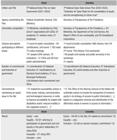
The 4th Colombian Plan says “In Colombia, we see Open Government as a way to consolidate a country of equity and recover citizen confidence in public institutions” (OGP, 2020, p. 8). Some commitments mention equity indirectly or as an aspect to be considered:
[…] can be adapted to the information needs and contexts of the public, adopting a clear language and a differential approach to guarantee the democratization of environmental information.
Integrate the national financial systems and make available in open formats all relevant, updated and quality public information, in order to mobilize citizens and thus enhance social control and participation in the pre-budgetary cycle related to public resources allocated to cross-cutting policies.
Promote collective intelligence exercises in the design and implementation of investment projects with the participation of citizens from at least 50% of the neighborhoods in each locality.
Efficiently disseminate the decisions of the Council of State in clear and simple language, in open data format, as well as in native languages in order to expand knowledge of the problems of the State and promote citizen empowerment at all levels by knowing the decisions that protect their rights.
Colombia is one of the pioneering countries that moved from the concept of open government toward that of open state (OECD, 2019), involving the executive branch and other levels and branches of government. Brazil continues using open government, although the 5th edition included one commitment coordinated by the judiciary and another by a municipal parliament.
In 2023, Brazil elaborated the 6th edition and Colombia the 5th edition of their open government plans (not published when the research was conducted). In the same year, both countries launched development plans, emphasizing equity issues. Colombia launched its PND 2023-2027 in May 2023. Brazil launched its 2024-2027 PPA in December 2023.
The PND frequently mentions inequality and inequity. The indicators and targets are associated with the SDGs. The actors considered essential for change in the country are women, victims, children, and adolescents (OGP, 2023b).
The plan includes elaborating new measurements of inequalities related to private property and wealth to promote the visibility of inequalities and improve social policy decisions (Departamento Nacional de Planeación, 2023, p. 71) and creating the Sistema Nacional de Igualdad y Equidad (SNIE):
[…] to formulate and execute policies and measures to promote the elimination of economic, political, and social inequalities and promote the enjoyment of the right to equality, compliance with the principles of non-discrimination and non-regression, and the defense of subjects of special constitutional protection and discriminated or marginalized groups (Departamento Nacional de Planeación, 2023, p. 67).
In the theme of environmental justice and inclusive governance, for example, the plan addresses elements of open government:
The country will guarantee the fair treatment of all Colombians through effective, inclusive, differential participation and with a gender focus in decision-making on environmental development […] Transparency and access to information, public participation in decision-making processes, and effective control of public management will be ensured. Also, inclusive governance will be strengthened through the conservation of species and animals’ well-being and protection (Departamento Nacional de Planeación, 2023, p. 42).
The Brazilian PPA underscores “the full alignment of the PPA 2024-2027 lines of action” with the 17 SDGs (Brasil Participativo, 2023, p. 89). “Equity” is mentioned 49 times, linked to equality, diversity, justice, rights assurance, inclusion, regional inequality, equalizing opportunities, gender, race, ethnicity, and sexual orientation.
In the opening, a paragraph addressing the agenda for racial diversity, the rights of indigenous peoples and women, and the well-being of all individuals, without prejudice and discrimination, emphasizes that “the pursuit of equity is a priority of this PPA” (Ministério do Planejamento e Orçamento, 2023, p. 4). “Diversity and social justice” stand as one of the seven values guiding the plan, with the primary focus on “combating hunger and reducing inequalities.”
The document’s cross-cutting agendas encompass “children and adolescents, women, racial equality, and indigenous peoples.” Several objectives contain the term equity, such as “[…] standard of structural transformations centered on three axes interconnected by the dimensions - equity, development, and democracy” (Ministério do Planejamento e Orçamento, 2023, p. 89).
The CGU Ministry commitment in PPA links open government to public services:
Promote the development of public management and governance, strengthen transparency, integrity, and social participation, combating corruption, and delivering quality public goods and services, as well as increasing society’s trust in the state (Brasil Participativo, 2023).
4.2 São Paulo and Bogotá
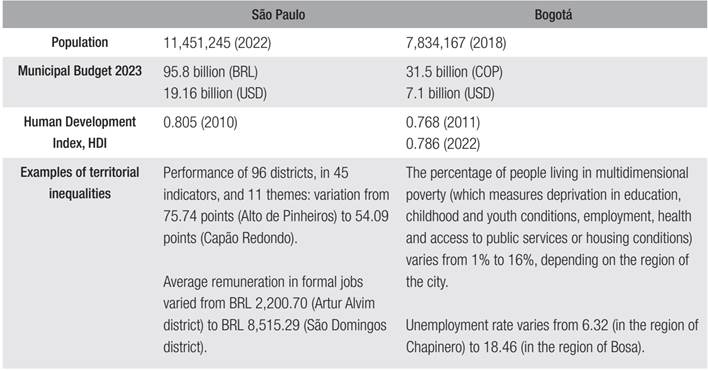
São Paulo and Bogotá are large cities in expanding metropolitan regions facing demographic and climate changes that challenge the quality and equitable access to public services (Hernandez et al., 2023). São Paulo is implementing its 3rd Open Government Action Plan and Bogotá, its 1st edition. Its local governments and CSOs have adopted various initiatives to map and reduce inequalities in access to services.
The pioneering civil society initiative Bogotá Cómo Vamos started in 1998. It publishes the annual report Calidad de Vida en Bogotá, gathering indicators and analysis on the quality of life in the city in different thematic and territorial dimensions (Bogotá Cómo Vamos, 2023b). The initiative led to the Colombian Red de Ciudades Cómo Vamos and the Latin American Network for Just, Democratic, and Sustainable cities and territories, including the Rede Nossa São Paulo (RNSP) (Hernandez et al., 2021).
Launched annually since 2012 by RNSP, the Mapa da Desigualdade compares public data and indicators of living conditions and access to public services among 96 districts. It includes the Desigualtômetro, which presents the relationship between the highest and lowest indicators in each theme and region (Rede Nossa São Paulo, 2023a). The information is used for public mobilization, debates, and advocacy Box 5presents some data.

São Paulo’s local government programs, such as the Programa de Metas, address the particularities of each region (Prefeitura de São Paulo, 2023). An example of equity-oriented innovation with accountability is Descomplica, which facilitates in-person and digital access to 350 public services. The initiative prioritized the installation of in-person units in the city’s peripheral and populated regions, reducing the need for citizens to travel to central areas to access public services (Prefeitura de São Paulo, 2019).
The Bogotá government programs for vulnerable populations include housing (Oferta Preferente), women’s care (Manzanas del Cuidado), and mobility (Movilidad Incluyente). The Portal Includata1 facilitates vulnerable groups’ access to social services, gathering and opening data related to their needs and services (Secretaría Distrital de Planeación, 2023). At the interface between citizenship and government audit agencies are the Veedorias ciudadanas, social audits used by citizens to influence urban planning in Bogotá. Their results are related to their capacity to involve interdisciplinary teams and technical and legal knowledge, relationships with political representatives, and the attractiveness for the educated and upper and middle classes through public opinion (Agüero & Montero, 2023).
Box 6summarizes the characteristics of the open government plans and other initiatives on accountability and equity in both cities.


There are direct or indirect links between open government plans and other initiatives in the cities on equity, accountability, and governance.
4.3 Accountability and equity in the four open government plans
The four open government plans analyzed promote accountability to some extent since they create dialogue and collaboration channels between segments of government and segments of society.
Regarding the process of the four plans, inclusive and collaborative governance and equity criteria are more visible in co-creation than implementation and monitoring. As observed by Oliveira and Ckagnazaroff (2023) in a study on the adoption of open government principles - transparency, participation, and collaboration - in three public policies in São Paulo, it does not occur uniformly across the phases of the policy cycle and unfolds to varying degrees.
The OGP (2022b) encourages the inclusion of vulnerable groups in plan governance. However, this inclusion in the coordination committee and each commitment is not comprehensive, mandatory, and relies on specific data and criteria. The coordination committees are not diverse in terms of region and expertise.
The Bogotá Plan mentions:
[…] co-creation workshops were made considering criteria of gender2 parity (66% of the participants identified themselves as women) and disability (more than 30 caregivers and 11 people with disabilities3 participated). In addition, organizational and territorial criteria were chosen so that the workshops wholly represented Bogota’s society, which resulted in the participation of the 20 localities of Bogota (OGP, 2021b, p. 1).
Regarding equity criteria in the content of the four plans, equity as a goal or objective is present in a few commitments, mainly on gender and disabilities. Gender issues have driven the OGP approach to equity and inclusion (OGP, 2022b, 2023).
Equity as a means to achieve goals and objectives is mentioned in some commitments, usually not detailed in terms of data, criteria, and operationalization. Power asymmetries are recognized more generally than specifically. The plans’ assumption is that public transparency and accountability will help improve citizen participation, trust, public services, and life conditions for all. The strategies include moving toward digital participation; facilitating citizen participation; education and training for citizens, promoting collaboration between citizens, CSOs, and control bodies, conducting participatory consultations to improve open data strategies, content, and usability.
There are few specific programs and data on inequalities in the country or the city and inequities as a base for planning, implementing, and monitoring results (Box 7).

4.4 Summary
The analysis of São Paulo, Bogotá, Brazil, and Colombia indicates that data, goals, and indicators supporting decisions and monitoring aspects of equity in public services are less explicit and prominent in open government plans compared to recent national development plans and municipal programs designed to promote equity. Open government is viewed as a means to enhance participation, accountability, and services, but the plans are often timid or lack specificity in their equity goals and measures.
The link between accountability and equity in public services has been addressed by civil society and academia in São Paulo and Bogotá. Local government initiatives have focused on reducing inequities in public services. Some of them are connected to the open government plans. Although monitoring goals and indicators are defined in these programs, accountability still requires improvement.
The Brazilian PPA and the Colombian PND include data, objectives, and targets related to equity. One example is the proposal to establish a National System of Equality and Equity to enhance the visibility of disparities and inform social policy decisions.
The link between the plans and the SDGs is evident in both countries and cities, possibly considered as a way to measure progress in equity.
Notably, the open government plans analyzed were formulated during the pandemic under center-right and right-wing governments, while national development plans were crafted post-pandemic, coinciding with the increased emphasis on equity under center-left governments. Brelàz et al. (2021) note that shifts in government leadership in São Paulo affect the institutionalization and scope of open government and governance spaces.
5. CONCLUSIONS
This article analyzed the relationship between accountability and equity in public services in the context of open government plans in unequal countries and cities.
The research shows that power asymmetries among population groups are usually approached in a general way in the open government plans analyzed, possibly limiting their contribution to reduce them. Despite being pioneers in open government and social accountability in Latin America, both countries, Brazil and Colombia, and cities, São Paulo and Bogotá, still grapple with high levels of inequality, and their open government plans are not particularly ambitious concerning equity in public services.
The assumption seems to be that transparency and accountability will naturally help improve citizen participation, trust, public services, and life conditions for all. Equity is mentioned in some open government commitments, mainly on gender and inclusion of people with disabilities.
Equity is a more prominent issue in recent national development plans and specific municipal programs than in open government plans. This shift has the potential to foster more collaborative and inclusive governance, as governance emerges from patterns of rules contingent upon a diversity of actions and political demands related to the beliefs of situated agents. This may vary from one context to another, given that governance is situated, relational, and asymmetrical.
We also identified that the literature on the relationship between governance, equity, and accountability is not well developed. This work represents a step in this direction, from which we identify areas for future investigation. Among the limitations of this research are its focus on just one edition of the plan for each country and city and the reliance solely on documentary analysis. This was a deliberate choice for this study. Our ongoing research aims to deepen this analysis.
Suggestions for future research include exploring accountability measures for equity in public services, analyzing more plans (including previous and upcoming open government plans in the two countries), and delving into the details of programs designed to promote equity in local governments and their corresponding accountability measures.
Equity in public services emerges as a promising area of study, requiring investigation into the operational aspects of service design and delivery. Connecting these studies with a relational approach to accountability underscores the importance of examining specific contexts. Such studies enable us to gather detailed insights into the operationalization of equity and explore power dynamics between actors.
Similar to how public management can serve as a pathway to advance in the “delivery” of equity (Young et al., 2023), the convergence between accountability and equity can, under certain conditions, make both more realistic in contexts characterized by high inequalities.
Regarding the implications of this study for practice, it is relevant to recognize that in contexts marked by high power differences, such as in Brazil and Colombia, power imbalances persist and may be reinforced if open government and accountability strategies do not consider and operationalize equity. Plans should specifically incorporate equity, including data and vulnerable groups, in the process of formulation and implementation and their content.
ACKNOWLEDGMENTS
The authors thank the Universidade do Estado de Santa Catarina and the Fundação de Amparo à Pesquisa e Inovação do Estado de Santa Catarina for the financial support for the research for this article.
REFERENCES
-
Agüero, S., & Montero, S. (2023). Incidencia ciudadana a través de la auditoría social: veedurías ciudadanas y planeación urbana en Bogotá. Territorios, 49(Especial), 1-26. https://doi.org/10.12804/revistas.urosario.edu.co/territorios/a.12810
» https://doi.org/10.12804/revistas.urosario.edu.co/territorios/a.12810 -
Ainscow, M. (2016). Diversity and equity: a global education challenge. New Zealand Journal of Educational Studies, 51, 143-155. https://doi.org/10.1007/s40841-016-0056-x
» https://doi.org/10.1007/s40841-016-0056-x -
Astom, T., & Santos, G. Z. (2022, August). Social accountability and service delivery effectiveness: what is the evidence for the role of sanctions? (working Paper, n. 4). World Bank. https://documents1.worldbank.org/curated/en/099534209302293819/pdf/IDU0aff7666c06b8804bc00a9170ce2d26867056.pdf
» https://documents1.worldbank.org/curated/en/099534209302293819/pdf/IDU0aff7666c06b8804bc00a9170ce2d26867056.pdf -
Azevedo, M. L. N. (2013). Igualdade e equidade: qual é a medida da justiça social? Avaliação: Revista da Avaliação da Educação Superior, 18(1), 129-150. https://doi.org/10.1590/S1414-40772013000100008
» https://doi.org/10.1590/S1414-40772013000100008 - Bevir, M. (2009). Key concepts in governance Sage.
-
Bogotá. (2022, December 15). Presupuesto de Bogotá para 2023 es de 31,5 billones y prioriza inversión social https://bogota.gov.co/mi-ciudad/hacienda/presupuesto-de-bogota-para-2023-inversion-social-movilidad-y-mas
» https://bogota.gov.co/mi-ciudad/hacienda/presupuesto-de-bogota-para-2023-inversion-social-movilidad-y-mas -
Bogotá Cómo Vamos. (2023a, 04 de agosto). Informe de Calidad de Vida 2022 https://bogotacomovamos.org/productos/#calidad
» https://bogotacomovamos.org/productos/#calidad -
Bogotá Cómo Vamos. (2023b). Informe de Calidad de Vida 2023 https://bogotacomovamos.org/productos/#calidad
» https://bogotacomovamos.org/productos/#calidad -
Bogotá Cómo Vamos. (2023c). Población https://bogotacomovamos.org/datos1/poblacion/
» https://bogotacomovamos.org/datos1/poblacion/ -
Bovens, M. (2007). Analyzing and assessing accountability: a conceptual framework 1. European Law Journal, 13(4), 447-468. https://doi.org/10.1111/j.1468-0386.2007.00378.x
» https://doi.org/10.1111/j.1468-0386.2007.00378.x -
Brasil Participativo. (2023). Programas Ministeriais https://brasilparticipativo.presidencia.gov.br/pages/trabalho_emprego?format=html&locale=pt-BR
» https://brasilparticipativo.presidencia.gov.br/pages/trabalho_emprego?format=html&locale=pt-BR -
Brelàz, G. de, Crantschaninov, T., & Bellix, L. (2021). Open Government Partnership in São Paulo city and the São Paulo Aberta Programme: challenges in the diffusion and institutionalization of a global policy. Cadernos EBAPE.BR, 19(1), 123-137. https://doi.org/10.1590/1679-395120200023x
» https://doi.org/10.1590/1679-395120200023x -
Cepiku, D., & Mastrodascio, M. (2021). Equity in public services: a systematic literature review. Public Administration Review, 81(6), 1019-1032. https://doi.org/10.1111/puar.13402
» https://doi.org/10.1111/puar.13402 -
Departamento Nacional de Planeación. (2023). Plan Nacional Desarrollo Colombia 2022-2026 https://www.dnp.gov.co/plan-nacional-desarrollo/pnd-2022-2026
» https://www.dnp.gov.co/plan-nacional-desarrollo/pnd-2022-2026 -
Edwards, D., & McGee, R. (2016). Opening governance: change, continuity and conceptual ambiguity. IDS Bulletin: transforming development knowledge, 47(1), 3-24. https://opendocs.ids.ac.uk/opendocs/bitstream/handle/20.500.12413/7686/IDSB_47_1_10.190881968-2016.103.pdf?sequence=1
» https://opendocs.ids.ac.uk/opendocs/bitstream/handle/20.500.12413/7686/IDSB_47_1_10.190881968-2016.103.pdf?sequence=1 -
Fernandes, G. A. de A. L., Fernandes, I. F., & Teixeira, M. A. C. (2023). Transparência dos governos subnacionais: o impacto da desigualdade na transparência. Revista de Administração Pública, 57(6), e2023-0025. https://doi.org/10.1590/0034-761220230025.
» https://doi.org/10.1590/0034-761220230025 -
Ferreira, F. H. G. (2023). Is there a ‘new consensus’ on inequality?(Working paper, n. 101). The London School of Economics and Political Science, International Inequalities Institute. http://eprints.lse.ac.uk/120113/1/III_working_paper_101.pdf
» http://eprints.lse.ac.uk/120113/1/III_working_paper_101.pdf - Fraser, N. (2010). Redistribuição, reconhecimento e participação por uma concepção integrada da justiça. In D. Sarmento, D. Ikawa, & F. Piovesan (Eds.), Igualdade, diferença e direitos humanos (2a ed., pp. 167-189). Lumen Juris.
-
Guerzovich, F., Astom, T., Levy, B., Schommer, P. C., Haines, R., Cant, S., & Santos, G. F. Z. (2022). How do we shape and navigate pathways to social accountability scale? Introducing a middle-level Theory of Change (CEDIL Research Project Paper 1). CEDIL. https://doi.org/10.51744/CRPP1
» https://doi.org/10.51744/CRPP1 - Hernandez, A., & Cuadros, D. (2014). Iniciativas de transparência y accountability en America Latina: naturaleza, tipológía e incidência en la democracia y el desarollo. In D. M. Pinheiro, D. Melo, & J. Costa(Orgs.), Democracia: desafios, oportunidades e tendências(pp. 226-270). Imaginar o Brasil.
-
Hernandez, A., Schommer, P.C., & Cuadros, D. (2021). Incidence of social accountability in local governance: the case of the network for fair, democratic and sustainable cities and territories in Latin America. Voluntas, 32(3), 650-662. https://doi.org/10.1007/s11266-020-00295-6
» https://doi.org/10.1007/s11266-020-00295-6 -
Instituto Brasileiro de Geografia e Estatística. (2023). São Paulo https://cidades.ibge.gov.br/brasil/sp/sao-paulo/panorama
» https://cidades.ibge.gov.br/brasil/sp/sao-paulo/panorama -
Instituto Cidades Sustentáveis. (2023). Mapa da desigualdade 2023 https://institutocidadessustentaveis.shinyapps.io/mapadesigualdadesaopaulo/
» https://institutocidadessustentaveis.shinyapps.io/mapadesigualdadesaopaulo/ -
Interamerican Development Bank. (2023). Health and City - Your zip code matters more than your genetic code https://youtu.be/ET1Iyj0Dku8
» https://youtu.be/ET1Iyj0Dku8 -
Koppell, J. G. S. (2005). Pathologies of accountability: ICANN and the challenge of “Multiple Accountabilities Disorder”. Public Administration Review, 65(1), 94-108. https://doi.org/10.1111/j.1540-6210.2005.00434.x
» https://doi.org/10.1111/j.1540-6210.2005.00434.x -
Lange, P., Driessen, P. P. J., Sauer, A., Bornemann, B., & Burger, P. (2013). Governing Towards Sustainability: Conceptualizing Modes of Governance. Journal of Environmental Policy & Planning, 15(3), 403-425. https://doi.org/10.1080/1523908X.2013.769414
» https://doi.org/10.1080/1523908X.2013.769414 -
Lucchese, P. T. R. (2003). Eqüidade na gestão descentralizada do SUS: desafios para a redução de desigualdades em saúde. Ciência & Saúde Coletiva, 8(2), 439-448. https://doi.org/10.1590/S1413-81232003000200009
» https://doi.org/10.1590/S1413-81232003000200009 -
Miller, D. (2023). Justice. In E. N. Zalta, & U. Nodelman (Eds.), The Stanford Encyclopedia of Philosophy https://plato.stanford.edu/archives/fall2023/entries/justice/
» https://plato.stanford.edu/archives/fall2023/entries/justice/ -
Ministério do Planejamento e Orçamento. (2023). Plano Plurianual 2024-2027 https://www.gov.br/planejamento/pt-br/assuntos/planejamento/plano-plurianual
» https://www.gov.br/planejamento/pt-br/assuntos/planejamento/plano-plurianual - Moncrieffe, J. (2011). Relational accountability: complexities of structural injustice, Bloomsbury Academic & Professional Zed Books.
-
Mulgan, R. (2000). ‘Accountability’: An ever‐expanding concept? Public administration, 78(3), 555-573. https://doi.org/10.1111/1467-9299.00218
» https://doi.org/10.1111/1467-9299.00218 -
Oliveira, D. J. S., & Ckagnazaroff, I. B. (2023). Governo aberto na cidade de São Paulo: Uma análise de políticas públicas abertas. Revista de Administração Contemporânea, 27(2), e210279. https://doi.org/10.1590/1982-7849rac2022210279
» https://doi.org/10.1590/1982-7849rac2022210279 -
Open Government Partnership. (2020, December 10). IV National Open State Action Plan 2020-2022 https://www.opengovpartnership.org/documents/colombia-action-plan-2020-2022/
» https://www.opengovpartnership.org/documents/colombia-action-plan-2020-2022/ -
Open Government Partnership. (2021a). Fifth National Action Plan on Open Government https://www.opengovpartnership.org/wp-content/uploads/2022/01/Brazil_Action-Plan_2021-2023_EN.pdf
» https://www.opengovpartnership.org/wp-content/uploads/2022/01/Brazil_Action-Plan_2021-2023_EN.pdf -
Open Government Partnership. (2021b, August). Action plan - Bogotá, Colombia, 2021-2023 https://www.opengovpartnership.org/documents/action-plan-bogota-colombia-2021-2023/
» https://www.opengovpartnership.org/documents/action-plan-bogota-colombia-2021-2023/ -
Open Government Partnership. (2021, December). Toolkit for More Gender-Responsive Action Plans https://www.opengovpartnership.org/documents/toolkit-for-more-gender-responsive-action-plans/
» https://www.opengovpartnership.org/documents/toolkit-for-more-gender-responsive-action-plans/ -
Open Government Partnership. (2022a). The skeptic’s guide to open government: 2022 Edition https://www.opengovpartnership.org/skeptics-guide-to-open-government-2022-edition/
» https://www.opengovpartnership.org/skeptics-guide-to-open-government-2022-edition/ -
Open Government Partnership. (2022b, March). OGP National Handbook: Rules and Guidance for Participants https://www.opengovpartnership.org/wp-content/uploads/2022/03/OGP-National-Handbook-2022.pdf
» https://www.opengovpartnership.org/wp-content/uploads/2022/03/OGP-National-Handbook-2022.pdf -
Open Government Partnership. (2023a). National Members https://www.opengovpartnership.org/our-members/#national
» https://www.opengovpartnership.org/our-members/#national -
Open Government Partnership. (2023b, September). OGP Fact Sheets https://www.opengovpartnership.org/documents/fact-sheets/
» https://www.opengovpartnership.org/documents/fact-sheets/ -
Open Society Foundations. (2023). Equity - Open Society Foundations https://www.opensocietyfoundations.org/what-we-do/themes/equity#
» https://www.opensocietyfoundations.org/what-we-do/themes/equity# -
Organisation for Economic Cooperation and Development. (2019). OECD Public governance scan Colombia. https://www.oecd.org/gov/Colombia%20Scan%20Final%20English.pdf
» https://www.oecd.org/gov/Colombia%20Scan%20Final%20English.pdf -
Organisation for Economic Cooperation and Development. (2020). What does “inclusive governance” mean? (OECD Development Policy Papers, n. 27). https://doi.org/10.1787/960f5a97-en
» https://doi.org/10.1787/960f5a97-en -
Organisation for Economic Cooperation and Development. (2021). Does Inequality Matter? How People Perceive Economic Disparities and Social Mobility https://www.oecd.org/wise/does-inequality-matter-3023ed40-en.htm
» https://www.oecd.org/wise/does-inequality-matter-3023ed40-en.htm -
Organisation for Economic Cooperation and Development. (2022). Open Government Review of Brazil https://www.oecd.org/digital/open-government-review-of-brazil-3f9009d4-en.htm
» https://www.oecd.org/digital/open-government-review-of-brazil-3f9009d4-en.htm -
Phenomenology and Mind. (2023, April 04). CFP - Structural Injustice: Reflections on Social Groups, Identity and Intersectionality http://ojs.lexis.srl/index.php/PhMind/announcement/view/26
» http://ojs.lexis.srl/index.php/PhMind/announcement/view/26 - Pineda, A. M. (2023). O valor das diferenças na educação: equidade no discurso e no advocacy do investimento social privado brasileiro (Tese de Doutorado). Fundação Getulio Vargas, São Paulo, SP, Brasil.
-
Rede Nossa São Paulo. (2023a). Mapa da Desigualdade 2022 https://www.nossasaopaulo.org.br/wp-content/uploads/2023/01/Mapa-da-Desigualdade-2022_MAPAS_23.pdf
» https://www.nossasaopaulo.org.br/wp-content/uploads/2023/01/Mapa-da-Desigualdade-2022_MAPAS_23.pdf -
Rede Nossa São Paulo. (2023b). Redes e campanhas: mapa da desigualdade https://www.nossasaopaulo.org.br/campanhas/#13
» https://www.nossasaopaulo.org.br/campanhas/#13 -
Prefeitura de São Paulo. (2019). Secretaria Municipal de Inovação e Tecnologia. Como aprimorar o atendimento público ao cidadão?https://copicola.prefeitura.sp.gov.br/guias-publicados/descomplica-sp
» https://copicola.prefeitura.sp.gov.br/guias-publicados/descomplica-sp -
Prefeitura de São Paulo. (2023). Programa de Metas 2021-2024 https://www.prefeitura.sp.gov.br/cidade/secretarias/governo/planejamento/programa_de_metas_20212024/
» https://www.prefeitura.sp.gov.br/cidade/secretarias/governo/planejamento/programa_de_metas_20212024/ -
Schommer, P. C., & Guerzovich, F. (2023). Collaborative Governance. In R. A. List, H. K. Anheier, & S. Toepler (Eds.), International Encyclopedia of Civil Society Springer. https://doi.org/10.1007/978-3-319-99675-2_9519-1
» https://doi.org/10.1007/978-3-319-99675-2_9519-1 -
Secretaría Distrital de Planeación. (2023). Plan de Desarrollo Distrital 2020-2024 https://www.sdp.gov.co/gestion-a-la-inversion/participacion-y-comunicacion-para-la-planeacion/voces-ciudadanas/plan-de-desarrollo-distrital-2020-2024/
» https://www.sdp.gov.co/gestion-a-la-inversion/participacion-y-comunicacion-para-la-planeacion/voces-ciudadanas/plan-de-desarrollo-distrital-2020-2024/ -
Svara, J. H., & Brunet, J. R. (2005). Social equity is a pillar of public administration. Journal of Public Affairs Education, 11(3), 253-258. https://doi.org/10.1080/15236803.2005.12001398
» https://doi.org/10.1080/15236803.2005.12001398 -
United Nations Development Programme. (2023). What are the Sustainable Development Goals?https://www.undp.org/sustainable-development-goals
» https://www.undp.org/sustainable-development-goals -
United Nations Development Programme. (2024). Últimos Informes sobre Desarrollo Humano https://www.undp.org/es/colombia/informe-sobre-desarrollo-humano-colombia
» https://www.undp.org/es/colombia/informe-sobre-desarrollo-humano-colombia -
World Bank. (2017). World Development Report 2017: Governance and the law https://elibrary.worldbank.org/doi/abs/10.1596/978-1-4648-0950-7
» https://doi.org/10.1596/978-1-4648-0950-7 -
World Bank. (2023). LAC Equity Lab: Equality of Opportunities https://www.worldbank.org/en/topic/poverty/lac-equity-lab1/equality-of-opportunities
» https://www.worldbank.org/en/topic/poverty/lac-equity-lab1/equality-of-opportunities -
World Bank. (2024a). Brazil https://data.worldbank.org/country/brazil
» https://data.worldbank.org/country/brazil -
World Bank. (2024b). Colombia https://data.worldbank.org/country/colombia
» https://data.worldbank.org/country/colombia -
World Bank. (2024c). Gini index - Brazil https://data.worldbank.org/indicator/SI.POV.GINI?locations=BR
» https://data.worldbank.org/indicator/SI.POV.GINI?locations=BR -
World Bank. (2024d). Gini index - Colombia https://data.worldbank.org/indicator/SI.POV.GINI?locations=CO
» https://data.worldbank.org/indicator/SI.POV.GINI?locations=CO -
World Health Organization. (2021). Health equity and its determinants https://www.who.int/publications/m/item/health-equity-and-its-determinants
» https://www.who.int/publications/m/item/health-equity-and-its-determinants -
Young, S. L., Wiley, K. K., & Cepiku, D. (2023). Intersecting public management and social equity. Introduction to the special issue. Public Management Review https://doi.org/10.1080/14719037.2023.2288261
» https://doi.org/10.1080/14719037.2023.2288261
Reviewers:
-
8
Marcus Vinícius de Azevedo Braga (Ministério da Transparência e Controladoria-Geral da União, Rio de Janeiro / RJ - Brazil) https://orcid.org/0000-0002-7399-0952
-
9
Marco Antonio Carvalho Teixeira (Fundação Getulio Vargas, São Paulo / SP - Brazil) https://orcid.org/0000-0003-3298-8183
-
10
Francisco Marton Gleuson Pinheiro (Universidade do Estado da Bahia, Senhor do Bonfim / BA - Brazil) https://orcid.org/0000-0002-8542-2709
-
11
Cristina Toth Sydow (Instituto Unibanco, São Paulo / SP - Brazil)
-
12
One of the reviewers did not authorize the disclosure of their identity.
Edited by
The entire dataset supporting the results of this study was published in the article itself.

 Source: Elaborated by the authors.
 Source: Elaborated by the authors.
 Source: Elaborated by the authors.
 Source: World Bank (
 Source: OGP (
 Source: Bogotá (
 Source:
 Source: Elaborated by the authors.